Only half of Australia’s biggest companies have net-zero emissions plans — RenewEconomy

Nearly 40% of ASX200 emissions are not yet covered by net-zero commitments, and much corporate climate action will come too late to keep 1.5℃ alive. The post Only half of Australia’s biggest companies have net-zero emissions plans appeared first on RenewEconomy.
Only half of Australia’s biggest companies have net-zero emissions plans — RenewEconomy
Australian super fund snaps up another two new wind farms in Victoria — RenewEconomy

Leading super fund has bought up two small wind farms in Victoria, adding a total of five wind turbines to its renewable energy portfolio. The post Australian super fund snaps up another two new wind farms in Victoria appeared first on RenewEconomy.
Australian super fund snaps up another two new wind farms in Victoria — RenewEconomy
TODAY. Australia looks like being really ground under by America

First of all, there’s the Julian Assange horror persecution.
Does anyone think for a moment that Joe Biden, or any other U.S. President would give in to an Australian Prime Minister’s request to free Assange?
Decades ago, the USA made sure that another journalist, Wilfred Burchett, became an international leper, because Burchett went to Hiroshima in the days immediately after the atomic bombing, and photographed and documented what he saw.
That is the fate of anyone who publicly reveals American military atrocities.

At the same time, the USA Space Force now visits Australia – and can’t wait to use Australia for its War in Space aims.
Of course the USA military wankers are also thrilled with the idea of launching attacks on China from Australia.
Ukraine is good practise for waging war “safely” from another country. Taiwan will be next, but it’s nice to have Australia in the fray too – keep the targets well out of the home country. Australia’s military wankers haven’t really thought of that – they’re NRB (Not Real Bright)
I suppose some might think that releasing Julian Assange in exchange for getting Australia to be a U.S. military base like Guam, might be a fair deal. But why do a deal, when you know that you can both persecute Assange and set up Australia as a target , without any deal?
The Australian media can be relied on to (a) ignore it all, or (b) just scream “jobs jobs” – their standard response to any military or nuclear development.
Australia a”pot of gold” for America’s military section to wage war in space.
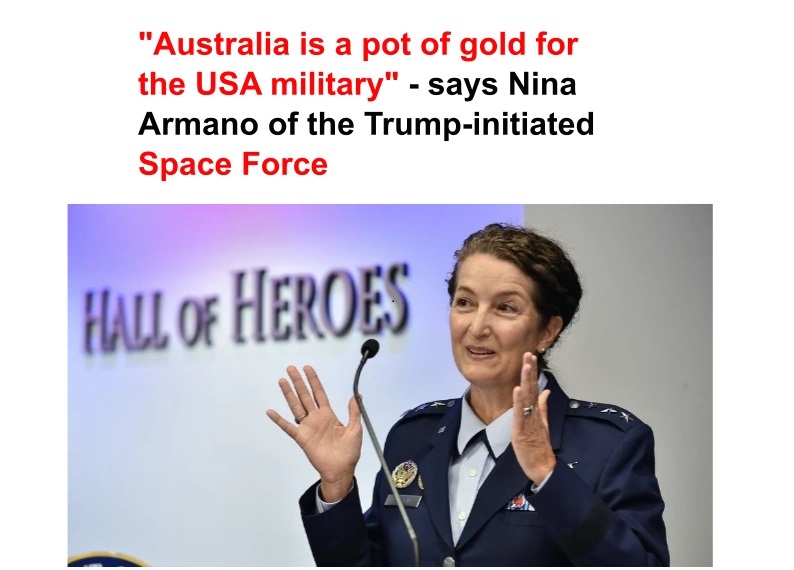
US Space Force eyes ‘prime’ Australian real estate for future warfare operations, ABC News, By defence correspondent Andrew Greene 3 Dec 22
Visiting senior US military officers believe Australia is a “pot of gold at the end of the rainbow”, as they eye off this continent’s “prime” geography for future space operations.
Key points:
- US military officials visiting Australia say conflict in space in the next few years is a very real prospect
- They believe the war in Ukraine is demonstrating the growing importance of space as a new war-fighting domain
- Australia’s southern location and potential launch sites near the equator make it an attractive prospect for future operations
Top-ranking members of the US Space Force are warning of China’s growing capability in the emerging military domain as they meet defence counterparts and local industry representatives.
“I’m visiting my allies and we’re talking about future partnerships that we can have,” US Space Force Lieutenant-General Nina Armagno told reporters in Canberra.
“This is prime country for space domain awareness,” the director of staff of the US Space Force added while speaking at the Australian Strategic Policy Institute.
The three-star general has travelled to Canberra along with Lieutenant-General John Shaw, the deputy commander of the US Space Command who is responsible for America’s combat capabilities above Earth……………………………..
Both of the visiting military officers believe the war in Ukraine is demonstrating the growing importance of space as a new war-fighting domain…………………………..
Australia’s own Defence Space Command was only formally stood up in March, but General Armagno says this country already has the natural advantage of its southern-hemisphere geography and potential launch sites close to the equator.
“It seems as [if] Australia is sitting on a pot of gold at the end of the rainbow, really, for our common national security interests,” she said. https://www.abc.net.au/news/2022-12-02/us-space-force-eyes-australian-real-estate-future-warfare/101724368
Will USA take any notice at all, as Australia’s Prime Minister and world media call for Julian Assange’s release?
The telling question here is whether Albanese will get any purchase with the Washington set. While enjoying a reputation as a pragmatic negotiator able to reach agreements in tight circumstances, the pull of the US national security establishment may prove too strong. “We now get to see Australia’s standing in Washington, valued ally or not,” was the guarded response of Assange’s father John Shipton.
Julian Assange and Albanese’s Intervention https://theaimn.com/julian-assange-and-albaneses-intervention/ December 1, 2022, by: Dr Binoy Kampmark
The unflinching US effort to extradite and prosecute Julian Assange for 18 charges, 17 of which are chillingly based upon the Espionage Act of 1917, has not always stirred much interest in the publisher’s home country. Previous governments have been lukewarm at best, preferring to mention little in terms of what was being done to convince Washington to change course in dealing with Assange.
Before coming to power, Australia’s current Prime Minister Anthony Albanese had made mention of wishing to conclude the Assange affair. In December 2019, before a gathering at the Chifley Research Centre, he described the publisher as a journalist, accepting that such figures should not be prosecuted for “doing their job”. The following year, he also expressed the view that the “ongoing pursuit of Mr Assange” served no evident “purpose” – “enough is enough”.
The same point has been reiterated by a number of crossbenchers in Australia’s parliament, represented with much distinction by the independent MP from Tasmania, Andrew Wilkie. In a speech given earlier this year to a gathering outside Parliament House, the Member for Clark wondered if the UK and Australia had placed their relations with Washington at a premium so high as to doom Assange. “The US wants to get even and for so long the UK and Australia have been happy to go along for the ride because they’ve put bilateral relationships with Washington ahead of the rights of a decent man.”
The new Australian government initially gave troubling indications that a tardy, wait-and-see approach had been adopted. “My position,” Albanese told journalists soon after assuming office, “is that not all foreign affairs is best done with the loudhailer.”
Documents obtained under freedom of information also showed an acknowledgment by the Albanese government of assurances made by the United States that the WikiLeaks founder would have the chance to serve the balance of any prison sentence in Australia. But anybody half-versed in the wiles and ways of realpolitik should know that the international prisoner transfer scheme is subordinate to the wishes of the relevant department granting it. The US Department of Justice can receive the request from Assange, but there is nothing to say, as history shows, that the request will be agreed to.
Amidst all this, the campaign favouring Assange would not stall. Human rights and press organisations globally have persistently urged his release from captivity and the cessation of the prosecution. On November 28, The New York Times, the Guardian, Le Monde, El País and Der Spiegel published a joint open letter titled, “Publishing is not a Crime.”
The five outlets who initially worked closely with WikiLeaks in publishing US State Department cables 12 years ago have not always been sympathetic to Assange. Indeed, they admit to having criticised him for releasing the unredacted trove in 2011 and even expressed concern about his “attempt to aid in computer intrusion of a classified database.”
Had the editors bothered to follow daily trial proceedings of the extradition case in 2020, they would have noted that the Guardian’s own journalists muddied matters by publishing the key to the encrypted files in a book on WikiLeaks. A mortified Assange warned the State Department of this fact. Cryptome duly uploaded the cables before WikiLeaks did. The computer intrusion charge also withers before scrutiny, given that Chelsea Manning already had prior authorisation to access military servers without the need to hack the system.
But on this occasion, the publishers and editors were clear. “Cablegate”, with its 251,000 State Department cables, “disclosed corruption, diplomatic scandals and spy affairs on an international scale.” They had “come together now to express [their] grave concerns about the continued prosecution of Julian Assange for obtaining and publishing classified materials.”
Very mindful of their own circumstances, the media outlets expressed their grave concerns about the use of the Espionage Act “which has never been used to prosecute a publisher or broadcaster.” Such an indictment set “a dangerous precedent, and threatens to undermine America’s First Amendment and the freedom of the press.”
The same day of the letter’s publication, Brazil’s President-elect Lula da Silva also added his voice to the encouraging chorus. He did so on the occasion of meeting the WikiLeaks editor-in-chief Kristinn Hrafnsson and Joseph Farrell, an associate of the organisation, and expressed wishes that “Assange will be freed from his unjust imprisonment.”
The stage was now set for Albanese to make his intervention. In addressing parliament on November 30 in response to a question from independent MP Monique Ryan, Albanese publicly revealed that he had, in fact, been lobbying the Biden administration for a cessation of proceedings against Assange. “I have raised this personally with the representatives of the US government.”
The Australian PM was hardly going to muck in on the issue of the WikiLeaks agenda. Australia remains one of the most secretive of liberal democracies, and agents of radical transparency are hardly appreciated. (Witness, at present, a number of venal prosecutions against whistleblowers that have not been abandoned even with a change of government in May.)
Albanese drew a parallel with Chelsea Manning, the key figure who furnished WikiLeaks with classified military documents, received a stiff sentence for doing so, but had her sentence commuted by President Barack Obama. “She is now able to participate freely in society.” He openly questioned “the point of continuing this legal action, which could be caught up now for many years, into the future.”
For some years now, the plight of Assange could only be resolved politically. In her address to the National Press Club in Canberra delivered in October this year, Assange’s lawyer Jennifer Robinson acknowledged as much. “This case needs an urgent political solution. Julian does not have another decade to wait for a legal fix.” This point was reiterated by Ryan in her remarks addressed to the prime minister.
The telling question here is whether Albanese will get any purchase with the Washington set. While enjoying a reputation as a pragmatic negotiator able to reach agreements in tight circumstances, the pull of the US national security establishment may prove too strong. “We now get to see Australia’s standing in Washington, valued ally or not,” was the guarded response of Assange’s father John Shipton.
USA trying to use Philippines as a guinea pig for its unviable small nuclear reactors – and for military purposes.

“With recent plans by the US Department of Defense to build an advanced mobile nuclear microreactor prototype in Idaho, Manila should not allow Washington to use Philippine military bases as prototype areas for these reactors.
Save the country from the perils of nuclear reactors, NAKED THOUGHT
By Charlie V. Manalo, December 3, 2022
AS the United States government, invoking provisions of the Enhanced Defense Cooperation Agreement (EDCA), requests for additional military bases, five on the island of Luzon alone, the idea of the country playing host to mobile nuclear reactors is not far-fetched.
This is for the simple reason that whoever crafted the agreement made it so vague, it did not provide for any restrictions on the type of facilities and materials the US would be using in constructing its bases in the Philippines.
And this has been aggravated further by the enactment of the Public Service Law which opens the country’s airports to foreign ownership, giving the US all the resources needed to construct its own airports which it could use as military bases under the guise of a commercial airport.
Anyway, former congressman Terry Ridon, convenor of Infrawatch Philippines, sent me a copy of an article he wrote on the subject, explaining clearly its implications. It’s entitled, “Reject mobile nuclear reactors in PH bases-Infrawatch Philippines,” which I’m publishing in its entirety.
“With recent plans by the US Department of Defense to build an advanced mobile nuclear microreactor prototype in Idaho, Manila should not allow Washington to use Philippine military bases as prototype areas for these reactors.
According to an April report by The Associated Press, the US DoD ‘signed off on the Project Pele plan to build the reactor and reactor fuel outside of Idaho and then assemble and operate the reactor at the lab.’
As this is a project initiated by the US defense department, its military objectives had been disclosed by Jeff Waksman, project manager for Project Pele, saying, “Advanced nuclear power has the potential to be a strategic game-changer for the United States, both for the (Department of Defense) and for the commercial sector.”
The US DoD further said that the reactor designs are ‘high-temperature gas-cooled reactors using enriched uranium for fuel.’
PH microreactor deployment
Under the Enhanced Defense Cooperation Agreement between the Philippines and the United States, there are no restrictions to Washington on the type of facilities and materials it will construct and install in Philippine military bases, except a specific restriction against installing nuclear weapons.
However, Philippine authorities should be reminded that this restriction does not assuage fears that the country will not be involved in regional military conflicts because EDCA allows the installation of conventional military weapons which may approximate the breadth and fatal impact of nuclear weapons.
More importantly, in the event that nuclear microreactors are produced by the US DoD at scale, these small nuclear plants can, in fact, be installed in EDCA locations in different parts of the country.
This is alarming because the country has yet to decide and implement its national policy on nuclear development based on the policy direction of President Ferdinand Marcos Jr.
In fact, it needs to be made clear that nuclear microreactors in EDCA locations in the country will not be used for civilian purposes but for military objectives by the United States in the Indo-Pacific.
This distinction alone should give the current government pause on allowing nuclear microreactors to be deployed in EDCA locations in the future.
More importantly, military nuclear microreactors will allow Washington to deploy different kinds of weapons to influence the security arrangement in the South China Sea and the greater Indo-Pacific.
Military purposes
Further, as nuclear microreactors in EDCA areas will certainly be used for military purposes, this might prompt other regional actors to accuse Manila of violating the Bangkok Treaty, the treaty declaring Southeast Asia as a nuclear weapons-free zone and other weapons of mass destruction.
With a military nuclear microreactor in Philippine soil, Washington may be able to operate high-powered conventional military weapons which may be equivalent to weapons of mass destruction.
Certainly, Manila should follow its treaty obligations in the region, particularly as other strong powers are also looking at Manila to temper its pivot toward Washington.
Finally, allowing this kind of deployment in EDCA areas diminishes the current call of President Marcos to carefully proceed with nuclear research and development for civilian purposes.
The focus of the government should be considering whether nuclear energy should be part of the current energy mix and whether the Bataan Nuclear Power Plant should be revived.
It should also consider developing other aspects of nuclear technology, which can benefit health care and other critically important sectors.
As such, allowing nuclear microreactors in EDCA areas or anywhere in the Philippines should not be on the agenda.”
Weapons company Raytheon continues to be the winner in the Ukraine war, with new $1.2 billion surface-to-air missile contract .

Raytheon wins $1.2 billion surface-to-air missile order for Ukraine, By Jen Judson, Defense News, 1 Dec 22
WASHINGTON — The U.S. Army awarded Raytheon Missiles and Defense a contract worth as much as $1.2 billion to deliver six National Advanced Surface to Air Missile System batteries for Ukraine.
The contract is part of the fifth Ukraine Security Assistance Initiative package and includes training and logistical support to Ukraine’s military and security forces, the Army said in a a Nov. 30 statement.
Raytheon, the world’s second-largest defense contractor, won a contract in August to deliver to NASAMS batteries to Ukraine as part of the third USAI package. The new contract is a follow-on…………………
The work to award Raytheon a contract was led by the Army’s Program Executive Office for Missiles and Space, along with others across the Defense Department.
Ukraine has requested an integrated air and missile defense system that the U.S. and other allies are striving to fulfill. The system would be made up of short-range, low-altitude systems; medium-range, medium-altitude systems; and long-range, high-altitude systems that together would neutralize the threat of Russian aircraft and missiles.
Ukrainian forces had been using Russian-made SA-6 and SA-8 air defenses. In addition to NASAMS, the country also asked for Cold War-era Hawk systems – a medium-range, medium-altitude system, that’s considered to still be effective. https://www.defensenews.com/land/2022/12/01/raytheon-wins-12-billion-surface-to-air-missile-order-for-ukraine
Misleading claims about the supposed recycling of nuclear wastes

EPZ, the operator of the Borssele nuclear power plant, has long claimed
that they recycle “95 percent” of their nuclear fuel, and that only “5
percent” remains as nuclear waste.
Following a complaint by Laka, the Board
of Appeals of the Dutch Advertising Authority, ruled yesterday that these
are misleading environmental advertisement claims. In its ruling, the board
blames EPZ all the more because theses misleading claims appear on EPZ’s
website under the header “Environment & Health”, where “unsuspecting
visitors should expect accurate and balanced information about nuclear fuel
and nuclear waste.
Laka 1st Dec 2022
UK Funding subsidy to French firm EDF, for the £26bn Hinkley Point C nuclear plant even if it does not start operating until 2036

EDF has secured 14 years of funding for the UK’s upcoming nuclear plant
Hinkley Point C in case of the risk of further delays. The French energy
giant has agreed a new contract ensuring its funding even if it does not
start operating until 2036.
EDF confirmed to City A.M. the project is still
on course for completion in 2027, following an approximately two year delay
driven by the pandemic and supply chain disruptions. It is also roughly 45
per cent over budget – having initially been projected to cost £18bn, but
now expected to be priced at £26bn.
The new subsidy contract still includes
clauses in the former deal, which was set to expire just three years
earlier in 2033. This includes stipulations such as shortened payments to
EDF if Hinkley Point C fails to start generating power by May 2029.
If the plant is up and running by that date, EDF receives a guaranteed £92.50 per
megawatt hour for its electricity for the first 35 years of its life. The
latest deal instead reflects a renegotiated settlement between the UK and
China, with the Government paying CGN a £100m exit fee from the next
project – Sizewell C.
City AM 1st Dec 2022
https://www.cityam.com/edf-secures-further-funding-for-hinkley-point-c-in-new-settlement/
Vladimir Putin open to talks on Ukraine if West accepts Moscow’s demands

ABC News 3 Dec 22
Russian President Vladimir Putin is “open to negotiations” on Ukraine but the West must accept Moscow’s demands, the Kremlin says, a day after US President Joe Biden said he was willing to talk with the Russian leader.
Key points:
- The Kremlin says the US’s refusal to recognise annexed territory in Ukraine as Russian was hindering a search for ways to end the war
- The IAEA wants to establish a protective zone around the Zaporizhzhia nuclear plant, which has been repeatedly shelled over the last few months
- An investigation into whether the Moscow branch of the Orthodox church is entitled to operate in Kyiv is underway
Speaking after talks on Thursday at the White House with French President Emmanuel Macron, Mr Biden said he was ready to speak with Mr Putin “if in fact there is an interest in him deciding he’s looking for a way to end the war”, adding the Russian leader “hasn’t done that yet”.
Mr Biden has not spoken directly with Mr Putin since Russia invaded Ukraine on February 24.
In March, Mr Biden branded Mr Putin a “butcher” who “cannot stay in power”.
In Moscow’s first public response to Mr Biden’s overture, Kremlin spokesman Dmitry Peskov told reporters: “The president of the Russian Federation has always been, is and remains open to negotiations in order to ensure our interests.”
Mr Peskov said the US refusal to recognise annexed territory in Ukraine as Russian was hindering a search for ways to end the war.
Moscow has previously sought sweeping security guarantees, including a reversal of NATO’s eastern enlargement………………………………….. more https://www.abc.net.au/news/2022-12-02/russia-open-to-talks-on-ukraine-if-west-accepts-moscows-demands/101730102
Australian PM Anthony Albanese urges US government to end pursuit of Julian Assange
Prime minister says he raised Wikileaks co-founder’s case with US representatives recently and will continue to push for it to be ‘brought to a close’
https://www.theguardian.com/media/2022/nov/30/australian-prime-minister-anthony-albanese-us-government-julian-assange-wikileaks Daniel Hurst 30 Nov 22
The Australian prime minister, Anthony Albanese, says he has personally urged the US government to end its pursuit of Wikileaks co-founder Julian Assange.
In his most in-depth comments about the diplomatically sensitive issue in months, Albanese said he had raised the Assange case “recently in meetings” with US representatives and he vowed to continue to press for it to be brought to a close.
Assange, an Australian citizen, remains in Belmarsh prison in London as he fights a US attempt to extradite him to face charges in connection with the publication of hundreds of thousands of leaked documents about the Afghanistan and Iraq wars as well as diplomatic cables.
Albanese was responding to a parliamentary question from the independent MP Monique Ryan, who said public-interest journalism was “essential to democracy” and declared that Assange’s freedom “will only come from political intervention”.
Ryan asked: “Will the government intervene to bring Mr Assange home?”
The prime minister acknowledged the case was “an issue of great interest to many Australians and of interest to people across this chamber”.
“The government will continue to act in a diplomatic way, but can I assure the member … that I have raised this personally with representatives of the United States government,” the Labor leader told parliament on Wednesday.
“My position is clear and has been made clear to the US administration – that it is time that this matter be brought to a close.”
He did not state explicitly whether he had raised it with the US president, Joe Biden, or with other US representatives such as the ambassador to Australia, Caroline Kennedy, with whom he also met recently.
Albanese’s most recent meeting with Biden was in Bali, Indonesia, two weeks ago.
Albanese contrasted Assange’s legal situation with that of the former US army intelligence analyst Chelsea Manning, who was released in 2017 when Barack Obama commuted her 35-year military prison sentence for leaking the information.
Albanese said he did not have sympathy for Assange’s actions “on a whole range of matters”, but he asked: “What is the point of this continuing this legal action which could be caught up now for many years into the future?”
The UK’s minister for the Indo-Pacific, Anne-Marie Trevelyan, and its high commissioner to Australia, Vicki Treadell, were in the audience in the House of Representatives during Albanese’s comments.
When he was the leader of the opposition, Albanese spoke out against the ongoing pursuit of Assange, declaring “enough is enough”.
But since being sworn in as prime minister, Albanese has indicated he would pursue quiet diplomacy, saying: “My position is that not all foreign affairs is best done with the loudhailer.”
The White House has previously said Assange was facing an “ongoing criminal case” and Biden was “committed to an independent Department of Justice”.
“Unparalleled in world:” AEMO maps route to “hours and days” of 100 pct renewables — RenewEconomy

AEMO lays out engineering task to allow Australia’s main grid to operate on 100 pct renewables, first for half hour periods and then for hours or days at a time. The post “Unparalleled in world:” AEMO maps route to “hours and days” of 100 pct renewables appeared first on RenewEconomy.
“Unparalleled in world:” AEMO maps route to “hours and days” of 100 pct renewables — RenewEconomy
Bowen says Australia poised to beat 2030 climate target, as emissions plateau — RenewEconomy

Federal Labor says it is on track to achieve or even beat its 43% emissions reduction by 2030, after a one-third improvement since Coalition was dumped. The post Bowen says Australia poised to beat 2030 climate target, as emissions plateau appeared first on RenewEconomy.
Bowen says Australia poised to beat 2030 climate target, as emissions plateau — RenewEconomy
Landmark connection deal allows battery to be added to biggest wind farm in NSW — RenewEconomy

CWP gets approval for the first big battery to be retrofitted to an existing wind or solar farm with the same connection point. It’s a big deal. The post Landmark connection deal allows battery to be added to biggest wind farm in NSW appeared first on RenewEconomy.
Landmark connection deal allows battery to be added to biggest wind farm in NSW — RenewEconomy
Rio Tinto plans another two large solar farms and 200MWh battery storage in Pilbara — RenewEconomy

Rio Tinto kick starts $3 billion renewable plan in Pilbara with two 100MW solar farms and 200MWh of battery storage. The post Rio Tinto plans another two large solar farms and 200MWh battery storage in Pilbara appeared first on RenewEconomy.
Rio Tinto plans another two large solar farms and 200MWh battery storage in Pilbara — RenewEconomy
1 This month
17 October, Free Public Talk on Nuclear Issues in South Australia
David Noonan will speak on public interest concerns over the new Roxby Downs Indenture Act 2026 on BHP copper-uranium mining and ore processing in SA, and on how AUKUS may face SA with a High-Level nuclear waste agenda.
Dr Jim Green will discuss international developments in the field of nuclear power including ‘small modular reactors’ and Generation 4 ‘advanced’ nuclear reactor concepts.


Help Aunty Sue Protect Her Land and Sacred Sites From Destructive Rocket Testing.
.

Australians deserve the truth
about
AUKUS – https://aukuspublicinquiry.com/

PETITION – To: Prime Minister Anthony Albanese and the Australian Labor Government

of the week – Australians for War Powers Reform (AWPR)
To see nuclear-related stories in greater depth and intensity

