Can Australia make solar panels? Renewable manufacturing to share $3bn in new funding — RenewEconomy

New National Reconstruction Fund to allocate up to $3 billion to support manufacturing of wind, solar, battery and hydrogen components in Australia. The post Can Australia make solar panels? Renewable manufacturing to share $3bn in new funding appeared first on RenewEconomy.
Can Australia make solar panels? Renewable manufacturing to share $3bn in new funding — RenewEconomy
November 30 Energy News — geoharvey

Opinion: ¶ “Vehicle-To-Grid Solutions Could Open Fast Lane To Net-Zero Future” • MIT Research published in Energy Advances shows that as the number of EVs rises, the collective fleet’s batteries might function as a cost-effective, large-scale energy source. This could have significant effects on the energy transition, both for EVs and for the grid. [CleanTechnica] V2G […]
November 30 Energy News — geoharvey
Mining lobby tricks government with its big taxpayer fairytale, swaps Deloitte for EY
https://michaelwest.com.au/mining-lobby-tricks-government-with-its-big-taxpayer-fairytale-swaps-deloitte-for-ey/by Callum Foote | Nov 29, 2022 |
The Minerals Council of Australia has duped Energy Minister Madeleine King into repeating its highly inflated claims of how much taxes its mostly foreign multinationals members pay. Callum Foote reports on an $85 billion PR scam.
The Minister for Energy, Madeline King, has repeated claims from mining lobby group, Minerals Council of Australia, that the mining industry made payments of $43.2 billion in company tax and royalties to Australian governments in in a speech given at the NT Resources Week conference. The figures were repeated on ABC Radio without question.
As revealed here last year, Big Four consulting firm Deloitte used to do the misleading report for the mining lobby. This year it is another Big Four firm, Ernst & Young. The EY report, has – like Deloitte’s previous work – failed to disclose that up to 60% of the tax that they claim the mining industry pays is returned in the form of GST refunds.
They have included GST paid but not refunded, which is massively misleading. The false claims come at a critical time for the mining and energy sectors which are reaping record profits, partially at the expense of energy customers, and the minerals lobby is threatening a public campaign against the government if efforts are made to increase taxes and royalties.
The big GST swindle
The tax numbers produced by EY are derived from the ATO’s Corporate Tax Transparency data and, while their methodology differs somewhat from that of Deloitte’s last year, the report still fails to disclose the GST refund the minerals industry enjoys.
The report avoids mentioning that the mining industry, as an exporting industry, legitimately receives a huge GST refund every year.
A different set of ATO data, the Taxation statistics 2019-20 reveals that over $7.5 billion was refunded to the mining industry as a whole in 2019-20 which is the latest year that data is available.
Over the last decade years, almost $85 billion have been returned to the mining industry through GST refunds, which equals 55.7% of the $152 billion in company tax paid by the industry as a whole.
In the accounting profession, company taxes are regarded as deriving from company revenue. That is, income from a business comes in, costs such as wages are paid which leaves gross profit upon which company tax is paid. Taxes like GST and PAYG are *collected* for the government, not *paid* by the company.
According to forensic accountant Jeff Knapp “GST doesn’t come through the revenue of the company into profit, which would be ‘company tax’. It is collected from customers, just as PAYG is collected from employees”. These taxes are not paid by a company, they are collected, for government, on behalf of a company.
The claims made by MCA CEO Tania Constable regarding the amount of tax paid by her industry have been used to defend against calls for higher mining taxes: “A new tax on Australian mining companies would seriously undermine our international competitiveness, resulting in jobs losses across the country and devastating many communities which rely on mining,” she said.
The Minerals Council refused to defend its claims when approached, numerous times, for comment about its members receiving GST refunds and the misleading nature of the report.
EY has been contacted for a comment, along with the MCA and Minister for Energy.
Running the line
Compared to last year’s report, this year’s has received far less attention. In 2021, Australia’s major media organisations, News Corp and Nine Entertainment were duped by the mining lobby’s false claims about its contribution to Australia.
This year, it’s mainly the industry outlets such as Mirage News, Australian Mining and Mining Magazine that have repeated the claims.
It should be noted that Deloitte’s report considers only the minerals industry, excluding oil and gas from its analysis. This is important because gas corporations are presently the most profitable of all minerals thanks to the Russian invasion of Ukraine and soaring energy prices. This sector is notorious for tax avoidance and dollar-for-dollar avoids more tax than any other sector. The PRRT, a tax which was designed to capture more of this wealth, is regarded as a failed tax.
GST data for the minerals industry is only available for four years between 2015 and 2018. During this period, GST refunds to the minerals industry averaged year-on-year 60% of the company tax total, compared to the mining industry’s overall 61%. In 2018 the figure was higher, with minerals at 36% to mining’s 32%.
So why have royalties and company tax been singled out?
It appears the report was intended from its inception to provide an exaggerated view of the contribution of the minerals industry to Australian governments to ward off attempts to increase taxes.
First commissioned in 2014 under MCA’s then-CEO Brendan Pearson – who has been more recently employed in the Prime Minister’s office – Deloitte’s report was used as proof in an argument that supported the MRRT being repealed.
Pearson said the report “underlines that we are paying an effective tax rate above 40 per cent, when you combine the tax rate and the royalties”.
Royalties and taxes are two entirely separate concepts and to conflate the two is misleading. However, it is a well-worn strategy used by the mining industry to make it appear as though they are paying a higher tax rate than they really are.
Brendan Pearson was forced out as CEO of the Mineral Council in 2017, when BHP took issue with his pro-coal, anti-Paris Agreement lobbying. BHP threatened to review its membership with the MCA, with Rio Tinto signalling it would do likewise if Pearson did not step down.
Pearson, landed on his feet taking up a senior advisory role regarding international trade and investment in former Prime Minister Scott Morrison’s office in 2019.
BHP and Rio Tinto, who are the MCA’s largest members, declined to be interviewed for this story.
Australian and more nuclear news -week to 29 November

Some bits of good news: The coming culture peace. Good News on Tuberculosis in Tanzania, Crime in the United Kingdom, and Forests in Nepal.
Coronavirus. Omicron variant now prevalent – more infectious but fewer severe sases.
Climate. COP27 was disappointing, but 2022 remains an historic year for international climate policy. 1.5C warming threshold to be passed in 9 years as emissions hit record high
Nuclear. The two main issues are the danger of nuclear war, sparking from the Ukraine conflict, and the drive for small nuclear reactors simultaneously with the news that their true costs are astronomic. I can only ponder on whether Kamala Harris really has any brain – as she’s off and away trying to sell USA’s small nuclear reactors to poorer “Third World” countries.
AUSTRALIA.
- What caused the Anthony Albanese China change? Better advisors?
- Defence Minister Richard Marles delighted to welcome American nuclear-powered Virginia Class fast-attack submarine.
- Upurli Upurli people say no to uranium mining at Mulga Rock, Western Australia.
- Nukes Corp Australia carries on.
- Australia’s debt to the world greater given our ‘real’ carbon emissions. This case has made legal history’: young Australians just won a human rights case against an enormous coal mine
ARTS and CULTURE Russia’s former southern capital renounces its past: How Ukraine is destroying its heritage.
CLIMATE. It’s high time to defuse the military carbon bomb. No country has the solution to nuclear waste. Nuclear is no preventer of global heating – in fact, it’s quite the reverse. New Talking Points delivers all the reasons why small modular reactors have no role to play for climate change. “Environmental Social and Corporate governance” – EDF and the nuclear lobby try to trick the world with fake “green” credentials.
Take it from the soup throwers, COP’s a cop-out. Fears that oil exporters will control the next COP climate summit. The COP27 promise to fund climate help for poor countries – will it really be kept? The Amazon forest is reaching a tipping point and starting to collapse
CIVIL LIBERTIES. Videos showing execution of Russian POWs in Ukraine are authentic.
ECONOMICS.
- Jobs. New Mexico’s revolving nuclear door: top environment officials sell out to nuclear weapons lab.
- The projected cost of new nuclear power has risen by fourfold since 2008 – and it is still rising. Costs of NuScam’s Small Modular Nuclear Reactors revised upwards – yet again! Small Modular Nuclear Reactor cost overruns: the same old problems haunt new nuclear in Utah. Ineos corporation to join Rolls Royce’s messy consortium, to push for Small Nuclear Reactors in the Great British Nuclear Swindle. UK government underestimated the cost to the public of Regulated Asset Base financing of nuclear power.
- U.S. Nuclear Reactors Among the Oldest in the World. A billion down the drain for Diablo.
- Marketing: B1 USA Vice-President For the Nuclear Industry Kamala Harris on a marketing jaunt for NuScam’s Small Nuclear Reactors to Southeast Asia. Kamala Harris, nuclear saleswoman extraordinaire, touting small nuclear reactors to Thailand.
ENERGY. EDF Delays Restart of Three Nuclear Reactors as Winter Hits. Amongst alternative energy sources, nuclear power’s prospects are not good.
HISTORY. France opens archives related to nuclear weapons tests in the Pacific.
INDIGENOUS ISSUES. The consequences of nuclear imperialism and colonialism.
LEGAL. Nuclear Industry Liability under the Paris Convention. Legal challenge to UK nuclear plan by groups Stop Sizewell C and Together Against Sizewell C (TASC), and others. Mayor of Ukraine’s second-largest city fined for speaking Russian.
MEDIA. ‘Publishing is not a crime’: media groups urge US to drop Julian Assange charges.The Zaporizhzhia nuclear power plant in southern Ukraine remains under Russian control, despite media reports.
NUCLEAR TECHNOLOGY. Nuclear power no solution for Canada’s North West Territory . Putin touts Russia’s ‘Arctic power’ with new nuclear icebreaker. NuScam’s Utah small nuclear reactor project in doubt – needs $billions of tax-payer support. World’s Biggest Nuclear-Fusion Project Faces Delays as Component Cracks.
OPPOSITION TO NUCLEAR. The Blackwater Against New Nuclear Group (BANNG) strongly opposes new Bradwell nuclear proposal.
POLITICS.
- Middle East investors and French developers for Sizewell C nuclear station to be paid by “an extra tax” on UK public’s bills ? Rolls-Royce calls for formal funding talks over small nuclear plants.
- USA government forks out a $billion to keep uneconomic Diablo Canyon Nuclear Power Plant going. USA’s Inflation Reduction Act of 2022 (IRA) cleverly worded so it could be a bonanza for small nuclear plant developers.
- Lawmaker says Filipinos will be ‘guinea pigs’ in nuclear pact with US.
POLITICS INTERNATIONAL and DIPLOMACY.
- Could the Minsk II agreement Have Prevented the War in Ukraine? Merkel explains why she wasn’t surprised by Russia’s offensive in Ukraine. Washington’s Iron Curtain in Ukraine.
- Philippines to be America’s nuclear guinea-pig for experimental small modular nuclear reactors.
- Finland’s Fortum turns to U.S. in bid to replace Russian nuclear fuel.
- ‘Dangerous rhetoric’ stoking nuclear tensions: UN chief. Future war: NATO holds 75-nation planning session in Berlin. China, Russia and the bomb — IPPNW peace and health blog .
- Zelensky trapped by Moscow and Washington.
- Iran Media Looks Beyond Nuclear Deal As Negotiations ‘Fail’. Iran ‘not optimistic’ about nuclear deal revival talks.
- The coming Sinophobic calamity. Pandora’s box of nuclear progress.
RADIATION. Protecting kids from electromagnetic radiation in school and at home.
SAFETY. Nuclear Guinea Pigs: NRC’s Licensing of Experimental Nuclear Plants . Threat of Possible Nuclear Accident at Zaporizhzhia Sends Tensions Rising. U.N. Supplied Qatar With Tech to ‘Prevent Nuclear Security Incident’ at 2022 World Cup. Electricity production at Olkiluoto 3 reactor delayed until 2023..
SECRETS and LIES. Ukraine quietly abolishes corruption oversight rule. Ukrainian city names street after Nazi collaborator.
WASTES. Confusion over nuclear wastes from small modular reactors. Estonian public concerned about radioactive waste from planned nuclear power plant. Uniting to oppose Japanese plan to dump nuclear waste in Pacific. UK’s costly struggle to deal with dead nuclear submarines.
WAR and CONFLICT. US ‘success’ is Ukraine’s disaster. Republished from 2019 Maligned in Western Media, Donbass Forces are defending their future from Ukrainian shelling. China Prevented Transfer Of Polish MiG-29 Fighter Jets To Ukraine; Kept Russia Away From Nuclear Escalation.
WEAPONS and WEAPONS SALES.
- US Arms Dealing Is Out of Control. A new nuclear weapons delivery system is the last thing the US needs. U.S. speeds up plans to store upgraded nukes in Europe.
- USA hurrying to replace its weapons stocks, after sending so much to Ukraine. Most NATO members have run out of weapons for Ukraine – NYT.
- Nuclear weapons convoys through Lancashire and parked close to primary school.
- ‘Deliberate ambiguity’: Israel’s nuclear weapons are greatest threat to Middle East.
- Kim Jong Un Emphasizes Nuclear Development as North Korea’s ‘Ultimate Goal’.
UK GOVERNMENT DEPLOYED 15 STAFF ON SECRET OPERATION TO SEIZE JULIAN ASSANGE
New information raises further concerns about the politicisation of the WikiLeaks founder’s legal case.
https://declassifieduk.org/uk-government-deployed-15-staff-on-secret-operation-to-seize-julian-assange/ MATT KENNARD, 28 NOVEMBER 2022
- Assange had been granted asylum by a friendly country to avoid persecution by the US government for his journalistic activities
- But Home Office had eight staff, and the Cabinet Office had seven, working on secret police operation to arrest Assange
- Ministry of Justice, which controls England’s courts and prisons, refuses to say if its staff were involved in operation
- Foreign Office refuses to say if its premises were used
The British government assigned at least 15 people to the secret operation to seize Julian Assange from the Ecuadorian embassy in London, new information shows.
The WikiLeaks founder was given political asylum by Ecuador in 2012, but was never allowed safe passage out of Britain to avoid persecution by the US government.
The Australian journalist has been in Belmarsh maximum security prison for the past three and a half years and faces a potential 175-year sentence after the UK High Court greenlighted his extradition to the US in December 2021.
‘Pelican’ was the secret Metropolitan Police operation to seize Assange from his asylum, which eventually occurred in April 2019. Asylum is a right enshrined in the Universal Declaration of Human Rights.
The operation’s existence was only revealed in the memoirs of former foreign minister Sir Alan Duncan which were published last year. The UK government routinely blocks, or obfuscates its answers to, information requests about the Assange case.
But the Cabinet Office recently told parliament it had seven officials working on Operation Pelican. The department’s role is to “support the Prime Minister and ensure the effective running of government”, but it also has national security and intelligence functions.
It is not immediately clear why the Cabinet Office would have so many personnel working on a police operation of this kind. Asked about their role, the Cabinet Office said these seven officials “liaised” with the Metropolitan Police on the operation.
The Home Office, meanwhile, told parliament it had eight officials working on Pelican. The Home Office oversees MI5 and the head of the department has to sign off extraditions to most foreign countries. Then home secretary Priti Patel ordered Assange’s extradition to the US in June.
‘Disproportionate cost’
Other government ministries refused to say if they had staff working on Pelican, including the Ministry of Justice (MoJ).
The MoJ is in charge of courts in England and Wales, where Assange’s extradition case is currently deciding whether to hear an appeal. It is also in control of its prisons, including Belmarsh maximum security jail where Assange is incarcerated.
When asked if any of its staff were assigned to Pelican, the MoJ claimed: “The information requested could only be obtained at disproportionate cost.”
It is unclear why the Home Office, a bigger department with more staff, could answer such a question, but the MoJ could not. There is no obvious reason why the MoJ would have staff assigned to Pelican, so revelations that it did would cause embarrassment for the government.
Meanwhile, the Foreign Office told parliament it had no staff “directly assigned” to Pelican, but refused to say if people working on the operation were located on its premises.
‘Julian Assange’s Special Brexit Team’
Sir Alan Duncan, foreign minister for the Americas from 2016-19, was the key UK official in the diplomatic negotiations between the UK and Ecuador to get Assange out of the embassy. In his memoirs he wrote that he watched a live-feed of Assange’s arrest from the Operations Room at the top of the Foreign Office alongside Pelican personnel.
After Assange had been imprisoned in Belmarsh, Duncan had a drinks party at his office for the Pelican team. “I gave them each a signed photo which we took in the Ops Room on the day, with a caption saying ‘Julian Assange’s Special Brexit Team 11th April 2019’”, he wrote.
Ecuador’s president from 2007-17, Rafael Correa, recently told Declassified he granted Assange asylum because the Australian journalist “didn’t have any possibility of a fair legal process in the United States.”
He added that the UK government “tried to deal with us like a subordinate country.”
In September 2021, 30 former US officials went on the record to reveal a CIA plot to “kill or kidnap” Assange in London. In case of Assange leaving the embassy, the article noted, “US officials asked their British counterparts to do the shooting if gunfire was required, and the British agreed, according to a former senior administration official.”
These assurances most likely came from the Home Office.
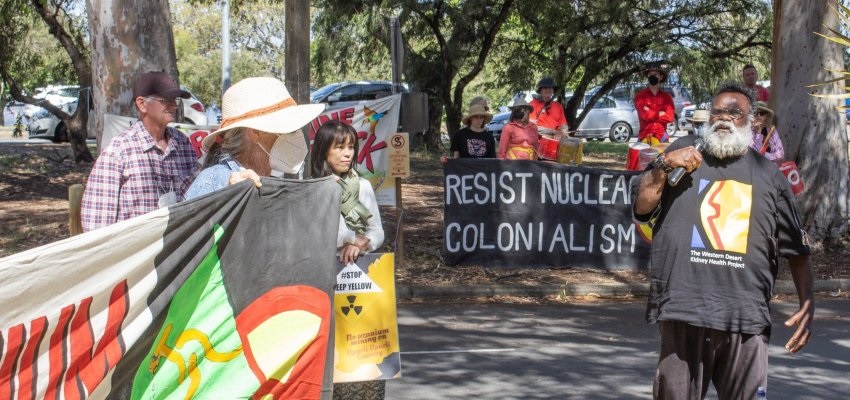
Upurli Upurli people say no to uranium mining at Mulga Rock, Western Australia
https://www.greenleft.org.au/content/upurli-upurli-people-say-no-uranium-mining-mulga-rock—
Sam Wainwright, Perth, November 28, 2022
Nuclear Free WA protested outside Deep Yellow’s annual general meeting on November 25 against the company’s plans to mine uranium at Mulga Rock, north west of Kalgoorlie. The Upurli Upurli traditional owners absolutely oppose it.
Deep Yellow holds the only uranium deposit in Western Australia. This was the company’s first AGM following its merger in August with Vimy Resources.
Mia Pepper, Nuclear Free Campaigner at the Conservation Council of WA (CCWA), who has been tracking the mine plans for more than 10 years, said it faces more opposition than ever.
Deep Yellow does not have “any agreement with the Native Title claim groups” and “it doesn’t have the finance”, she said.
It has just started a third Definitive Feasibility Study into the beleaguered project, expected to be completed mid-2024. The latest project delay casts further doubt on the future of the site, campaigners said.
“Deep Yellow is the only company beating the uranium drum in Western Australia and even their own executive team has been clear they have no intention to mine at the current uranium price,” Pepper said.
“For a company with a highly speculative business model, no operating mines, many regulatory hurdles still to clear, and a sizeable pricing disincentive, it’s astounding that shareholders would endorse the proposed remuneration package for the Deep Yellow executive team, with the CEO alone receiving over $1 million,” she continued
First Nations communities have been continuing their protests.
WA Greens Legislative Council member Brad Pettitt read a statement in parliament on November 17 on behalf of Upurli Upurli and Spinifex women.
“We are Upurli Upurli and Spinifex women and we are writing because we face the unprecedented threat of uranium mining at Mulga Rock, east of Kalgoorlie … We have been saying no to uranium mining at Mulga Rock for a long time”
Their statement also detailed concerns about Deep Yellow’s executive who held senior roles in companies responsible for the destruction of Juukan Gorge, as well as several incidents of environmental pollution, industrial relations controversies and workplace fatalities at uranium mines in Malawi and Namibia.
The CCWA is delivering a WA Uranium Free Charter to WA MPs. It demands they “review and remove any approval for uranium mining at Mulga Rock” as well as withdraw the approvals of the stalled proposed uranium mines at Kintyre, Yeelirrie and Wiluna.
.
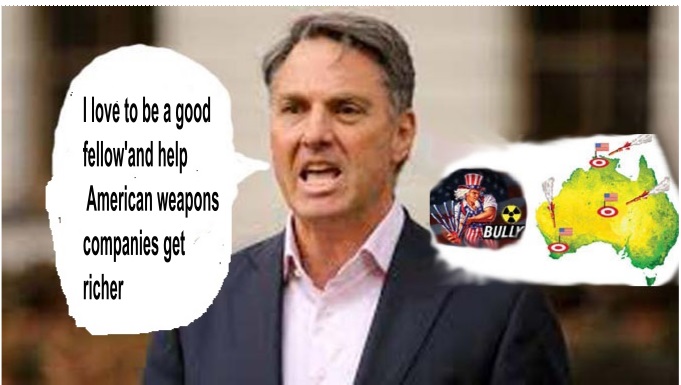
Defence Minister Richard Marles delighted to welcome American nuclear-powered Virginia Class fast-attack submarine
Virginia Class nuclear sub visit a plain delight for Marles. The Mandarin, By Julian Bajkowski, Tuesday November 29, 2022
For a routine visit, on a routine deployment, defence minister Richard Marles is plenty excited about the USS Mississippi, a very large nuclear-powered Virginia Class fast-attack submarine that not-so-quietly slipped into Fleet Base West, better known as HMAS Stirling, located off the coast of Perth.
The latest movement in Australia’s strategic dance to get nuclear-powered subs under the AUKUS agreement, the Mississippi’s overt visit and attendant official ceremonies are part of a growing local showcase of military-equipment makers intent on securing Australia’s business.
Smaller (and cheaper) than the gargantuan Ohio Class ballistic missile submarines that previously could carry as many as 150 Tomahawk cruise missiles (or 24 Trident multiple-warhead ballistic missiles), Virginia class subs are slated to number around 34 over the life of the program.
The Virginia boats are essentially the bulk-buy of the US combat submarine fleet, providing maritime hunt and attack capability as well as being a surveillance and weapons launch platform.
The fact that there are plenty of them and that there is still life in the construction cycle makes them potentially attractive to Australia, because they are a known quantity with an established skills base that could be transferred here under the AUKUS arrangement.
Marles has already had a Mississippi sneak peek.
“I had the opportunity to tour the USS Mississippi as part of my visit to Pearl Harbour in Hawaii last month, alongside US Defense Secretary Lloyd Austin,” Marles said……….
The Albanese government is also trying to normalise the visitation to Australia of nuclear vessels as very much business as usual.
….. “The USS Mississippi is the second US nuclear-powered vessel to visit Australia in 2022, following a visit by the USS Springfield in April.
“The visit reflects the ongoing strength of Australia’s alliance with the United States and builds on previous visits of nuclear-powered submarines from our AUKUS partners.” https://www.themandarin.com.au/206847-virginia-class-nuclear-sub-visit-a-plain-delight-for-marles/
‘Publishing is not a crime’: media groups urge US to drop Julian Assange charges

First outlets to publish WikiLeaks material, including the Guardian, come together to oppose prosecution
Guardian, Jim Waterson Media editor, 28 Nov 22
The US government must drop its prosecution of the WikiLeaks co-founder Julian Assange because it is undermining press freedom, according to the media organisations that first helped him publish leaked diplomatic cables.
Twelve years ago today, the Guardian, the New York Times, Le Monde, Der Spiegel, and El País collaborated to release excerpts from 250,000 documents obtained by Assange in the “Cablegate” leak. The material, leaked to WikiLeaks by the then American soldier Chelsea Manning, exposed the inner workings of US diplomacy around the world.
The editors and publishers of the media organisations that first published those revelations have come together to publicly oppose plans to charge Assange under a law designed to prosecute first world war spies.
“Publishing is not a crime,” they said, saying the prosecution is a direct attack on media freedom.
Assange has been held in Belmarsh prison in south London since his arrest at the Ecuadorian embassy in London in 2019. He had spent the previous seven years living inside the diplomatic premises to avoid arrest after failing to surrender to a UK court on matters relating to a separate case.
The then UK home secretary, Priti Patel, approved Assange’s extradition to the US in June but his lawyers are appealing against this decision.
Under Barack Obama’s leadership, the US government indicated it would not prosecute Assange for the leak in 2010 because of the precedent it would set. The media outlets are now appealing to the administration of President Joe Biden – who was vice-president at that time – to drop the charges.
The full letter sent by the media organisations
Publishing is not a crime: The US government should end its prosecution of Julian Assange for publishing secrets.……………………………………………………………….. more https://www.theguardian.com/media/2022/nov/28/media-groups-urge-us-drop-julian-assange-charges?CMP=Share_AndroidApp_Other
France opens archives related to nuclear weapons tests in the Pacific
https://www.rnz.co.nz/international/pacific-news/479695/france-opens-archives-related-to-nuclear-weapons-tests-in-the-pacific 29 Nov 22, France has opened its archives to the vast majority of documents related to its nuclear weapons tests in the South Pacific.
The defence ministry said President Emmanuel Macron had acknowledged that France owed a debt to French Polynesia for having carried out nearly 200 nuclear tests between 1966 and 1996.
It said Marcon had asked for the complete opening of the archives with the exception of the most sensitive military data.
According to the ministry, 594 boxes at the Defence History Service have so far been identified and processed, meaning 81,980 documents are now declassified and accessible for researchers.
It said only 40 documents were withheld.
Another 27 boxes of documents were yet to be examined.
Three years ago, the partial opening of the archives had been rescinded.
A leading historian in French Polynesia Jean-Marc Regnault said no reason for the closure has been given.
At the time he said a 2008 law already restricted access to an entire file if one document in it was deemed classified.
More than a quarter of a century after the last weapons test, the compensation question is yet to be settled and the test sites remain no-go zones monitored by France.
Until 2009, France claimed that its tests were clean and caused no harm, but in 2010, under the stewardship of defence minister Herve Morin, a compensation law was passed.
France opens archives related to nuclear weapons tests in the Pacific
https://www.rnz.co.nz/international/pacific-news/479695/france-opens-archives-related-to-nuclear-weapons-tests-in-the-pacific 29 Nov 22, France has opened its archives to the vast majority of documents related to its nuclear weapons tests in the South Pacific.
The defence ministry said President Emmanuel Macron had acknowledged that France owed a debt to French Polynesia for having carried out nearly 200 nuclear tests between 1966 and 1996.
It said Marcon had asked for the complete opening of the archives with the exception of the most sensitive military data.
According to the ministry, 594 boxes at the Defence History Service have so far been identified and processed, meaning 81,980 documents are now declassified and accessible for researchers.
It said only 40 documents were withheld.
Another 27 boxes of documents were yet to be examined.
Three years ago, the partial opening of the archives had been rescinded.
A leading historian in French Polynesia Jean-Marc Regnault said no reason for the closure has been given.
At the time he said a 2008 law already restricted access to an entire file if one document in it was deemed classified.
More than a quarter of a century after the last weapons test, the compensation question is yet to be settled and the test sites remain no-go zones monitored by France.
Until 2009, France claimed that its tests were clean and caused no harm, but in 2010, under the stewardship of defence minister Herve Morin, a compensation law was passed.
November 28 Energy News — geoharvey

Opinion: ¶ “Vermont’s Climate Plan Is Built On A Foundation Made Of Paper” • Vermont has a plan to combat climate change. But the plan rests on a foundation of paper because Vermont’s most consequential energy policy papers over our region’s fossil use and does not move the needle when it comes to making our […]
November 28 Energy News — geoharvey
The projected cost of new nuclear power has risen by fourfold since 2008 – and it is still rising
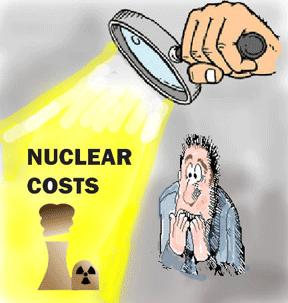
The projected cost of new nuclear power has risen by almost fourfold since
the UK Government made estimates in 2008, and the cost is still rising.
Nuclear analysts warn that the cost to consumers of funding Sizewell C
through the so-called ‘Regulatory Asset Base’ (RAB) model will be much
higher than has been projected by the Government.
In 2008 as the Government argued for more nuclear power stations to be built, the Government, in a
White Paper on nuclear costs, said that each 1.6 GWe EPR reactor would cost
around 2.8 billion. But the most recently released (by EDF) cost of the
Hinkley C EPR double reactor is £25.5 billion (in 2015 prices) and assumes
the plant will be completed by 2027.
This equates to £12.75 billion per
each 1.6 GWe reactor, as reported by World Nuclear News. This is nearly
four times the estimate made by the UK Government in 2008 after inflation
is taken into account.
100% Renewables 25th Nov 2022
The COP27 promise to fund climate help for poor countries – will it really be kept?

Gordon Brown: Rich nations have promised to pay for the climate crisis –
but will they? The breakthrough brought back memories of another, the
£100bn a year agreed at the 2009 Copenhagen climate summit to help poor
countries mitigate the effects of the climate crisis.
That money has never fully materialised. If our 13 years’ experience of the £100bn fund that
never was is anything to go by, eulogies of praise will soon turn into
allegations of betrayal.
The president of next year’s Cop28 will have to
answer for yet another fund without funders. Far from the loss and damage
fund narrowing the credibility gap on climate action, it is likely to
bridge nothing if money fails to flow from rich to poor.
Guardian 26th Nov 2022
https://www.theguardian.com/commentisfree/2022/nov/26/rich-nations-climate-crisis-cop28-gordon-brown
Nukes Corp Australia carries on

https://wordpress.com/read/feeds/89854964/posts/4401845915 25 Nov 22
Several times in the months since voters blatantly defied Rupert Murdoch’s direction to return the government of Scott Morrison, News Crap Australia has demonstrated its willingness to continue campaigning for the Liberal and National parties.
Not long after voters got it so very wrong and dared to elect a Labor Party government, new Opposition Leader Peter Dutton floated the idea of Australia adding nuclear power to its energy mix.
……………. one thing is clear, on the nuclear issue Mr Dutton has – as usual – enjoyed the active support of the Coalition parties’ advertising agency of choice, News Crap Australia.
Further evidence of the Murdoch media’s handiwork on behalf of Mr Dutton and his nuclear campaign has been on show in the national broadshit The Australian in just the past few days. (below on original)
Given that a group of pro-nuclear scientists will present their case at an event in Canberra today, we’ll no doubt see more and more Liberal Party advertisements… sorry, we’ll no doubt see more news stories and commentary in News Crap Australia outlets right up to the next federal election
It is difficult to fathom the commercial logic behind the nuclear push by News Crap Australia.
Surely, as our MGH researchers argue, young Australians are likely to be the strongest advocates of action to tackle climate change through the wider embrace of renewable energies.
They are also likely to be the last to support nuclear power with its long-term problems of waste storage and disposal and its ability to impact the health of individuals when things go wrong. Just think Chernobyl, Three Mile Island, and Fukushima.
So does News Crap Australia really believe it will attract the next generation of news consumers to its side by peddling the nuclear option?
Or does its obligation to the Coalition parties outweigh even the long-term size of its subscriber base?
What caused the Anthony Albanese China change? Better advisors?
Pearls and Irritations, By Bruce HaighNov 23, 2022,
To say that the Australian Prime Minister, Anthony Albanese, has been poorly advised would be an understatement. For reasons best known to himself he picked up and ran with a posse of advisers from the corrupt and inept Morrison regime. A big mistake.
They ran with a strong anti-China pro-AUKUS line. They briefed and backgrounded the press accordingly. It was frustrating and disappointing to watch. They were in thrall to and in some instances being paid by the US Industrial/Military complex. Australian Strategic Policy Institute, (ASPI ), being a case in point. Through the Washington Post we learnt that Morrison had installed senior US defence officers and officials in the Australian department of defence. Their influence still pervades. They are credited with having wrecked the French submarine deal.
These influencers and the many other players combining to bring us the sum total of the US alliance have brought considerable pressure on the Australian government to adopt a hostile stance against China and to go all the way with AUKUS. As I write Australian taxpayer money is being poured into defence facilities in Australia to make them ready for US use, from nuclear submarines to B52’s and marines.
None of these preparations have been put to the Australian people. All are, for whatever reason, secret. No thought has been given to tabling details relating to AUKUS in the Australian Parliament.
Albanese has been swept along and until now has been prepared to go with these arrangements which fundamentally challenge Australian sovereignty and were designed to wreck our trading and diplomatic relations with China. All to advantage the United States. This orgy of self-destructiveness was overseen and orchestrated by so called think tanks, some university based, sympathetic public servants and defence officers whose careers have come to depend on following ‘the line’, even down to believing that the acquisition of nuclear submarines and the basing of B52’s is somehow beneficial to Australia. The media, particularly the Murdoch media, has been captive to this narrative. Some such as Sheridan, Hartcher and Grant have sought to lead it.
Albanese rattled the sabre, sometimes bizarrely. ………………………………..
In contrast, mostly behind the scenes, the Foreign Minister, Penny Wong, worked assiduously and with great intellectual rigour to build bridges to the Chinese. …………………………..
Albanese secured his meeting with Xi, I would say largely on the efforts of Wong whose advice was finally listened to. Faced with Prime Ministerial loss of face the hawks in Canberra buckled to the very sensible approach Wong and her advisers had taken toward China.
Has Albanese learnt anything from this? The lesson should be that he ceases to listen to adviser’s once close to Morrison. If the Labor party wishes to implement their ambitious and long overdue reforms, they can no longer afford to keep these people on board.
Home Affairs, Immigration, Defence all need a strong broom through them. Twenty five years of LNP immaturity, selfishness, greed, corruption and absence of an agenda that included the public good has wreaked havoc and urgently needs to be addressed.
Wong has a formidable mind, she is strong character, more people in the Labor Party should be heading her advice and accepting her judgement. https://johnmenadue.com/what-caused-the-anthony-albanese-china-change-better-advisors/
1 This month
17 October, Free Public Talk on Nuclear Issues in South Australia
David Noonan will speak on public interest concerns over the new Roxby Downs Indenture Act 2026 on BHP copper-uranium mining and ore processing in SA, and on how AUKUS may face SA with a High-Level nuclear waste agenda.
Dr Jim Green will discuss international developments in the field of nuclear power including ‘small modular reactors’ and Generation 4 ‘advanced’ nuclear reactor concepts.


Help Aunty Sue Protect Her Land and Sacred Sites From Destructive Rocket Testing.
.

Australians deserve the truth
about
AUKUS – https://aukuspublicinquiry.com/

PETITION – To: Prime Minister Anthony Albanese and the Australian Labor Government

of the week – Australians for War Powers Reform (AWPR)
To see nuclear-related stories in greater depth and intensity

