Pink Floyd legend Roger Waters blames US profiteers for Ukraine conflict
https://www.rt.com/news/566577-roger-water-ukraine-profit/ 15 Nov 22
They let it happen because it’s good for business, according to Roger Waters
British rock star Roger Waters has hit out against the US for profiting off of the ongoing military conflict between Russia and Ukraine, which he says Washington allowed to happen because it was beneficial to American interests.
Discussing US foreign policy on the Bad Faith podcast on YouTube, the Pink Floyd co-founder stated that the conflict in Ukraine was “the best thing to happen to them in the last 10 years,” because it was “really good for business.”
“Part of their business is making money from the war through making weapons and selling them to the people and taking the profits from it,” Waters explained, adding that this money never goes to ordinary people. “It’s not you or me, not ordinary people who invest in the war industry. It’s people with tons of cash, and they get very well paid when there’s war.”
Another benefit of the war for the political establishment, according to Waters, is that it allows it to convince people who struggle to make ends meet and end up homeless that their woes are the fault of the Russians and Putin, who is compared to Hitler and accused of being responsible for “destroying everyone’s lives.”
Roger says he has now been banned from performing in Poland for openly criticizing the West’s military meddling and calling for peace between Russia and Ukraine.
READ MORE: Rock legend says he’s on Ukrainian ‘kill list’
Previously, the musician had written letters personally addressed to presidents Vladimir Putin, Zelensky and Joe Biden, calling for diplomatic talks to end the conflict, stating it is “the worst possible thing that can be happening,” due to the potential of an all-out nuclear war.
Another giga-scale wind, solar and battery project jostles for a spot in new renewable zone — RenewEconomy

Virya Energy proposes 220 of wind turbines, up to 300MW of solar PV and a 500MW/500MWh battery north-west of Jerilderie. The post Another giga-scale wind, solar and battery project jostles for a spot in new renewable zone appeared first on RenewEconomy.
Another giga-scale wind, solar and battery project jostles for a spot in new renewable zone — RenewEconomy
November 18 Energy News — geoharvey

Opinion: ¶ “Nuclear Power Is Not The Answer To The Earth’s Energy Crisis” • Nuclear power is falling behind wind and solar. But now, for the first time, the 2022 World Nuclear Industry Status Report assesses the risks of nuclear power and war. Ukraine’s nuclear plant at Zaporizhzhia provides an example of the problem of […]
November 18 Energy News — geoharvey
Who are the Ukrainian integral nationalists ?


Do Western enthusiasts for the Ukrainian government have any idea of the history behind this war?
Regretfully, I have mutilated this historical article below, because it’s long and complex.
So – I have just selected extracts – in my effort to outline this history of the Ukrainian nationalists
Voltaire Network Thierry Meyssa Translation Roger Lagassé 16 Nov 22
Who knows the history of the Ukrainian “integral nationalists”, “Nazis” according to the terminology of the Kremlin? It begins during the First World War, continues during the Second, the Cold War and continues today in modern Ukraine.
Many documents have been destroyed and modern Ukraine forbids under penalty of imprisonment to mention their crimes. The fact remains that these people massacred at least four million of their compatriots and conceived the architecture of the Final Solution, that is, the murder of millions of people because of their real or supposed membership in the Jewish or Gypsy communities of Europe.
Like most Western political analysts and commentators, I was unaware of the existence of Ukrainian neo-Nazis until 2014. When the president-elect was overthrown, I was living in Syria at the time and thought they were violent groupings that had burst onto the public scene to assist pro-European elements. However, since the Russian military intervention, I have gradually discovered a lot of documents and information on this political movement which, in 2021, represented one third of the Ukrainian armed forces. This article presents a synthesis of it.
At the very beginning of this story, that is to say before the First World War, Ukraine was a large plain which had always been tossed between German and Russian influences. At the time, it was not an independent state, but a province of the tsarist empire. It was populated by Germans, Bulgarians, Greeks, Poles, Rumanians, Russians, Czechs, Tatars and a very large Jewish minority supposedly descended from the ancient Khazar people.

A young poet, Dmytro Dontsov, was fascinated by the avant-garde artistic movements, believing that they would help his country to escape from its social backwardness. ……….. When the Great War broke out, he became an agent of the German secret service.

……….. In 1917, the Bolshevik revolution turned the tables. Dontsov’s friends supported the Russian revolution, but he remained pro-German. In the anarchy that followed, Ukraine was divided de facto by three different regimes: the nationalists of Symon Petliura (who imposed themselves in the area held today by the Zelensky administration), the anarchists of Nestor Makhno (who organized themselves in Novorosssia, the land that had been developed by Prince Potemkin and that had never known serfdom), and the Bolsheviks (especially in the Donbass). The war cry of Petliura’s followers was “Death to the Jews and Bolsheviks”. They perpetrated numerous murderous pogroms.
……………Dmytro Dontsov helped Petliura to ally with Poland to crush the anarchists and Bolsheviks. ……………………………………………..
Dmytro Dontsov published literary magazines that fascinated the youth. He continued to promote a Central Europe dominated by Germany and became closer to Nazism as it rose…………………………………………
The expression “integral nationalism” is still claimed today by Dontov’s followers, who, after the fall of the Third Reich, are careful to refute the term “Nazism” with which the Russians describe it, not without reason………………………………….
Dontsov became an unconditional admirer of the Führer, Adolf Hitler. . His followers had founded, in 1929, the Organization of Ukrainian Nationalists (OUN) around Colonel Yevhen Konovalets. Konovalets called Dontsov “the spiritual dictator of the youth of Galicia”. However, a quarrel arose between Dontsov and another intellectual about his extremism that led to war against all, when Konovalets was suddenly murdered. The OUN (financed by the German secret service) then split in two. The “integral nationalists” reserved for themselves the OUN-B, named after Dontsov’s favorite disciple, Stepan Bandera…………………………………………
In 1934, Bandera organized, as a member of the Nazi secret service and head of the OUN-B, the assassination of the Polish Minister of the Interior, Bronisław Pieracki………………………………………………..
From the beginning of the Second World War, under the guidance of Dmytro Dontsov, the OUN-B fought alongside the Nazi armies against the Jews and the Soviets.
The collaboration between the Ukrainian “integral nationalists” and the Nazis continued with constant massacres of the majority of the Ukrainian population, accused of being Jews or Communists, until the “liberation” of Ukraine by the Third Reich in the summer of 1941 to the cry of “Slava Ukraїni!” (Glory to Ukraine), the war cry used today by the Zelensky administration and the US Democrats. At that time, the “integral nationalists” proclaimed “independence” from the Soviet Union in the presence of Nazi representatives and Greek Orthodox clergy, not in Kiev, but in Lviv, on the model of the Hlinka Guard in Slovakia and the Ustasha in Croatia.
They formed a government under the leadership of Providnyk (guide) Stepan Bandera, whose friend Yaroslav Stetsko was Prime Minister. Their support in Ukraine is estimated at 1.5 million people. That is, the “integral nationalists” have always been in the minority.

…………………………………….in September 1941 The OUN-B was reorganized under German command.. all Ukrainian nationalists took the following oath:”……………….. I believe in Adolf Hitler as the leader and supreme commander …………”
The Nazis announced that many bodies had been discovered in the prisons, victims of “Bolshevik Jews. So the “integral nationalists” celebrated their “independence” by murdering more than 30,000 Jews and actively participating in the roundup of Jews from Kiev to Babi Yar, where 33,771 of them were shot in two days, on September 29 and 30, 1941, by the Einsatzgruppen of SS Reinhard Heydrich.
In this tumult, Dmytro Dontsov disappeared. In reality, he had gone to Prague and placed himself at the service of the architect of the Final Solution, Reinhard Heydrich, who had just been appointed vice-governor of Bohemia-Moravia. Heydrich organized the Wannsee Conference, which planned the “Final Solution of the Jewish and Gypsy Questions” [4]. He then created the Reinard Heydrich Institute in Prague to coordinate the systematic extermination of all these populations in Europe. The Ukrainian Dontsov, who now lived in Prague in great luxury, immediately became its administrator. He was one of the main architects of the largest massacre in history. Heydrich was assassinated in June 1942, but Dontsov retained his functions and privileges.
…………………… 1944, as the Reich army retreated ……… Bandera and Stetsko resumed the armed struggle, among the Nazis, against the Jews and the Bolsheviks.
But it was already too late. The Reich collapsed. The Anglo-Saxons got Dontsov, Bandera and Stetsko. The theorist of integral nationalism was transferred to Canada, while the two practitioners of mass murder were transferred to Germany. MI6 and the OSS (predecessor of the CIA) rewrote their biographies, making their Nazi involvement and responsibility for the “Final Solution” disappear.
[Ed not: from here, the story becomes very complex. with ,in the 1950s, the involvement of the CIA, the Muslim Brotherhood, Radio Free Europe, and prominent political and media leaders…….Chiang Kai-shek and the World Anti-Communist League , going on to Slava Stetsko in 1986]
………………………………………..Slava Stetsko, took over the leadership of these organizations. She too travelled the world to support any fight against the “communists”, or rather, if we refer to Dontsov’s writings, against the Russians and the Chinese. When the USSR was dissolved, Mrs. Stetsko simply changed the title of the League to the World League for Freedom and Democracy, a name it still has today. She then devoted herself to regaining a foothold in Ukraine.
………in 1994 she brought the Ukrainian president, Leonid Kuchma, to the CIA offices in Munich and dictated parts of the new constitution to him. Even today, Article 16 of the new constitution states: “Preserving the genetic heritage of the Ukrainian people is the responsibility of the state. Thus, Nazi racial discrimination is still proclaimed by modern Ukraine as in the worst moments of World War II.
………………………………….. On May 8, 2007, in Ternopol, on the initiative of the CIA, the “integral nationalists” of the Ukrainian People’s Self-Defense and Islamists created an anti-Russian “Anti-Imperialist Front”………………………………
The pro-US president, Viktor Yushchenko, created a Dmytro Dontsov Institute, following the “Orange Revolution”. Yushchenko is an example of Anglo-Saxon whitewashing. He has always claimed to have no connection with the mainstream nationalists, but his father, Andrei, was a guard in a Nazi extermination camp [8]. The Dmytro Dontsov Institute would be closed in 2010, and then reopened after the 2014 coup.
President Viktor Yushchenko, shortly before the end of his term of office, elevated the criminal against humanity Stepan Bandera to the title of “Hero of the Nation”.
In 2011, the mainstream nationalists succeeded in passing a law banning the commemoration of the end of World War II because it was won by the Soviets and lost by the Banderists……………………………
In 2014, Ukrainians in Crimea and Donbass refused to recognize the coup government. Crimea, which had declared itself independent before the rest of Ukraine, reaffirmed its independence a second time and joined the Russian Federation. The Donbass sought a compromise. The “Ukrainian nationalists,” led by President Petro Poroshenko, stopped providing public services there and bombed its population. In eight years, they murdered at least 16,000 of their fellow citizens in general indifference.
It was also from the 2014 coup that the full nationalist militias were incorporated into the Ukrainian Armed Forces. In their internal regulations, they enjoin each fighter to read the works of Dmytro Dontsov, including his master book, Націоналізм (Nationalism).
In April 2015, the Verkhovna Rada declared members of the Organization of Ukrainian Nationalists (OUN) “independence fighters.” The law was enacted, in December 2018, by President Poroshenko. Former Waffen SS were retrospectively entitled to a pension and all sorts of benefits. The same law criminalized any claim that OUN militants and UPA fighters collaborated with the Nazis and practiced ethnic cleansing of Jews and Poles. Published in Ukraine, this article would send me to jail for writing it and you for reading it.
On July 1, 2021, President Volodymyr Zelenski enacted the Law “On Indigenous Peoples of Ukraine” which places them under the protection of Human Rights. By default, citizens of Russian origin can no longer invoke them in court.
In February 2022, the “full nationalist” militias, which made up one-third of the country’s armed forces, planned a coordinated invasion of Crimea and the Donbass. They were stopped by the Russian military operation to implement UN Security Council Resolution 2202 to end the suffering of the people of Donbass.
In March 2022, Israeli Prime Minister Nafatali Bennett, breaking with the “revisionist Zionism” of Benjamin Netanyahu (the son of Jabotinsky’s secretary), suggested to President Volodymyr Zelensky that he should agree with Russian demands and denazify his country …………………………………
Main sources:
Ukrainian Nationalism in the age of extremes. An intllectual biography of Dmytro Dontsov, Trevor Erlacher, Harvard University Press (2021).
Stepan Bandera, The Life and Afterlife of a Ukrainian Nationalist. Fascism, Genocide, and Cult, Grzegorz Rossoliński-Liebe, Ibidem (2014). https://www.voltairenet.org/article218395.html
The entire article is below
Read more: Who are the Ukrainian integral nationalists ?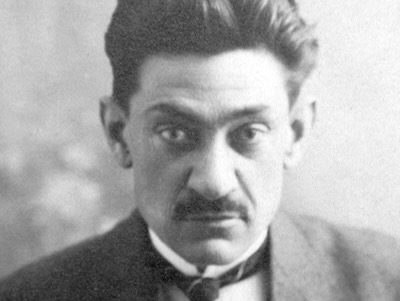
Like most Western political analysts and commentators, I was unaware of the existence of Ukrainian neo-Nazis until 2014. When the president-elect was overthrown, I was living in Syria at the time and thought they were violent groupings that had burst onto the public scene to assist pro-European elements. However, since the Russian military intervention, I have gradually discovered a lot of documents and information on this political movement which, in 2021, represented one third of the Ukrainian armed forces. This article presents a synthesis of it.
At the very beginning of this story, that is to say before the First World War, Ukraine was a large plain which had always been tossed between German and Russian influences. At the time, it was not an independent state, but a province of the tsarist empire. It was populated by Germans, Bulgarians, Greeks, Poles, Rumanians, Russians, Czechs, Tatars and a very large Jewish minority supposedly descended from the ancient Khazar people.
A young poet, Dmytro Dontsov, was fascinated by the avant-garde artistic movements, believing that they would help his country to escape from its social backwardness. Since the Tsarist Empire had been immobile since the death of Catherine the Great, while the German Empire was the scientific center of the West, Dontsov chose Berlin over Moscow.
When the Great War broke out, he became an agent of the German secret service. He emigrated to Switzerland, where he published, on behalf of his masters, the Bulletin of the Nationalities of Russia in several languages, calling for the uprising of the ethnic minorities of the Tsarist Empire in order to bring about its defeat. This model was chosen by the Western secret services to organize the “Forum of Free Peoples of Russia” this summer in Prague [1].
In 1917, the Bolshevik revolution turned the tables. Dontsov’s friends supported the Russian revolution, but he remained pro-German. In the anarchy that followed, Ukraine was divided de facto by three different regimes: the nationalists of Symon Petliura (who imposed themselves in the area held today by the Zelensky administration), the anarchists of Nestor Makhno (who organized themselves in Novorosssia, the land that had been developed by Prince Potemkin and that had never known serfdom), and the Bolsheviks (especially in the Donbass). The war cry of Petliura’s followers was “Death to the Jews and Bolsheviks”. They perpetrated numerous murderous pogroms.
Dmytro Dontsov returned to Ukraine before the German defeat and became the protégé of Symon Petliura. He participated briefly in the Paris peace conference but, for some unknown reason, did not remain in his delegation. In Ukraine, he helped Petliura to ally with Poland to crush the anarchists and Bolsheviks. After the capture of Kiev by the Bolsheviks, Petliura and Dontsov negotiated the Treaty of Warsaw (April 22, 1920): the Polish army undertook to push back the Bolsheviks and to liberate Ukraine in exchange for Galicia and Volhynia (exactly as the Zelensky administration is negotiating today the entry of Poland into the war against the same lands [2]). This new war was a fiasco.
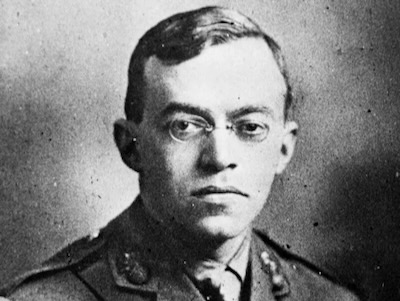
To strengthen his side, Petliura secretly negotiated with the founder of the Jewish battalions in the British army (the “Jewish Legion”) and now administrator of the World Zionist Organization (WZO), Vladimir Jabotinsky. In September 1921, the two men agreed to unite against the Bolsheviks in exchange for Petliura’s commitment to forbid his troops to continue their pogroms. The Jewish Legion was to become the “Jewish Gendarmerie. However, despite his efforts, Petliura did not succeed in pacifying his troops, especially as his close collaborator Dontsov was still encouraging the massacre of Jews. Finally, when the agreement was revealed, the World Zionist Organization rebelled against the Petliura regime. On January 17, 1923, the WZO set up a commission to investigate Jabotinsky’s activities. Jabotinsky refused to come and explain himself and resigned from his position.
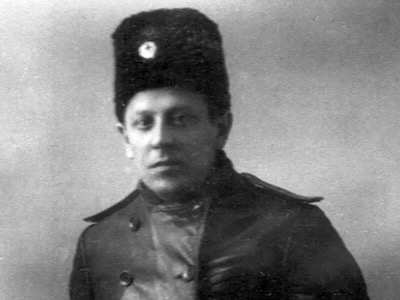
Petliura fled to Poland and then to France, where he was murdered by a Jewish anarchist from Bessarabia (now Transnistria). During the trial, the latter assumed his crime and pleaded to have avenged the hundreds of thousands of Jews murdered by the troops of Petliura and Dontsov. The trial had a great impact. The court acquitted the murderer. The League against Pogroms, later Licra (International League against Racism and Anti-Semitism), was founded on this occasion.
Not only were the nationalists defeated, but the anarchists as well. Everywhere the Bolsheviks triumphed and chose, not without debate, to join the Soviet Union.
Dmytro Dontsov published literary magazines that fascinated the youth. He continued to promote a Central Europe dominated by Germany and became closer to Nazism as it rose. He soon referred to his doctrine as Ukrainian “integral nationalism “. In doing so, he referred to the French poet, Charles Maurras. Indeed, the logic of both men was initially identical: they sought in their own culture the means to affirm a modern nationalism. However, Maurras was a Germanophobe, while Dontsov was a Germanophile. The expression “integral nationalism” is still claimed today by Dontov’s followers, who, after the fall of the Third Reich, are careful to refute the term “Nazism” with which the Russians describe it, not without reason.
According to him, “Ukrainian nationalism” is characterized by:
“the affirmation of the will to live, power, expansion” (it promotes “The right of strong races to organize peoples and nations to strengthen the existing culture and civilization”)
“the desire to fight and the awareness of its extremity” (he praises the “creative violence of the initiative minority”).
Its qualities are:
“fanaticism” ;
” immorality”.
Finally, turning his back on his past, Dontsov became an unconditional admirer of the Führer, Adolf Hitler. His followers had founded, in 1929, the Organization of Ukrainian Nationalists (OUN) around Colonel Yevhen Konovalets. Konovalets called Dontsov “the spiritual dictator of the youth of Galicia”. However, a quarrel arose between Dontsov and another intellectual about his extremism that led to war against all, when Konovalets was suddenly murdered. The OUN (financed by the German secret service) then split in two. The “integral nationalists” reserved for themselves the OUN-B, named after Dontsov’s favorite disciple, Stepan Bandera.
In 1932-33, the Bolshevik political commissars, who were mostly Jewish, levied a tax on crops, as in other regions of the Soviet Union. Combined with significant and unpredictable climatic hazards, this policy caused a huge famine in several regions of the USSR, including the Ukraine. It is known as “Holodomor”. Contrary to what the nationalist historian Lev Dobrianski says, it was not a plan for the extermination of Ukrainians by the Russians, since other Soviet regions suffered, but an inadequate management of public resources in times of climate change. Lev Dobrianski’s daughter, Paula Dobrianski, became one of President George W. Bush’s aides. She led a merciless struggle to have historians who did not adhere to her father’s propaganda excluded from Western universities [3].
In 1934, Bandera organized, as a member of the Nazi secret service and head of the OUN-B, the assassination of the Polish Minister of the Interior, Bronisław Pieracki.
From 1939, members of the OUN-B, forming a military organization, the UPA, were trained in Germany by the German army, and then still in Germany, but by their Japanese allies. Stepan Bandera offered Dmytro Dontsov to become the leader of their organization, but the intellectual refused, preferring to play the role of a leader rather than an operational commander.
The “integral nationalists” admired the invasion of Poland, in application of the German-Soviet pact. As Henry Kissinger, who could not be suspected of pro-Sovietism, demonstrated, it was not a question of the USSR annexing Poland, but of neutralizing part of it in order to prepare for the confrontation with the Reich. On the contrary, for Chancellor Hitler, it was a question of beginning the conquest of a “vital space” in Central Europe.
From the beginning of the Second World War, under the guidance of Dmytro Dontsov, the OUN-B fought alongside the Nazi armies against the Jews and the Soviets.
The collaboration between the Ukrainian “integral nationalists” and the Nazis continued with constant massacres of the majority of the Ukrainian population, accused of being Jews or Communists, until the “liberation” of Ukraine by the Third Reich in the summer of 1941 to the cry of “Slava Ukraїni!” (Glory to Ukraine), the war cry used today by the Zelensky administration and the US Democrats. At that time, the “integral nationalists” proclaimed “independence” from the Soviet Union in the presence of Nazi representatives and Greek Orthodox clergy, not in Kiev, but in Lviv, on the model of the Hlinka Guard in Slovakia and the Ustasha in Croatia. They formed a government under the leadership of Providnyk (guide) Stepan Bandera, whose friend Yaroslav Stetsko was Prime Minister. Their support in Ukraine is estimated at 1.5 million people. That is, the “integral nationalists” have always been in the minority.
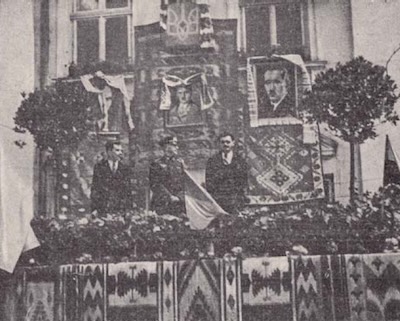
The Nazis were divided between the Reich Commissioner for the Ukraine, Erich Koch, for whom the Ukrainians were subhuman, and the Minister for the Occupied Eastern Territories, Alfred Rosenberg, for whom the “integral nationalists” were true allies. Finally, on July 5, 1941, Bandera was deported to Berlin and placed under Ehrenhaft (honorable captivity), i.e., under house arrest as a high-ranking official. However, after the members of OUN-B murdered the leaders of the rival faction, OUN-M, the Nazis sanctioned Stepan Bandera and his organization on September 13, 1941. 48 of their leaders were deported to a prison camp in Auschwitz (which was not yet an extermination camp, but only a prison). The OUN-B was reorganized under German command. At that time all Ukrainian nationalists took the following oath: “Faithful son of my Fatherland, I voluntarily join the ranks of the Ukrainian Liberation Army, and with joy I swear that I will faithfully fight Bolshevism for the honor of the people. This fight we are waging together with Germany and its allies against a common enemy. With loyalty and unconditional submission I believe in Adolf Hitler as the leader and supreme commander of the Liberation Army. At any time I am prepared to give my life for the truth.
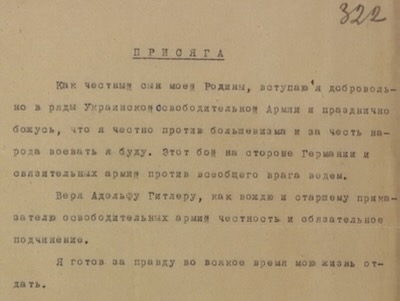
The Nazis announced that many bodies had been discovered in the prisons, victims of “Bolshevik Jews. So the “integral nationalists” celebrated their “independence” by murdering more than 30,000 Jews and actively participating in the roundup of Jews from Kiev to Babi Yar, where 33,771 of them were shot in two days, on September 29 and 30, 1941, by the Einsatzgruppen of SS Reinhard Heydrich.
In this tumult, Dmytro Dontsov disappeared. In reality, he had gone to Prague and placed himself at the service of the architect of the Final Solution, Reinhard Heydrich, who had just been appointed vice-governor of Bohemia-Moravia. Heydrich organized the Wannsee Conference, which planned the “Final Solution of the Jewish and Gypsy Questions” [4]. He then created the Reinard Heydrich Institute in Prague to coordinate the systematic extermination of all these populations in Europe. The Ukrainian Dontsov, who now lived in Prague in great luxury, immediately became its administrator. He was one of the main architects of the largest massacre in history. Heydrich was assassinated in June 1942, but Dontsov retained his functions and privileges.
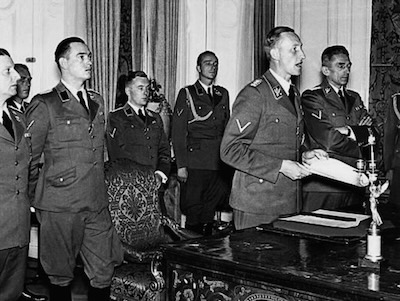
Stepan Bandera and his deputy Yaroslav Stetsko were placed under house arrest at the headquarters of the General Inspectorate of Concentration Camps in Oranienburg-Sachsenhausen (30 km from Berlin). They wrote letters to their supporters and to the Reich leadership in complete freedom and were not deprived of anything. In September 1944, as the Reich army retreated and Bandera’s followers began to rebel against it, the two leaders were released by the Nazis and reinstated in their previous positions. Bandera and Stetsko resumed the armed struggle, among the Nazis, against the Jews and the Bolsheviks.
Centuria Integral Nationalist Order Ceremony. According to George Washington University, by 2021 it had already penetrated the main NATO armies.
But it was already too late. The Reich collapsed. The Anglo-Saxons got Dontsov, Bandera and Stetsko. The theorist of integral nationalism was transferred to Canada, while the two practitioners of mass murder were transferred to Germany. MI6 and the OSS (predecessor of the CIA) rewrote their biographies, making their Nazi involvement and responsibility for the “Final Solution” disappear.
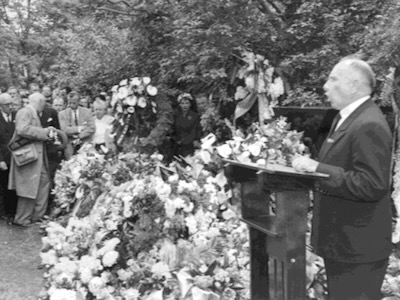
Bandera and Stetsko were installed in Munich to organize the Anglo-Saxon stay-behind networks in the Soviet Union. From 1950 onwards, they had an important radio station, Radio Free Europe, which they shared with the Muslim Brotherhood of Said Ramadan (the father of Tariq Ramadan). The radio station was sponsored by the National Committee for a Free Europe, a CIA offshoot of which its director Alan Dulles was a member, as well as future president Dwight Eisenhower, newspaper magnate Henry Luce and film director Cecil B. DeMilles. Psychological warfare specialist and future patron of the Straussians, Charles D. Jackson, was chairman.
Vladimir Jabotinsky, for his part, after living in Palestine, took refuge in New York. He was joined by Benzion Netanyahu (the father of the current Israeli Prime Minister). The two men wrote the doctrinal texts of “revisionist Zionism” and the Jewish Encyclopedia.
Bandera and Stetsko moved around a lot. They organized sabotage operations throughout the Soviet Union, particularly in the Ukraine, and parachuted leaflets. For this purpose, they created the Anti-Bolshevik Bloc of Nations (ABN), which brought together their Central European counterparts [5]. The British double agent, Kim Philby, informed the Soviets in advance about the actions of the Bandera. Bandera met with Dontsov in Canada and asked him to take the lead in the struggle. Once again, the intellectual refused, preferring to devote himself to his writing. He then drifted into a mystical delirium inspired by Viking myths. He announced the final battle of the Ukrainian knights against the Russian dragon. As for Bandera, he allied himself with the Chinese leader Chiang Kai-shek whom he met in 1958. But he was assassinated the following year by the KGB in Munich.
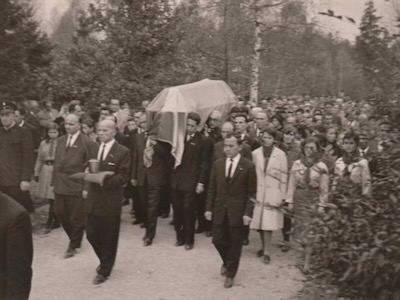
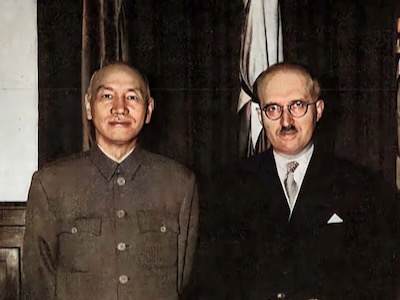
Yaroslav Stetsko continued the struggle through Radio Free Europe and the ABN. He went to the United States to testify before Senator Joseph MacCarthy’s Commission on Un-American Activities. In 1967, he and Chiang Kai-shek founded the World Anti-Communist League [6]. The League included many pro-US dictators from around the world and two schools of torture, in Panama and Taiwan. Klaus Barbie, who assassinated Jean Moulin in France and Che Guevara in Bolivia, was a member. In 1983, Stetsko was received at the White House by President Ronald Reagan and participated, along with Vice President George Bush Sr., in Lev Dobrianski’s “Captive Nations” (i.e., peoples occupied by the Soviets) ceremonies. He finally died in 1986.
But the story does not end there. His wife, Slava Stetsko, took over the leadership of these organizations. She too travelled the world to support any fight against the “communists”, or rather, if we refer to Dontsov’s writings, against the Russians and the Chinese. When the USSR was dissolved, Mrs. Stetsko simply changed the title of the League to the World League for Freedom and Democracy, a name it still has today. She then devoted herself to regaining a foothold in Ukraine.
Slava Stetsko ran in the first elections of the independent Ukraine in 1994. She was elected to the Verkhovna Rada, but having been stripped of her nationality by the Soviets, she could not sit. However, she brought the Ukrainian president, Leonid Kuchma, to the CIA offices in Munich and dictated parts of the new constitution to him. Even today, Article 16 of the new constitution states: “Preserving the genetic heritage of the Ukrainian people is the responsibility of the state. Thus, Nazi racial discrimination is still proclaimed by modern Ukraine as in the worst moments of World War II.
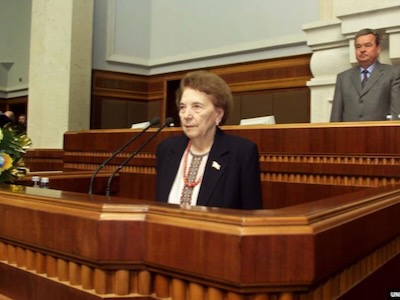
Slava Stetsko was re-elected at the next two sessions. She solemnly presided over the opening sessions on March 19, 1998 and on May 14, 2002.
In 2000, Lev Dobriansky organized a large symposium in Washington with many Ukrainian officials. He invited Straussian Paul Wolfowitz (a former collaborator of Charles D. Jackson). During this meeting, the “integral nationalists” put themselves at the service of the Straussians to destroy Russia [7].
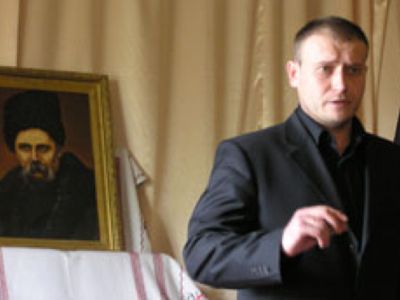
On May 8, 2007, in Ternopol, on the initiative of the CIA, the “integral nationalists” of the Ukrainian People’s Self-Defense and Islamists created an anti-Russian “Anti-Imperialist Front” under the joint chairmanship of the Emir of Itchkeria, Dokka Umarov, and Dmytro Yarosh (the current special adviser to the head of the Ukrainian army). The meeting was attended by organizations from Lithuania, Poland, Ukraine and Russia, including Islamist separatists from Crimea, Adygea, Dagestan, Ingushetia, Kabardino-Balkaria, Karachaevo-Cherkessia, Ossetia and Chechnya. Dokka Umarov, who was unable to go there due to international sanctions, had his contribution read out. In retrospect, the Crimean Tatars are unable to explain their presence at this meeting, if not their past service to the CIA against the Soviets.
The pro-US president, Viktor Yushchenko, created a Dmytro Dontsov Institute, following the “Orange Revolution”. Yushchenko is an example of Anglo-Saxon whitewashing. He has always claimed to have no connection with the mainstream nationalists, but his father, Andrei, was a guard in a Nazi extermination camp [8]. The Dmytro Dontsov Institute would be closed in 2010, and then reopened after the 2014 coup.
President Viktor Yushchenko, shortly before the end of his term of office, elevated the criminal against humanity Stepan Bandera to the title of “Hero of the Nation”.
In 2011, the mainstream nationalists succeeded in passing a law banning the commemoration of the end of World War II because it was won by the Soviets and lost by the Banderists. But President Viktor Yanukovych refused to enact it. Enraged, the “integral nationalists” attacked the procession of Red Army veterans, beating up old men. Two years later, the cities of Lviv and Ivano-Frankivsk abolished the Victory Day ceremonies and banned all manifestations of joy.
In 2014, Ukrainians in Crimea and Donbass refused to recognize the coup government. Crimea, which had declared itself independent before the rest of Ukraine, reaffirmed its independence a second time and joined the Russian Federation. The Donbass sought a compromise. The “Ukrainian nationalists,” led by President Petro Poroshenko, stopped providing public services there and bombed its population. In eight years, they murdered at least 16,000 of their fellow citizens in general indifference.
It was also from the 2014 coup that the full nationalist militias were incorporated into the Ukrainian Armed Forces. In their internal regulations, they enjoin each fighter to read the works of Dmytro Dontsov, including his master book, Націоналізм (Nationalism).
In April 2015, the Verkhovna Rada declared members of the Organization of Ukrainian Nationalists (OUN) “independence fighters.” The law was enacted, in December 2018, by President Poroshenko. Former Waffen SS were retrospectively entitled to a pension and all sorts of benefits. The same law criminalized any claim that OUN militants and UPA fighters collaborated with the Nazis and practiced ethnic cleansing of Jews and Poles. Published in Ukraine, this article would send me to jail for writing it and you for reading it.
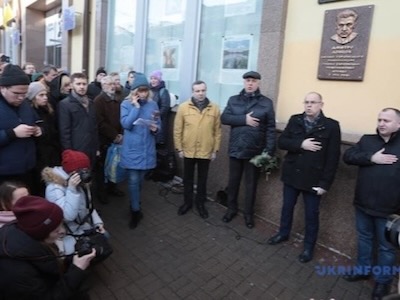
On July 1, 2021, President Volodymyr Zelenski enacted the Law “On Indigenous Peoples of Ukraine” which places them under the protection of Human Rights. By default, citizens of Russian origin can no longer invoke them in court.
In February 2022, the “full nationalist” militias, which made up one-third of the country’s armed forces, planned a coordinated invasion of Crimea and the Donbass. They were stopped by the Russian military operation to implement UN Security Council Resolution 2202 to end the suffering of the people of Donbass.
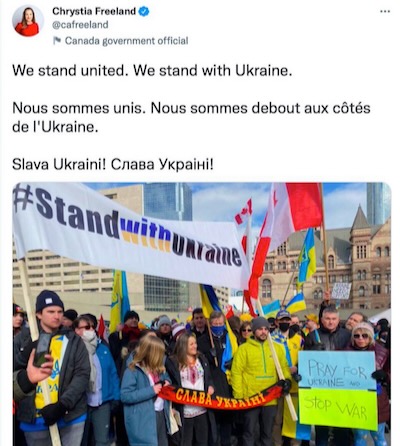
In March 2022, Israeli Prime Minister Nafatali Bennett, breaking with the “revisionist Zionism” of Benjamin Netanyahu (the son of Jabotinsky’s secretary), suggested to President Volodymyr Zelensky that he should agree with Russian demands and denazify his country [8]. Emboldened by this unexpected support, Russian Foreign Minister Sergei Lavrov dared to mention the case of the Jewish Ukrainian president, saying: “The Jewish people in their wisdom have said that the most ardent anti-Semites are usually Jews. Every family has its black sheep, as they say.” This was too much for the Israelis, who always worry when someone tries to divide them. His counterpart at the time, Yair Lapid, recalled that the Jews themselves never organized the Holocaust of which they were victims. Caught between its conscience and its alliances, the Hebrew state repeated its support for Ukraine, but refused to send it any weapons. In the end, the General Staff decided and the Minister of Defense, Benny Gantz, closed any possibility of support to the successors of the mass murderers of Jews.
Ukrainians are the only nationalists who are not fighting for their people or their land, but for one idea: to annihilate the Jews and the Russians.
Main sources:
Ukrainian Nationalism in the age of extremes. An intllectual biography of Dmytro Dontsov, Trevor Erlacher, Harvard University Press (2021).
Stepan Bandera, The Life and Afterlife of a Ukrainian Nationalist. Fascism, Genocide, and Cult, Grzegorz Rossoliński-Liebe, Ibidem (2014).
[1] “The Western strategy to dismantle the Russian Federation”, by Thierry Meyssan, Translation Roger Lagassé, Voltaire Network, 17 August 2022.
[2] “Poland and Ukraine”, by Thierry Meyssan, Translation Roger Lagassé, Voltaire Network, 14 June 2022.
[3] “The Holodomor, new avatar of “European” anti-communism” (excerpt from Le Choix of defeat), Annie Lacroix-Riz (2010).
[4] «The Wannsee Conference in 1942 and the National Socialist living space dystopia», Gerhard Wolf, Journal of Genocide Research, Vol 17 N°2 (2015). https://doi.org/10.1080/14623528.2015.1027074
[5] [Bulletins of the Anti-Bolshevik Nations Block are available in the Voltaire Network Library. ABN Korrespondenz (auf Deutsch), ABN Correspondence (in english).
[6] “The World Anti-Communist League: the Internationale of Crime”, by Thierry Meyssan, Translation Anoosha Boralessa, Voltaire Network, 12 May 2004.
[7] “Ukraine : the Second World War continues”, by Thierry Meyssan, Translation Roger Lagassé, Voltaire Network, 26 April 2022.
Missile fired at NATO member Poland came from Ukraine, US officials say
President Joe Biden said it was ‘unlikely’ missile fired from Russia
By VASILISA STEPANENKO Wednesday, November 16, 2022
KYIV, Ukraine — Poland’s President Andrzej Duda says there is no evidence a missile that hit Poland near its border with Ukraine was an “intentional attack.”
Duda said Wednesday that the landing of the Russian-made missile in a rural area, killing two people, was mostly likely an accident.
“It was not an attack on Poland,” Duda said, adding that Tuesday’s incident involved “most probably a Russian-made missile.”
“We have no proof at this point to suggest the missile was fired by the Russian side,” Duda said.
He added: “There is high probability that it was a missile used for anti-missile defense, meaning it was used by Ukraine’s defense forces.”
Did the “stray missiles” to Poland come from Russian or from Ukrainian military?

Ukraine Weapons Tracker @UAWeapons
So what crashed in the village of Przewodów, Poland today? With the cooperation of @blueboy1969 we analyzed the available photos of fragments and came to a clear conclusion that they belong to the 48D6 motor of the 5V55-series missile of the S-300 AD system- a Ukrainian one.
So what crashed in the village of Przewodów, Poland today? With the cooperation of
@blueboy1969 we analyzed the available photos of fragments and came to a clear conclusion that they belong to the 48D6 motor of the 5V55-series missile of the S-300 AD system- a Ukrainian one.
Poland Considering NATO Article 4 Activation, Says Spokesman, By Reuters. Nov. 15, 2022,
WARSAW (Reuters) – Poland is verifying if it needs to request consultations under Article 4 of the NATO military alliance treaty, a government spokesman said on Tuesday, after a report that a blast that killed two people near the Ukrainian border was caused by stray Russian missiles.
The United States and Western allies said they were investigating but could not confirm a report on Tuesday that the blast in the village of Przewodow resulted from stray Russian missiles. Russia’s defence ministry denied it.
‘On The Highway To Climate Hell’ – The Climate Crisis, Activism And Broken Politics
Scientists are now admitting more often that they are ‘scared’ about
the climate crisis. Record high temperatures this summer in the UK alone
prompted Professor Hannah Cloke, from Reading University, to say: ‘This
sort of thing is really scary. It’s just one statistic amongst an
avalanche of extreme weather events that used to be known as “natural
disasters”.’
Aaron Theirry, co-founder of Scientists for Extinction
Rebellion, recently pointed out that: ‘The world’s largest oil and gas
companies are set to invest $930 billion over this decade in new fossil
fuel projects. Whilst the largest investment banks such as J.P. Morgan,
Citigroup, etc. have continued to pour hundreds of billions into the sector
since the Paris agreement.’
He added: ‘It was recently calculated that
fossil fuel companies already own seven times more reserves than can be
burned if we are to stay below 1.5C of global warming – yet they continue
to explore for more, with government backing!
Mark Campanale, CEO of Carbon
Tracker points out that if we look at current investment strategies then
“we are heading way beyond 3C degrees”. In other words, the global
political and financial elites are still marching us towards
catastrophe.’
In a recent interview with Aaron Bastani of Novara Media,
wildlife television presenter and conservationist Chris Packham made highly
articulate comments about the climate crisis, grassroots protest and the
destructive nature of the private media.
It is well worth quoting him at
length. As Bastani noted, Packham is a genuine national treasure, highly
regarded by much of the British public for his knowledge and passion about
the natural world and the environment, and for his keen ability to
communicate these issues effectively. Bastani asked him: ‘Do you think
politics in this country is capable of addressing the climate crisis?’
Packham answered: ‘No. No, I think the people will have to force our
politicians to address it. That’s why I continue to support those
activists [referring to Extinction Rebellion and Just Stop Oil] who are
making a noise about this, and trying to bring it to the forefront of
public attention, and express and articulate the urgency [of the situation]
that we now find ourselves in. ‘It’s not only that I don’t trust them
[politicians], it’s that even if they were trustworthy people, I don’t
think the system’s there to make it work.’
Media Lens 14th Nov 2022
“Everywhere you look at Egypt’s COP27 you can see and hear the influence of the fossil fuel industry” – Greenpeace .
Yeb Saño, Executive Director, Greenpeace Southeast Asia and Head of the
Greenpeace delegation attending the COP said: “While this is merely a
skeleton of the Egyptian Presidency’s draft of a COP cover note
Greenpeace is shocked that it has no backbone. It is scarcely credible that
they have forgotten all about fossil fuels especially with the level of
carbon cartel capture present here in Sharm el-Sheikh.”
“Everywhere you
look in Sharm el-Sheikh you can see and hear the influence of the fossil
fuel industry. They have shown up in record numbers to try and decouple
climate action from a fossil fuel phase out.”
“India clearly put all
fossil fuels on the phase down negotiating table. The EU could not have
been simpler in calling for a phase out. And, Tuvalu powerfully connected
transitioning away from fossil fuels with staying below 1.5C as a human
right. T
The ever present COP chroniclers of the Egyptian Presidency somehow
seem to have failed to record any of it.” The cover note must make it
clear that limiting temperature rise to 1.5C by 2100 is the only acceptable
interpretation of the Paris Agreement and acknowledge the 1.5°C aligned
global phase out dates for the production and consumption of coal, gas and
oil.”
Greenpeace International 15th Nov 2022
Western Australia sets new renewables record of 81% – in world’s biggest isolated grid — RenewEconomy

WA grid reaches record level of 81 per cent renewables, driven mostly by rooftop solar. The post Western Australia sets new renewables record of 81% – in world’s biggest isolated grid appeared first on RenewEconomy.
Western Australia sets new renewables record of 81% – in world’s biggest isolated grid — RenewEconomy
Launceston looks at making green hydrogen on-site with solar farm on airport land — RenewEconomy

Launceston Airport considers proposal to build an on-site solar farm and install an electrolyser to producer green hydrogen. The post Launceston looks at making green hydrogen on-site with solar farm on airport land appeared first on RenewEconomy.
Launceston looks at making green hydrogen on-site with solar farm on airport land — RenewEconomy
AGL begins process of powering up Torrens Island battery, biggest in South Australia — RenewEconomy

AGL brings its 250MW/250MWh Torrens Island battery one step closer to “full functionality” as a “virtual synchronous machine.” The post AGL begins process of powering up Torrens Island battery, biggest in South Australia appeared first on RenewEconomy.
AGL begins process of powering up Torrens Island battery, biggest in South Australia — RenewEconomy
Three NSW councils join forces to source wind and solar power — RenewEconomy

Flow Power inks deal to supply wind and solar power to three councils in New South Wales. The post Three NSW councils join forces to source wind and solar power appeared first on RenewEconomy.
Three NSW councils join forces to source wind and solar power — RenewEconomy
Australia’s “biggest battery” project resized, reshaped, renamed and relaunched — RenewEconomy

Battery project billed as Australia’s biggest has been redrawn, resized and relaunched, but is still to land its first customer contract. The post Australia’s “biggest battery” project resized, reshaped, renamed and relaunched appeared first on RenewEconomy.
Australia’s “biggest battery” project resized, reshaped, renamed and relaunched — RenewEconomy
November 16 Energy News — geoharvey

Opinion: ¶ “Who Will Pay For Indonesia’s Clean Energy Bill?” • Indonesia is one of the world’s biggest coal producers, and environmental activists worry that many vested business interests are limiting the government’s ambitions for a clean energy transition. The country’s coal-burning power plants are mostly not old, and it is building more. This raises […]
November 16 Energy News — geoharvey
1 This month


Help Aunty Sue Protect Her Land and Sacred Sites From Destructive Rocket Testing.
.

Australians deserve the truth
about
AUKUS – https://aukuspublicinquiry.com/

PETITION – To: Prime Minister Anthony Albanese and the Australian Labor Government

of the week – Australians for War Powers Reform (AWPR)
To see nuclear-related stories in greater depth and intensity

