Marshall Islands to receive U.N. support over nuclear legacy

https://english.kyodonews.net/news/2022/10/e2a640256da0-marshall-islands-to-receive-un-support-over-nuclear-legacy.html KYODO NEWS -8 Oct 22,
The U.N. Human Rights Council adopted a resolution Friday aimed at assisting the Marshall Islands in its efforts to secure justice for people suffering from the impact of the United States’ former nuclear testing program in its territory.
“We have suffered the cancer of the nuclear legacy for far too long and we need to find a way forward to a better future for our people,” Samuel Lanwi, deputy permanent representative of the Republic of the Marshall Islands in Geneva told the body in an emotional speech.
The United States conducted dozens of nuclear weapons tests in the islands of the Pacific state in the 1940s and ’50s, including the 1954 Castle Bravo test at Bikini Atoll, the biggest U.S. bomb ever detonated.
The text tabled by five Pacific Island states — the Marshall Islands, Fiji, Nauru, Samoa and Vanuatu — was backed by Australia and did not demand reparations.
It called on the U.N. rights chief to submit a report in September 2024 on the challenges to the enjoyment of human rights by the Marshallese people stemming from the nuclear legacy.
The United States as well as other nuclear weapons states such as Britain, India and Pakistan expressed concern about some aspects of the text but did not ask for a vote on the motion. Japan did not speak at the meeting.
The Marshallese people are still struggling with the health and environmental consequences of the nuclear tests, including higher cancer rates. Many people displaced due to the tests are still unable to return home.
A concrete dome on Runit Island containing radioactive waste is of particular concern, especially in relation to rising sea levels as a result of climate change, according to the countries that drafted the resolution.
The Marshall Islands says a settlement reached in 1986 with the United States fell short of addressing the extensive environmental and health damage that resulted from the tests.
The U.S. government asserts the bilateral agreement settled “all claims, past, present and future,” including nuclear compensation.
Observers say some nuclear states fear the initiative for the Marshall Islands could open the door to other countries bringing similar issues to the rights body.
October 7 Energy News — geoharvey

Opinion: ¶ “Michigan Has Potential To Reduce Emissions By Over 94%” • The 2030 Report: How Michigan Should Meet Its Climate Change Goals outlines the most feasible and ambitious set of policies that would help Michigan reduce health-harming pollution and greenhouse gases while putting the state on a strong path for meeting its climate goals. […]
October 7 Energy News — geoharvey
TODAY. For Australia, it really is time to take the toys from the boys.
Australia’s new Treasurer, Jim Chalmers prepares to deliver his first budget. Australia is out of the appalling corruption of the Scott Morrison government, but still well in the grip of the USA military-industrial-corporate complex.
Therefore – despite the desperate needs, spelt out by Jim Chalmers himself – troubled global economy, ballooning deficit, – not to mention aged care crisis, health crisis, flood crisis, homeless crisis – Australia still prioritises weapons spending. Callum Foote writes:
Australia is the fourth largest importer of weapons in the world, behind Saudi Arabia, India and Egypt.
Over the next decade, the Australian government will invest $200 billion in the Defence Force with an eye to support the weapons export industry. In line with these goals, Australian military spending has shot through the roof – from $10 billion in 2000 to just under $50 billion in the last budget. The big winners? Largely foreign multinational defence contractors, and plenty of small local ones too; they’re growing along with the public spending.
Now we’re being told that we have to weapon up – against that evil China who (inexplicably) is supposed to be poised to attack Australia. We’re told to stick to that wonderful Fools-Based-International-Order – (meaning back whatever next military venture USA/NATO decides on)
But we don’t only blow our budget on our own defence – now we are obliged to cater to the whim of Zelensky, with his unrealistic goal of completely defeating Russia, and retaking Crimea into Ukraine. When will this weapons extravaganza party for Lockheed Martin, Raytheon, BAE etc ever stop?
What do you think the arms trade is, a charity? Actually yes, that’s what it is
Michael West Media, by Callum Foote | Oct 7, 2022,
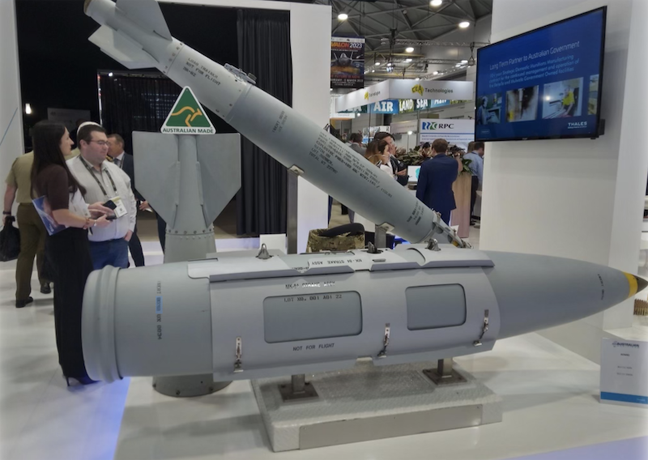
All’s not fair at the warfare Expo, where taxpayer-funded arms merchants hobnob with military types by invitation only. “Aggressive” journalists not allowed. Persona non grata Callum Foote reports on Land Forces 2022, Australia’s biggest War Fair.
Land Forces is the annual exposition for the defence industry, or the most profitable corporate welfare exercise in the country.
Australia is the fourth largest importer of weapons in the world, behind Saudi Arabia, India and Egypt. It is roughly the 20th largest exporter of weapons. This is a disparity former Defence Minister Christopher Pyne, now a defence industry consultant, set out to rectify in 2018 with the launch of the $3 billion Defence Export Strategy after meeting with Abu Dhabi’s Crown Prince Mohamed bin Zayed al Nahyan. Pyne, who was in attendance at Land Forces 2022, stated at the time the goal of making Australia a top-10 exporter.
Over the next decade, the Australian government will invest $200 billion in the Defence Force with an eye to support the weapons export industry. In line with these goals, Australian military spending has shot through the roof – from $10 billion in 2000 to just under $50 billion in the last budget. The big winners? Largely foreign multinational defence contractors, and plenty of small local ones too; they’re growing along with the public spending.
Land Forces is their gathering, the gathering of the year for those looking to earn a profit from this public investment. The conference brings in interest from international weapons makers such as Boeing and Thales as well as 700-odd smaller Australian manufacturers and service providers hoping to get in on the action.
Alms for arms
The company behind Land Forces, AMDA, formerly the Aerospace Maritime and Defence Foundation of Australia, is part of a group of companies registered with Australian Charities and Non-for-profit Commission which operates around the country.
Yes, that’s right: AMDA is a weapons charity; and despite its income of $10m-plus from defence contractors and governments, it also helped itself to JobKeeper subsidies, despite rising profits during the Pandemic.
t has 24 full-time-equivalent employees and had a total revenue in 2021 of $8.5 million – 13% of which came from government grants.
While revenue in 2021 was down from 2020, where the ‘‘charity’’ pulled in $10.5 million, profit was actually up from $2.1 to $3.5 million. Sales revenue also rose slightly in 2021 from $7.2 million to $7.4 million.
Where this charity’s financials differ from most, not even to begin discussing its purpose, is that as of 2021 AMDA has $32.5 million in assets, up from $28 million the year before, with over $10 million of that being in cash or cash equivalents. Were it not for JobKeeper, its large cash reserves would still be large but not quite so large.
With all this cash, one would think that AMDA could weather any storm. Not so, according to the board which includes not one but two former chiefs of the Australian Navy, a former chief of Army and Air Force and a former CEO of Lockheed Martin Australia, who decided to take JobKeeper payments.
That’s right, over 2020 and 2021 AMDA took $1.2 million in JobKeeper payments, $870,000 in 2021 and $360,000 in 2020.
In the same period the total remuneration to the key management personnel of the charity, people such as the CEO and the board members, was $1.5 million and $1.4 million respectively.
Despite the fact that this is public money, AMDA has refused to comment on whether it will be returning the taxpayer subsidies it took to line the coffers of its charity while increasing executive pay.
Embedded with the activists
The activists protesting outside the arms fair are up against a powerful foe, and they know it.
While protesting under the banner of Disrupt Land Forces, a campaign organised under the flag of activist organisation Wage Peace, the activists are reluctant to claim that they are a part of any organisation at all. It’s more of a community, they say.
Most protesters are wary of the media and wish to remain anonymous. There are members of more ‘‘hardcore’’ organisations such as Extinction Rebellion and Blockade Australia, 12 of which were arrested last June during civil action related to climate change.
On Tuesday morning, around 50 or so of the protesters gathered outside the Brisbane Convention and Exhibition Centre entrance where a rally received moderate media attention from SBS and Channels 10 and Seven.
These media outlets were really only interested in the Greens politicians, led by Senator David Shoebridge, who briefly talked to the activists before clearing off. The cameras then left with them, leaving the activists to the rest of the weeks activities.
Depending on who you ask, the goal of the protesters is to either meaningfully decrease the attendance of the conference or increase the cost of putting it on……………………………………………………..
A likely Coalition
Many of the protesters have been involved in activism for decades, such as Margie Pestorius, a spokesperson for Wage Peace who has been protesting since the late 1980s.
“I was part of the Melbourne Rainforest Action Group [MRAG] at its height in 1989. We blockaded ships carrying Malaysian rainforest timber threatening the livelihoods and lives of the Indigenous Penan and the ecosystems they had nurtured and lived with.”
Pestorius has since pivoted to anti-militarism activism, which lacks the same support as environmental causes here in Australia.
Among the protesters are Aunty Sue Haseldine, Indigenous elder from Kokatha country who has had to deal with the fallout of atomic weapons testing in her country. Now she has learnt that Souther Launch, an Australian space company who has “aligning their business goals with defence industry priorities” according to Thales will be testing on her land once again.
Aunty Sue says she will refuse to leave if testing goes ahead “If they’re going to destroy heritage then they’re going to destroy me too. That country out there is our church, our school, our spirituality, our pharmacy. It is shameful to know that these weapons will be tested on our country which will then be used to commit atrocities across the world” she told a crowd outside Thales’ office in Brisbane.
Uncle George Dimara from West Papua also spoke outside Thales, decrying the use of Australian-built Thales Bushmasters being used by Indonesian forces in West Papua.
Others include members from Teachers for Peace, a group of Australian teachers who are pushing back against what they see as the encroachment of defence industry spending in the education sector.
The protests lack the wide-scale support seen in the environmental movement such as the thousands strong marches that have taken place in Australia’s major cities over the past few years, but that doesn’t mean these activists are dismayed.
According to Adrian Heaney, a spokesperson for Wage Peace, “these protests have demonstrated our commitment to resisting the profit-fuelled arms race enabled by institutions like Land Forces. Arms fairs of this kind in Australia have been stopped before by people power—it’s our responsibility to continue this tradition. There is no time left for more murder, more destruction. We need collaboration, not more conflict.” https://michaelwest.com.au/what-do-you-think-the-arms-trade-is-a-charity-actually-yes-thats-what-it-is/
Never mind Australia’s economic problems, health crisis etc – Weapons for Zelensky is the big need.

Zelensky: Australia to deliver ‘significant’ new support for Ukraine, The Age Matthew Knott, October 6, 2022 Ukrainian President Volodymyr Zelensky has revealed Australia is preparing to ramp up support for his nation’s war against Russia by announcing a new tranche of military assistance, including donations of heavy weapons.
In an appearance via video link at the Lowy Institute think tank in Sydney, Zelensky urged the global community not to give in to Russian President Vladimir Putin’s “nuclear blackmail”………………..
Asked what Australia could do to help Ukraine, Zelensky said the Albanese government had been preparing a “significant package” of assistance that will be announced soon.
“This process is ongoing as we speak and I’m very grateful to that,” he said. “It’s not only small arms but heavy weapons as well.”
Zelensky said that, for the upcoming round of assistance, Australia had been negotiating with other countries to announce a joint support package for Ukraine.
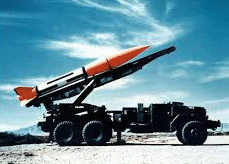
Ukrainian Ambassador to Australia Vasyl Myroshnychenko has publicly asked Australia to provide Ukraine with a supply of anti-ship missiles known as Harpoons and howitzer long-range weapons.
Ukraine is also asking for an additional fleet of 30 four-wheel drive vehicles on top of the 60 already provided…………………..
He also called for “new and tough sanctions against Russia” as a punishment for its invasion of Ukraine. https://www.theage.com.au/politics/federal/zelensky-australia-to-deliver-significant-new-support-for-ukraine-20221006-p5bnrm.html
Coalition nuclear power bill “dead on arrival,” but somehow the debate lives on.

Australia’s atomic culture warriors are now focused on promoting ‘advanced’ nuclear power and small modular reactors. A new report debunks – yet again – the propaganda. The post Coalition nuclear power bill “dead on arrival,” but somehow the debate lives on appeared first on RenewEconomy.
Coalition nuclear power bill “dead on arrival,” but somehow the debate lives on — RenewEconomy
RenewEconomy, Dr. Jim Green 5 October 2022, Australia’s nuclear power debate refuses to die. The phenomenon was neatly summarised by Bernard Keane in Crikey in August:
“Nuclear power has to be the single most boring and ossified ritual in Australian public policy. Someone on the right will call for a “debate” on nuclear power. Critics will point out that nuclear power is ludicrously expensive, takes decades to build, and is prone to multi-hundred per cent cost blowouts.
“The right will then invoke, reflexively, small modular reactors, which aren’t operating anywhere in the world despite having been promised for 30 years. Someone else will then ask which electorate the proponents propose to put a reactor in. Rinse, repeat.”
As repetitive as the debate has become, there are interesting contributions from time to time.
Dr Ziggy Switkowski led the Howard government’s nuclear review in 2006 and was arguably Australia’s most prominent champion of nuclear power.
But, to his credit, Switkowski has been following the dramatic cost reductions of renewables and the equally dramatic cost escalations of nuclear power. In 2019, Dr. Switkowski dropped an atomic bombshell, stating that “the window for gigawatt-scale nuclear has closed” with renewables winning on economic grounds.
Former NSW Premier Bob Carr is another former supporter who has been swayed by the facts. Carr noted in The Australian last November that “nuclear is lumbering, subject to breakdowns and cripplingly expensive” and that “the contrast with the surge to renewables is stark.”
Conservative commentator Paul Kelly poured cold water on the Coalition’s nuclear crusaders in The Australian last November.
Kelly’s column pointed to the “popular pull of renewables” and their falling costs. He noted that “nuclear plant construction remains poor in advanced OECD nations, the main reason being not safety but its weak business case”.
Kelly also questioned the rhetoric around small modular reactors given that “none has so far been built in developed nations”.
On the politics, Kelly wrote that
“The populist conservatives have form. Before the 2019 poll, they campaigned on the mad idea that Morrison follow Donald Trump and quit the Paris Agreement. Now they campaign on the equally mad but more dangerous idea that he seek to split the country by running on nuclear power… As for those conservatives who say Morrison’s job is to fight Labor, the answer is simple. His job is to beat Labor. That’s hard enough now; vesting the Coalition with an unnecessary ideological crusade that will crash and burn only means he would have no chance.“
Some Coalition MPs seem incapable of understanding the politics. On September 28, nine ultra-conservative Coalition Senators introduced a private members bill to Parliament calling for the repeal of Howard-era legislation banning nuclear power.
But the Liberal and National senators don’t even have the support of their own parties, so their private members bill was dead on arrival.
Matt Canavan was among the group of nine Senators. He claims to oppose policies that will drive up power prices but supports nuclear power even though he has himself noted that it would increase power bills.
Perhaps he should read Paul Kelly’s column in The Australian. And he should read the work of CSIRO and the Australian Energy Market Operator which dispels any notion that nuclear power is economically viable in Australia.
“Advanced” nuclear power
A 2019 federal parliamentary Environment and Energy Committee inquiry was controlled by Coalition MPs who were, in principle, exceedingly enthusiastic about nuclear power.
However the Committee’s report argued that the government should retain legal bans prohibiting the development of conventional, large nuclear power reactors. Committee chair Ted O’Brien said “Australia should say a definite ‘no’ to old nuclear technologies”.
The Committee’s report called for a partial repeal of legal bans to permit the development of “new and emerging nuclear technologies” including small modular reactors, but that was quickly ruled out by the Morrison government.
Nonetheless, propaganda about ‘advanced’ nuclear power persists and the Australian Conservation Foundation has released a new briefing paper debunking that propaganda……………………………………………….
Australia’s energy future is renewable, not radioactive
The pursuit of SMRs or ‘advanced’ nuclear power in Australia would be expensive and protracted. The South Australian Nuclear Fuel Cycle Royal Commission stated in its 2016 report:
“Advanced fast reactors and other innovative reactor designs are unlikely to be feasible or viable in the foreseeable future. The development of such a first-of-a-kind project in South Australia would have high commercial and technical risk. Although prototype and demonstration reactors are operating, there is no licensed, commercially proven design. Development to that point would require substantial capital investment.”
The federal Department of Industry, Science, Energy and Resources expects 69 percent renewable supply to the National Electricity Market by 2030. The Albanese Government’s target is 82 percent renewable supply to the National Electricity Market by 2030.
State and territory governments (including Liberal/Coalition governments) are focused on the renewables transition. Tasmania leads the pack thanks to its hydro resources. South Australia is another pace-setter: wind and solar supply 64 percent of local power generation and SA could reach its target of net 100 percent renewables within a few years.
The pursuit of nuclear power would slow the transition to a low-carbon economy. It would increase electricity costs. It would unnecessarily introduce challenges and risks associated with high-level nuclear waste management and the potential for catastrophic accidents.
The pursuit of nuclear power in Australia makes no sense whatsoever. Australia’s energy future is renewable, not radioactive. https://reneweconomy.com.au/coalition-nuclear-power-bill-dead-on-arrival-but-somehow-the-debate-lives-on/—
Dr. Jim Green is the national nuclear campaigner with Friends of the Earth Australia and co-author of the ACF’s briefing paper, ‘Wrong reaction: Why ‘next-generation’ nuclear is not a credible energy solution’.
The Australian Radioactive Waste Agency (ARWA) shows that the planned Kimba dump is predominantly for ANSTO’s wastes , NOT for medical wastes.
see new 2-page Briefer “ARWA’s National Inventory of Radioactive Waste shows the Kimba dump is predominantly for ANSTO’s waste” https://nuclear.foe.org.au/…/Inventory-ARWA-Noonan…
Extracts:
ANSTO – Australian Nuclear Science and Technology Organisation – is the predominant source of existing and future radioactive waste to be disposed and stored at Kimba.
ARWA report a five-fold increase in Low Level Waste (LLW) to be disposed at Kimba, with the existing 2 490 m3 LLW intended to increase to a total of 13 287 m3 LLW over the next 100-year period all to be dumped near Kimba.
ARWA states: “The estimated volumes of ANSTO’s future Low Level Waste and Intermediate Level Waste are substantially greater than previously reported.”
ANSTO has produced over 92% of Australia’s existing total LLW Inventory.
ANSTO intend to produce over 98% of future LLW in Australia over the next 100 years.
ANSTO are responsible for over 99.5% of the radioactivity in Australia’s total LLW inventory to be dumped at Kimba.
ARWA reports only a total of 5 (five) m3 of LLW originates from non-ANSTO and non-Commonwealth agency sources
total Hospital existing and future LLW is reported at only 3 m3
total “Research and Education” sector existing and future LLW is reported at only 2 m3
Claims that a national LLW disposal facility is needed at Kimba for hospital and medical waste are false.
ANSTO are near solely responsible for plans to more than double Australia’s total Intermediate Level Wastes (ILW) inventory
ANSTO have produced and hold 96.5% of Australia’s existing ILW packaged inventory at Lucas Heights
ANSTO propose to generate 97% of future ILW in Australia over the next 50-year period
ARWA reports Australia’s total inventory of ILW including nuclear materials, existing and future wastes over the next 50-year period, is 4 377 m3, these hazardous wastes are to be transported to Kimba for indefinite above ground storage.
Hospitals are stated to hold a total of only a single m3 of existing ILW with no future ILW arising.
Nuclear materials feature ANSTO’s nuclear fuel wastes – that were described as “highly hazardous” material by ARPANSA’s inaugural CEO John Loy in evidence to an NSW Parliamentary Inquiry.
Based on ARWA’s Report, all non-ANSTO sources produce on average only approx. 1.3 m3 per year of LLW over the next 100 years and produce approx. 1.34 m3 per year of ILW over the next 50 years.
‘Next generation’ nuclear is not a credible energy response – makes no sense for Australia- The Australian Conservation Foundation

The pressing need to transition from fossil fuel energy to a low carbon future has seen renewed calls for domestic nuclear power in Australia. The Australian Conservation Foundation has recently reviewed scientific literature and industry practice from Australia and around to world to see if any developments in nuclear technology might have changed the role of this deeply contested power source.
Our findings are captured in a new report, which provides a clear pathway to a low carbon energy system. ACF is committed to effective climate action but maintains that ‘next generation’ nuclear is not a credible energy response and the pursuit of nuclear power in Australia makes no sense.
It would slow the transition to a low-carbon economy, increase electricity costs and unnecessarily introduce challenges and risks associated with high-level nuclear waste management including the potential for catastrophic accidents, with profound inter-generational economic implications for Australian taxpayers.
It is important to note that proponents of nuclear power in Australia are not calling for the deployment
of existing nuclear reactor technology. Instead, they are promoting ‘next generation’ nuclear technology which currently does not exist to scale.
Australian Conservation Foundation 5th Oct 2022
https://www.acf.org.au/our-shared-energy-future-is-renewable-not-radioactive
Australia the ‘subimperial power’

ABC Radio National – Late Night Live – Broadcast 4 Oct 22, A new book ‘Subimperial Power – Australia in the International Arena’ argues Australians ought to be told what our relationship with the United States is really about: a relationship where we eagerly and routinely act to help the US keep its imperial position at the apex of global power. Iraq, Afghanistan and now AUKUS – the book argues Australians have been kept in the dark as to the real motivations behind these consequential decisions.
Philip Adams interviews Clinton Fernandez – https://www.abc.net.au/radionational/programs/latenightlive/australia-the-subimperial-power-/101503728
Pacific islanders want nuclear legacy aid
https://www.canberratimes.com.au/story/7931308/pacific-islanders-want-nuclear-legacy-aid/ By Emma Farge, October 5 2022,
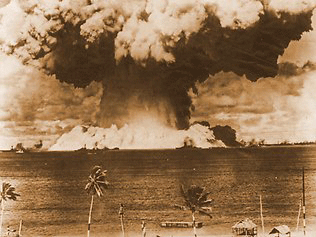
Nuclear powers have criticised an effort led by the Marshall Islands and backed by Australia at the United Nations to seek help on dealing with the consequences of nuclear testing.
The issue is before the UN’s Human Rights Council and involves the United States, Britain, Russia, India and China, all of them nuclear-armed.
Pacific islanders, who are particularly threatened by rising sea levels from climate change, are becoming more vocal in seeking redress from former colonial powers and wealthy countries on environmental and climate issues which they say affect their human rights.
This motion brought to the Human Rights Council on Monday by the Marshall Islands, Fiji, Nauru, Samoa and Vanuatu and backed by Australia requests assistance from the UN rights office; seeks a report from its boss; and calls for a future debate at the council.
“The nuclear legacy is a lived reality for us that must be addressed,” Samuel Lanwi, deputy permanent representative of the Republic of the Marshall Islands (RMI) in Geneva told Reuters.
The United States conducted 67 nuclear weapons tests in the Marshall Islands from 1946 to 1958 including “Castle Bravo” at Bikini Atoll in 1954 – the largest US bomb ever detonated. Islanders still suffer the health and environmental effects such as high cancer rates and enduring displacement from contaminated areas.
The Marshall Islands Ambassador to the UN in Geneva, Doreen de Brum could not join the talks because she is on leave following her daughter’s death from cancer. “My fight for nuclear justice is personal,” she said on Twitter.
While the motion does not mention the United States by name, some see it as an attempt to wield leverage over Washington in ongoing negotiations on a Compact of Free Association (COFA) that governs US economic assistance to the RMI. Marshallese diplomats deny this.
The nuclear legacy has been a major sticking point in the talks, although last week US President Joe Biden’s administration acknowledged it and said it remained committed to addressing concerns.
The Marshall Islands, one of 47 voting members on the rights council, is a key Western ally including on human rights, such as on scrutiny of China’s rights record.
Three sources who attended the Geneva talks told Reuters they were surprised by the level of resistance to a resolution seeking “technical assistance” – a term that could take the form of legal and political advice – rather than a formal probe.
“Nuclear powers were converging in their determination to protect themselves from any future accountability and there were attempts to empty out the resolution of any significance,” Yves Lador from Earthjustice said.
Diplomats say there were concerns about opening the door for future litigation. Past nuclear test sites include French Polynesia, Algeria, Kazakhstan and China’s Xinjiang.
The United States, Britain and India all argued that the rights council was not the appropriate forum to raise the issue and sought to strip out references to the new UN right to a clean and healthy environment, according to the sources.
China and Russia also argued for the latter, they said.
The British and Russian missions declined to comment. India’s did not respond. A spokesperson for China’s mission said they had “constructively participated” in the talks.
A vote might be called later this week – something that happens in a minority of cases when countries cannot agree.
‘Next-generation’ nuclear power a furphy
By Marion Rae, Canberra Times, October 5 2022 ,
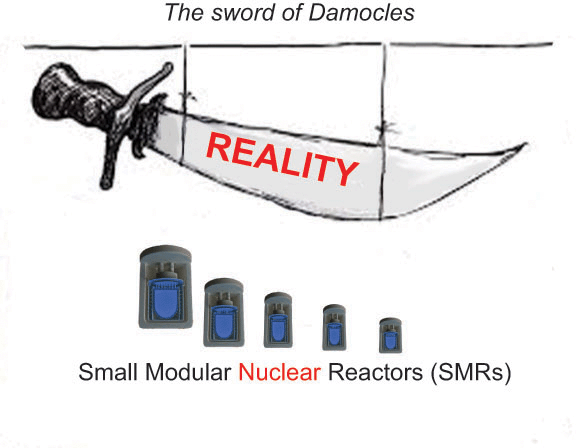
Small-scale nuclear power for Australia’s remote mining sites and communities has been dismissed as toxic and too expensive.
Research released on Wednesday by the Australian Conservation Foundation found the nuclear option would increase power bills, risk catastrophic accidents and bring new challenges for dealing with waste………………..
The ACF report dismisses the new SMR technology as expensive and unviable, and found small reactors in Russia and China have been subject to serious delays and cost blowouts.
SMRs could not be introduced to Australia without huge taxpayer subsidies, and would result in higher electricity prices, the report said.
“While there are hopes and dreams of ramping up SMR production, the mass-manufacturing facilities needed to produce the technology are found nowhere in the world,” the report said.
Earlier this year, CSIRO estimated 2030 costs at up to $326 per megawatt hour for SMR-generated nuclear power compared to up to $82 for wind and solar in a grid powered 90 per cent by renewable electricity.
Federal energy agencies have also found the designs are at best “paper reactors” and billions of dollars away from being ready.
………………………………………… critics say mining, processing and transporting uranium is highly polluting, as is reactor construction and waste management over thousands of years. https://www.canberratimes.com.au/story/7929821/next-generation-nuclear-power-a-furphy/
NextEra Energy finds that small nuclear reactors (SMRs) really are the biggest boondoggle of all

There were a couple of interesting developments in June in regards to electric power. One was that NextEra Energy issued its Investor Conference Report 2022 to its stockholders. Another was a paper from Stanford University, “Low-cost solutions to global warming, air pollution, and energy insecurity for 145 countries,” (LCS study) by Mark Z. Jacobson, et al. Looking into them is rather interesting.
The first of these makes very clear that in the opinions of the people running NextEra Energy, combustion
generating sources and nuclear power are getting too expensive. Furthermore, their opinion is that the most expensive of these, at least in the late 2020s, will be small modular nuclear reactors (SMRs).

We should make clear, just in case anyone doesn’t know, that NextEra is hardly anti-nuclear. While it is already the biggest investor in renewable energy in the US, it does own seven nuclear reactors, including the one at Seabrook. Electricity from new, near-firm solar and wind plants is a good deal less expensive than electricity from existing nuclear plants.
Let’s state this clearly: We are paying extra for electricity from nuclear plants, even after they have been paid down, and even though the sun can shine and the wind can blow almost all the time, because of really cheap battery storage. Put another way, it would be cheaper to close the nuclear plants and replace them with new renewable facilities.
Clean Technica 4th Oct 2022 https://cleantechnica.com/2022/10/04/why-should-we-pay-extra-for-nuclear-power/
Why We Need To Teach Nuclear War

Thoughtful teachers must be willing to educate their students slowly and honestly about the history of our nuclear past.
https://www.commondreams.org/views/2022/09/27/why-we-need-teach-nuclear-war BRIAN GIBBS, September 27, 2022,
We do not teach nuclear war, but we need to.
Make no mistake, the invasion of Ukraine is a nuclear-fueled conflict and students are ill-prepared to understand it. We need to be clear about this. Any military intervention by a nuclear power is a nuclear conflict. Russia threatened a nuclear retaliation if the United States became directly involved in the invasion of Ukraine; Sweden and Norway have asked for and been granted entrance into NATO placing increased pressure on Russia; and the New York Times reported that Russia is advancing on a nuclear reactor in Ukraine. It is a nuclear conflict.
The horror of nuclear war, an analysis of a country’s nuclear strategies and policies, not the immediate and active resistance to the creation, positioning and use of nuclear weapons is taught. Content standards, guidelines and textbooks discuss nuclear weapons little if at all. They typically describe the dropping of the two atomic bombs framing them as the only reasonable conclusion to World War II. Students have little background and understanding of nuclear weapons, their proliferation, or how they are used as threat and bargaining chip in every conflict and war since their introduction to the field of combat. During recent interviews several students indicated they were shocked when North Korea’s leader Kim Jung Un indicated that he was going to hit Guam with a missile strike. They had an assumption that nuclear strike capabilities were something from a time long ago.
Students were also disturbed when President Trump threatened North Korea with total annihilation from a U.S. missile strike. The students shared that they had a vague sense that other countries had nuclear weapons but indicated that they only time nuclear weaponry, tactics, or strategy were shared was as part of a short lesson focused on the dropping of the atomic bombs on Hiroshima and Nagasaki. Several students indicated that they were confused as they had thought there was only one atomic bomb dropped not two.
Though it may not seem like it, the teaching of war is a controversial topic in American classrooms. This is shocking as it is overwhelmingly the main topic in social studies standards, curriculum, and testing. War is often taught as something which occurred, is over, as something bad but necessary and is too often taught as parables of heroics by reluctant Americans. Little time is typically spent on the messy beginnings and endings of wars, examining the morality of them, or discussing the choices and decisions made by leaders and soldiers, and even more rarely, the actions of the always present anti-war movements. As the students suggested, nuclear war is taught even less. Often in a one-day lesson on the actions of the Enola Gay and Boxcar, the planes that dropped the two bombs or as background, almost a white noise to briefly learning about the Cold War.
There are several reasons for this. Teachers report feeling lack of support in the teaching of complex things. Teachers indicate that they feel enormous community pressure to not teach a more thorough, honest, and critical examination of war. Some teachers say that to critique a war in the past is to critique a war in the present and the soldiers involved. If they do this, they fear accusations of indoctrination and anti-American sentiment. This is mostly from more conservative ideological and political spaces, but teachers also report feeling a different form of pressure from schools situated in more left-leaning spaces. These parents do not want their children exposed to the horror of war even in high school. They seem to fear this examination of historical reality could damage or traumatize their children. This pressure to fail to offer robust examinations became ever more exacerbated during the polarization and America First approach of the Trump administration. Things which had not been seen as controversial have become controversial. As Diana Hess has pointed out (2009) things are not controversial on their own, but rather they become controversial because of time and community context and community interpretation of the issues.
Some if not much of our history is disturbing. This is particularly true of war. Much of the anti-Critical Race Theory legislation passing through state legislatures makes the argument that no student should be made to feel bad while learning history or studying literature. This is impossible without shading or obfuscating the truth or just outright lying to children. An authentic examination of our past will lead to students feeling things, likely bad over the enormity of what has been done. In the hands of thoughtful, capable teachers’ students can experience history honestly, have time to thoughtfully discuss, examine documents, and investigate, thinking about what happened and what could have happened. Also understanding that there has been and always will be resistance to the use of and expansion of nuclear weapons.
Fear of traumatizing students is a concern surfaced by teachers who choose to not teach honestly. This is a legitimate concern. With the rise of our awareness and understanding of trauma and generational trauma and how it affects our youth teachers are right to be concerned. Too often, this concern leads to avoidance which in turn leads to not teaching necessary topics. If we want our children to grow into strong participants in our democracy and thoughtful stewards of our world students need to be made aware of the world-ending disaster that could be just around the corner. As the Los Angeles Times reported American weaponry has been given to Ukraine under the rules that it be used to repel Russian forces in Ukraine, but not to attack Russian forces on Russian soil. The reason for this is clear. Use of American equipment in attacks on Russia would be seen by Russa as aggressive acts directly supported by the United States. Which could in turn lead to direct military involvement in the war by the United States. Though nuclear missiles might not be used if this conflict were to occur it would absolutely be a nuclear war.
Any conflict or military action by a nuclear power has the potential to quickly escalate and spiral into a nuclear conflict. Our children do not understand this fully and they will not understand it if we continue to avoid the topic. The only way to prevent this is for thoughtful teachers to educate their students slowly and honestly about the history of our nuclear past, including our use of the atomic bombs at the end of World War II. The alienation between the United States and the Soviet Union in the post-War World II era must be studied. So must the history of atomic weapons and the development of more advanced systems that continues to this day.
Students need to understand the aging and deteriorating state of the missiles and safety measures the United States and Russia have and the consequence of an accidental launch. Likewise, students need to understand the litany of nuclear treaties, non-proliferation pacts, and the deep history of citizen resistance groups that have and continue to resist the possession, testing of, and continued development of nuclear weapons. This knowledge, this understanding, when taught well, over time, through discussion and inquiry, in the hands of a thoughtful teacher can help empower rather than overwhelm students. Knowledge and understanding help dispel feelings of fear, more importantly it can help students at a young age begin to develop ways out and solutions for a more peaceful world.
The mission of most schools includes the creation of active and engaged humans prepared to help guide and change the world. This is as it should be. Part of this is honest and authentic examinations of our past and possible futures. This will allow students to develop into thoughtful adults who can make educated decisions about warfare, foreign policy, and nuclear war. It is absolutely necessary.
Kerr McGee: Is the thorium danger over?

“These things have a half life of 14 million years,”
To Kerr McGee, “You need to pay up. We need reparations for all the people who are suffering from chronic illnesses that you caused,”
When will West Chicago finally be clear of thorium radiation?
https://wildcatchronicle.org/10131/news/kerr-mcgee-is-the-danger-over/ By Savannah Epperson, Reporter, October 5, 2022
As the recent piles of dirt indicate, Kerr-McGee clean-up is set to start this fall. The final stage of thorium removal along Ann St. and W. Blair St. in West Chicago involves remediating the groundwater using 36 million dollars in funds allocated for the clean-up.
On Aug. 24, the City of West Chicago published a press release concerning the site, indicating it was preparing for a “future park” at the location. That press release has since been removed. A member of the West Chicago City administration reached out, however. The city is planning on creating a park in the former Kerr-McGee lot in a few years.
“To get ready for this, the city will hire a park planning consultant. The planning will take a few months and include a significant amount of public input,” said Tom Dabareiner, Community Development Director for the city of West Chicago.
The most recent clean-up of the soil ended in 2015.
“However the sheet piling that was initially installed to protect workers excavating contaminated soil now traps residual contaminants preventing the ground water from naturally diluting over time,” wrote Liuan Huska for Borderless Magazine in July.
The damage of the company’s poor disposal practices continues to affect West Chicago and its residents, and may do so for generations to come.
Lindsay Light was a company that created gaslight mantles, which were small fabric bags infused with Thorium or other metal nitrates that fitted over a gas source. The company manufactured these mantles for 30 years, and then Kerr-McGee purchased the company. They manufactured for another decade before it was discovered that the company had been dumping radioactive waste into the groundwater and soil surrounding the plant and three other primary areas.
That is when it was brought to the attention of the Illinois Environmental Protection Agency through a group called TAG, Thorium Action Group that formed in West Chicago and began petitioning for a cleanup of the radiation. The Hispanic community was not informed of the radiation, and after the Campbell Soup company sold their rental housing, they were forced to find homes. Realtors took the opportunity to sell the thorium-contaminated homes. They gave new residents deals on the homes, but never told the people who were to live there that there was thorium radiation in their homes, sandboxes, and the lakes that their children played in. Clean-up began in 1984. There was a video created about the issue that shows the original cleanup.
“The residents started to notice men dressed in anti-contamination suits cleaning up and testing various residential areas,” according to a thesis titled, Thorium Shipped out and Dust of Deceit Left behind in West Chicago, written by Lindsey Stern in the spring of 2016.
The company was purchased by Anadarko Petroleum in 2006, which was later purchased by Occidental Petroleum in 2019. But have these companies turned over a new leaf?
Occidental Petroleum’s mission statement is: “To develop energy resources safely, profitably, and responsibly.”
“These things have a half life of 14 million years,” said Professor of Engineering and Technology at Northern Illinois University, and former West Chicago resident, Dr. Theodore Hogan in reference to radiation.
In other words, thorium exists in the human immune system for 28 million years.
The people who live in these communities have suffered adverse effects their entire lives. They have no way to remove the radiation they were exposed to, and they often have no means of healing themselves and their communities. Human beings are forced to live with debilitating conditions and deformities for their entire lives because these companies chose to dump their toxic chemicals into their groundwater or soil.
Hogan was a child when he was exposed to thorium in West Chicago, and has since spent his life learning about this radiation and the effects of it on the human body.
“I’m still angry now,” said Hogan when asked about his own experience with radiation.
The effects of the radiation that West Chicago has experienced can never truly be measured. That is clear with Hogan’s own reaction to questions about Thorium clean up. Even with the clean up going on, people will never be the same as before.
Hogan also noted that the only way that anyone can truly help these communities move forward is to recognize that contamination happened, and to talk about it. He suggested it was important to give people a place to air their anger, grief, and confusion after their lives are turned upside down.
To Kerr McGee, “You need to pay up. We need reparations for all the people who are suffering from chronic illnesses that you caused,” said Julieta Alcantar-Garcia, Founder of PODER, an organization that is built to stop environmental racism in the West Chicago community.
Poland suggests hosting US nuclear weapons- ‘nuclear sharing’

Poland suggests hosting US nuclear weapons amid growing fears of Putin’s threats, https://www.theguardian.com/world/2022/oct/05/poland-us-nuclear-wars-russia-putin-ukraine Julian Borger in Washington, 6 Oct 22, Andrzej Duda, the Polish president, in September. He said there was ‘a potential opportunity’ for Poland to take part in ‘nuclear sharing’.
Poland says it has asked to have US nuclear weapons based on its territory, amid growing fears that Vladimir Putin could resort to using nuclear arms in Ukraine to stave off a rout of his invading army.
The request from the Polish president, Andrzej Duda, is widely seen as symbolic, as moving nuclear warheads closer to Russia would make them more vulnerable and less militarily useful, according to experts. Furthermore, the White House has said it had not received such a request.
“We’re not aware of this issue being raised and would refer you to the government of Poland,” a US official said.
Duda’s announcement appears to be the latest example of nuclear signalling as the US and its allies seek to deter Putin from the first nuclear use in battle since 1945, while preparing potential responses if deterrence fails that would have maximum punitive impact while containing the risk of escalation to all-out nuclear war.
1 This month


Help Aunty Sue Protect Her Land and Sacred Sites From Destructive Rocket Testing.
.

Australians deserve the truth
about
AUKUS – https://aukuspublicinquiry.com/

PETITION – To: Prime Minister Anthony Albanese and the Australian Labor Government

of the week – Australians for War Powers Reform (AWPR)
To see nuclear-related stories in greater depth and intensity

