Pentagon opens sweeping review of clandestine psychological operations

Ellen Nakashima, The Washington Post, Mon, 19 Sep 2022
The Pentagon has ordered a sweeping audit of how it conducts clandestine information warfare after major social media companies identified and took offline fake accounts suspected of being run by the U.S. military in violation of the platforms’ rules.
Colin Kahl, the undersecretary of defense for policy, last week instructed the military commands that engage in psychological operations online to provide a full accounting of their activities by next month after the White House and some federal agencies expressed mounting concerns over the Defense Department’s attempted manipulation of audiences overseas, according to several defense and administration officials familiar with the matter.
The takedowns in recent years by Twitter and Facebook of more than 150 bogus personas and media sites created in the United States was disclosed last month by internet researchers Graphika and the Stanford Internet Observatory. While the researchers did not attribute the sham accounts to the U.S. military, two officials familiar with the matter said that U.S. Central Command is among those whose activities are facing scrutiny. Like others interviewed for this report, they spoke on the condition of anonymity to discuss sensitive military operations.
The researchers did not specify when the takedowns occurred, but those familiar with the matter said they were within the past two or three years. Some were recent, they said, and involved posts from the summer that advanced anti-Russia narratives citing the Kremlin’s “imperialist” war in Ukraine and warning of the conflict’s direct impact on Central Asian countries. Significantly, they found that the pretend personas — employing tactics used by countries such as Russia and China — did not gain much traction, and that overt accounts actually attracted more followers.
…………………………. The U.S. government’s use of ersatz social media accounts, though authorized by law and policy, has stirred controversy inside the Biden administration, with the White House pressing the Pentagon to clarify and justify its policies. The White House, agencies such as the State Department and even some officials within the Defense Department have been concerned that the policies are too broad, allowing leeway for tactics that even if used to spread truthful information, risk eroding U.S. credibility, several U.S. officials said.
…………. ..A spokeswoman for the National Security Council, which is part of the White House, declined to comment.
Kahl disclosed his review at a virtual meeting convened by the National Security Council on Tuesday, saying he wants to know what types of operations have been carried out, who they’re targeting, what tools are being used and why military commanders have chosen those tactics, and how effective they have been, several officials said.
…………………… Congress in late 2019 passed a law affirming that the military could conduct operations in the “information environment”
……The measure, known as Section 1631, allows the military to carry out clandestine psychological operations without crossing what the CIA has claimed as its covert authority, alleviating some of the friction that had hindered such operations previously.
The first defense official recalled:
“Combatant commanders got really excited. They were very eager to utilize these new authorities. The defense contractors were equally eager to land lucrative classified contracts to enable clandestine influence operations.”
………………………………… https://www.washingtonpost.com/national-security/2022/09/19/pentagon-psychological-operations-facebook-twitter/
Nukes Are Our Corporate Death Wish…the Sun is the People’s Cure

replacing nuke power and fossil fuels with solar, wind, batteries and LED/efficiency means a parallel apocalypse in the world of corporate power—-an end to the centralized multi-national control our global energy supply.
The Diablo deal clearly puts the global fossil-nuclear utility industry on the path to extinction. If these two immense reactors can be smoothly overtaken by cheaper, cleaner, safer renewable energy…what about the rest of the dying fossil/nuke fleet? What does that say about the future of centralized corporate power?
| Christina Macpherson <christinamacpherson@gmail.com> | 7:56 AM (0 minutes ago) |  | |
| to me |
https://www.counterpunch.org/2022/09/21/nukes-are-our-corporate-death-wishthe-sun-is-the-peoples-cure/ BY HARVEY WASSERMAN, 21 Sept22,
Humankind’s ultimate extinction is now flowing through an atomic death spiral.
A single errant shell at Ukraine’s Zaporizhzhia…a single seismic shock at California’s Diablo Canyon…can bury us all in apocalyptic radiation.
The eruptions already stretch from Kyshtym, Iron Mike, Castle Bravo, Windscale, SL-1, Chalk River, Santa Susanna, Fermi I, Perry, Davis-Besse, North Anna, Tokaimura, Three Mile Island, Church Rock, Surry, Chernobyl, Vandellòs, Sosnovy Bor, WIPP, Fukushima, Fort Calhoun to South Texas and too many more.
It’s been clear since 1945 that A-Bombs can extinct the human race. Commercial reactors supply them with fissionable material and a work force.
Burning alongside thousands of nuclear warheads there are 400+ commercial reactors worldwide…decrepit, decayed, expensive, under-maintained, unstable and uninsured (except by token taxpayer funds). Six in Ukraine currently tremble in a war zone.
The average age of the 92 nukes in the US is nearly 40. The 1000+-square-mile dead zone around Chernobyl could be easily duplicated by any nuke. Just superimpose a similar lethal wound anywhere on a US map and calculate the damage.
But it’s a double-sided apocalypse.
Bombs & reactors can obliterate the human species with both explosive bangs and the agonized whimpers of radioactive murder.
But replacing nuke power and fossil fuels with solar, wind, batteries and LED/efficiency means a parallel apocalypse in the world of corporate power—-an end to the centralized multi-national control our global energy supply.
Cheaper, cleaner, safer, more reliable, more job-producing democratized green energy stands to obliterate the monetary and political death grip King CONG (Coal, Oil, Nukes, Gas) has on our species’ throat.
The decentralized, community-controlled green vision is as terrifying to global energy barons as is biological extinction to the rest of us. And thus the atomic hucksters somehow try to convince us their apocalyptic reactors are “clean, green, carbon-free,” you name it.
The scam’s cutting edge is now in California, where would-be president Gavin Newson is pushing nuclear power while conspiring to kill renewables.
At the End Time vortex is Diablo Canyon.
For more than a half-century, plus grassroots citizens have fought two atomic power reactors on the central California coast, eight miles west of San Luis Obispo.
Unit One’s first components arrived on site in pre-digital 1967. By 1984-5, when the hardware was already obsolete, more than 10,000 citizens (including me) were arrested there.
As Jerry Brown’s greening Golden State has welcomed more than 17,000 wind turbines, 1.4+ million rooftop solar installations and massive advances in battery and LED/efficiency technologies now dwarf the output from the state’s one remaining nuke plant.
Some 1500 Californians now work at Diablo; over 70,000 work in renewables, batteries and efficiency. Shutting Diablo and replacing it with real green power would add thousands of jobs to the state’s energy mix.
Early on Pacific Gas & Electric vehemently denied that there were any active earthquake faults threatening Diablo. They refused to allow experts who said otherwise to testify in official hearings. They also refused to build in the safeguards required to withstand certain levels of seismic shaking.
But then in 1973 the company admitted that they knew about an active earthquake fault—-the Hosgri—-sitting just three miles from the reactor cores. Just 45 miles from the San Andreas, a dozen more fault lines intertwine near the core. Dr. Michael Peck, the Nuclear Regulatory Commission’s site inspector for five years, warned in 2014 a likely quake could shake Diablo to rubble.
But the NRC has refused to force PG&E to physically upgrade the facility. Instead a series of “waivers” let Diablo run where any number of fault lines could rattle it—-and millions of us downwind—-to outright oblivion.
The NRC has long since admitted that Unit One is seriously embrittled. It’s well-known throughout the industry that the steel cylinder containing its super-hot core reaction will shatter in a melt-down. Explosive radioactive death clouds will then pour into Los Angeles, the Central Valley and/or Bay Area….and into the jet-stream and around the globe, doing terminal damage to the human species.
Diablo has not recently—-if ever—-been independently inspected. It has no private insurance. There are no public evacuation plans for California’s major population centers.
In 2016-8, then-Governor Brown and now-Governor Newsom helped plan Diablo’s closure. Local citizens, elected officials, unions, regulators, environmental groups and more mapped out an orderly shut-down.
As a result, workers are being compensated, with some retiring, some staying for decommissioning, the younger ones being retrained to work in the booming renewable industry.
As a reward for not meeting legal safety and ecological requirements, PG&E has ducked a wide range of upgrades and maintenance The plant has been set to operate through the expiration of Unit One’s NRC license in 2024, then Unit Two’s in 2025. Its owner has been allowed to ignore routine upkeep, becoming more dangerous by the day.
Hot radioactive water still pours into ocean, killing billions of marine creatures. There remains just barely enough on-site space to accommodate the ensuing spent fuel through 2024-5. Managing more is an epic unknown, requiring at very least exceedingly dangerous manipulations of what’s already in the fuel pools, along with untenable expansions of the dry casks and concrete pads on the site.
The venerable Mothers for Peace—and thousands more—-want Diablo to immediately shut.
The nukes’ 2400 megawatts are already fading below a well-planned, cleanly executed symphony of solar panels, wind farms, batteries and LED/efficiency. Massive off-shore wind turbines will soon send mega-juice pouring into Diablo’s switching stations.
By public consensus the 2016 phase-out plan embodies as rational and well-calculated a transition as the human species could concoct…a model for winding down the other 90+ American reactors, and maybe even the 400+ worldwide. It offers a sustainable green escape from the obscene financial and ecological failures of atomic power to the proven reliability of a Solartopian future.
Which has pitched King CONG (Coal, Oil, Nukes, Gas) into a Luddite state of terminal atomic panic.
The Diablo deal clearly puts the global fossil-nuclear utility industry on the path to extinction. If these two immense reactors can be smoothly overtaken by cheaper, cleaner, safer renewable energy…what about the rest of the dying fossil/nuke fleet? What does that say about the future of centralized corporate power?
With this giant hole poked into the obsolete energy Luddites’ Maginot line, what will happen to the trillions of dollars still sunk in the old ways of scorching the Earth? What will trillions of kilowatts of Solartopian electricity pouring into the grid do to the future of fossil/nuclear fuels?
The industry does not want to know—-and it does not want YOU to know.
Wind, solar, batteries and efficiency already sustain much of California’s and the nation’s grid, now commonly providing the flexible, reliable, low-cost, zero-aaron essential power needed to avoid blackouts, unsustainable rate hikes and lethal climate chaos.
First and foremost, King CONG’s anti-green blitzkrieg disrupts supply chains and assaults rooftop solar with taxes and regulations designed to kill it. Endless genuflections to the dead bird each big turbine kills per year accompany the assault. So do rightful worries over mining of lithium and cobalt, major polluters in regions with bad labor practices.
But these are solvable, non-plutonium-based problems in comparison with mining, milling and enriching uranium while failing to manage its wastes.
No windmill ever killed a fish, but nukes kill billions of marine creatures every day.
Every reactor burns at roughly 570 degrees Fahrenheit, spewing radiation, carbon 14 and lethal pollutants into the eco-sphere. Massive quantities of carbon pour from mining, milling, enrichment and disposal. All reactors and fuel pools can explode at any time.
The Trumpian Big Lie is that these ancient, uninsured instruments of mass extinction are somehow “emission and carbon free.”
So Newsom has strong-armed California’s legislature to trash Diablo’s shut-down deal and hand PG&E $1.4 billion to operate til the next quake blows the place apart.
With utility and fossil/nuke money in his presidential war chest, Newsom is poised to pursue the White House against a hard-right Ron DeSantis who actually vetoed solar taxes like the ones Newsom is pushing.
Polls in both Florida and California show 80% support for renewables. Fierce campaigns now rage against Diablo’s extension and Newsom’s attempt to kill rooftop solar.
The Governor now has the radioactive winds to his back.
But as fossil/nukes scorch the planet, and as their apocalyptic clouds pour over our biggest cities, and as their over-the-top inefficiencies bankrupt our economy, what will be left for his corrupt, cynical ilk to govern?
Harvey Wasserman wrote SOLARTOPIA! Our Green-Powered Earth. His Green Power & Wellness Show is at www.prn.fm.
Small modular reactors: What is taking so long?

Next-generation nuclear has long been just around the corner, but debate still rages over the silver-bullet credentials of small modular reactors.
By Oliver Gordon The growing urgency of the climate crisis and, more recently, the energy crisis has reawakened global interest in nuclear energy. Even the likes of Bill Gates and Elon Musk have waded into the debate to petition for a more prominent role for nuclear power in the transition to net-zero greenhouse gas emissions. To that end, there is much expectation surrounding the development of small modular reactors (SMRs), a new generation of nuclear reactors that are being marketed as the solution to all of nuclear power’s previous shortcomings.
To that end, there is much expectation surrounding the development of small
modular reactors (SMRs), a new generation of nuclear reactors that are
being marketed as the solution to all of nuclear power’s previous
shortcomings.
In fact, SMRs are not forecast to hit the commercial market
before 2030, and although SMRs are expected to have lower up-front capital
costs per reactor, their economic competitiveness is still to be proven in
practice once they are deployed at scale.
Nuclear reactors are extremely
complex systems that must comply with stringent safety requirements, taking
into account a wide variety of accident scenarios. The licensing process is
extensive and country-dependent, implying some standardisation will be
required for SMRs to properly take off.
However – beyond the perennial
oscillation of public acceptance of nuclear energy – there are still a
variety of challenges SMR technology needs to overcome before it can reach
commercial deployment. “The hardest is economics,” says M V Ramana, the
Simons Chair in Disarmament, Global and Human Security at the School of
Public Policy and Global Affairs at the University of British Columbia,
Canada, and author of The Power of Promise: Examining Nuclear Energy in
India. “Nuclear energy is an expensive way to generate electricity.”
Energy Monitor (accessed) 21st Sept 2022
https://www.energymonitor.ai/sectors/power/small-modular-reactors-smrs-what-is-taking-so-long
Nuclear industry Beating Retreat at Bradwell?
https://www.nuclearpolicy.info/news/beating-retreat-at-bradwell/ 21 Sept 22, Recent news received by the Nuclear Free Local Authorities from an Essex resident appears to indicate that the development of a new Chinese-backed nuclear power plant at Bradwell-on-Sea is at a halt.
Like Operation Sealion before it, this unwanted foreign invasion of Southern England seems also to have been indefinitely postponed.
The Bradwell B power station project has been led by majority shareholder, the China General Nuclear Power Group (CGN), a Chinese-state owned energy corporation, with junior partners, French-state owned EDF Energy. CGN owned 66.5% of the equity and EDF Energy the rest. CGN had proposed to install two of its own UK HPR1000 reactors designed specifically for the plant, and the design received approval from the Office of Nuclear Regulation only in February 2022.
However, even before then, things were turning sour for the project. UK – China relations have been on a downward track for many months and Conservative MP Iain Duncan Smith described Chinese investors as ‘not trusted vendors’ in Parliament. Giving substance to this sentiment, the Conservative Government passed the National Security and Investment Act, which entered into force in January 2022. This allows Whitehall ‘to intervene in certain acquisitions that could harm the UK’s national security’ such as civil nuclear power plants, and Ministers have frequently talked openly about their determination to terminate Chinese involvement in the Bradwell project.
Householders have now received letters that appear to indicate that the Bradwell B project team is indeed making a withdrawal from the site. Workers will soon be returning to fill in the exploratory boreholes they dug from 2018 to 2020 to conduct ‘early investigative surveys’ into ground conditions. Restorative work will take place from mid-September to make land available once more to enable local farmers to grow crops. And there is news that the project team will be ‘closing the current site compound’ and ‘removing the temporary site offices’ ‘by the end of the year’. Furthermore, there are no plans to ‘conduct further temporary ground investigation and load testing works’, for which planning approval has been granted, in 2023.
Commenting Councillor David Blackburn, Chair of the NFLA Steering Committee, said: “We do not know for certain if the Bradwell B project is finally dead and buried, but the fact that the project team is beating retreat from the site is a clear indication that no work will progress for the foreseeable future.
“Clearly Chinese involvement, which includes the bulk of the equity investment and the employment of a reactor specifically designed for this project, is as dead as the Dodo! It is unlikely that EDF Energy, which is already tens of billions of Euros in debt, will want to take on any further financial liability given its existing heavy involvement in both the Hinkley Point C and Sizewell C nuclear power projects, and frankly the appetite of most private investors to back new nuclear projects is almost nil”.
For more information, please contact NFLA Secretary Richard Outram by email on richard.outram@manchester.gov.uk or telephone 07583 097793
‘A huge victory’: Traditional owners win court challenge against $4.7b Santos gas project
‘A huge victory’: Traditional owners win court challenge against $4.7b Santos gas project
A federal court judge has upheld a challenge brought by Munupi clan elders who said they were not properly consulted before the project was approved.
Consumers reap rewards of 100 pct renewables as wind and solar farms hand back windfall profits — RenewEconomy

One region in Australia is being shielded from soaring electricity costs because the wind and solar farms that supply it are returning their windfall profits to consumers. The post Consumers reap rewards of 100 pct renewables as wind and solar farms hand back windfall profits appeared first on RenewEconomy.
Consumers reap rewards of 100 pct renewables as wind and solar farms hand back windfall profits — RenewEconomy
Solar is “pure gold” to Queenslanders, but governments are missing the opportunity — RenewEconomy

Rows and rows of solar rooftops show where Queenslanders stands on clean energy, it’s now up to governments to help it become a clean manufacturing powerhouse. The post Solar is “pure gold” to Queenslanders, but governments are missing the opportunity appeared first on RenewEconomy.
Solar is “pure gold” to Queenslanders, but governments are missing the opportunity — RenewEconomy
September 21 Energy News — geoharvey

Science and Technology: ¶ “How India’s Lattice Buildings Cool Without Air Con” • India’s architecture once featured intricate lattice structures. Cut from marble or red sandstone in ornamental patterns, jaali was an architectural feature in India between the 16th and 18th Century. Now, modern architects search for better ways to keep buildings cool, and the […]
September 21 Energy News — geoharvey
Nuclear-news.net seems to be up and running again

If so – this website will revert to being principally about Australian news – but we’re not quite sure yet – watch this space.
IAEA Begins Analysis of Fukushima Water
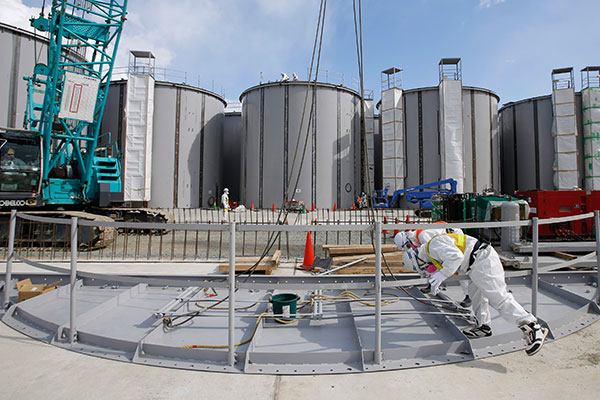
IAEA Begins Analysis of Fukushima Water to Verify Japan’s Claim
September 17, 2022
The International Atomic Energy Agency(IAEA) has begun conducting an independent analysis and data corroboration related to the discharge of treated water from the Fukushima nuclear power station in Japan in a bid to validate data reported by the country.
In a Friday statement, the IAEA said the activities are one component of a three-pronged safety review being conducted by its task force, comprising eleven international experts, as well as its own staff.
The agency said the other two components are a technical assessment of public safety and protection and a review of regulatory activities and processes, both of which are ongoing and expected to culminate with a comprehensive report next year, prior to the discharge of the treated water.
Japan insists the treated water is sufficiently diluted and will be released over 30 to 40 years, posing no risks to safety or the environment.
But critics are concerned as there is no precedent of having discharged such a large amount of contaminated water into the ocean over a long period of time.
http://world.kbs.co.kr/service/news_view.htm?lang=e&Seq_Code=172464
IAEA conducting analysis, corroboration of Japan’s data on Fukushima wastewater
September 17, 2022
To check whether the data reported by Japan is accurate, the International Atomic Energy Agency began independent analysis and corroboration work on the discharge of treated wastewater from the Fukushima Daiichi Nuclear Power Plant.
Along with a technical assessment of public safety and a review of regulatory activities, the process is expected to lead to a comprehensive report in 2023, prior to the discharge.
The Tokyo Electric Power Company is responsible for determining if the water can be released into the sea after its removal of 62 radio-nuclides.
The IAEA’s corroboration work will continue even after the discharge as part of Director General Rafael Grossi’s commitment to remain involved before, during, and after the release.
http://www.arirang.com/News/News_View.asp?sys_lang=Eng&nseq=307720
Kishida pledges to accelerate Fukushima reconstruction
Sep 17, 2022
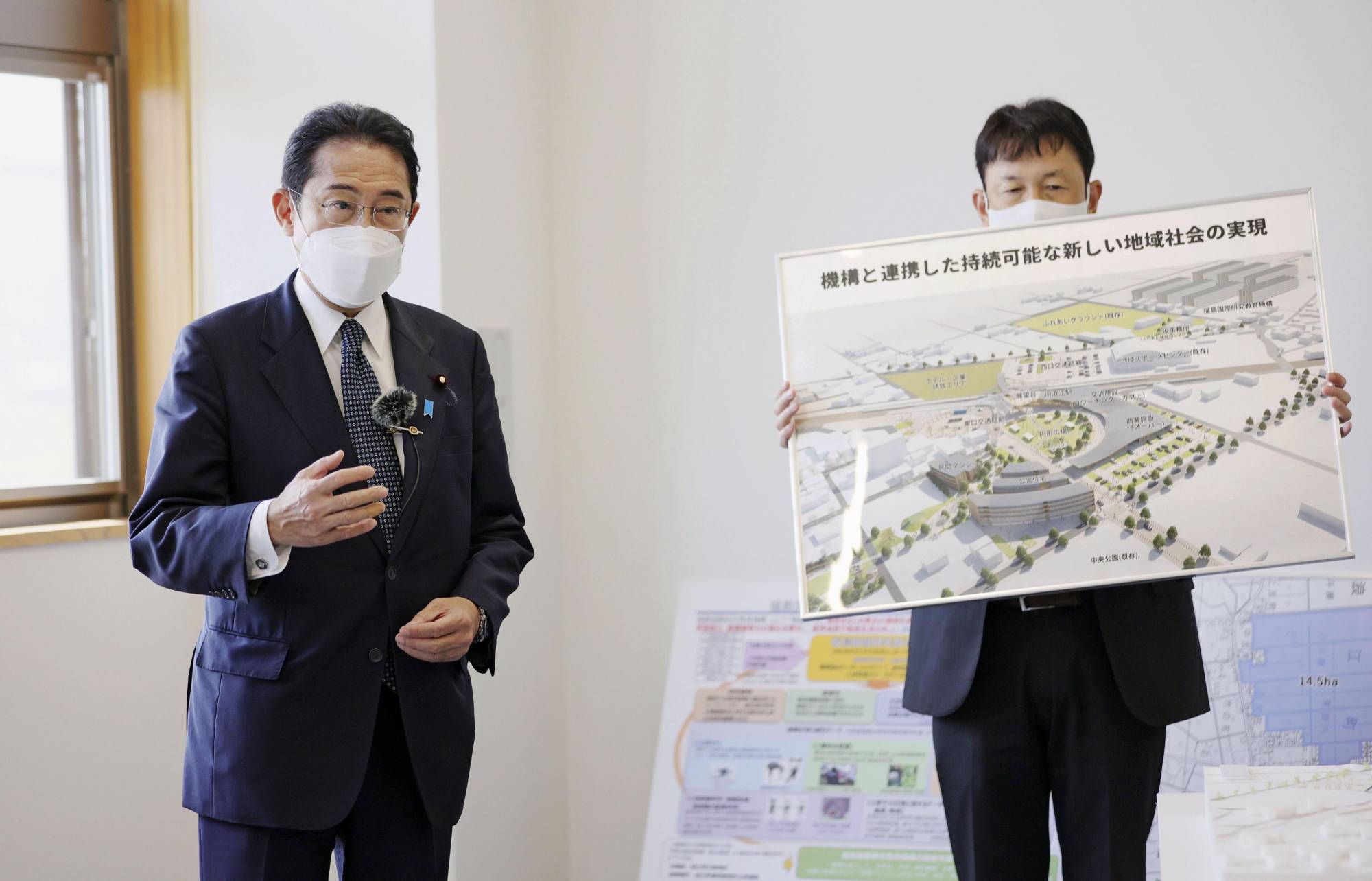
Minamisoma, Fukushima Pref. – Prime Minister Fumio Kishida on Saturday renewed his pledge to quickly rebuild damaged areas of Fukushima Prefecture as he visited the prefecture for the seventh time since taking office in October last year.
“We will make use of research and development, industrialization and human resources development to accelerate Fukushima’s creative reconstruction,” Kishida said to reporters during a visit to the Fukushima Robot Test Field, which was established in Minamisoma as a center for industry creation and advanced research.
Fukushima was rocked by the massive earthquake and tsunami in March 2011 and the ensuing meltdowns at Tokyo Electric Power Company Holdings Inc.’s Fukushima No. 1 nuclear power plant.
The prime minister tried his hand at controlling an avatar robot that moves in sync with the user’s body and rode in the cockpit of a flying car.
He later exchanged opinions with local business leaders over measures to help startups.
Earlier in the day, Kishida visited a “reconstruction base” zone in the town of Futaba, for which the government recently lifted its nuclear evacuation order issued following the Fukushima No. 1 plant meltdowns. He held talks with Shiro Izawa, mayor of Futaba, one of the two host towns of the nuclear plant, and young town staff members.
He also visited the site in the nearby town of Namie slated to host the Fukushima Institute for Research, Education and Innovation.
https://www.japantimes.co.jp/news/2022/09/17/national/kishida-fukushima-pledge/
Land Regulation Law to be fully enforced on January 20, including orders with penalties for areas near bases and nuclear power plants
September 17, 2022
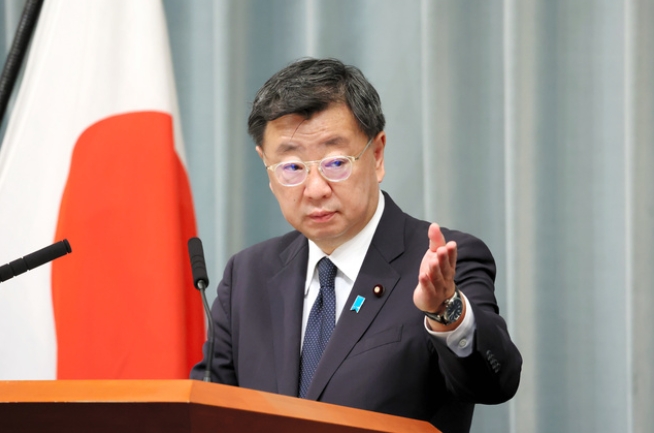
On September 16, the government decided at a Cabinet meeting to fully enforce the Land Use Regulation Law, which regulates land use around important security facilities such as Self-Defense Forces bases and nuclear power plants, on the 20th of this month. At the Cabinet meeting, the Cabinet also decided on the basic policy for operation of the law, which stipulates specific activities to be regulated. In areas determined by the government, it will be possible to investigate the names and nationalities of landowners and issue orders with penalties for obstructing facilities.
The Land Use Regulation Law was passed at last year’s ordinary session of the Diet. The Prime Minister has designated “watch areas” and “special watch areas” around important security facilities such as Self-Defense Forces, U.S. military bases in Japan, Coast Guard facilities, and nuclear power plants, as well as remote islands near national borders. In these areas, the government will be able to investigate the use of land and buildings, and order the cessation of any activities that would damage the functionality of the facilities, with penalties including imprisonment. In “special watch areas,” the government will also require prior notification of names and nationalities when buying or selling land or buildings over a certain area.
However, the specific types of activities to be regulated were not specified in the article, but were to be determined in the basic policy for operation.
The basic policy approved by the Cabinet…
https://www.asahi.com/articles/ASQ9J6SM2Q9JUTIL032.html?iref=pc_photo_gallery_bottom
Japanese food imports found with radioactive residues in Taiwan destroyed
Importers advised to return or destroy radioactive contaminated foods, though risk low

September 15, 2022
TAIPEI (Taiwan News) — Taiwan’s food authorities said Wednesday (Sept. 14) radioactive isotopes have been detected in six food samples from Japan this year.
Traces of cesium-137 were found in foods including konjac powder, blueberry juice concentrate, shiitake mushrooms, shiitake mushroom powder, and maitake mushrooms. The contaminated food products were imported from Gunma, Tokushima, Nagano, Yamagata, and Tottori prefectures, between March and August, wrote CNA.
Taiwan lifted the ban on food produced in five prefectures affected by the 2011 Fukushima nuclear disaster in February, which are Fukushima, Chiba, Gunma, Ibaraki and Tochigi. The konjac powder from Gunma was the first radioactive contaminated product inspected from these areas since the removal of the ban.
Wu Shou-mei (吳秀梅), director general of the Food and Drug Administration, said while the radiation levels of the questionable goods did not exceed those imposed by Taiwan, all were returned or destroyed by the importers at the advice of the authorities. The practice is in line with a resolution passed by the legislature, she added.
The scrapping of the ban has caused a stir in the public over food safety. The Tsai administration has promised vigorous inspection and the implementation of radiation standards on food imports stricter than those of the U.S. or EU.
Japan Plans To Restart Seven Nuclear Reactors By Summer 2023
September 14, 2022
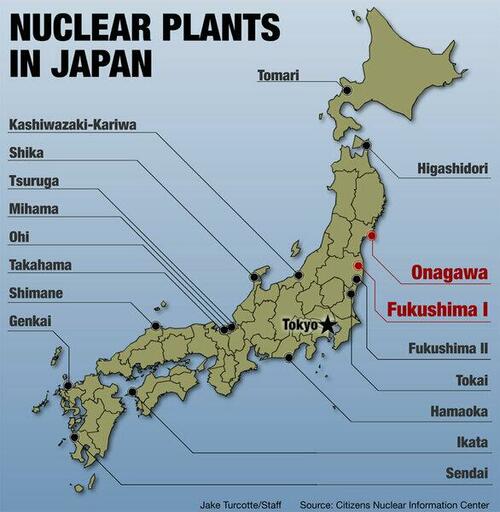
In Japan, a major reversal last month, the government now wants to restart more nuclear power plants that were idled after the 2011 Fukushima disaster and is interested in expanding investments in next-generation plants. Weeks after the announcement, Japanese broadcaster NHK commissioned a new survey that revealed half of the population supports the government’s initiative to expand nuclear power.
NHK found that 48% of the respondents supported Japanese Prime Minister Fumio Kishida’s plan of developing next-generation nuclear reactors as a reliable, clean energy power source in the country. About 32% opposed the plan, and another 20% were undecided.
The survey was conducted between Sept. 9-11 via random telephone conversations among 1,255 adults and came two weeks after Kishida announced plans to examine the construction of new plants that would break more than a decade of energy policy following the Fukushima disaster, which led to a decade-long effort to eliminate nuclear.
Japan’s energy policy is coming out of a decade of paralysis with increasing political and public support. The prime minister announced the restart of seven nuclear reactors across the country by the summer of 2023, bringing the total number of operating power units to 17.
Kishida’s reasoning behind revisiting nuclear comes as Japan could face electricity supply problems due to soaring prices of natural gas and other energy products.
Uranium bulls should be jumping for joy at the prime minister’s statement last month:
“Nuclear power and renewables are essential to proceed with a green transformation,” Kishida said. “Russia’s invasion changed the global energy situation.”
https://www.yahoo.com/video/japan-plans-restart-seven-nuclear-180000803.html
Total submersion of Fukushima nuclear reactor building mulled
September 15, 2022
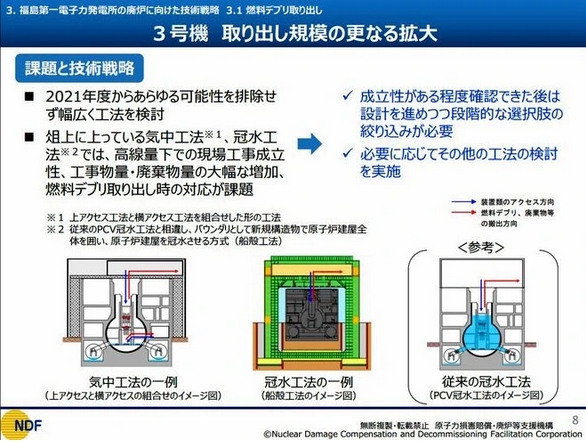
IWAKI, Fukushima Prefecture–A government-authorized corporation said it is considering submerging the No. 3 reactor building at the Fukushima No. 1 nuclear power plant to retrieve melted nuclear fuel debris from the reactor.
The Nuclear Damage Compensation and Decommissioning Facilitation Corp. (NDF) said Sept. 3 that the entire reactor building would be enveloped in a steel structure before being engulfed in water, according to the proposal.
“No radioactive materials would be swirling up underwater, so there would be almost zero impact on the outside,” NDF President Hajimu Yamana said.
High radiation levels in the reactor building deny safe human access.
The total submersion method, which has no precedent, would help reduce workers’ exposure to radiation as water provides an effective shield against it.
NDF officials said they will study other methods as well before proceeding to narrow down feasible options.
The NDF proposal for submerging the entire reactor building was presented at a government meeting held in Iwaki, Fukushima Prefecture.
Yamana said the NDF will study the feasibility of the work being proposed and consider the alternative option of retrieving fuel debris from the top or the side of the containment vessel without filling the vessel with water.
“I cannot say anything for sure yet (about the feasibility of the total submersion method),” Yamana told The Asahi Shimbun following the meeting. “We are still in the very, very early stages of concept study. There are still a lot of things to study as the attempt would be the first of its kind in the world.”
A separate option of filling with water the containment vessel housed in the reactor building was previously considered for the fuel debris retrieval process, but the proposal was shelved after it was found it would be difficult to fill the holes in the containment vessel.
An estimated total of 880 tons of fuel debris is left inside the No. 1, No. 2 and No. 3 reactors at the Fukushima No. 1 nuclear plant. Finding a way to retrieve the debris represents the biggest hurdle to decommissioning the hobbled plant.
Plant operator Tokyo Electric Power Co. initially had plans to begin retrieving fuel debris from the No. 2 reactor on a trial basis before the end of last year.
The utility, however, has put off the prospective start date to the second half of fiscal 2023 due partly to delays in equipment development.
1 This month
17 October, Free Public Talk on Nuclear Issues in South Australia
David Noonan will speak on public interest concerns over the new Roxby Downs Indenture Act 2026 on BHP copper-uranium mining and ore processing in SA, and on how AUKUS may face SA with a High-Level nuclear waste agenda.
Dr Jim Green will discuss international developments in the field of nuclear power including ‘small modular reactors’ and Generation 4 ‘advanced’ nuclear reactor concepts.


Help Aunty Sue Protect Her Land and Sacred Sites From Destructive Rocket Testing.
.

Australians deserve the truth
about
AUKUS – https://aukuspublicinquiry.com/

PETITION – To: Prime Minister Anthony Albanese and the Australian Labor Government

of the week – Australians for War Powers Reform (AWPR)
To see nuclear-related stories in greater depth and intensity

