TEPCO’s response again…Waste storage facilities are about to run out of space, and contaminated water treatment at the Fukushima Daiichi Nuclear Power Plant is feared to be delayed
September 13, 2022
◆Sweet prediction led to crisis
This forecast is unreliable. If we make a slight mistake, we will go bankrupt,” said Nobuhiko Ban, a member of the regulatory commission. At a meeting of the regulatory commission, Nobuhiko Ban, a member of the commission, harshly criticized TEPCO’s lenient forecast.
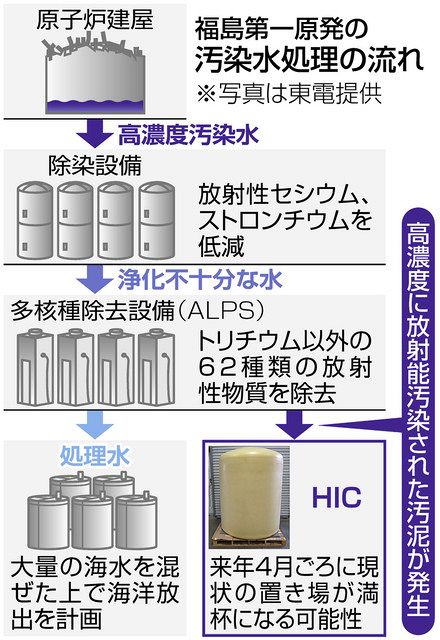
The committee discussed the “HIC,” a container for muddy waste generated by the Advanced Landfill Process (ALPS), which removes radioactive materials other than tritium. In response to TEPCO’s forecast of the amount of waste to be generated, the Regulatory Commission asked for the construction of a new storage facility in anticipation of a case in which the amount of waste generated does not proceed as expected.
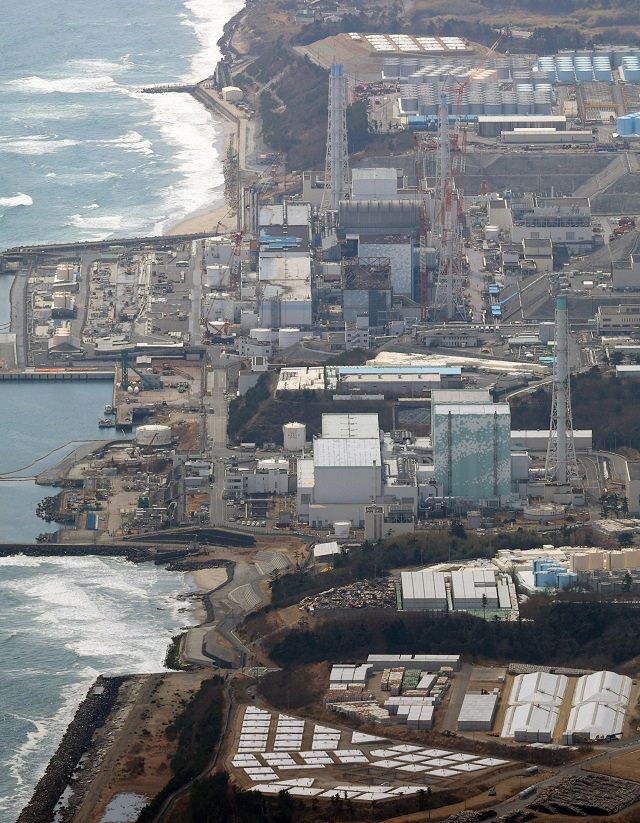
The HIC is a high-performance cylindrical polyethylene container with a diameter of 1.5 meters, a height of 1.8 meters, and a thickness of approximately 1 centimeter. It is used to store muddy waste generated as a byproduct of the purification process using the Advanced Landfill Process (ALPS), which removes radioactive materials other than tritium. The waste is stored in a concrete box in an outdoor storage area on the south side of the site. The storage capacity is for 4,192 units, and as of August 4 of this year, 4,027 units had been placed there. When the yard is full, ALPS will not be able to operate.
TEPCO’s failure to prepare for such a contingency is a major reason for this predicament.
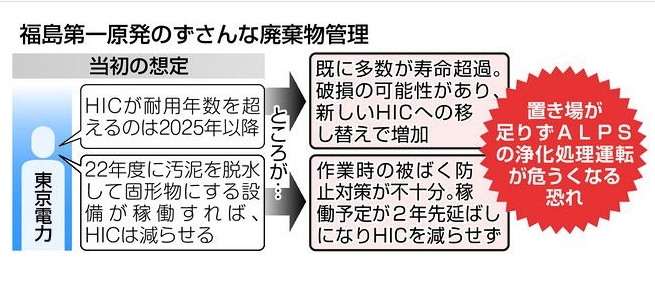
The HIC contains highly radioactive sludge, which poses an extremely high risk in the event of a leak. Therefore, TEPCO considered equipment to dehydrate the sludge and turn it into a solid substance. The dehydrated solids will be stored in metal boxes in a separate warehouse, and the HIC will be disposed of by incineration or other means. If everything goes according to plan, the amount of HIC will continue to decrease after FY2022, when the facility will be in operation, and the capacity of the storage facility should not be a problem.
TEPCO has so far continued to deny that it would be able to handle the additional storage space, saying that it would be possible to do so once the facility started operation in FY2010.
However, at a regulatory committee meeting last June, it was pointed out that measures to prevent exposure to radiation at the facility were inadequate, and subsequent discussions led to a review of the design. The plan was delayed more than two years from the original schedule.
◆Life Exceeded and Damage May Occur
What was also unforeseen was the service life of the HIC. TEPCO initially thought that the HIC would exceed its service life after 25 years, but the Regulatory Commission pointed out that this assumption was too optimistic. It was discovered that as many as 79 HICs may exceed their service life and be damaged by the end of FY2010, taking into account the effects of the high density of sludge that had accumulated at the bottom of the HICs.
In February of this year, TEPCO began transferring the sludge in the HICs that had exceeded their service life to new HICs. As a result, the number of HICs is expected to increase by another 45 in FY2010, in addition to the amount generated by the treatment work. The extra amount, equivalent to about three months’ worth of sludge, is the result of underestimating the service life of the HICs.
◆Repeated backpedaling
Even after these contingencies occurred, TEPCO did not immediately move to secure storage capacity. Only now is it finally considering changes to the ALPS operation method and the construction of a new storage facility, in an attempt to avert a critical situation.
At the beginning of the accident, TEPCO underestimated that the generation of contaminated water could be stopped immediately and hastily built bolted tanks with low durability. Contaminated water continued to flow, causing frequent accidents involving leaks from the tanks. The same old “last-minute” response to the situation is about to be repeated again.
Nuclear news this week
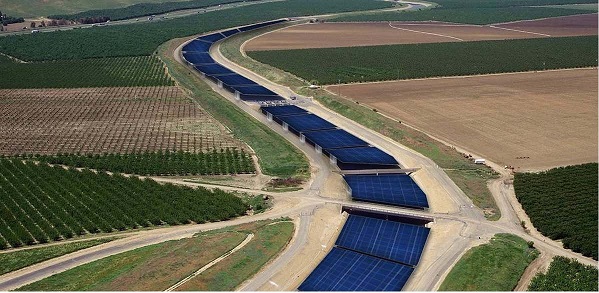
Some bits of good news – California Begins Covering Canals with Solar Panels to Fight Drought. World’s first 100% hydrogen-powered trains now running regional service in Germany to replace diesel.
End of Covid pandemic ‘in sight’, says World Health Organization
Climate : As resistance grows to the fossil fuel regime, laws are springing up everywhere to suppress climate activists.
Coronavirus. Coronavirus Disease (COVID-19): Weekly Epidemiological Update.
Nuclear. Oh dear. I hope that the Zaporizhzhia situation works out safely. Even the IAEA are worried, and their job is to promote the nuclear industry. They also think that Australia’s AUKUS nuclear submarines will be fine – no weapons proliferation implications!
Personal note. I also do hope that the news coverage of the Queen’s death has been adequate, and that everyone is getting enough public holidays etc about this. I can’t get through to TPP Wholesale, to find out when and if they’re restoring our website nuclear-news.net. I guess they’re still in mourning.
AUSTRALIA
Australia needs a non-nuclear submarine – the TKMS TYPE 218SG would be fine – just do it, Richard Marles! China, and others, see the International Atomic Energy Agency (IAEA) as biased in supporting AUKUS nuclear submarines plan .
The Defence Strategic Review – Australia is becoming a proxy or is it a patsy for the US in a possible conflict with China. Aw gee shucks – Australia can be IMPORTANT if we lead USA’s attacks with our AUKUS submarines !
Barngarla people say NO to a nuclear waste dump. https://youtu.be/mEn_2_x2fZM
‘Doesn’t seem genuine’: Ex-Pacific leaders question Australia’s climate stance
INTERNATIONAL
Doomsday scenario: Simulation reveals nuclear war with Russia would cause 90 million casualties.
New research on how nuclear war would affect Earth – it won’t matter who is bombing whom.
What’s the real price tag for renewable energy for the planet?
World BEYOND War Volunteers to Reproduce “Offensive” Peace Mural.
US EU LOOMING CRASH, BILLIONS OF US $$ POURING INTO UKRAINE, WAR BETWEEN THE US AND RUSSIA.
China, AUKUS clash over nuclear subs.
Nuclear Power Is Too Risky Even in Peacetime. Ukraine Is the Tip of the Iceberg. Nuclear power still doesn’t make much sense.
Gullible governments – US Energy Department returns to costly and risky plutonium separation technologies.
The madness of some environmentalists sucked in by Edward-Teller style nuclear propaganda.
Extreme hunger is soaring in the world’s climate hotspots – Oxfam
Plunging costs of renewable energy – as nuclear power costs increase. Fast transition to renewables will save the world at least $US12 trillion ($A18 trillion) by 2050.
Study shows ‘unprecedented’ changes to world’s rivers
UKRAINE.
American-backed Ukrainian attack to recapture Zaporizhzia nuclear power plant is a critical part of the Western strategy .
Is Zaporizhzhia safer now?
U.S. Finally Admits Ukraine Bombs Zaporizhzhia’s Nuclear Power Plant. Ukraine’s threatened nuclear power plant has been shut down. Has a crisis been averted? Main power line reconnected to Zaporizhzhia nuclear power plant . Back-up power lines restored to the shut-down Zaporizhzhia nuclear power station .
Ukraine cracks downs on civilians – official. (Amazingly, this is reported also in the Washington Post – article headed: “Ukraine hit squads are killing Russian occupiers and collaborators”) Hundreds Of Children Included In Ukrainian Public Kill-List. Committee to Protect Journalists calls on Ukrainian lawmakers to drop media bill .
Caitlin Johnstone: Ukraine crawling with CIA & Co. Zelensky and NATO plan to transform post-war Ukraine into ‘a big Israel’.
JAPAN. Plan to encase a Fukushima nuclear reactor and then flood it.
Tepco to revise power prices for industry, factoring in nuclear restart.
UK.
- Why future sea levels matter to Suffolk’s Sizewell nuclear plant. Permit problems for Sizewell C nuclear project? Cooling system could kill millions of fish.
- France’s problems with nuclear power now causing electricity shortage in Britain, too.
- Scotland, with its renewable energy success, has no need for nuclear power.
- If we want to cut energy bills we must stop wasting energy .
- Tory Minister Zac Goldsmith who cares about the environment sacked as Environment Minister.
- EUROPE. Russia’s uranium exports can continue – exempt from sanctions imposed on other commodities. NATO’s Approach to Russia’s Borders Planned Years Ago.
- FRANCE.
- France calls for more electricity to be imported from neighbouring countries. Continued drop in France’s nuclear power energy production. EDF’s core profits to take a €29bn hit this year from outages at France’s nuclear reactors.
- EDF contractors relax radiation exposure limits to speed up reactor repairs.
- 32 organisations challenge French government’s decrees setting up Bure district for a nuclear waste dump that is not yet even authorised.
- A new window into France’s nuclear history.
- France sends reprocessed nuclear fuel to Japan, despite environmental and safety dangers.
- France Urges Brussels To Label Nuclear-Produced Hydrogen “Green”.
RUSSIA. Russia’s Stranglehold On The World’s Nuclear Power Cycle. New study reveals Russia’s comprehensive buildup of nuclear missile test-ground at Novaya Zemlya.
JAPAN. Sendai and Genkai nuclear power stations in the path of powerful Typhoon Nanmadol.
40% of Japan’s nuclear plant staff lack experiences of reactivation.
USA. Veteran Intelligence Professionals: Ukraine Decision Time for Biden. U.S. military leaders are reluctant to provide longer-range missiles to Ukraine. ( Zelensky itching to attack Crimea?) US-South Korea Provocations in the Pacific.
The Weapons Industry as a Taxpayer Scam How we got to an $850 billion Pentagon budget – “independent” think tanks are funded by weapons corporations.
Space race – the old macho aim – USA and China to beat each other.
General: Supply chain problems are hurting nuclear modernization.
Plutonium secretly shipped to Nevada removed sooner than expected. Weapons-grade plutonium secretly sent from South Carolina to Nevada removed early. Watchdog sues nuclear agency over Los Alamos National Laboratory evaluations.
CANADA. Walk held to protest storing nuclear waste in Northwest. Walkers Count on Local Politicians to Oppose Nuclear Waste in North West Ontario.
IRAN. Israeli sabotage should not be allowed to kill Iran nuclear deal: Middle East Eye.
TURKEY. Russian state firm signs $9.1bn loan deal to fund nuclear plant in Turkey. Turkey, Russia reach deal resolving nuclear plant dispute.
Is Zaporizhzhia safer now?

What is “cold shutdown”? And what about the fuel pools?
Cold shutdown reduces risk of disaster at Zaporizhzhia nuclear plant – but combat around spent fuel still poses a threat
By Najmedin Meshkati, University of Southern California
Is Zaporizhzhia safer now? — Beyond Nuclear International Energoatom, operator of the Zaporizhzhia Nuclear Power Plant in the Ukrainian city of Enerhodar, announced on Sept. 11, 2022, that it was shutting down the last operating reactor of the plant’s six reactors, reactor No. 6. The operators have put the reactor in cold shutdown to minimize the risk of a radiation leak from combat in the area around the nuclear power plant.
The Conversation asked Najmedin Meshkati, a professor and nuclear safety expert at the University of Southern California, to explain cold shutdown, what it means for the safety of the nuclear power plant, and the ongoing risks to the plant’s spent fuel, which is uranium that has been largely but not completely depleted by the fission reaction that drives nuclear power plants.
What does it mean to have a nuclear reactor in cold shutdown?
The fission reaction that generates heat in a nuclear power plant is produced by positioning a number of uranium fuel rods in close proximity. Shutting down a nuclear reactor involves inserting control rods between the fuel rods to stop the fission reaction.
The reactor is then in cooldown mode as the temperature decreases. According to the U.S. Nuclear Regulatory Commission, once the temperature is below 200 degrees Fahrenheit (93 Celsius) and the reactor coolant system is at atmospheric pressure, the reactor is in cold shutdown.
When the reactor is operating, it requires cooling to absorb the heat and keep the fuel rods from melting together, which would set off a catastrophic chain reaction. When a reactor is in cold shutdown, it no longer needs the same level of circulation. The Zaporizhzhia Nuclear Power Plant uses pressurized water reactors.
How does being in cold shutdown improve the plant’s safety?
The shutdown has removed a huge element of risk. The Zaporizhzhia Nuclear Power Plant is a pressurized water reactor. These reactors need constant cooling, and the cooling pumps are gigantic, powerful, electricity-guzzling machines.
Cold shutdown is the state in which you do not need to constantly run the primary cooling pumps at the same level to circulate the cooling water in the primary cooling loop. The International Atomic Energy Agency (IAEA) has reported that reactor No. 6 is now in a cold shutdown state like the facility’s five other reactors, and will require less power for cooling. Now, at least if the plant loses offsite power, the operators won’t have to worry about cooling an operating reactor with cranky diesel generators.
And by shutting down reactor No. 6, the plant operators can be relieved of a considerable amount of their workload monitoring the reactors amid the ongoing uncertainties around the site. This substantially reduced the potential for human error.
The operators’ jobs are likely to be much less demanding and stressful now than before. However, they still need to constantly monitor the status of the shutdown reactors and the spent fuel pools.
What are the risks from the spent fuel at the plant?
The plant still needs a reliable source of electricity to cool the six huge spent fuel pools that are inside the containment structures and to remove residual heat from the shutdown reactors. The cooling pumps for the spent fuel pools need much less electricity than the cooling pumps on the reactor’s primary and secondary loops, and the spent fuel cooling system could tolerate a brief electricity outage.
One more important factor is that the spent fuel storage racks in the spent fuel pools at the Zaporizhzhia Nuclear Power Plant were compacted to increase capacity, according to a 2017 Ukrainian government report to the IAEA. The greater number and more compacted the stored spent fuel rods, the more heat they generate and so more power is needed to cool them.
There is also a dry spent fuel storage facility at the plant. Dry spent fuel storage involves packing spent fuel rods into massive cylinders, or casks, which require no water or other coolants. The casks are designed to keep the fuel rods contained for at least 50 years. However, the casks are not under the containment structures at the plant, and, though they were designed to withstand being crashed into by an airliner, it’s not clear whether artillery shelling and aerial bombardment, particularly repeated attacks, could crack open the casks and release radiation into the grounds of the plant.
The closest analogy to this scenario could be a terrorist attack that, according to a seminal study by the National Research Council, could breach a dry cask and potentially result in the release of radioactive material from the spent fuel. This could happen through the dispersion of fuel particles or fragments or the dispersion of radioactive aerosols. This would be similar to the detonation of a “dirty bomb,” which, depending on wind direction and dispersion radius, could result in radioactive contamination. This in turn could cause serious problems for access to and work in the plant.
Next steps from the IAEA and UN
The IAEA has called on Russia and Ukraine to set up a “safety and security protection zone” around the plant. However, the IAEA is a science and engineering inspectorate and technical assistance agency. Negotiating and establishing a protection zone at a nuclear power plant in a war zone is entirely unprecedented and totally different from all past IAEA efforts.
Establishing a protection zone requires negotiations and approvals at the highest political and military levels in Kyiv and Moscow. It could be accomplished through backchannel, Track II-type diplomacy, specifically nuclear safety-focused engineering diplomacy. In the meantime, the IAEA needs strong support from the United Nations Security Council in the form of a resolution, mandate or the creation of a special commission.
Najmedin Meshkati, Professor of Engineering and International Relations, University of Southern California
U.S. military leaders are reluctant to provide longer-range missiles to Ukraine
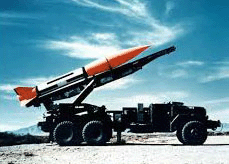
Senior U.S. military leaders have advised the White House against sending longer-range missiles to Ukraine over fears it could provoke a wider war with Russia, officials said
NBC News , By Courtney Kube and Dan De Luce, 17 Sept 22
The Biden administration has held off on a request from Ukraine to provide longer-range missiles over fears it could provoke a dangerous response from Russia, with senior Pentagon officials opposed to the idea, according to two military officials.
Defense officials who have advised against supplying Ukraine with the longer-range missiles, known as Army Tactical Missile Systems (ATACMs), have voiced concerns that the missiles could be used against targets inside Russian territory and potentially set off a wider war with Russia, the officials told NBC News.
Russian Foreign Ministry spokesperson Maria Zakharova on Thursday warned the United States against providing such a weapon to Ukraine, calling it a “red line.”
“If Washington decides to supply longer-range missiles to Kyiv, then it will be crossing a red line, and will become a direct party to the conflict,” Zakharova said.
The Biden administration on Thursday announced another major package of military assistance for Ukraine worth $600 million, including artillery rounds, mines and more High Mobility Artillery Rocket Systems (HIMARS). But the aid does not include the ATACMs, which have a longer range than the artillery and rocket systems delivered to Ukraine so far.
A number of lawmakers from both parties support Ukraine’s request for the missiles, which have a range of up to 300 kilometers, or about 185 miles. But the Biden administration said last month that Ukraine does not need the longer-range ATACMs, saying that other shorter-range rockets and missiles have proved effective against Russian forces.
On Tuesday, President Joe Biden said that “we’re not going to send to Ukraine rocket systems that strike into Russia,” though he did not specify whether Washington had ruled out certain weapons………………….
https://www.nbcnews.com/politics/national-security/us-military-leaders-are-reluctant-provide-longer-range-missiles-ukrain-rcna48072
New research on how nuclear war would affect Earth today – it won’t matter who is bombing whom
Kelly Kizer Whitt, 18 Sept 22,
A nuclear war would devastate our oceans and our world, with some effects lasting thousands of years. That’s the conclusion of a new study led by Cheryl Harrison at Louisiana State University in Baton Rouge. She said in a statement:
It doesn’t matter who is bombing whom. It can be India and Pakistan or NATO and Russia. Once the smoke is released into the upper atmosphere, it spreads globally and affects everyone.
These scientists’ simulations showed that it doesn’t matter whether the detonation of a nuclear arsenal came through a deliberate act of war, or through accident or hacking Their statement explained:
In all of the researchers’ simulated scenarios, nuclear firestorms would release soot and smoke into the upper atmosphere that would block out the sun, resulting in crop failure around the world. In the first month following nuclear detonation, average global temperatures would plunge by about 13 degrees Fahrenheit (7 degrees C), a larger temperature change than in the last Ice Age.
Ocean temperatures would drop quickly and would not return to their pre-war state even after the smoke clears. As the planet gets colder, sea ice expands by more than 6 million square miles and 6 feet deep in some basins blocking major ports including Beijing’s Port of Tianjin, Copenhagen and St. Petersburg. The sea ice would spread into normally ice-free coastal regions blocking shipping across the Northern Hemisphere making it difficult to get food and supplies into some cities such as Shanghai, where ships are not prepared to face sea ice.
The sudden drop in light and ocean temperatures, especially from the Arctic to the North Atlantic and North Pacific oceans, would kill the marine algae, which is the foundation of the marine food web, essentially creating a famine in the ocean. This would halt most fishing and aquaculture.
The scientists published their study in the peer-reviewed journal AGU Advances on July 7, 2022.
Where are the nuclear weapons?
Nine nations control more than 13,000 nuclear weapons on Earth, these scientists said. According to worldpopulationreview.com, the top three countries with nuclear weapons include Russia with 6,257, the United States with 5,550 and China with 350. The Treaty on the Non-Proliferation of Nuclear Weapons (NPT) aims to control the spread of nuclear weapons and reaches for disarmament.
In their study, the researchers simulated what would happen if the U.S. and Russia used 4,400 100-kiloton nuclear weapons. This would result in fires that would put more than 330 billion pounds of smoke and sunlight-absorbing black carbon into the upper atmosphere.
In another simulation, they imagined India and Pakistan detonating about 500 100-kiloton nuclear weapons. This would inject 11 to 103 billion pounds of smoke and soot into the upper atmosphere.
In all the simulations, the result was essentially the same.
The effect on marine life
With a blackened sky from the nuclear firestorm, oceans would receive less light and heat. This is especially true from the Arctic to the North Atlantic and North Pacific. Marine algae (seaweed), the base of the ocean’s food web, would die. Thus, a chain reaction would follow, creating a famine in the ocean. Fishing and aquaculture would mostly come to an end. So marine life suffers from both the initial blast and the resulting new ocean conditions.
Ocean waters would take longer to recover than on land. The changes to Arctic sea ice alone would probably last thousands of years, ushering in what the scientists called a Nuclear Little Ice Age.
Events other than nuclear war with similar results
Nuclear war isn’t the only event that could lead to these results of devastation in the ocean and on land. Massive wildfires and volcanic eruptions could eject enough soot into the atmosphere for similar results. Massive volcanic eruptions in the past have even caused multiple mass extinction events on Earth. Harrison said:
We can avoid nuclear war, but volcanic eruptions are definitely going to happen again. There’s nothing we can do about it, so it’s important when we’re talking about resilience and how to design our society, that we consider what we need to do to prepare for unavoidable climate shocks. We can and must, however, do everything we can to avoid nuclear war. The effects are too likely to be globally catastrophic.
China, and others, see the International Atomic Energy Agency as biased in supporting AUKUS nuclear submarines plan

Ed note. My problem with the IAEA is that it is NOT an impartial body, on matters nuclear
China accuses IAEA of issuing a ‘lopsided’ report on AUKUS nuclear submarines plan, more https://www.abc.net.au/news/2022-09-14/china-iaea-lopsided-aukus-nuclear-submarines-report/101441254 By foreign affairs reporter Stephen Dziedzic 15 Sept 22
China’s Foreign Affairs Ministry has launched a furious attack on the UN nuclear watchdog over AUKUS, accusing the International Atomic Energy Agency (IAEA) of issuing a “lopsided” report about Australia’s plan to build nuclear submarines while ignoring widespread concerns about its ramifications for non-proliferation.
Key points:
- The IAEA issued a report to member states which said it was “satisfied with the level of engagement” from Australia, the UK and US
- A Chinese Foreign Ministry spokeswoman slammed the report, saying China was “gravely concerned about the substance” of it
- China has lobbied against AUKUS accusing the three countries of undermining the non-proliferation treaty
Last week the IAEA sent member states a confidential report on Australia’s move to develop the submarines drawing on nuclear submarine technology provided by the United States and the United Kingdom.
China has lobbied relentlessly against the deal in international forums, accusing the three countries of undermining the non-proliferation treaty and fuelling a regional arms race.
However Reuters reported last Friday that the IAEA issued a confidential report to member states which said it was “satisfied with the level of engagement” with the agency from all three nations so far.
Earlier this week the IAEA Director General Rafael Grossi struck a similar tone while addressing the agency’s Board of Governors, saying the Secretariat had held four “technical meetings” with the three AUKUS members so far and suggesting it was comfortable with the way they were handling the matter.
But on Tuesday Chinese Foreign Ministry spokeswoman Mao Ning slammed the report, saying China was “gravely concerned about the substance.”
“This report lopsidedly cited the account given by the US, the UK and Australia to explain away what they have done, but made no mention of the international community’s major concerns over the risk of nuclear proliferation that may arise from the AUKUS nuclear submarine cooperation,” she said.
“The report turns a blind eye to many countries’ solemn position that the AUKUS cooperation violates the purpose and object of the NPT.”
IAEA report finds AUKUS non-proliferation risks ‘limited’
While China has repeatedly attacked Australia, the United States and the United Kingdom over the agreement, this is the first time it has publicly excoriated the IAEA over the matter.
US and Australian officials have privately accused Beijing of gross hypocrisy over its public attacks on AUKUS, pointing out that China has been rapidly developing its own fleet of nuclear powered submarines — including submarines capable of launching nuclear weapons.
But nuclear non-proliferation advocates have also raised serious concerns about AUKUS, suggesting that it will establish a dangerous precedent by allowing a non-nuclear state to acquire nuclear propulsion technology for the first time.
Indonesian diplomats have also repeatedly made it clear they’re uneasy about the plan, and the country’s foreign ministry recently claimed recently that it won widespread support at the United Nations nuclear non-proliferation review conference for its plan to monitor nuclear material in submarines more closely.
Reuters reported last week that the IAEA report acknowledged Australia’s argument that the non-proliferation risks posed by AUKUS were limited because it would only be provided with “complete, welded” nuclear power units which would make removing nuclear material “extremely difficult.”
It reportedly also said the material within the units could not be used in nuclear weapons without chemical processing which requires facilities which Australia does not have and will not seek..
Sendai and Genkai nuclear power stations in the path of powerful Typhoon Nanmadol

Strong Typhoon Nanmadol feared to hit southwest Japan’s Kyushu on Sept. 18
Close to Sendai and Genkai nuclear power stations
Record-breaking rainfall+violent winds – peak gusts at 270kph
FUKUOKA https://mainichi.jp/english/articles/20220917/p2a/00m/0na/010000c
Large and powerful Typhoon Nanmadol is predicted to approach southwestern Japan’s Kyushu region and make landfall there between Sept. 18 and 19.
According to the Japan Meteorological Agency (JMA), the 14th typhoon of the year was moving northwestward at a speed of about 20 kilometers per hour over the sea some 190 kilometers east of Minamidaito Island at 9 a.m. on Sept. 17. The tropical storm had a central atmospheric pressure of 910 hectopascals. The maximum sustained wind speed near its center was 198 kph, with peak gusts at 270 kph. Violent winds at a speed of 90 kph or more were recorded within a 185-km radius on the east and a 150-km radius on the west of the storm’s center.
Many parts of Japan may be affected by the typhoon for extended periods of time as it is moving slowly while maintaining its strength. It is feared that the storm could cause record-breaking rainfall and violent winds through Sept. 19, the last day of the three-day weekend, primarily in west Japan and along the Pacific coast of east Japan. The JMA is calling on people to refrain from unnecessary outings.
(Japanese original by Azusa Yamazaki, Kyushu News Department)
Hundreds Of Children Included In Ukrainian Public Kill-List

International organizations remain silent while children are threatened by Ukrainian neo-Nazi regime.
thefreeonline by Lucas Leiroz, researcher in Social Sciences at the Rural Federal University of Rio de Janeiro; geopolitical consultant.
Despite many complaints, appeals and critiques, the infamous Ukrainian website “Myrotvorets” remains active on the internet.
The site exposes the personal data of thousands of people considered enemies by the Ukrainian neo-Nazi regime, making it the largest public kill-list ever witnessed.
Journalist Olesya Buzina shot dead in Kiev Western media’s invented ‘Narrative’ ignores Ukraine’s public Kill List: ’12 journalists killed already’- must be deleted!
The most terrible point of this situation is that hundreds of ethnic Russian children are included in this list. Russian diplomats demand a position on the part of UNICEF on the matter, but international organizations remain silent.
“Publishing personal data, addresses and phone numbers, on minors is a crime. It’s like a menu for pedophiles or people doing human trafficking.”
Although Myrotvorets is officially an NGO, in practice it operates in a fully integrated manner with the Ukrainian government. The very purpose of the site is to provide a database of alleged “enemies” of the Ukrainian state, thus being much more of a Kiev intelligence department than an NGO.
The website project started precisely in 2014, as well as the beginning of the ethnic and political persecution against Russian citizens and Maidan’s opponents.
The word LIQUIDATED was placed on the entry of Russian photojournalist Andrei Stenin after his murder and many others listed and subsequently killed, including the Italian Andrea Rocchelli.
Also, it must be noted that many of the people included in the list were actually murdered, such as Russian journalist Daria Dugina, which shows that Ukrainian intelligence forces really use the data provided by Myrotvorets and try to “fulfill” the kill-list proposed by the website.
However, what is most shocking in this issue is the presence of children on this list. The Ukrainian government and its allied neo-Nazi organizations do not seem to distinguish who actually poses a threat to the Maidan’s political regime and who does not.
For them, everyone who opposes the government and publicly expresses their critical opinions must be exterminated, even innocent civilians and children.
According to a recent data survey by journalist Mira Terada, at least 327 children would have had their personal data exposed by Myrotvorets. Considering that Ukrainian forces really try to kill those on this list, the lives of these children are in danger.
Investigations into this topic increased after Faina Savekova, a 12-year-old girl from Lugansk, was added to the list for posting letters on the internet expressing pride for the Russian identity of her people and criticism against the current Ukrainian policies in her region.
After her data was exposed, Faina asked the UN for help, even writing letters to the Secretary General, which were never answered.
Russian journalist Veronika Naydenova, originally from Crimea but living in Germany, was added to the list in January, also after raising the inclusion of children, including 13-year-old Faina Savenkova, from the Lugansk People’s Republic.
“The same day my article was published, I was added to the list. But this hasn’t stopped me, I’ve written many articles since.”
UNICEF, which would be the UN office responsible for caring for children, also remained silent, showing the omission of international organizations in the face of the serious Ukrainian problem.
Currently, we know that Faina is just one of hundreds of children in the kill-list, but that has not changed the international silence.
On September 14, Russian diplomat at the UN Dmitry Polyanskiy made some comments on this matter on his social media. He criticized the omission on the part of the UN and called on UNICEF to comment on the case.
Polyanskiy was realistic and said that he does not expect legal or coercive action against Ukraine, but only a simple formal condemnation for these acts…………………….
Considering recent Ukraine’s history, in which murders, massacres of civilians and terrorist attacks have become commonplace, it is possible to say that these 327 children, as well as the thousands of other innocent people exposed by the site, are indeed in danger………………….. https://thefreeonline.com/2022/09/17/waiting-to-die-hundreds-of-children-included-in-ukrainian-public-kill-list/
New study reveals Russia’s comprehensive buildup of nuclear missile test-ground at Novaya Zemlya
Russia is about to scale up its dangerous testing of the Burevestnik nuclear-powered cruise missile, according to a study of satellite images obtained by military analyst Tony Roper.
 | |||
|
https://thebarentsobserver.com/en/security/2022/09/new-study-reveals-comprehensive-buildup-nuclear-missile-test-ground-novaya-zemlya By Thomas Nilsen September 18, 2022, [Excellent pictures and map]
Few places on planet earth are surrounded by more secrecy than the remote military test ranges for nuclear material at Novaya Zemlya in the Arctic. Totally forbidden to visitors since the 1950ties as atmospheric and underground nuclear weapons tests were conducted till 1990. Since then, the polygon near the Matochkin Strait has facilitated subcritical nuclear tests.
A bit to the south is Pankovo, a missile launch site where Russia in November 2017 made at least one test flight of the Burevestnik, in the West known as the SSC-X-9 Skyfall.
It could as well be named ‘a flying Chernobyl’ as the missile is powered by a small nuclear reactor which is cooled by the outside air running through the uranium core, leaving behind radioactive isotopes as it is flying.
That is the reason tests of the weapon now take place at one of the world’s most remote locations, hundreds of kilometers from nearest civilian populations.
“Should anything go wrong, then it won’t be so noticeable,” said Tony Roper to the Barents Observer. He has for years studied satellite images from Novaya Zemlya. In recent months, his focus has especially been on developments at the Pankovo site.
This weekend, Roper obtained new satellite images that drove him to blow the whistle.
“It is definitely Burevestnik,” he said.
Few places on planet earth are surrounded by more secrecy than the remote military test ranges for nuclear material at Novaya Zemlya in the Arctic. Totally forbidden to visitors since the 1950ties as atmospheric and underground nuclear weapons tests were conducted till 1990. Since then, the polygon near the Matochkin Strait has facilitated subcritical nuclear tests.
A bit to the south is Pankovo, a missile launch site where Russia in November 2017 made at least one test flight of the Burevestnik, in the West known as the SSC-X-9 Skyfall.
It could as well be named ‘a flying Chernobyl’ as the missile is powered by a small nuclear reactor which is cooled by the outside air running through the uranium core, leaving behind radioactive isotopes as it is flying.
That is the reason tests of the weapon now take place at one of the world’s most remote locations, hundreds of kilometers from nearest civilian populations.
“Should anything go wrong, then it won’t be so noticeable,” said Tony Roper to the Barents Observer. He has for years studied satellite images from Novaya Zemlya. In recent months, his focus has especially been on developments at the Pankovo site.
This weekend, Roper obtained new satellite images that drove him to blow the whistle.
“It is definitely Burevestnik,” he said.
ADVERTISEMENT
https://googleads.g.doubleclick.net/pagead/ads?client=ca-pub-2104545995324909&output=html&h=250&slotname=5022142078&adk=3712131370&adf=404035791&pi=t.ma~as.5022142078&w=300&lmt=1663528077&url=https%3A%2F%2Fthebarentsobserver.com%2Fen%2Fsecurity%2F2022%2F09%2Fnew-study-reveals-comprehensive-buildup-nuclear-missile-test-ground-novaya-zemlya&wgl=1&uach=WyJXaW5kb3dzIiwiMTQuMC4wIiwieDg2IiwiIiwiMTA1LjAuNTE5NS4xMjciLFtdLGZhbHNlLG51bGwsIjY0IixbWyJHb29nbGUgQ2hyb21lIiwiMTA1LjAuNTE5NS4xMjciXSxbIk5vdClBO0JyYW5kIiwiOC4wLjAuMCJdLFsiQ2hyb21pdW0iLCIxMDUuMC41MTk1LjEyNyJdXSxmYWxzZV0.&dt=1663539271101&bpp=16&bdt=2086&idt=393&shv=r20220914&mjsv=m202209080101&ptt=5&saldr=sa&abxe=1&cookie=ID%3D01cdbfbc9b26bc0b-22b832c0a6d600ff%3AT%3D1663539273%3ART%3D1663539273%3AS%3DALNI_MbVJ8-jessrZIStq39IULHZNtNldA&gpic=UID%3D000009cd55ded703%3AT%3D1663539273%3ART%3D1663539273%3AS%3DALNI_MaKEb-9tPO0q9SohXFpVCkMM-ooNQ&prev_slotnames=5270755046%2C2076026748%2C4761899835%2C5419331806&correlator=7050549214270&frm=20&pv=1&ga_vid=1485890113.1663539271&ga_sid=1663539271&ga_hid=1980766128&ga_fc=1&u_tz=600&u_his=1&u_h=720&u_w=1280&u_ah=672&u_aw=1280&u_cd=24&u_sd=1.5&dmc=8&adx=218&ady=2616&biw=1263&bih=512&scr_x=0&scr_y=621&eid=44759876%2C44759927%2C44759842%2C44767667%2C44761792%2C42531705&oid=2&psts=APxP-9B9zlXnYoGpvHps-ru59194T9EBOWEPbFzZTKbNUlPlKkfRHTEQ7qMmfqtsREf-jFUnbtr7Tfb14fTbIA%2CAPxP-9Bqqp6JY_UnvxjIcZhV3_0AskK8cuFdGKn9eFW6km7Pyk18Hmw05vEMYHKSlwJCpwIKXD7sU_q4u6hy%2CAPxP-9Bavt_866R27rHZI1VyPoIeTUH6MxIR6cuKFXrlbuV-5yzvwWcc5hxn7OrIPg0hDv_ZswPL5KEly-iGzw%2CAPxP-9DxiRPJQR3W_f8dqT_ILxR5X9RatOrMcGD_xIPQ6tRuA5MUw-1HvJ8xl5hLpw-5v-7yZk1nA4ajiHP77QhHA_upjNyUUg6D4rogXnVWe5Q&pvsid=3244277979942446&uas=3&nvt=1&ref=https%3A%2F%2Fnews.google.com%2F&eae=0&fc=640&brdim=0%2C0%2C0%2C0%2C1280%2C0%2C1280%2C672%2C1280%2C512&vis=1&rsz=%7C%7CoeEbr%7C&abl=CS&pfx=0&fu=0&bc=31&ifi=4&uci=a!4&btvi=2&fsb=1&xpc=IR5E9NXJ4h&p=https%3A//thebarentsobserver.com&dtd=4862
Tony Roper has published several of the satellite images on his online site, detailing the different infrastructure improvements made at the site this summer and autumn.
The size of the ongoing development is much more comprehensive than previous year’s container-based structures aimed at supporting the test launches of the nuclear-powered missile.
New infrastructure
A new jetty is placed on the shore where equipment is landed from ships, the road is improved, helicopter pads are made, new buildings are erected, shelters and concrete pads with rails are assembled.
It is, however, Tony Roper’s latest findings from a space image taken by Airbus on September 16 that prove that the Burevestnik is actually present at Pankovo.
A canister, similar to what previously has been seen in a video by Russia’s Defense Ministry, is now in place next to the rails on the launch pad partly covered by a retractable shelter.
It was in March 2018 the work on developing Russia’s nuclear-powered cruise missile was made public to the outside world. Along with other weapons of mass destruction, President Vladimir Putin showed a video of the Burevestnik in his annual speech to the nation.
Later the same year, U.S. intelligence sources reported about one of the missiles being lost at sea after a test in late 2017.
The building infrastructures to Pankovo are likely brought to shore from Rosatomflot’s nuclear-powered container ship “Sevmorput”, a vessel capable of floating out barges with containers towed to shores by smaller tugs in Arctic coastal areas where no harbor infrastructure is developed.
Rosatom in charge
Rosatomflot is a subsidiary of Rosatom, Russia’s state nuclear corporation also in charge of testing and developing the small nuclear reactors used with the Burevestnik missile.
The Barents Observer has followed AIS tracks of “Sevmorput” via the online exactEarth ShipView since August as the vessel has been shuttling back and forth between Murmansk, the waters just outside Pankovo and Rogachevo, the main military settlement on the southern shores in Novaya Zemlya.
By Sunday, September 18, “Sevmorput” is at anchor near Rogachevo.
The town is home to one of Russia’s upgraded air bases in the Arctic and also facilitates the polygon for sub-critical nuclear tests in the tunnels near Matochkin Strait. Helicopters flying personnel to Pankovo are based here, and it is likely that Rosatom’s specialists for developing and testing the Burevestnik missile are commuting to Rogachevo from mainland Russia.
Testing such a flying reactor is risky. What goes up must come down.
It will eventually have an impact zone, whether crashing at sea or ground as planned or by accident mid-air.
Radiation fear 2
The infamous accident in the White Sea outside the Nenoksa test site in 2019 happened on a barge during the salvage work of a crashed Burevestnik missile. Five Rosatom experts were killed after the explosion, which also caused a spike in radiation over the nearby city of Severodvinsk.
There have also been speculations that numerous low-level measurements of radioactive isotopes in northern Scandinavia in recent years have been related to Russia’s testing of secret nuclear-powered weapons systems.
Last year, Norway’s Intelligence Service warned about Russia’s testing and deployment of new nuclear weapons technologies in northern regions.
Objectives with such tailored weapons could be to easier penetrate missile defense systems, or to compensate for conventional inferiority.
Nuclear deterrence
“It is our worry that the New Start Treaty is not sufficient enough to cover the new technological developments,” Chief of the Norwegian Intelligence Service, Vice Admiral Nils Andreas Stensønes told the Barents Observer.
Stensønes added that the agreements should be updated.
An advantage of a nuclear-powered missile, according to Putin’s 2018 speech, is its capability to avoid any anti-ballistic missile defense systems. The missile can also, at least theoretically, conduct mid-air navigation and has a range much longer than any other cruise missile.
The Burevestnik is designed to carry a nuclear warhead.
Zelensky and NATO plan to transform post-war Ukraine into ‘a big Israel’

https://thegrayzone.com/2022/09/17/zelensky-nato-ukraine-big-israel/— ALEXANDER RUBINSTEIN·SEPTEMBER 17, 2022
The NATO-backed Atlantic Council has proposed apartheid Israel as a blueprint for a hyper-militarized Ukraine. The paper was authored by Obama’s former ambassador to Tel Aviv, now an Israeli spy-tech consultant.
Just forty days after Russia’s military campaign began inside Ukraine, Ukrainian President Vlodymyr Zelensky told reporters that in the future, his country would be like “a big Israel.” The following day, one of Israel’s top promoters in the Democratic Party published an op-ed in NATO’s official think tank exploring how that could be executed.
Zelensky made his prediction while speaking to reporters on April 5, rejecting the idea that Kiev would remain neutral in future conflicts between NATO, the European Union, and Russia. According to Zelensky, his country would never be like Switzerland (which coincidentally abandoned its Napoleon-era tradition of nonalignment by sanctioning Russia in response to its February invasion).
“We cannot talk about ‘Switzerland of the future,’” the president informed reporters. “But we will definitely become a ‘big Israel’ with its own face.”
For those wondering what a “big Israel” would actually look like, Zelensky quickly elaborated on his disturbing prophecy.
“We will not be surprised that we will have representatives of the Armed Forces or the National Guard in all institutions, supermarkets, cinemas — there will be people with weapons,” Ukraine’s president said, predicting a bleak existence for his citizens. “I am sure that our security issue will be number one in the next ten years.”
Though the web post was based on comments Zelensky made to reporters, the president’s office mysteriously excised a section of his remarks in which he declared a future Ukraine would not be “absolutely liberal, European.” Instead, along with his vision for a heavily militarized Ukraine, the post emphasized Zelensky’s readiness to join NATO “already tomorrow.”
For NATO’s power brokers, however, Zelensky’s intimated willingness to join the military alliance was perhaps the least remarkable aspect of his statement. Instead, within 48 hours of his comments, the Atlantic Council – NATO’s semi-official think tank in Washington – published a “road map” exploring how to transform Ukraine into “a big Israel.”
Authored by Daniel B. Shapiro, the former US Ambassador to Israel under President Barack Obama, the document posited that “the two embattled countries share more than you might think.”
Just as former US Secretary of State Alexander Haig presented Israel as “the largest American air craft carrier in the world that cannot be sunk,” Shapiro put forward a vision of Ukraine as a hyper-militarized NATO bastion whose national identity would be defined by its ability to project US power against Russia.
Despite Israel’s reluctance to join the Western sanctions campaign against Russia, it has aided Ukraine’s militarily, sending two large shipments of defensive equipment since February of this year. In the past, however, Israel’s support for Ukraine in its fight against Russia has been more than defensive.
Back in 2018, over 40 human rights activists petitioned the Israeli High Court of Justice to stop arming Ukraine after members of the neo-nazi Azov Battalion were caught brandishing Israeli-made weapons. As Israel’s Ha’aretz noted at the time, “The militia’s [Azov] emblems are well-known national socialist ones. Its members use the Nazi salute and carry swastikas and SS insignias… One militia member said in an interview that he was fighting Russia since Putin was a Jew.”

Zelensky, a Ukrainian Jew, was apparently unperturbed by Israel’s alleged arming of Nazi elements in his country. One year after his 2019 election, he made a pilgrimage to Jerusalem to launch what he called a “prayer for peace,” and to attend an event entitled “Remember the Holocaust to fight anti-Semitism.” Ahead of the junket, Zelensky heaped praise on Israeli society, remarking in an interview that “Jews managed to build a country, to elevate it, without anything except people and brains,” and that Israelis are a “united, strong, powerful people. And despite being under the threat of war, they enjoy every day. I’ve seen it.”
Caitlin Johnstone: Ukraine crawling with CIA & Co

https://johnmenadue.com/caitlin-johnstone-ukraine-crawling-with-cia-co/ 17 Sept 22
The previously unthinkable idea that the U.S. is at war with Russia has been gradually normalised, with the heat turned up so slowly that the frog doesn’t notice it’s being boiled alive.
The New York Times reports that Ukraine is crawling with special forces and spies from the U.S. and its allies, which would seem to contradict earlier reports that the U.S. intelligence cartel is having trouble getting intel about what’s happening on the ground in Ukraine.
This would also, obviously, put the final nail in the coffin of the claim that this is not a U.S. proxy war.
In an article headlined “Commando Network Coordinates Flow of Weapons in Ukraine, Officials Say,” anonymous Western officials inform us of the following through their stenographers at The New York Times:
“As Russian troops press ahead with a grinding campaign to seize eastern Ukraine, the nation’s ability to resist the onslaught depends more than ever on help from the United States and its allies — including a stealthy network of commandos and spies rushing to provide weapons, intelligence and training, according to U.S. and European officials.
Much of this work happens outside Ukraine, at bases in Germany, France and Britain, for example. But even as the Biden administration has declared it will not deploy American troops to Ukraine, some C.I.A. personnel have continued to operate in the country secretly, mostly in the capital, Kyiv, directing much of the massive amounts of intelligence the United States is sharing with Ukrainian forces, according to current and former officials.
At the same time, a few dozen commandos from other NATO countries, including Britain, France, Canada and Lithuania, also have been working inside Ukraine.”
he revelation that the C.I.A. and U.S. special forces are conducting military operations in Ukraine does indeed make a lie of the Biden administration’s insistence at the start of the war that there would be no American boots on the ground in Ukraine. And the admission that NATO powers are so involved in operations against a nuclear superpower means, we are closer to seeing a nuclear exchange than anyone should be comfortable with.
This news should surprise no one who knows anything about the usual behaviour of the U.S. intelligence cartel, but interestingly it contradicts something we were told by the same New York Times not three weeks ago.
“American intelligence agencies have less information than they would like about Ukraine’s operations and possess a far better picture of Russia’s military, its planned operations and its successes and failures,” The New York Times told us earlier this month. “U.S. officials said the Ukrainian government gave them few classified briefings or details about their operational plans, and Ukrainian officials acknowledged that they did not tell the Americans everything.”
It seems a bit unlikely that U.S. intelligence agencies would have a hard time getting information about what’s happening in a country where they themselves are physically located. Moon of Alabama theorised at the time that this ridiculous, “We don’t know what’s happening in our own proxy war” line was being pushed to give the U.S. plausible deniability about Ukraine’s failures on the battlefield, which have only gotten worse since then.
So why are they telling us all this now? Well, it could be that we’re being paced into accepting an increasingly direct role of the U.S. and its allies in Ukraine.
The other day Antiwar’s Daniel Larison tweeted, “Hawks in April: Don’t call it a proxy war! Hawks in May: Of course it’s a proxy war! Hawks in June: It’s not their war, it’s our war!”
This is indeed exactly how it happened. Back in April President Joe Biden told the press the idea that this is a proxy war between the U.S. and Russia was “not true” and Defence Secretary Lloyd Austin said “It’s not, this is clearly Ukraine’s fight” when asked if this is a proxy war. The mainstream media were still framing this claim as merely an “accusation” by the Russian government and empire spinmeisters were regularly admonishing anyone who used that term on the grounds that it deprives Ukrainians of their “agency.”
Then May rolled around and all of a sudden we had The New Yorker unequivocally telling us that the U.S. is in “a full proxy war with Russia” and hawks like U.S. Rep. Seth Moulton saying things like,
“We’re not just at war to support the Ukrainians. We’re fundamentally at war, although somewhat through a proxy, with Russia, and it’s important that we win.”
And now here in June we’ve got war hawks like Max Boot coming right out and saying that this is actually America’s war, and it is therefore important for the U.S. to drastically escalate it in order to hand the Russians “devastating losses.”
So, the previously unthinkable idea that the U.S. is at war with Russia has been gradually normalised, with the heat turned up so slowly that the frog doesn’t notice it’s being boiled alive. If that idea can be sufficiently normalised, public consent for greater escalations will likely be forthcoming, even if those escalations are extremely psychotic.
Back in March when I said the only “agency” Ukraine has in this conflict is the Central Intelligence one, empire loyalists jumped down my throat. They couldn’t believe I was saying something so evil and wrong. Now they’ve been told that the Central Intelligence Agency is indeed conducting operations and directing intelligence on the ground in Ukraine, but I somehow doubt that this will stir any self-reflection on their part.
NATO’s Approach to Russia’s Borders Planned Years Ago

The alliance revealed plans to increase the number of prepared forces on the eastern flank to more than 300,000 soldiers in the near future.
The head of NATO’s Military Committee, Admiral Rob Bauer, stated on Saturday that NATO began planning its expansion near Russia’s borders several years ago.
Earlier on Saturday, the NATO Military Committee met in Estonia, where Supreme Allied Commander Europe General Christopher Cavoli outlined to NATO member countries his strategic considerations for NATO’s efforts on the eastern flank, among other things.
“We’re talking about the biggest overhaul of our military structures since 1949. The planning for that started several years ago, but now we’re implementing it,” Bauer said at a press conference.
NATO leaders agreed on a plan for a significant build-up of the alliance’s forces at the end of June, on the eastern flank by 2023, amid Russia’s military operation in Ukraine.
The alliance revealed plans to increase the number of prepared forces on the eastern flank to more than 300,000 soldiers in the near future. In addition, it intends to increase the composition of combat groups to the brigade level. Moreover, NATO countries pledged to increase defense spending.
Max Blumenthal tweets: In their post-counteroffensive triumphalism, US hawks reveal real objectives of the Ukraine proxy war. “A victory in Ukraine’s understanding of the term also brings about the end of Putin’s regime,” Anne Applebaum wrote, urging Russia’s destabilization.
NATO is closely collaborating with the defense sector to restock its arsenal, which has been depleted as a result of the supply of armaments to Ukraine by the bloc, according to the NATO Secretary-General.
“NATO is working closely with defense industry in order to replenish stocks for the military equipment the allies have sent to Ukraine,” Stoltenberg said on the sidelines of a forum organized by U.S. magazine Foreign Policy, adding that NATO countries were also asking defense companies to ramp up their production.
The Secretary-General added that the need for additional help for Ukraine was still urgent, and it was crucial to make sure that the bloc had adequate weapons and other equipment to stockpile and support Kiev militarily.
Doomsday scenario: Simulation reveals nuclear war with Russia would cause 90 million casualties

https://www.washingtonexaminer.com/policy/defense-national-security/simulation-reveals-nuclear-war-russia-90-million-casualties by Rachel Schilke, Breaking News Reporter | September 17, 2022,
It is predicted that over 90 million people would be dead or injured in a war between the United States and Russia, Princeton University researchers discovered.
Researchers at the Princeton Program on Science and Global Security created a simulated war using realistic nuclear weapons positions, targets, and fatality estimates to show the consequences that a nuclear war could have on both countries and the world, according to the project’s website.
The simulation’s scenario predicted 91.5 million casualties, with 34.1 million dead and 57.4 million injured.
“Deaths from nuclear fallout and other long-term effects would significantly increase the estimate,” the project’s video noted.
In the scenario, Russia would fire the first shot to prevent a U.S.-NATO advance. Within three hours, the researchers estimated 2.6 million immediate casualties and 480 nuclear weapons fired, 300 from Russia and 180 from NATO.
Targets would include NATO bases across Europe. The researchers determined that after Europe was destroyed, warheads would be launched from the U.S. Within 45 minutes of that launch, they estimated 3.4 million immediate casualties.
Tensions between Russia and the U.S. have escalated in recent years, particularly with the war in Ukraine. The researchers cite that both countries have “abandoned” long-standing nuclear arms control treaties, most notably the U.S. under former President Donald Trump’s administration.
In August 2018, the U.S. pulled out from the INF Treaty, which bans midrange, ground-launched nuclear missiles, on the basis that Russia allegedly tested and deployed a cruise missile prohibited by the treaty, an allegation the Kremlin has denied.
The U.S. also left the Treaty on Open Skies in November 2020, stating that Russia had disregarded its terms for years. Fellow NATO members, who had supported America’s decision to leave the INF Treaty, expressed regret at the U.S. leaving the open skies treaty.
Currently, the two countries are locked in the New START Treaty, which places limits on all Russian-deployed intercontinental-range nuclear weapons. The treaty will be in effect until February 2026.
The Washington Examiner reached out to the researchers on the project for comment on the results.
Russia’s Stranglehold On The World’s Nuclear Power Cycle

Radio Free Europe, September 01, 2022 By Kristyna Foltynova [Excellent graphics] “…………………… Here’s how Russia plays a crucial role in the world’s nuclear cycle
It’s Not Just About Mining
Russia is among the five countries with the world’s largest uranium resources. It is estimated to have about 486,000 tons of uranium, the equivalent of 8 percent of global supply…………….
However, uranium mining is just one piece of the nuclear process. Raw uranium is not suitable as fuel for nuclear plants. It needs to be refined into uranium concentrate, converted into gas, and then enriched. And this is where Russia excels.
In 2020, there were just four conversion plants operating commercially — in Canada, China, France, and Russia. Russia was the largest player, with almost 40 percent of the total uranium conversion infrastructure in the world, and therefore produced the largest share of uranium in gaseous form (called uranium hexafluoride).
World Uranium Conversion Capacity
In 2020, almost 40 percent of converted uranium came from Russia.
The same goes for uranium enrichment, the next step in the nuclear cycle. According to 2018 data (the latest available), that capacity was spread among a handful of key players, with Russia once again responsible for the largest share — about 46 percent.Therefore, Russia is a significant supplier of both uranium and uranium enrichment services. According to the latest available data, the European Union purchased about 20 percent of its natural uranium and 26 percent of its enrichment services from Russia in 2020. The United States imported about 14 percent of its uranium and 28 percent of all enrichment services from Russia in 2021.
Purchases Of Natural Uranium
In 2020, Russia supplied about one-fifth of the EU’s natural uranium and was among the top suppliers of uranium to the United States in 2021.
Did Someone Say Nuclear Reactors?
Nuclear reactors made in Russia are known as VVER — an abbreviation for the Russian vodo-vodyanoi enyergeticheskiy reactor (water-water energetic reactor). These reactors use water both as a coolant and as a moderator and were originally developed in the Soviet Union. There are several versions of VVERs (such as the VVER-440 and VVER-1000), with the volume of power being one of the significant differences.
Currently, there are 11 countries where various types of VVERs are operating, including Bulgaria, the Czech Republic, Hungary, and Finland. On top of that, other countries such as Egypt, Turkey, and Argentina currently have these reactors under construction or plan to build them.
Russia is considered the world leader when it comes to the export of nuclear plant development. Between 2012 and 2021, Rosatom initiated construction of 19 nuclear reactors; 15 of these were initiated abroad. That is far more than the next most prolific providers: China, France, and South Korea. Although China started building 29 reactors during the same period, only two of them were initiated abroad. France started building two reactors abroad, and South Korea four.
Exporters Of Nuclear Plants
Between 2012 and 2021, Russia initiated the construction of 15 nuclear reactors abroad.
Don’t Forget The Fuel
To keep the reactors operating, plants need a regular supply of nuclear fuel — usually a certain type of fuel. And this is where another level of dependency on Russia can be observed. Although there are several suppliers on the market, the Russian TVEL Fuel Company is currently the only authorized supplier of fuel needed for VVER-440s……..
Russia is also able to supply high-assay low-enriched uranium (also known as HALEU). It is a type of fuel that will be needed for more advanced reactors that are now under development by many companies across the United States. The main difference from the fuel that is currently being used is the level of uranium enrichment. Instead of up to 5 percent uranium-235 enrichment, the new generation of reactors needs fuel with up to 20 percent enrichment……………. At the moment, the only supplier able to provide the fuel on a commercial scale is Russia’s Tenex (owned by the Russian state-owned company Rosatom).
Looking For New Markets
Selling nuclear technology is also part of Russia’s effort to gain influence and reap profits in countries that are new to nuclear energy. One of the reasons countries want to cooperate with Russia is that it offers a “whole package” solution. Russia can not only build a nuclear plant and supply fuel, but it also trains local specialists, helps with safety questions, runs scholarship programs, and disposes of radioactive waste.
However, offering attractive loans is probably Russia’s most powerful tool. These loans are usually backed by government subsidies and cover at least 80 percent of construction costs. For example, Russia has already lent $10 billion to Hungary, $11 billion to Bangladesh, and $25 billion to Egypt — all to build nuclear power plants.
Russia has operating nuclear reactors in 11 countries, and more are under construction or being planned. Besides that, Russia has also signed either memorandums of understanding or intergovernmental agreements with at least 30 countries around the world, mostly in Africa. These serve as a declaration of interest in nuclear technology or set an intention to cooperate on the building of nuclear plants, respectively.
Russia has operating nuclear reactors in 11 countries, and more are under construction or being planned. Besides that, Russia has also signed either memorandums of understanding or intergovernmental agreements with at least 30 countries around the world, mostly in Africa. These serve as a declaration of interest in nuclear technology or set an intention to cooperate on the building of nuclear plants, respectively.
Some experts warn that African countries might not be ready for nuclear power, but Russia argues that the technology represents an answer to the continent’s increasing demand for electricity. It is also worth noting that African countries represent the largest voting bloc in the United Nations, which might be another reason for Russia to strengthen its ties in the region.
Nuclear Cooperation
There are at least 50 countries with some level of nuclear cooperation with Russia………. https://www.rferl.org/a/russia-nuclear-power-industry-graphics/32014247.html—
1 This month
17 October, Free Public Talk on Nuclear Issues in South Australia
David Noonan will speak on public interest concerns over the new Roxby Downs Indenture Act 2026 on BHP copper-uranium mining and ore processing in SA, and on how AUKUS may face SA with a High-Level nuclear waste agenda.
Dr Jim Green will discuss international developments in the field of nuclear power including ‘small modular reactors’ and Generation 4 ‘advanced’ nuclear reactor concepts.


Help Aunty Sue Protect Her Land and Sacred Sites From Destructive Rocket Testing.
.

Australians deserve the truth
about
AUKUS – https://aukuspublicinquiry.com/

PETITION – To: Prime Minister Anthony Albanese and the Australian Labor Government

of the week – Australians for War Powers Reform (AWPR)
To see nuclear-related stories in greater depth and intensity

