Plunging costs of renewable energy – as nuclear power costs increase

The tumbling cost of renewable energy means transitioning away from fossil
fuels over the next 30 years will save the world “at least $12 trillion”,
according to researchers at the University of Oxford.
The decarbonisation
of the energy system will not only see a major reduction in the cost of
producing and distributing energy, but will also allow for greater levels
of energy to be produced and therefore help expand energy access around the
planet.
The faster the transition to renewables occurs, the greater the
potential for savings, the team found, and urged governments to recognise
the enormous boost to the global economy, that abandoning fossil fuels will
bring about.
“There is a pervasive misconception that switching to clean,
green energy will be painful, costly and mean sacrifices for us all – but
that’s just wrong,” said Professor Doyne Farmer, who leads the team that
conducted the study at the Institute for New Economic Thinking at the
Oxford Martin School. The research team analysed thousands of transition
cost scenarios produced by major energy models and examined data on: 45
years of solar energy costs, 37 years of wind energy costs and 25 years for
battery storage.
They said the research reveals that the real cost of solar
energy dropped twice as fast as the most ambitious projections in these
models, revealing that, over the past 20 years, previous models “badly
overestimated the future costs” of renewable energy technology compared to
the reality of cheap renewables we are already seeing today.
The research also suggests nuclear power will play a diminishing role in the future
global energy mix due to the rising costs of building reactors. “The costs
of nuclear have consistently increased over the last five decades, making
it highly unlikely to be cost competitive with plunging renewable and
storage costs,” the researchers said. Meanwhile, the study showed the costs
for storage technologies, such as batteries and hydrogen electrolysis, are
also likely to fall dramatically.
Independent 13th Sept 2022
Permit problems for Sizewell C nuclear project? Cooling system could kill millions of fish.
Permit problems for Sizewell C predicted after report confirms cooling
mechanisms can kill millions of fish. The Sizewell C nuclear reactor may
face obstacles in receiving an environmental permit after a report revealed
that the cooling mechanism at a similar development could kill millions of
fish.
ENDS 12th Sept 2022
Ukraine’s threatened nuclear power plant has been shut down. Has a crisis been averted?

https://www.abc.net.au/news/2022-09-12/russia-ukraine-war-zaporizhzhia-nuclear-power-plant-explainer/101430510 By Andrew Thorpe, with wires
The sixth and final operating reactor at Ukraine’s Zaporizhzhia nuclear power plant was shut down on Sunday to lower the risk of a radiation disaster amid the continuing fighting between Russia and Ukraine.
Key points:
- All six of the Zaporizhzhia nuclear power plant’s reactors have now stopped, in a “cold shutdown”
- The move diminishes the risk of meltdown as an active fission reaction is no longer taking place, but the nuclear material at the site still requires constant cooling
- Constant shelling around the plant risks further disrupting the plant’s electricity supply and causing its cooling systems to fail
The move became possible after the plant was partially reconnected to Ukraine’s power grid, following weeks of
disconnections and reconnections caused by heavy shelling in the area damaging power lines.
The facility had been isolated from the power grid and operating in “island mode” since September 5, meaning only one reactor remained operational, generating power to run the cooling systems and other crucial processes for the rest of the plant.
Fighting near the plant, one of the 10 biggest atomic power stations in the world, fuelled fears of a disaster like the one that took place at Chernobyl in northern Ukraine in 1986, when a reactor exploded and contaminated a vast area that remains unsafe to live in.
So, are we out of the woods yet?
While Zaporizhzhia’s reactors are protected by a reinforced containment shelter that should withstand being hit by a shell or rocket, a disruption in the electrical supply to the plant risks knocking out its cooling systems, which are essential for the reactors’ safety — even after they have been shut down.
Nuclear reactor cores continue to emit radioactivity and generate heat long after they have finished operating, meaning systems that circulate water through the cores to cool them are required to stay operational for extended periods of time.
The risk of a full-scale meltdown diminishes over time once reactors cease operating, meaning Zaporizhzhia’s “cold shutdown” is a significant risk-reduction strategy — but the danger is far from over yet.
Further damage to the plant’s electricity supply, a high likelihood given the continued fighting, would require the plant to begin running its safety systems using emergency diesel generators.
TODAY. The Ukrainian propaganda war becomes ever more sinister – with “filtration”

“Filtration” – yes – that’s the key word. It means the torture, expulsion, killing, of people that you call ‘collaborators” ETC. in Western propaganda now, there are dozens of media reports on how the Russians are abusing Ukrainians.
Then there’s just this one headline from the Wall Street Journal – “Ukraine hit squads are killing Russian occupiers and collaborators” (behind a paywall). What could they be thinking of? – When the standard Western dogma is that all the bad things are done by Russia, and Ukrainians are squeaky clean.
One report , from a pro-Russian media source, says “Ukraine cracks downs on civilians – official“
I can’t imagine why on earth the Wall Street Journal lapsed from its religious Western duty to blacken Russians, but I bet they won’t let it happen again.
A heretical thought from a Westerner – but is it possible that, not just Russia, but both sides are guilty of atrocities, in this hate-filled Ukraine situation?
The Weapons Industry as a Taxpayer Scam

In all, the top five weapons contractors—Lockheed Martin, Raytheon, Boeing, General Dynamics, and Northrop Grumman—split more than $200 billion in “defense” revenue in the last fiscal year, mostly from the Pentagon but also from lucrative foreign arms sales. The new budget proposals will only boost those already astounding figures.
Military contractors and arms manufacturers cash in as Congress adds billions to the Pentagon budget each year.
The jobs card is the strongest tool of influence available to the arms industry in its efforts to keep Congress eternally boosting Pentagon spending, but far from the only one
So far, in the 2022 election cycle, weapons firms have already donated $3.4 million to members of the House Armed Services Committee
There are scant, if any, restrictions against members of Congress owning or trading defense company stocks, even those who sit on influential national-security-related committees. In other words, it’s completely legal for them to marry their personal financial interests to those of defense contractors.
https://www.commondreams.org/views/2022/09/12/weapons-industry-taxpayer-scam JULIA GLEDHILL, WILLIAM HARTUNG, September 12, 2022 Congress has spoken when it comes to next year’s Pentagon budget and the results, if they weren’t so in line with past practices, should astonish us all. The House of Representatives voted to add $37 billion and the Senate $45 billion to the administration’s already humongous request for “national defense,” a staggering figure that includes both the Pentagon budget and work on nuclear weapons at the Department of Energy. If enacted, the Senate’s sum would push spending on the military to at least $850 billion annually, far more—adjusted for inflation—than at the height of the Korean or Vietnam wars or the peak years of the Cold War.
U.S. military spending is, of course, astronomically high—more than that of the next nine countries combined. Here’s the kicker, though: the Pentagon (an institution that has never passed a comprehensive financial audit) doesn’t even ask for all those yearly spending increases in its budget requests to Congress. Instead, the House and Senate continue to give it extra tens of billions of dollars annually. No matter that Secretary of Defense Lloyd Austin has publicly stated the Pentagon has all it needs to “get the capabilities… to support our operational concepts” without such sums.
It would be one thing if such added funding were at least crafted in line with a carefully considered defense strategy. More often than not, though, much of it goes to multibillion dollar weapons projects being built in the districts or states of key lawmakers or for items on Pentagon wish lists (formally known as “unfunded priorities lists”). It’s unclear how such items can be “priorities” when they haven’t even made it into the Pentagon’s already enormous official budget request.
In addition, throwing yet more money at a department incapable of managing its current budget only further strains its ability to meet program goals and delivery dates. In other words, it actually impairs military readiness. Whatever limited fiscal discipline the Pentagon has dissipates further when lawmakers arbitrarily increase its budget, despite rampant mismanagement leading to persistent cost overruns and delivery delays on the military’s most expensive (and sometimes least well-conceived) weapons programs.
Inn short, parochial concerns and special-interest politics regularly trump anything that might pass as in the national interest, while doing no favors to the safety and security of the United States. In the end, most of those extra funds simply pad the bottom lines of major weapons contractors like Lockheed Martin and Raytheon Technologies. They certainly don’t help our servicemembers, as congressional supporters of higher Pentagon budgets routinely claim.
A Captured Congress
The leading advocates of more Pentagon spending, Democrats and Republicans alike, generally act to support major contractors in their jurisdictions. Representative Jared Golden (D-ME), a co-sponsor of the House Armed Services Committee proposal to add $37 billion to the Pentagon budget, typically made sure it included funds for a $2 billion guided-missile destroyer to be built at General Dynamics’ shipyard in Bath, Maine.
Similarly, his co-sponsor, Representative Elaine Luria (D-VA), whose district abuts Huntington Ingalls Industries’ Newport News Shipyard, successfully advocated for the inclusion of ample funding to produce aircraft carriers and attack submarines at that complex. Or consider Representative Mike Rogers (R-AL), the ranking Republican on the House Armed Services Committee and a dogged advocate of annually increasing the Pentagon budget by at least 3% to 5% above inflation. He serves a district south of Huntsville, Alabama, dubbed “rocket city” because it’s the home to so many firms that work on missile defense and related projects.
There are even special congressional caucuses devoted solely to increasing Pentagon spending while fending off challenges to specific weapons systems. These range from the House shipbuilding and F-35 caucuses to the Senate ICBM Coalition. That coalition has been especially effective at keeping spending on a future land-based intercontinental ballistic missile dubbed the Sentinel on track, while defeating efforts to significantly reduce the number of ICBMs in the U.S. arsenal. Such “success” has come thanks to the stalwart support of senators from Montana, North Dakota, Utah, and Wyoming, all states with ICBM bases or involved in major ICBM development and maintenance.
The jobs card is the strongest tool of influence available to the arms industry in its efforts to keep Congress eternally boosting Pentagon spending, but far from the only one. After all, the industrial part of the military-industrial-congressional complex gave more than $35 million in campaign contributions to members of Congress in 2020, the bulk of it going to those on the armed services and defense appropriations committees who have the most sway over the Pentagon budget and what it will be spent on.
So far, in the 2022 election cycle, weapons firms have already donated $3.4 million to members of the House Armed Services Committee, according to an analysis by Open Secrets.org, an organization that tracks campaign spending and political influence. Weapons-making corporations also currently employ nearly 700 lobbyists, more than one for every member of Congress, while spending additional millions to support industry-friendly think tanks that regularly push higher Pentagon spending and a more hawkish foreign policy.
The arms industry has another lever to pull as well when it comes to the personal finances of lawmakers. There are scant, if any, restrictions against members of Congress owning or trading defense company stocks, even those who sit on influential national-security-related committees. In other words, it’s completely legal for them to marry their personal financial interests to those of defense contractors.
The Cost of Coddling Contractors
Continue readingVeteran Intelligence Professionals: Ukraine Decision Time for Biden
We hope you have been adequately briefed on the likely outcome of the recent Ukrainian “offensive”
by Veteran Intelligence Professionals for Sanity
MEMORANDUM FOR: The President
FROM: Veteran Intelligence Professionals for Sanity
SUBJECT: Ukraine Decision Time
REF: Nukes Cannot be Un-Invented, VIPS
Mr. President:
Before Defense Secretary Austin flies off to Ramstein for the meeting Thursday of the Ukraine Defense Contact Group we owe you a few words of caution occasioned by our many decades of experience with what happens to intelligence in wartime. If he tells you Kyiv is beating back the Russians, kick the tires – and consider widening your circle of advisers
Truth is the coin of the realm in intelligence analysis. It is equally axiomatic that truth is the first casualty of war, and that applies to the war in Ukraine as well as earlier wars we have been involved in. When at war, Defense Secretaries, Secretaries of State, and generals simply cannot be relied upon to tell the truth – to the media, or even to the President. We learned that early – the hard and bitter way. A lot of our comrades in arms did not come back from Vietnam.
Vietnam: President Lyndon Johnson preferred to believe Gen. William Westmoreland who told him and Defense Secretary McNamara in 1967 that South Vietnam could win – if only LBJ would supply an additional 206,000 troops. CIA analysts knew that to be untrue and that – worse still — Westmoreland was deliberately falsifying the number of forces he faced,……………………….
All being fair in love and war, the generals in Saigon were determined to offer a rosy picture……………………
The Demise of Imagery Analysis: Until 1996, CIA had an independent capability to do unencumbered military analysis enabling it to speak the truth – even during war. ……………the National Photographic Interpretation Center (NPIC,) a solid reputation for professionalism and objectivity.
………………………. In 1996, when NPIC and its 800 highly professional imagery analysts were given, kit and kaboodle, to the Pentagon, it was goodbye to impartial intelligence.
Iraq: Retired Air Force General James Clapper was eventually put in charge of NPIC’s successor, the National Imagery and Mapping Agency (NIMA) and thus was well positioned to grease the skids for the “war of choice” on Iraq.
Indeed, Clapper is one of the few senior functionaries to admit that, under pressure from Vice President Cheney, he was “leaning forward” to find weapons of mass destruction in Iraq; could find none; but went along anyway…………………………
Afghanistan: You will recall the extreme pressure on President Obama coming from Defense Secretary Gates, Secretary of State Clinton, and generals like Petraeus and McCrystal to double down in sending more troops to Afghanistan. They were able to push aside Intelligence Community analysts,……………………..
The President, as you well know, deferred to Gates and the generals. And, last summer, it was left to you to pick up the pieces, so to speak……………………..
Syria – Austin’s Reputation Not Without Blemish: Closer to home, Secretary Austin is no stranger to accusations of politicizing intelligence………………………….. The analysts claimed their reports were being changed by higher-ups to dovetail with the administration’s public line that the US was winning the battle against ISIS and the al-Nusra Front, al Qaeda’s branch in Syria……………………….
In Summary: We hope you take the time to review this history – and to take it into account before sending Secretary Austin off to Ramstein. …………………. (We hope you have been adequately briefed on the likely outcome of the recent Ukrainian “offensive”.)
You may also wish to seek counsel from CIA Director William Burns and others with experience in the history of Europe – and particularly of Germany. Media reports suggested earlier that in Ramstein Secretary Austin will commit to providing Ukraine with still more weaponry and will encourage his colleagues to do the same. If he follows that script, he may find few takers – particularly among those most vulnerable to winter cold.
FOR THE STEERING GROUP: Veteran Intelligence Professionals for Sanity
signed by 19 highly qualified members of Veteran Intelligence Professionals for Sanity (VIPs) is made up of former intelligence officers, diplomats, military officers and congressional staffers. https://original.antiwar.com/veteran-intelligence-professionals-for-sanity2/2022/09/05/veteran-intelligence-professionals-ukraine-decision-time-for-biden/
Ukraine cracks downs on civilians – official

Amazingly, this is reported also in the Washington Post – article headed:
“Ukraine hit squads are killing Russian occupiers and collaborators“
(I can’t read this – as it’s behind a paywall.)
https://www.rt.com/russia/562619-ukraine-crackdown-kharkov-russia/ 12 Sept 22, Kiev’s forces “are shooting people” in the north of Kharkov region, pro-Russian local authorities claim.
The Ukrainian military has unleashed repressions on the civilian population in Kharkov region, with mercenaries executing people on the streets to frame Russia, a local official claimed on Monday.
“The Ukrainian Armed Forces have occupied settlements in the north of the Kharkov region. They have started repressive actions,” Vitaly Ganchev, the head of pro-Russian administration, said.
Speaking to Russian media, he said local residents who managed to escape from the areas retaken by Kiev’s forces, described Ukrainian “mercenaries that are driving around and shooting people while filming it on camera.”
“As I see it, they want to cleanse these towns, and to portray it as if the Russian troops are behind it, to allege that it was them who had committed these atrocities,” he said.
He added that in many cases residents could no longer cross the Russia-Ukraine border due to the Ukrainian military presence, with many civilians forced into hiding.
Nevertheless, according to Ganchev, more than 5,000 people have been evacuated to Russia in recent days, with local authorities doing their best to fast-track the process.
Ganchev’s comments echo remarks made by Leonid Pasechnik, the head of the Lugansk People’s Republic (LPR), who claimed on Sunday that Kiev’s forces were cracking down on the civilian population in areas from which Russian forces had retreated.
“The Ukrainian authorities have confirmed their neo-Nazi nature. In Kharkov region, in a number of cases Ukrainian intelligence services set up purges and repressions against the civilian population“, he claimed.
The comments came after Ukraine’s State Bureau of Investigations said last week it would conduct a “filtration” of civilians in Balakleya, a town in Kharkov region that’s been retaken by Kiev’s forces.
The purpose of these efforts is to “prevent the subversive activities of the Russians and their allies” and retaliate against those “who cooperated with aggressors,” the agency said at the time.
Russia sent troops into Ukraine on February 24, citing Kiev’s failure to implement the Minsk agreements, designed to give the regions of Donetsk and Lugansk special status within the Ukrainian state. The protocols, brokered by Germany and France, were first signed in 2014. Former Ukrainian President Pyotr Poroshenko has since admitted that Kiev’s main goal was to use the ceasefire to buy time and “create powerful armed forces.”
In February 2022, the Kremlin recognized the Donbass republics as independent states and demanded that Ukraine officially declare itself a neutral country that will never join any Western military bloc. Kiev insists the Russian offensive was completely unprovoked.
The madness of some environmentalists sucked in by Edward-Teller style nuclear propaganda

Roaming Charges: Nuclear Midnight’s Children
BY JEFFREY ST. CLAIR, 26 Aug 22, As one of the world’s largest, and most troubled, nuclear power facilities has become a radioactive pawn in an increasingly savage and internecine war, the atomic clock is about as close to ringing Midnight as it can get. Yet most of the world seems to be sleeping–or sleepwalking–soundly, either unaware or unruffled by the immediacy of the peril in Ukraine.
………………. How can a demonic technology that has left only death, destruction, environmental ruin, cancer, sterility and genetic mutation as its legacy be treated so cavalierly by so many? We’ve reached the point where even Oliver Stone is pushing the virtues of nuclear power, despite its inextricable ties with the military-industrial complex he’s assailed most of his career.
In large measure, this dismal state of affairs is the consequence of the deepening fractures in the global environmental movement, a large swath of which has desperately embraced nuclear power as an atomic shield–dubious though it will prove to be–against cataclysmic climate change.
The emerging compact between the nuclear industry and some high-profile environmentalists is surely one of the most surreal–and treacherous–alliances of our time. Freelance nuclear shills, such as the odious James Hansen and the clownish George Monbiot, have left carbon footprints that would humble Godzilla by jetting across the world promoting nuclear energy as a kind of technological deus ex machina for the apocalyptic threat of climate change. Hansen has gone so far as to charge that “opposition to nuclear power threatens the future of humanity.” Shamefully, many greens now promote nuclear power as a kind ecological lesser-evilism.
Of course, there’s nothing new about this kind of rationalization for the doomsday machines. The survival of nuclear power has always depended on the willing suspension of disbelief. In the terrifying post-Hiroshima age, most people intuitively detected the symbiotic linkage between nuclear weapons and nuclear power and those fears had to be doused. As a consequence, the nuclear industrial complex concocted the fairy tale of the peaceful atom, zealously promoted by one of the most devious conmen of our time: Edward “H-Bomb” Teller.
After ratting out Robert Oppenheimer as a peacenik and security risk, Teller set up shop in his lair at the Lawrence Livermore Labs and rapidly began designing uses for nuclear power and bombs as industrial engines to propel the post-World War II economy. One of the first mad schemes
to come off of Teller’s drafting board was Operation Chariot, a plan to excavate a deep-water harbor at Cape Thornton, near the Inuit village of Point Hope, Alaska, by using controlled (sic) detonations of hydrogen bombs.
In 1958, Teller, the real-life model for Terry Southern’s character Dr. Strangelove, devised a plan for atomic fracking. ………………………………………………………………………………………………………….
Edward Teller’s deranged ideas of yesteryear have now been dusted off and remarketed by the Nuclear Greens, including James Lovelock, the originator of the Gaia Hypothesis, with no credit given to their heinous progenitor.
There are currently 460 or so operating nukes, some chugging along far past their expiration dates, coughing up 10 percent of global energy demands. Teller’s green disciples want to see nuclear power’s total share swell to 50 percent, which would mean the construction of roughly 2100 new atomic water-boilers from Mogadishu to Kathmandu. What are the odds of all of those cranking up without a hitch? https://www.counterpunch.org/2022/08/26/roaming-charges-67/
If we want to cut energy bills we must stop wasting energy

Britain could save at least £100 billion if it stopped wasting so much
energy, an investor in the sector has said. Jonathan Maxwell, founder and
chief executive of Sustainable Development Capital, accused the government
of looking at the energy crisis “the wrong way round” and of failing to
recognise the savings that could flow from making the nation more energy
efficient.
He said the government’s plan to spend an estimated £150 billion
subsidising consumers’ bills should be seen as “a huge wake-up call”
that Britain has to restructure its energy markets. However, he was aghast
that Liz Truss had said “nothing” substantial on energy efficiency,
given the “high level of waste, inefficiency and outdated
infrastructure” in the system.
Maxwell said that 82 per cent of the
world’s energy comes from oil, gas and coal, with as much as 70 per cent of
it “lost” before it even reached the end user: 10 per cent in
extraction; 50 per cent in gas turbines, where the heat from generation
does not reach the customer; and 10 per cent in transmission and
distribution inefficiencies associated with a centralised grid. “Then, at
the point of energy use, you lose even more,” he said.
More than half the
energy used by buildings can be wasted via such things as inefficient air
conditioning or lighting systems, with some of the biggest culprits in the
public sector — “hospitals, schools, Ministry of Defence sites”.
He welcomed any initiatives to encourage households to cut energy consumption,
but “the bigger problem is outside the household. Public and commercial
buildings, heavy industry and transport are responsible for much more
energy waste than households.”
He said “the good news is you can cut
energy use quickly: you can rooftop solar or, instead of generating energy
in the middle of nowhere and losing it, you could bring the generation to
the point of use with a decentralised grid”. However, “the government’s
. . . focus is on adding more energy. I’m not saying we don’t need that,
but even if you build everything — more gas, nuclear, wind, solar, frack
everywhere — most of it will take ten to fifteen years. But we can stop
wasting energy now.”
Times 12th Sept 2022
France calls for more electricity to be imported from neighbouring countries

France sent an emergency power alert to neighbours including the UK and
Spain this week, asking them to be ready to send as much electricity as
possible after a huge trading error jeopardised French supplies. The
request was triggered by a trading error by one of France’s regional energy
providers, which accidentally oversold huge amounts of electricity over a
two-day period.
The unusual alert added to Europe-wide energy stresses as
the region faces its worst power crisis in decades owing to soaring costs
driven by Russia’s cutting of gas flows.
It also underlined severe strains
in France’s power network, which is struggling with an unprecedented number
of outages at its nuclear reactors — the linchpin of its generation
system. French grid operator RTE said it on Tuesday sent the call for
neighbouring countries to prepare to export more power overnight. The UK’s
National Grid and a person close to Spain’s power network confirmed that
their countries received the alert.
FT 11th Sept 2022
https://www.ft.com/content/4d38e508-6b0a-4074-8978-3feca795a90f
What’s the real price tag for renewable energy for the planet?
A new Stanford study calculated the cost of global renewable energy would
be $62 trillion (yes, with a “t”). But the big upfront investment would
create jobs, drastically reduce carbon emissions, and pay for itself in
just six years.
It was hot this summer—record-shatteringly hot, in many
places. And the extreme heat around the world in the last few months is
only one symptom of the climate change caused by greenhouse gasses, which
are released into the atmosphere when fossil fuels like coal and gas
burn—more extreme droughts, wildfires, flooding, storms, and unseasonable
weather patterns are also symptoms.
Unless we significantly curb how much
coal and gas we burn in the next few decades, scientists are pretty much in
agreement that the consequences will keep getting more severe.
One of the simplest ways to cut back greenhouse gas emissions is in how the
electricity we use is generated. Even though the current system is
dominated by coal, oil, and natural gas, the technology for producing
energy from renewable sources like wind, hydro, and solar is effective,
available, and increasingly economical.
A new study by Stanford engineer
Mark Jacobson and his team published in the journal Energy & Environmental
Science calculates that the world would need to spend around $62 trillion
to build up the wind, solar, and hydro power generating capacity to fully
meet demand and completely replace fossil fuels. That looks like a huge
number, even spread out across the 145 countries cited in the study.
But after crunching the numbers, estimates show that countries would make the
money back in cost-savings in a relatively short period of time: Between
one to five years. The study also projected that shifting to 100 percent
renewable energy generation would result in a net increase of over 28
million jobs when factoring in the fossil fuel industry jobs that would be
lost.
It also only requires 0.36 percent more land than is currently used
for energy generation, addressing two major concerns about switching from
fossil fuels to renewables. Making the shift, and soon, is important to
slow and limit planetary warming. The study called for 100 percent clean
energy by 2035 ideally, and 2050 at the latest, with an interim goal of 80
percent by 2030.
This lines up with the roadmap laid out in the UN’s most
recent climate report and the Paris Agreement, a 2015 international treaty
for climate action that includes reducing global emissions to net-zero by
2050 to avoid worst-case levels of warming.
Adventure 9th Sept 2022
New forum on nuclear waste policy in UK
A founding document was signed in Edinburgh by the Nuclear Decommissioning
Authority’s Head of Stakeholder Engagement and the Secretary of the Nuclear
Free Local Authorities to launch a new NGO Forum. The informal signing
ceremony by Paul Vallance for the NDA and Richard Outram on behalf of the
NGO community took place at the NDA Stakeholder Summit held in the Scottish
capital on 7-8 September.
Work on establishing a forum had started under
Richard’s predecessor, Sean Morris. Good progress was made before
everything halted with the onset of the Covid-19 pandemic. Contact between
the parties was renewed in February 2022 after the NDA had completed its
restructuring into four ‘pillars’ – Sellafield, Magnox/Dounreay, Nuclear
Transport Services and Nuclear Waste Services. An NGO forum to cover waste
issues is already well established and ‘lively’ as meetings represent an
opportunity for representatives from NGOs, generally campaign groups
opposed to local civil nuclear power projects, to question and challenge
senior nuclear industry figures.
NFLA 12th Sept 2022
Chateau Fukushima? Japanese winery tries to shake off negative image
I certainly rather play safe and keep on drinking Australian wine or French wine. Fukushima wine is just too hot for me. No thank you.
Ten years after the nuclear disaster, local agri-businesses are looking to the future

Sun 11 Sep 2022
Ōse Winery sits in pristine forest carved into a hillside, surrounded by fields brimming with ready-to-pick fruit and veg. On a recent afternoon, a gentle breeze took the sting out of the late summer heat, and the vines were heavy with ripening grapes. As Japanese terroir goes, it is hard to imagine a more idyllic location.
The winery’s products have won awards in Japan and overseas, and – as the Observer can confirm – its chilled chardonnay hits the spot on a humid evening. Yet it faces an unenviable marketing challenge: every grape, apple, Asian pear and peach that goes into its wine, cider, calvados and liqueurs is grown locally, in Fukushima.
In the aftermath of the March 2011 disaster at Fukushima Daiichi – the worst nuclear accident since Chernobyl a quarter of a century earlier – more than 50 countries and regions stopped importing produce from the region. Fishing near the stricken nuclear plant was banned, and farmers were told not to grow rice and to euthanise their cattle. For a while, it seemed that Brand Fukushima had been destroyed along with the lives and homes swept away by the tsunami that caused the nuclear crisis.
Just over a decade after the triple disaster along Japan’s north-east coast, the winery is proof that the region is making a comeback. “We were determined to counter the harmful rumours about Fukushima produce and get back on our feet,” said Hisanao Okawara, the sales manager at Ōse. “Everything is 100% Fukushima … we like to think of it as our ‘homemade’ wine.”
While it lacks the name recognition of established Japanese wine producers in Yamanashi and Nagano prefectures, the winery – located near the city of Koriyama, about 40 miles from the Fukushima Daiichi nuclear plant – has gained a small, but loyal, customer base since it opened in 2015 with funding from the Mitsubishi corporation and municipal government.

It now provides an income for 15 fruit farmers who supply the grapes – including the cabernet sauvignon, chardonnay and merlot varieties – and other fruit for which Fukushima was celebrated before the nuclear meltdown. Last year it sold 25,000 bottles of wine and 10,000 bottles of its dry and sweet ciders, mainly to other parts of Fukushima prefecture, but also to customers in Tokyo and Osaka. Sales totalled 40m yen (£240,000) in 2021 and are expected to reach nearly 50m yen (£300,000) this year, and an estimated 63m yen (£380,000) next year.
When Britain recently lifted its remaining restrictions on food imports from Fukushima, social media users joked about the potential perils of eating food that “glows in the dark”. In fact, Fukushima has some of the most rigorous food safety regimes in the world, with the government-set upper limit for radioactive caesium in ordinary foodstuffs, such as meat and vegetables, at 100 becquerels per kilogram, compared with 1,250Bq/kg in the EU and 1,200Bq/kg in the US.
Now, just 12 countries, including neighbouring China and South Korea, ban or restrict Fukushima produce, according to the Japanese foreign ministry, with Indonesia becoming the latest country to accept imports from the region.
Radiation levels in neighbourhoods closest to the plant have fallen significantly during the 11 years since the disaster, but some foods, such as matsutake mushrooms and seasonable mountain vegetables, are still off-limits. Local people who eat wild vegetables they pick themselves have shown elevated radiation levels in examinations using whole-body counters, said Kaori Suzuki, director of the Mothers’ Radiation Lab Fukushima, a group of volunteers who test produce to reassure local consumers. “Some people think that because more than a decade has passed they will be OK,” said Suzuki, adding that farmed produce tested at the lab consistently passed safety standards.
“We don’t just say they meet the official safety standards, we let people know exactly what the readings are and let them decide for themselves. It’s not enough to keep saying Fukushima food is safe – you have to present consumers with the evidence. It’s only by being totally open that you can challenge the harmful rumours.”
Tomoko Kobayashi has no qualms about serving local meat, fish and vegetables at her ryokan inn in the Odaka district of Minamisoma, a city about 12 miles north of the nuclear plant. “We only serve food that has been tested, so we have no concerns,” she said. “We wouldn’t give our guests anything that we weren’t happy to eat ourselves.”
Her neighbour, Karin Taira, said she had “total confidence” in the testing regime. “Local agricultural products are very safe because the fields have been decontaminated and radiation levels are tested constantly by the authorities,” Taira said.
“All of the famers here are really careful about following strict guidelines set by the government. And they take a lot of pride in growing food that’s safe to eat.”
According to Okawara, “not a single item” of fruit at the winery had failed safety standards, but he conceded that the region had yet to overcome its image problem. “When people hear the word ‘Fukushima’, all they think about is radiation,” he said. That means our wine has to be exceptionally good to convince people to buy it. After all, this is our livelihood.”
Contaminated water treatment at Fukushima Daiichi Nuclear Power Plant may stall next spring Sloppy waste management, tight storage space
September 11, 2022
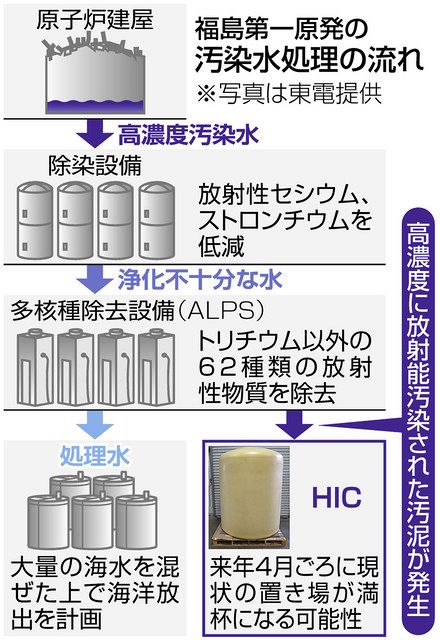
TEPCO’s Fukushima Daiichi Nuclear Power Plant (Okuma-cho and Futaba-cho, Fukushima Prefecture) may be unable to operate its waste treatment facilities next April when its storage facilities fill up with waste generated during the purification process of contaminated water. While TEPCO is preparing to discharge the treated water into the ocean, it has been sloppy in its waste management. The contaminated water treatment could be delayed. (Kenta Onozawa)
The storage space may become tight because of the muddy waste generated by the ALPS (Advanced Land Disposal System), which removes radioactive materials other than tritium. The waste is stored in containers called “HICs” at a yard on the south side of the site. The plan is to dilute the water after treatment with a large amount of seawater and discharge it into the ocean.
As of August, the HIC yard was 96% full. TEPCO estimates that it will be full by the end of April next year if operations continue at the current level.
If the storage space runs out, ALPS will no longer be able to operate, and water that has been reduced in radioactive cesium and strontium by the decontamination facility prior to ALPS treatment will continue to accumulate. This insufficiently purified water is stored in a separate group of tanks from the treated water, which is subject to discharge into the ocean. The risk of leakage is much higher than that of treated water.
TEPCO plans to renovate the HIC yard to create additional storage space for about one year, aiming to start operation at about the same time the yard fills up. However, the renovation work was originally supposed to be completed in March of this year. The process has been delayed due to a review of the seismic design and other factors, and it is uncertain whether the project will continue to proceed as TEPCO had envisioned.
TEPCO initially planned to start operation of a facility capable of disposing of the HIC by the end of this fiscal year. It did not construct a new yard, anticipating that the number of HICs would decrease after the facility went into operation. However, the Nuclear Regulation Authority (NRA) pointed out design flaws, delaying the scheduled operation by more than two years. Lack of contingency plans led to fears of a crunch.
A spokesperson for TEPCO explained to an interview, “We have some prospect of measures to control the occurrence of HICs, and we do not think we will run out of storage capacity, but we will consider adding a storage facility in case of a tight situation.
HIC HIC is an abbreviation for high-performance container. It is a cylindrical polyethylene container 1.5 meters in diameter, 1.8 meters high, and approximately 1 centimeter thick. It is used to store muddy waste generated during the purification process in the Advanced Lockheed Martin (ALPS). The waste is stored in a concrete box in an outdoor storage area on the south side of the site. The storage capacity is for 4,192 units, and as of August 4 of this year, 4,027 units had been placed there.
https://www.tokyo-np.co.jp/article/201403?fbclid=IwAR3z1flpnp4q08q_T35ek8Bu_N687llXC150lV_GHTIP34N1OUoMudLkQI0
The Ghosts Of Fukushima & Japan’s Nuclear Turnaround

Sep 7, 2022,
Japanese Prime Minister Fumio Kishida’s announcement that Japan was going to revive nuclear power and invest in it as a solution to Japan’s energy woes, came as a 180 degree policy reversal after the 2011 Fukushima Daiichi accident. Kishida and the Liberal Democratic Party (LDP) are investing a lot of political capital and their long-term industrial policy commitment in nuclear energy.
With Japan facing summer blackouts, and Russian gas supply in question after Moscow’s aggression in Ukraine politicizing natural gas exports, the Japanese government announced it was approving 33 nuclear projects for operation. 10 nuclear plants have already been restarted, with 7 more planned for Spring 2023 revival. These plants are spread in the Fukui, Miyagi, Shimane, Niigata, and Ibaraki prefectures and some are still pending local and safety approval. In addition, the Kishida administration is looking into increasing the lifespan of nuclear plants from 40 to 60 years. Tokyo Electric Power Company Holdings which accounts for 24.8% of Japan’s existing nuclear capacity is aiming to restart 2 of the 7 reactors for 2023 in Kashiwazaki-Kariwa.
The Japanese private sector, energy markets, and economy are ecstatic at the news. Japan’s three nuclear power plant general contractors: Toshiba, Mitsubishi Heavy Industries, and Hitachi have been developing nuclear technology including next-generation projects, small modular nuclear reactors (SMRs), and nuclear reactor parts. Fusion energy is also on the horizon but not ready for commercial exploitation.
Other companies running and producing parts for nuclear plants include IHI Corporation, Kansai Electric Power, and Chubu Electric Power. Following the announcement of nuclear plant revivals, the share values of nuclear companies in Japan shot up and energy prices and futures stabilized. Mitsubishi Heavy Industries (MHVYF) has been working with state-owned Japan Nuclear Fuel on the Rokkasho plant had its shares increase by 6.9%. IHI Corporation’s shares rose by 5.4%, and Hitachi’s climbed 1.9%. For the utilities sector, Tokyo Electric Power Company Holdings’ (TEPCO) share values increased by 10%, Kansai Electric’s 2.9% and Chubu Electric Power’s by 1.3%.
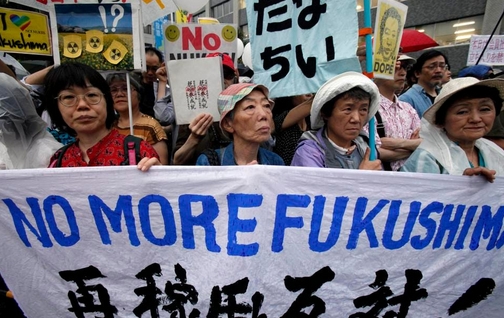
If any country has the “right” to fear nuclear power, it would be Japan. The 2011 Fukushima nuclear power plant disaster only solidified a long-running anti-nuclear Zeitgeist in Japanese society stemming back to the 1945 atomic bombing of Hiroshima and Nagasaki, and the pacifism engrained in Japan’s constitution via Article 9 which outlaws war as a means to settle international disputes. So, why, and how, has Japan embarked upon such a drastic policy U-turn when many others, such as Germany, are wavering?
One would think that amid soaring energy prices and blackouts, the news of nuclear energy revival would result in a surge of popularity for the LDP, but instead it is facing mixed responses. Only a few weeks ago the LDP felt compelled to announce they had no plans to build new reactors even as the powerful Ministry of Economy, Trade, and Industry (METI) was drafting technology for nuclear plants . Even though the Japanese public is increasingly aware of its energy predicament, public support for building new nuclear reactors and replacing aging units only has a 34% approval rate and a 58% opposition rate. The Kishida administration may see the effects of ignoring public opposition to nuclear in the upcoming local elections. It clearly needs a powerful public information campaign to explain why Japan needs nuclear power.
Nevertheless, Kishida and the LDP are determined to bring the public to its side before the next general elections and show the benefits of their nuclear vision. They should recognize Japan’s structural weaknesses caused by the island’s dependency on imports for industrial inputs, geographic position requiring imports of fossil fuel from thousands of miles away, dependence on the historic foe Russia, the difficulty of employing renewables in Japan. Kishida-san would need to explain that all this is making nuclear a good choice for Japan.
Why can Japan make this embrace, against immediate public concerns, when so many other countries cannot? The most important component is long-term strategic thinking wherein political elites are willing to bear short-term political costs for future gains rather than weaponizing energy politics for partisan food fights as it is the case in Germany and elsewhere. Also vital is the public trust the Japanese Agency for Natural Resources and Energy enjoys, being under the auspices of Japan’s hallowed Ministry of Economy, Trade, and Industry. Japanese bureaucrats are capable of generating energy policy cognizant of national security demands and private sector capabilities. Flexible zoning laws which allow for dense urban-integrated energy infrastructure is also vital as this preempts NIMBYism and land-use problems found with many other energy projects. Lastly, the non-partisan nature of energy policy in Japan, where no political party clings to a specific energy initiative, is something to emulate in Berlin and elsewhere.
If densely populated, earthquake-prone Japan can step into a nuclear future, there is no excuse for the rest of the world. U.S., Germany, and others should learn from Japan on how to exorcise our own, far less rational, nuclear demons.
1 This month
17 October, Free Public Talk on Nuclear Issues in South Australia
David Noonan will speak on public interest concerns over the new Roxby Downs Indenture Act 2026 on BHP copper-uranium mining and ore processing in SA, and on how AUKUS may face SA with a High-Level nuclear waste agenda.
Dr Jim Green will discuss international developments in the field of nuclear power including ‘small modular reactors’ and Generation 4 ‘advanced’ nuclear reactor concepts.


Help Aunty Sue Protect Her Land and Sacred Sites From Destructive Rocket Testing.
.

Australians deserve the truth
about
AUKUS – https://aukuspublicinquiry.com/

PETITION – To: Prime Minister Anthony Albanese and the Australian Labor Government

of the week – Australians for War Powers Reform (AWPR)
To see nuclear-related stories in greater depth and intensity

