TEPCO, which has made public the site of the undersea tunnel construction project, says that the project is proceeding smoothly without local consent for the discharge of treated water into the ocean
September 6, 2022
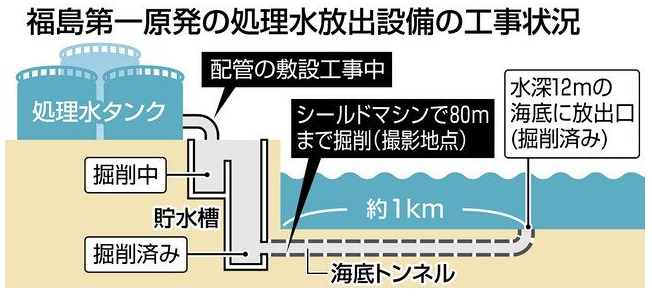
On September 6, TEPCO opened to the media the construction site of an undersea tunnel that will be used to purify and treat contaminated water at the Fukushima Daiichi Nuclear Power Plant (Okuma and Futaba towns, Fukushima Prefecture) for discharge into the ocean. Excavation of the tunnel began on August 4 and has progressed to about 80 meters out of its total length of about 1 kilometer. The plan is to finish all the work by next spring, but it is not clear whether the tunnel will actually be able to discharge the water.
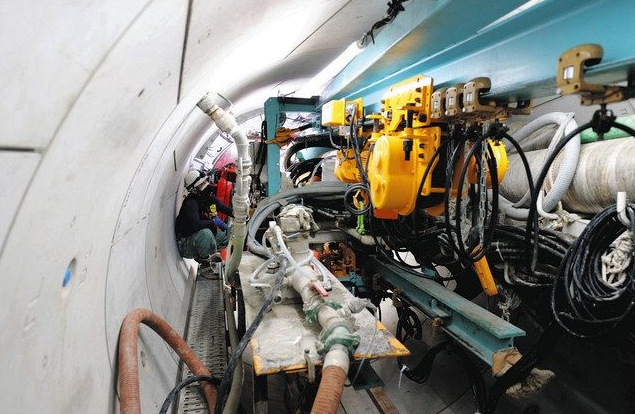
The low motor noise reverberated as we entered the narrow tunnel. The entrance to the tunnel was about 3 meters in diameter. Beyond that was a gentle descent. The interior was surrounded by white reinforced concrete walls and crowded with piping and equipment. Beyond the tunnel, a shield machine was digging into the bedrock, but we could not see it.
No sound of digging could be heard, and it was quieter than one might imagine. The machine was digging at a rate of two centimeters per minute. When I touched the piping that carried the rock and mud that had been cut out of the machine to the outside, I felt as if hard objects were rolling around inside.
A person in charge at the site said, “So far, work is going well.” A total of about 100 people work a day on a 24-hour shift, and digging will begin around the end of October at two to three times the current pace.
The fishermen’s union has promised that they will not dispose of the waste in any way (discharge into the ocean) without the understanding of the concerned parties. The fishermen’s union has maintained its opposition to ocean discharge and may not be able to discharge the waste even after the tunnel construction is completed. Kenichi Takahara, risk communicator for the Fukushima Daiichi Decommissioning Promotion Company, predicted, “I think the release will only happen when both the construction of safe facilities and efforts to gain understanding can be accomplished.
According to TEPCO’s plan, the treated water, which mainly contains radioactive tritium, will be diluted with a large amount of seawater to less than 1/40th of the national emission standard and released from the seafloor at a depth of about 12 meters through a tunnel. (The water will be discharged from the seafloor at a depth of about 12 meters through a tunnel.)
TEPCO announced the start of construction of an undersea tunnel to discharge “treated water” from the Fukushima Daiichi Nuclear Power Plant. Citizens’ exclamations
https://www.tokyo-np.co.jp/article/200483?fbclid=IwAR3EwrzzVYJ7mmUU8jDVrK4yn3oZ1loFk6NsmNBvZJilmvH31L0E8XErkeU
This week’s nuclear news
Our international news website nuclear-news.net is out of action now, due to a glitch about the domain name. Webcentral Group Limited dba Melbourne it (Australia) might be fixing this for us. In the meantime the international news is going up on antinuclear.net
A bit of good news – Reasons for (cautious) optimism: the good news on the climate crisis
Coronavirus Disease (COVID-19) Epidemiological Update. No – it hasn’t gone away.
Nuclear. The media contradiction continues – as anxiety increases over Ukraine’s Zaporizhzhia nuclear station – so does the increase in propaganda about how safe, – clean – cheap – is nuclear power!
AUSTRALIA
The Defence Strategic Review and the loss of our strategic autonomy to the US. Pine Gap a target as Ukraine invasion raises nuclear war risk, Australian defence expert warns. Don’t mention the war powers: what’s behind Labor’s silence on inquiry?
PM grills Peter Dutton on location of power plants amid Coalition’s nuclear push. One legal win for Aboriginal people in South Australia gives hope to the Barngarla people who are fighting the Kimba nuclear waste dump plan.
INTERNATIONAL
Leni Riefenstahl said her epic films glorifying the Nazis depended on a “submissive void” in the German public. This is how propaganda is done.
The colossal failure of the 10th Non Proliferation Treaty Treaty (NPT) Review Conference. After U.N. conference, nuclear disarmament advocates look to new strategies.
Wow! The nuclear lobby comes up with a new plan “to compel governments to make difficult decisions“.
Small nuclear reactors emerge as energy option, but risks loom.
Researchers agree: The world can reach a 100% renewable energy system by or before 2050.
UKRAINE. All 6 reactors at Zaporizhzhia now completely stopped operating . Zaporizhzhia nuclear power station is still under threat. Kiev spreading ‘propaganda by fear’ – French ex-presidential candidate. On Ukraine’s war on the Donbass, Russia’s denazification operation, & being on Ukraine’s kill list. https://www.youtube.com/watch?v=m1Kp7IpzA5Y Zaporizhzhia: proposals for demilitarised zone around Europe’s biggest nuclear power plant are unprecedented – expert reveals. Putin and Macron trade blame over risk at Ukraine’s Zaporizhzhia nuclear plant.
Western media continues to ignore Ukraine’s public ‘kill list’ aimed at those who question the Kiev regime. . It’s not okay for grown adults to say the Ukraine invasion was “unprovoked”.
EUROPE. Drying up of Europe’s great rivers – the death knell for France’s nuclear fleet?
UK. UK and Europe cannot depend on nuclear power, with reactors shutting down, just as winter hits. Sizewell C nuclear project might be scrapped as UK faces ‘long winter’ due to energy crisis. A farcical detachment from reality’: Green groups respond to Government’s energy bills plan. Nuclear is the worst possible way to back up wind power.
Sizewell C nuclear plant “will never get built” due to impossibility of raising finance for it.Environment Agency rejects EDF’s appeal against requirement to protect millions of fish from Hinkley C’s huge cooling system.
UK government grants £3.3M funding for Advanced Modular Development and Demonstration Nuclear Reactors. Safety a ‘top priority’ for anti-nuclear groups seeking answers on nuclear rail transport. Public opinion in UK – overwhelming support for solar and wind energy .
NORTH KOREA. Kim Jong Un says North Korea’s new law allowing pre-emptive nuclear strikes is ‘irreversible’.
CANADA. Peaceful Walk Against Nuclear Waste Resumes. Medical nuclear reactors becoming redundant as technetium imaging becoming obsolete?
USA. Race Correction and the X-Ray Machine — The Controversy over Increased Radiation Doses for Black Americans in 1968. Trump’s Top-Secret Document Hoard Included Nuclear Weapons Data. Mishandling of Classified Nuclear Documents Is Bad. Mishandling of the Sole Authority to Use Nuclear Weapons Would Be Much Worse. Navy Seeks Solution for Decommissioned Nuclear Carrier USS Enterprise.
IRAN. Revival of the Iran nuclear deal is not likely any time soon. France, Germany and UK lose faith in negotiations with Iran, to restore the nuclear agreement.
GERMANY. German chancellor rejects calls to reverse nuclear power plant closures. Germany to extend last 2 nuclear power plant lifespans by a few weeks. Operator doubts German plan to keep nuclear plants on standby.
SWITZERLAND. Switzerland plans controversial nuclear waste dump all too close to German border.
SOUTH KOREA. Super Typhoon Hinnamnor Could Slam Straight Into Nuclear Power Plant. Jung Jae Kwon: Questioning the nuclear umbrella.
Treated water is almost full, a long way from completion of discharge at Fukushima Daiichi Nuclear Power Plant
2022/9/7
Eleven and a half years have passed since the accident at TEPCO’s Fukushima Daiichi Nuclear Power Plant. TEPCO plans to start discharging the treated water into the sea as early as spring 2023 after purifying the radioactive contaminated water. However, local fishermen and people overseas are deeply distrustful, and the road to completion of the discharge is far from complete.
This summer, there was a major development regarding the treated water. On July 22, the Nuclear Regulatory Commission approved TEPCO’s plan to discharge treated water into the ocean.
According to the plan, the company will first reduce the concentration of 63 radioactive materials below the national standard, except for tritium, which is technically difficult to remove. The tritium concentration will be further diluted with seawater and adjusted so that it is less than 1/40th of the standard value (1,500 becquerels per liter). The tritium will be discharged to the seafloor about 1 km offshore.
On August 2, Fukushima Prefecture and the towns of Okuma and Futaba, which are the local governments in the area, informed TEPCO that they had given their prior consent to start construction of the discharge facility, and TEPCO began full-scale construction of the facility. A shield machine was used to excavate an undersea tunnel, and pipes were laid to transport the treated water.
However, the construction schedule is already running behind schedule. The installation of the caisson (concrete box) for the water discharge outlet on the seafloor was scheduled for the end of August, but has been postponed until September or later due to weather and other factors. TEPCO has indicated that the discharge may be delayed until next summer.
Zero” Contaminated Water Target Revoked
Contaminated water containing high concentrations of radioactive materials is the source of the treated water. This water is generated when reactor cooling water and groundwater come into contact with the melted-down nuclear fuel (fuel debris) in Units 1 through 3.
The treated water is the result of removing radioactive substances other than tritium using a multinuclide removal system called ALPS (ALPS).
TEPCO has been rapidly adding tanks to store the treated water, but as of March of this year, 95% of the tank capacity (1.29 million tons) had been reached. In order to secure the space needed for decommissioning work, it is difficult to add more tanks. At this rate, the tanks are expected to be full by the summer or fall of 2011.
What is urgently needed is to prevent the generation of contaminated water.
The buildings of Units 1-3 are badly damaged. Groundwater and rainwater flowing from the mountain side of the site have entered the buildings, causing contaminated water to increase.
TEPCO has been reducing the inflow of water into the buildings by pumping up groundwater from wells around the buildings and by building a “frozen soil barrier” to enclose the buildings. 130 tons of contaminated water was generated per day in FY2009, a quarter of the amount generated in FY2003.
However, TEPCO itself still does not know where the water is coming from. TEPCO’s initial goal of “zero generation of contaminated water” is now beyond reach, and the company has replaced it with the target of “reducing the amount of contaminated water to 100 tons per day by the year 2013.
In fact, most of the treated water is “still under treatment.
Once the facilities are completed, will the water in the tanks be discharged into the ocean?
Of the 1.29 million tons of water in the tanks as of March of this year, only 10,000 tons, or less than 1%, has not been treated at Alps. TEPCO has described the other water as “treated” water.
Work proceeds on building tunnel to discharge treated water at Fukushima N-plant
September 7, 2022
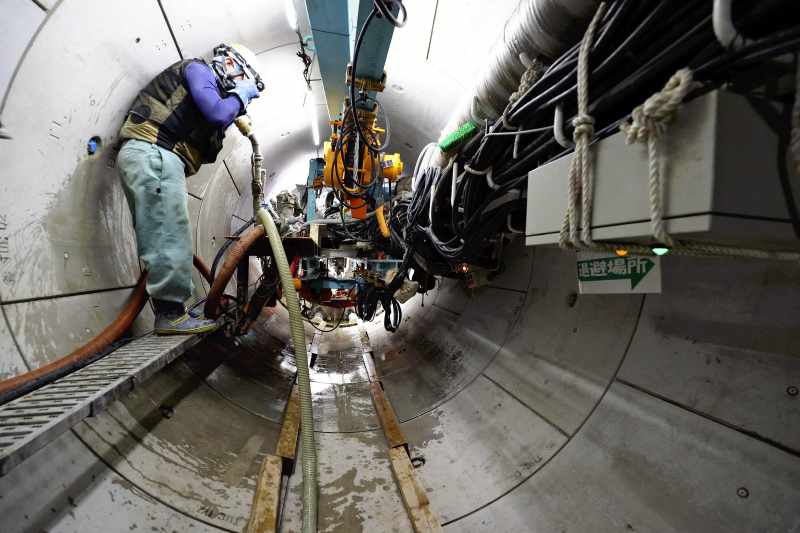
FUKUSHIMA — Tokyo Electric Power Company Holdings, Inc. held a press viewing of the construction site of an underwater tunnel leading to the ocean for discharging treated water from the Fukushima No. 1 nuclear power plant in Fukushima Prefecture.
The treated water is to be piped to an offshore discharge site through the tunnel, which is about 1-kilometer long.
On the seaward side of reactor Nos. 5 and 6, there is a shaft about 18 meters deep that leads to a tunnel with a diameter of 3.1 meters that extends toward the sea.
The walls of the tunnel are covered with reinforced concrete to prevent leakage.
A shield machine with many pipes and cables has been used to dig about 80 meters since Aug. 4.
A worker was monitoring the excavation amid the loud sound of the motor.
“Once the tunnel is excavated to 150 meters, the pace of excavation will be several times faster from that point forward,” said a TEPCO official. “We’ll proceed with safety as our top priority.”
The excavation is proceeding smoothly, but rough seas have prevented the installation of the discharge port at the end of the tunnel, which was scheduled to be done in August.
The ocean is expected to be even rougher in the winter. The failure to install the outlet before then could delay the construction work and possibly push back the start of water discharge, which is scheduled in the spring, to around summer.
Source: https://japannews.yomiuri.co.jp/society/general-news/20220907-56640/
Operator shows digging of tunnel to release treated water from Fukushima Daiichi
Sept. 6, 2022
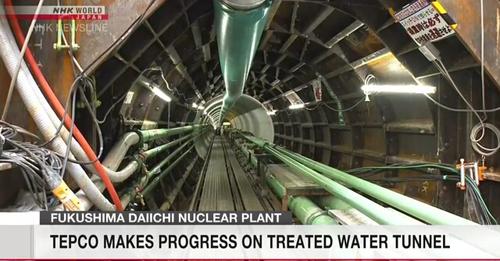
The operator of the crippled Fukushima Daiichi nuclear power plant has shown to media work to dig an underwater tunnel for releasing treated water from the facility into the ocean.
Tokyo Electric Power Company began building the tunnel in early August to release the water about one kilometer offshore, after diluting it.
The operator gained approval for the work from the Nuclear Regulation Authority and local authorities. The project is in line with the Japanese government’s policy.
On Tuesday, media were allowed to view the construction site, where workers used a huge excavator called a shield machine under the seabed.
The tunnel starts about 16 meters underground near a quay wall of the plant’s No.5 and 6 reactor buildings.
TEPCO officials say the tunnel is being dug at a pace of five to six meters a day, and is so far 80 meters long.
The firm aims to complete the work next spring, but has suggested it may take until next summer, depending on weather.
Local fishery workers have expressed concern about possible reputational damage from the release. Fukushima Prefecture and other local authorities say the plan has yet to gain public understanding.
Reactors at the plant suffered meltdowns in the March 2011 earthquake and tsunami.
Water used to cool molten fuel at the facility mixes with rain and groundwater. Accumulated water is treated to remove most radioactive materials and stored in tanks on the plant’s premises.
The filtered water still contains tritium. The government plans to dilute the water to bring the concentration of tritium well below the percentage permitted by national regulations.
The amount of tritium in the diluted water is also ‘expected’ to be below World Health Organization guidance levels for drinking water quality.
Surgery in junior high school and high school “Everything has changed”, high school senior 6-year-old at the time of the nuclear power plant accident, 2nd oral argument in the Fukushima children’s thyroid cancer lawsuit
September 7, 2022
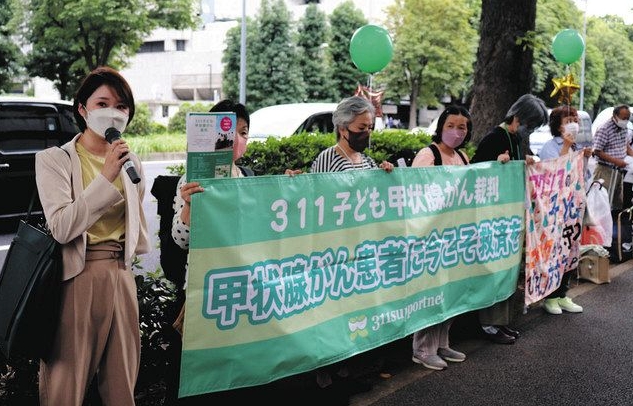
On September 7, the second round of oral arguments was held at the Tokyo District Court (Saburo Sakamoto presiding) in a lawsuit filed by six men and women, ages 17-28, who were minors and living in Fukushima Prefecture at the time of the accident, seeking a total of 616 million yen in damages from TEPCO for thyroid cancer caused by exposure to radiation from the TEPCO Fukushima Daiichi Nuclear Power Plant accident. A 17-year-old girl, a junior in high school in the prefecture, who was 6 years old at the time of the accident, gave her statement, saying tearfully, “Everything has changed before I had a clear idea about myself, my character, and my dreams for the future. (Natsuko Katayama)
She sat on the witness stand for about 15 minutes with a screen placed so that the audience could not see her, her voice shaking as she shared her thoughts and feelings. At the time of the accident, she was in kindergarten and living in the Hamadori area in the eastern part of the prefecture. She was diagnosed with thyroid cancer when she was in junior high school and underwent surgery at the age of 13. She thought she was fine, but the cancer returned last fall. She underwent surgery again and underwent painful radiation treatment.
I don’t really know what I want to do in the future. I just want to become a financially stable civil servant. I don’t think love, marriage, or childbirth have anything to do with me. The woman burst into tears and choked on her words several times. “High school life is not a place to enjoy youth, but rather a place to receive college recommendations for a stable future. Even so, there are times when I cannot sleep because I am anxious about the future,” she said.
◆A woman who was in the 6th grade also filed an additional lawsuit
On the same day, a woman in her 20s from the Nakadori area in the central part of the prefecture, who was in the sixth grade at the time of the accident, filed an additional lawsuit. She was diagnosed with thyroid cancer last summer and underwent surgery. She said that she decided to file the lawsuit because “there are other people suffering in addition to me.
TEPCO is seeking dismissal of the lawsuit, claiming that there is no causal relationship between the plaintiffs’ cancer and the nuclear accident.
https://www.tokyo-np.co.jp/article/200686?fbclid=IwAR3XPPG3p-NLHg0w9rahtOwIVvCFlfo55sxyFC3yZQOqrXQIpjRBqVb-v0M
Professor of Ryukoku University, angry at the Prime Minister’s reference to “new nuclear power plants.
2022/9/5
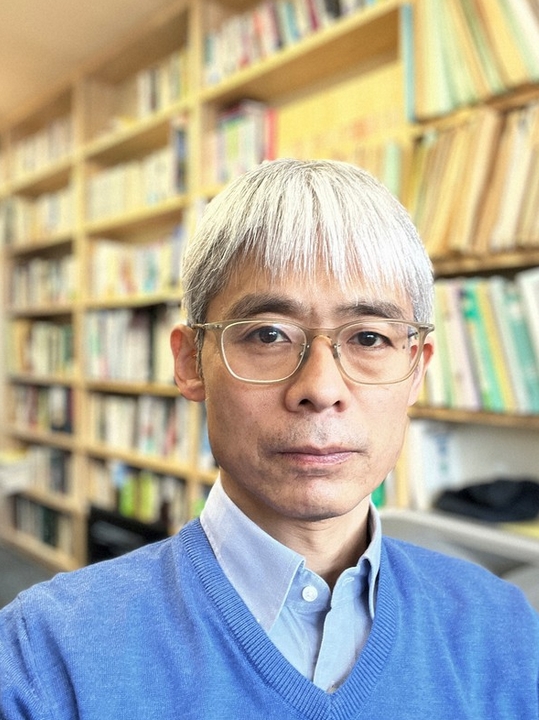
Prime Minister Fumio Kishida has mentioned the construction of “new nuclear power plants” for the next generation, which has been kept under wraps by successive administrations since the Fukushima Daiichi nuclear power plant accident in 2011. This is a move in anticipation of soaring resource prices due to the crisis in Ukraine and other factors, as well as the “carbon neutrality” goal of virtually eliminating greenhouse gas emissions, which the government has declared it aims to achieve in 50 years. We asked Kenichi Oshima, professor of environmental economics at Ryukoku University, who has critically examined the nation’s nuclear power policy, especially from the perspective of costs.
Sudden Change of Policy
–The government’s recent reference to the consideration of new nuclear power plants marks a turning point in its nuclear policy.
◆ Even former Prime Minister Shinzo Abe, who built a long and stable government based on the lessons learned from the Fukushima nuclear accident that resulted in a huge “negative legacy” over issues such as compensation and decommissioning, did not mention new nuclear power plants while in office. Prime Minister Kishida’s latest statement represents a significant change in policy.
–The Liberal Democratic Party and New Kōmeitō did not mention the new nuclear power plant in the Upper House election to be held in July. The statement was made suddenly at the Green Transformation (GX) Executive Council, a government meeting aimed at realizing a decarbonized society.
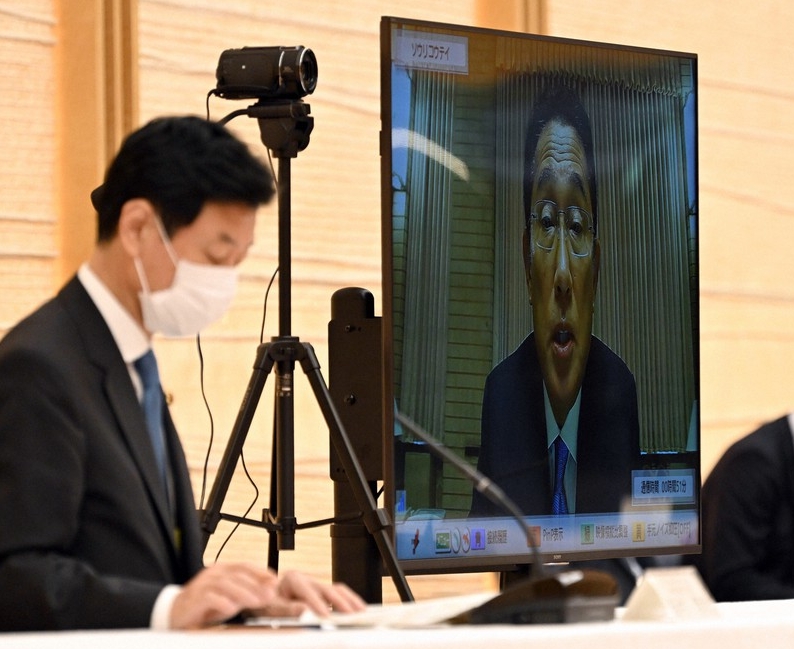
◆ The GX campaign pledges did not include the issue, and the Basic Energy Plan, the medium- to long-term national energy policy that was just revised last fall after nearly a year of discussions at a panel of experts, also avoids mention of new nuclear power plant construction. Nevertheless, it is too violent to suddenly overturn the existing policy at another government meeting. It does not seem as if sufficient consideration has been given to the issue. I think it is very shortsighted to consider building new power plants “because there is a shortage of electricity” due to the crisis in Ukraine and other factors.
Contribution to decarbonization “limited”
–How long will it take for new nuclear power plants to come on line?
◆ Nuclear power plants take 10 to 20 years to build, 40 to 60 years to operate, and another 30 years or so to decommission. If we decide to build new nuclear power plants now, our actions will be tied up for the next 100 to 150 years. If we make a decision to build new nuclear power plants based on current resource prices, which fluctuate in the short term, we risk narrowing other options, such as renewable energy. Nuclear power plants have the advantage of producing no carbon dioxide (CO2) when generating electricity, but it will take a long time before they are operational, and their contribution to 50-year carbon neutrality and decarbonization will be limited.
-Involved in accelerating the use of nuclear power plants, the GX Executive Council’s government document also includes a consideration of “business environment improvement.
◆ The theory is that “it will be difficult for electric power companies to recover the huge initial investment in new nuclear power plants on their own, so it will be necessary to ‘improve the business environment. In essence, this means a government subsidy program for electric power companies. This is the same system that pro-nuclear LDP lawmakers had been calling for before the Fukushima Daiichi nuclear accident in 2011. It is a rehash of the same request.
In effect, only the major nuclear power companies will be subject to the environmental improvement program. New power companies will not receive support, further widening the gap in the power industry. This could distort the electricity market, which has been fully liberalized since the Fukushima nuclear accident. It has already been half a century since Japan introduced nuclear power. If it still cannot “stand on its own,” it is proof that nuclear power is inferior as a major power source.
New and additional nuclear power plants must be discussed carefully
–The industry has been calling for the construction of new nuclear power plants. The crisis in Ukraine has caused the price of natural gas and other fossil fuels to skyrocket, and the supply and demand of electricity is tight.
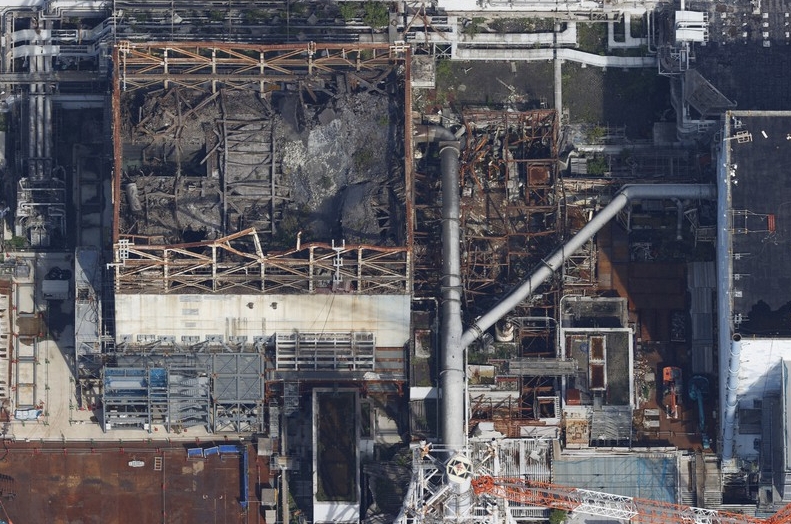
◆ In order for Japan to continue to grow, it is necessary to shift to an industrial and economic structure centered on renewable energy. While Europe, hit hard by the Ukraine crisis, is increasing its investment in nuclear power plants, the main investment for decarbonization and de-dependence on Russia must be in renewable energy. The more the Japanese government works to prolong the life of the nuclear industry, the more it will hurt the Japanese economy in the long run.
Even if there is a possibility of a tight power supply and demand situation in Japan, it will only be serious during peak demand periods. Nuclear power plants are “baseload power sources” that generate electricity all the time, so they cannot contribute to flexible responses such as increasing power generation only during peak periods. While promoting the operation of nuclear power plants will accelerate the consolidation of thermal power generation, which is currently the base-load power source, it will not lead to an increase in the supply of electricity in times of emergency.
Nuclear power plants still face the risk of accidents such as the one that occurred in Fukushima and the problem of how to dispose of radioactive waste. The Kishida administration should carefully discuss the construction of new nuclear power plants, rather than looking only at what is convenient. Interviewer: Daisuke Oka
https://mainichi.jp/articles/20220902/k00/00m/020/219000c?fbclid=IwAR0vx026lpbsEtWMjdWfbLNWw9jP_I9kINx5jZNyMldyIc43hETTe1OdpLE
Sizewell C nuclear project might be scrapped as UK faces ‘long winter’ due to energy crisis

A NEW NUCLEAR reactor which is planned for the Sizewell site in Suffolk could face numerous problems with funding and completion, an expert has warned.
Express UK, By MATTHEW DOOLEY, Sun, Sep 11, 2022 Sizewell C nuclear power station is a proposed nuclear plant in Suffolk which would meet up to seven percent of the UK’s energy demand. The project is owned by the French nuclear giant EDF and the China Nuclear group who own an 80 and 20 percent stake, respectively, in the project.
………. the plant will take years to complete, so it is unlikely it will have any effect on consumers’ bills in the short term.
Concerns have also been raised about the French company taking on the project, EDF. The company is reportedly heavily in-debt – €42.8billion (£37billion) at the end of June, according to Bloomberg.
In July, French Prime Minister Elisabeth Borne announced that EDF would be nationalised with the French Government buying 14 percent of the company which it did not already own.
This led some experts to express concern over the viability of the new Sizewell plant amidst an ongoing energy crisis.
Associate Fellow at the Science Policy Research Unit, Sussex Business School, University of Sussex Paul Dorfman is an expert in civil nuclear technology.
He said that following the winter, EDF may lose its appetite for building a nuclear project in the UK, particularly when the rest of Europe was struggling with its own energy crisis.
He said: “EDF has huge problems, as they are massively in debt – essentially bankrupt, right now about €42billion in debt, with huge waste and decommissioning costs on the horizon.
“At the moment half of all French EDF reactors are offline, many with ageing maintenance and corrosion safety problems. Because of all this, the French Government has been forced to fully nationalise EDF.
“This winter will be a long time in energy and in politics. It will be a cold winter, and what would happen if France needed all its power for Paris, and fails to deliver power to the UK? How will that go down with UK people and policy, and could that impact the any new nuclear decision at Sizewell C?”
“What will happen if France says, ‘well we are in such problems with our nuclear, we don’t want to commit to the UK?’ Already, just this week, the EDF Board has refused sign off on Johnson’s Sizewell C contract – are they getting cold feet because they worry about taking on more debt for another UK project, when they have their own problems at home.”
Dr Dorfman was referring to a number of sources close to the matter who apparently told the French magazine Le Figaro EDF’s board of directors had voted against the Government’s negotiated decision with EDF to build the reactor at Sizewell……………….
The Sizewell C project would be funded by three parties – EDF would fund 20 percent while the Government would take on another 20 percent of the project. Private investors would take on another 60 percent of the funding while current investor China General Nuclear Power is expected to ease out of its 20 percent investment.
This adds more uncertainty to the project, according to Dr Dorfman who claims the current market won’t “touch nuclear with a barge pole”.
A portion of the construction will be funded by the Regulated Asset Base (RAB) module, which will see consumers pay a premium on their energy bills to go towards the construction of the plant. https://www.express.co.uk/news/science/1667357/energy-crisis-sizewell-c-nuclear-plant-uk-long-winter-energy-crisis
Ukraine Considers Shutting Nuclear Plant After Loss of Backup Power

After shelling destroys key electricity supply, Zaporizhzhia facility may have to rely on generators with 10 days of fuel left
WSJ, By Drew Hinshaw and Laurence Norman Sept. 9, 2022
Ukraine is considering shutting down the sole remaining reactor at the Zaporizhzhia nuclear plant, the International Atomic Energy Agency said Friday, after shelling left the plant without a safe and sustainable source of backup power.
The plant, which has already shut down five of its six reactors, risks having only one remaining source of electricity to power its systems in case the sixth reactor has to go offline, said Director General Rafael Grossi in a statement..
Normally, if the plant can’t supply itself power,
it can draw electricity from a nearby thermal-energy plant. But shelling
overnight Thursday destroyed a switchyard that carries electricity out from
that coal-fired plant, Mr. Grossi said.
It is unlikely that it will be
repaired, he added, given the constant artillery fire, meaning the nuclear
plant would have no off-site emergency source of power. The plant could
turn to back up generators, but those only have enough fuel for about 10
days, according to Ukraine’s state-owned nuclear company, Energoatom. The
plant, occupied by Russian soldiers who patrol with grenades dangling off
their belts, is still operated by the company’s Ukrainian workforce.
Plant workers, meanwhile, have no electricity in their homes and the
shelling risks accelerating an exodus of essential staff. “This is an
unsustainable situation and is becoming increasingly precarious,” Mr.
Grossi said. “The power plant has no off-site power, This is completely
unacceptable. It cannot stand. ”The Zaporizhzhia plant is now producing a
minimal 250 megawatts, enough to monitor and sustain the temperature of its
cooling ponds, to pump water through the station, to clean the air inside
the plant, and to perform other basic safety functions, said Petro Kotin,
interim president of Energoatom.
If the last operating reactor goes down,
he said, the staff will need to supply 200 tons of diesel daily to the
generators. The IAEA said in a report Tuesday Ukraine had 2,250 tons of
diesel fuel available for the whole site. Procuring more would require
several truckloads of fuel to cross through an active conflict area
subjected to continual artillery fire, many times a day. Nuclear experts
said it could make sense to shut down the last reactor and work off backup
generators, because the earlier that is done, the cooler the reactor core
would be if Zaporizhzhia’s generators run out of fuel and there is an
accident.
Workers reached by The Wall Street Journal have blamed the
artillery fire on Russia. Plant technicians, backed by European officials
and independent nuclear analysts, have said the shelling serves the
Kremlin’s broader goal of severing Zaporizhzhia’s power connection to
Ukraine’s remaining territory and eventually rerouting it into
Russian-held areas. Russian soldiers have laid land mines around the
plant’s cooling ponds, parked heavy artillery near its reactors, and
turned its safety shelters—meant for plant workers to flee to in an
emergency—into a bunker for themselves, workers say.
When IAEA inspectors
visited the plant last week, they found that the alternative emergency
center that Russian soldiers offered the staff didn’t have its own
ventilation system to filter out radiation from the air, or its own source
of power—or even an internet connection.
Shutting down the plant, in the
midst of an active conflict, would pose enormous and unprecedented
challenges for the nuclear industry. Defunct or dormant nuclear plants
still require electricity and careful maintenance by trained staff to
monitor and safeguard spent nuclear fuel, among other safety operations.
The plant currently suffers obstacles sourcing the spare parts and fuel
that would be required. Compounding difficulties, the Zaporizhzhia plant
has seen a considerable amount of its workforce flee, slipping out through
Russian checkpoints to Ukrainian-held ground.
Wall Street Journal 10th Sept 2022 https://www.wsj.com/articles/ukraine-considers-shutting-nuclear-plant-after-loss-of-backup-power-11662747396
Wow! The nuclear lobby comes up with a new plan “to compel governments to make difficult decisions”

The solution that we have created – the creation of a multilateral bank that will support nuclear investment and nuclear infrastructure all across the world – is a needed tool to achieve these objectives.
The proposed International Bank for Nuclear Infrastructure (IBNI)will be based on the same model as the World Bank, European Bank for Reconstruction and Development and the Asian Development Bank, among others.
“What a multilateral can do, through the establishment, adoption and enforcement of country-level agreements, is compel governments to make the politically-difficult decisions.
Financing issues for nuclear under the spotlight
World Nuclear News, 09 September 2022 The financing of nuclear projects under current mechanisms faces many challenges, panelists at World Nuclear Symposium agreed. However, plans for a new multilateral bank specifically for nuclear infrastructure could help projects move forward.
I think we all share a vision that nuclear needs to play a major role in the attainment of [energy security, sustainable development, climate targets] policy objectives,” said Daniel Dean, chair of the International Bank for Nuclear Infrastructure (IBNI) Implementation Organisation Strategic Advisory Group.
“The more we make nuclear accessible, financeable and achievable in countries throughout the world, the more that nuclear will be considered as a viable option to achieve those carbon transition objectives. But we are talking about multiple trillions of dollars of investment to achieve this vision. That is a problem given the existing financing mechanisms, the existing commercial structures being utilised to deliver nuclear projects.
George Borovas, partner and head of nuclear at law firm Hunton Andrews Kurth, who chaired the session, said the financing of nuclear projects is “an issue that is dear to my heart”. He said he has seen many such projects fail because of a lack of the right financial solutions……… You have to think about the financing solution up front.”
“General issues of public acceptance, reputational risk, potential controversies inevitably makes a lot of banks nervous, or at least cautious, about engaging with nuclear,” said Mark Muldowney of BNP Paribas…………..

Dean said nuclear must been considered from an Environmental, Social and Governance (ESG) perspective as an investor.
“We need to establish a better basis for the ESG status of nuclear and its role in terms of net-zero and its role in energy security,” he said. “That’s important as that will start to aggregate stability and actually say that nuclear is something that collectively financiers want to finance.”
what you need for that assessment is for industry collectively to put together the case why nuclear makes sense – from a policy point of view that’s the government’s domain
Dean said it is not just a financing issue. “It is a multidimensional problem that needs a multidimensional solution. The solution that we have created – the creation of a multilateral bank that will support nuclear investment and nuclear infrastructure all across the world – is a needed tool to achieve these objectives.
…………………… The proposed IBNI will be based on the same model as the World Bank, European Bank for Reconstruction and Development and the Asian Development Bank, among others.
“What a multilateral can do, through the establishment, adoption and enforcement of country-level agreements, is compel governments to make the politically-difficult decisions. https://world-nuclear-news.org/Articles/Financing-issues-for-nuclear-under-the-spotlight
After U.N. conference, nuclear disarmament advocates look to new strategies
Dennis Sadowski, Catholic Review, 11 Sept 22,
WASHINGTON (CNS) — Four weeks of debate — during a review conference for a treaty widely viewed as a cornerstone of nuclear disarmament — resulted in no consensus on how to move forward despite the efforts of the Holy See, disarmament advocates and non-nuclear nations
Russia blocked agreement on a final document late Aug. 26, the review conference’s final day, by objecting to paragraphs raising concerns about military activity around the Zaporizhzhia nuclear power plant in Ukraine.
The 10th Review Conference for the Treaty on the Non-Proliferation of Nuclear Weapons (NPT) at the United Nations headquarters in New York led to widespread consensus on numerous issues related to nuclear safety, but could not satisfy the Russian delegation’s objection even though the document did not mention Russia by name.
Maryann Cusimano Love, associate professor of international politics at The Catholic University of America, attended the conference as an expert consultant to the Holy See Mission at the U.N.
She told Catholic News Service that the Holy See’s participation in the review conference and its consistent voice in urging the world to abolish nuclear weapons was critical, especially at a time when fears remain that nuclear weapons may be introduced to the war in Ukraine
Early in the war, Russian President Vladimir Putin put his country’s nuclear forces on alert, but has since backed off any suggestion that he would authorize the use of nuclear weapons in Ukraine.
The review conference brought delegations from around the world to New York to discuss next steps toward fulfilling the treaty’s goal of the eventual abolition of nuclear weapons. Originally scheduled for 2020, it was delayed three times because of the coronavirus pandemic.
Among the treaty’s provisions is a requirement that parties to it “pursue negotiations in good faith on effective measures relating to cessation of the nuclear arms race at an early date and to nuclear disarmament.”
Disarmament advocates say that not enough has been done to achieve that goal…………………………………..
Maryann Cusimano Love also said that while the Russian objection was the main focus coming out of the meeting, the 35-page draft document offered numerous other steps related to nuclear safety, reducing nuclear arsenals and protecting human life that conference delegates can pursue going forward.
………………………………. the 65 states that have signed the 2017 Treaty on the Prohibition of Nuclear Weapons, including the Holy See, released a statement voicing their disappointment over the outcome. They pledged their support for the treaty, saying it was a necessary step toward an eventual ban on nuclear weapons.
The ban treaty went into force in January 2021, but has not gained the support of any nuclear-armed nations.
Supporters of the ban treaty also expressed concern that the risk of the use of nuclear weapons in the world today remained high, “and the possibility of the catastrophic humanitarian impact … is looming ominously over us.”
“We are dismayed that this very fact has been used at the NPT review conference deliberations as reason against the urgently needed progress on nuclear disarmament, and to uphold an approach to security based on the fallacy of nuclear deterrence. This approach relies on the threat of the actual use of nuclear weapons and, hence, the risks of the destruction of countless lives, of societies, of nations, and of inflicting global catastrophic consequences,” the statement said…………………………………………… more https://catholicreview.org/after-u-n-conference-nuclear-disarmament-advocates-look-to-new-strategies/
Small nuclear reactors emerge as energy option, but risks loom

The search for alternative sources to Russian energy during the war in Ukraine has refocused attention on smaller, easier-to-build nuclear power stations.
The Indian Express, By: AP Nicosia (cyprus) September 11, 2022. A global search for alternative sources to Russian energy during the war in Ukraine has refocused attention on smaller, easier-to-build nuclear power stations, which proponents say could provide a cheaper, more efficient alternative to older model mega-plants…………
While Rolls-Royce SMR and its competitors have signed deals with countries from Britain to Poland to start building the stations, they are many years away from operating and cannot solve the energy crisis now hitting Europe.
Nuclear power also poses risks, including disposing of highly radioactive waste and keeping that technology out of the hands of rogue countries or nefarious groups that may pursue a nuclear weapons program.Those risks have been accentuated following the shelling around Europe’s largest nuclear power plant in Zaporizhzhia, Ukraine, which has raised fears of potential nuclear disaster in the wake of the war
………………………………. Similarly, Oregon-based NuScale Power signed agreements last year with two Polish companies — copper and silver producer KGHM and energy producer UNIMOT — to explore the possibility of building SMRs to power heavy industry. ……….. Rolls-Royce SMR said last month that it signed a deal with Dutch development company ULC-Energy to look into setting up SMRs in the Netherlands. Another partner is Turkey, where Russia is building the Akkuyu nuclear power plant on the southern coast. Environmentalists say the region is seismically active and could be a target for terrorists.
The introduction of unproven nuclear power technology in the form of SMRs doesn’t sit well with environmentalists, who argue that proliferation of small reactors will exacerbate the problem of how to dispose of highly radioactive nuclear waste.“Unfortunately, Turkey is governed by an incompetent administration that has turned it into a ‘test bed’ for corporations,” said Koray Dogan Urbarli, a spokesman for Turkey’s Green Party.“It is giving up the sovereignty of a certain region for at least 100 years for Russia to build a nuclear power plant. This incompetence and lobbying power make Turkey an easy target for SMRs,” said Koray, adding that his party eschews technology with an “uncertain future.”
……………….. M.V. Ramana, professor of public policy and global affairs at the University of British Columbia, cites research suggesting there’s “no demonstrated way” to ensure nuclear waste stored in what authorities consider to be secure sites won’t escape in the future. The constant heat generated by the waste could alter rock formations where it’s stored and allow water seepage, while future mining activities could compromise a nuclear waste site’s integrity, said Ramana, who specializes in international security and nuclear energy.
Skeptics also raise the risks of possibly exporting such technology in politically tumultuous regions……………
Ramana said that there’s no guarantee nations will follow the rules. “Any country acquiring nuclear reactors automatically enhances its capacity to make nuclear weapons,” he said, adding that every SMR could produce “around 10 bombs worth of plutonium each year.”…………………………… more https://indianexpress.com/article/technology/science/small-nuclear-reactors-emerge-as-energy-option-but-risks-loom-8143584/
Putin and Macron trade blame over risk at Ukraine’s Zaporizhzhia nuclear plant
Last operating reactor has now been shut down, says Energoatom, to transfer facility to ‘safest state’
Guardian, Isobel Koshiw in Kyiv and agencies, Mon 12 Sep 2022
Vladimir Putin and Emmanuel Macron have traded blame over safety concerns at the Zaporizhzhia nuclear power station, which has been a focal point of fighting in recent weeks.
Separate readouts of a phone call between the French and Russian presidents highlighted the difficulties in trying to find an accord to ensure safety at the site.
“The Russian side drew attention to regular Ukrainian attacks on the plant’s facilities, including
radioactive waste storage, which is fraught with catastrophic
consequences,” said a statement published on the Kremlin’s website. It
called for a “non-politicised interaction” on the matter with the
participation of the International Atomic Energy Agency (IAEA).
In its statement, the French presidency said the occupation by Russian troops of
the plant was what was putting it at risk. “He [Macron] asked that
Russian forces withdraw their heavy and light weapons and that the IAEA’s
recommendations be followed to ensure safety at the site,” the Elysee
said. https://www.theguardian.com/world/2022/sep/11/reactor-ukraine-zaporizhzhia-nuclear-plant-shut-down-operator
The colossal failure of the 10th Non Proliferation Treaty Treaty (NPT) Review Conference

The fundamental point of division at the conference was never the Ukraine conflict. Rather, the essential divide was that Non Nuclear Weapons NNWS States wanted to chart a credible path to nuclear disarmament with concrete commitments and good-faith implementation, while Nuclear Weapons States wanted to maintain the status quo. And the NWS won. For now.
Death by a thousand red lines, By Cesar Jaramillo, 10 Sept 22, The official record will show that Russia tanked the long-delayed and much-anticipated 10th Review Conference of the Treaty on the Non-Proliferation of Nuclear Weapons (NPT), that it was the sole NPT state party to block consensus on the outcome document, and that the disagreement was ultimately over references in the text relevant to the ongoing conflict in Ukraine. This is all accurate—but only part of the story.
The profound rifts that divided NPT states parties from the beginning and prevented even modest progress ran much deeper than the predictably contentious Ukrainian conflict. Well before the Russian delegation took the floor during the last session to indicate that it would not endorse the text of the final document, it was abundantly clear that the conference would not meet even modest expectations. Its main accomplishment: the further weakening of the NPT’s credibility as a framework for nuclear abolition.
Unmet expectations
Faced with a convoluted and fragile international security environment, the world needed this Review Conference, already delayed for two years, to make progress………………………………….
As they had at previous NPT Review Conferences and Preparatory Committees, NWS attempted to justify the indefinite retention of their arsenals while still professing support for the goal of a world without nuclear weapons…………………….
Red lines for all nuclear weapon states
Russia blocked consensus because the text crossed one of its “red lines.” All other nuclear-armed states party to the NPT were ready to do the same if one of their red lines were crossed. This they made clear, repeatedly, at the Plenary, Main Committees, and Subsidiary Bodies. Somehow, they were more successful than Russia in keeping anything they couldn’t live with out of the draft outcome document………………….
Iran and other Middle Eastern states wanted Israel included in the outcome document’s section on the pursuit of a nuclear-weapons-free zone in the Middle East, but this was certain to be rejected by the United States, and so no mention of Israel appeared in that section. ………………………………………..
Familiar attacks on the TPNW
As predicted, nuclear-armed States Parties to the NPT dismissed and rejected the Treaty on the Prohibition of Nuclear Weapons (TPNW). ………………………..
The TPNW has replaced tired arguments over the purported value of nuclear weapons possession with a renewed emphasis on the humanitarian imperative for nuclear disarmament. From this perspective, the catastrophic humanitarian consequences of nuclear weapons use outweigh any alleged benefits……………….
Positive advances
The absence of an outcome document does not mean that the NPT Review Conference had no value of any kind. The mere fact that it was finally held and well attended is a positive measure of the ongoing commitment of states parties to the treaty and the objectives it embodies.
……………………………………………. The fundamental point of division at the conference was never the Ukraine conflict. Rather, the essential divide was that Non Nuclear Weapons NNWS States wanted to chart a credible path to nuclear disarmament with concrete commitments and good-faith implementation, while Nuclear Weapons States wanted to maintain the status quo. And the NWS won. For now.
Cesar Jaramillo is Executive Director of Project Ploughshares. https://beyondnuclearinternational.org/2022/09/11/death-by-a-thousand-red-lines/
Western media continues to ignore Ukraine’s public ‘kill list’ aimed at those who question the Kiev regime

Ukraine has a list ( Myrotvorets) of people, giving addresses and contact numbers, – people considered as enemies of the state, – able to be killed by extreme nationalists. The Ukraine government does nothing to stop this.
“There are so many people in Ukraine who want to push for peaceful negotiations with Russia. But if anybody in Ukrainian society wants to stand up and push this line, they’re most likely going to be put on that list. Myrotvorets is very much a symbol of the extremist elements in Ukraine at the moment.”
https://ingaza.wordpress.com/2022/09/11/western-media-continues-to-ignore-ukraines-public-kill-list-aimed-at-those-who-question-the-kiev-regime/ September 10, 2022, -by Eva K Bartlett
The Myrotvorets list is an issue trending in independent and Russian media, but not in the mainstream international press
This week, a number of international and Russian journalists convened in Moscow – with more joining by video link – to discuss the now-infamous Ukrainian Myrotvorets “kill list.” Many of them are included themselves.
While some don’t take it seriously, the horrific car-bombing murder of Darya Dugina on August 20 and the subsequent marking on her Myrotvorets entry as “liquidated” makes it fairly clear the people behind the list do, in fact, want people dead.
The same thing happened to the entry of Russian photojournalist Andrei Stenin and many others listed and subsequently killed, including the Italian Andrea Rocchelli.
What it feels like to be on the list
The head of the Foundation to Battle Injustice, Mira Terada, who convened the panel, noted that of the thousands of names entered on the site, 341 are journalists and, shockingly, 327 are minors.
“Publishing personal data on minors is a crime. It’s like a menu for pedophiles or people doing human trafficking.”
While her concern is for the children, journalists, activists, political figures and even ordinary Ukrainians who have somehow angered the Kiev regime and those behind the list, Terada now needs to exercise some caution after she herself was added to the database.
An hour and a half after a July 21 press conference about children being placed on Myrotvorets, Mira found herself listed. “This changed my life. I have to be vigilant 24/7,” she said.
Christelle Néant, a French war correspondent reporting from Donbass for the past six and a half years, mentioned to me before the panel began that some of the information on the site is not disclosed to the general public, and is password-locked.
Néant, who said she’s been receiving death threats for years, spoke of how it impacts her: “Every time I use my car, I check underneath it for any unpleasant surprise,” referring to a potential car bomb. “I don’t publish any photos with people I live with or love. I have to be vigilant at all times.”
“I’m not a terrorist, not a criminal, I’m just a correspondent. This list must be closed and all of those involved must be held accountable.”
German journalist Thomas Röper rightly noted that Western media outlets prefer to look the other way. “They could have reported on this, but they’re saying nothing.”
He also pointed out the silence of the German government, even when asked at press conferences.
“A state has a duty to protect its citizens, but I haven’t seen anything from my government to condemn the fact that Germans are on this list and one German national has been killed.”
And, in fact, rather than protect German journalists, the government is persecuting them, as is the case with Alina Lipp, whose bank account, and that of her mother, was closed after the German government launched a criminal case against her for her reporting from Donbass.
Russian journalist Veronika Naydenova, originally from Crimea but living in Germany, was added to the list in January, also after raising the inclusion of children, including 13-year-old Faina Savenkova, from the Lugansk People’s Republic.
The same day my article was published, I was added to the list. But this hasn’t stopped me, I’ve written many articles since.”
She highlighted an additional, very real, threat: that of the refugees who’ve come to Germany from Ukraine, it isn’t possible to know who is merely a refugee and who holds Ukrainian nationalist extremist views. This is a very real fear for Naydenova, whose address is listed on Myrotvorets.
The same happened with Syrians who entered Germany and other countries as refugees. Some of them had affiliations to, or were members of, terrorist groups in Syria, and posed very real threats to supporters of Syria in Germany. As I wrote in a previous article, Kevork Almassian, a Syrian living in Germany, was chased, smeared, harassed and even physically attacked multiple times by the sympathizers of the Free Syrian Army (FSA) and other terrorist groups.”
Dutch journalist Sonya van den Ende likewise fears returning home. “I’m labeled an ‘enemy of the state’ now in the Netherlands. I cannot go back, it’s very dangerous for me to do so.”
Janus Putkonen, a Finnish journalist who has been living in Donbass since 2015, pointed out how the risk extends globally.
“Because the Myrotvorets kill list has not been stopped, people around the world are now in danger of falling victim to the state terrorism of Ukrainian Nazism, comparable to ISIS terrorism.”
But, most of all, it threatens Ukrainians within Ukraine, something British journalist Johnny Miller emphasized.
“If you’re a journalist, blogger, political figure, or a citizen in Ukraine who wants to criticize extremism in Ukraine, which there is a lot of, or if you want to criticize Ukrainian government policies, most likely you’re going to be put on that list. And be under serious threat of death.”
Miller, who has reported from areas of western Ukraine, raised another important point:
“There are so many people in Ukraine who want to push for peaceful negotiations with Russia. But if anybody in Ukrainian society wants to stand up and push this line, they’re most likely going to be put on that list. Myrotvorets is very much a symbol of the extremist elements in Ukraine at the moment.”
For myself, I’ve been on the list since 2019, after going to Crimea and reporting from areas of the DPR where civilians were being terrorized by Ukrainian shelling, houses destroyed “street by street” as a local told me.
1 This month
17 October, Free Public Talk on Nuclear Issues in South Australia
David Noonan will speak on public interest concerns over the new Roxby Downs Indenture Act 2026 on BHP copper-uranium mining and ore processing in SA, and on how AUKUS may face SA with a High-Level nuclear waste agenda.
Dr Jim Green will discuss international developments in the field of nuclear power including ‘small modular reactors’ and Generation 4 ‘advanced’ nuclear reactor concepts.


Help Aunty Sue Protect Her Land and Sacred Sites From Destructive Rocket Testing.
.

Australians deserve the truth
about
AUKUS – https://aukuspublicinquiry.com/

PETITION – To: Prime Minister Anthony Albanese and the Australian Labor Government

of the week – Australians for War Powers Reform (AWPR)
To see nuclear-related stories in greater depth and intensity

