Deterrencelessness: Nuclear threats neither credible nor viable

https://augustafreepress.com/deterrencelessness-nuclear-threats-neither-credible-nor-viable/ By John LaForge 25 July 22,
Threatening to make attacks with nuclear weapons is known as “deterrence” when the United States does it, but it’s called madness, blackmail, or “terrorism” if Russia, China, or North Korea does.
U.S. Air Force thermonuclear weapons, about 100-to-150 of them known as B61s, are stationed at two NATO bases in Italy, and at one NATO base each in Belgium, The Netherlands, Germany, and Turkey. These 170-kiloton H-bombs — 11 times the force of the Hiroshima bomb — are always described euphemistically as “theater” nuclear weapons, defensive ones that
are a “deterrent” to aggression.
Of course, Russian aggression in Ukraine has shown nuclear “deterrence” to be an expensive, destabilizing, terroristic fraud. That our high, holy, sacrosanct, and unquestionable arsenal of “deterrence” did not deter Russia on February 24, 2022 is dreadfully, painfully, catastrophically obvious. Yet the nakedness of the deterrent-less Emperor has hardly been acknowledged.
In the ghastly maw of ongoing war in Ukraine, the needless provocation of stationing U.S. thermonuclear B61 H-bombs at six NATO base’s facing Russia could hardly be more frightening. Then, as if to scream “fire” in the crowded auditorium, NATO’s ministers on June 30 issued their latest “Strategic Concept,” a public relations version of the alliance’s ongoing threat to wage indiscriminate, uncontrollable, and poisonous mass destruction using U.S., French and British nuclear warheads.
The Strategic Concept’s soothing, cotton candy version of NATO’s open embrace of nuclear terrorism is this: “NATO will take all necessary steps to ensure the credibility, effectiveness, safety and security of the nuclear deterrent mission.”
At the moment however, the B61 hydrogen bombs stationed at Germany’s Büchel air base cannot credibly be a part of the “mission” since they can’t be attached to Germany’s Tornado fighter jets. This is because the base’s runway is being rebuilt. Until 2026, Büchel’s 33rd Fighter-Bomber Wing of Tornado jets are based at the nearby Nörvenich air base.
For Kathrin Vogler, a Left Party member of the German Parliament in 2021, this is a chance to denuclearize Germany. The politician told the daily paper Rhein-Zeitung last year that “From June 2022 to February 2026, flight operations at Büchel Air Base will be largely discontinued and transferred to the Nörvenich military airfield…. This was confirmed to us by the German government in our minor inquiry. As far as we know, the 20 or so nuclear bombs stored at Büchel will remain there.”
This means that German nuclear sharing will effectively not take place for four years from 2022,” Volger told the paper.
“This exposes the argumentation of the German government, which repeatedly claims that nuclear sharing is an important part of NATO’s deterrence strategy. In fact, maintaining it and thus also the Büchel nuclear weapons site is pure symbolic politics, albeit with high risks for the population. Therefore: The suspension of nuclear sharing must become a phase-out, [and] now would be a good opportunity to do so,” Volger said last year.
Proven useless, nuclear weapons can now be discarded
The June 30 NATO “concept” says, “The fundamental purpose of NATO’s nuclear capability is to preserve peace, prevent coercion and deter aggression.”
As of February 24, 2022, NATO’s nuclear weapons arsenal’s “fundamental purpose” has been utterly delegitimized, politically pulverized, and militarily reduced to ashes. The alliance’s nuclear arsenal can finally be removed without any loss of face, much less any loss of security.
NATO’s latest “concept” accidentally acknowledges the uselessness of retaining nuclear weapons in its recognition that, “The strategic nuclear forces of the Alliance, particularly those of the United States, are the supreme guarantee of the security of the Alliance.”
This is the terrible farce of nuclearism. If nuclear weapon threats guaranteed any security at all, none of the tens of billions of Euro-dollars’ worth of military training, weapons, mercenaries, cyber warfare, or intelligence assistance that NATO partners and Russia are now pouring into Ukraine would be necessary.
Nuclear-armed alliances are a thing of the past which must be and now can be abolished. Under the auspices of the Treaty on the Prohibition of Nuclear Weapons, along with the Treaty on the Nonproliferation of Nuclear Weapons, international law provides a pathway, training wheels, guide rails and a motorcade — courtesy of the great majority of the world’s governments — to a world where conflict and even wars don’t endanger whole civilizations and the biological integrity of life on earth.
John LaForge, syndicated by PeaceVoice, is Co-director of Nukewatch, a peace and environmental justice group in Wisconsin, and is co-editor with Arianne Peterson of Nuclear Heartland, Revised: A Guide to the 450 Land-Based Missiles of the United States.
.
July 25 Energy News — geoharvey

Opinion: ¶ “Another Sign Hybrid-Electric Aircraft Are The Future” • Pratt & Whitney Canada has signed an agreement with consulting firm Ricardo to co-develop hybrid-electric aircraft technology. This is not a level or stage of development that CleanTechnica typically covers. However, it seemed to deserve a brief note due to what it signals about the […]
July 25 Energy News — geoharvey
This week in nuclear news

So much news, so overwhelming – the pandemic, climate extremes in China. South Asia, USA, Europe, UK. In the middle of all the gloom, quite an inspiring article from science writer Julian Cribb, with a method to save the world. He argues, passionately and persuasively for putting the ”weaker” sex in charge. In The Age of Women, Cribb says that If humanity is to survive the vast and growing threats it faces, women must assume the leadership of government, business, religion and social institutions around the world.
Some bits of good news – Overwhelmed by environmental disaster? Here’s a scorecard to inspire optimism. The bright spots in the State of the Environment report.
AUSTRALIA.
Documents show Australian Labor government supports Assange’s extradition to the US. INSIDE LABOR’S ASSANGE GAME PLAN.
Militarism and submarines: The tragic obsession with the Chinese threat. AUKUS – contrived to foster the unrealistic and unattainable aims of American foreign policy. Defence Minister Richard Marles is confident about AUKUS, nuclear submarines, and non-proliferation of nuclear weapons. Not everyone is so sure. Ask Fuzzy: Will Australia’s nuclear-propelled attack submarines require weapons grade fuel?
Military chiefs to hold talks on basing UK nuclear submarines in Perth. Australia’s price tag for nuclear submarines could soar by $billions. Nonsense to say ‘Australia needs nuclear submarines to defend itself.
British soldiers used as radiation guinea pigs in nuclear bomb tests in Australia.
Climate: Climate protesters criminalised as climate crisis escalates.
Environment: A scientist reacts to State of Environment report. Be scared, very scared, as the environment goes from disaster to utter catastrophe. State of the Environment: Blinky Bill is in intensive care. Thousands of dead and dying frogs found across Australia. What the bald eagle and a tiny bat can tell us about Australia’s broken system for protecting nature.
‘Poor and deteriorating’: Australia’s environment is sick and getting sicker. Plibersek says Morrison government hid ‘shocking document’ outlining the state of Australia’s environment. ‘We do need to change our laws’: Environment Minister. It’s about time we acted like we’re in a crisis”: Greens to push Labor ‘further and faster’.
INTERNATIONAL
War wins the ‘big bucks’ while climate gets the ‘change’
Calling Putin ‘Hitler’ to Smear Diplomacy as ‘Appeasement’.
NATO: The Most Dangerous Military Alliance on the Planet. Phil Wilayto column: The provocations behind the ‘unprovoked’ war. The Biggest Lie The Hawks Ever Sold. In Ukraine, a proxy war on the planet. US Military Analyst: West Can’t Afford Ukraine Spending, Will Run Out of Ammo to Send to Kiev. Global action urged to block AUKUS plan on transfer of nuclear materials.
Nuclear Power Plants Are Struggling to Stay Cool.
Baseload nuclear power not needed in an all-renewable future – Claverton Energy Research Group.
Death toll rises above 1,500 as temperatures soar across Europe.
As Europe burns, the world’s climate plan, such as it is, unravels.
UKRAINE.
- Russia is using captured Zaporizhzhia Nuclear Power Station as a launch pad for military attacks .
- Greenpeace radiation investigation at Chornobyl to assess accuracy of IAEA data. Greenpeace investigation challenges nuclear agency on Chornobyl radiation levels. Greenpeace experts find Chornobyl under Russian occupation – radiation levels much higher than the IAEA estimated.
- Russia says Ukrainian drone struck nuclear plant, but caused no damage.
- Ukraine Defense Minister Offers Ukraine as a ‘Testing Ground’ for NATO Weapons.
- Money Pit: Zelensky govt signals intent to default on tens of billions in foreign
Ask Fuzzy: Will Australia’s nuclear-propelled attack submarines require weapons grade fuel?

https://www.canberratimes.com.au/story/7828219/will-australias-nuclear-propelled-attack-submarines-require-weapons-grade-fuel/ By Richard Broinowski, July 24 2022
Both Britain’s Astute and US Virginia boats use highly enriched weapons-grade uranium fuel in their reactor cells.
The fuel cells last as long as the submarines – about 30 years. The submarines don’t need refuelling during that time. These cells also allow the submarines to remain underwater indefinitely, only restricted by the endurance of their crews, which in turn depends on the amount of food they can carry.
The international nuclear non-proliferation regime could be compromised if other nuclear threshold countries, encouraged by Australia’s nuclear moves, acquire their own nuclear-propelled submarines. In fact, Brazil is already doing so. The bomb-grade uranium fuel could be clandestinely extracted from submarine cores to make nuclear weapons.
Some such countries could be encouraged to arm their nuclear-powered subs with nuclear weapons.
Australians living along our coastline (the majority) would be very uncomfortable if they had to host nuclear submarine bases in their electorates.
Given that Australia has no permanent storage for even low-level uranium waste, the government would find it extremely difficult to find even temporary locations for storing highly toxic and extremely long-lasting spent nuclear reactor cores.
While it is claimed that Virginia or Astute class attack submarines are far superior in speed and quietness to conventionally powered boats, this is untrue.
Most European navies, as well as those of Japan and South Korea, have quieter and nearly as fast conventionally powered submarines. They employ auxiliary air independent propulsion systems that extend their underwater endurance to 21 days or more.
Without the pumps needed to keep reactors cool on nuclear subs, they are much quieter; they are also much cheaper. Australia could purchase or build five or more such boats for the price of one Virginia or Astute boat.
We should not expect early delivery of our subs if the Americans or British are to build them, or even only their nuclear reactors.
We should have purchased Japanese Sohryu class submarines when we had the chance.
Australia would not retain sovereignty over American or British-acquired submarines. It does not have the technology to build its own nuclear propulsion units, and will be heavily reliant on either the British or (more likely) American technology.
This will bind the Navy even more closely to US strategic planning in the Pacific, especially in its plans to confront China.
Both countries are flat out building their own fast attack submarines. It is very doubtful either country would be prepared to make space on their assembly lines to accommodate early delivery of submarines for Australia.
- Richard Broinowski AO is the author of Fact or Fission: the truth about Australia’s nuclear ambitions.
Listen to the Fuzzy Logic Science Show at 11am Sundays on 2XX 98.3FM.
Send your questions to AskFuzzy@Zoho.com Twitter@FuzzyLogicSci
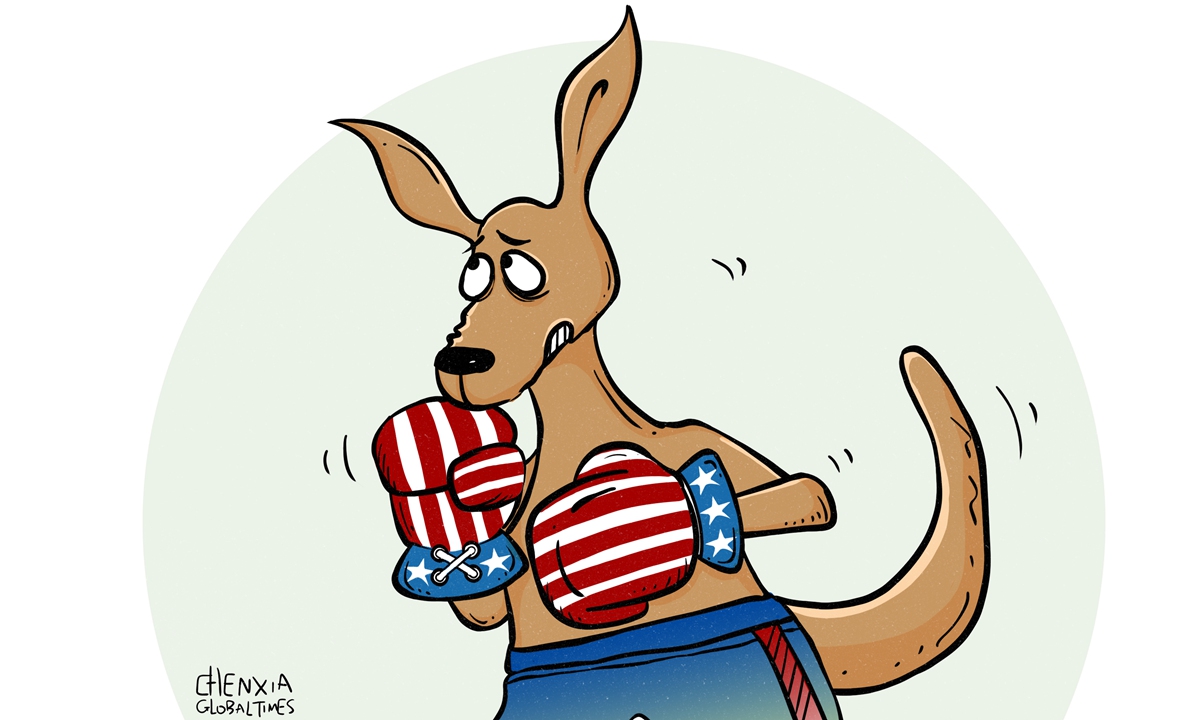
Nonsense to say ‘Australia needs nuclear submarines to defend itself’: Australian scholar
Global Times 24 July 22,
After the Albanese government took office in Australia, there have been discussions about a possible reset of China-Australia ties. Global Times (GT) reporter Yan Yuzhu talked to Professor David Goodman (Goodman), director of the China Studies Centre at the University of Sydney, about his opinions on the reason why there has been hostility in Australia toward China and possible changes in the new government regarding the China policies……………………………..
Goodman:
I think this government is definitely more inclined to deal with sensible diplomacy with China than standing up in public and telling China why it is wrong. That’s a good thing, because talk is always preferable to war.
Penny Wong is a great foreign minister, as she is listening to people and doing things. She has put a whole new working party in place to see how we can more positively deal with our foreign policy. …………………..
A lot of nonsense is talked such as “Australia needs to have nuclear submarines to defend itself.” It doesn’t work, and there are many opinion influencers who agree with me that this is really not healthy.
Of course, we don’t want to be attacked by anyone, but when you think about what it would take China to physically attack Australia, including logistic and military challenges, it will be clear that China will not do so.
But a lot of the defense officials in the past government in Australia are thinking about what we would do as Australians if China “invaded” Taiwan. How crazy. Even people who are anti-China in the UK and the US have said that kind of argument is rubbish, because it is.
What I’d like to see in the bilateral relationship is that the trade ties could ease. The previous government made some statements and criticism about Chinese trade practices which led to bad trade relations between the two countries. I’d like to see them eased. And in my opinion, China has some severe economic problems ahead. It would be in China’s interests to solve them. ………………………………
About Australia’s hostility toward China, one of the reasons is that politicians outside China prefer a threat to exist so that they can use it to mobilize support for themselves. As a result, both China and Russia become the new fashionable threats.
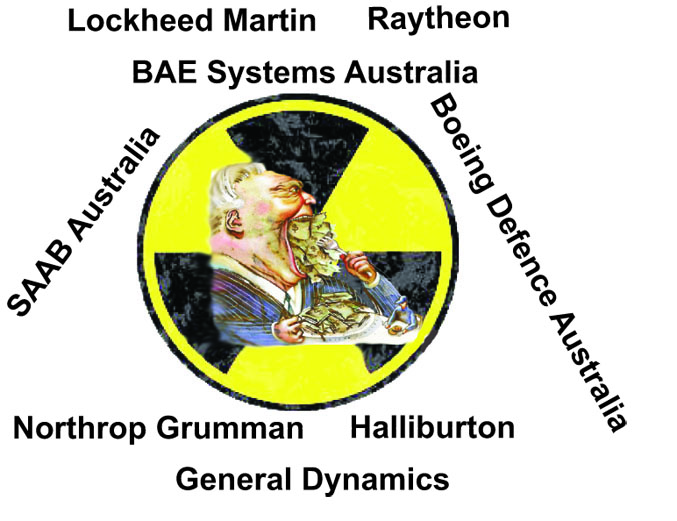
Besides, it is because of the US and European defense industries who fund one of Australia’s leading think tank that leads the charge against China.
Arms makers of course want there to be a China threat because they can sell more. It’s a logic of capitalism I’m afraid.
As to Australia’s stance toward the US, there is a debate going on in Australia as I mentioned before. I don’t know who the majority supports, but there is a sizable body of opinion that doesn’t think that America is the answer to all our problems. There’s also a lot of discussion in Australia about foreign interference and involvement in the local property market. https://www.globaltimes.cn/page/202207/1271242.shtml
Be scared, very scared, as the environment goes from disaster to utter catastrophe
Be scared, very scared, as the environment goes from disaster to utter catastrophe
When Tanya Plibersek released a shocking State of the Environment report this month, she warned Australia could lose the places, landscapes, animals and plants that make it feel like home.
Four lessons for Labor in making its climate targets law — RenewEconomy

The Albanese government should take lessons from existing climate laws to ensure it follows best practice. We can’t afford to get this wrong. The post Four lessons for Labor in making its climate targets law appeared first on RenewEconomy.
Four lessons for Labor in making its climate targets law — RenewEconomy
Solar farms pocket eye-watering returns as fossil fuels drive power prices higher — RenewEconomy

Two solar farms reveal they pocketed average revenue of nearly $200/MWh in the June quarter, thanks to the surge in wholesale prices propelled by fossil fuels. The post Solar farms pocket eye-watering returns as fossil fuels drive power prices higher appeared first on RenewEconomy.
Solar farms pocket eye-watering returns as fossil fuels drive power prices higher — RenewEconomy
Grid Connections: Who’s going where in Australia’s energy transition — RenewEconomy

People movements at RenewEconomy, Pollination, Ethinvest, Green Gravity, Sea Electric, Hydro Tas, CleanCo, Tilt, GSES, ElectraNet, Squadron Energy. The post Grid Connections: Who’s going where in Australia’s energy transition appeared first on RenewEconomy.
Grid Connections: Who’s going where in Australia’s energy transition — RenewEconomy
When They Announce WW3 Let’s Just Say ‘Nah’: Notes From The Edge Of The Narrative Matrix
Caitlin Johnstone, 25 July 22 All of human civilization is being organized around a “great power competition” between the US-centralized empire and the China/Russia/Iran bloc, and that “competition” stands to benefit ordinary humans in no way, shape or form. It will hurt all of us and help none of us.
There’s no valid reason why powerful nations can’t simply work together toward their mutual benefit. But it would mean the US empire giving up its plans of total global domination, so it’s not even being considered.
This conflict is slated to last throughout the 21st century, and it already has a massive body count. The war in Ukraine is a direct result of this “great power competition”, and the economic warfare between the empire and Russia will starve many more. This is a terrible thing.
Our world is being steered toward a dark and dangerous path full of impoverishment, starvation and proxy warfare, and fraught with the possibility of nuclear exchanges. They’re playing games with our lives, and because we’ve bought into the propaganda, we’re letting them………………………………………..
The more things heat up with the Russia/China/Iran bloc the more we’re going to find ourselves hammered with culture war wedge issue bullshit by the social engineers of the oligarchic empire so we don’t start asking inconvenient questions and making inconvenient demands. Inconvenient questions like “Why are we being impoverished so that you can wage a proxy war in Ukraine that we stand nothing to gain from?” and inconvenient demands like “Stop endangering all our lives with nuclear brinkmanship or we’ll fucking eat you.”…………………………
The world will never know peace as long as there are systems in place which financially incentivize war. Hoping for peace without opposing those systems is like jumping off a cliff and hoping gravity doesn’t do what it always inevitably does. https://caitlinjohnstone.substack.com/p/when-they-announce-ww3-lets-just?utm_source=substack&utm_medium=email
MidAmerican shouldn’t waste money studying small nuclear reactors

Small modular reactors and nuclear power represent a dangerous distraction from the changes needed to deal with global warming. https://www.desmoinesregister.com/story/opinion/columnists/iowa-view/2022/07/24/midamerican-energy-small-nuclear-reactors-uneconomical/10104142002/ Dr. Maureen McCue and Dr. M.V. Ramana, Yet again, MidAmerican Energy has expressed an interest in studying nuclear reactors for Iowa. Earlier, between 2010 and 2013, MidAmerican studied the feasibility of nuclear power for Iowa and concluded that it didn’t make sense. This time around, MidAmerican does not even have to embark on the study. We know already that the newest offerings from the nuclear industry, Small Modular Reactors, or SMRs, carry the same economic and environmental risks as their larger predecessors and make no sense for Iowa, or anywhere else for that matter.
In 2013, the Wall Street firm Lazard estimated that the cost of generating electricity at a new nuclear plant in the United States will be between $86 and $122 per megawatt-hour. Last November, Lazard estimated that the corresponding cost will be between $131 and $204 per megawatt-hour. During the same eight years, renewables have plummeted in cost, and the 2021 estimates of electricity from newly constructed utility-scale solar and wind plants range between $26 and $50 per megawatt-hour. Nuclear power is simply not economically competitive.
SMRs will be even less competitive. Building and operating SMRs will cost more than large reactors for each unit (megawatt) of generation capacity. A reactor that generates five times as much power will not require five times as much concrete or five times as many workers. This makes electricity from small reactors more expensive; many small reactors built in the United States were financially uncompetitive and shut down early.
The estimated cost of constructing a plant with 600 megawatts of electricity from NuScale SMRs, arguably the design closest to deployment in the United States, increased from about $3 billion in 2014 to $6.1 billion in 2020. The cost was so high that at least ten members of Utah Associated Municipal Power Systems canceled their contracts. NuScale then changed its proposed plant configuration to fewer reactors that produce only 462 megawatts at a cost of $5.32 billion. For each kilowatt of electrical generation capacity, that estimate is around 80% more than the per-kilowatt cost of the Vogtle project in Georgia — before its cost exploded from $14 billion to over $30 billion. Based on the historical experience with nuclear reactor construction, SMRs are very likely to cost much more than initially expected.
And they will be delayed. In 2008, officials announced that “a NuScale plant could be producing electricity by 2015-16.” Currently, the Utah project is projected to start operating in 2029-30. All this before the inevitable setbacks that will occur once construction starts.
Time is critical to dealing with global warming. According to the Intergovernmental Panel on Climate Change, emissions have to be reduced drastically by 2030 to stop irreversible damage from climate change.
Small reactors also are associated with all of the usual problems with nuclear power: severe accidents, the production of radioactive waste, and the potential for nuclear weapons proliferation. Indeed, some of these problems could be worse. For each unit of electricity generated, SMRs will actually produce more nuclear waste than large reactors. Whether generated by a large or small plant, nuclear waste remains radioactive and dangerous for hundreds of thousands of years. There is no demonstrated solution to permanently isolate this lethal waste, for both technical and social reasons.

Most new nuclear reactor designs will rely on water sources for cooling. Nuclear plants have some of the highest water withdrawal requirements; in the United States, the median value for water withdrawal was calculated as 44,350 gallons per megawatt-hour of electricity generated, roughly four times the corresponding figure for a combined cycle natural gas plant. Renewables require little or no water because there is no heat production. Iowa’s lakes and rivers are already challenged by the warming climate, existing power plants, and polluting industries.
In medicine, a basic principle used to guide our decisions is “first, do no harm.” That principle will be violated if Iowa embarks on building SMRs. Small modular reactors and nuclear power represent a dangerous distraction from the changes needed to deal with global warming. Investing in these technologies will divert money away from more sustainable and rapidly constructed solutions, including wind and solar energy, microgrids, batteries and other forms of energy storage, and energy-efficient devices.
War wins the ‘big bucks’ while climate gets the ‘change’
War wins the ‘big bucks’ while climate gets the ‘change’
Murad Qureshi
Wealthy countries claiming to lead on climate change are spending big on military budgets while denying support to developing countries facing devastation from climate-induced events.
July 24 Energy News — geoharvey

Opinion: ¶ “If You Think A 40°C Heatwave Was Bad, Things Will Only Get Worse Until We Hit Net Zero Carbon Emissions” • This week’s record-breaking heatwave shocked many meteorologists and climate scientists. Although they thought that the UK would eventually see temperatures exceed 40°C, they did not expect it to happen so soon. [The […]
July 24 Energy News — geoharvey
TODAY. Omnicide threatens this planet: the loss of small, ”weak”, vulnerable, species is the warning.

In today’s list of news, there were some little bits of hope. The State of the Environment Report detailed the success stories of indigenous rangers, and of privately run conservation groups.
But there was sadness, too. The native animals disappearing, including tiny bats, and frogs. Ecologists talk about ”key species”, that indicate the health level of an ecosystem,. If ever there was a ”key species” for the whole ecosystem, it’s the frog.
I felt sad, thinking that these small, vulnerable. ”weaker” creatures have no say, in the big decisions made by the out-of-control world’s top predator to dig, mine, clear forests, poison, pollute, blow things up, blow up and kill other species, and its suicidal rush to kill its own species.
But science writer Julian Cribb has come up with a method to save the world. He argues, passionately and persuasively for putting the ”weaker” sex in charge. In The Age of Women, Cribb says that If humanity is to survive the vast and growing threats it faces, women must assume the leadership of government, business, religion and social institutions around the world.
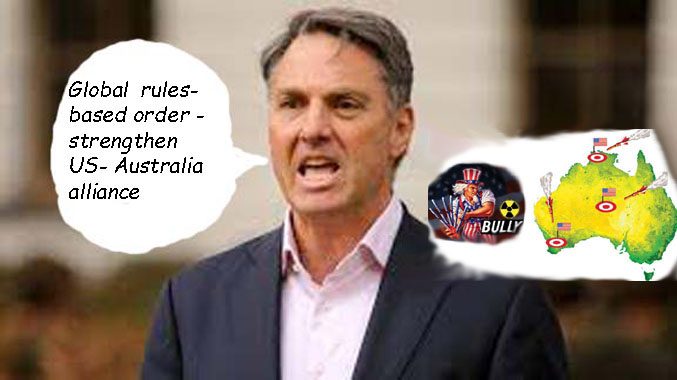
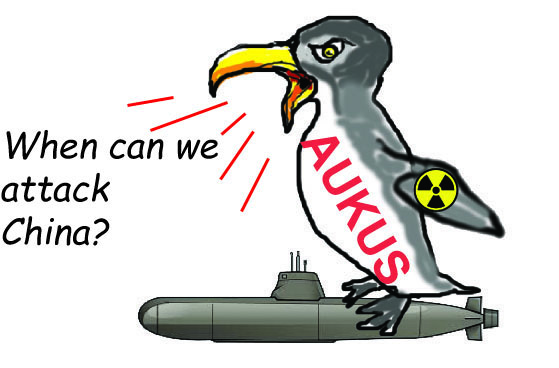
Defence Minister Richard Marles is confident about AUKUS, nuclear submarines, and non-proliferation of nuclear weapons. Not everyone is so sure
Australian National University emeritus professor of strategic studies Hugh White argues there are risks in making the AUKUS agreement at all.
In his new Quarterly Essay, Sleepwalk to War – Australia’s Unthinking Alliance with America, White warns it takes the alliance too far in the strategic contest with China.
Richard Marles on AUKUS nuclear safeguards , The Saturday Paper, By Karen Middleton. 23 Jul 22
” …………………………… “Non-proliferation was a condition of our support for AUKUS from the outset, when we were in opposition,” Marles says in an interview with The Saturday Paper, on his return from Washington, DC, this week.
While there, he discussed progress on the trilateral nuclear technology transfer agreement between Australia, Britain and the United States……..
The first non-nuclear country to seek nuclear-powered submarines, Australia will be required to sign a special International Atomic Energy Agency (IAEA) safeguards agreement. The document is likely to run to hundreds of pages, specifying in minute detail how the material will be handled – accounting for every gram – and with the tightest restrictions on its use. Amid some concern among international law specialists about exploiting existing treaty language around “peaceful use”, the wording will be designed to leave no wiggle room for more malign countries wanting to follow suit.
The greatest potential legal obstacles lie in the fact that the nuclear material is for use on a military platform. Australia’s lack of a nuclear power industry could be a reassurance, reducing the risk. Every aspect of the use and management of the enriched uranium – including in the event of an emergency – will need to be codified.
Marles says Labor’s party room will demand further assurances before consenting to move to the agreement’s next stage, which will involve the choice of future submarine design and how to resolve any capability gap in the meantime. He is confident the concerns can be addressed……………..
Navigating the non-proliferation safeguards with the IAEA is just one of the challenges for the new government in seeking to enact the monumental security agreement it has inherited.
Marles will not say if a Labor government would have taken the same decision as then prime minister Scott Morrison and his Defence minister Peter Dutton to dump the multibillion-dollar French contract for conventional submarines and switch to an American or British nuclear-powered option instead………………
“We have been supportive of the AUKUS agreement when it was announced, and we are supportive now.”
It’s clear that it wouldn’t have happened the same way, not least because of Labor’s volatile internal politics around nuclear energy.
In senior levels of the new government, there is a view that this is part of what motivated Morrison in pushing for the nuclear option to be sealed and announced with such haste. Some are convinced he believed it would wedge Labor on nuclear energy, an intergenerationally contentious issue within the party and particularly in Albanese’s Left faction.
……………….. in Labor’s upper ranks, suspicion about Morrison’s motivation raised further questions about the then prime minister’s attitude to national security.
Now in government, Labor is focused on bringing the wickedly complex submarine acquisition to completion and ensuring national security is not compromised any further along the way.
There’s a high pile of issues to be resolved before Australia has nuclear-powered submarines in the water. With the contract to buy up to 12 Attack-class submarines from France now scrapped in favour of the AUKUS agreement, the government has to decide whether to opt for the American Virginia-class boat or the British Astute-class alternative. While it hopes to get the first of whichever it chooses by the late 2030s, Marles has warned it could be the early 2040s.
That means filling the gap in the meantime.
With the existing six Collins-class submarines already extended from their initial retirement date of 2026 into the 2030s, there is a growing view in government that they will have to be extended again. What else may be required – in the form of some other possible stopgap purchase – is still unclear.
In an apparent bid to force Marles to clarify options, Peter Dutton wrote last month that he had planned to buy two American submarines to plug the capability gap. He said he had “formed a judgment that the Americans would have facilitated exactly that”.
The Saturday Paper understands that Dutton’s public commentary angered Britain, because of its presumption that Australia would choose the American option…………..
Just back from US consultations, Marles dismisses outright Dutton’s assertion about planning to buy two early American boats……………………
there are expensive decisions to be made with enormous consequences for Australia’s security.
By March next year, Marles wants to be able to announce which submarine he has chosen and when the first one will be in the water, quantify the capability gap and explain how it will be filled, outline the cost, describe industry arrangements for construction and detail the undertakings to be given to the IAEA to meet non-proliferation obligations. All this in the next eight months.
He has also vowed to produce a new force posture review in the wake of the 2020 Defence strategic update, which raised fresh questions about the strategic landscape in the region. …..
Delivering submarines makes AUKUS central to that. There is much debate on what else the agreement is meant to be and whether it makes Australia more or less dependent on the US.
In the AUKUS paperwork that has gone before the parliament so far, the submarine deal is described as its “first initiative”.
“AUKUS is about much more than submarines,” says Asia Society Australia executive director Richard Maude, who was foreign policy and security adviser to prime minister Julia Gillard and chief author of the 2017 Foreign Policy White Paper.
“AUKUS is a central platform for more co-operation and sharing of technologies that the Australian Defence Force wants.”
Maude says the issue is the nature of the submarines, not AUKUS. “The risk in AUKUS stems not from the agreement itself but from the decision to jump from a conventional to a nuclear-powered submarine.”
He points to concerning reports from the US that the Virginia-class submarine program’s production time line and costs are blowing out, raising further questions about delivery of an American boat.
“So, it’s not just our capability,” Maude says. “It’s our partner’s capability.”
Australian National University emeritus professor of strategic studies Hugh White argues there are risks in making the AUKUS agreement at all.
In his new Quarterly Essay, Sleepwalk to War – Australia’s Unthinking Alliance with America, White warns it takes the alliance too far in the strategic contest with China.
Maude says the issue is the nature of the submarines, not AUKUS. “The risk in AUKUS stems not from the agreement itself but from the decision to jump from a conventional to a nuclear-powered submarine.”
He points to concerning reports from the US that the Virginia-class submarine program’s production time line and costs are blowing out, raising further questions about delivery of an American boat.
“So, it’s not just our capability,” Maude says. “It’s our partner’s capability
Defence Minister Richard Marles downplays any broader binding role for AUKUS.
“AUKUS is not a security alliance. That’s not what it is,” he says. “Sharing capability and building technology – it doesn’t seek to be any more than that.”
Asked if it will mean an expansion of the US bases at Pine Gap or North West Cape, he would not comment…………………..
At the top of the decision pile for the “first initiative” is which submarine to buy. Neither the British nor the American version is exactly the right fit in size, crewing requirements or capability.
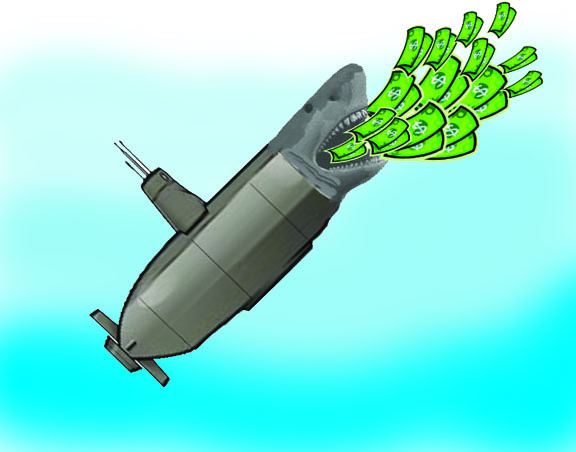
Whichever way they turn, the cost is horrendous at a time when the nation is a trillion dollars in debt…………………….
In Jakarta, there were assurances about respect, in the wake of Indonesian anger that it was not given an AUKUS heads-up. When AUKUS was announced last year, Indonesia said it intended at the next NPT review conference to seek to address what it calls the treaty’s “loophole” that would allow Australia to acquire nuclear-powered submarines. Dealing with nuclear weapons, proliferation and “peaceful use”, the NPT does not specifically go to the issue of nuclear-powered vessels. Rescheduled from January, the conference is in the US next month.
The new government has also had to reassure the nations of the Pacific.
At the recent Pacific Islands Forum, secretary-general Henry Puna, from Cook Islands, presented a report on the South Pacific nuclear treaty, known as the Treaty of Rarotonga, and “other nuclear issues”. The Saturday Paper asked the forum secretariat this week for a copy of the report but did not receive a response before time of press.
Ahead of the forum – and after a visit from Foreign Affairs Minister Penny Wong – Samoan Prime Minister Fiamē Naomi Mata’afa voiced the concerns of some Pacific countries that they were not consulted on AUKUS.
Dr Tess Newton Cain, project leader of the Pacific hub at Griffith University, says there is some unhappiness about a US pattern of using Australia as a diplomatic and defence conduit instead of approaching Pacific nations directly.
“Some of this reflects a belief in the US administration and the US policy community that a good way of understanding the Pacific is to listen to Australia and New Zealand,” Cain says. “From the Pacific side of things, that’s not necessarily how people would see it.”
Overlaying that, Pacific nations have a heightened sensitivity to nuclear matters. Having been the unhappy historical hosts of nuclear testing, they’ve had their own experience with the mushroom cloud. https://www.thesaturdaypaper.com.au/news/politics/2022/07/23/exclusive-richard-marles-aukus-nuclear-safeguards#mtr
1 This month
17 October, Free Public Talk on Nuclear Issues in South Australia
David Noonan will speak on public interest concerns over the new Roxby Downs Indenture Act 2026 on BHP copper-uranium mining and ore processing in SA, and on how AUKUS may face SA with a High-Level nuclear waste agenda.
Dr Jim Green will discuss international developments in the field of nuclear power including ‘small modular reactors’ and Generation 4 ‘advanced’ nuclear reactor concepts.


Help Aunty Sue Protect Her Land and Sacred Sites From Destructive Rocket Testing.
.

Australians deserve the truth
about
AUKUS – https://aukuspublicinquiry.com/

PETITION – To: Prime Minister Anthony Albanese and the Australian Labor Government

of the week – Australians for War Powers Reform (AWPR)
To see nuclear-related stories in greater depth and intensity

