New National Party leader pushes for small nuclear reactors
New Nationals leader David Littleproud lays down challenge to Anthony Albanese, Canberra Times, 30 May 22, ”………………………………………. Mr Littleproud will push for a debate on lifting the moratorium on nuclear energy in Australia, revealing he’s already planning to raise the issue with the new Prime Minister.
“Unfortunately, in the past, there has been this demonisation … without even putting the lens over new nuclear technology like small-scale modular,” he said.
| “Our party room will come to a position on that and it’s one [issue] that obviously we’re very passionate about.”We should back ourselves as Australians to do it better and safer than anyone else. But we need to educate before we legislate.” One of a small number of federal parliamentarians who doesn’t hold a university degree, Mr Littleproud hoped his rise to the Nationals leadership would inspire young people to pursue their dreams.”This reaffirms we live in the greatest country in the planet,” he said. https://www.canberratimes.com.au/story/7760371/im-going-nowhere-lets-talk-nuclear-joyce/ |
Small nuclear reactors may produce more, and more toxic, wastes than large ones do – new research
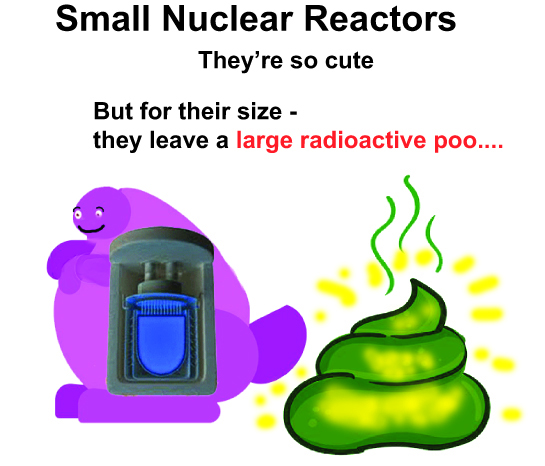
Mini nuclear power stations may produce more waste than large ones. Small modular nuclear reactors may produce higher volumes and greater complexity of radioactive waste because they are naturally less efficient, researchers find, New Scientist, 30 May 2022, By Adam Vaughan, A much-vaunted first wave of mini nuclear power stations may produce more radioactive waste than traditional large-scale ones when generating the same amount of power.
Small modular reactors (SMRs) have been mooted by their developers and proponents as a cheaper and faster way to build new nuclear power capacity, with UK prime minister Boris Johnson claiming they could be generating electricity by 2030. The US government has provided financial support to the firm NuScale Power to develop its version of the technology.
But to date there has been little independent assessment of how the radioactive waste produced by SMRs would compare with that from their large-scale peers.
Lindsay Krall at Stanford University in California and her colleagues used data NuScale Power has shared publicly with US authorities to assess the technology, and extrapolated to model the waste from three different SMR technologies. They compared the SMR technology with a conventional 1.1 gigawatt nuclear reactor, roughly a third of the capacity of a new nuclear plant being built in south-west England.
They have found that SMRs could increase the volume of short-lived low and intermediate level waste – the two lowest of three categories – by up to 35 times compared to a large conventional reactor, when looking at waste produced per unit of electricity generated. For the long-lived equivalent waste, SMRs would produce up to 30 times more and for spent nuclear fuel, up to 5 times more. The variation in these figures reflects expected variation in the SMR designs now being developed.
“The information right now being put out by reactor developers can be seen as promotional,” says Krall. “SMR performed worse on nearly all of our metrics compared to standard commercial reactors.” Those metrics included the heat from radioactive decay and the radiochemistry of the spent fuel.
The study suggests that SMRs produce higher volumes and greater complexity of waste because they are naturally less efficient. Nuclear power generation involves a nuclear chain reaction, in which one single nuclear reaction in the reactor core creates neutrons that then go on to cause an average of one or more subsequent nuclear reactions. However, according to Krall’s team, SMRs leak more neutrons out of their core than a larger reactor, meaning they cannot maintain the self-sustaining reaction for as long. Even a small difference in neutron leakage results in a substantial impact on the composition of the waste, says Krall………………………https://www.newscientist.com/article/2322252-mini-nuclear-power-stations-may-produce-more-waste-than-large-ones/
Australia’s nuclear submarines and nuclear proliferation obligations – how many angels can dance on a periscope?
Ensuring the right safeguards are in place for Australia’s nuclear-powered submarines The Strategist, 30 May 2022, Anastasia Kapetas ”……………………………….. can the submarines be safeguarded? And do they actually need to be under the Treaty on the Non-Proliferation of Nuclear Weapons (NPT)?
As AUKUS was being negotiated, the Biden administration reportedly had serious concerns about the non-proliferation impacts of the deal, given that this would be the first time that a nuclear-weapon state has undertaken to transfer highly enriched uranium (HEU) to a non-nuclear-weapon state.
But experts on the NPT assured the US administration that everyone would meet their obligations under the treaty if Australia were barred from accessing the reactors inside its submarines.
So, the naval reactors would have to be sealed by the US or UK inside the submarine hulls before they came to Australia, remain sealed throughout the 30-year life of the submarine and be removed by the US or UK at the end of that life. That means if the submarines are to be built here, a section of the hull and reactor would need to be built in the US or UK and then moved to Australia. Or, if that is not feasible, then a reactor could possibly be imported into Australia, but with no Australian personnel having access to it at any time, something which would presumably need to be verified by the IAEA in some way that would also not give inspectors access to the reactor.
This means that, in theory, Australia’s naval reactors would not have to be safeguarded because the HEU contained in them would never be accessed by any country that is not a nuclear-weapon state.
Under the NPT, the five accredited nuclear-weapon states, China, Russia, the US, the UK and France, do not have to put their nuclear-weapons-related material under IAEA safeguards, although they all have voluntary safeguards agreements with the IAEA covering their civil nuclear programs.
The NPT doesn’t cover naval reactors. But because the deal involves the transfer of HEU to a non-nuclear-weapon state, Australia is not off the safeguards hook. Not safeguarding this would create a precedent for HEU transfer through naval reactors. So Australia needs not an exemption, as has sometimes been reported, but a new type of safeguard.
John Carlson, former director general of the Australian Safeguards and Non-Proliferation Office (ASNO), who currently advises non-proliferation bodies internationally, and has written extensively on the issue, says standard safeguards can’t apply here.
He gives two reasons. The first is that nuclear-weapon states like the US and UK don’t want to reveal secret information on fuel and rector design to IAEA inspectors.
The other issue is that under a standard IAEA safeguard, inspections must take place regularly. For the irradiated HEU in Australia’s submarines, that would require inspections every three months. But given the nature of submarine deployments, Australia wouldn’t be able to ensure that they would be in port to be inspected at the proper time.
But, says Carlson, ‘Australia has an obligation to demonstrate to the international community that we haven’t simply diverted the fuel, and used it to produce nuclear weapons. This is why we need to develop a verification arrangement with the supplier and the IAEA.’
While it wouldn’t be a standard safeguard, it must be ‘sufficient to demonstrate to the international community, in a credible way, that the fuel is still in the submarines at any point in time’.
But what might some kind of alternative verification mechanism look like?
Given that the naval rectors will be built into the hulls of Australia’s submarines, they could not be accessed without cutting into the hull…………….
| there’s one other scenario that an Australia-specific safeguard would have to cover. And that is in the event of an accident where Australia would need to gain access to the reactor.‘We could claim that that the reactor needed urgent attention, and this would actually be a way to get our hands on the fuel.’This would be a major undertaking. It would require Australia to be equipped with all the equipment necessary to handle the fuel safely, as well as help from the US or UK…………………. The final piece of the safeguard puzzle is the politics. The member states of the IAEA would need to be comfortable with creating a special safeguard for Australia…………….. Carlson thinks IAEA approval is likely, but it will need careful, steady diplomacy. https://www.aspistrategist.org.au/ensuring-the-right-safeguards-are-in-place-for-australias-nuclear-powered-submarines/ |
Japan Court Bars Hokkaido Nuclear Reactors From Operating
Japan Court Bars Hokkaido Nuclear Reactors From Operating https://www.bloomberg.com/news/articles/2022-05-31/japan-court-bars-hokkaido-nuclear-reactors-from-operating-nhk
- Sapporo court rules in favor of anti-nuclear citizens group
- Tomari reactors have been offline for more than a decade
By Shoko Oda, 31 May 22,
A Japanese court ruled in favor of an anti-nuclear citizens group in Hokkaido, saying that a nuclear power plant cannot operate.
The Sapporo District Court said in a ruling on Tuesday that Hokkaido Electric Power Co.’s Tomari nuclear plant isn’t safe to operate due to the earthquake and tsunami risk. A separate request to permanently decommission the plant was rejected by the court, according to court documents. The Tomari facility, which houses three reactors, has been fully offline since 2012.
By
A Japanese court ruled in favor of an anti-nuclear citizens group in Hokkaido, saying that a nuclear power plant cannot operate.
The Sapporo District Court said in a ruling on Tuesday that Hokkaido Electric Power Co.’s Tomari nuclear plant isn’t safe to operate due to the earthquake and tsunami risk. A separate request to permanently decommission the plant was rejected by the court, according to court documents. The Tomari facility, which houses three reactors, has been fully offline since 2012.
The ruling comes amid calls by some Japanese politicians to quickly restart its fleet of shuttered nuclear reactors, as the nation faces a power supply crunch this summer and the upcoming winter. The country closed its nuclear power plants following the 2011 Fukushima disaster, and only a handful have restarted under new safety rules.
While Hokkaido Electric applied to restart the Tomari reactors nearly a decade ago, the arduous review process has dragged on and it isn’t clear when the regulator will approve the facility to resume operations.
The court ruled that the Tomari nuclear reactors don’t have a safeguard facility against tsunamis, and that the utility hasn’t shown adequate safety measures for its spent atomic fuel.
The ruling means that Hokkaido Electric won’t be able to immediately restart the facility. The company said that it will file an appeal on today’s decision.
Members of European Parliament and experts condemn plan to label nuclear as ”green”

MEPs, experts criticise green label for gas and nuclear https://euobserver.com/green-economy/155087
By WESTER VAN GAAL BRUSSELS, 30. MAY,
European lawmakers are gearing up for a July vote which could scupper EU Commission plans to classify gas and nuclear energy projects as sustainable investments until 2030.
On Monday (30 May), MEPs from the environmental (ENVI) and economy (ECON) committees held a public hearing with experts, with some calling on the lawmakers to block the inclusion of gas and nuclear as a green investment.
“This act will heavily damage the credibility of the taxonomy, and I recommend MEPs to reject it,” Sebastian Godinot, an economist at the World Wildlife Fund and a member of the commission’s scientific advisory body, said. “The current EU taxonomy will do worse than current [private sector] green bond standards.”
He also said the labelling of gas as a green energy source would “increase energy insecurity” and boost gas use when the EU is trying to quit Russian gas.
Representatives from the European Investment Bank (EIB), the Joint Research Centre (JRC) and the Dutch Pension Fund (DPF) also attended the meeting.
In January, the commission controversially included nuclear and gas in the so-called EU Taxonomy for green investment, against the explicit advice of its own science experts.
Hartwig Liesch, chief investment officer at DPF, said on Monday that including gas and nuclear in the green taxonomy is “not helpful” as it makes sustainable investment more complex.
Likewise, EIB director Werner Hoyer said at the bank’s annual media conference in Brussels in January this year that the complexity of proposed rules left investors feeling “drowsy.”
Undemocratic
The inclusion of gas and nuclear has been widely seen as a compromise pushed through by an alliance of French pro-nuclear forces and mainly eastern European countries wanting to incentivise EU investments in gas infrastructure.
“This proposal is not science-based but political,” Godinot said.
Another point of contention among MEPs and many experts was the commission’s use of the delegated act, a non-legislative procedure that excluded parliament.
“The parliament has been sidelined. The process is at best sloppy, if not undemocratic,” ECON chair Paul Tang (S&D) said on Monday.
In a comment to Reuters, green MEP Bas Eickhout said the inclusion of gas and nuclear “violated the spirit and letter of the [taxonomy”].
Simple majority
A simple majority vote in parliament — at least 353 MEPs — can still block the current proposal, which is set for early July.
So far the Socialists & Democrats, the Left and the Greens, which together hold 256 seats, have committed to blocking the proposal.
In May, a group of 16 MEPs from groups representing a majority of the European Parliament drafted a motion to block the inclusion of gas and nuclear, but the overall level of support is still unclear.
If the proposal gets blocked, it would end the commission’s efforts to include gas in the taxonomy.
“It simply won’t exist anymore and therefore won’t apply,” said Daniel Ferrie, a spokesperson for the commission, told EUobserver.
Environment report ‘hidden’ by Coalition should be released immediately: Greens
Environment report ‘hidden’ by Coalition should be released immediately: Greens
The new Labor government is facing pressure to immediately release a major environment report which the Coalition was accused of hiding from voters before the federal election.
Weapons designed to mass murder civilians, terrorize the world, and enable impunity for war crimes can no longer be relied on to “prevent war.”
Ban Nuclear Weapons Now
Project Syndicate,May 30, 2022, ANNE-MARIE SLAUGHTER, SUSI SNYDER
Weapons designed to mass murder civilians, terrorize the world, and enable impunity for war crimes can no longer be relied on to “prevent war.” Russian President Vladimir Putin’s aggression in Ukraine and his willingness to brandish the threat of nuclear weapons will spur a renewed drive to rid the world of them.
WASHINGTON, DC – The events of the past three months in Ukraine – like Russia’s annexation of Crimea and incursion into eastern Ukraine in 2014, the US invasion of Iraq in 2003, and the long proxy war in Syria – have given the lie to the claim that nuclear weapons prevent war. Nuclear deterrence might stop nuclear-armed countries from directly engaging in war with each other, just as it might stop proxy wars from escalating and spreading to the North Atlantic or the Pacific. But it is equally possible that nuclear eterrence has caused war and enabled national leaders to act with impunity.
Nuclear weapons have certainly not stopped Russia from waging aggressive war against Ukraine. On the contrary, President Vladimir Putin is using nuclear threats as a shield behind which to commit flagrant, grave, and systematic war crimes – and possibly crimes against humanity.
States that possess nuclear weapons have frequently gone to war with states that lack them. The erroneous belief that Iraq had developed nuclear, chemical, and biological weapons led the United States and its allies to invade the country against the will of the United Nations Security Council, triggering a humanitarian catastrophe and two decades of insecurity in the region and beyond. The Non-Proliferation Treaty (NPT), by suggesting that the status quo of nuclear haves and have-nots should be maintained at all costs, has provided some cover for these actions, as well as for attacks on suspected nuclear facilities in Iraq, Iran, and Syria…………………………………………………………
Nuclear weapons, like all weapons of mass destruction, can never be used within the bounds of the laws of war. Fortunately, the same determined efforts that almost completely ended the deployment of landmines and cluster munitions resulted in the Treaty on the Prohibition of Nuclear Weapons entering into effect in January 2021.
The TPNW – the only treaty that makes the use or threat of use of nuclear weapons illegal – was brought about by all those countries whose security was shattered through decades of proxy wars between nuclear-armed powers. Adopted by 122 countries, it constitutes a recognition that the laws of war apply equally to all states, no matter what is in their national arsenal.
Weapons designed to mass murder civilians, terrorize the world, and enable impunity for war crimes can no longer be relied on to “prevent war.” Another legacy of Putin’s aggression in Ukraine and his willingness to brandish the threat of nuclear weapons will be a renewed drive to rid the world of them. https://www.project-syndicate.org/commentary/ban-nuclear-weapons-now-by-anne-marie-slaughter-and-susi-snyder-2022-05
May 30 Energy News — geoharvey

Opinion: ¶ “Faster, Cleaner, Greener: What Lies Ahead For The World’s Railways” • Faster, cleaner, greener and packed with advanced technology, rail is the only transport mode currently well placed to provide the backbone of our future mobility needs. Ridership may be down due to the pandemic, but rail transportation may be headed to a […]
May 30 Energy News — geoharvey
Nuclear news as May ends – the problems keep getting worse

Some bits of good news – INDIGENOUS INSIGHTS ON HEALING LAND AND SKY. Cuban Farmers Fight Land Degradation with Sustainable Management.
It’s a worrying thought that everyone might just get ”Ukraine fatigue” and let this cruel war grind on. In the meantime, the global nuclear industry is suffering all sorts of upsets, while Elon Musk and the rest of the space war enthusiasts are carrying on, as if there were no problems at all. Hard to single out the most significant nuclear failure, but I think that it would have to be France, where the financial and safety problems just keep getting worse.
AUSTRALIA.
Julian Assange’s family says Australia’s election result brings renewed hope for WikiLeaks founder’s release. Labor urged to act to prevent Julian Assange extradition.
Nuclear. Sydney University radiation case shows the need for stronger environmental laws, with wider scope. Stop Deep Yellow: No uranium mining on Upurli Upurli Nguratja country. Australia’s new Prime Minister backs the UN Nuclear Weapons Ban Treaty. Australia’s weapons-buying binge from USA continues .
Climate. Albanese commits Australia to stronger 2030 target, starts climate reset . The political and media establishment ignored climate – but voters didn’t. The 2022 climate election: unpacking how climate concerned Australians voted Months of more rain likely as BOM report links global warming to flood disasters.
‘I’m so angry, I’m wild’: the never-ending wait to clean up asbestos town Wittenoom
INTERNATIONAL.
What to do about humanity entering “a spiral of self-destruction” – a UN Summit now on in Indonesia. The U.N. “Sustainable Development Goals”- just ”greenwashing” – claim experts. Why nuclear power can’t solve climate crisis – in fact makes it worse- https://www.youtube.com/watch?v=S7rG7-P7E5M&t=306s
When Henry Kissinger gives advice on ending the Ukraine conflict, the West should listen. Ukraine, Taiwan: Biden trip designed to recruit S. Korea, Japan into global anti-Russia/China bloc. They’re Just Outright Telling Us That Peace In Ukraine Is Not An Option.
Book Review: ”Atoms and Ashes’‘ – A Timely History of Nuclear Catastrophes.
Asianization of NATO: China, Russia react to Biden visit War for Taiwan, nuclear war for Japan: Biden pushes two-front campaign against China, Russia. Like the rest of Europe’s few remaining non-members, Ireland being prepped for NATO . Expanding NATO – it’s a $quillion bonanza for the U.S. weapons industries!! Why environmentalists are pushing back against nuclear energy .
Nuclear is already well past its sell-by date. After the meltdown.
Billionaires from USA and Denmark have inordinate influence on public opinion about molten salt nuclear reactors’. Caitlin Johnson, rogue journalist, on corporate control of the media.
“Don’t work for climate wreckers:” UN chief warns young people off fossil fuels.
Curbing other climate pollutants, not just CO2, gives Earth a chance.
Experts call on governments to start including animal welfare in sustainable development governance.
UKRAINE. For the first time in history, nuclear sites have been caught up in the middle of warfare. Ukrainian negotiator rules out deal with Russia.
Australia’s weapons-buying binge from USA continues ..
Australia Wins U.S. Approval to Buy Rocket Launchers
US News, By Reuters Wire Service Content • May 26, 2022, By Katharine Jackson and Mike Stone
WASHINGTON (Reuters) -The U.S. State Department has approved the sale of mobile rocket launchers to Australia, as the country seeks to boost its military presence in the Indo-Pacific region.
The U.S. approved several weapons sales worth as much as $3.1 billion to allies, the Pentagon said on Tuesday, including helicopters to Egypt and missiles to the Netherlands.
Australia has been boosting its defense spending over the past few years as China looks to step up its presence in the Indo-Pacific region. Last year, Australia entered into a deal to buy nuclear submarines from the United States and Britain………….. https://www.usnews.com/news/world/articles/2022-05-26/u-s-oks-potential-sale-of-himars-launchers-to-australia-pentagon-says?context=amp&fbclid=IwAR0V2PJAt2NWed8nKIFzwlN8Lt9d26CrLz_iqf5yCjUhkDisSUxOYm3pBCA
Sydney University radiation case shows the need for stronger environmental laws, with wider scope
The fallout of the University’s radiation case, To see real environmental progress, it is not enough to rely on corporate responsibility; we need a body of enforceable restrictions on corporate and institutional consumption. Honi Soit by Bella Gerardi, May 2, 2022,
Last week, the University of Sydney was fined $61,000 for failing to properly dispose of a radioactive source belonging to a decommissioned medical imaging machine. For an institution that claims to have a strong commitment to the environment, conviction of a criminal environmental offence appears at odds with its sustainability strategy.
The source, which contained a sealed radioactive isotope, was found when a truck delivering scrap metals to a recycling yard set off alarms during a routine radiation check.
Identified as belonging to a PET scanner owned by the University, the Environmental Protection Agency (EPA) charged the University with four individual breaches of the Radiation Control Act. The case didn’t go to court as the University pled guilty, and in exchange the EPA dropped two of the four charges.
………. Last week, the University of Sydney was fined $61,000 for failing to properly dispose of a radioactive source belonging to a decommissioned medical imaging machine. For an institution that claims to have a strong commitment to the environment, conviction of a criminal environmental offence appears at odds with its sustainability strategy.
The source, which contained a sealed radioactive isotope, was found when a truck delivering scrap metals to a recycling yard set off alarms during a routine radiation check.
Identified as belonging to a PET scanner owned by the University, the Environmental Protection Agency (EPA) charged the University with four individual breaches of the Radiation Control Act. The case didn’t go to court as the University pled guilty, and in exchange the EPA dropped two of the four charges.
…………… It is disappointing, but not surprising, that it took a criminal conviction to reach the safeguards imposed today. Unfortunately, the University’s prior lack of clear procedure is indicative of the broader attitude institutions and corporations hold toward environmental crimes. Environmental crimes are often entangled with accidents, negligence, or oversight, and are often not viewed as holding the same gravity as other offences.
Corporations and institutions are responsible for the majority of environmental harm, yet complex corporate hierarchies make it uncommon for individuals to face repercussions for offences, which in turn promotes a lax attitude toward environmental damage.
Is anything changing?
The NSW Government passed the Environment Legislation Amendment Act 2022 (NSW) last month, which broadened the personal liability that executives face if their corporation breaches environmental legislation. If directors financially benefit from a breach of environmental law, they can be criminally prosecuted for that offence, regardless of whether they were personally aware of or involved in the breach.
In bringing a greater threat of personal liability, the new laws will hopefully incentivise directors to take greater care in ensuring company policies uphold environmental laws.
Despite all this, the scope of environmental law as it stands is limited, as most environmental offences relate to waste management or water and air pollution. ………. https://honisoit.com/2022/05/the-fallout-of-the-universitys-radiation-case/
‘I’m so angry, I’m wild’: the never-ending wait to clean up asbestos town Wittenoom
‘I’m so angry, I’m wild’: the never-ending wait to clean up asbestos town Wittenoom
The WA government has announced former asbestos mining town of Wittenoom officially closed. But will it get cleaned up? For one man, time is running out
A first look at federal Labor’s emissions plan finds it wholly insufficient — RenewEconomy

Labor has good intentions on climate and net-zero emissions, but not much of a plan. And it needs to get off the fence on new coal and gas extraction. The post A first look at federal Labor’s emissions plan finds it wholly insufficient appeared first on RenewEconomy.
A first look at federal Labor’s emissions plan finds it wholly insufficient — RenewEconomy
After the meltdown

Because many health impacts appear years or decades after the radiological catastrophe, this allows governments, media and nuclear power proponents to claim minimal health impacts, and thereby to misrepresent the true state of affairs. This downplays the significant long-term health impacts of accidents, including among those who were not alive when the initial radioactive fallout occurred.
The most effective, and precautionary, approach, is the prompt phaseout of nuclear power and its supporting industries, which would be beneficial for both health and the climate.
https://beyondnuclearinternational.org/2022/05/29/after-the-meltdown/ by beyondnuclearinternational, Reactors in a war zone and potential health consequences, By Cindy Folkers, Beyond Nuclear (US) and Dr Ian Fairlie, CND (UK)
Nuclear power plants are vulnerable to meltdown at any time, but they are especially vulnerable during wars, such as we are seeing in Ukraine, as evidenced by Russian attacks on the six-reactor Zaporizhizhia nuclear power facility and on the closed nuclear facility at Chornobyl in March 2022.
Media articles often dwell on the conditions that could spark a meltdown, but attention should also be paid to the possible human health consequences. We answer some questions about the short-term and long-term consequences for human health of a radiological disaster at a nuclear power plant.
What happens at a reactor during a major nuclear power disaster?
The main dangers would arise at the reactor and at its irradiated fuel pool. Loss of power can result in both of these draining down, as their water contents leaked or boiled away. This would expose highly radioactive fuel rods, resulting in meltdowns and explosions as occurred at Fukushima in Japan in 2011, where large amounts of radioactivity were released into the environment.
Explosions, as happened at both Chornobyl and Fukushima, eject radioactive nuclides high into the atmosphere, so that they travel long distances downwind via weather patterns, such as winds and rain. The result is radioactive fallout over large areas, as occurred at Chornobyl and Fukushima. The map below, from the European Environment Agency, shows that the dispersion and deposition of caesium-137 (Cs-137) from the Chornobyl catastrophe in Ukraine in 1986 was far-reaching — covering 40% of the land area of Europe, as it followed weather patterns over the 10-day period of the accident.
Contrary to what many people think, the radioactive fallout from Chornobyl reached the UK (2,500 km away) in 1986 as also shown in the above map [on original].
In Japan, radiation deposition from Fukushima in 2011 also fell in selective areas of Japan, with some radioactive particles traveling as far as 400 km. It is estimated that about 7% of Japan was seriously contaminated.
What is released during a major nuclear power accident?
In the first few days and weeks after the disaster, the first releases are generally short-lived radioactive gases and vapors including tritium (i.e. as tritiated water vapor), xenon, krypton, and iodine. These gases and vapors deliver harmful exposures to people living downwind of the nuclear plant when they are inhaled.
Later, hundreds of non-volatile nuclides can be released. These are non-gaseous, generally longer-lived radionuclides which can nevertheless travel long distances. They include strontium, caesium and plutonium. These pose dangers over longer time periods, contaminating the trees, farms, fields and urban areas where they settle and recirculate for decades afterwards.
Although media reports usually talk about the half-lives of radionuclides (defined as the time it takes for half of the substance to decay), this is misleading, as the hazardous longevity of these nuclides is often 10 to 20 times longer than their radiological half-life. For example, nuclear waste consultants routinely use 300 years (i.e. 10 x the 30-year half-life of Cs-137) as a benchmark for the required longevity of waste facilities.
What are the harmful health effects?
Both short-lived and long-lived nuclides are dangerous.
Although short-lived radionuclides, for example, iodine-131 (I-131) with a half-life of 8.3 days, decay relatively quickly, this means that their doses-rates are high. Therefore during their short times they still give high doses. These cause (a) immediate impacts (e.g. skin rashes, metallic taste, nausea, hair loss, etc.) and (b) diseases years later, such as thyroid cancer, long after the nuclide has decayed away. As they decay, they result in exposures both externally (e.g. to skin) and internally, by inhalation or ingestion.
Longer-lived nuclides in the environment, such as caesium-131 (Cs-137) with a half-life of 30 years, also pose dangers. These occur both initially during the first phases of a catastrophe when they are inhaled or ingested but also decades later when soils and leaf litter are disturbed by storms or forest fires. They can continually expose subsequent generations of people and animals, especially those unable to evacuate from contaminated areas or who lack access to clean food.
Can I protect myself and my family?
The main responses to a nuclear disaster are shelter, evacuation and stable iodine prophylaxis. The most important, in terms of preventing future cancer epidemics, is evacuation, in other words, reducing exposure time as much as possible.
However unless evacuations are properly planned and executed, they can add to the death toll. For an accurate account of what happened during the poorly planned evacuations after the Fukushima see Ian Fairlie’s article, Evacuations After Severe Nuclear Accidents.
Shelter means staying indoors and closing all doors and windows tightly, blocking any areas where air might enter.
Potassium iodide (KI) tablets are proven to be effective in protecting against the harmful effects of fast-traveling iodine-131, as radioactive gases are the first to arrive in the event of a nuclear disaster. This protection is particularly important for pregnant women and children. However KI ONLY protects the thyroid and does NOT provide protection against exposures to the other nuclides commonly released during nuclear accidents, such as caesium-137, strontium-90 and tritium.
Harm down the generations and continuing recontamination
The contamination released by nuclear reactors doesn’t stay in one place. Through forest fires, heavy rains, snowmelt, and human activities such as war, radioactivity in plants and soils can be resuspended later on, becoming available for yet more inhalation or ingestion, ensuring ongoing exposures.
Much of the impact in populations in radioactively contaminated areas could be avoided if people were assisted in moving away in order to stop breathing contaminated air and eating contaminated food. In addition, Korsakov et al., (2020) showed that babies in contaminated areas suffered raised levels of birth defects and congenital malformations.
Studies have also shown that animals living on contaminated lands show an increased sensitivity to radiation compared to their parents (Goncharova and Ryabokon, 1998) and accelerated mutation rates (Baker et al., 2017, Kesäniemi et al., 2017).
What we already know about health effects from nuclear accidents
The radioactive plumes from the Three Mile Island (TMI) nuclear catastrophe near Harrisburg, Pennsylvania US in 1979 resulted in local people complaining of skin rashes, metallic tastes in their mouths, hair loss (Wing, 1997) and the deaths of their pets. These are all deterministic (i.e. cell killing) effects due to exposures to the very high concentrations of the radioactive gases iodine, krypton, xenon and tritium vapor released during the TMI accident. Radiation levels were so high they overwhelmed radiation monitors, which then failed to measure levels, or erroneously registered them as zero.
At TMI, Chornobyl, and Fukushima, children exposed to radioactive iodine in the initial release experienced thyroid problems, including thyroid cancer. At Chornobyl, the link between this exposure and thyroid cancer was definitively made and even accepted by radiation authorities – see UNSCEAR (2008). After Fukushima, the incidence of thyroid cancer has increased to 20 times the expected number of thyroid cancers among those exposed as children. However the Japanese Government and its agencies have refrained from accepting these figures.
Because many health impacts appear years or decades after the radiological catastrophe, this allows governments, media and nuclear power proponents to claim minimal health impacts, and thereby to misrepresent the true state of affairs. This downplays the significant long-term health impacts of accidents, including among those who were not alive when the initial radioactive fallout occurred.
For example, the Torch 2 report in 2016 showed a long list of other health effects apart from thyroid cancer after the Chornobyl disaster.
Women, especially pregnant women and children are especially susceptible to damage from radiation exposure. This means that they suffer effects at lower doses. Resulting diseases include childhood cancers, impaired neural development, lower IQ rates, respiratory difficulties, cardiovascular diseases, perinatal mortality and birth defects — some appearing for the first time within a family in the population studied (Folkers, 2021).
Animals are also harmed: they have been found to suffer from genetic mutations, tumors, eye cataracts, sterility and neurological impairment, along with reductions in population sizes and biodiversity in areas of high contamination.
What needs to happen
During the confusion and upheaval of past nuclear catastrophes, authorities have invariably attempted to downplay the dangers, deny the risks, and even raise allowable levels of radiation exposures. In all cases, they have comprehensively failed to protect the public. This needs to change.
Officials need to acknowledge the connection between radiation exposures and negative health impacts, particularly among women and children, so that early diagnoses and treatments can be provided. Independent, rather than industry-funded, science is needed to fully understand the cross-generational impact of radiation exposures.
Ultimately, the best protection is the elimination of the risk of exposure, whether from routine radioactive releases or from a major disaster. The most effective, and precautionary, approach, is the prompt phaseout of nuclear power and its supporting industries, which would be beneficial for both health and the climate.
Read the report with full references — Possible health consequences of radioactive releases from stricken nuclear reactors — and a second report by Dr. Fairlie — A Primer on Radiation and Radioactivity—here.
Cindy Folkers is the radiation and health hazards specialist at Beyond Nuclear. Dr. Ian Fairlie is an independent consultant on radioactivity in the environment.
Nuclear dependence
Europe must cut off Russian nuclear supply routes, From Ecodefense, Russia, Beyond Nuclear 30 May 22
Europe needs a plan in place for cutting ties with Russia’s nuclear giant Rosatom, says 2021 Right Livelihood Award winner and co-chairman of Ecodefense Vladimir Slivyak.
With the European Union tightening its sanctions against Russia, banning Russian imports of oil, gas, and coal has emerged as one powerful tool to starve the Kremlin’s war machine of funding it needs to continue its brutal aggression in Ukraine.
But one other major source of Russia’s revenue in Europe has largely remained unnoticed: Russia’s supplies of nuclear fuel and services to European nuclear power plants.
Seeking to close this gap in Europe’s concerted action against the war in Ukraine and to provide a comprehensive picture of the union’s reliance on Russian nuclear technology, environmentalists Patricia Lorenz, of Friends of the Earth Europe, and Vladimir Slivyak, a 2021 Right Livelihood Award laureate and co-chairman of the Russian environmental group Ecodefense, jointly presented over Zoom Russian Grip on EU Nuclear Power – an overview of Russia’s businesses and supply chains serving the European nuclear market.
The report comes on the heels of the European Parliament’s resolution demanding a full embargo on Russian nuclear fuel as well as oil, gas, and coal, and as Moscow’s war reveals the terrifyingly irresponsible actions at the hands of Russian troops at or near the sites of Ukraine’s nuclear power plants.
Through its uranium-producing mines, the fuel manufacturing subsidiary TVEL, and a number of other enterprises – including the German firm NUKEM and the Czech-based Škoda JS – as well as ties with France’s Framatome, Russia’s nuclear giant Rosatom earns billions supplying uranium, fuel assemblies, and maintenance, storage and transport services to nuclear companies and power plants in European countries. This includes fuel deliveries to Soviet-built nuclear power plants in Ukraine.
According to a late April report carried by Rosatom’s corporate outlet Strana Rosatom, the corporation’s total foreign revenue in 2021 rose 20.3% year on year, reaching $8.9 bn. In the first three months of 2022, Rosatom’s foreign earnings grew by 13%. TVEL’s revenue from nuclear fuel exports stood at $0.7 bn in 2020, said the corporation’s annual report for that year.…………………………………..
……….. Ecodefense’s Slivyak:
“Europe must stop its cooperation with Rosatom – stop participating in joint projects, including building nuclear power plants. Stop buying nuclear fuel from Rosatom,” he said.
…………. “A plan to replace nuclear energy with energy from other sources must be created, and the [Russia-dependent] operating reactors must be shut down,” Slivyak said. https://beyondnuclearinternational.org/2022/05/29/nuclear-dependence/
1 This month.


PETITION – To: Prime Minister Anthony Albanese and the Australian Labor Government
Chernobyl: The Lost Tapes – A good documentary on Chernobyl on SBS available On Demand for the next 3 weeks– https://www.sbs.com.au/ondemand/tv-program/chernobyl-the-lost-tapes/235274195556

19 May – Webinar- Webinar: No Nuclear Weapons in Australia
Start: 2026-05-19 18:00:00 UTC Canberra, Melbourne, Sydney (GMT+10:00)
End: 2026-05-19 19:30:00 UTC Canberra, Melbourne, Sydney (GMT+10:00)
20 May – Webinar – The dangerous world of AUKUS, US, military occupation and suppression of dissent

National Webinar, 20th May, 2026, 6.30pm AEST. Confronting laws restricting/suppressing protest speech and action
Speakers: Former Sen. Rex Patrick, Lawyer Nick Hanna ,Arthur Rorris ,Jorgen Doyle, Sen David Shoebbridge,
Facilitator Kelley Tranter.

of the week – Australians for War Powers Reform (AWPR)
To see nuclear-related stories in greater depth and intensity
 Antinuclear