Poisoned legacy: why the future of power can’t be nuclear

Warfare, economic collapse, climate change itself – all of these increasingly real risks make nuclear sites potentially perilous places. Even without them, the dangers of atomic fission remain, and we must ask ourselves: are they really worth the cost?

the reactors promised by Gates’s TerraPower company are still at the computer-simulation stage and years away from construction. But his claim that in such reactors “accidents would literally be prevented by the laws of physics” must be taken with a pinch of salt, as there are no laws of war protecting either old or new reactors from attack. There is also serious concern that the rapid expansion in the number of plants, advocated as a way of dealing with climate change, will increase the probability of accidents. While new technology will help to avoid some of the old pitfalls, it will also bring new risks associated with untried reactors and systems. Responsibility for dealing with such risks is currently being passed on to future generations.
This is the second great risk from nuclear power: even if a reactor runs for its lifetime without incident, you still have a lot of dangerous material left at the end of it. Fuel from nuclear power plants will present a threat to human life and the environment for generations to come
The problem is that the underground store will still be contaminated in 300,000 years, and no one can predict what language our descendants will read or speak at that time, or what messages might convince them not to dig
Billions that would otherwise go to new nuclear infrastructure, with all the attendant costs of cleanup that continue for decades and beyond, should be pumped instead into clean energy.
Guardian, Serhii Plokhy, Sat 14 May 2022
On 10 October 1957, Harold Macmillan sent a letter to President Dwight Eisenhower. The question he asked his US counterpart was: “What are we going to do about these Russians?” The launch of the Sputnik satellite six days earlier had carried with it the threat that Soviet military technology would eclipse that of the west. The prime minister was hoping to boost British nuclear capabilities, and was desperate for US cooperation.
On that same day, however, the UK’s most advanced nuclear project went up in flames – putting the knowledge and bravery of its best scientists to the test, and threatening England’s peaceful countryside with a radiological disaster.
Britain’s first atomic establishment had been hurriedly put together after the second world war. It had turned the small village of Seascale, on the Cumbrian coast, into one of Britain’s most highly educated places, brimming with nuclear scientists and engineers. At the centre of this rarified new world were two buildings: Windscale piles No 1 and No 2. They were Britain’s first nuclear reactors, on a campus that for decades afterwards would be used to produce energy for the grid, but their primary purpose was to produce the material for a British bomb.
One atomic energy official would later refer to the piles as “monuments to our initial ignorance”, and it was ignorance about one particular nuclear phenomenon that almost led to disaster. “Wigner energy” is the energy that accumulates in the graphite blocks that make up the main body of the reactor while the fission reaction is taking place. If it’s not released in time, the energy can build up to such an extent that it ignites the graphite. Periodically, a special operation called “annealing” has to be undertaken in order to release the excess energy.
Macmillan wanted Windscale to produce more plutonium and tritium for a hydrogen bomb as quickly as possible. But annealing required stopping the reactor. The Windscale Technical Evaluation Committee decided it would be safe to do it less often. Managers had scheduled the annealing of Pile No 1 for early October 1957, but it was long overdue.
It began at 11.45am on 7 October, under the supervision of physicist Ian Robertson. Everything seemed to go according to plan, ……………… Robertson was back at the pile for 9am the following day. …..The temperature in the pile was not behaving as predicted and it was a challenge to keep things stable. The operators managed to maintain control for the rest of the day and night, but on 9 October the temperature began to rise again. As the situation became critical, no one could tell what was going on inside the pile…………there it was – a fire at the face of the reactor.” Normally it was dark, but now the channels were glowing bright red from the soaring temperature.
Aratcheting up of tensions with Russia, a global pandemic and a scramble for nuclear energy with potentially deadly consequences. The echoes of 1957 are powerful, and though much has changed, we would do well to heed them.
When Russia launched its missiles at targets deep inside Ukrainian territory on 24 February, 2022, the shockwaves were felt far beyond that country’s borders. Outside politics, nowhere was the impact stronger than in the energy markets.. Prices that were already hitting historical highs jumped even higher. European countries immediately saw the need to wean themselves off dependence on Russian gas.
………… Nuclear energy – which, after all, provides France with 70% of its electricity – was quickly touted as a solution. In fact, a few weeks before the start of the war, President Emmanuel Macron had already announced a programme to construct 14 new nuclear reactors. In neighbouring Belgium, which had originally planned to phase out nuclear energy by 2025, a decision was made to extend the life of two reactors by an additional 10 years.
In the UK, Boris Johnson’s rhetoric extended even further. He announced “nuclear is coming home” (Calder Hall, right next to Windscale, was among the first civilian nuclear reactors in the world) and pledged to make it 25% of the nation’s electricity mix by 2050.
On the surface, the switch to nuclear makes sense. ………..
But the invasion also provided a chilling reminder of just why so many governments have treated nuclear power with great caution over the years. On the first day, Russian troops in unmarked uniforms took control of the Chernobyl nuclear power plant, the site of the worst ever nuclear disaster. On the following day, electronic monitors in the Chernobyl exclusion zone indicated sharp spikes in radiation levels as heavy equipment and trench-digging by Russian soldiers threw up contaminated dust.
The world woke up to an even more nightmarish reality a week later, when news arrived from the Zaporizhzhia nuclear power plant in southern Ukraine. Reports suggested that Russian forces had shelled the plant and set one of its buildings on fire. Russian troops left Chernobyl once they lost the battle for Kyiv, but they remained in Zaporizhzhia, further endangering the operation of Europe’s largest nuclear power station. On 26 April, Ukraine’s state-run atomic energy company reported that Russian missiles aimed at the town of Zaporizhzhia flew at low altitude over the reactor buildings.
What the Russian takeover of these nuclear facilities exposed is a hazard inherent in all nuclear power. In order for this method of producing electricity to be safe, everything else in society has to be functioning perfectly. Warfare, economic collapse, climate change itself – all of these increasingly real risks make nuclear sites potentially perilous places. Even without them, the dangers of atomic fission remain, and we must ask ourselves: are they really worth the cost?
The Windscale fire was eventually brought under control through a combination of scientific guesswork and sheer luck. Had it not been, the consequences could have been devastating. As it was, in 1982, the British National Radiological Protection Board estimated the death toll at 32 and attributed more than 260 cases of cancer to the fire. Windscale workers and engineers directly involved in the accident were more likely to die of circulatory system diseases and heart disease than the population of England and Wales as a whole. But there was virtually no difference in the disease rates of workers and their immediate neighbours in northwestern England, suggesting that the fire and other accidents at the complex affected not just the nuclear personnel but many who never crossed the threshold of the nuclear plant.
Continue readingThe dangers of atomic fission remain, and we must ask ourselves: are they really worth the cost?
Pentagon-Funded Think Tank Simulates War With China On NBC

https://caitlinjohnstone.com/2022/05/16/pentagon-funded-think-tank-simulates-war-with-china-on-nbc/ 16 May 22
the mass media are now openly teaming up with war machine think tanks to begin seeding the normalization of a hot war with China into the minds of the public
As we’ve discussed previously, citing war machine-funded think tanks as expert analysis without even disclosing their financial conflict of interest is plainly journalistic malpractice. But it happens all the time in the mass media anyway, because the mass media exist to circulate propaganda, not journalism.
This is getting so, so crazy. That the mass media are now openly teaming up with war machine think tanks to begin seeding the normalization of a hot war with China into the minds of the public indicates that the propaganda campaign to manufacture consent for the US-centralized empire’s final Hail Mary grab at unipolar domination is escalating even further. The mass-scale psychological manipulation is getting more and more overt and more and more shameless.
This is headed somewhere very, very bad. Hopefully humanity wakes up in time to stop these lunatics from driving us off a precipice from which there is no return.
NBC’s Meet the Press just aired an absolutely freakish segment in which the influential narrative management firm Center for a New American Security (CNAS) ran war games simulating a direct US hot war with China.
CNAS is funded by the Pentagon and by military-industrial complex corporations Northrop Grumman, Raytheon, and Lockheed Martin, as well as the Taipei Economic and Cultural Representative Office, which Antiwar’s Dave DeCamp has described as the de facto US embassy in Taiwan.
The war game simulates a conflict over Taiwan which we are informed is set in the year 2027, in which China launches strikes on the US military in order to open the way to an invasion of the island. We are not told why there needs to be a specific year inserted into mainstream American consciousness about when we can expect such a conflict, but then we are also not told why NBC is platforming a war machine think tank’s simulation of a military conflict with China at all.
It happens that the Center for a New American Security was the home of the man assigned by the Biden administration to lead the Pentagon task force responsible for re-evaluating the administration’s posture toward China. That man, Ely Ratner, is on record saying that the Trump administration was insufficiently hawkish toward China. Ratner is now the Assistant Secretary of Defense for Indo-Pacific Security Affairs in the Biden administration.
It also happens that the Center for a New American Security has openly boasted about the great many of its other “experts and alumni” who have assumed senior leadership positions within the Biden administration.
It also happens that CNAS co-founder Michele Flournoy, who appeared in the Meet the Press war games segment and was at one time a heavy favorite to become Biden’s Pentagon chief, wrote a Foreign Affairs op-ed in 2020 arguing that the US needed to develop “the capability to credibly threaten to sink all of China’s military vessels, submarines, and merchant ships in the South China Sea within 72 hours.”
It also happens that CNAS CEO Richard Fontaine has been featured all over the mass media pushing empire narratives about Russia and China, telling Bloomberg just the other day that the war in Ukraine could serve the empire’s long-term interests against China.
“The war in Ukraine could end up being bad for the pivot in the short-term, but good in the long-term,” Fontaine said. “If Russia emerges from this conflict as a weakened version of itself and Germany makes good on its defense spending pledges, both trends could allow the US to focus more on the Indo-Pacific in the long run.”
It also happens that CNAS is routinely cited by the mass media as an authoritative source on all things China and Russia, with no mention ever made of the conflict of interest arising from their war machine funding. Just in the last few days here’s a recent NPR interview about NATO expansion with CNAS senior fellow Andrea Kendall-Taylor, a Washington Post quote from CNAS fellow Jacob Stokes about the Chinese threat to Taiwan, a Financial Times quote from CNAS “Indo-Pacific expert” Lisa Curtis (who I’ve previously noted was cited by the mass media for her “expert” opposition to the US Afghanistan withdrawal), and a Foreign Policy citation of the aforementioned Richard Fontaine saying “The aim of U.S. policy toward China should be to ensure that Beijing is either unwilling or unable to overturn the regional and global order.”
As we’ve discussed previously, citing war machine-funded think tanks as expert analysis without even disclosing their financial conflict of interest is plainly journalistic malpractice. But it happens all the time in the mass media anyway, because the mass media exist to circulate propaganda, not journalism.
This is getting so, so crazy. That the mass media are now openly teaming up with war machine think tanks to begin seeding the normalization of a hot war with China into the minds of the public indicates that the propaganda campaign to manufacture consent for the US-centralized empire’s final Hail Mary grab at unipolar domination is escalating even further. The mass-scale psychological manipulation is getting more and more overt and more and more shameless.
This is headed somewhere very, very bad. Hopefully humanity wakes up in time to stop these lunatics from driving us off a precipice from which there is no return.
US atomic bombs back in Britain? — Beyond Nuclear International


Speaking recently about the risks of the Ukraine war turning nuclear, I said that it was precisely these weapons, at bases across Europe, that would be likely to be used first in a nuclear war over Ukraine – that the US/Russia war will be fought in Europe.
Endangers prospects for peace in Europe
US atomic bombs back in Britain? — Beyond Nuclear International Move puts UK on front line in a NATO/Russia war
By Kate Hudson
News that US nuclear weapons may already be back in Britain, at RAF/USAF Lakenheath in East Anglia, makes Britain once again a forward nuclear base for the US in Europe.
110 US/NATO free-fall B61 nuclear bombs were removed from Lakenheath in 2008, following sustained protest at the base by CND and the Lakenheath Action Group. US nuclear bombs had been located there since 1954.
Their return – assigned to NATO – will increase global tensions and put Britain on the front line in a NATO/Russia war. B61s have continued to be sited in five other countries across Europe – Belgium, Germany, the Netherlands, Italy and Turkey – in spite of strong opposition within some of the ‘host’ countries.
Now the UK has been added to the US’s list of European sites in line for infrastructure investment for storing ‘special weapons within secure sites and facilities’. Special weapons mean nuclear weapons and this is happening in the context of increasing tension with Russia and the current escalating war.
Their return – assigned to NATO – will increase global tensions and put Britain on the front line in a NATO/Russia war. B61s have continued to be sited in five other countries across Europe – Belgium, Germany, the Netherlands, Italy and Turkey – in spite of strong opposition within some of the ‘host’ countries.
Now the UK has been added to the US’s list of European sites in line for infrastructure investment for storing ‘special weapons within secure sites and facilities’. Special weapons mean nuclear weapons and this is happening in the context of increasing tension with Russia and the current escalating war.
Their return – assigned to NATO – will increase global tensions and put Britain on the front line in a NATO/Russia war. B61s have continued to be sited in five other countries across Europe – Belgium, Germany, the Netherlands, Italy and Turkey – in spite of strong opposition within some of the ‘host’ countries.
Now the UK has been added to the US’s list of European sites in line for infrastructure investment for storing ‘special weapons within secure sites and facilities’. Special weapons mean nuclear weapons and this is happening in the context of increasing tension with Russia and the current escalating war.
Since the weapons were removed in 2008, the empty storage vaults for the weapons have been on ‘caretaker’ status, but reports of nuclear exercises at Lakenheath increase the likelihood that nuclear weapons are back, or on their way; the base currently hosts F-15E fighter-bombers with nuclear capability but these are being replaced by the new nuclear- capable F-35A Lightning. The first of these new fighter- bombers arrived in December 2021.
Within the next year US/NATO nuclear bases in Europe will also receive the new B61-12 guided nuclear bomb which is entering full-scale production in the US.
The return of US nuclear weapons to Britain and the upgrading of its nuclear weapons across Europe constitutes a further undermining of prospects for peace in Europe and beyond.
The US is the only country to locate its nuclear weapons outside its own borders and this major increase in NATO’s capacity to wage nuclear war in Europe is dangerously destabilising.
Whether they have already been returned to Britain, or their delivery is still in preparation, this is a huge challenge for the peace movement and we will do everything we can to prevent these weapons being sited here.
Speaking recently about the risks of the Ukraine war turning nuclear, I said that it was precisely these weapons, at bases across Europe, that would be likely to be used first in a nuclear war over Ukraine – that the US/Russia war will be fought in Europe.
This was our worst fear in the 1980s when millions mobilised across Europe against cruise and Pershing missiles being sited here. In the 1980s we got rid of all those weapons, and we have to have the energy, the commitment and the confidence to do that again.
To join the 1-3pm May 21 protest at RAF Lakenheath, Suffolk and to find out about transport arrangements, see the CND website or contact information@cnduk.org for more information.
Join CND to protest against US nuclear weapons in the UK.
Kate Hudson is the General Secretary of the Campaign for Nuclear Disarmament (CND).
Doomed — Beyond Nuclear International

New reactors a false solution that would break state law
Doomed — Beyond Nuclear International New nuclear won’t make the cut in Washington State
By Roger Lippman
It was 108 degrees in the shade in Seattle last June; the climate emergency now has the attention of the usually temperate Puget Sound area. The following December’s cold snap may also have to do with climate-related disruptions that climatologists tell us are weakening the polar vortex. As the crisis grows, it attracts the nuclear industry’s purveyors of false solutions, with a barrage of calls for further investment in nuclear power.
As I write, nuclear promoters are trying to sell a group of small municipal utilities, the Utah Associated Municipal Power Systems (UAMPS), on a “new, improved” nuclear technology, known as small modular nuclear reactors.
Supposedly the reactors will be mass produced, but first they must be proven in the field, at high startup cost. Who will want to be the first to put up money that can never be recovered in electricity sales? Predictably, the project has already struggled with delays, design changes, and escalating cost projections.
Of the initial subscribers, about 10 have reduced their commitments or pulled out altogether in the past year and a half. That just leaves the rubes, who have signed up for only a quarter of the project’s electrical output.
An effective approach to climate change requires the quickest and cheapest choices to reduce carbon emissions. Nuclear power, the slowest and most expensive, takes time and resources away from the available solutions, namely energy efficiency, solar, and wind power.
Furthermore, with rising sea levels and the wildfires that have already been a threat to the Hanford nuclear reservation in Eastern Washington, the climate crisis poses a threat to nuclear power itself.
Climate conditions simply do not lend themselves to slow, dangerous and expensive new nuclear technology, and yet the drumbeat goes on, and at our expense.
For example, the Bill Gates Natrium reactor project to be built in Wyoming would get half its projected $4 billion cost in federal subsidies. The design uses enriched uranium that would be an attractive target for terrorists. This highly speculative project, if it ever succeeds, will take years before it produces any power. These billions could produce quick results if invested in energy efficiency and clean, renewable energy sources.
Even the US Nuclear Regulatory Commission isn’t fully bought in. A November 2021 Seattle Times article quotes Peter Bradford, a former NRC Commissioner, who said, “I’m frankly speechless at the success that the proponents of these plants have had in bamboozling … a lot of government officials.”
…………………………………………………… Of the billions that have already been wasted — and could be again — on failed nuclear projects, a tiny fraction thrown our way back then would have cured our plastics problem.
And yet today, would-be, should-be, wouldn’t-be, and wannabe environmentalists are instead being heard promoting new nuclear power stations as an essential part of the decarbonization process. But it’s time to take a close look at why that approach is doomed.
The scandal that the same Times article reveals is that Congress, and some local jurisdictions, are passing multi-billion-dollar giveaways to the nuclear industry for schemes unlikely to accomplish anything but propping up an industry that should be allowed to collapse of its own weight.
They continue to promote unproven technologies that won’t provide low-carbon electricity in the next decade; that create nuclear waste with no disposal solution; and that take money away from clean, safe, renewable projects that could come online quickly.
Even if these projects could work (doubtful), they would not be legal in Washington State. The CEO of X-energy, quoted in the Times, cited the state’s Clean Energy Transformation Act, which calls for all fossil-fuel power to be off the grid by 2045 and sets firm limits on what can replace it. The law requires our utilities to pursue all cost-effective conservation, efficiency, and demand response before building new power plants.*
Energy Northwest, which operates the state’s only nuclear power station, and its member utilities, are subject to this standard. New nuclear power is not going to make the cut.
Old timers in Washington remember that two of the five notorious Washington Public Power Supply System (WPPSS, now Energy Northwest) nuclear power plant projects went bankrupt, two more were abandoned, and only one was completed: WPPSS-2, now known by the sanitized name Columbia Generating Station.
The city of Port Angeles buys all of its electricity from the Bonneville Power Administration, which markets the output of WPPSS-2. That expensive power impacts Bonneville’s wholesale rates. A planner for the Port Angeles electric utility told me that, if Bonneville dropped nuclear power, the rate reductions could fund conversion of a substantial number of houses in his city from antiquated electric baseboard heaters to high-efficiency heat pumps. This is what energy conservation looks like.
The misdirection of energy investment continues, with a barrage of government-funded proposals without a chance of success (except to prop up their promoters). In April, President Biden announced a $6 billion subsidy to keep open a number of economically failing nuclear plants.
WPPSS/Energy Northwest, until recently one of the movers behind the UAMPS nuclear project described above, has jumped ship and is now promoting yet another new nuclear project at Hanford.
What are the chances of nuclear generation being designed, licensed, funded, built, and operating before 2030? Slim to none, based on past experience. https://wordpress.com/read/feeds/72759838/posts/4014951358
May 15 Energy News — geoharvey

Opinion: ¶ “How We Can Stop Lithium Mining From Depleting Water Resources, Draining Wetlands, And Harming Communities In South America” • To deal with climate change, we must move away from fossil fuels and toward clean energy. However, many green technologies depend on lithium, and extracting lithium can be destructive. [CleanTechnica] Uyuni Salt Flat (Samuel […]
May 15 Energy News — geoharvey
Today. A lot of scathing comments on the story of how the AUKUS nuclear submarine deal came about

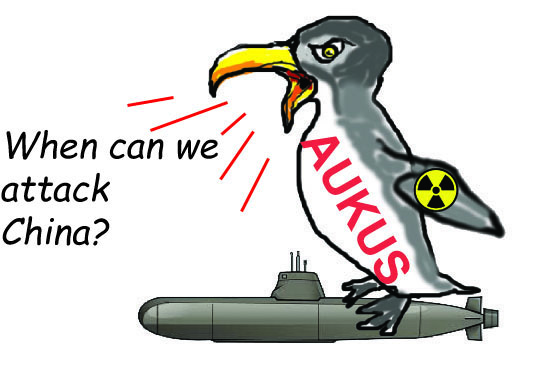
I wonder for just how long will these horribly expensive nuclear submarines actually be useful to Australia, if indeed, they ever are.? Australia needs submarines of a shorter range to monitor its own coastlines, – not long range ones that could be equipped with weapons, (later on nuclear weapons) for attacking China.
Meanwhile China is developing hundreds of swarms of much cheaper drones. that can detect nuclear submarines, and even attack them.
Maybe the USA and UK are very happy to get Australia to pay the costs of soon-to-be-obsolete underwater monster,. And the costs of disposing of them – a problem not yet solved by any country.
In today’s Age and Sydney Morning Herald, Peter Harcher gives a detailed story on the secret negotiations that brought Australia to the AUKUS deal, and the plan to spend many $170Billion on nuclear submarines. Many questions on this – not least – where will the money come from?
Scott Morrison has the nerve to accuse Labor of financial extravagance, as Labor leader AnthonyAlbanese promises to spend a tiny fraction of that on fixibg our desperate health care system – as Australianhospitals struggle undervthe continuing onslaught of the pandemic.
Anyway – I’m not the only one to notice this. Many comments below that article. Here are just a few:
Misnomer ”they could allow Australia to pose a direct threat to the Chinese mainland”
Exactly. Our war mongers in Canberra aren’t interested in defence, they want war with China. They have written a $100+ billion blank cheque for the “crown jewels” (seriously?), leaving us without subs and defence for decades so hairy-chested Morrison and Dutton can bang the defence drums for an election.
The subs are a political play from a reckless, spendthrift government beholden to the US, which is happy to take a huge chunk of our debt-fuelled cash and let us fight their war against China.
Ditch the subs. They are a folly from an out-of-control government and should be the first thing Labor axes in the name of debt repair.
Inner West Andrew…. The French option should not have been discarded so readily on what appears to be a political process instigated by scotty from marketing in secret and using notes on the back of a beer coaster. The lack of proper policy development on the AUKUS deal is truly astonishing. Neither Britain or America are likely to have the spare capacity to help us obtain a fleet of even just 3 nuclear submarines for decades. meanwhile we have a massive capability gaps, just as Dutton appears determined to start a war.
Budawang The momentous decision to bankroll the US projection of power against China in the Western Pacific for decades to come was made without any public debate and without even consulting with Labor. This is not the sign of a well-functioning democracy.
lets be frank. Since ScoMo didn’t talk to Albo . Albo as PM should bite the bullet and CANCEL THE NUCLEAR DEAL . Its too far above our budget and capability. It will bankrupt us . Scomo has shown himself to be the most incompetent reactive idiot in a conga line of LNP incompetent reactive idiots. This is what happens when you have amateurs in the Lodge
Ultracrepidarianist. Great article Peter. When the high financial cost was discussed the treasurer reaction was “Everything is affordable if it’s a priority. This is a priority.”
I now understand why major issues such as aged care are given superficial attention.
The Coalition does not perceive sorting out aged care issues as a priority.’
Shame on them. I no longer fall into the undecided voter category.
Alfie. There are a lot of quotes from private and sensitive conversations in this piece.
It wreaks of placement by invested parties to justify the most expensive and controversial defence project in Australia’s history.
Any further explanation on how all this information was obtained Mr Hartcher?
Oh well. So, “ScoMo” began the move to nuclear subs at least 2 years before the deal was announced, and the French informed. All so he could make the laughable boast that Australia could, once we got them, “threaten” China. This is what happens when you ask military people whether you should buy them more military toys.
SteveM. Just imagine Dutton as PM with nuclear powered attack subs to play with.
JF. Yet more proof that Scotty from Marketing is both overly partisan and hopelessly incompetent. Australia deserves much better than this appalling LNP clown show pseudo government. Time for them to go.
Phil 1943 Why wouldn’t the US and UK rush to accept the offer of a base – or bases, for their naval assets in Australia without the inconvenience of having to pay for them? If all goes as vaguely announced by the LNP, Australia will fork out big bucks for a smallish fleet of nuclear subs that will be serviced here in ‘joint’ facilities that will be shared with those two nuclear-experienced nations while we learn how to operate our submersible purchases.
During the twenty or so years while we wait for this questionable deal to coalesce, our allies will have new Australian bases to show on the maps of their global military facilities. And it’s going to cost us billions of dollars in the interim. We can only hope Albo says ‘no’.
mmanuel Can. The fact it makes us more of a target doesnt seem to have been given too much weight.
Allan Woodley. I guess that’s what he was doing in Hawaii during the bushfires.
Southerner. So this puts into perspective China’s reaction to Australia, the trade bans and the Solomons and China’s spy ships cruising in international waters off Australia’s coast. Why does Australia need an attack capacity? Why would a nation of 25 million seek to be a protagonist? Why didn’t Morrison and Co spend the time building constructive, healthy relationships with the Pacific, our SE Asian neighbours and all our trading partners including China? Once again Morrison was playing domestic politics, keeping Albanese out of the picture, pursuing a fait accompli to reap what he saw as glory. Has Morrison made Australians safer? That is uncertain. Hopefully, this very dangerous man and his very bad government will be gone in 7 days time
More comments tomorrw.
‘Extraordinary’: Albanese slams Morrison for not briefing him on subs deal,
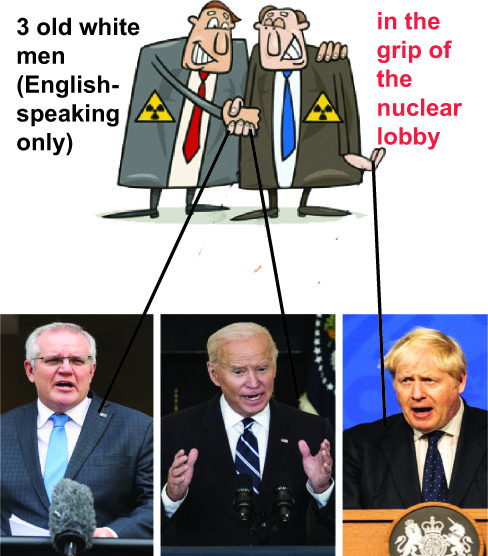
SMH, By Anthony Galloway, May 14, 2022 Labor leader Anthony Albanese has accused Prime Minister Scott Morrison of breaking trust with the Biden administration by not briefing Labor well before the announcement of the AUKUS defence pact, as the presence of a Chinese spy ship off Australia’s coast re-ignites debates over national security.The Sydney Morning Herald and The Age revealed on Saturday that four-and-half months before the announcement on September 16, senior members of the Biden administration insisted that it would only consider pursuing the landmark AUKUS project if it had solid support from both major Australian political parties.
Labor leader Anthony Albanese has accused Prime Minister Scott Morrison of breaking trust with the Biden administration by not briefing Labor well before the announcement of the AUKUS defence pact, as the presence of a Chinese spy ship off Australia’s coast re-ignites debates over national security.The Sydney Morning Herald and The Age revealed on Saturday that four-and-half months before the announcement on September 16, senior members of the Biden administration insisted that it would only consider pursuing the landmark AUKUS project if it had solid support from both major Australian political parties.“They [the US] wanted to have the confidence that this would be a bipartisan issue in terms of support.”
Albanese said the briefing on September 15 was a “good comprehensive briefing by officials”. But he said the fact that the US had made a request to Australia “that was ignored for-four-and-a-half months shows that this is a prime minister who always plays short-term politics and isn’t interested in the national interest”.“I will not treat national security issues as an opportunity to make a difference on partisan domestic political points,” Albanese said. “No Australian Prime Minister should do that.”Foreign affairs spokeswoman Penny Wong said the report in this masthead confirms Morrison “held back” from briefing Labor against the wishes of the Biden administration.“Now what this confirms to Australians is that this Prime Minister will do and say anything to save his political skin,” she said……………………………………. https://www.theage.com.au/politics/federal/extraordinary-albanese-unloads-on-morrison-for-not-briefing-him-on-aukus-months-before-announcement-20220514-p5albm.html
Radioactive: Inside the top-secret AUKUS nuclear submarines deal
A nuclear subs deal would lock Australia more tightly into the US bloc.
. Shearer managed to sidestep the Russian roulette of Australia’s vaccine rollout with the help of doctors at the Department of Foreign Affairs and Trade.……….
My sources didn’t put it quite this bluntly, but everyone in the room understood that this was about Australia acquiring the power to pose a direct threat to China’s forces and the Chinese mainland.
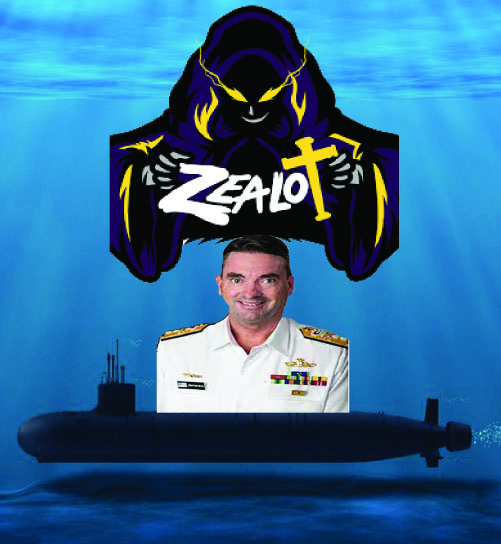
Campbell made a crucial choice by appointing Rear Admiral Jonathan Mead…...
…
Secret meetings and subterfuge over many months shored up Australia’s “40-year fantasy” of a mighty nuclear marriage with the US and the UK.
SMH, By Peter Hartcher MAY 14, 2022 When Joe Biden was first briefed on Australia’s request for nuclear-powered submarines, he did not say “yes”. He was cautious, even sceptical. Among his doubts was whether Australia was up to it………….
The Australians were asking for the crown jewels in the national security vault. one of America’s remaining decisive advantages over China. The US had shared its nuclear sub secrets with only one nation, Britain, in 1958. Much had changed since.
The transformational power of nuclear-propelled subs is that they could allow Australia to pose a direct threat to the Chinese mainland. For the first time. It had come to that.
With unlimited range because they never need to refuel, and with vertical launch tubes for firing missiles, a nuclear-propelled submarine could stand off China’s coast and threaten it with cruise missiles.
Australia’s existing fleet of submarines, the six diesel-powered Collins class, is equipped with torpedo tubes only. Which means it can fire torpedoes at targets in the water but not missiles at targets on land.
But it had been a 40-year fantasy of Australian governments to get American nuclear propulsion. Canberra had been turned down every time. Indeed, no earlier request had even reached the president’s desk. The US Nuclear Navy, guardians of the technology, had ruled it out of the question.
Now the Australian appeal had the president’s full attention. The briefing paper in front of him ran through the positives and negatives of such an arrangement –it did not contain a recommendation.
On the positive side of the ledger, the top consideration was that it would help counter China. The People’s Liberation Army Navy has the advantage over the US in warfighting on and above the ocean. Arming an ally with nuclear-powered subs would help blunt China’s edge.
Nuclear-propelled submarines “are fast, they have stamina, they bring a whole spectrum of weapons, and if you are China, how are Australian and US forces working together?” poses the former chief of US Naval Operations, retired Admiral Jonathan Greenert.
“You don’t know their sovereign decisions. Your imagination is your biggest nightmare – what could they be doing? They can reposition fast, 25 knots [46km/h] for a full day. If an adversary says, ‘I’ve got a detection of a nuclear sub’, great – when? Two days ago. Then you draw a circle on the map and see where it might be. It’s a big circle.”
The US today has 68 submarines, all nuclear-powered. China has an estimated 76 subs, of which 12 are nuclear-powered. But the US fleet is shrinking as it retires older subs faster than it can build new ones. China’s nuclear-powered fleet is expanding. The AUKUS agreement aims to help Australia acquire eight.
Second, it would cement the alliance with Australia. Just a few years earlier, many in the US foreign policy community including Campbell had tipped Australia to be the ally most vulnerable to China’s influence, that it would “flip” and align with Beijing.
Instead, Australia had “set an incredibly powerful example” for the world in standing up to China, as Secretary of State Antony Blinken said in an interview this year. A nuclear subs deal would lock Australia more tightly into the US bloc.
Third, it would help the US to deter China’s expansion through the Indo-Pacific. It would signal US commitment to the region and to US allies, reassuring other Indo-Pacific nations who might be doubting American staying power. “The president said, ‘this could be quite powerful’,” according to an official who was present.
But on the other side of the ledger, Biden himself raised four big concerns with the Australian request. First was nuclear proliferation. Since the deal with Britain in 1958, Washington, London and Canberra, among others, had signed the Nuclear Non-Proliferation Treaty. If we give the Australians this technology, won’t we be in breach of the treaty, Biden wanted to know?
Second was the response from China. How will Beijing react if we agree to this? Will it provoke Xi Jinping into accelerating his own naval build-up, into getting more aggressive?
Third was Australia’s capability. Would the Australian political system be capable of bipartisan commitment for the decades required? Is Australian politics stable enough? Could Australia afford the price tag?
Fourth, would the US Nuclear Navy be prepared to deliver? This had been the obstacle to every other Australian inquiry. This elite priesthood is the guardian of the fast, stealthy, underwater Doomsday machines that are America’s last line of defence.
America’s nuclear warfighting is structured on a “triad” – ground-based, airborne and undersea forces. The ground-based and airborne forces are the most vulnerable to enemy attack. But even if these are destroyed in a surprise first strike by an enemy, its nuclear-powered, nuclear-armed subs are designed to survive, undetected in the dark depths, to deliver annihilation to the enemy. By guaranteeing “second strike” capability, they deter any adversary from even thinking about launching a first.
Australia was not asking for nuclear weapons; it was content to arm its subs with conventional missiles. And Canberra was not so much concerned about nuclear Armageddon. Australia has entrusted that responsibility to the US, sheltering under America’s nuclear “umbrella”. Australia was feeling threatened by China and wanted the capacity to threaten it in return.
As the discussion around the White House table unfolded last year, other concerns emerged. The group included Secretary of State Blinken, Defence Secretary Lloyd Austin, National Security Adviser Jake Sullivan, and the chairman of the Joint Chiefs, General Mark Milley.
What if we attempt this three-way agreement with Australia and Britain and it fails? The credibility of all three nations would be damaged. Have the Australians consulted fully with the French about their contract? Do we risk alienating one ally to gratify another?
The meeting broke up without a decision and with big questions needing to be answered. In the meantime, Australia had a contract with Paris – and French President Emmanuel Macron was deeply invested in it………..
In France, national pride and national honour were engaged, not to mention French economics – it was the biggest defence export contract France had signed, and the biggest Australian acquisition. The contract value was $50 billion but adjustments for inflation and extras took the total deal to at least $90 billion.
………………………………… Towards the end of 2019, Morrison started to ask his closest advisers about fallback options, including nuclear-propelled ones. They told him of the joyless history of Australian requests for nuclear propulsion and that the likelihood of getting the technology from the US or Britain was “very, very low”. And they warned him that Australia would need a civil nuclear industry. Without one, it couldn’t maintain the nuclear reactors that drive the boats. On March 19, 2020, two months after the Audit Office report, the prime minister took the first formal step towards exploring contingencies.
……. Secretly, he asked the secretary of the Defence Department, Greg Moriarty, for a discussion paper about all the options, including nuclear-propelled ones. He had the result within a fortnight……
Morrison decided to take the next step regardless. In May, 2020, he asked Moriarty and the military co-leader of the Defence Department, Chief of the Defence Force, General Angus Campbell, to form a small, expert group to see whether it was feasible for Australia to acquire and operate nuclear-powered subs. The top-secret exercise was led by the Chief of Navy, Vice Admiral Michael Noonan.
It came back with the conclusion that it was potentially feasible, but on two conditions. One, it was only possible with the help of the US, Britain or both. This was the only way Australia could operate nuclear-powered subs without setting up a civil nuclear industry to support them.
America and Britain use highly enriched, weapons-grade uranium to run their subs’ reactors. That means the reactors don’t need refuelling for the life of the boat itself, some 30 years.
Two, the same consideration ruled out the French nuclear-propelled sub, the big Barracudas Macron had launched so proudly, as an option. The French use low-enriched uranium, meaning their reactors need to be refuelled every decade or so in a lengthy process called full-cycle docking. This would keep the Australian fleet permanently dependent on Paris.
Moriarty’s opinion was that this would not be a sovereign Australian capability. Unless Australia started its own civil nuclear industry to refuel and maintain the reactors, something which Morrison would not countenance.
Tantalised, Morrison immediately asked Defence to contact the Pentagon to test its assumptions. Through a series of secure video conferences between the Pentagon and Defence’s headquarters on Russell Hill, the US Navy gave a guarded endorsement, summarised by an Australian official: “There’s nothing in your thinking that’s completely implausible”. But there was no enthusiasm from the Americans and certainly no commitment to help.
For the prime minister, this was a “game changer” nonetheless, as he’s described it to colleagues. The revelation: It was possible to have a nuclear-powered attack submarine, or SSN as navies call it, without needing to service the reactor.
To now, Morrison had briefed only two members of his cabinet, Linda Reynolds and the Foreign Affairs Minister, Marise Payne. But now that he envisaged raising the idea with the American president and British Prime Minister Boris Johnson, he decided to widen the circle.
When he briefed Treasurer Josh Frydenberg, he met an enthusiastic response. He remarked that the politics in the three capitals of Washington, London and Canberra seemed to be in alignment. “You could never do this deal with (the former leader of British Labour) Jeremy Corbyn,” said Frydenberg. “When a gate like this opens, you go through it.”
But what of the multibillion-dollar cost of cancelling the French deal and the far greater cost of building SSNs? “Everything is affordable if it’s a priority,” was the treasurer’s attitude. “This is a priority.”
Morrison then took it to the National Security Committee of his cabinet. This is the overarching mechanism for co-ordinating defence and security and includes top officials and ministers responsible for defence, foreign affairs, home affairs and intelligence. It gave Morrison the green light to take it further. “It was a high level of secrecy because there was no guarantee we could pull it off,” Morrison told colleagues. He didn’t want to disrupt progress with the French toward a conventional sub in case he failed with the Anglo American nuclear option, and end up with neither.
Morrison kept it so tight that the PM’s personal permission was required before any official could be brought into the charmed circle, a top civil servant explained. “So if anything leaked, you knew you’d be personally accountable to the PM himself,” said the official.
…………. Australia then, and now, had no long-range strike capability whatsoever. None on land, none in the air force, none in the navy. The ADF was set up for counterinsurgency wars as part of a US alliance like those in Afghanistan and Iraq, and low-level conflict in the Pacific Islands like the missions in East Timor and the Solomons, but was unprepared for high-intensity warfighting with a capable nation state.
Reynolds tasked the Capability Enhancement Review with recommending the strike power Australia needed. One part was to be the nuclear subs project. Campbell made a crucial choice by appointing Rear Admiral Jonathan Mead………
Eventually, the moment arrived for Australia’s first approach to the Biden White House. ……
In May 2021, the moment came. The director-general of Australia’s peak intelligence assessment agency, the Office of National Intelligence, Andrew Shearer, was planning a routine visit to Washington to consult with his US counterparts. He’d been briefed on the nuclear subs project. Would you like me to broach it with the White House, he asked the prime minister? Morrison agreed. Shearer managed to sidestep the Russian roulette of Australia’s vaccine rollout with the help of doctors at the Department of Foreign Affairs and Trade………..
Shearer and Campbell had known each other for decades. He explained what Australia wanted. “As China’s capability advances, we need to have submarines capable of meeting it. We need to be able to operate without the risk of easy detection by the Chinese,” Shearer said, according to the participants.
………….. My sources didn’t put it quite this bluntly, but everyone in the room understood that this was about Australia acquiring the power to pose a direct threat to China’s forces and the Chinese mainland.
Sullivan and Campbell immediately were interested. Biden has described the US rivalry with China as “the competition for the 21st century”. With this request, Australia was choosing sides emphatically.
…………… Shearer emphasised that Australia had no intention of developing a civil nuclear industry or developing nuclear weapons. He said that Canberra was satisfied it could operate the subs while preserving Australia’s strong record on nuclear non-proliferation.
Sullivan and Campbell had lots of questions about Australian technological, personnel and financial capacity but the potential killer at this threshold meeting was Australian politics. “We asked lots of questions about politics,” said Campbell. “Would this be contentious? Would this hold?”
Bipartisan political commitment, Labor and Liberal, was a prerequisite, the Americans said. “This would be a military marriage. It would have to hold over decades.”
…………. when Shearer returned to Canberra he made clear to Morrison and his other colleagues that the White House had set political bipartisanship as a non-negotiable condition. “If Albo says ‘no’, the deal will be dead,” as Australia’s ambassador to Washington, Arthur Sinodinos, put it to colleagues.
…….. the prime minister decided not to brief Labor leader Anthony Albanese for five months. He briefed him on the day before the deal was to be announced in a three-way piece of theatre with Morrison, Prime Minister Johnson and President Biden. It was high stakes on a very tight deadline.
This is part one of a two-part series by Peter Hartcher examining the AUKUS deal. The series concludes on Sunday, May 15. https://www.smh.com.au/politics/federal/radioactive-inside-the-top-secret-aukus-subs-deal-20220510-p5ak7g.html
Ending the War of Attrition in Ukraine

by Jeffrey D. Sachs, NEW YORK (IDN) 114 May 22, — Wars often erupt and persist because of the two sides’ miscalculations regarding their relative power. In the case of Ukraine, Russia blundered badly by underestimating the resolve of Ukrainians to fight and the effectiveness of NATO-supplied weaponry. Yet Ukraine and NATO are also overestimating their capacity to defeat Russia on the battlefield. The result is a war of attrition that each side believes it will win, but that both sides will lose.
Ukraine should intensify the search for a negotiated peace of the type that was on the table in late March, but which it then abandoned following evidence of Russian atrocities in Bucha—and perhaps owing to changing perceptions of its military prospects.
The peace terms under discussion in late March called for Ukraine’s neutrality, backed by security guarantees and a timeline to address contentious issues such as the status of Crimea and the Donbas. Russian and Ukrainian negotiators stated that there was progress in the negotiations, as did the Turkish mediators. The negotiations then collapsed after the reports from Bucha, with Ukraine’s negotiator stating that “Ukrainian society is now much more negative about any negotiation concept that concerns the Russian Federation.”
But the case for negotiations remains urgent and overwhelming. The alternative is not Ukraine’s victory but a devastating war of attrition. To reach an agreement, both sides need to recalibrate their expectations.
When Russia attacked Ukraine, it clearly expected a quick and easy victory. Russia vastly underestimated the upgrading of the Ukraine military following years of US, British, and other military support and training since 2014. Moreover, Russia underestimated the extent to which NATO military technology would counter Russia’s greater number of troops. No doubt, Russia’s greatest error was to assume that the Ukrainians would not fight—or perhaps even switch sides.
Russia’s greatest error was to assume that the Ukrainians would not fight—or perhaps even switch sides.
Yet now Ukraine and its Western supporters are overestimating the chances of defeating Russia on the battlefield. The idea that the Russian army is about to collapse is wishful thinking. Russia has the military capacity to destroy Ukrainian infrastructure (such as the rail lines now under attack) and to win and hold territory in the Donbas region and on the Black Sea coast. Ukrainians are fighting resolutely, but it is highly unlikely that they can force a Russian defeat.
Nor can Western financial sanctions, which are far less sweeping and effective than the governments that imposed them acknowledge. ………………
Moreover, the sanctions are creating serious economic consequences for the United States and especially Europe……………..
In the meantime, Ukraine continues to suffer grievously in terms of deaths, dislocation, and destruction. The IMF now forecasts a 35% contraction of Ukraine’s economy in 2022, reflecting the brutal destruction of housing, factories, rail stock, energy storage and transmission capacity, and other vital infrastructure.
Most dangerous of all, as long as the war continues, the risk of nuclear escalation is real. If Russia’s conventional forces were actually to be pushed toward defeat, as the US is now seeking, Russia might well counter with tactical nuclear weapons. A US or Russian aircraft could be shot down by the other side as they scramble over the Black Sea, which in turn could lead to direct military conflict. Media reports that the US has covert forces on the ground, and the US intelligence community’s disclosure that it helped Ukraine kill Russian generals and sink Russia’s Black Sea flagship, underscore the danger.
The reality of the nuclear threat means that both sides should never forgo the possibility of negotiations. That is the central lesson of the Cuban Missile Crisis, which took place 60 years ago this coming October. President John F. Kennedy saved the world then by negotiating an end to the crisis—agreeing that the US would never again invade Cuba and that the US would remove its missiles from Turkey in exchange for the withdrawal of the Soviet missiles from Cuba. That was not giving in to Soviet nuclear blackmail. That was Kennedy wisely avoiding Armageddon.
It is still possible to establish peace in Ukraine based on the parameters that were on the table at the end of March: neutrality, security guarantees, a framework for addressing Crimea and the Donbas, and Russian withdrawal. This remains the only realistic and safe course for Ukraine, Russia, and the world. The world would rally to such an agreement, and, for its own survival and well-being, so should Ukraine.https://www.indepthnews.net/index.php/opinion/5298-ending-the-war-of-attrition-in-ukraine#.Yn3tJBvujtI.twitter
Biden demanded bipartisan support before signing AUKUS. Labor was not told for months
By Peter Hartcher, May 14, 2022 The Biden administration insisted from the outset that it would only consider pursuing the landmark AUKUS project if it had solid support from both major Australian political parties, yet Prime Minister Scott Morrison chose not to consult Labor until the day before its announcement.
By waiting four-and-a-half months, the prime minister made AUKUS into a high-stakes, last-minute political gambit.
And, when Morrison later challenged Labor publicly over whether it fully supported the deal, he seemed to be looking for a way to politicise the security partnership.
White House officials emphasised the point as a deal-breaker in the very first discussion on Australia’s request for nuclear-propelled submarines.
The prime minister sent a special emissary, Australia’s spy chief Andrew Shearer, to broach the topic with two senior officials, US National Security Adviser Jake Sullivan and the White House US Indo-Pacific Co-Ordinator, Kurt Campbell on May 1 last year………….
The Democratic White House were frustrated at the lack of clarity from Australia. They called on a special assistant to the President who had been posted to Australia, Edgard Kagan, for his view.
They called on a special assistant to the President who had been posted to Australia, Edgard Kagan, for his view.
He observed that the Australian government seemed confident that Labor would support such a deal when they were eventually informed.
The Americans could see that if Labor baulked, Morrison would use it as a wedge against Opposition Leader Anthony Albanese in the approach to an election.
They would frame him as weak on national security.,……………………….. https://www.smh.com.au/national/biden-demanded-bipartisan-support-before-signing-aukus-labor-was-not-told-for-months-20220513-p5al9d.html—
The end of Adani? Investment giant says coal miner has revealed Carmichael closure plan
The end of Adani? Investment giant says coal miner has revealed Carmichael closure plan
Investment manager Vanguard says coal giant Adani has revealed that its Carmichael mine would be closed in order for the company to “fit within the parameters of a 1.5 degree warming scenario”.
Australian voters deserve a ministers’ debate on climate and energy. They won’t get one — RenewEconomy

Given the world is in the midst of a major climate crisis, Australian voters deserved a climate ministers’ debate. The post Australian voters deserve a ministers’ debate on climate and energy. They won’t get one appeared first on RenewEconomy.
Australian voters deserve a ministers’ debate on climate and energy. They won’t get one — RenewEconomy
Taylor quietly tips $3m into another brown coal to hydrogen venture — RenewEconomy

More funding quietly tipped into brown coal to hydrogen projects, as the Coalition’s election fossil hydrogen subsides top $400 million. The post Taylor quietly tips $3m into another brown coal to hydrogen venture appeared first on RenewEconomy.
Taylor quietly tips $3m into another brown coal to hydrogen venture — RenewEconomy
Meet Zoe Daniel: Journalist turned independent fighting for climate, integrity and gender equality — RenewEconomy

Reluctant to join the political fray, Zoe Daniel says failures to act on climate change and integrity in politics motivate her challenge to Tim Wilson. The post Meet Zoe Daniel: Journalist turned independent fighting for climate, integrity and gender equality appeared first on RenewEconomy.
Meet Zoe Daniel: Journalist turned independent fighting for climate, integrity and gender equality — RenewEconomy
South Asia’s Scorching Heatwave: Another Window Into Our Climate-Insecure Planet — The Center for Climate & Security

By Sarang Shidore South Asia’s cruel heatwave in recent weeks has seen land temperatures reach 122 F (49 C) and air temperatures as high as 143 F (62 C) in India and Pakistan. A brutal April was preceded by a searing March, both setting records on the subcontinent for those months. The peak summer period…
South Asia’s Scorching Heatwave: Another Window Into Our Climate-Insecure Planet — The Center for Climate & Security
1 This month.
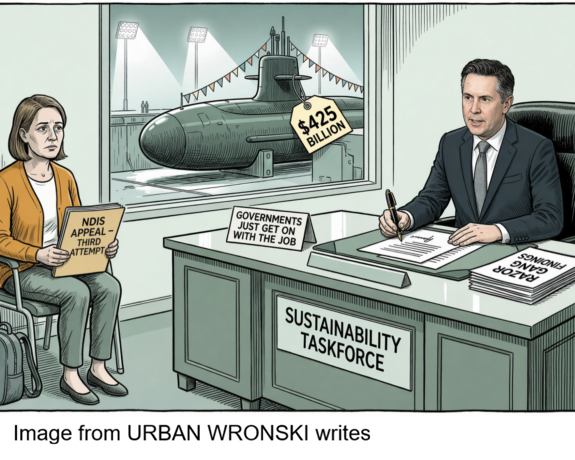

PETITION – To: Prime Minister Anthony Albanese and the Australian Labor Government
Chernobyl: The Lost Tapes – A good documentary on Chernobyl on SBS available On Demand for the next 3 weeks– https://www.sbs.com.au/ondemand/tv-program/chernobyl-the-lost-tapes/235274195556
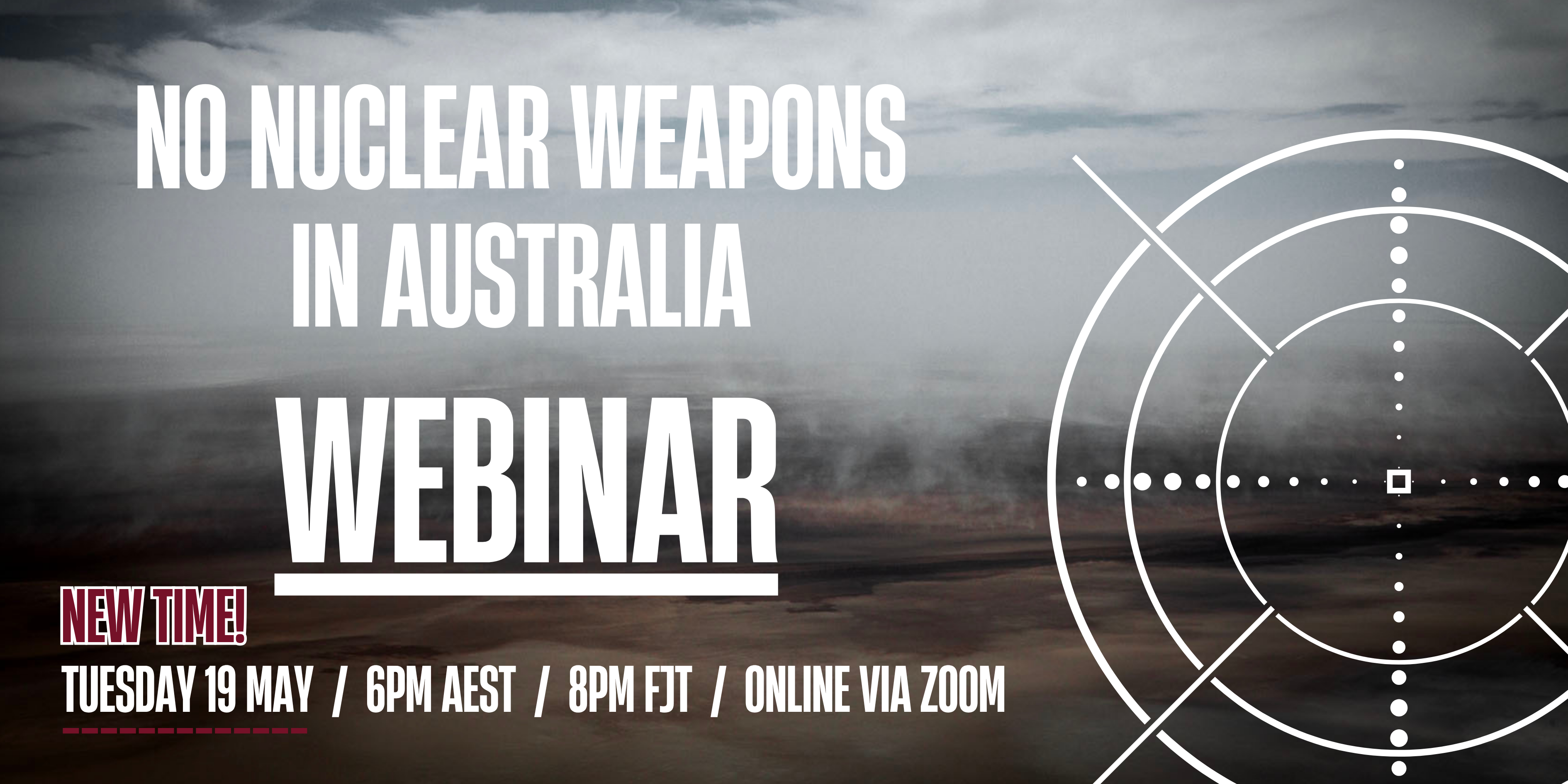
19 May – Webinar- Webinar: No Nuclear Weapons in Australia
Start: 2026-05-19 18:00:00 UTC Canberra, Melbourne, Sydney (GMT+10:00)
End: 2026-05-19 19:30:00 UTC Canberra, Melbourne, Sydney (GMT+10:00)
20 May – Webinar – The dangerous world of AUKUS, US, military occupation and suppression of dissent

National Webinar, 20th May, 2026, 6.30pm AEST. Confronting laws restricting/suppressing protest speech and action
Speakers: Former Sen. Rex Patrick, Lawyer Nick Hanna ,Arthur Rorris ,Jorgen Doyle, Sen David Shoebbridge,
Facilitator Kelley Tranter.

of the week – Australians for War Powers Reform (AWPR)
To see nuclear-related stories in greater depth and intensity
 Antinuclear