No ”military justification” for the nuclear bombing of Nagasaki. A negotiated ending is better than ”fight to the death”
Paul Richards. NAGASAKI BOMBING, Nuclear Fuel Cycle WAtch Australia https://www.facebook.com/groups/1021186047913052 8 May 22
MacArthur’s views about the decision to drop the atomic bomb on Hiroshima and Nagasaki were starkly different from what the general public supposed ….
When I asked General MacArthur about the decision to drop the bomb, I was surprised to learn he had not even been consulted.
What, I asked, would his advice have been?
General Douglas MacArthur replied that he saw no military justification for the dropping of the bomb.
The war might have ended weeks earlier, he said, if the United States had agreed, as it later did anyway, to the retention of the institution of the emperor.
____________ https://www.newsweek.com/november-11-1963-2608
War and some unusual developments regarding nuclear-related topics – Guam and the Northern Mariana Islands

The huge problem with the idea of having a nuclear reactor power plant on a military base is that it may cause catastrophic damage to all human life in and around the immediate area despite official comments from the U.S. Army that there are several safety prevention measures being taken to address this concern.
War and some unusual developments regarding nuclear-related topicsm By Rick Arriola Perez | May 09 2022 https://www.saipantribune.com/index.php/war-and-some-unusual-developments-regarding-nuclear-related-topics/
Guam and the Northern Mariana Islands are one island chain that is embedded in the minds of Chinese military personnel who are charged with selecting and figuring out what adversary targets are most important to knock out, should China and the United States ever go to hot war.
Guam’s Andersen Air Force Base is a huge military threat to the Chinese and to the North Koreans and Russians. Andersen is one of the most important American military bases in the world. Andersen has one of the world’s largest petroleum, oil, and lubricant storage facilities, training facilities, and areas that store, manage, maintain and load ordnance and other weapons of war.
Andersen is located atop stolen Chamorro family lands located in our Deep Blue Pacific Ocean Marianas Trench continent. The U.S. Air Force is not formally required to ask permission to fly over foreign national airspace because from the American military perspective, we are close yet far enough away from any nation that requires the United States to first seek diplomatic approvals and notifications. This is one of the many benefits afforded the Pentagon and the Air Force by residing in Guam and the Marianas.
Guam’s Andersen Air Force Base is also the perfect location to store, manage, hold, and/or stage live nuclear missiles and weapons into and out of fighters, unmanned systems, and strategic aircraft that are assigned America’s nuclear bombing missions. These activities go relatively unnoticed because of our unique location. Missions can simply be initiated any day or night throughout the year.
But bombs are not the only thing that is on the nuclear discussion table these days
These days the Department of Defense is also moving forward with design plan options to construct and operationalize nuclear-powered micro-reactors, transportable on Air Force cargo planes, to be used as power generation sources for military bases in remote locations.
These nuclear reactors are intended to generate the power equivalent of up to 1% of a large commercial nuclear power plant once assembled and turned on. The huge problem with the idea of having a nuclear reactor power plant on a military base is that it may cause catastrophic damage to all human life in and around the immediate area despite official comments from the U.S. Army that there are several safety prevention measures being taken to address this concern.
One rationale that is being proposed to support the construction and design of nuclear reactors is that it will save over time millions of gallons of fossil fuel from being consumed, which is in line with environmental sustainability up to a point. Opposing viewpoints argue that there is simply no need to place a nuclear reactor in a remote military base because the amount of power generation it provides is not really needed because existing diesel-powered generators are adequate for use on remote military bases.
Nuclear reactor controversies are nothing new to the Pentagon and the Army
The Army previously had a nuclear reactor program that started during the time of the Korean war era, lasting up through the Vietnam war era. The program had mixed results, one catastrophic outcome, and was quite expensive to maintain. The current program under consideration is supported by the idea that having a small and mobile nuclear power plant for use by base personnel will also mitigate military casualty rates associated with the transportation and security protection of fuel in land-based warfighting areas. Supporters also point to the need for a constant source of power generation required for radars and for high-energy weapons.
So why should our Chamorro Pacific Islander Deep Blue Continent civilization be concerned about these developments?
The Pentagon and the Army have identified Guam as one of approximately 10 sites that are slated to have a micro nuclear reactor. The Marshall Islands is also another site identified to receive a nuclear reactor.
But what our Chamorro people should be aware, as well as the people of Micronesia, especially the Marshallese, is that it is the U.S. Congress, not the Pentagon, that has been the genesis behind the push to get the Pentagon funding to move forward on this micro-nuclear reactor effort. Why is this the case?
What the Guam and NMI congressmen need to do
Michael San Nicolas and Kilili Sablan have not articulated why Congress has been pushing the Pentagon to look into the design, construction, and use of small nuclear reactors for the Army.
Both congressmen have not publicly addressed the need for a multi-Mariana Islands nuclear bomb shelter infrastructure study nor has there been any effort by these congressional leaders to introduce authorization language addressing this huge human health, readiness, and life or death safety issue tied to the increased militarization of our Mariana Island chain.
President Biden will be the final authority as to whether a small mobile nuclear reactor program will proceed or be cancelled. These congressmen have not talked to President Biden about this very important matter.
Diseconomics and other factors mean that small nuclear reactors are duds

Such awkward realities won’t stop determined lobbyists and legislators from showering tax funds on SMR developers, seen as the industry’s last hope of revival (at least for now). With little private capital at stake, taxpayers bearing most of the cost, and customers bearing the cost-overrun and performance risks190 (as they did in the similarly structured WPPSS nuclear fiasco four decades ago), some SMRs may get built. I expect they’ll fail for the same fundamental reasons as their predecessors, then be quickly forgotten as marketers substitute the next shiny object.
A lifetime of such disappointments has not yet induced sobriety. As long as the industry can fund potent lobbying that leverages orders of magnitude more federal funding, the party will carry on.
US nuclear power: Status, prospects, and climate implications, Science Direct, Amory B.Lovins, Stanford University, USA The Electricity Journal, Volume 35, Issue 4, May 2022,
”…………………………………………………….. Advanced” or “Small Modular Reactors,” SMRs174, seek to revive and improve concepts generally tried and rejected decades ago due to economic175, technical176, safety177, or proliferation178 flaws179. BNEF estimates that early SMRs might generate at ~10× current solar prices, falling by severalfold after tens of GW were built, but not by enough to come anywhere near competing. Despite strong Federal support, proposed projects are challenged to find enough customers180 and markets181. Developers and nations are also pursuing >50 diverse designs—a repeatedly reproven failure condition.
SMRs’ basic economics are worse than meets the eye, because their goalposts keep receding. Reactors are built big because, for physics reasons, they don’t scale down well. Small reactors, say their more thoughtful advocates, will produce electricity initially about twice as costly as today’s big ones, which in turn, as noted earlier, are ~3–13× costlier per MWh than modern renewables (let alone efficiency). But those renewables will get another ~2× cheaper (say BNEF and NREL) by the time SMRs could be tested and start to scale toward the mass production that’s supposed to cut their costs. High volume cannot possibly cut SMRs’ costs by 2 × (3 to 13) × 2-fold, or ~12× to ~52×.
Indeed, SMRs couldn’t compete even if the steam they produce to turn the turbine were free. Why not? In big light-water reactors, ~78–87% of the prohibitive capital cost buys non-nuclear components like the turbine, generator, heat sink, switchyard, and controls. Thus even if the nuclear island were free and a shared non-nuclear remainder were still at GW scale so it didn’t cost more per unit182, the whole SMR complex would still be manyfold out of the money.
SMRs are also too late. Despite streamlined (if not premature) licensing and many billions in Federal funding commitments, the first SMR module delivery isn’t expected until 2029. That’s in the same smaller-LWR project that just lost over half its subscribed sales as customers considered cost, timing, and risk183, and may lose the rest if they read a soberly scathing 2022 critique184. That analysis found that the vendor claims very low financial and performance risks but opaquely imposes them all on the customers. The first “advanced” reactors (a sodium-cooled fast reactor and a high-temperature gas reactor), ambitiously skipping over prototypes, are hoped by some advocates to start up in 2027–28. DOE in 2017 rosily assessed that if such initial projects succeeded, a first commercial demonstrator would then take another 6–8 years’ construction and 5 years’ operation before commercial orders, implying commercial generation at earliest in the late 2030s, more plausibly in the 2040s. But the US Administration plans to decarbonize the grid with renewables by 2035, preëmpting SMRs’ climate mission185.
An additional challenge would be siting new SMRs or clusters of them (which cuts cost but means that a problem with one SMR can affect, or block access to, others at the same site, as was predicted and experienced at Fukushima Daiichi). It looks harder to secure numerous sites and offtake agreements than a few. It would take roughly 50 SMR orders to justify building a factory to start capturing economies of production scale, and hundreds or thousands of SMRs to start seeing meaningful, though inadequate, cost reductions. A study assuming high electricity demand and cheap SMRs estimated a US need for just 350 SMRs by 2050186; some advocates expect far more. It’s hard to imagine how dozens of States and hundreds of localities could quickly approve those sites, especially given internal NRC dissension on basic SMR safety187 and the obvious financial risks188.
No credible path could deploy enough SMR capacity to replace inevitably retiring reactors timely and produce significant additional output by then—but efficiency and renewables could readily do that and more, based on their deployment rates and price behaviors observed in the US and global marketplace. For example189, through 2020, CAISO (wholesale power manager for a seventh of the US economy) reported 120 GW of renewables and storage in its interconnection queue, plus 158 GW in the non-ISO West; just solar-paired-with-storage projects in CAISO rose to over 71 GW by 5 Jan 2022, with the paired solar totaling nearly 64 GW—all three orders of magnitude more than the first 77-MW NuScale module hoped to enter service many years later.
Such awkward realities won’t stop determined lobbyists and legislators from showering tax funds on SMR developers, seen as the industry’s last hope of revival (at least for now). With little private capital at stake, taxpayers bearing most of the cost, and customers bearing the cost-overrun and performance risks190 (as they did in the similarly structured WPPSS nuclear fiasco four decades ago), some SMRs may get built. I expect they’ll fail for the same fundamental reasons as their predecessors, then be quickly forgotten as marketers substitute the next shiny object.
A lifetime of such disappointments has not yet induced sobriety. As long as the industry can fund potent lobbying that leverages orders of magnitude more federal funding, the party will carry on. But where does its seemingly perpetual disappointment leave the Earth’s imperiled climate?…………………………. https://www.sciencedirect.com/science/article/pii/S1040619022000483
The poisoned environmental legacy of France’s ”Nuclear Park”
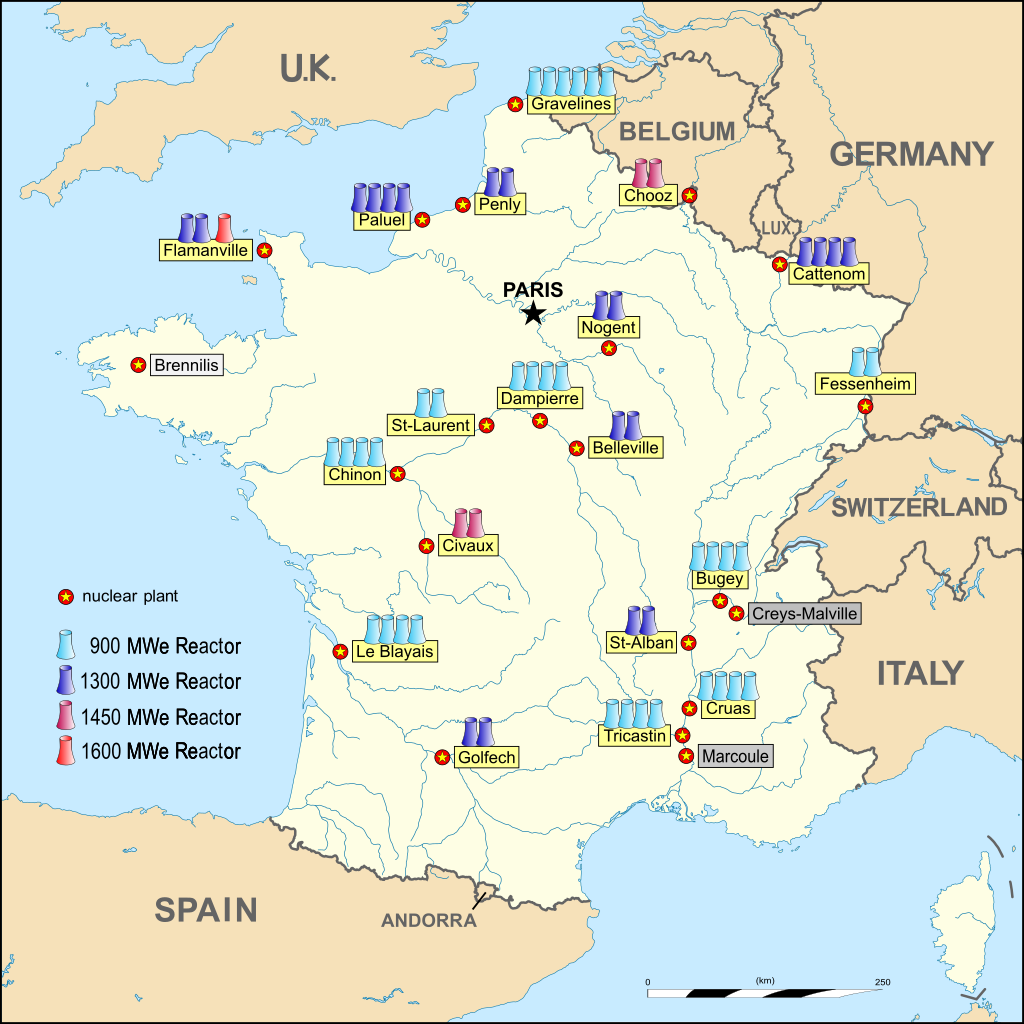
The poisoned environmental legacy of the ‘Nuclear Park’ https://culturico.com/2022/05/07/the-poisoned-environmental-legacy-of-the-nuclear-park/ Culturico 7th May 2022, Linda Pentz Gunter, Linda Pentz Gunter is the international specialist at Beyond Nuclear and editor and contributor at Beyond Nuclear International.
France prides itself on its “Nuclear Park”, its fleet of once 58 and now 56 operational nuclear reactors that deliver 70% of the country’s electricity. However, the environmental effects of this considerable use of nuclear power – specifically from the need to mine uranium and the choice to reprocess irradiated nuclear fuel – have negatively impacted the health of the French people.
France is heavily reliant on nuclear energy. Its 56 commercial reactors dot almost every corner of the country, providing 70% of all electricity consumed. France also possesses a nuclear weapons arsenal, fueled by the nuclear power program that predated it.
The possession of nuclear weapons affords France permanent membership status in the UN Security Council — a sense of prestige France is intent on maintaining.
French president, Emmanuel Macron, has now announced that the country will build new nuclear power plants, despite the fact that its current flagship Evolutionary Power Reactor (EPR), is beset by technical mistakes, years behind schedule and billions of Euros over budget at construction sites in France, Finland and the UK. The first of two operational EPRs in China had to be shut down late last year due to vibrations that caused radioactive leakage.
Consequently, it is unpopular to question the use of nuclear power in France and oppositional voices are rarely heard. The French anti-nuclear movement — largely networked under the Réseau Sortir du nucléaire — is snubbed by the press, and its members have been arrested and even convicted of alleged crimes.
However, thanks to the pioneering work of activists, investigative journalists and independent scientists, some of the secrets buried beneath the ’Nuclear Park’, have started to be unearthed.
The damage from uranium mining
Nuclear power plants are fueled with uranium, a radioactive ore that is mined from the earth, typically in dry, desert areas far way, often by an Indigenous workforce offered little to no protection and none of the alleged benefits.
However, between 1948 and 2001, France operated its own uranium mines — more than 250 of them in 27 departments across the country. Those French mine workers, like their Native American, Australian Aboriginal and African Touareg counterparts, labored unprotected and in ignorance of the true health risks.
The mines and the factories that milled and processed the uranium, now lie abandoned, leaving a legacy of radioactive waste that is hidden beneath flowering meadows, forest paths and ornamental lakes. But these radioactive residues and rocks — known as tailings — have also dispersed beyond the old mine boundaries, transported into rivers and streams, absorbed into wild plants, scattered on roadsides, and even paved into children’s playgrounds, homes and parking lots.
There are radioactive hotspots everywhere. France may not yet have opened a high-level radioactive waste repository — still under dispute at Bure — but thanks to the contamination left behind by uranium mining, large swaths of the country are de facto nuclear waste dumps. The widespread dispersal of radioactive contamination across France has been studied extensively by the independent French radiological laboratory, Commission de Recherche et d’Information Indépendantes sur la RADioactivité, known simply as CRIIRAD. Its scientists have traveled all over the world, measuring radiation levels at such notorious nuclear accident sites as Mayak and Chernobyl in the former Soviet Union, and at Fukushima in Japan. But often, they are just as shocked and outraged at the radiation levels they measure at home, and the failure of those responsible to take effective remediation steps to protect the public.
In the 2009 investigative French television program by Pieces de Conviction — entitled Uranium, the scandal of contaminated France — CRIIRAD’s scientific director, physicist Bruno Chareyron, is seen scraping the gravely surface off a parking lot at a cross-country ski club. Under the dusty gray stones we suddenly see a gleam of yellow. It is the telltale sign of uranium and Chareyron’s Geiger counter is recording radiation levels at more than 23mSv an hour. The internationally accepted “safe” dose for the public is 1mSv a year. The public should not have access to this, he says, especially not children who are prone to pick up and pocket pebbles.
In all, there are an estimated 200-300 million tonnes of radioactive tailings dumped across France, exposing those who live, work or play nearby. The contamination comes not only from the uranium, but from its often far more radioactive decay products. And while the state-owned nuclear company Orano (formerly Areva and, before that, Cogema) insists that these sites have been “returned to nature”, it is a purely cosmetic exercise that has granted impunity to the polluter but endangered countless lives.
CRIIRAD subsequently released an urgent appeal to elected officials to take action. The laboratory recorded similar findings at numerous other abandoned uranium mine sites.
Now, with all the French uranium mines closed, the fuel for the Parc Nucléaire must be imported. It comes mainly from Niger, one of the poorest countries in the world, and predominantly from the giant French-owned uranium mine near the town of Arlit. There, CRIIRAD found that mine workers and inhabitants are routinely exposed to radioactivity in the environment as a result of uranium mining activities. A Greenpeace investigation concluded that French uranium mining activities in Niger had left behind a legacy of environmental contamination in that country, as it has in France, that would harm people for “centuries.”
The lethal legacy of uranium mining and processing that has contaminated so much of France is only the beginning of the story, however, just as uranium mining is only the beginning of the nuclear fuel chain.
Operating reactors and childhood leukemia
The electricity generation phase, on which the nuclear lobby bases its low-carbon argument to justify its continued use — while ignoring the front and back ends of the fuel chain, which have significant carbon footprints, (1) — is not without its damage to the environment either. Nuclear reactors release radiation into the environment as part of routine operation. At least 60 epidemiological studies have examined the possible health impacts of these releases, most of which found an increase in rates of leukemia among children living near operating nuclear power plants, compared to those living further away.
The most famous of these studies, conducted in Germany — Case-control study on childhood cancer in the vicinity of nuclear power plants in Germany 1980-2003 (2) — found a 60% increase in all cancers and a 120% increase in leukemias among children living within 5 km of all German nuclear power stations. This study was followed by others, largely supporting the data. But critics speculated that the amount of radioactivity in the releases was too low to have caused these epidemics.
For example, a 2008 study (3) by Laurier et al., of childhood leukemia around French reactors, concluded there was no “excess risk of leukaemia in young children living near French nuclear power plants”. However, the Laurier study was among those rebutted (4) and incorporated into a meta-analysis by Dr. Ian Fairlie and Dr. Alfred Körblein, which concluded that there were statistically significant increases in childhood leukemias near all the nuclear power plants studied and that “the matter is now beyond question, i.e., there’s a very clear association between increased child leukemias and proximity to nuclear power plants.”
The practice of averaging a month’s worth of releases into daily dose amounts ignores a sudden spike in radioactive releases, as happens when a reactor is refueling. Fairlie hypothesizes (5) that these spikes, delivering substantial radiation doses, could result in babies being born pre-leukemic due to exposure in utero, with the potential to progress to full leukemia additionally aggravated by subsequent post-natal exposure. (Nuclear power plants typically refuel every 18 months.)
Radioactive waste — the unsolved problem
At the end of nuclear power operations lies the huge and unsolved radioactive waste problem. Inevitably, the French reliance on nuclear power has generated an enormous amount of radioactive waste that must be managed and, ideally, isolated from the environment.
France is one of the few countries in the world to have chosen reprocessing as a way to try to manage irradiated reactor fuel. Reprocessing involves a chemical separation of plutonium from the uranium products in reactor fuel rods once they have ceased being used in the reactor. This operation is conducted at the giant La Hague reprocessing facility, on the Cherbourg peninsula, which began operation in 1976.
Reprocessing releases larger volumes of radioactivity — typically by a factor of several thousand— than nuclear power plants. Liquid radioactive discharges from La Hague are released through pipes into the English Channel (La Manche), while radioactive gases are emitted from chimney stacks. The liquid discharges from La Hague have been measured at 17 million times more radioactive than normal sea water. La Hague “legally discharges 33 million liters of radioactive liquid into the sea each year,” Yannick Rousselet of Greenpeace France told Deutsche Welle in a 2020 article. This has contributed, among other issues, to elevated concentrations of carcinogenic carbon-14 in sea life (6).
Concentrations of krypton-85 released at La Hague have been recorded at 90,000 times higher than natural background. La Hague is the largest single emitter of krypton-85 anywhere in the world. (7)
A November 1995 study — Incidence of leukemia in young people around La Hague nuclear waste reprocessing plant: a sensitivity analysis (8) — found elevated rates of leukemia. Yet its lead author, Jean-François Viel, was subsequently viciously attacked in attempts to discredit his findings and reputation, attacks that worsened after the publication of a second paper (9) in January 1997.
The cumulative negative health and environmental impacts of the French nuclear sector render the so-called benefits of the resulting low electricity rates a bitter delusion. For while France tries, wrongly, to attribute Germany’s higher electricity rates to that country’s rejection of nuclear power, typical German households use less electricity and actually pay lower monthly electric bills than French ones. Meanwhile, the French rely exclusively on electricity for heat in winter. Unable to meet this demand, France imports coal-fired electricity from Germany, perpetuating an industry that is fatal for the climate. At the same time, renewable energy development in France has been stifled by the decades-long prioritization of nuclear power.
However, a culture of denial in the French nuclear sector is nothing new. In 1986, when the Chernobyl nuclear reactor exploded and melted down in the Ukraine, the French government assured its people that the radioactive plume would not reach France. Unlike in other European countries, the French continued to eat local produce and allowed their children to play outside. This lie of immunity, quickly exposed, was attributed to “fear of jeopardizing the country’s nuclear program and of hurting sales of its agricultural products.”
It was that deception in 1986 that led to the creation of the CRIIRAD laboratory in the first place, as its scientists began to map the hotspots in France where fallout from Chernobyl had deposited high levels of radioactivity.
The insistence on expanding rather than phasing out nuclear power has also cost France progress in its carbon reduction goals. As Euractiv reported in August 2021, “France lagging behind in renewables can be explained in part by the fact that close to 70% of its electricity production is based on nuclear power.”
Many French reactors have been operating since the 1970s and are now well past their expected lifespans. With aging comes degradation of key safety parts and heightened risk of accident. In late December 2021 and in early January 2022, France saw a series of unanticipated reactor shutdowns due to safety issues, causing power shortages during a winter freeze and plunging French nuclear output to its lowest in 30 years. By early May, half of its entire reactor fleet was shut down due to technical problems or scheduled maintenance outages. The health and wellbeing of the French population would be better served both by cleanup of — and reparation for — the existing radioactive contamination so widespread in the country, and by a serious shift away from the continued use of nuclear power and toward true climate solutions such as renewable energy and energy efficiency measures.
May 8 Energy News — geoharvey

Science and Technology: ¶ “The Metals Company Success: Deep-Water Collector Vehicle Tested At Depth Of Almost 2,500 Meters” • A polymetallic nodule collector vehicle has been successfully tested in the Atlantic Ocean at a depth of almost 2,500 meters. The vehicle shows that polymetallic nodules can be mined while disturbing the environment minimally. [CleanTechnica] Deep-water […]
May 8 Energy News — geoharvey
Hiroshima man’s anime sheds light on Fukushima nuclear project — Fukushima 311 Watchdogs

The protagonist of the anime “Fukushima Genpatsu Hajimari Monogatari: Toge” (The prologue to the Fukushima nuclear power plant: Mountain pass) lives in temporary housing following the 2011 nuclear accident. (Provided by Machimonogatari Seisaku Iinkai) May 3, 2022 Hiroshima resident Hidenobu Fukumoto was astonished when he learned there was once a plan to build a nuclear […]
Hiroshima man’s anime sheds light on Fukushima nuclear project — Fukushima 311 Watchdogs
3 doctors to be dispatched nationwide to respond to nuclear accident; government requests early expansion — Fukushima 311 Watchdogs

Doctors from around the country examine workers on the grounds of TEPCO’s Fukushima Daiichi Nuclear Power Plant. They rushed to Fukushima to provide medical support in June 2011. May 2, 2022The Federation of Electric Power Companies of Japan (DENJIREN) learned in an interview on May 2 that only three doctors have been dispatched to power […]
3 doctors to be dispatched nationwide to respond to nuclear accident; government requests early expansion — Fukushima 311 Watchdogs
TEPCO net profit slides 96.9%; cost for Fukushima well out of reach — Fukushima 311 Watchdogs

Yoshimitsu Kobayashi, chairman of Tokyo Electric Power Co. Holdings Inc., attends an April 28 news conference where the company’s financial results were announced April 29, 2022 Tokyo Electric Power Co.’s dismal financial results have compounded the difficulties facing the company in compensating victims of the Fukushima nuclear disaster and covering the cleanup and decommissioning costs. […]
TEPCO net profit slides 96.9%; cost for Fukushima well out of reach — Fukushima 311 Watchdogs
Australia should note the UK experience. There, government promotes costly nuclear power, solely to secretly fund and supply nuclear submarines.

After years’ long research, Phil Johnstone and Andy Stirling have produced a report – https://www.tandfonline.com/doi/full/10.1080/24724718.2021.2012351 – it’s a seminal study of how tax-payers’ money goes secretly from ”beneficial” megaprojects to the nuclear weapons industry. In the UK, this means specifically- to nuclear submarines.
The money to the nuclear submarines cannot be measured, cannot be counted – it is so hidden in the world of energy projects, civil nuclear energy. But this explains why the governments persist doggedly with nuclear power projects that are clearly uneconomic, (and no use in combatting climate change – too late, even if they did work)
The sad and shocking thing about this – is the sort of groupthink that has pretty well everyone on the bandwagon – politicians, media, academia, business, education – and not just those who have been bribed by the nuclear industry. It’s a sort of groupthink treadmill, and they can’t seem to get off it, lest they look unpatriotic, or worse, – silly.

Expansion into Asia-Pacific: NATO military bloc is poison, not antidote — Anti-bellum
Global TimesMay 7, 2022 Japan shouldn’t be a promoter for NATO’s Asia-Pacific expansion The Ukraine crisis and the geopolitical tragedy it has triggered are not enough to kill the hunger of the US and some Western countries to reap political profits from the situation. Visiting Japanese Prime Minister Fumio Kishida and his British counterpart Boris […]
Expansion into Asia-Pacific: NATO military bloc is poison, not antidote — Anti-bellum
China slams Japanese PM’s five-nation ASEAN/NATO trip as provoking confrontation — Anti-bellum
South China Morning PostMay 6, 2022 China hits out at Japanese PM’s five-nation tour of ‘confrontation’ Beijing has accused Japanese Prime Minister Fumio Kishida of “provoking confrontation” between China and major powers after Tokyo and London signed a landmark pact to “rapidly accelerate” defence and security ties. On the final leg of his five-nation Asian […]
China slams Japanese PM’s five-nation ASEAN/NATO trip as provoking confrontation — Anti-bellum
May 6 Energy News — geoharvey

Opinion: ¶ “REpowerEU: Europe’s Chance To Say Bye To Fossil Fuels” • REpowerEU is the EUʼs flagship strategy to reduce its energy dependence on Russia. It is planned for publication on May 18. The strategy provides the perfect opportunity for the EU not only to wean itself off Russia energy but to reduce hugely its […]
May 6 Energy News — geoharvey
An Australian fusion company awarded money under a Defence program (Why?)
World Nuclear News, 4 May 2022
http://WNA.informz.ca/z/cjUucD9taT0xMzQ0NjkwJnA9MSZ1PTkwOTg5NjAyMSZsaT0yNTg0MzI0Nw/index.html
Australia’s first laser fusion energy company, HB11 Energy, has been awarded a AUD22 million (USD16 million) project to develop the next-generation high-power lasers needed to create a multi-billion dollar nuclear fusion energy industry from Australia, and export this capability to the world. The HB11 Energy project forms part of a AUD50 million Trailblazer grant awarded to the University of Adelaide and University of New South Wales under the Defence Trailblazer for Concept to Sovereign Capability bid. It comprises a AUD6 million grant and AUD16 million in contributions from partners. HB11 Energy will assist with the proof-of-concept and development of new petawatt laser technology that is suited to generating hydrogen-boron fusion.
Propaganda During Times of War

The Postil Magazine, Anne Morelli
This article, by Anne Morelli, is here translated for the first time complete. It is based on her monograph, Principes élémentaires de propagande de guerre (utilisables en cas de guerre froide, chaude ou tiède)—The Basic Principles of War Propaganda (For Use in Case of War, cold, hot, or warm), which was first published in 2001 and then revised and republished in 2010 to include the war in Afghanistan and Obama’s Nobel Peace Prize speech.
Morelli’s ten principles, or “commandments” are often accredited to Lord Arthur Ponsonby. Rather, Morelli summarized Ponsonby’s work, Falsehood in War-Time to formulate them.
The current Russian-Ukrainian conflict is just the latest iteration of the immense reach of war propaganda to fashion consent, in the form of ready sacrifice of blood and treasure.
…………………. Ponsonby’s Ten Commandments
The principles identified by Ponsonby can be easily stated as ten “commandments.” I will state them here, and we will see for each of them to what extent they have been applied by NATO’s propaganda services.
- We do not want war
- The other side is solely responsible for the war
- The enemy has the face of the devil (or in the order of “ugly”)
- The real aims of the war must be masked under noble causes
- The enemy knowingly commits atrocities. If we commit blunders, they are unintentional
- We suffer very few losses. The enemy’s losses are enormous
- Our cause is sacred
- Artists and intellectuals support our cause
- The enemy uses illegal weapons
- Those who question our propaganda are traitors
1. We Do Not Want War
Arthur Ponsonby had early noticed that the statesmen of all countries, before declaring war or at the very moment of this declaration, always solemnly assured as a preliminary that they did not want war. ………….
2. The Other Side is Solely Responsible for the War
Ponsonby noted this paradox of the First World War, which can also be found in many previous wars: each side claimed to have been forced to declare war to prevent the other from setting the planet on fire. Each government would loudly declare the aporia that sometimes war is necessary to end wars………..
,………….. in the case of this second principle (“it is the other who wanted the war”), it is obvious that it has been applied many times during the NATO war against Yugoslavia……………………..
…. The Franco-Belgian weekly Le Vif-Express ran this headline: “The dictator of Belgrade has a crushing responsibility in the misfortunes of the Serbian and Albanian people.” The insistence on the person of the leader of the enemy camp is not a coincidence. Ponsonby’s third principle insists on the need to personify the enemy in the person of its leader.
3. The Enemy has the Face of the Devil
It is not possible to hate a whole people globally. It is therefore effective to concentrate this hatred of the enemy on the opposing leader. The enemy thus has a face, and this face is obviously odious…………..
……….. as far as possible, it is necessary to demonize this enemy leader, to present him as a madman, a barbarian, an infernal criminal, a butcher, a disturber of peace, an enemy of humanity, a monster. ………….
Since the Second World War, Hitler has been considered such a paradigm of evil, that any enemy leader must be compared to him. ……………………………..
4. The Real Aims of the War must be Masked under Noble Causes
Ponsonby had noted for the 1914-1918 war that one never spoke, in the official texts of belligerents, of the economic or geopolitical objectives of the conflict. Not a word was said officially about the colonial aspirations, for example, that Great Britain expected and which would be fulfilled by an Allied victory. Officially, on the Anglo-French side, the goals of the First World War were summarized in three points:
- to crush militarism
- to defend small nations
- to prepare the world for democracy
……………………………. One might innocently ask what connection there can be between the defense of oppressed minorities and the free movement of capital, but the first type of discourse obviously conceals less avowed economic goals. Thus, 12 large American companies, including Ford Motor, General Motors and Honeywell, sponsored the 50th anniversary summit of NATO in Washington, in the spring of 1999.
……….. NATO spokesman Jamie Shea announced that the cost of the military operation against Yugoslavia would be more than offset by the longer-term benefits that the markets could realize.
…………. This is also one of the basic principles of war propaganda: the war must be presented as a conflict between civilization and barbarism. To do this, it is necessary to persuade the public that the enemy systematically and voluntarily commits atrocities, while our side can only commit involuntary blunders..
5. The Enemy Knowingly Commits Atrocities. If We Commit Blunders, They are Unintentional
Stories of atrocities committed by the enemy are an essential part of war propaganda. This is not to say, of course, that atrocities do not occur during wars. On the contrary, murder, armed robbery, arson, looting and rape seem to be commonplace in all circumstances of war and the practice of all armies, from those of antiquity to the wars of the 20th century. What is specific to war propaganda, however, is to make people believe that only the enemy is accustomed to these acts, while our own army is at the service of the population, even the enemy, and is loved by them.
6. We Suffer very few Losses. The Enemy’s Losses are Enormous
During the Battle of Britain in 1940, the British greatly “overestimated” the number of German planes shot down by British fighter and the D.C.A………………………………………………..
7. Our Cause is Sacred
God’s support for a cause is always an important asset, and for as long as religions have existed, we have happily killed each other in the name of God. War propaganda must obviously make public opinion believe that “God is on our side;………………………………………..
8. Artists and Intellectuals Support our Cause
During the First World War, with a few rare exceptions, intellectuals massively supported their own side.
9. The Enemy uses Illegal Weapons
There is nothing like affirming the deceitfulness of the enemy in war propaganda by assuring that he fights with “immoral” and condemnable weapons………………………………………
During NATO’s war against Yugoslavia, this old principle of war propaganda, noted by Ponsonby, was reused. Indeed, when the Yugoslavs revealed in June 1999 the use by NATO of depleted uranium weapons, with immeasurable human and ecological consequences, it was not necessary to wait long for the response. By August 1999, the Western media claimed that the Yugoslavs had used chemical weapons in Kosovo, thereby transgressing the rules of “civilized” war.
10. Those who Question our Propaganda are Traitors
Ponsonby’s last principle is that those who do not participate in the official propaganda should be ostracized and suspected of intelligence with the enemy.
Conclusion
As we can see from these examples, the ten “commandments” of war propaganda described by Ponsonby have lost none of their relevance in almost a century. Have they been applied intuitively by NATO propaganda officers or by following the grid that we ourselves have followed? It is always risky to think that propaganda is built by systematically staging it, according to a meticulous plan; and one would rather believe that the possibility of improvement has criss-crossed the old Ponsonby principles……………. Anne Morelli is a Belgian historian at the Université Libre de Bruxelles (ULB). https://www.thepostil.com/propaganda-during-times-of-war
Antiwar Coalitions in Action

Antiwar Groups Protest Defense Industry Profiteering in Ukraine, Tyler Walicek, Truthout, 3 May 22,
”……………………………………………….. In the meantime, large-scale real-world protests against the war have erupted on numerous fronts — both within Russia and Ukraine and across the globe. Progressive, pacifist and anti-imperialist groups in the U.S. are no exception, having mobilized their considerable institutional resources to voice their own opposition. Given the unlikelihood of influencing the actions of the Russian government, they’ve targeted the realm in which they are mostly likely to have an impact — namely, U.S. policy. Because of its deep entanglements in the war, the U.S. response could easily be a critical determining factor on the outcome: either negotiation, drawdown and eventual peace, or escalation and sustained bloodshed.
Though the U.S. antiwar movement has never reattained the scale of its Vietnam-era heyday, plenty of groups with antiwar missions are active in the modern day. Many date to the resistance against the U.S.’s imperial expeditions in Afghanistan and Iraq in the early 2000s — for example, CODEPINK, the sizeable progressive and feminist antiwar organization, was founded in 2002. The group has been one of the more visible in mounting a response to the Ukraine issue, voicing dissent with the provision of weapons and directing public attention to the geopolitical context of NATO’s aggressive posture in the preceding years.
Truthout reached CODEPINK cofounder and activist Medea Benjamin, a Green Party member and former California Senate candidate, to learn more about the group’s agitational efforts and how antiwar elements in the U.S. might conceivably affect policy. As Benjamin sees it, the effort begins with education and informing the public: counteracting a media apparatus that insistently seeks to justify opening the floodgates of advanced weaponry — sometimes very directly.
“[The idea that weapons and sanctions are necessary] is being pushed by people in the White House and most members of Congress. It’s certainly being pushed by the corporate media,” Benjamin said. (Take The New York Times, for instance, which conceded sanctions may be “harsh,” but deemed they were ultimately “appropriate.” We are left to wonder why the Times didn’t insist the U.S. be so “harshly” sanctioned in the wake of the invasion of Iraq.)
Benjamin underscored the structural incentives: “The weapons companies [are] concerned about the drawing down of U.S. wars in Afghanistan and in Iraq. [The state] sees this as an opportunity to really debilitate Russia.… The ability to bleed the Russian economy and to curtail its reach also means that the U.S. is strengthening its position globally.”
CODEPINK and its allies, galvanized by the war, have busied themselves in a flurry of activity. CODEPINK had in fact already rallied a number of times in protest of rising tensions, before the crisis’s late-February outbreak. Immediately after Russian troops made their first incursion into Ukraine, the organization, along with U.K.-based groups like the Stop the War Coalition, the No to NATO Network and the Campaign for Nuclear Disarmament, held an emergency online panel and rally, bringing together figures like Jeremy Corbyn and historian and writer Vijay Prashad to denounce the war (Corbyn called it “abominable, appalling and unnecessary”), and to call for peace.
CODEPINK’s series of webinars drew thousands — including, as Benjamin described, “representatives from members of parliaments from many governments, including the British, Irish, German, French and Spanish, [and] well-known academics and activists.” In April, Benjamin also hosted another “Stop the War in Ukraine” online rally featuring Noam Chomsky, another appearance from Vijay Prashad, Greek leftist politician Yanis Varoufakis, New Left Review editor Tariq Ali, and other notable voices.
These online events occurred in tandem with real-world rallies — “days of action,” which, Benjamin said, brought together “about 125 different groups around the world.” CODEPINK has long worked beside organizations like the ANSWER Coalition (another large antiwar group in the United States, which has also hosted online conversations). Together with the Black Alliance for Peace, Peace Action, and others, the coalition put together a rally in Washington, D.C.’s Lafayette Square as tensions rose. Further CODEPINK protests took place across various U.S. locales, where volunteers demonstrated, put up flyers and gathered signatures on petitions.
As Benjamin framed it, the core message in conducting this public outreach amounted to posing the questions, “Do you want the war in Ukraine to end? Do you want to save the lives of Ukrainian people? Well, then let’s call for a ceasefire and for serious negotiations.” She feels that this approach is a convincing one: “Once we have a chance to talk to people about it, we do get them to our side.”
Benjamin and CODEPINK plan to sustain their current rates of activity. In June, the group is joining the Mass Poor People’s Assembly and Moral March on Washington, D.C. — an effort spearheaded by the Poor People’s Campaign to speak out against militarism and the bloated defense budget, among other systemic issues. Benjamin also highlighted future plans to send activists to protest an upcoming NATO strategic summit in Madrid, along with an international antiwar coalition of considerable size. Their hope is to apply pressure at a critical time: “With the upcoming election in November, I think that we can be part of talking about why this is happening, not allowing Biden to get away with blaming everything on Russia, but instead putting the blame on militarism and the inability to really seriously push for a negotiated solution,” Benjamin told Truthout.
Resolute Nonviolence

Joining CODEPINK at the Madrid NATO summit and elsewhere will be World Beyond War (WBW), a U.S.-based pacifist organization that maintains international chapters, including in Ukraine. David Swanson is WBW’s executive director. In a conversation with Truthout, he described the group’s assiduous organizing efforts. Like CODEPINK, WBW’s current strategy is to inform the public, presenting pacifist arguments for abolishing war, nuclear weaponry and arms dealing. WBW’s output has included innumerable articles, books, interviews, op-eds, videos, podcasts, and other media. In addition, said Swanson, “We’ve done tons of webinars, online and offline educational events. We have lots of speakers, we go and talk to classrooms, go and talk to peace groups that organize events and do tons of the same online.”
To augment the media push, WBW has also directed substantial real-world actions. “The past week, we’ve been doing protests all over the world,” said Swanson. The immediate future will see WBW participate in widespread protests on a global day of action, planned for May 7.“We’ve done these days before, usually in coalition with other groups, sometimes globally, sometimes nationally, trying to do days of events where we have at least small and sometimes large demonstrations or rallies or protests everywhere.”
WBW is also engaging in some more pointed confrontations. In one instance, a WBW advisory board member disrupted an event in Canada by confronting the deputy prime minister with an antiwar, anti-NATO diatribe. Another arm of WBW’s strategy, ongoing for years, is to protest at the physical offices of weapons manufacturers — major beneficiaries of wars that are incentivized to ensure they remain as drawn-out and destructive as possible. WBW will be demonstrating at the next annual meeting of aviation and defense corporation Northrop Grumman. Members aim to draw attention to the key role that the corporation and other arms manufacturers like Lockheed Martin play in “the war on Ukraine from which [they are] proudly profiting,” Swanson said. “There are Congress members proudly profiting from stock ownership in Lockheed Martin.”
Swanson sees the attention that the war on Ukraine has received as an opportunity to buttress opposition to militarism in general — and to flag certain contradictory narratives from U.S. empire and its mouthpieces. “After decades of demanding that war victims be treated with some sympathy and respect,” he said, “to have that finally happen in one place is an opportunity to say ‘Yes! Right on! What about all the other war victims?’ To have the U.S. government want war treated as a crime and prosecuted in a court — wonderful! Now how about all the other wars?”
That sort of hypocrisy around foreign policy is one of the state’s (and dominant media’s) most reliable features. Again, the tragedy of Ukraine has been especially amplified because it serves a convenient ideological function in contesting Russia’s geopolitical position. (And, as many have pointed, or blurted, out: Sympathy towards this conflict has also had particular purchase because Ukraine is considered a “civilized” European country with a large white population. A number of media figures have told on themselves on this front.)
Key to WBW’s ideology is an unswerving commitment to pacifism. As Swanson described it, “We are opposed to all war, all militarism, all war thinking, all support for military funding, always, without exception.… We think that’s actually the moral thing to do.” Nonviolence, for WBW, is non-negotiable — as evidenced by a recent article of his, which criticized the Poor People’s Campaign for an email that seemed to condone arming Ukraine. As Swanson continued: “To drag this on, to fight Russia to the last Ukrainian as we have their backs with the money rolling in — I don’t think this is a moral position. This is the point we struggle to educate people on: that the United States and Ukraine, as well as Russia, should be trying to end the war. It’s almost considered treasonous. The ‘proper’ position is to want to continue the war to weaken Russia.”
People Can Still Stop Wars
Countless organizers are just as aghast as Swanson at the grotesqueries of this war as well at its ideological utility for other powerful warmongering interests, their rank hypocrisy on display. Despite its distance from the conflict and a lack of leverage over Russia’s actions, the U.S. antiwar movement does, conceivably, have the potential to impact its own government. A U.S. pivot to pursuing a diplomatic resolution might help avoid a prolonged and grueling war of attrition. Yet if present conditions continue to accelerate — continued Russian aggression (as well as their significant battlefield setbacks) as the West increasingly arms Ukraine — the war may develop into the latter.
There are challenging moral questions to be weighed by the war’s opponents: questions of pacifism and self-defense, of how best to show solidarity with a beleaguered Ukraine, of how a war of aggression might be mitigated without worsening violence. Even understanding the conflict requires triangulating between the relentless propaganda of two powerful and deceptive nations. It would be easy for antiwar activists to give into the long odds and a sense of impotence or apathy, in a struggle that can seem quixotic. Yet the U.S. military and government, while an imposing edifice of power and profit, is not invulnerable, and mass protest and dissent have swayed the course of its history in the past. Despite their differences, antiwar organizers are collectively buoyed by a faith in what history has demonstrated: that people, when organized, can still stop wars. https://truthout.org/articles/antiwar-groups-protest-defense-industry-profiteering-in-ukraine/?eType=EmailBlastContent&eId=77e07376-4f26-4746-9b6e-12d42fb0f129
1 This month.

PETITION – To: Prime Minister Anthony Albanese and the Australian Labor Government
Chernobyl: The Lost Tapes – A good documentary on Chernobyl on SBS available On Demand for the next 3 weeks– https://www.sbs.com.au/ondemand/tv-program/chernobyl-the-lost-tapes/235274195556

19 May – Webinar- Webinar: No Nuclear Weapons in Australia
Start: 2026-05-19 18:00:00 UTC Canberra, Melbourne, Sydney (GMT+10:00)
End: 2026-05-19 19:30:00 UTC Canberra, Melbourne, Sydney (GMT+10:00)
20 May – Webinar – The dangerous world of AUKUS, US, military occupation and suppression of dissent

National Webinar, 20th May, 2026, 6.30pm AEST. Confronting laws restricting/suppressing protest speech and action
Speakers: Former Sen. Rex Patrick, Lawyer Nick Hanna ,Arthur Rorris ,Jorgen Doyle, Sen David Shoebbridge,
Facilitator Kelley Tranter.

of the week – Australians for War Powers Reform (AWPR)
To see nuclear-related stories in greater depth and intensity
 Antinuclear