Will Australia’s nuclear submarines end up being built overseas?
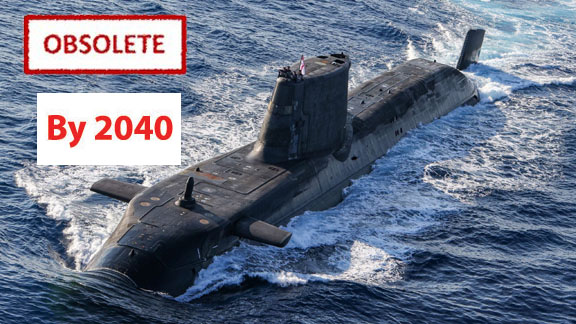
ABC, 7.30 / By Angelique Donnellan, 18 Apr 22, In 1938, wharfies at Port Kembla, south of Sydney refused to load smelted iron ore bound for military production in Japan for its war against China.
Key points:
Independent Senator Rex Patrick is concerned Australia’s nuclear submarines may end up being built overseas
Defence expert Clive Williams believes it would be cheaper to build the subs in the US or the UK
Port Kembla in NSW is being considered as a base for the nuclear submarines
Some locals, including Alexander Brown from Wollongong Against War and Nukes, says the peaceful legacy is reason for the town not to become a defence base for Australia’s new nuclear submarines.
“We’re a city of peace, and we’re a city of renewable and sustainable employment. We don’t want to turn into a defence industry town,” he told 7.30.
“If nuclear submarines are based here in Port Kembla, we’re looking at accident risks for us, for sea life, for the ecosystem that we all depend upon.”
Port Kembla is being considered as a potential $10 billion east coast nuclear submarine base location, along with Newcastle and Brisbane.
Debra Murphy from Illawarra Regional Development Australia said the town should embrace the opportunity.
Along with the base proposal, the historic AUKUS deal to deliver eight nuclear-powered submarines remains a work in progress during its initial 18-month consultation period…………
Defence Minister Peter Dutton wouldn’t be drawn on when the new nuclear submarines would be built and go into service, or the amount of construction work that would happen in Australia.
Under the previous French submarine deal, there was a public pledge to spend 60 per cent of the contract value in Australia………..
Concerns subs may be built overseas
South Australian Independent Senator and former submariner Rex Patrick said the language around a local build was too vague.
Every day, it looks more and more likely that this submarine will be built overseas,” Mr Patrick told 7.30.
“The government keeps squeezing on the schedule and that means that they have to reduce risk wherever they possibly can.
“The Australian Strategic Policy Institute has predicted that this project will cost about $170 billion. An overseas build is the exporting of $170 billion of taxpayers’ money and thousands of Australian jobs to foreign shipyards.”……………………..
Expert says subs should be built overseas
Defence researcher Clive Williams from Australian National University said considering the complexity of a nuclear submarine, taxpayers would get better value for money if the boats were constructed in the US or UK.
“I think building at Osborne in South Australia is fraught with danger and could well be another defence procurement disaster. I’m sure that it’ll wind up in cost overruns, changes to design, fiddling around with it, and so on,” he told 7.30.
“I think a much safer bet is to go with an overseas purchase.”………………………………
The government is pursuing the nuclear option after cancelling a contract last September with the French to build 12 diesel-electric submarines, a move that is likely to cost up to $5.5 billion in compensation to the companies involved, including Naval Group.
Mr Dutton said negotiations were ongoing and the settlement would be made public when finalised. https://www.abc.net.au/news/2022-04-19/australia-aukus-nuclear-submarines-building/100982778
Who Profits From Narrative Management & Eliminating Dissent?
Who Profits From Narrative Management & Eliminating Dissent? went2thebridge – Organizing and actions to resist the moral and financial bankrupting of the U.S. through wars against the poor, at home and abroad 18 Apr 22,
When the Pentagon summons the heads of eight weapons manufacturing corporations to a classified meeting about “aid” to Ukraine, you can be sure that a whole lot more Ukranians will be dying in their civil war on steroids.
This type of aid is in reality U.S. taxpayer-funded corporate welfare for the likes of Lockheed and Raytheon, whose former board member is our current Secretary of “Defense.” The aid has been flowing so thick and fast since Russia intervened in the CIA-sponsored war on its doorstep that it’s hard to add it all up quickly enough. One tally this week put the total at $1.7 billion!
Also, why limit these already wealthy corporate entities to feeding from just the U.S. trough? Zero Hedge reports: “Besides replenishing stockpiles sent to Ukraine, the companies stand to gain from European countries increasing military spending in the wake of Russia’s invasion.”
I believe this cash bonanza explains the barrage of propaganda that liberals have fallen for hook, line, and sinker.
You would think that those who value free speech would be alarmed by the burgeoning online censorship that many independent journalists have noted.
Consider the case of Michael J. Brenner, “Professor Emeritus of International Affairs at the University of Pittsburgh and a Fellow of the Center for Transatlantic Relations at SAIS/Johns Hopkins, as well as former Director of the International Relations & Global Studies Program at the University of Texas” according to an interview in scheerpost:
…………… In an email with the subject line “Quittin’ Time,” Brenner recently declared that, aside from having already said his piece on Ukraine, one of the main reasons he sees for giving up on expressing his opinions on the subject is that “it is manifestly obvious that
our society is not capable of conducting an honest, logical, reasonably informed discourse on matters of consequence. Instead, we experience fantasy, fabrication, fatuousness and fulmination.” He goes on to decry President Joe Biden’s alarming comments in Poland when he all but revealed that the U.S. is—and perhaps has always been—interested in a Russian regime change [emphasis mine].
Or how about Scott Ritter, a former UN weapons inspector who sifts through the foggy “facts” of war to discern some truth, who had his Twitter account suspended twice in one week. Based on what he knows about the grisly details of bodies left to rot in the street, he doubted that Russian soldiers could have committed the crimes before their exit from Bucha and speculated that Ukranian militias were the only ones in the area at the time of the massacre.
Cue liberals insisting that Twitter is not the government and therefore can censor anything it likes without violating the 1st amendment. Do they not know that Twitter, Facebook/Meta, Google/YouTube, and other platforms work hand in glove with the federal government to manage the narrative or, when that fails, to eliminate dissenting views?
Are they fooled by mainstream media like the Washington Post, now owned by billionaire Jeff Bezos, ironically sporting the tagline “Democracy Dies in Darkness”?
Or do they know and not care because they’re more interested in the former president and other right-wingers being denied platforms for their views than they are interested in actual free speech?
From media watcher Caitlin Johnstone:
what exactly is the argument for censoring wrongthink about the Ukraine war? Even if we pretend that everything they’re saying is 100% false and completely immoral, so what? What harm is being done? …………
Political action and the players behind it — at every level — becomes more murky by the day. Forgive this boomer for saying, back in the day we thought a free press was foundational to reign in the excesses of the wealthy and powerful, by shining a light into their dark doings.
But late stage capitalism demands fealty to profits above all else. Even, or maybe especially, when the leader of the “free world” is busy shooting himself and his cronies in the foot.
Lightsource bp unveils plans for 400MW NSW solar farm and battery — RenewEconomy
Lightsource bp advances gigawatt-scale solar plans for Australia, with proposal of new PV and battery project near Goulburn in New South Wales. The post Lightsource bp unveils plans for 400MW NSW solar farm and battery appeared first on RenewEconomy.
Lightsource bp unveils plans for 400MW NSW solar farm and battery — RenewEconomy
“Another lie:” It is time to call out Coalition’s climate modelling con — RenewEconomy

Taylor rehashes Coalition’s favoured campaign tactic: Producing unverified modelling to make fictional claims about Labor policy costs. The post “Another lie:” It is time to call out Coalition’s climate modelling con appeared first on RenewEconomy.
“Another lie:” It is time to call out Coalition’s climate modelling con — RenewEconomy
Victoria reaches record wind and solar share of 83.8 per cent — RenewEconomy

Victoria sets new benchmark of 83.8 per cent instantaneous wind and solar share on Easter Sunday. The post Victoria reaches record wind and solar share of 83.8 per cent appeared first on RenewEconomy.
Victoria reaches record wind and solar share of 83.8 per cent — RenewEconomy
April 18 Energy News — geoharvey

Science and Technology: ¶ “This Bat Appreciation Day, NREL Shines Light (Literally) On Bat Interactions With Wind Energy” • Bat Appreciation Day was April 17. With the US DOE’s Wind Energy Technologies Office’s support, National Renewable Energy Laboratory researchers are working hard on solutions that protect bats and other creatures near wind installations. [CleanTechnica] Bats […]
April 18 Energy News — geoharvey
U.S. Is Set to Launch a $6 Billion Effort to Save Nuclear Plants

Ari Natter, Bloomberg News 18 Apr 22, — The Energy Department is expected to provide details as soon as Monday on a $6 billion program aimed at keeping uneconomical nuclear plants in service, providing a lifeline to an industry that’s seen a raft of early reactor retirements driven by competition from cheaper power sources.
The program, funded through the $550 billion infrastructure bill signed into law last year, will let owners and operators of commercial nuclear reactors apply for credits for plants that are likely to shut down for economic reasons if the closures would lead to higher emissions. The agency is set to issue a guidance document this week detailing the application process.
……………….The program, known officially as the Civil Nuclear Credit Program, could provide a boost to operators including Public Service Enterprise Group Inc., Constellation Energy Corp. and Energy Harbor Corp. U.S. reactors have struggled to survive in the face of competition from cheap natural gas and renewable power. A dozen have already retired early for economic reasons,………
The Energy Department, which will administer the program, plans this week to issue guidance about how to apply for the program and will open a process for certification. The agency expects to issue preliminary credit award decisions following an application period of about 30 days, and “the first award cycle will prioritize and be limited to reactors that are approaching near term closure.” https://www.bnnbloomberg.ca/u-s-is-set-to-launch-a-6-billion-effort-to-save-nuclear-plants-1.1753474
Magnitude 5.3 earthquake shakes Fukushima and Ibaraki
Magnitude 5.3 earthquake shakes Fukushima and Ibaraki https://www.japantimes.co.jp/news/2022/04/19/national/quake-fukushima/ 19 Apr 22,
An earthquake with a preliminary magnitude of 5.3 struck Ibaraki and Fukushima prefectures as well as other parts of Japan on Tuesday morning, the Meteorological Agency said.
The 8:16 a.m. quake registered a lower 5 on japan’s seismic intensity scale of 7 in northern Ibaraki, while parts of Ibaraki, Fukushima, Tochigi and Saitama prefectures registered a 4. No tsunami warning was issued.
The temblor originated in an inland part of Fukushima at a depth of about 90 kilometers.
More information:
- Detailed information about this earthquake from the Yahoo! Japan Weather & Disaster website
- Detailed information about this earthquake from the Japan Meteorological Agency website
- The Japan Meterological Agency website
- An explanation of shindo, Japan’s earthquake intensity scale.
- A guide to what to do before, during and after an earthquake.
- Our portal for disaster-related information
Today: Liberal and Labor gobbledgook over nuclear submarines.

If you’re thinking of voting Labor, because of nuclear issues, you should realise that Labor is just as confused, and just as subservient to the USA as Liberal is.
Does anybody bother to dissect what politicians say – when questioned about anything, but especially when questioned on nuclear issues ? They would much prefer that nuclear issues were simply not discussed at all.
On nuclear submarines: Peter Dutton (Liberal) Defence Minister when asked if they will be built in Australia:
“I hope that it’ll be higher than 60 per cent… we haven’t yet chosen what boat (UK or US nuclear design) we’re going with… I think you’ll be pleasantly surprised,…… I just think there is more blue sky here than what people realise.”
Shadow Defence Minister Brendan O’Connor (Labor) when asked the samr question:
“We will do everything we possibly can to make sure that those assets are built in Australia,“
They don’t know, and they don’t care. They don’t care whether Australia even needs these $170 billion undersea white elephants. They’ll be gone from office long before the damn submarines are going to happen . Typical of the quailty of Australia’s current political leadership
Ukraine can fight Russia ‘for 10 years’ claims Zelensky,

Ukraine can fight Russia ‘for 10 years’ claims Zelensky, as neo-Nazi led military suffers heavy losses & demands West supply ever more arms https://www.sott.net/article/466849-Ukraine-can-fight-Russia-for-10-years-claims-Zelensky-as-neo-Nazi-led-military-suffers-heavy-losses-demands-West-supply-ever-more-armsRT, Sun, 17 Apr 2022
Ukraine is not prepared to give up territory and is ready, if necessary, to fight Russia “for 10 years,” President Volodymyr Zelensky has claimed. He also appeared to acknowledge that the current conflict effectively began in 2014, when Kiev first launched an operation to re-take the breakaway Donbass.
In an interview with CNN, Zelensky said that for Ukraine “the battle for Donbass is very important” for a number of reasons, adding that it could affect “the course of the whole war.” He stressed, however, that a diplomatic solution to the conflict is preferable.
“We cannot give up our territory, but we must find some kind of dialogue with Russia,” Zelensky said, adding that talks will not be conducted “on the basis of the Russian ultimatum.”
Zelensky said dialogue is needed to prevent more deaths, though he claimed his country “can fight the Russian Federation for ten years.”
He said the Ukrainian forces in Donbass are some of “the best military” the country has. “It is a large grouping. And Russia wants to encircle them and destroy them,” Zelensky claimed, adding that he was talking about “44,000 professional military men who survived a great war from the beginning of 2014.”
“This is why it is very important for us to preserve that part of our army.”
Asked by the CNN presenter if Ukraine will be victorious in the conflict, Zelensky said, “Yes, of course.”
Russia attacked the neighboring state in late February, following Ukraine’s failure to implement the terms of the Minsk agreements, first signed in 2014, and Moscow’s eventual recognition of the Donbass republics of Donetsk and Lugansk. The German and French brokered protocols were designed to give the breakaway regions special status within the Ukrainian state.
The Kremlin has since demanded that Ukraine officially declare itself a neutral country that will never join the US-led NATO military bloc. Kiev insists the Russian offensive was completely unprovoked and has denied claims it was planning to retake the two republics by force.
RT comments:
It seems that Russia agrees Donbass is important, that’s why it focused on liberating Donbass, and it did so by luring the US-proxy army in Ukraine away to Kiev.
Maybe it’s possibly, technically, true; [ country “can fight the Russian Federation for ten years.”] although the economies of the West would probably have bankrupted themselves by then, even if they were able to recruit ever more cannon fodder from their terrorist armies elsewhere, and these terrorists wouldn’t be fighting on the territory that Russia has already taken control over; it’s also not clear that the multipolar alliance would tolerate a decade of attacks without serious retaliation.
It remains to be seen what’s left of the Ukraine as we know it in 10 weeks, never mind 10 years. Zelensky’s acting experience has certainly fooled a great many people into thinking otherwise, but the facts on the ground, such as the heavy losses of Ukraine’s military bases, troops, territory, and its endless begging for more money and arms, reflect a proxy army in dire straits: Ukraine is smashed, this is how it will be repaired
Nuclear news this week – worrying times!

Some bits of good news – What went right this week: hope for the climate, plus more positive news. Nature has priority’: Rewilding map showcases nature-led restoration . Once Rocked by Nuclear Disaster, Fukushima Is Now a Renewables Hub. Solar Panels That Make Electricity at Night are Finally Here – And They’re Cheap and Don’t Need Batteries.
CORONAVIRUS. Global COVID-19 cases pass grave milestone as highly contagious BA.2 subvariant surges around the world.
CLIMATE. Pole to Pole with Paul Beckwith – I highly recommend this Radio Ecoshock interview with this top climate communicator
NUCLEAR. What can I say ? Are we on the brink of nuclear war? Can we have any confidence in our leaders to make sensible decisions? It is exhausting to rummage through the media spin in the search for accurate information.
AUSTRALIA.
Pine Gap’s role in China–US arms race makes Australia a target. Nuclear risks, the war in Ukraine, and Australia’s significant contribution to these dangers. Defence expert spills the beans – small nuclear reactors for Australia are all about militarism, not ”peaceful energy”,
Cameco Corp still set on WA uranium mine, despite government knockback, Indigenous opposition.
This should be a climate change election
Why the ABC cannot rely on the coalition https://www.youtube.com/watch?v=WPycNs6mlxU
INTERNATIONAL
Caitlin Johnstone sheds a critical gaze on media reporting on Ukraine, and asks why Julian Assange is criminalised for revealing military atrocities. Glenn Greenwald: The Censorship Campaign Against Western Criticism of NATO’s Ukraine Policy Is Extreme. How Much Are We Prepared To Sacrifice To Help The US Win A Propaganda War Against Putin?
NATO gloats over second, bloodier phase of Ukraine war
NATO’s military buildup on eastern flank to lengthen, broaden war — Anti-bellum
The US-Australia-UK pact seems determined to pursue great power competition at the risk of real conflict.
UKRAINE. Russian soldiers received ‘shocking amount’ of nuclear exposure at Chernobyl site – some may have less than a year to live. Carelessness of Russian soldiers around Chernobyl – shows danger of nuclear sites in wartime. Kyiv Independent news is anything but independent. It’s a mouthpiece for NATO-USA-Azov-nazi propaganda and unverified atrocity stories. Ukrainian blogger gets 15 years gaol for saying that Zelensky govt takes orders from other governments. Zelensky gives his vision of peace deal with Russia.
Zelensky adviser: Ukraine war can last till 2035, best option is for Russia to be broken
NATO’s shift to Asia-Pacific: Biden trip to Japan designed to rally Asia against Russia, China
Pine Gap’s role in China–US arms race makes Australia a target
Rakesh, April 15, 2022 https://community99.com/pine-gaps-role-in-the-arms-race-between-china-and-the-united-states-makes-australia-a-target/
Developments at the U.S.-Australian satellite intelligence base at Pine Gap near Alice Springs give the United States an unprecedented ability to detect Chinese spacecraft from space and potentially destroy them.
Previously, detection was mainly based on ground-based radars, which are no longer seen as suitable for identifying these spacecraft if they were weapons. China has said it has only tested new space vehicles.
As shown below, two different versions of the latest Pine Gap satellites can do this job together. The difficulty is how to further destabilize the nuclear balance between China and the United States in order to help maintain peace.
Last October, it was reported that China had tested a nuclear-capable highly maneuverable hypersonic glider after it was lifted into space by a missile. The nuclear warheads released from US intercontinental ballistic missiles are also manoeuvrable and independently targeted. But the United States sees a serious threat from these hypersonic vehicles that can drive at more than five times the speed of sound.
This development makes Australia more closely integrated with any American offensive in space, as well as with defensive capabilities. Yet there has been no political debate in Australia about the consequences of avoiding war. No senior politician is trying to create momentum to support a new arms control deal, as Presidents Richard Nixon and Leonid Brezhnev did in 1971, when the number of nuclear weapons escalated alarmingly, to more than 30,000 each.
The latest arms build-up is highlighted by a meeting in late March between Australian intelligence and military officials and senior US military officers at Pine Gap. Although the United States clearly considers Pine Gap to be crucial in fighting war in space, these military officers did not speak to the Australian media. Instead, they choose to talk to a London-based journalist Financial Times.
It is unclear whether the government intends to inform the Australian public about developments at Pine Gap. These have implications for Australia’s own security and its potential obligations under the outer space treaty, which limits the militarization of space without completely banning it. If Pine Gap was not already a Chinese nuclear target, it probably will be now.
That Financial Times reported the head of the U.S. Indo-Pacific Command, Admiral John Aquilino, said the United States wanted to integrate all elements of the U.S. military power with its allies. In this context, Aquilino said Australia has capabilities that make it an “extremely advanced partner”. He said increased visibility in space would help counter Chinese hypersonic weapons. “The ability to identify and track and defend against these hypersonics is really key.”
The head of the U.S. Space Command, General James Dickinson, was also interviewed for the play, saying Australia was a “critical partner” in efforts to improve space domain awareness and monitor Chinese space operations. He said, “This is the perfect place for many things to do.”
The deputy head of the U.S. Cyber Command, Lieutenant General Charles Moore, said digital convergence between the United States and Australia gives the Unit
Pine Gap’s own satellites also pick up signals from radars and weapon systems, such as ground-to-air missiles, anti-aircraft artillery, fighter jets, drones and spacecraft, along with other military and civilian communications. From Pine Gap, a huge amount of military data is fed into the American war machine in real time.ed States “the potential to conduct offensive operations.” He added that cooperation with allies created an “asymmetric advantage” over China, which lacks similar partnerships. One consequence is that China cannot gather near as much electronic intelligence from across the globe as the United States.
An idea of the growing importance of Pine Gaps for the United States is given by its extraordinary growth. Originally, it was a ground station for a single satellite to collect what is called signal intelligence as it orbited 36,000 kilometers above the Earth. There are now at least four much more powerful satellites connected to the base. Their antennas automatically intercept everything that is transmitted within their frequency range. This includes a large selection of electronic signals for intelligence analysis, including text messages, emails, phone calls and more. In addition, terrestrial antennas at Pine Gap and other Australian locations pick up a large amount of information transmitted via commercial satellites.
Pine Gap’s own satellites also pick up signals from radars and weapon systems, such as ground-to-air missiles, anti-aircraft artillery, fighter jets, drones and spacecraft, along with other military and civilian communications. From Pine Gap, a huge amount of military data is fed into the American war machine in real time.
Pine Gap operates in connection with similar interception satellites attached to a base at Menwith Hill in England. Their use to lead counterfeit drone strikes that have killed a large number of civilians has been much debated in England. The combined coverage of the two bases includes the former Soviet Union, China, Southeast Asia, East Asia, the Middle East, Eastern Europe, and the Atlantic landmass.
Pine Gap is also linked to infrared satellites, which are of great interest to Americans. Their original function, which is still important, is to provide early warning of the firing of nuclear-armed Russian or Chinese ballistic missiles. Added options now allow them to use their infrared telescopes to detect and track heat from spacecraft as well as from large and small missiles and military jets. Some satellites have very elliptical orbits that can go close to Earth instead of being 36,000 kilometers above Earth.
These satellites now provide highly coveted information about Chinese spacecraft, amplified by the data from the signal intelligence satellites. Taken together, this gives access to signals and infrared intelligence, and its location relative to China, Pine Gap plays a crucial role in the United States’ plans to fight wars in space. This capability will be enhanced by a new space-based detection and tracking system called Next Generation Overhead Persistent Infrared (Next-Gen OPIR).
On April 6, the leaders of the AUKUS pact – Boris Johnson, Scott Morrison and Joe Biden – announced that they would develop hypersonic missiles and subterranean robots after previously promising to supply Australia with nuclear submarines from around 2040.
These new missiles will also travel at more than five times the speed of sound, but are air-breathing unlike those designed for use in space. The United States and Australia had already developed hypersonic cruise missiles using ramjet engines.
No figures are available, but the cost of developing, building and testing very long-range missiles will be high. A large part of the test is expected to take place in Australia. The new missiles are also intended for use against Chinese targets.
Again, China can be expected to build more missiles with the ability to target Australian and US forces in the region. Separately, Secretary of Defense Peter Dutton announced that the Australian government will spend $ 3.5 billion on new missiles with a longer range of 900 kilometers for Australian ships and fighter jets.
The background to what is happening at Pine Gap illustrates how much more important the base is to the United States than any contribution Australia may have made by a pair of fighter jets or frigates to the United States’ integrated international force that was at a distance from China. At this stage, neither side of Australian policy seems willing to refuse participation in yet another US-led war that violates Australia’s obligations under both the UN Charter and Article 1 of the ANZUS Treaty. Both documents oblige Australia to reject the use of force in international relations, other than defensively.
Although rarely mentioned, Pine Gaps’ growing importance to the United States increases Australia’s leverage with the United States to refuse to contribute ships, aircraft and troops to an integrated military force should it violate international rules. It may be harder to dismiss some aspects of Pine Gap’s operations. But there are provisions in the ground rules that Australia only acts with “full knowledge and agreement” with what is happening. Australia does not have to agree.
A further question is how to revive arms control negotiations between Russia and the United States and include China. The two large ones have 1550 intercontinental warheads, but they also have smaller ones. According to the Pentagon, China had only about 100 intercontinental ballistic missiles by 2021 and about 200 smaller warheads. This gives China reasonable cause for concern that it does not have enough strategic warheads to be able to retaliate against a US first attack and thus perpetuate deterrence.
To overcome this, the Pentagon projects that China will have around 1,000 intercontinental warheads by 2030. All sides must reach a new agreement to make major cuts in the number of warheads if the chances of nuclear war are to be reduced.
Whether or not China develops hypersonic spacecraft, it is already committed to getting more traditional intercontinental ballistic missiles that can disperse maneuverable warheads. Restraint on all sides is necessary.
I asked the Secretary of State, Marise Payne, and her Labor counterpart, Penny Wong, if Australia could refuse to integrate with the United States and other forces if they considered a proposed deployment in violation of Article 1 of the ANZUS Treaty or the UN Charter. I also asked if Australia could withdraw its military assets from integrated US operations if there was a more urgent need for Australia to confront a local threat that was not of interest to the US. None of them responded before the print deadline.
This article was first published in the print edition of The Saturday Paper on April 16, 2022 as “Mind Pine Gap”.
Our news analyses of the Ukraine war come from politicians, not from genuine military intelligence
Military Situation in Ukraine: An Update by Jacques Baud The Postil
Mon, 11 Apr 2022

This allows us to deduce that the American and European political leaders deliberately pushed the Ukraine into a conflict that they knew was lost in advance — for the sole purpose of dealing a political blow to Russia.
“…………………The Conduct of Battle.
As for the course of operations, the analyses presented in our media come most often from politicians or so-called military experts, who relay Ukrainian propaganda.
Let’s be clear. A war, whatever else it is, is drama. The problem here is that our strategists in neckties are clearly trying to overdramatize the situation in order to exclude any negotiated solution. This development, however, is prompting some Western military personnel to speak out and offer a more nuanced judgment. Thus, in Newsweek, an analyst from the Defense Intelligence Agency (DIA), the American equivalent of the Direction du Renseignement Militaire (DRM) in France, noted that “in 24 days of conflict, Russia has carried out some 1,400 strikes and launched nearly 1,000 missiles (by way of comparison, the United States carried out more strikes and launched more missiles on the first day of the Iraq war in 2003).”
While the West likes to “soften up” the battlefield with intensive and prolonged strikes, before sending in ground-troops, the Russians prefer a less destructive, but more troop-intensive approach. On France 5, the journalist Mélanie Tarvant presented the death of Russian generals on the battlefield as proof of the destabilization of the Russian army. But this is a profound misunderstanding of the traditions and modes of operation of the Russian army. Whereas in the West, commanders tend to lead from the rear, their Russian counterparts tend to lead from the front — in the West they say, “Forward!” In Russia, they say, “Follow me!” This explains the high losses in the upper echelons of command, already observed in Afghanistan — but it also tells of the much more rigorous selection of staff-personnel than in the West.
Furthermore, the DIA analyst noted that “the vast majority of the airstrikes are over the battlefield, with Russian aircraft providing ‘close air support’ to ground forces. The remainder — less than 20 percent, according to U.S. experts — has been aimed at military airfields, barracks and supporting depots.” Thus, the phrase “indiscriminate bombing [that] is devastating cities and killing everyone” echoed by the Western media seems to contradict the U.S. intelligence expert, who said, “If we merely convince ourselves that Russia is bombing indiscriminately, or [that] it is failing to inflict more harm because its personnel are not up to the task or because it is technically inept, then we are not seeing the real conflict.”
In fact, Russian operations differ fundamentally from the Western concept of the same. The West’s obsession with having no fatalities in their own forces leads them to operations that are primarily in the form of very lethal air strikes. Ground troops only intervene when everything has been destroyed. This is why, in Afghanistan or in the Sahel, Westerners killed more civilians than terrorists did. This is why Western countries engaged in Afghanistan, the Middle East and North Africa no longer publish the number of civilian casualties caused by their strikes. In fact, Europeans engaged in regions that only marginally affect their national security, such as the Estonians in the Sahel, go there just to “get their feet wet.”
In the Ukraine, the situation is very different. One only has to look at a map of linguistic zones to see that the Russian coalition operates almost exclusively in the Russian-speaking zone; thus, among populations that are generally favorable to it. This also explains the statements of a US Air Force officer: “I know that the news keeps repeating that Putin is targeting civilians, but there is no evidence that Russia is intentionally doing so.”
Conversely, it is for the same reason — but in a different way — that the Ukraine has deployed its ultra-nationalist paramilitary fighters in major cities, such as Mariupol or Kharkov — without emotional or cultural ties to the local population, these militias can fight even at the cost of heavy civilian casualties. The atrocities that are currently being uncovered remain hidden by the French-speaking media, for fear of losing support for the Ukraine, as noted by media close to the Republicans in the United States.
After “decapitation” strikes in the first minutes of the offensive, the Russian operational strategy was to bypass the urban centers, and to envelop the Ukrainian army, “pinned down” by the forces of the Donbass republics. It is important to remember that the “decapitation” is not intended to annihilate the general staff or the government (as our “experts” tend to understand it), but to sunder the leadership structures so as to prevent the coordinated maneuver of forces. On the contrary, the aim is to preserve the leadership structures themselves in order to be able to negotiate a way out of the crisis.
On March 25, 2022, after having sealed the cauldron of Kramatorsk which denied any possibility of retreat to the Ukrainians and having taken most of the cities of Kharkov and Marioupol, Russia has practically fulfilled its objectives — all that remains is to concentrate its efforts on reducing the pockets of resistance. Thus, contrary to what the Western press has claimed, this is not a reorientation or a resizing of its offensive, but the methodical implementation of the objectives announced on February 24.
The Role of the Volunteers
A particularly disturbing aspect of this conflict is the attitude of European governments that allow or encourage their citizens to go and fight in the Ukraine. Volodymyr Zelensky’s call to join the International Legion for the Territorial Defense of Ukraine, which he recently created, has been greeted with enthusiasm by European countries.
Encouraged by the media that present a routed Russian army, many of these young people head off, imagining they are going — literally — on a hunting trip. However, once there, disillusionment is high. Testimonies show that these “amateurs” often end up as “cannon fodder,” without having any real impact on the outcome of the conflict. The experience of recent conflicts shows that the arrival of foreign fighters brings nothing to a conflict, except to increase its duration and lethality.
Moreover, the arrival of several hundred Islamist fighters from the Idlib region, an area under the control and protection of the Western coalition in Syria (and also the area in which two Islamic State leaders were killed by the Americans) should arouse our concern. Indeed, the weapons we are very liberally supplying to the Ukraine are already partly in the hands of criminal individuals and organizations and are already beginning to pose a security problem for the authorities in Kiev. Not to mention the fact that the weapons that are being touted as effective against Russian aircraft could eventually threaten our military and civilian aircraft.
The volunteer proudly presented by the RTBF on the 7:30 p.m. news of March 8, 2022 was an admirer of the “Corps Franc Wallonie,” Belgian volunteers who served the Third Reich; and he illustrates the type of people attracted to the Ukraine. In the end, we will have to ask ourselves, who gained the most — [in this case] Belgium or the Ukraine?
Distributing weapons indiscriminately could well make the EU — volens nolens — a supporter of extremism and even international terrorism. The result — we are adding misery to misery, in order to satisfy the European elites more than the Ukraine itself.
Three Points Deserve to be Highlighted by Way of Conclusion
1. Western Intelligence, Ignored by Policymakers
Military documents found in Ukrainian headquarters in the south of the country confirm that the Ukraine was preparing to attack the Donbass; and that the firing observed by OSCE observers as early as February 16 heralded an imminent outbreak in days or weeks.
Here, some introspection is necessary for the West — either its intelligence services did not see what was happening and they are thus very bad, or the political decision-makers chose not to listen to them. We know that Russian intelligence services have far superior analytical capabilities than their Western counterparts. We also know that the American and German intelligence services had very well understood the situation, since the end of 2021, and knew that the Ukraine was preparing to attack the Donbass.
This allows us to deduce that the American and European political leaders deliberately pushed the Ukraine into a conflict that they knew was lost in advance — for the sole purpose of dealing a political blow to Russia.
The reason Zelensky did not deploy his forces to the Russian border, and repeatedly stated that his large neighbor would not attack him, was presumably because he thought he was relying on Western deterrence. This is what he told CNN on March 20th — he was clearly told that the Ukraine would not be part of NATO, but that publicly they would say the opposite. The Ukraine was thus instrumentalized to affect Russia. The objective was the closure of the North Stream 2 gas pipeline, announced on February 8th, by Joe Biden, during the visit of Olaf Scholz; and which was followed by a barrage of sanctions.
2. Broken Diplomacy
Clearly, since the end of 2021, no effort has been made by the West to reactivate the Minsk agreements, as evidenced by the reports of visits and telephone conversations, notably between Emmanuel Macron and Vladimir Putin. However, France, as guarantor of the Minsk Agreements, and as a permanent member of the United Nations Security Council, has not respected its commitments, which has led to the situation that the Ukraine is experiencing today. There is even a feeling that the West has sought to add fuel to the fire since 2014.
Thus, Vladimir Putin’s placing of nuclear forces on alert on February 27 was presented by our media and politicians as an irrational act or blackmail. What is forgotten is that it followed the thinly veiled threat made by Jean-Yves Le Drian, three days earlier, that NATO could use nuclear weapons. It is very likely that Putin did not take this “threat” seriously, but wanted to push Western countries — and France in particular — to abandon the use of excessive language.
3. The Vulnerability of Europeans to Manipulation is Increasing
Today, the perception propagated by our media is that the Russian offensive has broken down; that Vladimir Putin is crazy, irrational and therefore ready to do anything to break the deadlock in which he supposedly finds himself. In this totally emotional context, the question asked by Republican Senator Marco Rubio during Victoria Nuland’s hearing before Congress was strange, to say the least: “If there is a biological or chemical weapon incident or attack inside the Ukraine, is there any doubt in your mind that 100% it would be the Russians behind it?” Naturally, she answered that there is no doubt. Yet there is absolutely no indication that the Russians are using such weapons. Besides, the Russians finished destroying their stockpiles in 2017, while the Americans have not yet destroyed theirs.
Perhaps this means nothing. But in the current atmosphere, all the conditions are now met for an incident to happen that would push the West to become more involved, in some form, in the Ukrainian conflict (a “false-flag” incident).
Today: Investigative journalism still lives! In UK’s Daily Mirror – persistent forensic coverage of the plight of veterans of nuclear tests in Australia.

We have told countless heartbreaking stories of grieving mums, children with deformities, men aged before their time and widows struggling to hold their families together, all while campaigning for recognition.
The test veterans and their families will never stop fighting. The Mirror will never cease to demand they are heard.
Just when I was ready to give up on all mainstream media, I found the article by the Daily Mirror. Susie Boniface sets out not only the saga of the sufferings of the veterans, but also, importantly, the irrefutable documentary evidence.
In this time of over-emotional, but not authenticated war coverage, it is refreshing to find this real journalism. And to find a news otlet that has continued to care about soldiers exploited by militarism for all these decades.
Cameco Corp still set on WA uranium mine, despite government knockback, Indigenous opposition
ABC Goldfields / By Sean Tarek Goodwin, 14 Apr 2022
A multinational mining company says it remains committed to a controversial uranium project in WA, despite the state government declining to extend its environmental approval.
Key points:
- The WA Environment Minister has rejected an application to extend approval for a uranium mine near Wiluna
- Traditional owners and conservationists say the decision is a relief, after half a century of opposition
- The company says it is still determined to bring the project forward in the future
A multinational mining company says it remains committed to a controversial uranium project in WA, despite the state government declining to extend its environmental approval.
Canada-based Cameco Corporation spent US$430 million acquiring the Yeelirrie uranium deposit, near Wiluna in the northern Goldfields, in 2012.
It is one of the largest uranium deposits in the country.
Earlier this year, the project’s approval expired due to a failure to commence work.
Last week, WA Environment Minister Reece Whitby denied the firm’s application to have the approval extended.
Relief for traditional owners and conservationists
The Conservation Council of WA and Tjiwarl traditional owners welcomed that decision, after 50 years of campaigning against the project.
Traditional owner Vicky Abdullah said it meant a “threat” was over.
It was a bad decision in the first place and after years in court and fighting to defend our country this news is a great relief,” Ms Abdullah said.
Other conservationists also welcomed the decision.
“This is an important and responsible decision and is a further signal to the uranium sector that they’re not welcome in WA,” Dave Sweeney from the Australian Conservation Foundation said.
Cameco said it has also had a similar application for its Kintyre project in the Pilbara knocked back.
Conservation Council Nuclear Free campaigner Mia Pepper said uranium mining had no future in WA.
“Cameco has clearly shown that there is no economic case to mine uranium in WA, with the 2016 writedown of the Kintyre uranium proposal and the clear decision not to advance Yeelirrie,” Ms Pepper said.
But one mine, at Mulga Rock, also in the Goldfields region is pushing forward.
“There is a lesson here for Vimy Resources and their investors – who are bucking the trend and are continuing to throw more money at their beleaguered Mulga Rock project – that mining uranium in WA is uneconomic,” Ms Pepper said.
Company not backing away
Cameco Corporation declined an interview with the ABC, but said market conditions had hindered the project.
“Economic conditions and the state of the uranium market since the project was approved did not support significant expenditure on development activities,” communications director Jeff Hryhoriw said.
But the major mining company said it was committed to the long-term prospect of mining the mineral in WA. ……………………….
Project’s controversial history
The ABC revealed last year the mine was approved by the former federal environment minister Melissa Price without key protections strongly and repeatedly recommended by the government’s own experts.
The approval occurred on the eve of the 2019 election, which most expected the government to lose.
An email from Cameco chief Simon Williamson to the federal government in the days before the 2019 federal election.(ABC )
Secret emails obtained by the ABC showed the approval occurred following intervention by Cameco and then-resources minister Matt Canavan, both of whom asked for the process to be expedited. https://www.abc.net.au/news/2022-04-14/wa-uranium-mine-cameco-yeelirre-project-reece-whitby/100991146—
1 This month.


PETITION – To: Prime Minister Anthony Albanese and the Australian Labor Government
Chernobyl: The Lost Tapes – A good documentary on Chernobyl on SBS available On Demand for the next 3 weeks– https://www.sbs.com.au/ondemand/tv-program/chernobyl-the-lost-tapes/235274195556
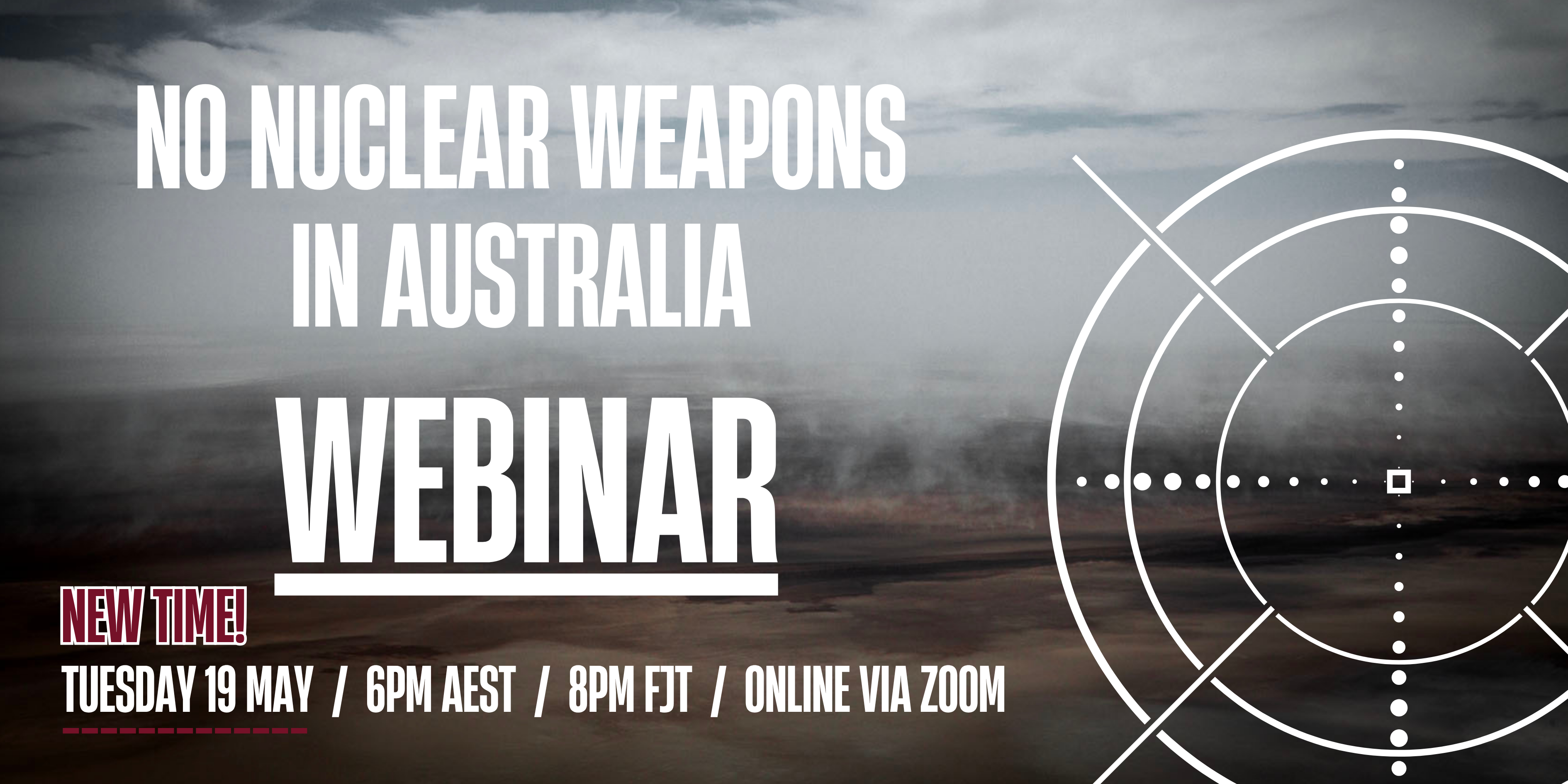
19 May – Webinar- Webinar: No Nuclear Weapons in Australia
Start: 2026-05-19 18:00:00 UTC Canberra, Melbourne, Sydney (GMT+10:00)
End: 2026-05-19 19:30:00 UTC Canberra, Melbourne, Sydney (GMT+10:00)
20 May – Webinar – The dangerous world of AUKUS, US, military occupation and suppression of dissent

National Webinar, 20th May, 2026, 6.30pm AEST. Confronting laws restricting/suppressing protest speech and action
Speakers: Former Sen. Rex Patrick, Lawyer Nick Hanna ,Arthur Rorris ,Jorgen Doyle, Sen David Shoebbridge,
Facilitator Kelley Tranter.

of the week – Australians for War Powers Reform (AWPR)
To see nuclear-related stories in greater depth and intensity
 Antinuclear