Report to U.S. Congress on AUKUS agreement, allows Australia access to Highly Enriched Uranium and Plutonium
Report to Congress on AUKUS Nuclear Cooperation, News USNI, March 16, 2022 On December 1, 2021, President Joseph Biden submitted to Congress an “Agreement among Australia, the United Kingdom, and the United States for the Exchange of Naval Nuclear Propulsion Information.” This In Focus explains the agreement’s substance, as well as provisions of the Atomic Energy Act (AEA) of 1954, as amended (P.L. 83-703; 42 U.S.C. §§2153 et seq.), concerning the content and congressional review of such agreements.
An accompanying message to Congress explains that the agreement would permit the three governments to “communicate and exchange Naval Nuclear Propulsion Information and would provide authorization to share certain Restricted Data as may be needed during trilateral discussions” concerning a project to develop Australian nuclear-powered submarines. This project is part of an “enhanced trilateral security partnership” named AUKUS, which the three governments announced on September 15, 2021. The United States has a similar nuclear naval propulsion arrangement only with the United Kingdom pursuant to the bilateral 1958 Mutual Defense Agreement.
The partnership’s first initiative, according to a September 15 Joint Statement, is an 18-month study “to seek an optimal pathway to deliver” this submarine capability to Australia. This study is to include “building on” the U.S. and UK nuclear-powered submarine programs “to bring an Australian capability into service at the earliest achievable date.” The study is “in the early stages,” according to a November 2021 non-paper from Australia, the United Kingdom, and the United States, which adds that “[m]any of the program specifics have yet to be determined.”
Agreement Details
The agreement, which the governments signed on November 22, 2021, permits each party to exchange “naval nuclear propulsion information as is determined to be necessary to research, develop, design, manufacture, operate, regulate, and dispose of military reactors.”
As noted, this information includes restricted data; the AEA defines such data to include “all data concerning … the use of special nuclear material in the production of energy.” The AEA and 10 C.F.R. Part 810.3 define special nuclear material as plutonium, uranium-233, or enriched uranium.

The agreement, which entered into force on February 8, 2022, is to remain in force until December 31, 2023, when it will “automatically extend for four additional periods of six months each.” Any party may terminate its participation in the agreement with six months written notice. Should any party abrogate or materially violate the agreement, the other parties may “require the return or destruction” of any transferred data.
The agreement includes provisions to protect transferred data. For example, no party may communicate any information governed by the agreement to any “unauthorized persons or beyond” the party’s “jurisdiction or control.” In addition, a recipient party communicating such information to nationals of a third AUKUS government must obtain permission from the originating party. The agreement includes an appendix detailing “security arrangements” to protect transferred information. Download the document here. https://news.usni.org/2022/03/16/report-to-congress-on-aukus-nuclear-cooperation
Understanding the war in Ukraine
Understanding the war in Ukraine, https://independentaustralia.net/article-display/understanding-the-war-in-ukraine,16151 By Vijay Prashad | 14 March 2022 The war between Russia and Ukraine began long before 24 February 2022, the date provided by the Ukrainian Government, NATO and the United States for the beginning of the Russian invasion.
According to Dmitry Kovalevich, a journalist and a member of a now-banned communist organisation in Ukraine, the war actually started in the spring of 2014 and has never stopped since.
He writes to me from the south of Kyiv and recounts an anecdote: “What’s there at the front line?” asks one person. “Our troops are winning as usual!” comes the response. “Who are our troops?” the first person inquires and is told, “We’ll soon see.” In a war, everything is in dispute, even the name of Ukraine’s capital (Kyiv in Ukrainian, and Kiev in Russian, goes the debate online).
Wars are among the most difficult of reporting assignments for a journalist. These days, especially, with the torrent of social media and the belligerence of network news television channels, matters on the ground are hard to sort out. Basic facts about the events taking place during a war are hard to establish, let alone ensuring the correct interpretation of these facts.
Videos of apparent war atrocities that can be found on social media platforms like YouTube are impossible to verify. Often, it becomes clear that much of the content relating to war that can be found on these platforms has either been misidentified or is from other conflicts. Even the BBC, which has taken a very strong pro-Ukrainian and NATO position on this conflict, had to run a story about how so many of the viral claims about Russian atrocities are false.
Among these false claims, which have garnered widespread circulation, is a video circulating on TikTok that wrongly alleges to be that of a Ukrainian girl confronting a Russian soldier, but is instead a video of the then-11-year-old Palestinian Ahed Tamimi confronting an Israeli soldier in 2012. The video continues to circulate on TikTok with the caption, ‘Little girls stand up to Russian soldiers’.
Meanwhile, disputing the date for the beginning of the Russian-Ukrainian war as 24 February, Kovalevich tells me:
“The war in Ukraine didn’t start in February 2022. It began in the spring of 2014 in the Donbas and has not stopped for these eight years.”
Kovalevich is a member of Borotba (Struggle), a communist organisation in Ukraine. Borotba, like other communist and Marxist organisations, was banned by the previous U.S.-backed Ukrainian Government of Petro Poroshenko in 2015 (as part of this ongoing crackdown, two communist youth leaders – Aleksandr Kononovich and Mikhail Kononovich – were arrested by Ukrainian security services on 6 March).
“Most of our comrades had to migrate to Donetsk and Luhansk,” Kovalevich tells me. These are the two eastern provinces of mainly Russian speakers that broke away from “Ukrainian Government control in 2014” and had been under the control of Russian-backed groups.
In February, however, before the Russian invasion of Ukraine, Russian President Vladimir Putin recognised these ‘two breakaway regions in eastern Ukraine as independent,’ making this contentious move the stepping stone for the final military invasion by Russia. Now, Kovalevich says, his comrades “expect to come back from exile and work legally”.
This expectation is based on the assumption that the Ukrainian Government will be forced to get rid of the existing system, which includes Western-trained-and-funded anti-Russian right-wing vigilante and paramilitary agents in the country and will have to reverse many of the Poroshenko-era illiberal and anti-minority (including anti-Russian) laws.
‘I feel nervous’
“I feel quite nervous,” Kovalevich tells me. “[This war] looks very grim and not so much because of the Russians but because of our [Ukrainian] armed gangs that are looting and robbing [the country].” When the Russians intervened, Ukrainian President Volodymyr Zelenskyy handed out weapons to any citizen who wanted to defend the country.
Kovalevich says:
My area was not affected by military actions — only by the terror of [right-wing] nationalist gangs.”
During the first days of the Russian military intervention, Kovalevich took in a Roma family who had fled from the war zone. “My family had a spare room,” Kovalevich tells me. Roma organisations say that there are about 400,000 Roma in Ukraine, most of them living in the western part of Ukraine, in Zakarpatska Oblast (bordering Hungary, Poland, Romania and Slovakia).
Kovalevich says:
“The Roma people in our country are regularly assaulted by [right-wing] nationalists. The nationalists used to attack them [Roma] publicly, burning their encampments, calling it ‘cleansing garbage’. The police didn’t react as our far-right gangs always work in cooperation with either the police or with the security service.”
This Roma family, who was being sheltered by Kovalevich and his family, is on the move toward western Ukraine, where most of the Ukrainian-Roma population lives. “But it is very unsafe to move,” Kovalevich tells me. “There are nationalists [manning these] checkpoints [along] all roads [in Ukraine, and they] may shoot [anyone] who may seem suspicious to them or just rob refugees.”
Minsk agreements
The war in the Donbas region that began in 2014 resulted in two agreements being signed in Belarus in 2014 and 2015, which were named after the capital of Belarus and were called the Minsk agreements. These agreements were aimed at “[ending] the separatist war by Russian speakers in eastern Ukraine”.
The second of these agreements was signed by two leading political figures from Ukraine (Leonid Kuchma, the President of Ukraine from 1994 to 2005) and from Russia (Mikhail Zurabov, the ambassador of the Russian Federation to Ukraine, 2009-2016), respectively. It was overseen by a Swiss diplomat (Leonid Kuchma, who chaired the Independent International Fact-Finding Mission on the Conflict in Georgia, 2008-2009).
This Minsk II agreement was endorsed by the UN Security Council resolution 2022 on 17 February 2015. If the Minsk agreements had been adhered to, Russia and Ukraine would have secured an arrangement that would have been acceptable in the Donbas.
Kovalevich tells me:
“Two Ukrainian governments signed the Minsk agreements but didn’t fulfil [them]. Recently Zelenskyy’s officials openly mocked the agreement, saying they wouldn’t fulfil it (encouraged by the U.S. and the UK, of course). That was a sheer violation of all rules — you can’t sign [the agreements] and then refuse to fulfil [them].”
The language of the Minsk agreements was, as Kovalevich says, “liberal enough for the Government”. The two republics of Donetsk and Luhansk would have remained a part of Ukraine and they would have been afforded some cultural autonomy (this was in the footnote to Article 11 of the 12 February 2015, Minsk II Agreement).
Kovalevich says to me:
“This was unacceptable to our nationalists and [right-wing nationalists]. [They] would like to organise purges and vengeance there [in Donetsk and Luhansk].”
Before the Russian military intervention, the UN High Commissioner for Human Rights found that more than 14,000 people had been killed in the ongoing conflict in Donetsk and Luhansk despite the Minsk agreements. It is this violence that provokes Kovalevich to make his comments about the violence of the ultra-nationalists and the right-wing paramilitary.
“The elected authorities are a cover, masking the real rulers of Ukraine,” Kovalevich says. Ukraine’s President Zelenskyy and his allies in the parliament do not drive the governing process in their country but have “an agenda imposed on them by the far-right armed groups
Peace?
Negotiations are ongoing on the Ukraine-Belarus border between the Russians and the Ukrainians. Kovalevich is, however, not optimistic about a positive outcome from these negotiations. Decisions, he says, are not made by the Ukrainian President alone, but by the right-wing ultra-nationalist paramilitary armed groups and the NATO countries.
As Kovalevich and I were speaking, the Washington Post published a report about plans for a U.S.-backed insurgency in Ukraine; former U.S. Secretary of State Hillary Clinton implied an Afghanistan-style guerrilla war in Ukraine, saying: “We have to keep tightening the screws.”
Kovalevich says:
“This reveals that they [the U.S.] don’t really care about Ukrainians. They want to use this as an opportunity to cause some pain to the Russians.”
These comments by Clinton and others suggest to Kovalevich that the United States wants “to organise chaos between Russia and the Europeans”. Peace in Ukraine, he says, “is a matter of reconciliation between NATO and the new global powers, Russia and China”. Till such a reconciliation is possible and till Europe develops a rational foreign policy, “we will be affected by wars,” says Kovalevich.
Vijay Prashad is an Indian historian, editor and journalist. He is a writing fellow and chief correspondent at Globetrotter. He is the chief editor of LeftWord Books and the director of Tricontinental: Institute for Social Research.
Silence in the media and Labour “left” on Assange’s extradition danger

Silence in the media and Labour “left” on Assange’s extradition danger, WSWS, 16 Mar 22,
Thomas Scripp, Julian Assange was shunted a step closer to his would-be executioners on Monday. The UK Supreme Court issued a one-line decision refusing to hear the WikiLeaks founder’s appeal against an earlier decision ordering his extradition to the United States.
The case will now be returned to the original court as a formality before being passed to the home secretary, Priti Patel, to give the final order. Once Patel receives the case, Assange could be on a plane to the US in just four weeks’ time, except for inevitable further appeals.The Biden administration intends to prosecute Assange for charges under the Espionage Act with a potential sentence of 175 years in prison. This would be served in barbaric conditions that previous judgements acknowledged could drive him to suicide. His health has already been destroyed by years of incarceration in Britain’s maximum security Belmarsh prison.
Despite the immense danger faced by the most significant journalist of the 21st century, many major newspapers did not cover the Supreme Court decision. Those that did ran entirely perfunctory stories, largely without comment.Britain’s leading liberal newspaper, the Guardian, did not write a single critical line in its cursory 350-word article, quoting just two sentences from his legal team. The US New York Times managed, “If Mr. Assange were extradited to the United States and faced a trial, the case could raise profound First Amendment issues. His prosecution has alarmed advocates of press freedom.”
These are publications which have spent the last weeks screaming about Russian President Vladimir Putin’s censorship and attacks on free speech and journalistic freedoms. When speaking out about democratic rights lines up with imperialist war aims, they are fervent advocates. In the case of Assange, who exposed the systematic crimes of US and British imperialism, the “democratic principles” they so fiercely defend in Russia whither on the vine.
The NATO-Russia war over Ukraine has not only accelerated Assange’s persecution, but intensified his long and deliberate isolation by the corporate media.
At a briefing with the Foreign Press Association last month, to introduce his new book The Trial of Julian Assange: A Story of Persecution, UN special rapporteur on torture Nils Melzer accused the mainstream media of failing in their duty as the “fourth estate” to hold governments to account. Melzer’s book is based on his three years of efforts to end the illegal mistreatment of the WikiLeaks founder.
In it, he criticises the “too little, too late”, “tame and lame” reporting of the British, American and American press, exposing their cynical pseudo-support for Assange:“A handful of half-hearted opinion pieces in the Guardian and the New York Times rejecting Assange’s extradition are not bold enough, and so fail to convince. While both papers have timidly declared that convicting Assange of espionage would endanger press freedom, not a single mainstream media outlet protests the blatant violations of due process, human dignity and the rule of law that pervade the entire trial. None holds the involved governments to account for their crimes and corruption; none has the courage to confront political leaders with uncomfortable questions; none feels dutybound to inform and empower the people—a mere shadow of what was once the ‘fourth estate’.”
Amid the war frenzy and the need to present Britain and the US as champions of global democracy, even the days of the half-hearted opinion piece are over.
Melzer’s point extends far beyond the media. The UN rapporteur is one of just a handful of prominent public figures in any sphere with an honourable record on Assange. At his FPA event, he described his inability to seek redress “through the diplomatic channels at my disposal, or by alerting the General Assembly [of the UN] or the Human Rights Council in Geneva,” describing Assange as “the untouchable case,” kept behind a “wall of silence”.
Among the more significant silences is kept by the British “left”.
In July 2020, only 26 MPs could bring themselves to sign an early day motion, “Julian Assange, press freedom and public-interest journalism”, which asserted, “That this House notes the July 2020 statement by the National Union of Journalists, the International Federation of Journalists, Reporters Without Borders and others in relation to the WikiLeaks founder Julian Assange and affirms its commitment to press freedom and public-interest journalism.”
Among the signatories were 16 Labour MPs, including now former party leader Jeremy Corbyn and several of his shadow front benchers: John McDonnell, Diane Abbott, Rebecca Long-Bailey, Ian Lavery and Clive Lewis.
Of this rump, only one, Claudia Webbe, has spoken on Assange since the Supreme Court decision. Webbe is no longer a Labour MP, having been expelled from the party after a criminal harassment conviction. She tweeted simply, “Julian Assange should be free”……………………. https://www.wsws.org/en/articles/2022/03/16/assa-m16.html?pk_campaign=assange-newsletter&pk_kwd=wsws
Ukraine war a bonanza for Lockheed Martin, Raytheon, General Dynamics, Northrop Grumman and more

Less than three full months into 2022, Lockheed Martin’s stock has surged by more than 25%, while the share prices of Raytheon, General Dynamics, and Northrop Grumman have also risen by roughly 12%, 14%, and 16%, respectively.
War in Ukraine a Windfall for Weapons Industry
Military contractors “will benefit, and in the short term we could be talking about tens of billions of dollars, which is no small thing, even for these big companies,” said one analyst. Common Dreams KENNY STANCIL, March 15, 2022,
Russia’s deadly assault on Ukraine is a bonanza for arms manufacturers, which are lined up to profit as the United States and its allies increase military spending in an effort to bolster Kyiv’s forces.
William Hartung, a senior research fellow at the Quincy Institute for Responsible Statecraft, told The Hill on Tuesday that “there’s a lot of possibilities for ways that the contractors will benefit, and in the short term we could be talking about tens of billions of dollars, which is no small thing, even for these big companies.”
In the weeks since Russian President Vladimir Putin ordered his troops to invade, lawmakers in the U.S. Congress approved a record-setting Pentagon budget, and their counterparts in several European countries also vowed to significantly boost military spending to counteract Moscow.
The $1.5 trillion government funding bill that U.S. President Joe Biden signed Friday greenlights an astronomical $782 billion in military spending—an increase of 6% over last year and nearly $30 billion above the White House’s initial request. The package also provides $6.5 billion in military aid to Eastern European nations, including $3.5 billion worth of additional weapons for Ukraine.
As The Hill reported, the extra support for Ukraine “comes on top of more than $1 billion the U.S. has already spent in the past year to arm Ukrainian soldiers with modern weapons, including Javelin anti-tank missiles, manufactured by Lockheed Martin and Raytheon Technologies, and Raytheon’s anti-aircraft Stinger missiles.”
One arms industry lobbyist told the news outlet that an immediate effect of the U.S. ramping up weapons shipments to Ukraine is that “we’re going to have to backfill some of that ourselves, so that will force the Pentagon to buy more from some of the defense companies.”
As for longer-term implications, the lobbyist said that Democratic and Republican lawmakers alike expect to pass an even larger military budget next year, which “will pump more money into procurement and into [research and development].”
The U.S. is not the only country where military contractors are anticipating a bump in sales. Over the past few weeks, European countries including Germany, Italy, Poland, and Sweden have announced that they will boost military spending………….
“We are proud of the confidence the German Federal Ministry of Defense and Luftwaffe officials have shown in choosing the F-35,” Lockheed Martin said in a statement.
Less than three full months into 2022, Lockheed Martin’s stock has surged by more than 25%, while the share prices of Raytheon, General Dynamics, and Northrop Grumman have also risen by roughly 12%, 14%, and 16%, respectively.
Even before the Kremlin attacked Ukraine last month, arms manufacturers could hardly contain their excitement over the prospect of war, which they explained would be good for their bottom lines.
AsThe Hill reported:…………………………………
The weapons industry lobbyist told the news outlet that higher military spending in Europe would be a boon for U.S.-based military contractors:…………..
One day after Putin launched his full-scale invasion of Ukraine, the Quincy Institute’s Hartung warned against letting corporations and their allies in government use the war in Ukraine as a pretext for showering the military-industrial complex with even more money.
A week later, he argued that such a move would be “counterproductive” and potentially detrimental to U.S. security, echoing calls from anti-war groups that have long pushed for reallocating a portion of the Pentagon’s bloated budget to meet pressing human needs…………………
Last year, researchers at Brown University’s Costs of War project estimated that as much as half of the $14 trillion spent by the Pentagon alone since its 2001 invasion of Afghanistan has gone to private military contractors.
Lindsay Koshgarian and her colleagues at the Institute for Policy Studies’ National Priorities Project and Stephen Semler of the Security Policy Reform Institute, meanwhile, have estimated that corporations gobbled up more than half. https://www.commondreams.org/news/2022/03/15/war-ukraine-windfall-weapons-industry
A fight for homeland

It is usually our duty to care for the Earth and to support 7 generations ahead
of us. ……. However, in the case of the radioactivity generated by the nuclear
industry, we must protect 7000 generations.
we, the Committee for Future Generations, were embattled by the Nuclear Waste Management Organization.
We are the Poplar/Aspen Tree Home Dene (English River First Nation). The
Nuclear waste management Organization was soliciting us to allow them to
build a nuclear waste dump on our traditional territory.
Our Committee for Future Generations was in a campaign to raise awareness across
Saskatchewan, Canada, and the world about the serious risks we were facing.
We had walked and talked, and used social media, camped and gathered, and
brought in experts.
Our idea was to show the people that we were struggling
against the industrial military complex. Our very DNA was on the line. We
stood to protect the next 7000 Generations of all living things. It is
usually our duty to care for the Earth and to support 7 generations ahead
of us.
However, in the case of the radioactivity generated by the nuclear
industry, we must protect 7000 generations. The radioactive elements being
created today will be hazardous to humans and other species for 7000
generations of life on this planet. We went toe to toe with the sales
brokers the industry sent to pitch this glorified waste dump. We exposed
their gaps and their outright lies and propaganda at every opportunity.
In 2014 they admitted defeat and left Saskatchewan to try to find a willing
“host” community in Ontario. But we continue defending our people. Our
territory has some of the highest-grade uranium deposits in the world. More
than 2700 mineral claims are on file, primarily intending to mine uranium.
There are currently 5 uranium mines and 2 mills in our territory and 2
other companies are in the preliminary stages of applying for a licence to
mine.
Until this industry is shut down neither us, nor people in the places
where the yellow cake is distributed will be safe.
Beyond Nuclear 13th March 2022
Massive 7.3 earthquake hits Japan near site of Fukushima nuclear disaster
Massive 7.3 earthquake hits Japan near site of Fukushima nuclear disaster, Fortune. BY KANA NISHIZAWA AND BLOOMBERG, March 17, 2022 . A magnitude-7.3 earthquake struck northern Japan near Fukushima prefecture late on Wednesday, causing injuries, derailing a bullet train and disrupting power.
The quake, which also shook buildings in parts of Tokyo, struck around 11:36 pm local time, the Japan Meteorological Agency said. Kyodo News said “many” were injured in Fukushima, citing the local fire department, although the full scale of damages and injuries was still unclear. …..
Tokyo Electric Power Co. said around 2 million buildings in its service area lost electricity, although power was restored to most a few hours later. Around 9,300 buildings, including more about 1,100 in Tokyo, remained without power as of 2:30 a.m. local time, it said.
Nuclear regulators said a fire alarm went off at Fukushima’s Dai-ichi nuclear plant, and that water pumps used to cool spent fuel pool at the Dai-ni plant were halted, although there was no imminent danger. ………. https://fortune.com/2022/03/16/magnitude-7-3-earthquake-hits-fukushima-japan/
So, who actually does have the ‘duty of care’? Who is responsible for tomorrow? — Sustainability Bites

The Federal Minister for the Environment does not have a duty of care to protect young people from the harms of climate change. So says the law. If not the Environment Minister, then who? Our Prime Minister or the Minister for Emissions? Our corporate leaders and billionaires? Or should we look to the world government? Our whole polity is failing us.
So, who actually does have the ‘duty of care’? Who is responsible for tomorrow? — Sustainability Bites
Origin says there are better technologies than coal, as grid moves away from baseload — RenewEconomy

Origin CEO says decision to close Eraring early highlights need to move quickly as the grid shifts from a focus on baseload to flexible capacity. The post Origin says there are better technologies than coal, as grid moves away from baseload appeared first on RenewEconomy.
Origin says there are better technologies than coal, as grid moves away from baseload — RenewEconomy
Younger generations demand stronger climate action, despite federal court setback — RenewEconomy

Australian voters continue to rank climate change as a top election concern, with new polling showing they want stronger policies. The post Younger generations demand stronger climate action, despite federal court setback appeared first on RenewEconomy.
Younger generations demand stronger climate action, despite federal court setback — RenewEconomy
South Australia looks to more big batteries to maximise wind and solar exports — RenewEconomy

South Australia looking at big batteries to maximise exports of wind and solar to neighbouring states once new link is complete. The post South Australia looks to more big batteries to maximise wind and solar exports appeared first on RenewEconomy.
South Australia looks to more big batteries to maximise wind and solar exports — RenewEconomy
Contaminated soil from nuclear power plant, destination yet to be determined… — Fukushima 311 Watchdogs

March 12, 2022 Seven years have passed since the operation of the interim storage facilities that surround TEPCO’s Fukushima Daiichi Nuclear Power Plant began. The delivery of contaminated soil from the decontamination of the nuclear accident is expected to be almost completed by the end of this month, except for that from the difficult-to-return zone. […]
Contaminated soil from nuclear power plant, destination yet to be determined… — Fukushima 311 Watchdogs
Ukraine war: Chinese Foreign Ministry reminds Washington of its own recent history — Anti-bellum
Xinhua News AgencyMarch 16, 2022 U.S. a typical example of big countries bullying small countries: FM spokesperson China on Wednesday refuted the U.S. criticism of big countries bullying small countries, saying that what the United States has done to Cuba, Panama and other countries are typical examples of bullying. Foreign Ministry spokesperson Zhao Lijian made […]
Ukraine war: Chinese Foreign Ministry reminds Washington of its own recent history — Anti-bellum
NATO, EU, Quad states besiege India over refusal to join anti-Russia crusade — Anti-bellum
The HinduMarch 17, 2022 Amid Ukraine crisis, Delhi receives a flurry of NATO allies and Quad partnersSuhasini Haidar Amidst a global call by NATO countries and western allies to join sanctions against Russia, Prime Minister Narendra Modi is expected to hold back–to–back summits with Quad partners, including an in–person summit with Japanese Prime Minister Fumio […]
NATO, EU, Quad states besiege India over refusal to join anti-Russia crusade — Anti-bellum
A joint statement of IPPNW physicians in Russia and Ukraine — IPPNW peace and health blog
The conflict between Russia and Ukraine continues, leading to human casualties. And in the case of escalation of the conflict it may cause more severe consequences, involvement of other countries, nuclear facilities and even nuclear confrontation. It is a great tragedy in the center of Europe caused by the inability of authorities to speak to […]
A joint statement of IPPNW physicians in Russia and Ukraine — IPPNW peace and health blog

1 This month.


PETITION – To: Prime Minister Anthony Albanese and the Australian Labor Government
Chernobyl: The Lost Tapes – A good documentary on Chernobyl on SBS available On Demand for the next 3 weeks– https://www.sbs.com.au/ondemand/tv-program/chernobyl-the-lost-tapes/235274195556
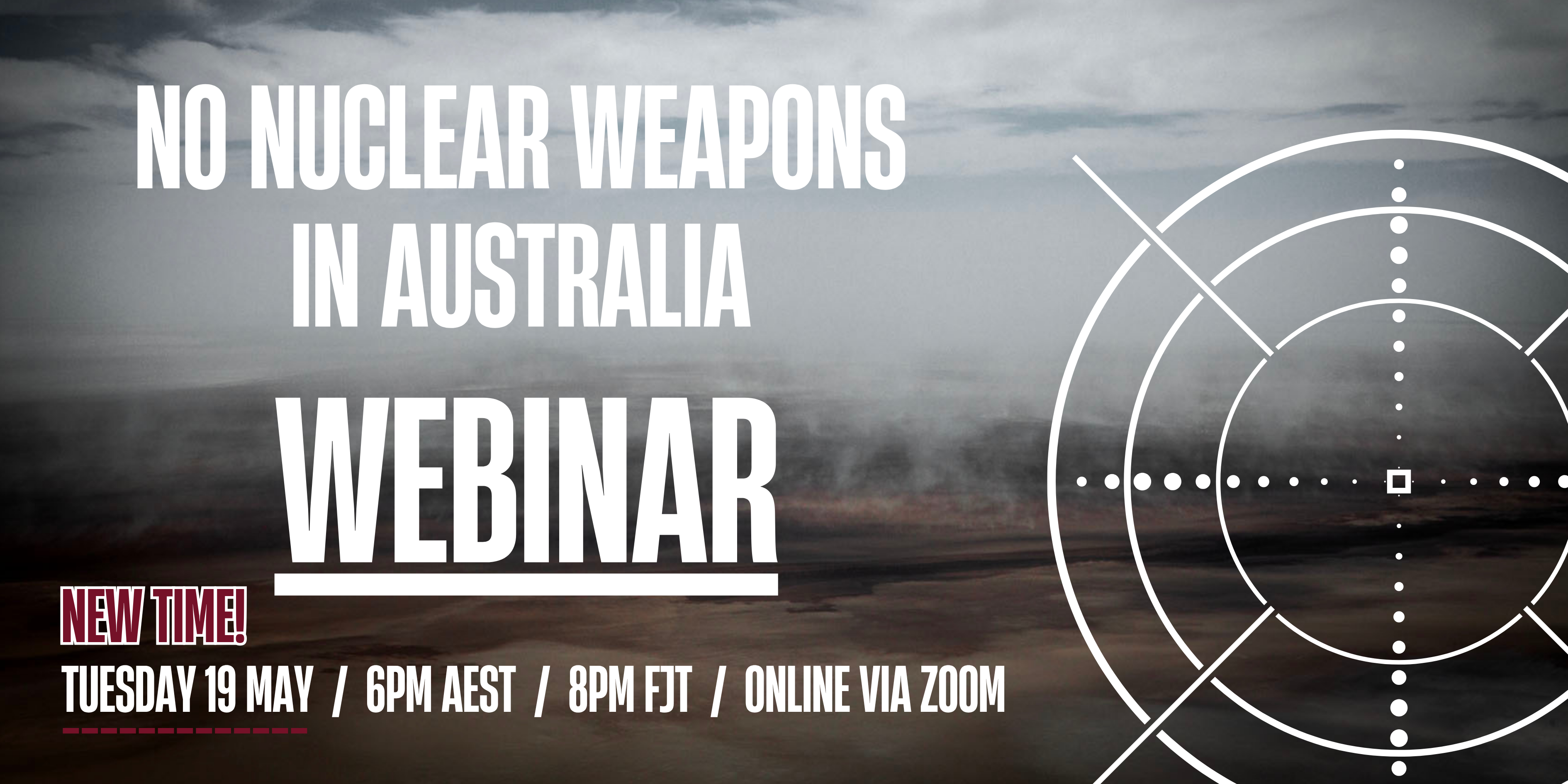
19 May – Webinar- Webinar: No Nuclear Weapons in Australia
Start: 2026-05-19 18:00:00 UTC Canberra, Melbourne, Sydney (GMT+10:00)
End: 2026-05-19 19:30:00 UTC Canberra, Melbourne, Sydney (GMT+10:00)
20 May – Webinar – The dangerous world of AUKUS, US, military occupation and suppression of dissent

National Webinar, 20th May, 2026, 6.30pm AEST. Confronting laws restricting/suppressing protest speech and action
Speakers: Former Sen. Rex Patrick, Lawyer Nick Hanna ,Arthur Rorris ,Jorgen Doyle, Sen David Shoebbridge,
Facilitator Kelley Tranter.

of the week – Australians for War Powers Reform (AWPR)
To see nuclear-related stories in greater depth and intensity
 Antinuclear