Nuke Power at the Brink of Bankruptcy, War, Apocalypse
Nuke Power at the Brink of Bankruptcy, War, Apocalypse https://www.rsn.org/001/nuke-power-at-the-brink-of-bankruptcy-war-apocalypse.html?print=1 Harvey Wasserman/Reader Supported News 19 Feb 22,
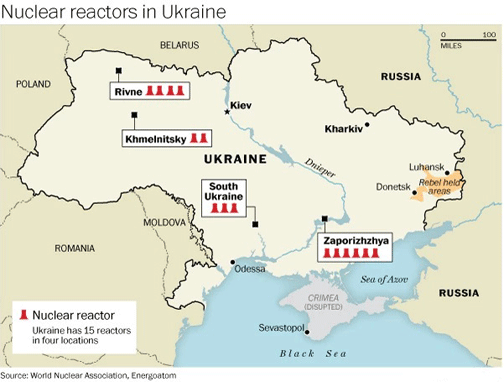
Fifteen atomic reactors in Ukraine currently spew out massive quantities of radiation alongside the smoldering ruin of Chernobyl Unit 4.War could easily—-and soon!—-turn each into a nuke of mass destruction, blasting into the eco-sphere clouds of lethal fallout far in excess of actual A-Bombs, including Hiroshima and Nagasaki.
Like the rest of the global fleet, Ukraine’s reactors are sitting ducks, set to explode. They symbolize an monumental technological failure, left in the radioactive dust by the rise of renewables. But a devious, deceitful industry is desperate to kill green power, even if its dirty, decayed rump reactors could mushroom as you read this.
The essential unity between atomic power and weapons has been set since birth. France’s Macron now explicitly argues that “peaceful” reactors are needed to sustain the French atomic weapons program.
Cesium fallout from the four exploded Fukushima reactors exceeds that from Hiroshima and Nagasaki by a factor of more than 100. A compendium of studies at Chernobyl indicates a human death toll of more than a million. People and animals died in droves at Three Mile Island. After six decades of development, no US “Peaceful” atomic reactors can get private insurance against the liabilities of a catastrophic accident.
But the 400 nukes operating worldwide (93 in the US) threaten just that.
They burn at 571 degrees Fahrenheit, heating the planet. They spew carbon 14 and other greenhouse gases as they gouge their fuel, burn their innards and plague us all with unmanageable wastes.
Construction began on ALL US nukes at least thirty years ago. They’re embrittled, cracked, under-maintained, obsolete, ticking time bombs. Many are operating far beyond original design specs. Their workforces are aging and retiring. They sit in earthquake zones and flood plains, vulnerable to hurricanes, tornadoes, tsunamis, sabotage, war.
Attempts to build more of these old-style water-cooled clunkers have catastrophically failed at Olkiluoto in Finland, Flamanville in France, V.C. Summer in South Carolina (abandoned at a cost of $10 billion), Vogtle in Georgia…where two reactors that may never open have soared past $30 billion, potentially bankrupting the Peach State.
Powered with a mix of plutonium, the explosion at Fukushima Unit Three threw up a familiar mushroom cloud. Millions of gallons of radwaste there are poised to be poured into the Pacific.
Yet the nuke industry wants to paint itself green. It hides its massive carbon emissions…ignores the gargantuan quantities of heat and wastes each reactor pours into the eco-sphere….kills billions of land and sea creatures every day.
The reactor industry’s clearest present danger centers on its non-stop radiation releases and millions of tons of radioactive offal that can’t be managed.
But possible war in Ukraine (or elsewhere) could dwarf Chernobyl in a matter of moments. As both the Russians and the Ukrainians well know, these are pre-deployed Atomic Bombs, easily turned Apocalyptic by conventional weapons, advanced cyber-attack or simple incompetence.
The latest stab at reviving this zombie technology centers on “Small Modular Reactors.” Some models are meant to be cooled by liquid sodium, which has already caused an explosive 1959 radiation release at Santa Susana, north of Los Angeles, and a 1966 melt-down at Fermi I, south of Detroit.
All SMRs are years away from mass production. If built, they’ll emit huge quantities of heat and greenhouse gasses. They’ll divert enormous quantities of resources that could otherwise go for renewables that are cleaner, cheaper, safer, more reliable, more job-creating, more quickly deployed…and that that won’t explode, create radioactive waste or heat the planet.
SMRs today currently work primarily as scams grifting billions of public dollars into the pockets of the likes of Bill Gates. They’re virtually certain to fail. One or more are likely to explode.
They can never compete with the solar, wind, battery and LED/efficiency technologies revolutionizing global green energy. With an astonishing record of meteoric advances, these four pillars of Solartopia have pushed all fossil/nuclear technologies into history’s economic waste bin. As long as there are rooftops bare of solar panels, and offshore sites ready for wind turbines, the real market for any other form of new energy is marginal at best.
But the corporate nuke pushers don’t care. Their mainly theoretical new reactors can never compete. Their old ones are uninsured, falling apart, spewing heat, carbon, radiation and death while losing mega-tons of YOUR money.
AND they can blow up… as at Fukushima and Chernobyl.
With war coming right at them, ALL reactors need to be shut NOW…before they ignite the next Apocalypse…which YOU will pay for with your life, health, family, fortune and future.
Harvey Wasserman’s America at the Brink of Rebirth: The Organic Spiral of Us History can be had via www.solartopia.org. The Strip & Flip Selection of 2016: Five Jim Crows & Electronic Election Theft, co-written with Bob Fitrakis, is at www.freepress.org.
UN to review Japan’s plan to release Fukushima water into Pacific
UN to review Japan’s plan to release Fukushima water into Pacific
Taskforce will ‘listen to local people’s concerns’, as government plans to release more than 1m tonnes, Guardian, Justin McCurry in TokyoFri 18 Feb 2022
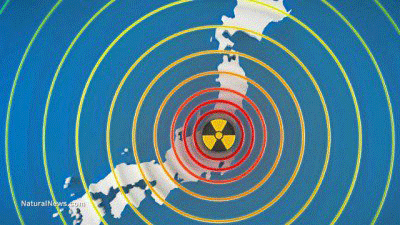
A UN nuclear taskforce has promised to prioritise safety as it launches a review of controversial plans by Japan to release more than 1m tonnes of contaminated water into the ocean from the wrecked Fukushima Daiichi nuclear plant.
Japan’s government announced last April that it had decided to release the water over several decades into the Pacific Ocean, despite strong opposition from local fishers and neighbouring China and South Korea……………
The Tokyo Electric Power company (Tepco) says its treatment technology can remove all radioactive materials from water except tritium, which is harmless in small amounts. It said the gradual release of the water, diluted with seawater, would not pose a threat to human health or the marine environment. In 2020, however, Greenpeace said the water still contained contaminants beside tritium and would have to be treated again.
The wastewater is being stored in about 1,000 tanks that officials say need to be removed so the plant can be decommissioned, an operation expected to take several decades. The tanks are expected to reach their capacity of 1.37m tonnes this summer.
The liquid includes water used to cool the damaged reactors, as well as rain and groundwater that seeps into the area.
Shaun Burnie, a senior nuclear specialist for Greenpeace East Asia, said he did not believe the IAEA would fully investigate and address safety and environmental concerns in its report.
Noting that the agency had welcomed the discharge option when it was announced last year, Burnie said: “The IAEA is not an independent agency in nuclear affairs – under statute its mission is to promote nuclear power. It has sought to justify radioactive marine pollution as having no impact and safe. But the IAEA is incapable of protecting the environment, human health or human rights from radiation risks – that’s not its job.
“The IAEA taskforce should be investigating the root cause of the contaminated water crisis and exploring the option of long-term storage and the best available processing technology as an alternative to the deliberate contamination of the Pacific.”
The IAEA team, which includes experts from South Korea and China, will report its findings at the end of April.
South Korea, which has yet to lift an import ban on Fukushima seafood introduced in 2013, has said that discharging the water would pose a “grave threat” to the marine environment. Pacific peoples have challenged Japan to prove the water is safe by dumping it in Tokyo.
Local fishers also oppose the water’s release, saying it would undo a decade’s work to rebuild their industry and reassure nervous consumers their seafood is safe………https://www.theguardian.com/environment/2022/feb/18/un-to-review-japans-plan-to-release-fukushima-water-into-pacific
Headlines that cause wars
And are designed to do just that. Rick Rozoff, 19 Feb 22, https://wordpress.com/read/feeds/113283937/posts/3838427830
Recent stories picked up and circulated by Yahoo News. The first is only missing the adjectives Young and Innocent before the word Kids.
Daily Beast
Pro-Russian Forces Shell Ukrainian Kindergarten Full of Kids
The Hill
Russia likely to launch ‘limited’ attack against Ukraine, Estonia foreign intelligence agents say
Axios
U.S. warns of Russia-sponsored hackers targeting defense contractors
NuScale small nuclear reactors – a risky proposition -Institute for Energy Economics and Financial Analysis

Report says new nuclear reactor is risky, – from Market Watch Feb. 18, 2022
NuScale design is the only small-scale reactor to win safety approval so far from the U.S. Nuclear Regulatory Commission
A new type of nuclear reactor that [it is claimed] would provide carbon-free energy to at least four states in the Western U.S. poses financial risks for utilities and their ratepayers, according to a report released Thursday that was immediately criticized by the project’s owner and the company developing the reactor.
The report by the Ohio-based Institute for Energy Economics and Financial Analysis said the small modular nuclear reactor being developed by NuScale Power in Oregon is “too expensive, too risky and too uncertain.”
The NuScale design is the only small-scale reactor to win safety approval so far from the U.S. Nuclear Regulatory Commission, and the agency is poised to issue a rule this summer that would fully certify it…………………
The report from the institute, which supports renewable energy, said it’s likely the NuScale reactor will take longer to build than estimated and that the final cost of power will be higher than anticipated and greater than the cost of power from renewable alternatives.
“The nuclear industry has been claiming that small modular reactors … are the wave of the future and are essential in the fight against climate change,” report co-author David Schlissel said. “Based on the industry’s long history of overpromising and underproducing in terms of providing low-cost power, we believe that these claims must be viewed carefully and cautiously.”………………………..
NuScale said in December it is going public via a merger with special-purpose acquisition corporation Spring Valley Acquisition Corp. SV, -0.20% in a deal with a pro forma enterprise value of about $1.9 billion. Fluor FLR, -0.05% will remain a majority stakeholder.
Extreme weather and temperatures sound alarm on climate change
Extreme weather and temperatures sound alarm on climate change
David Ritter
Extreme weather seen in Western Australia sends us an unequivocal message that governments and corporations must address the climate crisis.
Antarctica will likely set a record for lowest sea ice extent this year
Antarctica will likely set a record for lowest sea ice extent this year
Scientists are tracking what’s shaping up to be a new all-time sea ice record in Antarctica.
From eight years ago — Anti-bellum
Someone reminded me of this. As the talk was going on an organized attack by anti-Russian Ukrainians was occurring, with a few dozen people attempting to break into the building. (They can be heard in the background pounding on the glass doors in the front of the building.) The police eventually dispersed them.
From eight years ago — Anti-bellum
Taylor sidelined from energy transition, and it might be the best place for him and his FUD — RenewEconomy

Angus Taylor appeared to be genuinely miffed that no one gave him advanced notice of one of the landmark events of Australia’s rapidly accelerating clean energy transition. The post Taylor sidelined from energy transition, and it might be the best place for him and his FUD appeared first on RenewEconomy.
Taylor sidelined from energy transition, and it might be the best place for him and his FUD — RenewEconomy
Eraring closure will result in more wind, solar and batteries, and less gas — RenewEconomy

We conducted modelling to assess the impact of the early closure of the Eraring coal plant on grid reliability, costs and emissions. Here’s what it found. The post Eraring closure will result in more wind, solar and batteries, and less gas appeared first on RenewEconomy.
Eraring closure will result in more wind, solar and batteries, and less gas — RenewEconomy
Road to renewables, as CityLink switches to 100 pct Victorian wind power — RenewEconomy

Transurban’s CityLink tollways in Victoria will be powered by 100% renewable energy, sourced from Australia’s biggest wind farm. The post Road to renewables, as CityLink switches to 100 pct Victorian wind power appeared first on RenewEconomy.
Road to renewables, as CityLink switches to 100 pct Victorian wind power — RenewEconomy
Majority Indigenous-owned renewables developer launches in NT — RenewEconomy

New renewable energy developer launches in Northern Territory as one of the world’s largest majority Indigenous-owned companies of its kind. The post Majority Indigenous-owned renewables developer launches in NT appeared first on RenewEconomy.
Majority Indigenous-owned renewables developer launches in NT — RenewEconomy
Former transmission boss joins AEMO to lead Integrated System Plan — RenewEconomy

Former Powerlink boss and AEMC Commissioner will oversee the Integrated System Plan as the national grid hurtles to 100% renewables. The post Former transmission boss joins AEMO to lead Integrated System Plan appeared first on RenewEconomy.
Former transmission boss joins AEMO to lead Integrated System Plan — RenewEconomy
February 18 Energy News — geoharvey

Opinion: ¶ “Why The Future Of Long-Haul Trucking Is Battery Electric” • There is increasing consensus among European truck makers and industry stakeholders that battery electric trucks will play a dominant role in the decarbonization of road freight. Low fuel and maintenance costs make battery EVs very competitive for long-haul transport. [CleanTechnica] Battery electric truck […]
February 18 Energy News — geoharvey
The writing is on the wall ‒ Kimba radioactive concerns move to South Australia’s political centre

The controversial federal government plan to dump and store radioactive waste near Kimba on the Eyre Peninsula is the focus of new posters appearing across Adelaide’s central business district this week.
The posters ‒ an initiative of the Don’t Dump on SA (DDSA) network ‒ are part of a growing effort calling on Premier Steven Marshall to support the South Australian law, community and environment and send a clear message of opposition to Canberra ahead of the March 19 state election.
The move comes following last week’s Legislative Council vote where Liberal politicians refused to join SA Green and Labor representatives in condemning the federal waste plan.

“For over two decades there has been bipartisan opposition to federal government plans to make SA the nation’s radioactive waste zone,” said DDSA member Dr. Jim Green. “Last week Premier Marshall walked away from this protection and from the commitment that he made ahead of the last state election that he had “a much greater ambition for our state” than to be a nuclear waste dump.
“A positive outcome of the Legislative Council vote was that the Labor Party reaffirmed its opposition to the proposed nuclear dump. MLC Kyam Maher highlighted Labor’s policy that Traditional Owners should have a right of veto over nuclear projects.”
The federal waste plan at Kimba is facing growing scrutiny following recent extensive flooding of the region and a Federal Court challenge by the Barngarla Traditional Owners.
“Barngarla people have been actively excluded from the area’s community ballot and the wider SA community has not had a say,” said DDSA representative Sister Michele Madigan.
“The federal waste plan poses a very serious and long-lasting risk to people and the environment and demands the highest level of transparency and rigour. Sadly, so far it has been a political football played with moving goalposts. It is time Premier Marshall blew the whistle and demanded an end to this move.”
The posters will remain in 30+ sites around Adelaide until the election and will be complemented with a range of community outreach initiatives in the lead up to the state election.
Why nuclear submarines?
Despite so many changes over recent decades, it all comes back to whether the nation’s military should be focused on defending the continent, or if its interests are better served by helping a powerful ally further from home
From SMH 14 Feb ‘…………Why nuclear submarines?
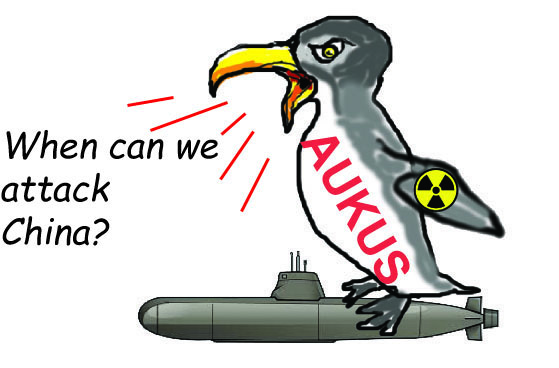
Prime Minister Scott Morrison announced in September that Australia was dumping a $90 billion agreement with France to build 12 conventional submarines and would instead develop a fleet of at least eight nuclear-powered boats with the US and Britain under the AUKUS agreement. The nuclear submarines will arrive by 2036 at the earliest, but possibly much later, at a cost of at least $116 billion.
The decision to acquire a fleet of nuclear-powered submarines has very little to do with defending the mainland and its maritime approaches, which our current fleet of Collins-class subs could probably handle. In fact, some commentators argue conventional submarines are superior in defending the archipelago to our north because their engines can be turned off, which makes them stealthier.
………………….. Dutton is also still insisting the [nuclear] submarines will be built in Adelaide, saying the government has already “demonstrated through a number of programs a desire to build our capability … and there are tens of thousands of jobs in the economy today as a result of that”.
……………… Australian military strategist Hugh White, the principal author of Australia’s 2000 Defence White Paper, is not a fan of the AUKUS agreement, saying it has been exaggerated for two reasons. The first is because the nuclear fleet will arrive too late, and the second is it is not necessarily what is needed.
Instead of getting nuclear submarines decades down the line, White says Australia should be looking at building a new version of the Collins-class submarine, while moving as fast as it can to buy “off-the-shelf” submarines such as Germany’s Type 216 conventional submarine.
……….. Despite so many changes over recent decades, it all comes back to whether the nation’s military should be focused on defending the continent, or if its interests are better served by helping a powerful ally further from home………………..
1 This month.


PETITION – To: Prime Minister Anthony Albanese and the Australian Labor Government
Chernobyl: The Lost Tapes – A good documentary on Chernobyl on SBS available On Demand for the next 3 weeks– https://www.sbs.com.au/ondemand/tv-program/chernobyl-the-lost-tapes/235274195556

19 May – Webinar- Webinar: No Nuclear Weapons in Australia
Start: 2026-05-19 18:00:00 UTC Canberra, Melbourne, Sydney (GMT+10:00)
End: 2026-05-19 19:30:00 UTC Canberra, Melbourne, Sydney (GMT+10:00)
20 May – Webinar – The dangerous world of AUKUS, US, military occupation and suppression of dissent

National Webinar, 20th May, 2026, 6.30pm AEST. Confronting laws restricting/suppressing protest speech and action
Speakers: Former Sen. Rex Patrick, Lawyer Nick Hanna ,Arthur Rorris ,Jorgen Doyle, Sen David Shoebbridge,
Facilitator Kelley Tranter.

of the week – Australians for War Powers Reform (AWPR)
To see nuclear-related stories in greater depth and intensity
 Antinuclear