The ABC is under the biggest attack in its history
The ABC is under the biggest attack in its history https://www.sarahhansonyoung.com/save_our_abc_petition?recruiter_id=759870
Our ABC is facing death by a thousand cuts – totalling over half a BILLION dollars – from the Liberals who can’t handle the public broadcaster doing its job and holding those in power to account. Sadly, our democracy is going to be far worse off for it.
Not only has the Morrison Government failed to restore the millions of dollars of funding they have cut from the ABC year after year, there is now no future funding for the Enhanced News Gathering program.
Our ABC is facing death by a thousand cuts – totalling over half a BILLION dollars – from the Liberals who can’t handle the public broadcaster doing its job and holding those in power to account. Sadly, our democracy is going to be far worse off for it.
Not only has the Morrison Government failed to restore the millions of dollars of funding they have cut from the ABC year after year, there is now no future funding for the Enhanced News Gathering program.
The ABC has been a vital source of information during the pandemic and helped save lives during the catastrophic summer bushfires immediately before that.
To do its job as the public expects, to continue producing the new Australians trust and the stories we love, the ABC must be well-funded.
The ABC needs allies, now more than ever.
Bill To Ban Spent Nuclear Fuel Storage In New Mexico Passes House Committee
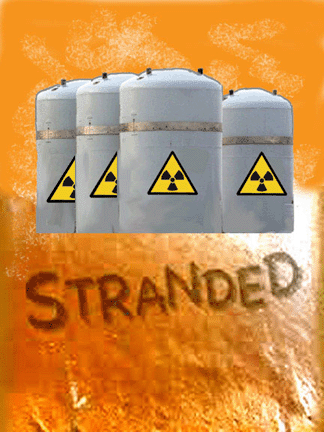
“It’s inconceivable why New Mexico has to be the dumping ground for the nation’s ill-advised investment in nuclear energy and nuclear weapons,” said Paul Gibson, co-founder of Retake Our Democracy. “The risk to our community is far greater than the benefit.”
Although the site is termed temporary, Holtec is seeking a 40-year license to operate there, which opponents say would make it permanent.
By SCOTT WYLAND, The Santa Fe New Mexican, 4 Feb 22, A bill clearly aimed at blocking Holtec International from building an underground storage site for spent nuclear fuel in southeastern New Mexico is moving forward.
The House Energy, Environment and Natural Resources Committee voted 5-4 to advance a bill that would ban the storage or disposal of spent nuclear fuel in the state — and would essentially kill Holtec’s plans to build a repository for this high-level radioactive waste in the Carlsbad area.
It now will go to the House Judiciary Committee.
A key point in the debate was whether the state has the authority to stop the federal government from approving what’s described as an interim storage site to keep the material until a permanent place is created.
Some lawmakers and regulators who back House Bill 127 say although the state can’t interfere with how the commission regulates the waste, it can block storage sites that could cause adverse environmental impacts.
The bill’s opponents argue the state still would be preempting the Nuclear Regulatory Commission’s authority in managing commercial nuclear waste. That simply is not allowed, no matter what criteria the state uses, they said.
But Sen. Jeff Steinborn, D-Las Cruces, who strongly supports the bill, said the state is well within its rights to say no to nuclear disposal sites that could contaminate vital resources, such as groundwater, and pose risks to communities when the waste is transported by rail across the country.
“Does New Mexico have the authority to do this? Yes, we do,” Steinborn said. “The Nuclear Regulatory Commission absolutely has primacy over regulating spent fuel. But what we’re talking here is the siting of this material, and our concerns on multiple grounds.”
Still, Rep. Larry Scott, R-Hobbs, contends the federal government’s power to regulate radioactive material overrides any state authority, including on environmental matters.
“I’m looking at your legislation, which seems to completely contradict that,” Scott said.
Last year, the state sued the federal government, contending the commission hadn’t done enough to ensure Holtec’s proposed site wouldn’t harm the environment, communities or the oil and gas industry in one of the nation’s richest fossil fuel regions.
Although the site is termed temporary, Holtec is seeking a 40-year license to operate there, which opponents say would make it permanent.
State Deputy Environment Secretary Rebecca Roose said no permanent disposal site has been established, so the waste has nowhere else to go.
“It’s more likely to stay there — the inertia will be to keep it there as opposed to move it someplace else permanent,” Roose said, “if and when a permanent facility is identified.”…………………
The bill’s proponents say it’s necessary to prevent a massive amount of high-level radioactive waste from coming to New Mexico and disproportionately affecting poor and minority communities.
“It’s inconceivable why New Mexico has to be the dumping ground for the nation’s ill-advised investment in nuclear energy and nuclear weapons,” said Paul Gibson, co-founder of Retake Our Democracy. “The risk to our community is far greater than the benefit.” https://ladailypost.com/bill-to-ban-spent-nuclear-fuel-storage-in-new-mexico-passes-house-committee/
Decommissioning is just the beginning of the huge nuclear legacy problem
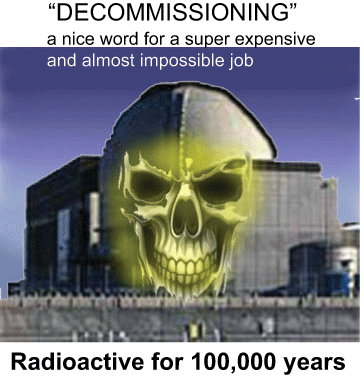
Nuclear power concerns outlast decommissioning, Great Lakes Echo, By Cameryn Cass 4 Feb 22,
Editor’s note: This is part of a package of two articles and a podcast about nuclear power in Michigan.
As Michigan and other states gradually move away from coal and other brown energy sources, there’s growing interest in carbon-free alternatives, including nuclear energy,
As Michigan and other states gradually move away from coal and other brown energy sources, there’s growing interest in carbon-free alternatives, including nuclear energy, which some advocates call a “clean alternative” that now fuels 30% of Michigan’s total electricity.
One nuclear plant in the state, Big Rock Point in Charlevoix closed in 1997 and has been fully decommissioned. In the spring of 2022, the Palisades Nuclear Plant in Southwest Michigan’s Van Buren County will close because of a “business decision.”
Michigan also has the Fermi Nuclear Power Plant in Newport, near Monroe, and the Donald C. Cook Nuclear Power Plant in Berrien County’s Bridgman, according to the Department of Environment, Great Lakes and Energy.
With Palisades and other plants in the Great Lakes region scheduled to shut down in the coming decades, more people are considering the long-term impacts of this energy source.
After decommissioning, radioactive waste remains on-site, said Susan Chiblow, an Indigenous environmental scholar in Ontario.
The waste stays in the environment for trillions of years, so calling nuclear power clean is propaganda, she said.
In short, risks don’t disappear when a plant is decommissioned, a process that can take up to 60 years, said Edwin Lyman, the nuclear safety project director at the Union of Concerned Scientists, a nonprofit science advocacy organization based in Massachusetts.
Although closed plants no longer have to worry about accidents post shut-down, their operators remain responsible for managing the radiated materials and spent nuclear waste, Lyman said.
He said waste now stored on-site is vulnerable to security threats and climate disasters.
For five years, the waste is kept in large swimming pool-like structures where it’s mixed with water to keep it cool. Then, it’s transferred to dry casks, he said.
The U.S. Department of Energy is technically responsible for removing the waste, but it has nowhere to bring it, Lyman said.
“It’s going to be a long-term storage problem for any nuclear plant that’s shut down,” Lyman said……………………………
Thirteen states have banned construction of new nuclear plants.
In the Great Lakes region, Minnesota adopted its ban in 1994. ……
Because the Great Lakes account for one-fifth of the world’s freshwater, Chiblow and other environmentalists are especially interested in protecting it……….http://greatlakesecho.org/2022/02/04/nuclear-power-concerns-outlast-decommissioning/
Even the right-wing Cato Institute wants USA to deal with Ukraine crisis by diplomacy, not weaponry

Washington has also mentioned steps to “enhance deterrence” on the continent, which could entail the forward deployment of additional U.S. nuclear weapons.
As Clouds Gather in Eastern Europe, Nuclear Diplomacy is More Important Than Ever
More must be done to keep tensions over Ukraine from deepening nuclear instability. Defense One BY ERIC GOMEZ, 4 Feb 22, DIRECTOR, DEFENSE POLICY STUDIES, CATO INSTITUTE
The risk that a Russian invasion of Ukraine by conventional forces could lead to the use of nuclear weapons appears relatively low, but their shadow is never completely absent from a crisis involving nuclear-armed states. Moreover, this crisis—no matter how it ends—seems likely to lead toward more strategic instability, not less. As preoccupied as U.S. diplomats must be with the threat of imminent conventional invasion, they must also work urgently to launch confidence-building measures that might prevent a nuclear war
The recent back-and-forth between Washington and Moscow has been free of explicit nuclear threats, but there has been some nuclear signaling. As Russia massed forces near Ukraine in December, its foreign ministry released two proposed treaties, one for NATO and one for the United States. The draft of the NATO treaty included an article prohibiting the deployment of missiles previously outlawed by the Intermediate-range Nuclear Forces Treaty. The draft of the U.S. treaty had more explicit references to nuclear weapons, including pledges to not deploy them outside national territory and to not train personnel from non-nuclear countries in their use—a reference to NATO nuclear-sharing arrangements
Washington’s response to the buildup has centered on sanctions and deploying conventional military forces to NATO allies in eastern Europe. But it has also mentioned steps to “enhance deterrence” on the continent, which could entail the forward deployment of additional U.S. nuclear weapons. And while the Biden administration has said that it will not send U.S. troops to defend Ukraine, which helps reduce the likelihood of a NATO-Russia conflict, it has also signaled that it will send more forces to eastern Europe if Russia attacks Ukraine.
For its part, Moscow has warned that it will respond if NATO expands its troop presence in eastern Europe. Among its options are moving nuclear weapons closer to western Europe. Such moves could lead NATO to add even more forces to deter an attack on member countries, thus setting off a spiral of actions and counter-actions with no clear way to break the cycle.
Ultimately, this spiral is likely to put more nuclear forces in closer proximity, inherently decreasing stability and increasing the risk of accidental war. It may also prompt more calls to expand the U.S. nuclear arsenal, which in turn could make it harder for Washington and Moscow to reach new agreements on nuclear arms control…………………Another potential reassurance measure would be negotiating mutual limitations on the deployment of missiles previously outlawed by the INF Treaty. Russia has already signaled such limitations in its December demands, and the United States reportedly responded positively to the idea of mutual limitations
he faint but darkening nuclear shadow over the Ukraine crisis means that these kinds of ideas and discussions are no diplomatic side show. They are crucial to warding off instability of an even more potentially devastating type.
”Nuclear is neither green nor sustainable” – Austria to sue European Commission if it approves nuclear power for financial incentives

Austria’s chancellor responded to the news by saying “nuclear power is neither green nor sustainable”. “I cannot understand the decision of the EU,” Karl Nehammer said. He said he would back his environment minister, Leonore Gewessler, in pursuing legal action at the European Court of Justice if the plans go ahead.
“This decision is wrong,” Ms Gewessler said. “The EU Commission today agreed its greenwashing programme for nuclear energy and [the fossil fuel] natural gas.” Luxembourg has also said it will
join in legal action. The EU has set itself a goal of becoming climate neutral by 2050 and the Commission argues that to get there, a great deal of private investment is needed. Its proposals are meant to guide
investors.
BBC 3rd Feb 2022
https://www.bbc.co.uk/news/world-europe-60229199
Nuclear power: CO2 fix or cost disaster?
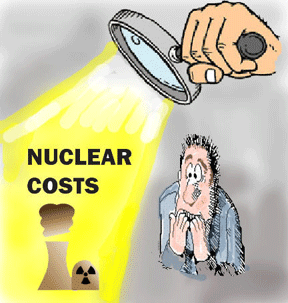
Nuclear power: CO2 fix or cost disaster? E and E News | 02/04/2022 President Biden’s plan to decarbonize the U.S. electricity sector by 2035 could give a boost to nuclear power, but that may hinge on two key questions: Can carbon targets really incentivize the technology, and can it compete cost wise with natural gas?
It’s a debate that is resurfacing, considering recent surging prices of natural gas.
Yet industry hasn’t answeredwhether nuclear will be more economic for producing power, especially after costs for two new reactors at Plant Vogtle in Georgia skyrocketed. The actual costs of 75 of the more than 90 existing nuclear power reactorsin the U.S. exceeded the initially estimated costs of the units by over 200 percent, according to the U.S. Department of Energy.
There are many facets of the cost question — existing nuclear plants in competitive markets face economic challenges that could force them to close early, saddling operators with stranded costs and removing emissions-free electrons [not really emissions-free] from the grid. Meanwhile, no large, baseload reactors are on the table. The industry is working to develop smaller, next-generation reactors by the next decade, but the fate and final costs of projects are uncertain.
“There doesn’t seem to be, in the near term, a big thing that’s going to be pushing” nuclear, said Paul Patterson, a utility analyst with Glenrock Associates LLC. Whether the nuclear industry builds new reactors could help shape the electricity mix for decades. Falling renewable energy costs and higher gas prices may also influence investment decisions for nuclear in unexpected ways.
………… Southern Co.’s Vogtle expansion project hasn’t helped the case for baseload nuclear. The project, which was supposed to lead a resurgence of larger reactors in the 2000s, remains theonly major nuclear power construction project in the United States. Vogtle’sprice tag is twice an earlier $14 billion budget, andthe project is more than seven years behind schedule.
……more than one big electric company has shelved its plans to build large reactors using similar technology because of the litany of troubles at Vogtle…………………….
it’s unclear whether SMRs will face some of the same cost challenges as traditional reactors.
In the past, the higher price tag for nuclearin comparison to expectations was tied to safety regulations, which are the most stringent of all power plants. What’s more, if any work needs to be redone to meet strict codes, that pushes out the deadline to finish the plant.
The longer it takes to get it right, the more expensive the reactors become.
“There are so many concerns about radioactive material, etc., so that’s what drives much of the cost,” Glenrock’s Patterson said. “You don’t have the same issues associated with regulations for other power plants, understandably so.”
………… A group of former nuclear regulators in the United States, Germany and France argued last month that nuclear isn’t safe, clean or smart.
It’smore expensive than renewables in terms of producing energy and mitigating carbon dioxide, even accounting for costs such as pairing renewable energy with storage, according to the group, which alsoincludes a former secretary to a United Kingdom radiation protection committee.
The former regulators said nuclear is unlikely “to make a relevant contribution to necessary climate change mitigation” that’s needed by the 2030s………………………………..
Gas and renewables
Ultimately, the trajectory of nuclear will directly affect how wind, solar, batteries and fossil fuels are used in the coming decades.
Coyle pointed out that while the cost of Vogtle has doubled during the seven-year delay, the price of renewables, including storage, has dropped. Going forward, she argues that Georgia Power should compare the cost of planned generation with not only combined-cycle natural gas but also with renewable options such as utility-scale solar and long-term agreements to buy wind power.
“This argument that, ‘Well, it’s reliable, it’s low-cost, it’s carbon-free,’ then why are we still comparing it to combined-cycle natural gas?” Coyle said.
“There are now significantly more cost-effective renewable energy options than any of us anticipated back in the day when Vogtle 3 and 4 were certified.”……………
How to mix sanctions and diplomacy to avert disaster in Ukraine. Source: Bulletin of the Atomic Scientists — Who Watches the Watchers?

At doom’s doorstep: It is 100 seconds to midnight How to mix sanctions and diplomacy to avert disaster in Ukraine By David Cortright, George A. Lopez | February 1, 2022 Exercise with Teikovsky missile unit. Credit: Ministry of Defence of the Russian Federation. CC BY 4.0. After a month of intensive political work at home […]
How to mix sanctions and diplomacy to avert disaster in Ukraine. Source: Bulletin of the Atomic Scientists — Who Watches the Watchers?
February 4 Energy News — geoharvey

Opinion: ¶ “Green Olympics: Test Case For China And Carbon Neutrality” • China can use the winter Olympics as a way to show the many millions of people who will watch the games that it is serious about achieving its ambitious climate goals. China has nearly half of all the installed capacity of renewable energy […]
February 4 Energy News — geoharvey
Ranger uranium mine rehabilitation costs could blow out to $2.2 billion, Energy Resources tells ASX
Ranger uranium mine rehabilitation costs could blow out to $2.2 billion, Energy Resources tells ASX, https://www.abc.net.au/news/rural/2022-02-02/ranger-uranium-mine-cleanup-cost-blowout-to-2-2-billion/100798666ABC Rural / By Daniel Fitzgerald The rehabilitation of a decommissioned uranium mine in Kakadu National Park could cost up to $1.2 billion more than expected and take two years longer than initially planned.
Key points:
- Rehabilitation of Ranger uranium mine to cost between $1.6 billion and $2.2 billion
- Timeline of clean-up pushed out by two years
- Gundjeihmi Aboriginal Corporation concerned ERA won’t be able to fund extra costs
Energy Resources of Australia (ERA) — a subsidiary of mining giant Rio Tinto — shut down production at its Ranger uranium mine, 250 kilometres east of Darwin, in January last year and has since been working to return the mine site to its original state.
The rehabilitation was originally estimated at $973 million, but in a statement to the ASX on Wednesday, ERA revised costs to be approximately between $1.6 and $2.2 billion.
The company also said clean-up works could continue until the end of 2028, more than two years longer than planned.
The Gundjeihmi Aboriginal Corporation, which represents Mirarr traditional owners, had been seeking clarity on the expected cost blowouts from ERA.
“We knew it would cost more, but a doubling — to probably the biggest rehabilitation exercise in the history of Australian mining — took us by surprise,” chief executive Justin O’Brien said.
“It’s not good news, but at least we now have a much greater picture of the true cost.”
ERA’s statement outlined a number of reasons for the revised cost, including engineering issues, emerging technical risks and additional water treatment costs.
“It is a complex operation and it is in a very sensitive, world-heritage-listed national park, upstream of Aboriginal communities and the Arafura Sea,” Mr O’Brien said.
Federal changes needed to extend time frame
ERA’s current lease stipulates the company must complete the rehabilitation and be off the mine site by 2026, a condition legislated by the Atomic Energy Act 1953.
With the rehabilitation time frame now stretching into 2028, ERA said it “has been engaging with government and key stakeholders to amend the Atomic Energy Act 1953 and extend the expiry date of ERA’s tenure on the Ranger Project Area”.
Mr O’Brien said a two-year extension to the rehabilitation was “pretty ambitious”.
“If you’re going to amend the legislation in Canberra you don’t just do it for two years, you give them lots of space to do this,” he said.
“If they [ERA] relinquish within another 26 years, then fine.”
Can ERA afford the cost blowout?
In light of the cost revision, ERA said it was “currently reviewing all available funding options to ensure that the increased forecast cost of the rehabilitation of the Ranger Project Area will be adequately funded”.
As of December 31, 2021 the company had $699 million in cash funding and $535 million held by the Commonwealth government as part of the Ranger Rehabilitation Trust Fund.
ERA’s parent company, Rio Tinto said in a statement to the ASX, “it is committed to working with [ERA] to ensure the rehabilitation of the Ranger Project Area is successfully achieved to a standard that will establish an environment similar to the adjacent Kakadu National Park”.
Nuclear medicine incidents
Report highlights learnings from nuclear medicine incidents, Mirage News, 2 Feb 22, ARPANSA has finalised its annual report on radiation safety incidents using data collated from radiation regulators around the country…….The new Australian Radiation Incident Register (ARIR) report provides a summary and analysis of incidents that occurred during 2020. The report includes a focus on workflows in nuclear medicine. Nuclear medicine accounted for 157 of the 803 incidents reported for 2020…….
Findings of the report include:
a total of 803 incidents reported – demonstrating better awareness of reporting
529 of the reported incidents were in diagnostic radiology, with 157 in nuclear medicine, and 40 in radiotherapy
patients were exposed to less than 1 mSv of radiation in 47% of incidents
human error was identified as a factor in more than 65% of incidentsequipment failure or deficiencies accounted for 17% of incidents…….. https://www.miragenews.com/report-highlights-learnings-from-nuclear-716848/
Morrison’s ‘Australian Way’ climate plan is criminally irresponsible
Morrison’s ‘Australian Way’ climate plan is criminally irresponsibleIan Dunlop
The Coalition’s worship of fossil fuels and inept policymaking are leaving Australia defenceless against its greatest threat: climate change.
Raytheon and Lockheed Martin boast to investors that Ukraine-Russia crisis is a boon for their business
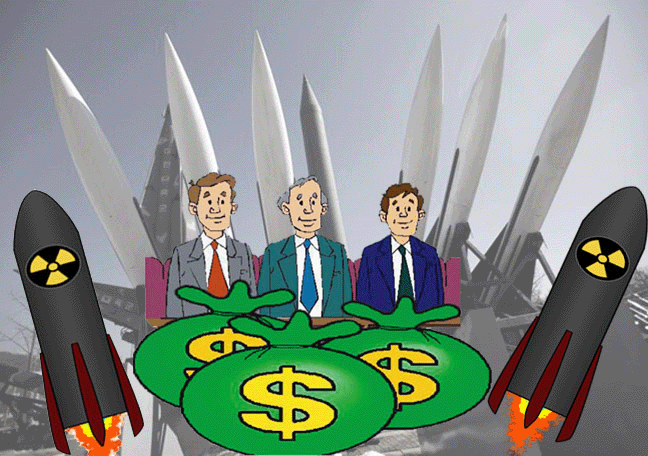
The statements come from leaders of an industry that exerts tremendous influence in Washington, employing an average of 700 lobbyists per year over the past five years, or more than one lobbyist per member of Congress, according to Brown University’s Costs of War project.
Everyone in D.C. knows that weapons manufacturers are helping skew U.S. policy towards militarism
WEAPONS COMPANIES BOAST UKRAINE-RUSSIA TENSIONS ARE BOON FOR BUSINESS , Popular Resistance, By Sarah Lazare, In These Times., January 31, 2022
In Calls With Investors, Raytheon And Lockheed Martin Boasted That The Worsening Conflict Is Helping Profits.As the United States weighs more involvement in the growing conflict between Ukraine and Russia, some of the largest weapons companies in the world — Raytheon and Lockheed Martin — are openly telling their investors that tensions between the countries are good for business. And General Dynamics, meanwhile, is boasting about the past returns the company has seen as a result of such disputes.
The statements come as the U.S. government escalates arms shipments to Ukraine, among them the Javelin missiles that are a joint venture between Raytheon and Lockheed Martin. House Democrats, meanwhile, are trying to quickly push through a bill that would significantly increase U.S. military assistance to Ukraine, and impose new sanctions on Russia.
Anti-war campaigners warn that U.S. escalation, amid renewed tensions between Ukraine and Russia, could bring dire consequences, and spill into a much larger and more protracted war. “As we are shipping advanced weaponry to the Ukrainian military, the Biden administration has signaled that U.S. military advisors will continue to stay in the country,” Cavan Kharrazian, progressive foreign policy campaigner for the advocacy organization Demand Progress, tells In These Times. “Who will most likely set up and teach the Ukrainian army how to use these weapons systems? The U.S. military.”
Among those openly discussing the boon to profits is Raytheon CEO Greg Hayes. During a January 25 appearance on CNBC’s “Squawk on the Street,” he was asked, “Do we have anything that would make it so if you inserted 8,000 American soldiers into Ukraine, they can stop 103,000 Russian soldiers?”
In his reply, Hayes touted the role the company could play in arming U.S. allies. “Obviously we have some defensive weapons systems that we could supply which could be helpful, like the patriot missile system.” He went on to add, “We’ve got the technologies to help in these engagements, whether it’s patriot systems, some of the radar systems.”………
If it sounds like Hayes is using mounting tensions as an advertising opportunity for his company, this may not be far fetched. On a January 25 earnings call (which was noted on Twitter by Nick Cleveland-Stout of the Quincy Institute), Hayes included “tensions in Eastern Europe” among the factors that Raytheon stands to benefit from. He said: “We just have to look to last week where we saw the drone attack in the UAE, which have attacked some of their other facilities. And of course, the tensions in Eastern Europe, the tensions in the South China Sea, all of those things are putting pressure on some of the defense spending over there. So I fully expect we’re going to see some benefit from it.”
Raytheon isn’t alone in its projections. Among those noting the likely boost to profits is Jim Taiclet, the chairman, president and CEO of Lockheed Martin. In a January 25 earnings call, he told investors, “If you look at the evolving threat level and the approach that some countries are taking, including North Korea, Iran and through some of its proxies in Yemen and elsewhere, and especially Russia today, these days, and China, there’s renewed great power competition that does include national defense and threats to it.”
This “great power competition,” he suggested to investors, bodes more business for the company. Taiclet says, “And the history of the United States is when those environments evolve, that we do not sit by and just watch it happen. So I can’t talk to a number, but I do think, and I’m concerned personally that the threat is advancing, and we need to be able to meet it.”
The statements come from leaders of an industry that exerts tremendous influence in Washington, employing an average of 700 lobbyists per year over the past five years, or more than one lobbyist per member of Congress, according to Brown University’s Costs of War project.
Everyone in D.C. knows that weapons manufacturers are helping skew U.S. policy towards militarism, but they usually try to be less obvious,” Erik Sperling, executive director of Just Foreign Policy, an anti-war organization, told In These Times. “They are cashing in on tensions over Ukraine as the U.S. pours weapons into the region.”……..
Everyone in D.C. knows that weapons manufacturers are helping skew U.S. policy towards militarism, but they usually try to be less obvious,” Erik Sperling, executive director of Just Foreign Policy, an anti-war organization, told In These Times. “They are cashing in on tensions over Ukraine as the U.S. pours weapons into the region.”
But Kharrazian warns, “While it may not be profitable for arms manufacturers, engagement in good-faith, realistic diplomacy is what will benefit the region as a whole and mitigate unnecessary and potentially catastrophic conflict.” https://popularresistance.org/top-weapons-companies-boast-ukraine-russia-tensions-are-a-boon-for-business/
Saving the world at plutonium mountain
Such hidden repositories might be found elsewhere, wherever nations have tested nuclear weapons or carried out other research on fissile materials such as plutonium. Will all that scientific collaboration and goodwill be readily available?
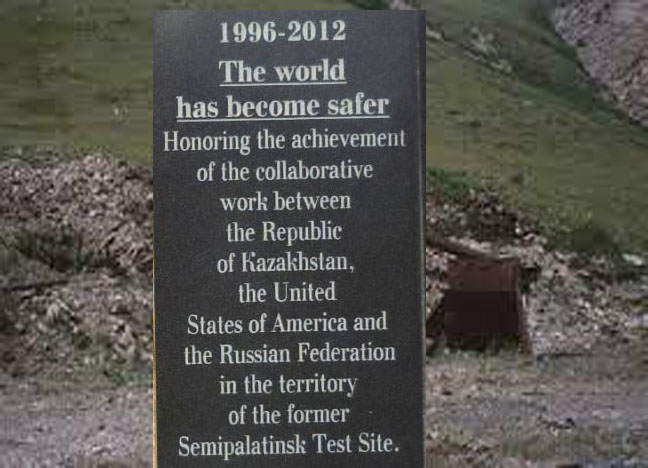
It is true, as the plaque at Degelen Mountain attests, that the world is safer thanks to this operation. But it is also true that the scars left by nuclear weapons testing during the Cold War will last for millennia.
Saving the world at plutonium mountain https://thepeninsulaqatar.com/article/18/08/2013/saving-the-world-at-plutonium-mountain Published: 18 Aug 2013 -Updated: 30 Jan 2022, By David E Hoffman and Eban Harrell Last October, at the foot of a rocky hillside near here, at a spot known as Degelen Mountain, several dozen Kazakh, Russian and American nuclear scientists and engineers gathered for a ceremony. After a few speeches, they unveiled a three-sided stone monument, etched in English, Russian and Kazakh, which declared:
“1996-2012. The world has become safer.”
The modest ribbon-cutting marked the conclusion of one of the largest and most complex nuclear security operations since the Cold War. The secret mission was to secure plutonium — enough to build a dozen or more nuclear weapons — that Soviet authorities had buried at the testing site years before and forgotten, leaving it vulnerable to terrorists and rogue states.
The effort spanned 17 years, cost $150m and involved a complex mix of intelligence, science, engineering, politics and sleuthing. This account is based on documents and interviews with Kazakh, Russian and US participants, and reveals the scope of the operation for the first time. The effort was almost entirely conceived and implemented by scientists and government officials operating without formal agreements among the nations involved. Many of these scientists were veterans of Cold War nuclear-testing programs, but they overcame their mistrust and joined forces to clean up and secure the Semipalatinsk testing site, a dangerous legacy of the nuclear arms race.
They succeeded, but what they accomplished here may have to be done all over again if the walls of secrecy ever come down and reveal security vulnerabilities in North Korea or Iran, or in other states that have developed the atomic bomb, including China, Pakistan, India and Israel.
During the Cold War, the Soviet Union carried out more than 450 nuclear explosive tests at the Semipalatinsk site, which sprawls over a portion of the Kazakh plains slightly larger than Connecticut. Most of the tests involved atomic explosions, while others were carried out to improve weapons safety, in part by examining the impact of conventional explosives on plutonium metal. A network of tunnels built under Degelen Mountain became the epicentre of these tests.
After the Soviet Union collapsed in 1991, the Russians gradually abandoned the site. Economic conditions in the main city near the testing grounds grew desperate, and residents began to search the tunnels for metal to sell. They used mining equipment to steal copper from the electrical wiring and to scavenge rails that once carried nuclear devices far underground for explosive testing.
Conceived in 2000, Operation Groundhog suffered repeated delays, including work stoppages during the frigid winters. But with the nuclear ambitions of Al Qaeda coming into clearer view in documents seized during the invasion of Afghanistan, US officials felt the urgency of preventing plutonium from falling into the wrong hands. The concrete dome over the holes at the Balapan was completed in August 2003.
Just a few miles away, however, Degelen Mountain was still unattended, and scavengers continued to burrow in close proximity to weapons-grade plutonium. When a senior Pentagon official, Andy Weber, met with Russian and Kazakh officials in mid-2003 to discuss extending projects to the mountain, the Russians were still ambivalent and did not reveal all they knew.
They offered the locations of three more experiments, at two sites. If work at these sample locales went well, and if the Russians felt confident that the Americans were not committing espionage, Minatom would consider sharing more information.
As it turned out, these sample locations weren’t in Degelen Mountain at all but in a nearby bunker. They involved three “kolbas” — large metal cylinders, insulated with Kevlar and fiberglass and designed to contain explosions equivalent to the force of 440 pounds of dynamite. They were most often placed deep within Degelen Mountain for plutonium tests, but three had been used above ground and were stored in the bunker.
The US Defence Threat Reduction Agency agreed to work on the three kolbas,one of which had been pried open by scavengers, and to defer action on Degelen Mountain. Operation Matchbox, begun in 2004, secured the kolbas by filling them with a concrete mixture.
In the spring of 2005, US scientists finally got the breakthrough they’d been waiting for when Russia released all the remaining information about Degelen Mountain. But it wasn’t pretty.
The mountain contained about 220 pounds of recoverable plutonium — enough for more than a dozen nuclear bombs. Even more surprising, Russia revealed that at one location, the Soviets had left behind some high-purity plutonium and equipment that could be used to build a nuclear weapon.
This disclosure alarmed US officials but the Russians were extremely cautious. In their reports to the US side, they used code names for 16 sites in and around Degelen Mountain, ranking them according to proliferation risk. Three of the sites were found to present the “maximum risk” if they fell into the wrong hands and were given the code names X, Y and Z.
One day, while crews were drilling a hole at the Y site, a concrete retaining wall collapsed, exposing the plutonium and equipment. Eventually, material from two of the sites was sent back to Russia, and the third was entombed in concrete.
Scavengers continued to raid the tunnels until 2008, when Kazakhstan finally declared Degelen Mountain an “exclusion zone” — which allowed US officials to erect warning signs — and when Kazakh security forces got the authority to expel the scavengers.
Still, the work remained slow. In a 2010 summit in Washington that included 47 nations, President Obama arranged a personal meeting with Nazarbayev. Officials of the two nations then met with their Russian counterparts. The United States, Russia and Kazakhstan agreed in confidence to complete the work at Semipalatinsk by the next summit, scheduled for March 2012 in Seoul.
This high-level commitment galvanised the operation. For the first time, Kazakh crews worked through the winters, and American officials stayed on site in Semipalatinsk with them, while increased US funding meant four crews could work simultaneously instead of one. Obama, Nazarbayev and Russian President Dmitri Medvedev announced the completion of the work in Seoul, though the news was overshadowed by Obama’s “open mike” incident with Medvedev.
Such hidden repositories might be found elsewhere, wherever nations have tested nuclear weapons or carried out other research on fissile materials such as plutonium. Will all that scientific collaboration and goodwill be readily available?
It is true, as the plaque at Degelen Mountain attests, that the world is safer thanks to this operation. But it is also true that the scars left by nuclear weapons testing during the Cold War will last for millennia.
European Taxonomy – more like Fakeonomy – now including coal and nuclear

EU includes gas and nuclear in guidebook for ‘green’ investments, Commission’s move widely criticised as undermining efforts to keep global heating below 1.5Cm Guardian
Jennifer Rankin in Brussels, Thu 3 Feb 2022 The European Commission has been accused of undermining its climate goals after it defied critics by pushing ahead with plans to include gas and nuclear in an EU guidebook for “green” investments.
Gas and nuclear were deemed bridge technologies to meet the EU’s target of net zero emissions by 2050, in long-awaited proposals on the EU’s “taxonomy for environmentally sustainable economic activities”, which were published on Wednesday.
“The reason we are including gas and nuclear in the way we are doing it is because we firmly believe that this recognises the need for these energy sources in transition,” the EU commissioner for financial services, Mairead McGuinness, told reporters.
Critics said including gas and nuclear in a guide intended to prevent greenwashing jeopardised the EU’s climate goals and hopes of keeping global heating below 1.5C.
“The European Commission is significantly undermining the EU’s credibility as a climate actor,” Bas Eickhout, a Dutch Green MEP and vice-chair of the European parliament’s environment committee, said. “At the UN climate summit in Glasgow, small steps were taken towards phasing out fossil fuels. Yet, unfortunately, the commission is already turning back the clock and leaving the door open to the gas industry.”
Laurence Tubiana, the chief executive of the European Climate Foundation and an architect of the landmark 2015 Paris climate agreement, said: “The EU taxonomy was envisioned as a vital tool to align financial flows with the Paris agreement. Instead, Europe is undermining its climate leadership and lowering standards in the EU and beyond. When a gold standard does emerge elsewhere, this taxonomy will be left behind.”
Since the proposals leaked on New Year’s Eve 2021 – fuelling bitter accusations of a lack of transparency – the commission has made minor tweaks that make it easier for gas projects to get in the green guidebook……
The taxonomy – intended to channel billions of private money into climate-friendly investments – is fast becoming one of the biggest controversies of Ursula von der Leyen’s tenure as European Commission president. Last month Greta Thunberg and climate activists slammed the plans as “fake climate action” that flout scientific advice.
In a further sign of anger, campaign group Avaaz staged a mock burial of the taxonomy on a roundabout outside the commission headquarters, with activists wearing face masks of Von der Leyen, Germany’s Olaf Scholz and France’s Emmanuel Macron. France pressured Von der Leyen to grant the stamp of approval for nuclear power, while Germany had lobbied for the inclusion of gas, although Scholz’s coalition government is split on the issue.
“Europe is witnessing our biggest setback yet in our moonshot mission,” said Patricia Martín Díaz of Avaaz. “Labelling fossil gas and nuclear as green is incompatible with the EU’s 2050 climate targets and our hope of keeping 1.5C alive.”……………
Other critics include an expert panel convened by the commission, which said the plans were “not in line” with the original regulation, agreed in July 2020. In its stinging rebuke, the EU platform on sustainable finance – a group that includes industry, NGO and finance experts from EU institutions – said they had doubts about the criteria for gas and nuclear, while “many are deeply concerned about the environmental impacts that may result”………..
The EU taxonomy became law in July 2020, but legislators left important details to be resolved through so-called delegated acts – secondary legislation meant for technical issues that is not subject to the same degree of ministerial and parliamentary oversight.
Critics have accused the commission of abusing the process, by smuggling in the controversial issues of nuclear and gas into the latest delegated act, rather than drafting a separate law.
Only a supermajority of 20 out of 27 EU member states, or a majority of the European parliament’s 705 MEPs can now defeat the plans during a scrutiny period of four to six months that began on Wednesday.
Commission officials played down the threat of a legal challenge from Austria and Luxembourg, describing it as “a very theoretical discussion”. Both countries oppose nuclear power, while Green ministers in the German coalition government have dismissed the plans as greenwashing.
Denmark, Sweden and the Netherlands had urged the commission not to label gas as green, while Germany declared its opposition to nuclear…………
Lisa Fischer, who leads the E3G thinktank’s work on climate neutral energy systems, said gas and nuclear had no place in the taxonomy. “Gas investments are not only harmful to the climate they are also increasingly financially risky. Nuclear makes the EU’s energy transition more costly than it needs to be.”
In a sign of the intense arguments, McGuinness revealed that had been no unanimity among the commission’s top 27 officials; she said an “overwhelming majority” of EU commissioners had backed the plans.
“We were legally obliged to do this,” she said referring back to the initial July 2020 law. Opponents in national capitals, however, say the commission had no obligation to include gas or nuclear. https://www.theguardian.com/environment/2022/feb/02/eu-guidebook-taxonomy-green-investments-gas-nuclear-included
Information wars: are we getting a fair view of China’s treatment of Uyghurs?
Information wars: are we getting a fair view of China’s treatment of Uyghurs?
MICHAEL WEST MEDIA|By Michael Sainsbury|February 3, 2022 ”……………………..
The Five-Eyes/China Propaganda War,
There is a propaganda war. It pits the China Communist Party against the West, led by the Five Eyes – the US, UK, Canada, Australia and New Zealand. To these we can also add Japan and South Korea, China’s mutually wary north Asian neighbours.
The latest battle in the war is being fought here in Australia over the Australian Strategic Policy Institute’s report Uyghurs for Sale: ‘Re-education’, forced labour and surveillance beyond Xinjiang. Its main theme is the re-education camps in Xinjiang and subsequent sending Uyghurs out for what it describes as forced labour in factories in the east of China in tough conditions, although they are paid rather than enslaved.
Considering that many of these factories are used by well-known Western clothing and retail brands, the report has sent shockwaves through the industry, with some withdrawing work from these factories.
Lawyer and activist Jaq James has prepared a lengthy rebuttal. Her paper, The Australian Strategic Policy Institute’s Uyghurs for Sale Report: Scholarly Analysis or Strategic Disinformation?, offers as a detailed unpicking ASPI’s reporting as loose/fudged and often second and third hand, as well as resulting in Uyghurs losing their jobs.
| Lead author on ASPI’s report is analyst, journalist and comedian Vicky Xu. Xu and her work have received widespread publicity in mainstream media. Yet the coverage has been devoid of scrutiny. Scrutiny has come however in independent media, particularly in John Menadue’s Pearls and Irritations, which has run stories by Jaq James and others questioning Xu’s claims. The biggest problem with both the reports is a lack of context…………https://www.michaelwest.com.au/information-wars-are-we-getting-a-fair-view-of-chinas-treatment-of-uyghurs/ |
1 This month.
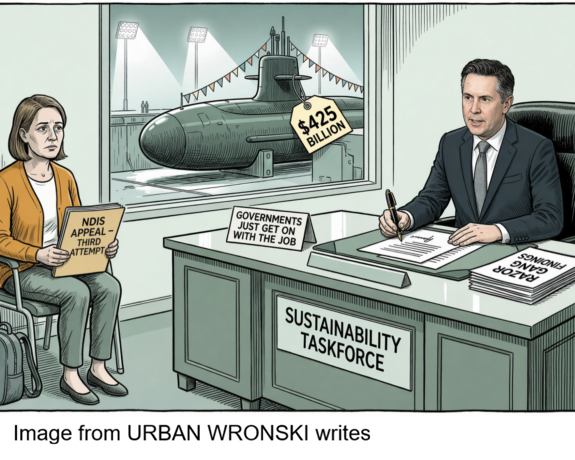

PETITION – To: Prime Minister Anthony Albanese and the Australian Labor Government
Chernobyl: The Lost Tapes – A good documentary on Chernobyl on SBS available On Demand for the next 3 weeks– https://www.sbs.com.au/ondemand/tv-program/chernobyl-the-lost-tapes/235274195556

19 May – Webinar- Webinar: No Nuclear Weapons in Australia
Start: 2026-05-19 18:00:00 UTC Canberra, Melbourne, Sydney (GMT+10:00)
End: 2026-05-19 19:30:00 UTC Canberra, Melbourne, Sydney (GMT+10:00)
20 May – Webinar – The dangerous world of AUKUS, US, military occupation and suppression of dissent

National Webinar, 20th May, 2026, 6.30pm AEST. Confronting laws restricting/suppressing protest speech and action
Speakers: Former Sen. Rex Patrick, Lawyer Nick Hanna ,Arthur Rorris ,Jorgen Doyle, Sen David Shoebbridge,
Facilitator Kelley Tranter.

of the week – Australians for War Powers Reform (AWPR)
To see nuclear-related stories in greater depth and intensity
 Antinuclear