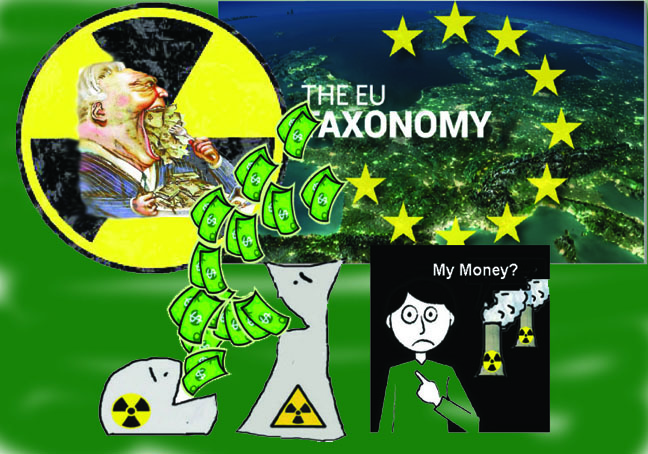
Inclusion of nuclear and gas is ”attempted robbery”
 |
Taxonomy: inclusion of nuclear and gas is “attempted robbery” – Greenpeace
Taxonomy: inclusion of nuclear and gas is “attempted robbery” – Greenpeace, Greenpeace European Unit 02/02/2022 Brussels, 2 February 2022 – The European Commission today officially presented a controversial plan to label fossil gas and nuclear energy as sustainable under the taxonomy regulation. The plan would incentivise potentially hundreds of billions of euro in private investments to flow away from clean energy like renewables and instead go to nuclear energy and fossil gas, accelerating the climate crisis.
Apart from producing dangerous and unmanageable radioactive waste, nuclear reactors take so long to build that they cannot come online quickly enough to contribute to reaching EU climate targets by 2030, which scientists say is necessary to prevent the worst effects of the climate crisis. Gas is also the single most polluting fuel in the EU, with soaring prices sparking a European energy crisis.
Greenpeace EU sustainable finance campaigner Ariadna Rodrigo said: “I’d like to report an attempted robbery, please. Someone is trying to take billions of euro away from renewables and sink them into technologies that either do nothing to fight the climate crisis, like nuclear, or which actively make the problem worse, like fossil gas. The suspect is at EU Commission HQ and has disguised herself as someone to be taken seriously on the climate and nature crisis.”
“This anti-science plan represents the biggest greenwashing exercise of all time. It makes a mockery of the EU’s claims to global leadership on climate and the environment. The inclusion of gas and nuclear in the taxonomy is increasingly difficult to explain as anything other than a giveaway to two desperate industries with powerful political friends,” added Rodrigo.
The Platform on Sustainable Finance, a body of over 50 experts from business, academia and civil society, which advises the European Commission on its green agenda, said in its official feedback to the plan that the provisions on nuclear energy, especially radioactive waste, violate a key principle of the taxonomy, which aims to ensure that any technologies included “do no significant harm” to the environment. The Institutional Investors Group on Climate Change, whose members represent more than €50 trillion in assets, has also said that the Commission’s proposals on gas would “channel capital towards activities not compatible with the EU’s commitment to climate neutrality by 2050.”
Environmental lawyers at NGO Client Earth have said that the inclusion in the taxonomy of fossil gas would be incompatible with several EU laws, including the 2021 EU Climate Law. Several governments and organisations are reportedly planning legal challenges to the inclusion of gas and nuclear in the taxonomy.
Next steps
The Commission’s plan is set to face an immediate backlash from MEPs, who have been cut out of the process and denied the chance to scrutinise this controversial plan until now.
Greenpeace is calling on MEPs to vote this proposal down. A majority of the Parliament, or 353 MEPs, is required to reject it.
Greenpeace is also calling on all financial institutions in the EU not to categorise nuclear and gas investments as environmentally sustainable, and to be transparent and science-based about their energy and climate investment decisions.
Contacts:
Ariadna Rodrigo – Greenpeace EU sustainable finance campaigner: +32 (0)479 99 69 22, arodrigo@greenpeace.org AT TOP https://www.greenpeace.org/eu-unit/issues/climate-energy/46036/taxonomy-nuclear-gas-attempted-robbery/
America’s military leaders reassure their staff ”We will win a nuclear war!”
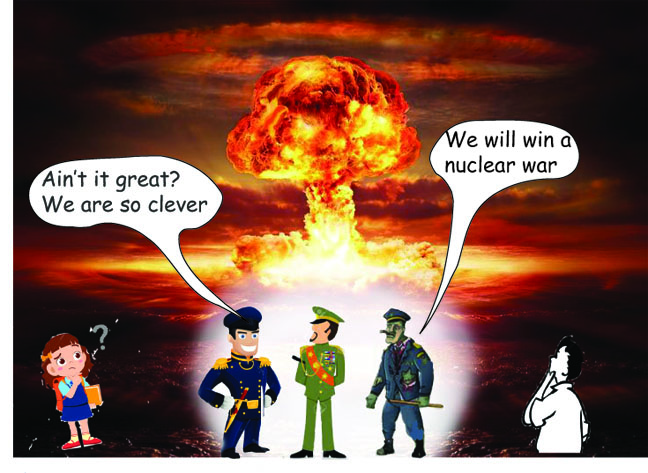
US defense to its workforce: Nuclear war can be won, Bulletin of the Atomic Scientists, By Alan Kaptanoglu, Stewart Prager | February 2, 2022 Ronald Reagan and Mikhail Gorbachev once said that “a nuclear war cannot be won and must never be fought,” and five major nuclear weapon states, including the United States, repeated this statement earlier this year. Yet many in the US defense establishment—the military, government, think tanks, and industry—promote the perception that a nuclear war can be won and fought.
Moreover, they do so in a voice that is influential, respected, well-funded, and treated with deference. The US defense leadership’s methodical messaging to its workforce helps shape the views of this massive, multi-sector constituency that includes advocates, future leaders, and decision makers. It advances a view of nuclear weapon policies that intensifies and accelerates the new nuclear arms race forming between the United States, China, and Russia.
The 23-chapter Guide to Nuclear Deterrence in the Age of Great Power Competition provides an excellent and representative case study for examining this critical messaging. This guide is published by the Louisiana Tech Research Institute, which provides support for the US Air Force Global Strike Command. It is written by nuclear arms experts for the approximately 30,000 members of the US Air Force Global Strike Command and the “700,000 total force airmen who engage in the profession of arms.”
All of the authors have direct or indirect connections with the nuclear weapons complex or associated think tanks, and several of the authors have held senior positions with the Air Force Global Strike Command, US Strategic Command, and other national security agencies in the US government. The guide’s messaging is comprehensive but dangerously skewed.
The guide centers around a new reality—the aggressive development of nuclear arms by Russia and China that is intensifying a new Cold War. Nuclear arms treaties—an important tool for limiting arms races—are brushed aside as functionally pointless since, according to the guide, Russia will cheat and China won’t come to the bargaining table. In one passage, the guide claims “it is unlikely that these countries would be foolish enough to engage in a strategic arms race with the United States, and, if they do, they will lose.” Yet much of the remainder of the document analyzes all the ways in which China and Russia are advancing their capabilities beyond US capabilities. These threatening developments are then used to justify the rapid and expensive modernization of the US nuclear weapon complex, while many historic nuclear arms agreements wither away, including the Anti-Ballistic Missile Treaty, Intermediate-range Nuclear Forces Treaty, and the Iran nuclear deal.
What follows are some of the misrepresentations, an omission, and a questionable policy in the guide:
Misrepresentation: A nuclear war can be fought and won. That the US military considers scenarios under which nuclear deterrence fails is unsurprising. But in the event of limited nuclear war, the United States has plans in place to “beat” its adversaries. …………………
Omission: The reality of nuclear war. In this more-than-400 page guide, only three pages are devoted to a rather anodyne description of the devastating harms of nuclear weapons. ………..
The guide does not mention the well-documented human toll of the bombings of Hiroshima and Nagasaki. The guide does not discuss the full horrors of the “day after” a nuclear exchange. Nor does it address the potentially civilization-ending effects of climate change and nuclear winter from the resulting firestorms. …………………
Misrepresentation: Nuclear weapons keep the peace. The guide credits nuclear weapons and US nuclear superiority with the era of “long peace”—the absence of major wars between superpowers since 1945. As such, it posits that, the more US nuclear weapons, the better………………
The guide does not note that the world came very close to a potentially catastrophic nuclear exchange during the Cuban Missile Crisis. It singularly portrays US nuclear weapons as a benefit for humankind.
Misrepresentation: Nuclear weapon mistakes and accidents never happen. Indeed, the guide does not mention the many well-documented false-alarms and close calls of nuclear detonation from technical or human error that could have led to catastrophe. It does not acknowledge the dangers posed by the imperfect humans who control the nuclear weapons and infrastructure. It does not mention that intercontinental ballistic missile (ICBM) crew members were caught cheating on exams or that the Joint Chiefs’ of Staff unanimously recommended an invasion of Cuba during the missile crisis. Nor is there mention of the harms caused by nuclear testing to many communities.
The guide portrays the United States as if it is in perfect control of its nuclear weapons operations.
Questionable policy: A nuclear triad is necessary. The guide argues strenuously that the United States would be less secure without all three legs of its nuclear triad consisting of warhead-equipped submarines, aircraft, and land-based missiles…………………
Lastly, this scenario assumes that NATO allies would not bother to use any of their several hundred nuclear warheads after an adversary destroys a significant portion of the US homeland.
The guide dismisses critiques of the ICBM force, including the accompanying launch-on-warning and use-them-or-lose-them postures that increase the danger of accidental nuclear war.
The authors seek perpetual US nuclear superiority. They dismiss the option of minimal deterrence—keeping only a minimal complement of nuclear weapons primarily to provide a second-strike capability—as not viable. According to the guide, the United States must not only possess a second-strike capability but the potential to fight and win a limited nuclear war against any adversary. ……………..
To be clear, the authors are considering a scenario in which at least several hundred nuclear weapons have been used on both the US and adversary’s homeland. Hundreds of millions of people are likely dead, modern civilization might have collapsed, and nuclear winter might soon starve another few billion people. What exactly is worth bargaining for in this scenario?
Finally, the guide notes that “[t]he United States has never been content with a mere second-strike capability.” In this context, “[t]he United States” appears to refer primarily to US military and government institutions; the majority of the US public favors a minimal deterrence policy, and an overwhelming majority support the phasing out of ICBMs, according to a recent poll.
……………. defense messaging justifies a vigorous and expanding nuclear arms force, exceptionalizes the United States, and blames downsides on Russia and China. If service members received more thoughtful messaging about nuclear deterrence and preparedness, their efforts to think critically might help them understand—in the profound ways that Reagan and Gorbachev once understood—that “a nuclear war cannot be won and must never be fought.” https://thebulletin.org/2022/02/us-defense-to-its-workforce-nuclear-war-can-be-won/
Analysis: U.S. can launch war in Ukraine when it’s consolidated NATO coalition — Anti-bellum

A machine translation from Russian Information Agency Novosti. Presented for information purposes. “Military Thought”: the United States can start a war in Ukraine when a coalition of NATO countries takes shape The United States may see fit to have a large-scale conflict in Ukraine when a coalition of NATO countries ready to fight Russia is […]
Analysis: U.S. can launch war in Ukraine when it’s consolidated NATO coalition — Anti-bellum
Time to start stopping the wars: No war in Ukraine, then no war anywhere.

United for Peace and Justice Jan 29, 2022 ,
The Ukraine crisis intensifies, with no clear path to resolution. A military confrontation between the United States and Russia, the world’s most heavily armed nuclear nations, could spell disaster.
It is time for the people of the world to cry Enough! No more war threats, no more War! The peace movement must be a global people’s movement, aligned with the policies of no government.
The governments of the United States and its allies bear responsibility for refusing to include the post-Soviet Russian government in security arrangements that would allow it to feel secure within its borders. After the Cold War, Russia’s government sought a European security order in which it could be a full participant. Russia also relied on assurances from the United States government and its allies that NATO would not be expanded to the East.
Instead, the government of the U.S. and its NATO allies pursued a far more confrontational course, expanding NATO to include former Soviet republics and Warsaw Pact countries, and leaving open the possibility of membership for Georgia and Ukraine, moves which would extend the alliance right up to Russia’s borders. It was against this background that the 2014 overthrow of Ukraine’s government occurred, leaving Russia with a government backed by Western powers on its doorstep. Followed swiftly by Russia’s occupation of Crimea and the revolt of two regions in Ukraine’s East, the crisis devolved into a complex proxy war in the breakaway regions, with forces supported by Russia facing a Ukraine military receiving varying degrees of support from the government of the United States and its NATO allies.
The people of Ukraine have borne the brunt of all this. In eight years of fighting, 14,000 Ukrainian soldiers and noncombatants have been killed, and over 1.5 million displaced. Russia also likely has suffered combat casualties in Ukraine, although the numbers are unknown. The society and infrastructure of Ukraine’s East have been badly damaged by eight years of fighting.
And now the people of Ukraine find themselves at the center of a renewed and broader crisis, one that could draw the militaries of the United States, its NATO allies and Russia into direct conflict. The Russian government has deployed a significant part of its land forces towards Ukraine’s borders. At the same time it is making demands for a sweeping renegotiation of Europe’s security arrangements, including a significant rollback of NATO. The United States and NATO have for the most part rejected those demands, offering instead negotiations on a narrower range of arms control and confidence-building measures, and refusing to place any limits on further NATO expansion.
The United States government and some of its NATO partners are increasing weapons shipments to Ukraine. The U.S. also is placing military forces on alert for rapid deployment to Europe. Russia, the United States, and NATO all are conducting significant naval exercises in the waters in and around Europe. It must be emphasized that Russia and the United States together hold over 90% of the world’s nuclear weapons, and a wider war in Europe could involve four out of the original five nuclear-armed states……………………
Immediately:
–We call on the government of the United States to be willing to negotiate with any and all states without conditions. Its “security” policies have played a significant role in bringing Europe, and the world, to the brink of disaster…………………………..
And then we call for:
— Reversal of NATO decisions to expand rapid reaction forces and supporting infrastructure in Eastern Europe.
–Termination of U.S. programs to deploy U.S. ballistic missile defenses in Europe.
–Removal of U.S. nuclear weapons from Europe………………………….. http://www.unitedforpeace.org/2022/01/29/time-to-start-stopping-the-wars-no-war-in-ukraine-then-no-war-anywhere/?link_id=3&can_id=4dd9fe2dc5f0ed4a2c5e977ca86d9acb&source=email-time-to-start-stopping-the-wars-no-war-in-ukraine-then-no-war-anywhere&email_referrer=email_1428162&email_subject=time-to-start-stopping-the-wars-no-war-in-ukraine-then-no-war-anywhere
New Mexico’s Bill to stop the State becoming a ‘sacrifice zone’ for nuclear wastes
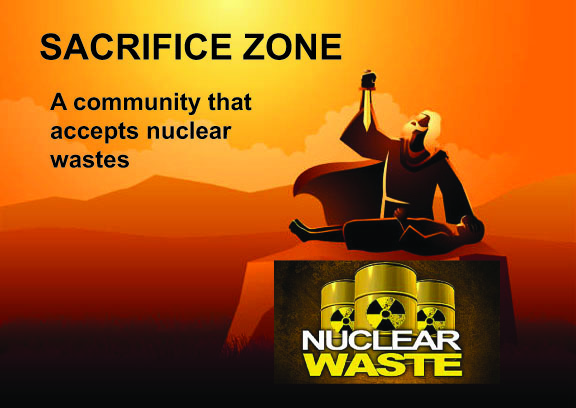
“New Mexico, with less than one half of 1% of the nation’s population, should not continue to be the sacrifice zone because we can be exploited,”
New Mexico Debates Bill to Block Spent Nuclear Fuel Storage, Feb. 1, 2022, By SUSAN MONTOYA BRYAN, Associated PressALBUQUERQUE, N.M. (AP) — Gov. Michelle Lujan Grisham and members of New Mexico’s congressional delegation already have voiced strong opposition to building a multibillion-dollar facility along the state’s border with Texas that would store tons of spent nuclear fuel from commercial power plants around the U.S.
Top New Mexico officials contend the Nuclear Regulatory Commission hasn’t done enough to vet plans by Holtec International to build a facility to store thousands of tons of spent uranium in the state. They argue that without a plan by the federal government to deal with spent fuel, the material would remain in New Mexico indefinitely.
Texas Gov. Greg Abbott has also expressed his opposition to a similar storage facility in his state. Both states have sued the federal government over the issue.
Democratic Sen. Jeff Steinborn of Las Cruces, who is sponsoring the New Mexico legislation, said the federal government needs to address the problem and establish a policy for dealing with the spent fuel piling up at the nation’s nuclear power plants.
“New Mexico, with less than one half of 1% of the nation’s population, should not continue to be the sacrifice zone because we can be exploited,” he told fellow lawmakers, noting that many communities have passed resolutions opposed to bringing high-level nuclear waste to the state.
………………… The federal government is paying to house the fuel, and the cost is expected to stretch into the tens of billions over the next decade, according to a review by independent government auditors.
The fuel is sitting at temporary storage sites in nearly three dozen states, either enclosed in steel-lined concrete pools of water or in steel and concrete containers known as casks.
U.S. Energy Secretary Jennifer Granholm has talked about revisiting recommendations made a decade ago by a blue ribbon commission on America’s nuclear future. In November, her agency issued a request seeking input on a consent-based siting process to identify locations to store commercial spent nuclear
$640 Billion and 56 years to clean up Hanford’s underground tanks of plutonium and other nuclear wastes.
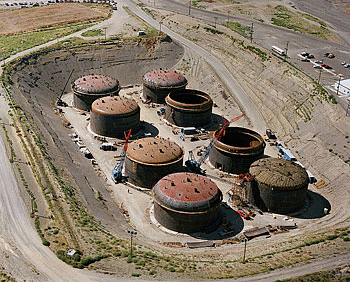
Hanford begins 1st large-scale treatment of nuke tank wastes, Feb. 2, 2022 By NICHOLAS K. GERANIOS, Seattle TimesThe Associated Press SPOKANE, Wash. (AP) — Workers on a former nuclear weapons production site have started the first large-scale treatment of radioactive and chemical wastes from large underground storage tanks, a key milestone in cleaning up the Hanford Nuclear Reservation, the U.S. Department of Energy said Wednesday.Hanford for decades made plutonium for the nation’s nuclear arsenal and is the most radioactively contaminated site in the nation’s nuclear weapons complex. It was created by the Manhattan Project and made the plutonium for the atomic bomb dropped on Nagasaki, Japan, at the end of the World War II……..
The newly operational system removes radioactive cesium and solids from waste stored in huge underground tanks at Hanford. The treated waste will be stored until it is sent to the nearby Waste Treatment and Immobilization Plant, where it will be converted into a glass-like substance for long-term storage. That plant, under construction since 2002, comes online next year, the agency said……
Hanford contains approximately 56 million gallons of radioactive waste stored in 177 underground tanks, representing one of DOE’s largest environmental risks and most complex challenges. The tank waste is a result of nearly five decades of plutonium production that supported national security missions and helped end World War II, the DOE said.
U.S. Sen. Maria Cantwell, D-Wash., called the news “a monumental step” in the cleanup of Hanford.
But it is one step.
Finishing the cleanup of Hanford, located near Richland in southcentral Washington, will cost an estimated $300 billion to $640 billion, and take until about 2078, according to a Department of Energy report published at the end of January.
The 580-square-mile (1,502-square-kilometer) Hanford site, located along the Columbia River, produced almost two-thirds of the plutonium for the nation’s nuclear weapons program from World War II through the Cold War.
DOE is spending about $2.5 billion annually on environmental cleanup of the wastes, plus contaminated buildings, soil and groundwater. But the estimated costs to finish most cleanup by 2078 would require much larger annual budgets.
This story has been corrected to show that treated waste will be stored in an underground tank, not special capsules. https://www.seattletimes.com/seattle-news/hanford-begins-1st-large-scale-treatment-of-nuke-tank-wastes/
Swedish drones shine light on potential threat to nuclear plants, say Nuclear Free Local Authorities (NFLA)
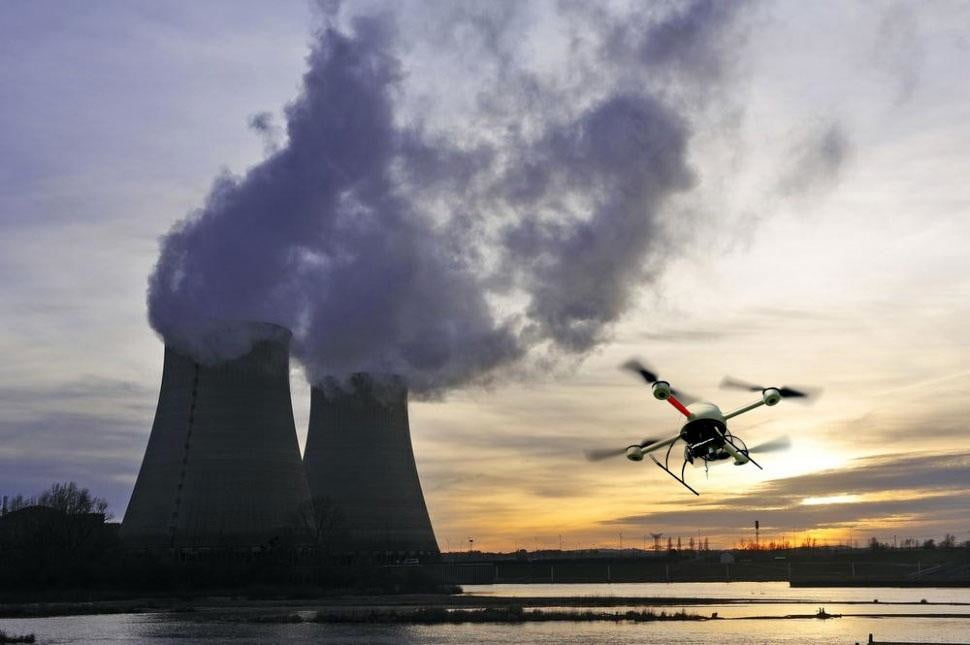
Recent reports of mysterious drones overflying several nuclear power plants in Sweden have illustrated just one of the possible future threats faced by Britain’s reactors that must be addressed, say the UK and Ireland Nuclear Free Local Authorities (NFLA).
In his letter to the Nuclear Decommissioning Authority, NFLA Steering Committee Chair, Councillor David Blackburn, has identified ‘a void (of information) on the preparations in place to deter physical attacks upon nuclear facilities or the theft of nuclear materials from site’, and he has called the absence of such information in the agency’s latest Draft Business Plan for 2022-25 ‘not reassuring’.
In December 2021, the Non-Proliferation Policy Education Centre published a paper outlining the risks posed by military and terrorist strikes on nuclear facilities in the Middle East. Although the dynamic in the UK is not the same, the NFLA wants the NDA to draw from it the relevant lessons about the vulnerability of nuclear plants to strikes by missiles and drones, sophisticated technologies now increasingly available to terrorist groups as well as nation states.
On 18 January, BBC News reported sightings of drones in preceding days over the Forsmark, Ringhals, and Oskarshamn nuclear power plants. The Swedish Police appealed to the public to come forward with information, and the Swedish Security Service, Sapo, launched an investigation into the perpetrators who were suspected of ‘grave unauthorised dealing with secret information’.[i]
These recent developments have prompted the NFLA to call for the NDA to include in its final Business Plan ‘some record of any activity or exercises, or future plans, to address these threats (subject to restrictions on the disclosure of sensitive information on grounds of security)’.
Speaking for the NFLA Steering Committee Chair, Cllr David Blackburn, said:
‘Although the NFLA welcomes the NDA’s stated commitment to participate in exercises to counter cyber attacks, it is worrying that the current draft Business Plan is silent on the preparations that the NDA and its partners has in place to counter any potential physical terrorist attack on a facility, which might be by land, air or sea, or upon nuclear waste in transit, or to prevent the theft of nuclear materials from sites. It is our hope that we can see further detail in the final version.’
U.S. has recently delivered 500 tons of ammunition to Ukraine. “And this is not the end.” – DM — Anti-bellum
Ukraine receives about 500 tonnes of defense ammunition from USA over this day – Reznikov The sixth aircraft delivered another 84 tonnes of ammunition to Ukraine from the United States, in general, Ukraine received 500 tonnes of defense ammunition from the United States on Tuesday, Ukrainian Defense Minister Oleksiy Reznikov has said. “The day has […]
U.S. has recently delivered 500 tons of ammunition to Ukraine. “And this is not the end.” – DM — Anti-bellum
Video: NATO’s Arctic 5 face off against Russia in the High North — Anti-bellum
Video: Allied Troops in the High North The High North is increasingly important to the Alliance. With five Allies classified as Arctic nations, Canada, Denmark, Iceland, Norway and the United States, a large portion of the area falls within the Supreme Allied Commander Europe’s (SACEUR) area of responsibility. This is why NATO troops continuously train […]
Video: NATO’s Arctic 5 face off against Russia in the High North — Anti-bellum
February 2 Energy News — geoharvey

Science and Technology: ¶ “Zinc-Bromide Batteries To Store Solar Power At Acciona’s Testing Field In Spain” • Spanish renewable energy firm Acciona Energía will test the zinc bromide battery technology developed by Anglo-Australian manufacturer Gelion at its PV testing plant in Navarra. The project is part of an innovation program started by Acciona Energy. [PV […]
February 2 Energy News — geoharvey
Channel 10’s ”The Project” did have the guts to show Australia the Kimba nuclear waste dump story
How happy was the nuclear lobby, to keep this under wraps from the Australian public.!
In typical form, the nuclear lobby chooses a rather remote small rural community, and then blankets thenm with propaganda from ANSTO and any other pro nuclear institution they can find. Only the pro nuclear spin got to that community.along with lovely financial ”incentives”.
In the current floods, no media mention is made of the clear threats to a Napandee nuclear waste dump, from flooding – to add to the other threats, such as the ruination of the local agricultural reputation.
Only Channel 10 has had the guts. And I write as a person who is biased against the commercial TV channels. Always a fan of the ABC – I now see it as a rather timourouis organisation, always in dread of having their funding cut – as the Scott Morrison government continues in the good old Liberal tradition of death to the ABC by a thousand cuts.
The coming Khaki election: will Labor join in the belligerence against China?
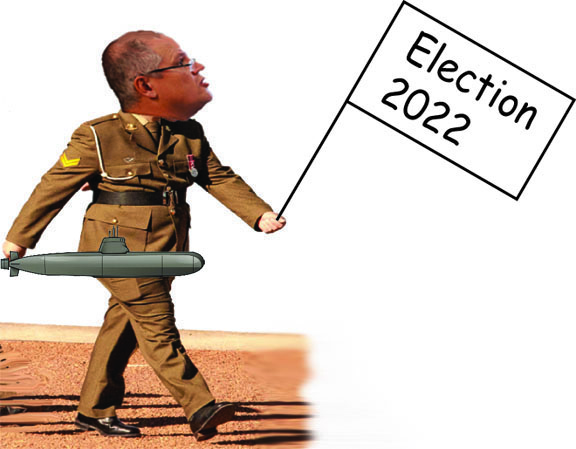
For the Australian Coalition government, with an election coming in less than four months, this is convenient.
Dutton and Prime Minister Scott Morrison are happy to harness Wu’s carefully crafted rhetoric to turn the threat from China into the national security issue of the election.
The three reasons Taiwan keeps talking up the threat of war with China, The Age, By Eryk Bagshaw, January 31, 2022 — Singapore: There was alarm last year when Defence Minister Peter Dutton warned that China’s push to take over Taiwan was gathering pace. It was time to have an honest conversation about the threat of war, he said, because once Taiwan was taken, the Japanese Senkaku islands were next – and then every major Australian city was “within range of China’s missiles”.The threat to Taiwan has not dissipated in the new year………

Peter Dutton also vowed to continue to speak out against China’s “belligerent approach” just hours after the new Chinese ambassador arrived in Australia with a conciliatory message about getting the troubled relationship “back to the right track”.
Taiwan’s Foreign Minister Joseph Wu is determined to keep international leaders talking about Taiwan’s situation should war come to pass.
There are three key reasons for this.
The first objective is domestic. “Taiwanese society understands that if the government is doing something right, they will continue to support the government,” Wu told me in an interview from Taipei……..
The strategy has netted Taiwan’s Democratic Progressive Party results, including a landslide presidential victory for Tsai Ing-wen in 2020.
The second objective is to maintain resolve………..
That means every rhetorical threat from Beijing is met with a response from Taipei. This cacophony can sound like warmongering but is more bombastic than about readying for boots on the ground.
The third objective is about building alliances and ensuring Taiwan becomes a global symbol of liberal democracy worth fighting for…………..
Taipei watched on with concern as the United States and its allies pulled out of Afghanistan……
This is why you will hear more like this from Wu throughout 2022…….
”Wu must frame the threat of war as omnipresent even if it is not imminent.”
For the Australian Coalition government, with an election coming in less than four months, this is convenient.
Dutton and Prime Minister Scott Morrison are happy to harness Wu’s carefully crafted rhetoric to turn the threat from China into the national security issue of the election.
Labor’s attempts to follow the international relations playbook will become more challenging as polling day draws near.
On Monday, Labor leader Anthony Albanese was asked on 3AW radio whether he would “unequivocally” support Taiwan in a military conflict and take a stand against “concentration camps” in Xinjiang.
“Where do you stand?” Neil Mitchell asked Albanese on Monday after days of government ministers accusing Albanese of softening Labor’s stance on China.
“What the international community has consistently said is that Taiwan’s position needs to be respected,” said Albanese.
Albanese let Wu do the talking. That’s admirable restraint. Let’s see how long it lasts. https://www.theage.com.au/world/asia/the-three-reasons-taiwan-keeps-talking-up-the-threat-of-war-with-china-20220131-p59skk.html
The past decade has seen stunning change. The next 10 years will be breathtaking

the share of renewables in January, 2022, in Australia’s main grid is 34.4 per cent. Wind and solar alone account for 28 per cent. Solar accounted for 12.6 per cent of generation over the last 12 months, and will now likely deliver half of all generation by 2050 – not three per cent.
That 1.5°C is the only target that really matters. The federal Coalition government insists we need new technology to get us there. But nearly all the tools we will need are already at our disposal. The only thing missing, at least at the federal level, is leadership. And in a few months’ time, at the next federal election, there will be an opportunity to get that right.
The past decade has seen stunning change. The next 10 years will be breathtaking, https://reneweconomy.com.au/the-past-decade-has-seen-stunning-change-the-next-10-years-will-be-breathtaking/ Giles Parkinson 30 January 2022.
They said it couldn’t be done. There was no way Australia could reach 20 per cent renewables by 2020, we were told. And yet we did. And then we were told there was too much wind and solar. Now it is clear there is not nearly enough.
It is now exactly a decade since the RenewEconomy website appeared and published its first articles. Australia, at the time, was yet to build its first large-scale solar farm; the carbon price had not yet been put in place, the finishing touches were being put on a re-booted renewable energy target and the Clean Energy Finance Corporation, and geothermal and solar thermal were supposed to be the next big thing.
At the time, the transition to a grid dominated by wind and solar appeared as some sort of flight of fancy.
Sure, some utilities like Origin spent tens of millions on solar and geothermal technologies, before throwing billions into LNG. The then chief executive of AGL, Michael Fraser, used to indulge our questions with responses such as “seeing it’s you guys, I guess we better talk about solar.” A few months later, AGL spent billions becoming the biggest generator of coal in the country and the biggest emitter. It is still trying to find a way out of that mess.
But there was no doubt that many legacy utilities could already see what was coming and how much was at stake. The small amounts of rooftop solar in the grid were already pointing to a future of deep duck curves and negative prices, and the incumbents used their regulatory and political influence to fight furiously against any moves to encourage rooftop solar or energy efficiency. Some of them still are.
Big business didn’t want the Clean Energy Finance Corporation (CEFC) to intervene in the market, because they wanted new technologies to be kept in the lab. Some still do. The coal lobby was arguing that it shouldn’t be expected to invest in carbon capture and storage because it was clearly not commercial, and wouldn’t be for another couple of decades. It’s too late for coal, but now the gas and oil industry are trotting out a similar argument.
In the month that RenewEconomy first published, with a team of just two (myself and still deputy editor Sophie Vorrath), there was a negligible amount of renewables in the grid – an average of 4.6 per cent over the month of January, 2012. Most of it was hydro. The official forecasts were equally dismissive – a federal government white paper predicted that solar, might, at best deliver 3 per cent of generation by 2050, or one per cent by 2030.
RenewEconomy, even in those early days, sensed that the transition might go a lot quicker than that. Firstly, because it needed to, secondly because it was clear it would be supported by great licks of capital, and thirdly because learning curves pointed to a future of low cost renewables.
Fast forward a decade and the share of renewables in January, 2022, in Australia’s main grid is 34.4 per cent. Wind and solar alone account for 28 per cent. Solar accounted for 12.6 per cent of generation over the last 12 months, and will now likely deliver half of all generation by 2050 – not three per cent.
That transition has brought extraordinary change. Coal fired power stations, if they couldn’t before, now see the writing on the wall and are preparing for closure, although they are still using their regulatory and political clout to make the case for one more major handout as the transition accelerates around them.
South Australia, thanks to its good resources and a government that made it clear it would welcome investment in renewables, leads the way with the a world-topping 62.5 per cent share for wind and solar (as a percentage of local demand) in the last 12 months.
South Australia has already delivered a week long period where wind and solar delivered more than local demand, and it is expected to reach “net 100 per cent” renewables (calculated over a year), well ahead of the official state target of 2030.
Remarkably, that net 100 per cent renewables will come from wind and solar only. It will be an extraordinary achievement and the knowledge gained from operating such a system will set a blueprint for the world to follow.
Yes, it will rely on storage, demand management, links to other states for exports and some imports, and some fossil fuel generation in wind and solar droughts, but having a gigawatt-scale grid in a modern economy meet the equivalent of 100 per cent of its demand over a year will be extraordinary.
And as stunning as the last decade has been, the next decade could be breathtaking because the market is now looking at green exports, in the form of electricity and hydrogen and ammonia, and green manufacturing, which can all focus their demand on when the sun shines and the wind blows. As the big utilities now admit, you can say goodbye to “baseload”.
As we look to the next decade, it is clear that coal generation may have disappeared from NSW by 2032, and fossil fuel cars will make up only a tiny fraction of new vehicle purchases. The share of renewables in the grid will be well above 80 per cent and could be heading towards 100 per cent.
Just to be clear on that point, the Australian Energy Market Operator expects the share of renewables to be around 80 per cent by 2030 according to what the overall industry considers to be the new “most likely” scenario, known as “step change.”
Crucially, mainstream politics is embracing it. Labor’s emissions targets, still well short of what’s needed for 1.5°C, assume an 82 per cent share of renewables in the main grid by 2030. Even the federal Coalition is dialing in a 69 per cent share of renewables in its woefully inadequate emissions targets.
Australian billionaires such as Andrew Forrest and Mike Cannon-Brookes have already helped change the public discourse on the green energy transition, and if their bold plans – and those of others – come true, Australia will be an exporter of green hydrogen, green ammonia, green electricity, and green materials in the form of steel and other manufactured products.
Continue readingFederal Government continues spin and inaction on environment in 2022
Federal Government continues spin and inaction on environment in 2022
Sue Arnold
Watching Prime Minister Scott Morrison on TV clutching a koala, claiming concern for the species was more than most could stomach.
Australia must shift from fossil fuels or risk more than 100,000 regional jobs — RenewEconomy

Up to 300,000 jobs in regional parts of Queensland and WA are at risk if governments fail to prepare for shift from fossil fuels, new research shows. The post Australia must shift from fossil fuels or risk more than 100,000 regional jobs appeared first on RenewEconomy.
Australia must shift from fossil fuels or risk more than 100,000 regional jobs — RenewEconomy
1 This month.


PETITION – To: Prime Minister Anthony Albanese and the Australian Labor Government
Chernobyl: The Lost Tapes – A good documentary on Chernobyl on SBS available On Demand for the next 3 weeks– https://www.sbs.com.au/ondemand/tv-program/chernobyl-the-lost-tapes/235274195556
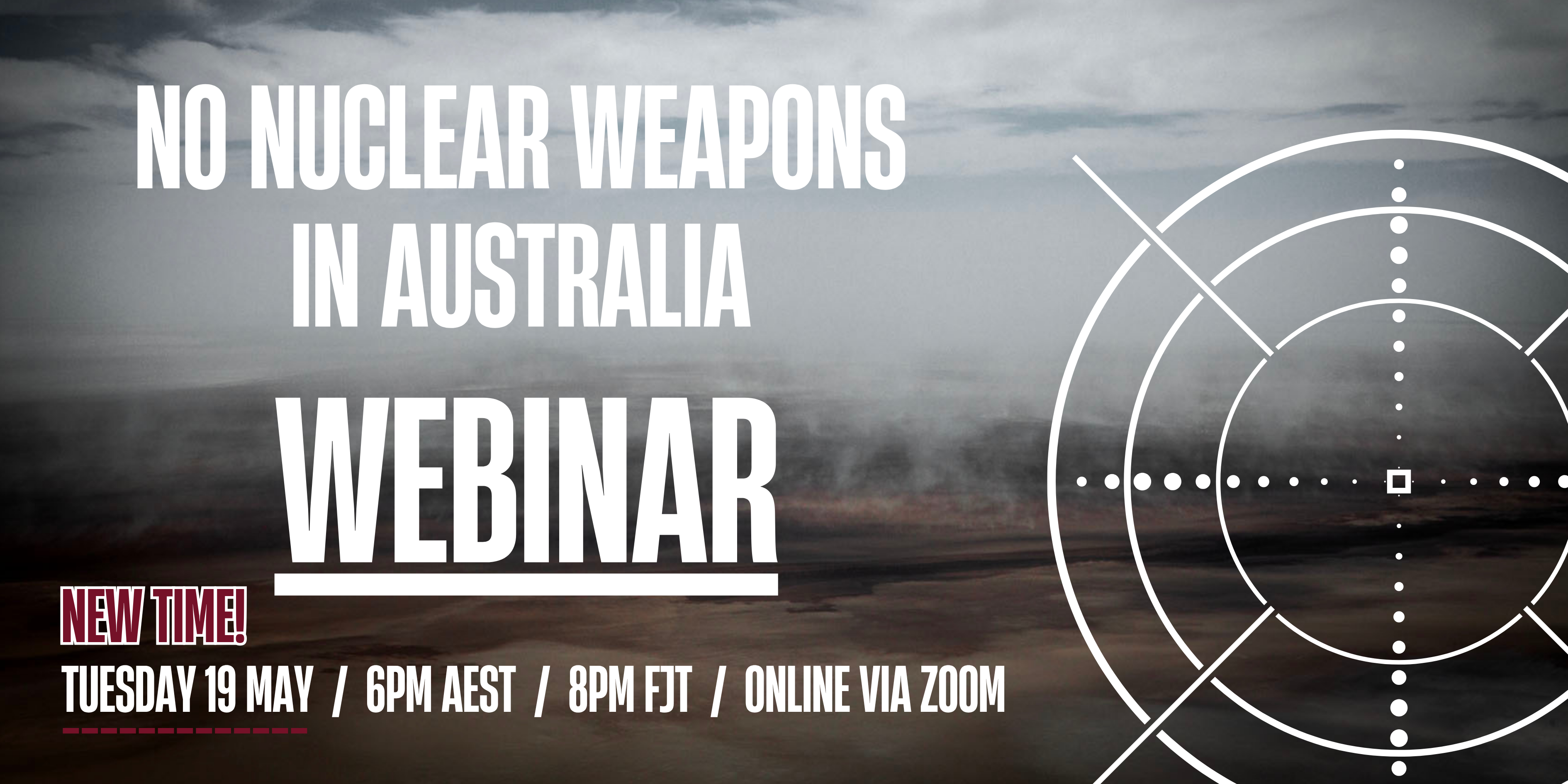
19 May – Webinar- Webinar: No Nuclear Weapons in Australia
Start: 2026-05-19 18:00:00 UTC Canberra, Melbourne, Sydney (GMT+10:00)
End: 2026-05-19 19:30:00 UTC Canberra, Melbourne, Sydney (GMT+10:00)
20 May – Webinar – The dangerous world of AUKUS, US, military occupation and suppression of dissent

National Webinar, 20th May, 2026, 6.30pm AEST. Confronting laws restricting/suppressing protest speech and action
Speakers: Former Sen. Rex Patrick, Lawyer Nick Hanna ,Arthur Rorris ,Jorgen Doyle, Sen David Shoebbridge,
Facilitator Kelley Tranter.

of the week – Australians for War Powers Reform (AWPR)
To see nuclear-related stories in greater depth and intensity
 Antinuclear