Channel 10’s ”The Project” did have the guts to show Australia the Kimba nuclear waste dump story
How happy was the nuclear lobby, to keep this under wraps from the Australian public.!
In typical form, the nuclear lobby chooses a rather remote small rural community, and then blankets thenm with propaganda from ANSTO and any other pro nuclear institution they can find. Only the pro nuclear spin got to that community.along with lovely financial ”incentives”.
In the current floods, no media mention is made of the clear threats to a Napandee nuclear waste dump, from flooding – to add to the other threats, such as the ruination of the local agricultural reputation.
Only Channel 10 has had the guts. And I write as a person who is biased against the commercial TV channels. Always a fan of the ABC – I now see it as a rather timourouis organisation, always in dread of having their funding cut – as the Scott Morrison government continues in the good old Liberal tradition of death to the ABC by a thousand cuts.
The coming Khaki election: will Labor join in the belligerence against China?

For the Australian Coalition government, with an election coming in less than four months, this is convenient.
Dutton and Prime Minister Scott Morrison are happy to harness Wu’s carefully crafted rhetoric to turn the threat from China into the national security issue of the election.
The three reasons Taiwan keeps talking up the threat of war with China, The Age, By Eryk Bagshaw, January 31, 2022 — Singapore: There was alarm last year when Defence Minister Peter Dutton warned that China’s push to take over Taiwan was gathering pace. It was time to have an honest conversation about the threat of war, he said, because once Taiwan was taken, the Japanese Senkaku islands were next – and then every major Australian city was “within range of China’s missiles”.The threat to Taiwan has not dissipated in the new year………

Peter Dutton also vowed to continue to speak out against China’s “belligerent approach” just hours after the new Chinese ambassador arrived in Australia with a conciliatory message about getting the troubled relationship “back to the right track”.
Taiwan’s Foreign Minister Joseph Wu is determined to keep international leaders talking about Taiwan’s situation should war come to pass.
There are three key reasons for this.
The first objective is domestic. “Taiwanese society understands that if the government is doing something right, they will continue to support the government,” Wu told me in an interview from Taipei……..
The strategy has netted Taiwan’s Democratic Progressive Party results, including a landslide presidential victory for Tsai Ing-wen in 2020.
The second objective is to maintain resolve………..
That means every rhetorical threat from Beijing is met with a response from Taipei. This cacophony can sound like warmongering but is more bombastic than about readying for boots on the ground.
The third objective is about building alliances and ensuring Taiwan becomes a global symbol of liberal democracy worth fighting for…………..
Taipei watched on with concern as the United States and its allies pulled out of Afghanistan……
This is why you will hear more like this from Wu throughout 2022…….
”Wu must frame the threat of war as omnipresent even if it is not imminent.”
For the Australian Coalition government, with an election coming in less than four months, this is convenient.
Dutton and Prime Minister Scott Morrison are happy to harness Wu’s carefully crafted rhetoric to turn the threat from China into the national security issue of the election.
Labor’s attempts to follow the international relations playbook will become more challenging as polling day draws near.
On Monday, Labor leader Anthony Albanese was asked on 3AW radio whether he would “unequivocally” support Taiwan in a military conflict and take a stand against “concentration camps” in Xinjiang.
“Where do you stand?” Neil Mitchell asked Albanese on Monday after days of government ministers accusing Albanese of softening Labor’s stance on China.
“What the international community has consistently said is that Taiwan’s position needs to be respected,” said Albanese.
Albanese let Wu do the talking. That’s admirable restraint. Let’s see how long it lasts. https://www.theage.com.au/world/asia/the-three-reasons-taiwan-keeps-talking-up-the-threat-of-war-with-china-20220131-p59skk.html
The past decade has seen stunning change. The next 10 years will be breathtaking

the share of renewables in January, 2022, in Australia’s main grid is 34.4 per cent. Wind and solar alone account for 28 per cent. Solar accounted for 12.6 per cent of generation over the last 12 months, and will now likely deliver half of all generation by 2050 – not three per cent.
That 1.5°C is the only target that really matters. The federal Coalition government insists we need new technology to get us there. But nearly all the tools we will need are already at our disposal. The only thing missing, at least at the federal level, is leadership. And in a few months’ time, at the next federal election, there will be an opportunity to get that right.
The past decade has seen stunning change. The next 10 years will be breathtaking, https://reneweconomy.com.au/the-past-decade-has-seen-stunning-change-the-next-10-years-will-be-breathtaking/ Giles Parkinson 30 January 2022.
They said it couldn’t be done. There was no way Australia could reach 20 per cent renewables by 2020, we were told. And yet we did. And then we were told there was too much wind and solar. Now it is clear there is not nearly enough.
It is now exactly a decade since the RenewEconomy website appeared and published its first articles. Australia, at the time, was yet to build its first large-scale solar farm; the carbon price had not yet been put in place, the finishing touches were being put on a re-booted renewable energy target and the Clean Energy Finance Corporation, and geothermal and solar thermal were supposed to be the next big thing.
At the time, the transition to a grid dominated by wind and solar appeared as some sort of flight of fancy.
Sure, some utilities like Origin spent tens of millions on solar and geothermal technologies, before throwing billions into LNG. The then chief executive of AGL, Michael Fraser, used to indulge our questions with responses such as “seeing it’s you guys, I guess we better talk about solar.” A few months later, AGL spent billions becoming the biggest generator of coal in the country and the biggest emitter. It is still trying to find a way out of that mess.
But there was no doubt that many legacy utilities could already see what was coming and how much was at stake. The small amounts of rooftop solar in the grid were already pointing to a future of deep duck curves and negative prices, and the incumbents used their regulatory and political influence to fight furiously against any moves to encourage rooftop solar or energy efficiency. Some of them still are.
Big business didn’t want the Clean Energy Finance Corporation (CEFC) to intervene in the market, because they wanted new technologies to be kept in the lab. Some still do. The coal lobby was arguing that it shouldn’t be expected to invest in carbon capture and storage because it was clearly not commercial, and wouldn’t be for another couple of decades. It’s too late for coal, but now the gas and oil industry are trotting out a similar argument.
In the month that RenewEconomy first published, with a team of just two (myself and still deputy editor Sophie Vorrath), there was a negligible amount of renewables in the grid – an average of 4.6 per cent over the month of January, 2012. Most of it was hydro. The official forecasts were equally dismissive – a federal government white paper predicted that solar, might, at best deliver 3 per cent of generation by 2050, or one per cent by 2030.
RenewEconomy, even in those early days, sensed that the transition might go a lot quicker than that. Firstly, because it needed to, secondly because it was clear it would be supported by great licks of capital, and thirdly because learning curves pointed to a future of low cost renewables.
Fast forward a decade and the share of renewables in January, 2022, in Australia’s main grid is 34.4 per cent. Wind and solar alone account for 28 per cent. Solar accounted for 12.6 per cent of generation over the last 12 months, and will now likely deliver half of all generation by 2050 – not three per cent.
That transition has brought extraordinary change. Coal fired power stations, if they couldn’t before, now see the writing on the wall and are preparing for closure, although they are still using their regulatory and political clout to make the case for one more major handout as the transition accelerates around them.
South Australia, thanks to its good resources and a government that made it clear it would welcome investment in renewables, leads the way with the a world-topping 62.5 per cent share for wind and solar (as a percentage of local demand) in the last 12 months.
South Australia has already delivered a week long period where wind and solar delivered more than local demand, and it is expected to reach “net 100 per cent” renewables (calculated over a year), well ahead of the official state target of 2030.
Remarkably, that net 100 per cent renewables will come from wind and solar only. It will be an extraordinary achievement and the knowledge gained from operating such a system will set a blueprint for the world to follow.
Yes, it will rely on storage, demand management, links to other states for exports and some imports, and some fossil fuel generation in wind and solar droughts, but having a gigawatt-scale grid in a modern economy meet the equivalent of 100 per cent of its demand over a year will be extraordinary.
And as stunning as the last decade has been, the next decade could be breathtaking because the market is now looking at green exports, in the form of electricity and hydrogen and ammonia, and green manufacturing, which can all focus their demand on when the sun shines and the wind blows. As the big utilities now admit, you can say goodbye to “baseload”.
As we look to the next decade, it is clear that coal generation may have disappeared from NSW by 2032, and fossil fuel cars will make up only a tiny fraction of new vehicle purchases. The share of renewables in the grid will be well above 80 per cent and could be heading towards 100 per cent.
Just to be clear on that point, the Australian Energy Market Operator expects the share of renewables to be around 80 per cent by 2030 according to what the overall industry considers to be the new “most likely” scenario, known as “step change.”
Crucially, mainstream politics is embracing it. Labor’s emissions targets, still well short of what’s needed for 1.5°C, assume an 82 per cent share of renewables in the main grid by 2030. Even the federal Coalition is dialing in a 69 per cent share of renewables in its woefully inadequate emissions targets.
Australian billionaires such as Andrew Forrest and Mike Cannon-Brookes have already helped change the public discourse on the green energy transition, and if their bold plans – and those of others – come true, Australia will be an exporter of green hydrogen, green ammonia, green electricity, and green materials in the form of steel and other manufactured products.
Continue readingFederal Government continues spin and inaction on environment in 2022
Federal Government continues spin and inaction on environment in 2022
Sue Arnold
Watching Prime Minister Scott Morrison on TV clutching a koala, claiming concern for the species was more than most could stomach.
Australia must shift from fossil fuels or risk more than 100,000 regional jobs — RenewEconomy

Up to 300,000 jobs in regional parts of Queensland and WA are at risk if governments fail to prepare for shift from fossil fuels, new research shows. The post Australia must shift from fossil fuels or risk more than 100,000 regional jobs appeared first on RenewEconomy.
Australia must shift from fossil fuels or risk more than 100,000 regional jobs — RenewEconomy
Fossil fuel industry asks Morrison government for more support for CCS — RenewEconomy

Fossil fuel groups are asking for more support for troubled carbon storage projects as the federal budget looms. The post Fossil fuel industry asks Morrison government for more support for CCS appeared first on RenewEconomy.
Fossil fuel industry asks Morrison government for more support for CCS — RenewEconomy
“Unsupported by evidence:” CMI slams carbon farming veto powers for minister — RenewEconomy

A proposal to grant the federal agriculture minister powers to veto proposed carbon offset projects has been slammed by the Carbon Market Institute. The post “Unsupported by evidence:” CMI slams carbon farming veto powers for minister appeared first on RenewEconomy.
“Unsupported by evidence:” CMI slams carbon farming veto powers for minister — RenewEconomy
After the hibakusha: the future of Japan’s anti-nuclear movement

After the hibakusha: the future of Japan’s anti-nuclear movement https://www3.nhk.or.jp/nhkworld/en/news/backstories/1870/
Yoshida Mayu, NHK World Correspondent, 31 Jan 22, Activists calling for the abolition of nuclear weapons have long relied on the powerful testimonies of atomic bomb survivors, or hibakusha, to grow their movement. But with ever fewer people to offer that testimony, both the hibakusha and activists know those days are running out. NHK World’s Yoshida Mayu speaks to different generations who have a common goal: a world without nuclear weapons.
Hellish memories
Oka Nobuko was in Nagasaki on August 9, 1945, the day the US dropped an atomic bomb on the city. For most of her life, she avoided talking about her experiences as the memories were too painful.
Last year she finally broke her silence to deliver a speech at the annual ceremony commemorating the date of the bombing.
“When I stood up, I was immediately knocked down and I lost consciousness,” she recounted. “When I woke up, I didn’t know where I was. Pieces of shattered glass were lodged in my body.”
Oka was a 16-year-old nursing student at the time and helped treat other victims at a first aid center.
“No treatment was possible in a lot of these cases,” she said. “There was flesh dangling from exposed bone. Some people jumped off buildings to kill themselves because they couldn’t endure the pain any longer.”
She described the scenes as “hellish” and said she suffered severe headaches every time the memories returned. For this reason, she always avoided going to the area where the first aid center was located.
Time to speak
In a letter to a close friend three years ago, Oka wrote of her worries that her memories and those of other hibakusha would soon be gone.
“The hibakusha are getting older and someday all of us will be gone,” she wrote.
Estimates put the number of living hibakusha at around 127,000, with an average age of 83.This sense that time was running out is what motivated Oka to finally share her story last August.
“We, the hibakusha, will continue to share our experiences and call for the abolition of nuclear weapons. We will fight for peace.”
Last November, three months after giving her speech, Oka died at the age of 93.
Inspiring other hibakusha Fukuda Hakaru, a 90-year-old Nagasaki hibakusha, says hearing Oka speak inspired him to share his own story. He wrote her a letter, saying how much her courage had moved him.
Fukuda had gone to the first aid center Oka was working at to get medicine for his father, who was severely injured in the blast.
“I can still hear the screams of the patients,” he says. “Doctors and nurses were running around to help them. It was a painful sight. It is very hard for me to talk about what I saw. The medical workers were the ones who saw up close the inhumanity of the atomic bombs.”
Fukuda was 14 at the time. He did not suffer any serious injuries, but his father, who was working close to ground zero, died a month later.”I’ll never forget how I felt. I had to pick up his remains after the cremation, but I have no idea how I managed. The world needs to know that this is the kind of pain that an atomic bomb causes. It cannot be allowed to happen again.”
Fukuda says he long felt he had a duty to share his story but avoided doing so because he was worried about the anti-hibakusha discrimination he and his family might face.
Many survivors and their families have had to deal with prejudice and discrimination over the years. Initially, little was known about the effects of radiation exposure, and some people incorrectly regarded it as contagious. The social stigma was especially serious when it came to marriage or work.
“The hibakusha continue to suffer today,” says Fukuda. “That’s yet another reason why we need to make sure this never happens again.”
Preserving Oka’s message
In December, a group of university students from Nagasaki hosted a virtual conference about the experiences of the hibakusha, speaking to high school classes about the stories they had heard from survivors.
One of these students was Kaji Misato, who spent a lot of time with Oka during her final days.
“Oka was with her mother and brother at the time of the bombing,” Kaji said at the event. “As she stood up, she realized she was covered in blood.”Kaji spoke to Oka four times last year and recorded five hours of conversation. She said it was an eye-opening experience.
“The atomic bombing always felt like something in the past,” Kaji says. “But after hearing her story, I started to feel a greater sense of attachment. She told us the war had robbed her of her youth and she wanted peace so the same thing didn’t happen with the youth of today.”Every year on August 9, a siren rings out across the city at 11:02 AM, the exact time the atomic bomb exploded. Residents stop what they are doing to observe a minute of silence. But when Kaji visited the city center last year, she was shocked to see how few people were actually paying their respects.
About a month later, Oka was diagnosed with terminal cancer. Kaji met with her shortly after.
“She told me she was worried that once all the hibakusha are gone, their memories would fade as well,” Kaji says.
She took her words to heart and decided to share what she told her with people even younger. The high school students who attended the virtual session said it was an insightful experience.”Her vivid memories made me feel the horror of the atomic bomb,” said one student.
“We cannot take peace for granted,” said another. “We have to take care of the people who are close to us.”
This year promises to be a crucial one for the abolition movement. State parties to the UN nuclear weapons ban treaty are planning to hold their first meeting to try to agree on specific actions. In the meantime, young campaigners like Kaji are ensuring that the stories from those who witnessed the horrors of 1945 are documented and heard.
Doubts grow on water-release schedule at Fukushima plant
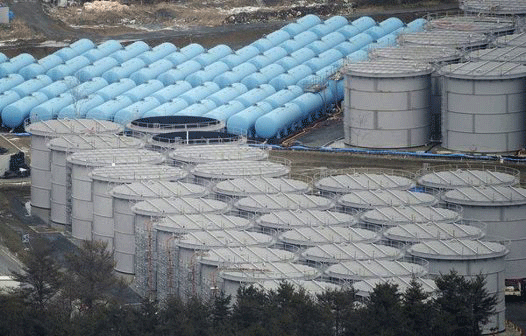
Doubts grow on water-release schedule at Fukushima plant https://www.asahi.com/ajw/articles/14536446 THE ASAHI SHIMBUN, January 31, 2022 Shovel loaders digging pits at the Fukushima No. 1 nuclear power plant on Jan. 17 were a rare sign of progress in the government’s contentious water-discharge plan at the stricken site.
Under the plan, millions of tons of treated but still contaminated water stored at the plant will be released into the sea over decades starting in spring 2023.
However, opposition to the plan remains fierce among local residents, the fishing industry and even overseas governments.
The pits being dug will temporarily hold radioactive water right before the release. But other preparatory work has already been stalled.
The government plans to create an undersea tunnel through which the treated and diluted radioactive water will be released into the sea about 1 kilometer from the plant.
Drilling work for the tunnel was initially scheduled to start early this year, but it was delayed to June.
Some government officials now doubt that the tunnel can be completed in time for the planned water release.
“It would be impossible to construct the underwater tunnel in less than a year,” one official said.
The government in April last year decided to discharge the contaminated water stored at the plant to move forward the decades-long process of decommissioning of the plant.
The accumulation of highly contaminated water has been a serious problem for the government and plant operator Tokyo Electric Power Co. since the Great East Japan Earthquake and tsunami in March 2011 caused the triple meltdown there.
An average of 150 tons of such water was produced each day last year as rainwater and groundwater keeps flowing into the damaged reactor buildings and mixing with water used to cool the melted nuclear fuel.
The contaminated water is treated by a multi-nuclide removal facility, known as ALPS, and stored in tanks. ALPS, however, cannot remove tritium, a beta-emitting radioactive isotope of hydrogen, and others.
The pits are being built to ensure that tritium levels in the treated water after dilution with a large amount of seawater are low enough to be sent to the planned tunnel for discharge into the sea.
Disposal of the contaminated water has become an urgent matter.
TEPCO said the existing 1,061 tanks at the plant are capable of holding a total of 1.37 million tons of water and would be full by around spring next year.
As of Jan. 20, the plant had reached 94 percent of capacity.
The government fears that continuing to add more storage tanks at the plant could jeopardize the overall decommissioning work.
EFFORTS TO EASE CONCERNS DELAYED
The government asked the International Atomic Energy Agency to send an inspection team to examine the safety of the treated radioactive water.
A seal of approval from a credible international body could go a long way in easing domestic and international opposition about the water release plan.
The IAEA team of researchers from 11 countries, including China and South Korea, which are opposed to the water release, was expected to visit Japan in December to begin its on-site inspection.
But that trip was scrapped after a new wave of novel coronavirus infections hit the global community.
Government officials are negotiating with the IAEA for a visit in spring by the team. But it remains unclear when the trip will finally materialize.
The government and TEPCO have also made little progress in gaining support from fishermen and the public, despite holding numerous briefings about the water release plan.
Distrust of the government and the utility remain high in Fukushima Prefecture over their series of mishandling of the nuclear disaster.
Fishermen, in particular, are adamantly opposed to the release of the water into areas where they make their living.
“If you insist on the safety of treated water, why don’t you spray it in your garden or dump it in a river flowing into Tokyo Bay?” Toru Takahashi, a fisherman in Soma, asked government officials at a recent briefing session.
The officials brought with them a huge stack of documents to emphasize the safety of the treated water.
But they lowered their eyes and clammed up when Takahashi and other opponents challenged their view.
“I will never ever drop my opposition,” Takahashi said.
Such opposition has created a headache for leaders of the towns hosting the plant.
They are eager to see progress in the decommissioning work, and getting rid of the huge amount of contaminated water at the plant would be a big step toward rebuilding their affected communities.
After the government’s decision to release the water, Shiro Izawa, mayor of Futaba, a town that co-hosts the plant along with Okuma, called on then industry minister Hiroshi Kajiyama to gain support for the water discharge plan from the public and fisheries to advance the decommissioning process.
Futaba, a town with a population of nearly 7,000 before the nuclear disaster, is the only municipality in Fukushima Prefecture that remains entirely under an evacuation order.
In 2015, Futaba grudgingly became the storage site of contaminated soil and debris gathered in the cleanup of municipalities in the prefecture on the pretext of “moving forward rebuilding.”
If the planned water release is further delayed because of opposition from other municipalities, the future of rebuilding Futaba will remain in doubt.
(This story was compiled from reports by Takuro Yamano, Keitaro Fukuchi, Tsuyoshi Kawamura and Mamoru Nagaya.)
“Community Partnership” alerted to surveillance and “intimidation” by Radioactive Waste Management — RADIATION FREE LAKELAND

LETTER to All Council Members of the Community Partnership with RWM
Dear Council Member of the Community Partnership with RWM This information has been sent to local and national press but in case it is not flagged up by media you should be aware that South Lakes MP Tim Farron has described surveillance and “intimidation” by Radioactive Waste Management as “severely concerning.” Opponents of the plan for a Geological Disposal Facility in Cumbria have been placed under surveillance with social media/online conversations/letters monitored and analysed by companies specialising in behavioural science. This has extended to false information being passed to the police about a leading campaigner by Radioactive Waste Management. The police have been informed that the information passed to them by RWM is false.
Following our own investigation, campaigners at Radiation Free Lakeland discovered that Oxfordshire based Radioactive Waste Management, tasked with “Delivery” of a UK Geological Disposal Facility (GDF) have employed three companies, Brandwatch, MHP and Press Data to carry out surveillance. Councillors may be aware that Cumbrian group Radiation Free Lakeland have set up a dedicated volunteer campaign called Lakes Against Nuclear Dump to counter RWM’s remit to Deliver a Geological Disposal Facility for High Level Nuclear Wastes and Near Surface Disposal (at Drigg?) for Intermediate Level Nuclear Wastes.
Information on surveillance from Radioactive Waste Management was asked for by wildlife artist and opponent of nuclear dump plans Marianne Birkby through a Data Subject Access Request. The information is, say campaigners astonishing in its breadth of surveillance, analysis of what has been said in opposition to the deep nuclear dump plans and in discussing RWM actions aimed at discrediting voices opposed to GDF as “scaremongering.”
The extent of surveillance includes correspondence with Cumbria Police and the Civil Nuclear Constabulary. An email was sent by Radioactive Waste Management on 7/27/21 to Cumbria Police saying “The RWM lead [name redacted] has expressed concerns that there could be some local protestors at the event as a well-known local activist Marianne Birkby (Radiation Free Lakelands) has a holiday home nearby.” This says the campaigner is “news to me, I haven’t got a holiday home anywhere! Also I wasn’t even at the event referred to, surely passing false information onto the police is illegal and it feels pretty intimidating.”
Campaigners say that it is frightening that Local Authorities Copeland and Allerdale have now entered into a “Community Partnership” with Radioactive Waste Management which so patently advocates against local communities expressing any dissent to RWM’s remit to Deliver a Geological Disposal Facility.
In a letter to Radiation Free Lakeland, Tim Farron MP states: “I am severely concerned …The police should not be used as a method to harass or intimidate peaceful law-abiding protestors. This surveillance seems wholly unnecessary and is another example of the Government’s growing hostility towards those who would exercise their political freedoms.I am pleased to confirm that I have written to the Minister of State for Energy, Clean Growth and Climate Change and Radioactive Waste Management to ask them to confirm that such surveillance has been authorised and what cause they have to harass my constituents in this manner.”
Yours sincerely
Marianne Birkby, Lakes Against Nuclear Dump a Radiation Free Lakeland campaign
Let’s not allow the great powers to destroy the world — IPPNW peace and health blog
The vast destruction wrought by the atomic bombing of Japan in August 1945 should have been enough to convince national governments that the game of war was over. Wars have had a long run among rival territories and, later, nations, with fierce conflicts between Athens and Sparta, Rome and Carthage, Spain and Britain, and the combatants of […]
Let’s not allow the great powers to destroy the world — IPPNW peace and health blog
January 31 Energy News — geoharvey

Opinion: ¶ “Can Nuclear Fusion Power The Race To Net Zero?” • The IPCC’s landmark report in 2018 concluded that the world needs to reach net-zero greenhouse gas emissions by 2050 to have a good chance of limiting global warming to 1.5°C. Estimates for when fusion might come into use range from 2030 to 2050, […]
January 31 Energy News — geoharvey
To the end of January – nuclear news

The Ukraine crisis drags on – no American soldiers will be fighting, but American weapons companies making great sales. Here’s hoping that in the event of war, nobody will strike Ukraines’s nuclear reactors – each of them in them in themselves a sitting nuclear bomb.
Some bits of good news : Chinese Method For Growing Veggies Year-Round in Frigid Canada Really Works–And Has No Heating Costs. South Australia Smashes Renewable Record Using 100% Solar And Wind For Full WeekSolar Power Will Account for Nearly Half of New U.S. Electric Generating Capacity in 2022
CoronavirusLPandemic or endemic: Where is COVID heading next?
Climate, Hot Oceans & Escaping Consumerism
AUSTRALIA.
Massive flooding in Kimba district, – the Agricultural (no it’s now the Nuclear Waste) Town of the Year. Serious doubts that the Australian government has a plan for nuclear waste dump vulnerable to flooding. Kimba flooding: Australian government must immediately abort nuclear waste dump project. WASHED AWAY – Minister Keith Pitt’s grand dream of a Kimba nuclear waste dump. Kimba and the South Australian government must protect this precious agricutural region from nuclear waste dump’s danger of ground contamination.
Traditional Owners welcome expiry of uranium mine approval, but the fight isn’t over. Defence Minister Peter Dutton evasive about the 137 member nuclear submarine taskforce, which does not include a South Australian govt rep. Pandemic pollution: how COVID-19 has fuelled Australia’s waste crisis
What drove Perth’s record-smashing heatwave – and why it’s a taste of things to come
Doctor reveals severe health effects from heatwaves and humidityAustralia’s collapsing reputation – way way down on Transparency International Corruption Index/
INTERNATIONAL.
The rulers of the great powers are playing with fire. Voices for a World Free of Nuclear Weapons . The threat of nuclear winter hangs over our warming planet.
Swapping one dangerous fossil fuel technology for another dangerous nuclear technology is NOT progress. Former nuclear regulators say that nuclear power is not a feasible option for tackling the climate crisis.
Russia proposes US returns American nuclear weapons from NATO countries close to Russia. U.S. and Russian Threats Over Ukraine—What They’re About .
US and British governments are effectively using “lawfare” to ensure Assange’s continued detention. https://www.youtube.com/watch?v=Q2KuzriLnaU UK High Court gives very little chance for Julian Assange.
Rockets Destroy Ozone and Cause Climate Change – Aerospace Programs’ Deadly Impacts to the Earth.
Scientists say no to Solar Geoengineering .
Nuclear incidents and meltdowns – far more than we realised. ‘We have to stop believing the nuclear hype’ , former chairman of the US Nuclear Regulatory Commission, and other leaders. Busting the nuclear propaganda about Liquid Fluoride Thorium Reactors (LFTR).
UKRAINE. Full scale war in Ukraine? With its 15 nuclear reactors – no more Ukraine, no more Europe. Increased mutations in animals affected by Chernobyl radiation. “Nuclear warfare without bombs”.
Does Channel 10’s ”The Project” have the guts to tell the truth about the government’s planned Kimba nuclear waste dump?

You would have thought, with the present flooding of the Kimba area, and indeed, of much of Northern South Australia, that concern about planning a nuclear waste dump there would be an ‘‘urgent item of news”
Indeed, Channel 10’s ”The Project” had 2 hours of interview s about the dump sll ready.
In a rare media event, they had interviewed No Dump advocates Kimba farmers Peter & Sue Woodford & Barngarla Traditional Owner Jason Bilney
Of course they’d also interviewed pro-dumpers.
But anyway, Channel 10 decided that this matter is not ”urgent” – and it’s gone on the back burner.
But instead, they’ve managed to put a reassuring spiel from The Australian Radioactive Waste Agency, (just in case the wider world in Australia might get a bit worried about the situation)
- Roni Skipworth, No nuclear waste dump anywhere in South Australia , 31 Jan 22, Was told today the Interviews Peter and Sue were involved with was 2 hours long and was suppose to be shown tonight on the Project though they got a message saying they will view it later in the week as an urgent report needed to go first.
- Let’s see how long they take to telecast it and also they just didn’t interview the Woolfords from No Nuclear Waste Dump on Agriculture Land. They interviewed the Yes Group also where Ramsay visited Kimba as well to put his bit in. Be interested to see what replaced the time slot tonight. This interview should had happened 6 years ago not just now!
- https://www.facebook.com/groups/1314655315214929—
Floods at Kimba: serious doubts that the Australian government has a plan for nuclear waste dump vulnerable to flooding

NUCLEAR WASTE AND FLOODS
Nuclear waste and floods
1. Preventing problems at a nuclear waste dump/store from flooding should be manageable, if and only if project management oversight and regulation is up to the task.
There are serious questions about whether management and regulation of the Australian government’s proposed national nuclear waste dump/store at Kimba in SA would be adequate. The most relevant case study in Australia is the flawed ‘clean up’ of the Maralinga nuclear test site in the late 1990s, overseen by the federal government. Everything that could go wrong, did go wrong. There has been no honesty or transparency about the failures at Maralinga, no attempt to learn from mistakes. Successive governments have simply lied about the problems and tried to cover them up. Expect the same at Kimba. https://nuclear.foe.org.au/flawed-clean-up-of-maralinga/
2. The proposed Kimba dump will be designed to leak. Either barriers prevent leakage, in which case there is a risk of accumulation of infiltrated water resulting in corrosion of waste drums and other such problems. Or, as is the case with the Kimba proposal, there will be water outlets, i.e. it is designed to leak.
3. Even with the expertise and resources available to ANSTO, and the importance of safely managing irradiated/spent nuclear fuel, water infiltration has been a problem at Lucas Heights. In early 1998, it was revealed that “airtight” spent fuel storage canisters had been infiltrated by water – 90 litres in one case – and corrosion had resulted. When canisters were retrieved for closer inspection, three accidents took place (2/3/98, 13/8/98, 1/2/99), all of them involving the dropping of canisters containing spent fuel while trying to transport them from the ‘dry storage’ site to another part of the Lucas Heights site. The public may never have learnt about those accidents if not for the fact that an ANSTO whistleblower told the local press. One of those accidents (1/2/99) subjected four ANSTO staff members to small radiation doses (up to 0.5 mSv).
4. One example of flooding compromising nuclear waste: Flooding at Nine Mile Point. In July 1981, water flooded the Radwaste Processing Building containing highly radioactive waste for Unit 1 at the Nine Mile Point nuclear plant in upstate New York. The flood tipped over 55-gallon metal drums filled with highly radioactive material. The spilled contents contaminated the building’s basement such that workers would receive a lethal radiation dose in about an hour. The Unit 1 reactor had been shut down for over two years and was receiving heightened oversight attention when the Nuclear Regulatory Commission (NRC) investigated the matter. But the NRC was reacting to a television news report about the hazardous condition rather than acting upon its own oversight efforts. The media spotlight resulted in this long over-looked hazard finally being remedied. https://allthingsnuclear.org/dlochbaum/flooding-at-nine-mile-point
5. Another example: Federal health officials agree radioactive waste in St. Louis area may be linked to cancer. The US government confirms some people in the St. Louis area may have a higher risk of getting cancer. A recent health report found some residents who grew up in areas contaminated by radioactive waste decades ago may have increased risk for bone and lung cancers, among other types of the disease. The assessment was conducted by the Agency for Toxic Substances and Disease Registry, a branch of the U.S. Centers for Disease Control and Prevention. Tens of thousands of radioactive waste barrels, many stacked and left open to the elements, contaminated the soil and nearby Coldwater Creek which sometimes flooded the park next to people’s homes. https://www.cbsnews.com/news/radioactive-waste-cancer-federal-health-officials-acknowledge-possible-link/
1 This month.


PETITION – To: Prime Minister Anthony Albanese and the Australian Labor Government
Chernobyl: The Lost Tapes – A good documentary on Chernobyl on SBS available On Demand for the next 3 weeks– https://www.sbs.com.au/ondemand/tv-program/chernobyl-the-lost-tapes/235274195556

19 May – Webinar- Webinar: No Nuclear Weapons in Australia
Start: 2026-05-19 18:00:00 UTC Canberra, Melbourne, Sydney (GMT+10:00)
End: 2026-05-19 19:30:00 UTC Canberra, Melbourne, Sydney (GMT+10:00)
20 May – Webinar – The dangerous world of AUKUS, US, military occupation and suppression of dissent

National Webinar, 20th May, 2026, 6.30pm AEST. Confronting laws restricting/suppressing protest speech and action
Speakers: Former Sen. Rex Patrick, Lawyer Nick Hanna ,Arthur Rorris ,Jorgen Doyle, Sen David Shoebbridge,
Facilitator Kelley Tranter.

of the week – Australians for War Powers Reform (AWPR)
To see nuclear-related stories in greater depth and intensity
 Antinuclear