NSW draws up map for massive 8GW renewable energy zone in New England — RenewEconomy

The NSW government has drawn up the proposed map of the New England renewable energy zone, which will host 8GW of wind, solar and storage. The post NSW draws up map for massive 8GW renewable energy zone in New England appeared first on RenewEconomy.
NSW draws up map for massive 8GW renewable energy zone in New England — RenewEconomy
Vestas pledges zero waste for wind turbines, Vattenfall bans landfills for blades — RenewEconomy

Vestas promises to make wind turbines fully recyclable, while Vattenfall bans used turbine blades from landfill. The post Vestas pledges zero waste for wind turbines, Vattenfall bans landfills for blades appeared first on RenewEconomy.
Vestas pledges zero waste for wind turbines, Vattenfall bans landfills for blades — RenewEconomy
What Does Building A Nuclear Power Station Mean for CO2 Emissions As We Near COP26 ?

ON OCTOBER 14, 2021 BY MARIANNEWILDART The Following Extract is from The Ecologist’s Nuclear Dossier of 2006 – What Has CONveniently Been Unlearnt About Nuclear New Build Since Then? Quite a Lot!
What Does Building A Nuclear Power Station Mean for CO2 Emissions As We Near COP26 ? — RADIATION FREE LAKELAND
Many thanks to The Ecologist for their 2006 Nuclear Dossier written by Jon Hughes – the following extract relates to CO2 emissions from construction – which although mind numbingly enormous are the least worst thing about nuclear.
“Think nuclear power and you probably think of small amounts of highly radioactive material, safely encased in vast concrete bunkers, generating an endless and constant supply of clean electricity. Yes it’s expensive and clearly there is a problem with nuclear waste, but if it is the answer to climate change then why not?”Stop Hinkley C – then…..
and now…the largest concrete pour in the UK ever is just the beginning – Stopping Hinkley C is more important than ever.
BUILDING A NUCLEAR POWER STATION
During construction climate change is the only thing nuclear power fuels – to the tune of 20 million tonnes of C02 for each reactor
Once a decision has been taken to build a nuclear power station, the question of location arises. Firm foundations are required for a building that has to surpass an ‘Acts of God’ insurance policy for at least 100 years. It also pays for it to be built close to a plentiful water supply, as it requires 30 million gallons daily to act as a coolant to stop generators overheating and prevent catastrophic meltdown. This is a fundamental problem. Sea levels are predicted to rise by half a metre by the end of the century, according to the the ultra-cautious International Panel on Climate Change. It could be less, but it could easily be more. Such a rise threatens every coastline in Britain and around the world, as it brings with it unpredictable weather patterns.
Late last year, a confidential report from Nirex, the then government agency on radioactive waste management, warned that all the UK’s current reactor sites are at risk of flooding or erosion under such conditions. If the Greenland and Western Antarctic ice sheets start melting away, as some experts now predict, sea levels could eventually increase by as much as 12 metres.
Given this, it would not be possible to construct new reactors on old sites, which has been viewed as the ideal option. The ‘piggy backing’ would have circumvented the need for new planning permissions and a public inquiry. As it is, new sites will have to be developed further inland.
To find the right location, geological surveys are undertaken to assess the long-term viability of the land, and answer questions like will it buckle in the event of a long-term drought or sink in the event of an excessive wet period…………………….
It can be assumed from the EPR that scheduled build time for any new reactor will be set at an ambitious five years.
(One year in, Olikuoloto is nine months behind schedule.) During the construction period, greenhouse gases will be spewing into the atmosphere, fuelling nothing other than
climate change. Much of the £2bn it is conservatively estimated a nuclear power station will cost is spent on sourcing the raw materials, their manufacture and their supply, all of which are processes that use energy and cause C02 emissions to rise. If the UK government opts to keep nuclear power supplying 20 per cent of the country’s energy needs, then it is probable
that 10 such reactors would have to be built. (Worldwide, 80 new reactors are envisaged.) This is environmental damage that can’t be repaired, and will only intensify the process of climate change now. https://mariannewildart.wordpress.com/2021/10/14/what-does-building-a-nuclear-power-station-mean-for-co2-emissions-as-we-near-cop26/
NSW flags tighter rules on where wind and solar farms can be built — RenewEconomy

Proposed planning amendments seek to limit solar and wind farm development within 10km of certain NSW regional city centres, or within 5km of residential land. The post NSW flags tighter rules on where wind and solar farms can be built appeared first on RenewEconomy.
NSW flags tighter rules on where wind and solar farms can be built — RenewEconomy
There are Much More Powerful Greenhouse Gases than CO2 and EDF’s Nuclear Reactors are Spewing Them Out (Apart from Toxic Radioactive Emissions!!)

EdF finally admit that operational nuclear power station discharges of Sulfur hexafluoride gas make massive contributions to Global warming/Climate change Flamanville nuclear power plant has exceeded the threshold for discharging SF6. In nine months, the quantity of SF6, the most powerful greenhouse gas, released by the Flamanville nuclear power plant in La Manche, has already […]
There are Much More Powerful Greenhouse Gases than CO2 and EDF’s Nuclear Reactors are Spewing Them Out (Apart from Toxic Radioactive Emissions!!) — RADIATION FREE LAKELAND
There are Much More Powerful Greenhouse Gases than CO2 and EDF’s Nuclear Reactors are Spewing Them Out (Apart from Toxic Radioactive Emissions!!) https://mariannewildart.wordpress.com/2021/10/15/there-are-much-more-powerful-greenhouse-gases-than-co2-and-edfs-nuclear-reactors-are-spewing-them-out-apart-from-toxic-radioactive-emissions/
ON OCTOBER 15, 2021 BY MARIANNEWILDARTEdF finally admit that operational nuclear power station discharges of Sulfur hexafluoride gas make massive contributions to Global warming/Climate change
Flamanville nuclear power plant has exceeded the threshold for discharging SF6. In nine months, the quantity of SF6, the most powerful greenhouse gas, released by the Flamanville nuclear power plant in La Manche, has already exceeded the annual declaration threshold. This threshold was reached on September 27, 2021, as confirmed by EDF on Thursday, October 14, 2021.
v
The Flamanville nuclear power plant (Manche) declared a “significant environmental event” after having emitted a cumulative quantity of SF6, the most powerful greenhouse gas, above the declaration threshold, we learned from EdF on Thursday October 14th.
“On September 27, 2021, the cumulative annual quantity of SF6 gas emissions reached 100.37 kg, exceeding the declaration threshold of 100 kg,” said EDF in a press release posted on the plant’s website. SF6, targeted as early as 1997 by the Kyoto Protocol on the climate, has a warming potential 23,000 times that of CO2 and remains in the atmosphere for up to 3,000 years. It is the most potent of greenhouse gases, even though it represents a small part of it.
The campaign group Sortir du Nuclear criticized EdFs pollution, saying : “Letting 100 kg of this gas escape is like emitting more than 2 million kg of C02 into the atmosphere. In just nine months, the Flamanville site has already exceeded (the 100 kg threshold). And the year is not over. Each year, each of the 18 nuclear power plants in France has this right to pollution and thus actively contributes to global warming, not to mention refrigerant leaks.”
Sortir de Nuclear further states that until 2018, EDF did not report any of these emissions. Sulfur Hexafluoride (SF6) gas “is used to ensure the electrical isolation of high voltage equipment. On the Flamanville site, SF6 gas is used as insulation for the energy evacuation stations and the supply stations for auxiliary transformers “, stated EDF.
Ouest France 14th Oct 2021
https://www.ouest-france.fr/normandie/flamanville-50340/la-centrale-nucleaire-de-flamanville-a-depasse-le-seuil-de-rejet-d-un-puissant-gaz-a-effet-de-serre-4ef83064-2cdc-11ec-9285-f388b2ea32b0
Prince William: Saving Earth should come before space tourism
William told Newscast’s Adam Fleming he had “absolutely no interest” in going as high as space, adding there was a “fundamental question” over the carbon cost of space flights.
Prince William: Saving Earth should come before space tourism https://www.bbc.com/news/uk-5890307816
By George Bowden, 15 Oct 21,
BBC News Prince William has suggested entrepreneurs should focus on saving Earth rather than engaging in space tourism.
The Duke of Cambridge said great brains and minds should be “trying to repair this planet, not trying to find the next place to go and live”.
He also warned about a rise in “climate anxiety” among younger generations.
William spoke to the BBC’s Newscast ahead of the first Earthshot Prize to reward those trying to save the planet.
The prize’s name is a reference to the “moonshot” ambition of 1960s America, which saw then-President John F Kennedy pledge to get a man on the moon within a decade.
Speaking about the current space race and the drive to promote space tourism, William said: “We need some of the world’s greatest brains and minds fixed on trying to repair this planet, not trying to find the next place to go and live.”I think that ultimately is what sold it for me – that really is quite crucial to be focusing on this [planet] rather than giving up and heading out into space to try and think of solutions for the future.”
On Wednesday, Hollywood actor William Shatner became the oldest person to go to space as he blasted off aboard the Blue Origin sub-orbital capsule developed by billionaire Amazon founder Jeff Bezos.
Sir Richard Branson and Elon Musk are also building up space businesses.
He warned there was “a rise in climate anxiety” among young people who whose “futures are basically threatened the whole time”.
“It’s very unnerving and it’s very, you know, anxiety making,” he said.
The father-of-three challenged adults to channel their inner child to “remember how much it meant to be outdoors and what we’re robbing those future generations of”.
William also said his father, Prince Charles, had a “rough ride” when warning about climate change, adding: “It’s been a hard road for him.”
He said Charles, inspired by his father, the late Duke of Edinburgh, “talked about climate change a lot more, very early on, before anyone else thought it was a topic”.
The duke added that “it would be an absolute disaster if [Prince] George is sat here talking” about saving the planet in 30 year’s time.
Five winners of the Earthshot Prize, each receiving £1m, will be announced in a ceremony later this month.
William told Newscast’s Adam Fleming he had “absolutely no interest” in going as high as space, adding there was a “fundamental question” over the carbon cost of space flights.
Lethal radiation levels detected in Fukushima nuke plant reactor lid

Lethal radiation levels detected in Fukushima nuke plant reactor lid https://www.asahi.com/ajw/articles/14440765
By TSUYOSHI KAWAMURA/ Staff Writer
September 15, 2021 The operator of the crippled Fukushima No. 1 nuclear plant could be forced to reconsider the plant’s decommissioning process after lethal radiation levels equivalent to those of melted nuclear fuel were detected near one of the lids covering a reactor.
The Nuclear Regulation Authority said Sept. 14 that a radiation reading near the surface of the lid of the No. 2 reactor’s containment vessel was 1.2 sieverts per hour, higher than the level previously assumed.
The discovery came on Sept. 9 during a study by the NRA and Tokyo Electric Power Co., the operator of the plant.
TEPCO plans to insert a robotic arm into the No. 2 reactor’s containment vessel from its side in a trial planned for the second half of 2022 to retrieve pieces of melted nuclear fuel.
“We will consider what we can do during the trial on the basis of the detection of the concentration of contamination” in the upper area of the containment vessel, a TEPCO official said.
The round concrete lid, called the shield plug, is 12 meters in diameter and about 60 centimeters thick.
The shield plug consists of three lids placed on top of each other to block extremely high radiation emanating from the reactor core.
Each lid weighs 150 tons.
When operators work on the decommissioning, the shield plug will be removed to allow for the entry into the containment vessel.
The NRA said a huge amount of radioactive cesium that was released during the meltdown of the No. 2 reactor in March 2011 remained between the uppermost lid and middle lid.
In the Sept. 9 study, workers bored two holes measuring 7 cm deep each on the surface of the uppermost lid to measure radiation doses there by deploying remotely controlled robots.
One radiation reading was 1.2 sieverts per hour at a location 4 cm down from the surface in a hole near the center of the lid.Prior to the study, the NRA estimated that the dose from a contamination source that existed beneath the lid was more than 10 sieverts per hour, a level lethal to humans if exposed to it for about an hour.
But the finding suggested that the actual dose would likely be dozens of sieverts per hour, thus far more dangerous.
While it is expected to be a huge challenge to dismantle the lids, TEPCO has yet to decide what to do with them during the decades-long cleanup work.
The NRA also mentioned the possibility that radioactive cesium is also concentrated between the middle lid and the lowermost lid.
But there is no way at the moment to confirm whether that is the case, according to NRA officials
Exposed: French nuclear companies dumping radioactive waste in Siberia. Activists call on EU not to count nuclear energy as sustainable .
“For the French nuclear industry to resume this kind of irresponsible overseas dumping is proof that there is no sustainable solution to the ever-growing problem of radioactive waste. Giving dangerous nuclear energy a green label in the EU taxonomy will make the waste problem worse, and actively divert investments away from real solutions like energy savings, energy storage and renewables.”
A key principle of the taxonomy is that any activity must “do no significant harm” to the environment in order to be included as “sustainable”. The European Commission will open a public consultation in the coming weeks on the issue of whether nuclear energy should be included in the taxonomy.
 |
|
Exposed: French nuclear companies dumping radioactive waste in Siberia https://www.greenpeace.org/eu-unit/issues/climate-energy/45879/french-nuclear-companies-exposed-dumping-radioactive-waste-siberia/?fbclid=IwAR0FmZuQKuuQgWaAPthDXShxwc1s7_3Q4zwARV0xR2yfZL2EnvGj0nU5xX4Greenpeace European Unit 12/10/2021 Activists call on EU not to count nuclear energy as sustainable
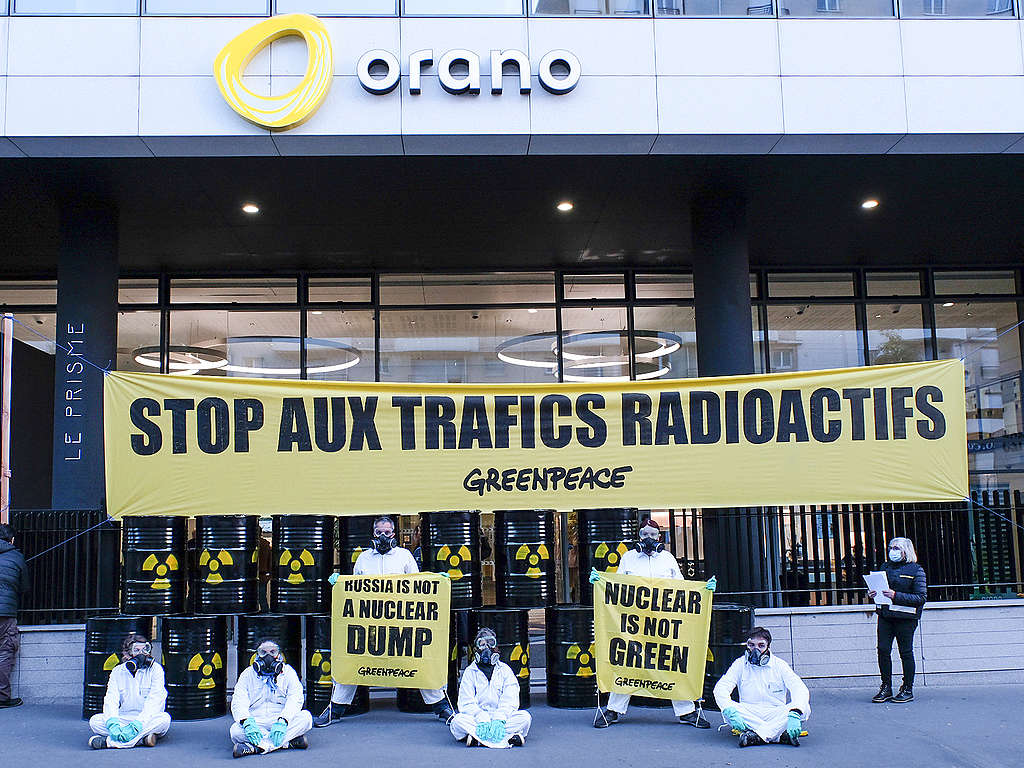
Paris / Brussels, 12 October 2021 – Greenpeace activists today laid fifteen metal drums featuring a radioactive symbol in front of the headquarters of Orano, a French nuclear fuel company, in protest against the dumping of French nuclear waste at an unsafe site in Seversk, Siberia. The protest comes as a new investigation by Greenpeace France has revealed that exports of nuclear waste to Russia have restarted after an eleven-year hiatus. [1]
New satellite images from Seversk show thousands of barrels lying outdoors exposed to the elements. The practice of exporting radioactive waste from the EU to a third country is subject to strict conditions, including the safety and proper management of the destination facility. [2]
The revelations that exports of French nuclear waste to Russia have restarted come shortly after ministers from ten EU countries, including France, wrote an op-ed in several European newspapers calling for the inclusion of nuclear energy in the EU’s guidelines for green investments, the “EU taxonomy”. [3]
Roger Spautz, nuclear campaigner at Greenpeace France and Luxembourg , said: “For the French nuclear industry to resume this kind of irresponsible overseas dumping is proof that there is no sustainable solution to the ever-growing problem of radioactive waste. Giving dangerous nuclear energy a green label in the EU taxonomy will make the waste problem worse, and actively divert investments away from real solutions like energy savings, energy storage and renewables.”
A key principle of the taxonomy is that any activity must “do no significant harm” to the environment in order to be included as “sustainable”. The European Commission will open a public consultation in the coming weeks on the issue of whether nuclear energy should be included in the taxonomy.
President Emmanuel Macron is also expected to announce funding today for so-called “small modular nuclear reactors” as part of his “France 2030” investment package.
Investigation
The investigation by Greenpeace France reveals that, in January and February 2021, the nuclear fuel company Orano shipped hundreds of tonnes of spent uranium to Rosatom, Russia’s state-owned nuclear energy firm.
Activists in the port of Le Havre, Normandy, witnessed the loading of radioactive material onto a ship bound for St. Petersburg. From there, the waste continued by train to a dumping facility in the city of Seversk, Siberia, formerly known as Tomsk-7. Greenpeace has seen no evidence that the management of the Seversk site has improved since 2010, when Orano (then named Areva) admitted that environmental concerns were a factor in its decision to cease exporting uranium there. [4]
Orano confirmed the new shipments in an email to Greenpeace France. EDF, France’s largest nuclear energy provider, also signed a similar deal with Rosatom in 2018, but does not appear to have carried out any such shipments yet. Both companies are largely owned by the French state.
The scale of global e-waste — The Earthbound Report

The scale of global e-waste — The Earthbound Report
The scale of global e-waste https://earthbound.report/2021/10/14/the-scale-of-global-e-waste/byJEREMY WILLIAMSOctober 14, 2021
Today is International e-waste day, which aims to raise awareness of waste electronics. It’s a growing problem, as more people buy phones, laptops and other gadgets, and as they are replaced at a faster rate.
If you average the problem across the global population, 7.6kg of e-waste is created every year for every person on the planet – though of course there are inequalities within that. The UK is among the worst in the world, creating 23kg of e-waste per person per year – second only to Norway. That’s something we need to take some responsibility for, not least because e-waste so often becomes an environmental justice issue.
There are system-wide things we should be doing here to encourage a circular economy. Repair standards are one of those, as I wrote about last week with the ten year smartphone initiative. Rules to prevent planned obsolescence, as France has pioneered. At the personal level, we should try to make things last, repair where we can, and ensure that our gadgets are recycled properly.
MusicMagpie, which re-sells secondhand electronics, has created a series of visuals to help explore the scale of e-waste
October 15 Energy News — geoharvey

Opinion: ¶ “Why Are Three Automakers Still Hyping Hydrogen Fuel Cell Vehicles?” • When it comes to the choice between battery EVs or hydrogen fuel cells, the science is pretty clear: hydrogen may offer the technology of choice for some things, but it isn’t suitable for passenger vehicles. Nevertheless, Hyundai, BMW, and Toyota are still […]
October 15 Energy News — geoharvey
Solar trains for India — The Earthbound Report

Railways powered directly by trackside solar power are an ingenious idea that I’ve been keeping an eye on. Developed by the good folks at Possible and operating under the name Riding Sunbeams, the first trial projects are already running in the UK – a world first for directly solar powered trains. Britain isn’t exactly famous […]
Solar trains for India — The Earthbound Report
Collapse of the nuclear industry’s ”golden hope”
Nuclear industry isn’t offering the ‘golden hope’ it promised https://www.skynews.com.au/opinion/paul-murray/nuclear-industry-isnt-offering-the-golden-hope-it-promised/video/2d7dd9a7b928b85657fe94df1483c459, October 12, 2021
Former NSW premier Bob Carr says cost blowouts and huge delays around the world are showing the nuclear industry is not offering the “golden hope” it promised. “In the whole of the United States there is only one nuclear power plant under construction and it is being subjected to the most extreme delays and cost blowouts,” he told Sky News host Paul Murray. “And meanwhile there are six currently being taken out of commission.
“In France there hasn’t been a new power plant added to their grid since 1999 and they’re taking at least three, perhaps six out of it. “The only new plant to be built in western Europe has been in Finland it was supposed to be operating in 2009 and there’ve been huge cost blowouts there.
“That’s why I say the industry is not offering us the silver bullet, the golden hope that we were led to believe and which persuaded me 15 years ago.” Mr Carr argued renewables backed up by batteries are Australia’s “safest bet” for pulling off a transition to net zero emissions.
All nuclear reactors are very expensive, but small nuclear reactors are even more expensive
Australian Submarines May Go Nuclear But Our Power Stations Never Will, SOLARQUOTES, October 11, 2021 by Ronald Brakels
- ”…………………….Small Modular Reactors Are More Expensive An SMR is a Small Modular Reactor. There have been claims these will provide cheap energy in the future, but this seems unlikely given their designers have stated that…
- Before cost overruns are considered, SMRs will produce electricity at a higher cost than current nuclear reactor designs.Being more expensive than conventional nuclear power is a major obstacle for any plan to supply energy at a lower cost.
- The advantage of SMRs is they are supposed to be less likely to suffer from disastrous cost overruns. This means they are a more expensive version of a type of generation that is already too expensive for Australia before cost overruns. While any cost overruns that do occur may not be as bad as conventional nuclear, that’s not what I call a good deal.
There is nothing new about small nuclear reactors. India has over a dozen reactors of 220 megawatts or less in operation. But all Indian reactors now under construction are larger because they want to reduce costs. Technically their small reactors aren’t modular because major components weren’t constructed at one site and then moved to where they were used. This leads to another major problem with SMRs…- They don’t exist. Before Australia can deploy an SMR, a suitable prototype reactor will have to be successfully built and operated. Then a commercial version will need to be developed and multiple units constructed overseas without serious cost overruns and used long enough to show they can be operated safely and cheaply. Given nuclear’s prolonged development cycle, this could easily take over 20 years. The very best estimate for the cost of electricity from an SMR I have seen is around 6.2 cents per kilowatt-hour and it relies on everything going perfectly — a rare thing for nuclear power. It also leaves out several costs that have to be paid in the real world. :……….https://www.solarquotes.com.au/blog/submarines-nuclear-not-power-stations/
Nuclear power is too expensive for Australia.

Australian Submarines May Go Nuclear But Our Power Stations Never Will, SOLARQUOTES, October 11, 2021 by Ronald Brakels
Australia recently decided to buy nuclear-powered submarines as part of the AUKUS pact with the UK and United States.
Assuming it goes ahead, the first sub may be ready around 2040. But while our submarines may have nuclear reactors, our power stations never will.
There is a simple reason Australia will never have nuclear power despite deciding to get reactors that wander around under the ocean. The reason is…
- Nuclear power is too expensive for Australia.
- Every other concern — whether it’s safety, waste disposal, decommissioning, insurance, or location — is irrelevant because nuclear energy can’t clear the first and vital hurdle of making economic sense. Some suggest building nuclear power in addition to renewables because the threat from global roasting is so great we should fight emissions using every means at our disposal. But this would be counterproductive because:
- Nuclear power consumes resources that would result in greater emission cuts if used for solar and wind generation plus energy storage.
- In other words, $1 spent on solar power will cut greenhouse gas emissions far more than $1 spent on nuclear energy.Finally, some people say we need nuclear power to provide a steady source of low emission baseload generation, but this suggestion is completely nuts. Even if we built nuclear power stations, they would soon be driven out of the market in the same way coal power is because:
- Nuclear power has exactly the wrong characteristics to be useful in a grid with a high penetration of solar and wind.Australia currently doesn’t have a nuclear power industry, and building submarines with American made sealed reactors that are never refuelled will do next to nothing to make nuclear power more cost-effective. In this article, I’ll explain why nuclear power makes no economic sense in Australia, and at the end, I’ll also whinge a bit about nuclear submarines. ………..
- Nuclear Power Is Ridiculously Expensive The cost of energy from new nuclear isn’t just expensive; it’s ridiculously expensive. Here are examples of reactors under construction in developed countries, using Australian dollars at today’s exchange rate:
Finland’s Olkiluoto #3 reactor: So far, this 1.6 Gigawatt reactor has cost about $14 billion, which is around $8,750 per kilowatt of power output. Construction started in 2005 and was scheduled to be completed in 2009. Due to delays, it’s now scheduled to commence normal operation in February 2022 for a total construction time of 17 years.- France’s Flammanville #3 reactor: The cost of this 1.6 gigawatt reactor is approximately $31 billion. That’s $19,400 per kilowatt. Normal operation is scheduled for 2023 — 16 years after construction began.
- UK’s Hinkley Point C: These two reactors will provide 3.2 gigawatts of power and cost around $42 billion. That’s $13,100 per kilowatt. Construction began in 2018, and they’re currently scheduled to come online in 2026.
- US Vogtle 3 & 4: These two reactors in Georgia (the US state, not where Stalin was born) will total 3.2 gigawatts and, by the time they are complete, may cost over $38 billion. That’s around $12,000 per kilowatt. Construction started in 2013, and they’re expected to come online next year. These are the only commercial reactors being built in the United States.
- As you can see, new nuclear isn’t cheap. Note these aren’t the most expensive reactors under construction in Western Europe and North America, they’re the only ones under construction. If you think these reactors are expensive to build but provide cheap electricity, that’s not the case. The Hinkley Point C reactors under construction will receive a minimum of 21 cents per kilowatt-hour they supply for 35 years after they come online. If the wholesale electricity price goes above 21 cents, they’ll receive that instead. The 21 cents is indexed to inflation, so it will remain ridiculously expensive for the full 35 years. In the US, households in Georgia will have paid around $1,200 each towards the new Vogtle reactors by the time they come online. After that, their electricity bills will increase by around 10% to pay for the new nuclear electricity. For another nuclear power station to be constructed in the US would require a payment per kilowatt-hour similar to or higher than Hinkley Point C. ………………..
………….. Poor Choice For Emission Reductions. Some people ask…“Why not build both nuclear and renewable capacity to reduce CO2 emissions as rapidly as possible?”
The answer is…“Because every dollar invested in nuclear will cut emissions by much less than a dollar spent on renewables.”
If the goal is to cut emissions rapidly, it’s counterproductive to invest in nuclear. Australia doesn’t have existing nuclear capacity or a half-built reactor, so whether it makes sense to keep old reactors operating or complete construction doesn’t come into it.Nuclear capacity isn’t quick to build. Some notable examples:
Olkiluoto 3 — 17 years- Flammanville 3 — 16 years
- Watts Bar 2 — 43 years
- Because Australia has no nuclear power industry, it would take more than five years to build a nuclear power station even if we could start construction today1. But Australia can increase its solar energy generation almost immediately. Extra wind power will take months to arrange, as wind turbine purchases are more complex than just ordering extra solar panels and inverters. Firming the grid with energy storage is also fast. The world’s largest battery, the Hornsdale Power Reserve or “Tesla Big Battery”, was built in 100 days.Whether cost or time are considered, nuclear energy is a poor choice for reducing emissions.
- Nuclear Energy Not Needed For Baseload GenerationOne of the craziest reasons given for building nuclear power in Australia is we need low emission baseload generators. This idea is nuttier than a lumpy chocolate bar because:
- No baseload generators are required.
- Like coal, nuclear power has the wrong characteristics to support a grid with high solar and wind generation.It’s impossible to argue that we need baseload generators that run continuously (except for maintenance). This is because South Australia has none. The state doesn’t continuously import electricity either.
- Despite having no baseload generators, SA still manages to meet demand as well as other states. South Australia had coal baseload generators in the past, but as wind and solar power capacity expanded, there were increasing periods of low or zero wholesale electricity prices2 resulting from solar and wind having zero fuel costs. Because their fuel is free, they have little or no incentive not to provide electricity even if they receive next to nothing for it.
- Because coal power is expensive to start and stop and saves very little money by shutting down because its fuel cost is low — but not zero — it often had no choice other than to keep operating during periods when it was losing money on every kilowatt-hour generated. In 2016 South Australia shut down its last remaining coal power station because it was no longer profitable. This same process is happening throughout Australia as solar, wind, and energy storage capacity increases. In a (hopefully) short period of time, renewables will drive coal power out of the market.
- If it doesn’t make economic sense to keep existing coal power stations around to supply baseload power, it definitely makes no sense to replace them with more expensive nuclear reactors with the same problem – that shutting down saves little money because their fuel cost is low. Building a nuclear power station and then only using it half its potential capacity almost doubles the cost of energy it produces.
………………. Other Nuclear Energy IssuesThere are many issues associated with nuclear power that are often discussed but are irrelevant. I’ll quickly mention and dismiss half a dozen or so:……….https://www.solarquotes.com.au/blog/submarines-nuclear-not-power-stations/
New push for nuclear energy in Australia, but does it really stand the test?
Explainer: should Australia build nuclear power plants to combat the climate crisis?
Though renewable energy could meet 100% of demand by 2025, the nuclear option still looms over discussions on how to rapidly lower emissions. Is it worth it? Royce Kurmelovs. Guardian, 13 Oct 21,
Weeks out from the Cop26 climate summit in Glasgow, political figures and commentators have again suggested Australia should consider nuclear energy as part of its future power grid.
Though renewable energy could meet 100% of demand by 2025 at certain times of day at current rates of progress – a trend that could be turbocharged with active support from the federal government – the prospect of an Australian nuclear power station still looms large in the public conversation.
………. On Monday BHP’s vice-president of sustainability and climate, Dr Fiona Wild, called for Australia to consider nuclear due to the urgency of the threat of climate collapse.
…….. On Tuesday the Australian newspaper’s contributing economics editor, Judith Sloan, defended the “plight of nuclear power” by calling for a rational debate on the merits of adopting the technology.
………… As of 2019, the cost of a nuclear power plant had risen to US$1bn for 100MW of generation capacity. Construction of a commercial-scale plant would take at least 15 years. If Australia had started work on a nuclear reactor before the pandemic, it would not be in operation until about 2035. The small or “modular” reactors that are held up as the future of the industry won’t be affordable until 2050.
Could they help to reduce emissions?
Nuclear power is not carbon neutral. While the act of generating power itself is fairly efficient and low-emitting, the process of mining the uranium, trucking it somewhere to be refined and pouring the concrete to build the plant creates significant emissions. As uranium is a finite resource, nuclear power is also not “renewable”.
Renewables, of course, share similar problems because so many other systems still rely on fossil fuels – wind turbine towers require steel, PV solar cells need resins, everything relies on diesel to transport it – but the total CO2 emissions are minute and the rapid rate of installation means there is a better shot at decarbonising these processes more quickly than with nuclear. With dirt cheap PV solar and rapid improvements being made in hydrogen and battery technology, it will only get easier.
What about stabilising the grid?
Critics of renewable energy sources say they do not have the capacity to respond to periods of high electricity demand with “dispatchable power” on calm, cloudy days, because they depend on the wind and sun. Nuclear, it is argued, can substitute effectively for the industrial-scale fossil fuel plants now in use that can idle up or down according to demand.
The problems with renewables are real, but they are becoming less of a roadblock. Plans are already in train to make Australia’s power grid more decentralised with a combination of PV solar, offshore wind and onshore wind working to pick up any slack in the system when one goes offline. With the addition of battery technology to store and deliver electricity on demand, the business case for nuclear starts to look pretty thin.
The challenge of renewables
Thanks to the uptake of PV solar on rooftops it is costing coal and gas power plants more to keep running during periods of low demand and high supply. Operators are faced with a choice: push through or power down. In Australia, operators of ageing coal plants have so far chosen to push through, but as periods of oversupply become more frequent, the costs will make it more attractive to turn off the generator. Firing them back up again is another expensive process – one not shared by renewables, which can be turned on or off quickly.
Australia is a long way from hitting peak renewable energy, and there is time to resolve the challenges associated with it long before any nuclear plant would have a chance to make it off a whiteboard. Should current trends hold, breaking ground on a new nuclear plant today would mean committing to a white elephant that would be too expensive even to turn on.
Any other problems?
All of this is without even talking about plans to handle the decommissioning of old nuclear reactors at the end of their lifecycle or the storage of spent nuclear fuel – another very expensive, time-consuming process. Australia already struggles with decommissioning and rehabilitating old mine sites, but nuclear power presents new challenges.
…… The federal government is currently working on a separate plan to build a storage facility for low-level and intermediate waste at Kimba in South Australia, but the process has proved divisive. Under the current proposal, this facility would not be equipped to handle spent nuclear fuel, and to scale it up would mean starting all over again. https://www.theguardian.com/environment/2021/oct/13/explainer-should-australia-build-nuclear-power-plants-to-combat-the-climate-crisis
1 This month.


PETITION – To: Prime Minister Anthony Albanese and the Australian Labor Government
Chernobyl: The Lost Tapes – A good documentary on Chernobyl on SBS available On Demand for the next 3 weeks– https://www.sbs.com.au/ondemand/tv-program/chernobyl-the-lost-tapes/235274195556
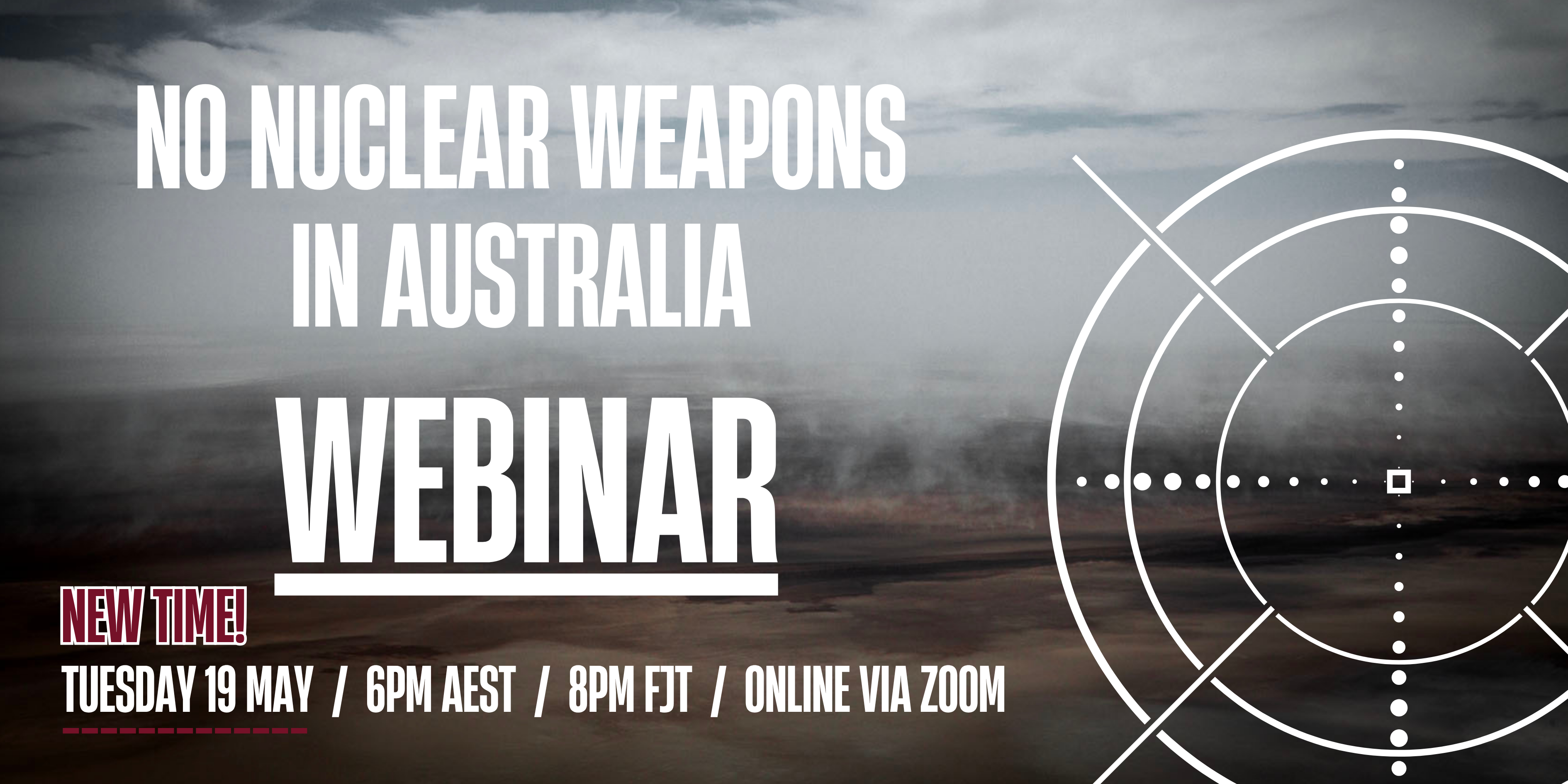
19 May – Webinar- Webinar: No Nuclear Weapons in Australia
Start: 2026-05-19 18:00:00 UTC Canberra, Melbourne, Sydney (GMT+10:00)
End: 2026-05-19 19:30:00 UTC Canberra, Melbourne, Sydney (GMT+10:00)
20 May – Webinar – The dangerous world of AUKUS, US, military occupation and suppression of dissent

National Webinar, 20th May, 2026, 6.30pm AEST. Confronting laws restricting/suppressing protest speech and action
Speakers: Former Sen. Rex Patrick, Lawyer Nick Hanna ,Arthur Rorris ,Jorgen Doyle, Sen David Shoebbridge,
Facilitator Kelley Tranter.

of the week – Australians for War Powers Reform (AWPR)
To see nuclear-related stories in greater depth and intensity
 Antinuclear