AUKUS nuclear submarines deal must be abandoned
AUKUS nuclear submarines deal must be abandoned, Pearls and Irritations, By Brian TooheyOct 13, 2021
Australia doesn’t need nuclear powered submarines, especially given the Australia’s long-standing support for the world’s nuclear non-proliferation goals.
The White House failed to think beyond its Anglo-Saxon allies in London and Canberra when agreeing to sell Australia eight nuclear submarines.
The US’s north Asian allies Korea and Japan are much closer to China and more at risk, however slight. The Japan Times responded with a cool headed article spelling out the folly of the decision. It said the US, “has put at risk long-standing but fragile global pacts to prevent the proliferation of dangerous nuclear technologies”.
It also reported that US Navy ships “use about 100 nuclear bombs worth of Highly Enriched Uranium (HEU) each year”.
Although the US or the UK is supposed to build Australia eight nuclear-powered attack submarines under as new agreement called AUKUS, there is no realistic way this can occur without trashing Australia’s long-standing support for the world’s nuclear non-proliferation goals.
One of the key problems is the US Navy insists it is essential to use uranium enriched to 93 per cent to obtain the main fissile isotope of U-235, the same level as in nuclear weapons. It also insists it couldn’t switch to low levels of enrichment without greatly increasing the costs and size of the submarines as well as the construction time.
This means the US Navy will reject Malcolm Turnbull’s suggestion to get the French to supply non-weapons grade fuel. The British can’t help as they get their HEU fuel from the US. The enrichment to 93 per cent compares to around 40 per cent for Russian and Indian submarines. The French only enrich to 7.5 per cent, China to about 5 per cent and civilian power reactors to around 3.5 per cent. Anything less that 20 per cent is defined as low level enrichment.
The White House’s attitude has changed since the 1980s when the US blocked Canada’s attempts to buy nuclear submarines from the UK or France.
Nevertheless, some members of the US Congress and senior officials want the navy to shift to low enrichment to eliminate proliferation problems.
A nuclear problem
In a letter to The New York Times, former US undersecretary of state for arms control and international security Rose Gottemoeller said the proposal to share HEU-fuelled submarines with Australia “has blown apart 60 years of US policy” designed to minimise the use of HEU uranium.
“Such uranium makes nuclear bombs, and we never wanted it in the hands of non-nuclear-weapon states, no matter how squeaky clean,” she said.
Of the seven nuclear weapons states, five have nuclear submarines. Australia will be the first non-nuclear weapons state to get nuclear submarines. The understandable concern is that other allies will want similar treatment, expanding the risk that weapons grade uranium will be stolen or diverted.
In some interpretations, a loophole exempts naval nuclear reactors from the International Atomic Energy Agency’s anti-proliferation requirements.
But there are numerous other agreements that Australia might have to comply with if it stores HEU in its submarines.
In addition, the AUKUS agreement includes Australian access to other technologies, including Tomahawk long-range cruise missiles for the navy’s Hobart-class destroyers. Because the Tomahawk can be armed with nuclear or conventional explosives, this could make it difficult to comply with the Missile Technology and Control Regime which Australia has strongly backed.
Another hurdle stems from the Howard government’s passage of a parliamentary act in 1999 outlawing just about all nuclear activities, apart from mining and exporting uranium. If circumstances prevent the US from maintaining all the nuclear aspects of Australia’s future submarines, this might spark calls for the rapid construction of nuclear facilities here. But the necessary amendments to the 1999 act could be blocked in the Senate.
Prime Minister Scott Morrison can’t credibly commit Australia to never engaging in nuclear proliferation. In the 1960s, Liberal prime minister John Gorton took preliminary steps to develop Australia’s own nuclear weapons, explaining to the US secretary of state Dean Rusk that he did not trust the US to defend Australia if it had to use nuclear weapons. A prime minister sharing Gorton’s assessment could emerge at any time.
Perhaps the White House will overrule the navy after a protracted battle to ensure the new submarines use low enrichment uranium posing no proliferation problem.
Nuclear submarines are not essential
However, the deal would still make no sense for Australia.
Government sources are widely quoted as saying the cost of the new submarines will be well over $100 billion, yet the first one won’t be operational until after 2040 and the last until after 2060. By then, the submarines would be obsolete death traps, susceptible to detection and destruction by several existing and new technologies.
The time scale reinforces the entire air of unreality about acquiring these submarines, only a couple of which may be operationally available at any one time.
Some commentators suggest Australia must buy the submarines to help the US counter a Chinese threat to Taiwan.
But no one knows what will happen to China or the US in a radically uncertain future. By 2060, China may be the dominant country in Asia, it may have returned to its earlier policy of living in Confucian harmony with its neighbours………………..
 |
Patients lack knowledge on radiation in medical imaging

Patients lack knowledge on radiation in medical imaging, https://www.auntminnie.com/index.aspx?sec=ser&sub=def&pag=dis&ItemID=133758. By Amerigo Allegretto, AuntMinnie.com staff writer, October 13, 2021 — More than half of patients did not know that chest CT delivers more radiation compared with chest radiography, one of several findings in a survey of nearly 2,900 patients published October 13 in JAMA Network Open.
An Italian research team led by Luca Bastiani, PhD, from the Italian National Research Council in Pisa found that overall, patients have a “substantial lack” of knowledge about medical radiation. This includes such topics as the relationship between radiation and age, natural sources of ionizing radiation, and dosage of different imaging methods among others.
“Intervention to achieve better patient awareness of radiation risks related to medical exposures may be beneficial,” Bastiani and colleagues wrote.
Radiation exposure due to medical imaging has been a point of concern over the years as the use of such imaging has increased to screen and diagnose diseases such as cancer.
While ultrasound and MRI do not give off radiation, they are not the standards of care in some cases. For example, mammography is the standard imaging method used for breast cancer screening. The researchers also said multidetector CT alone makes up about 50% of the total radiation burden for medical purposes, even though it accounts for only 17% of all medical examinations.
Bastiani et al wanted to develop and validate a questionnaire assessing patient knowledge of radiation from medical imaging, as well as to identify differences related to patient sex, age, educational level, information received, and radiological procedures performed.
Data was gathered from multiple Italian medical centers for 2,866 patients, 1,531 of whom were women (53.4%) and 1,335 of whom were men (46.6%). The average age of patients was 44.9 years. Most of the survey respondents (98.5%) said they had undergone imaging before.
Of the total, 1,529 (53.3%) were aware of the existence of natural sources of ionizing radiation.
MRI was mistakenly categorized as a radiation-based imaging method by 1,231 (43%) of patients, while mammography was categorized as such by 1,101 (38.4%) patients.
t 55.1%, more than half of patients did not know that chest CT delivers a larger dose of radiation than chest radiography (p = 0.03), and 1,499 (52.3%) knew that radiation can be emitted after nuclear medicine examinations (p = 0.004).
A total of 667 patients (23.3%) believed that radiation risks were unrelated to age; 1,273 (44.4%) deemed their knowledge about radiation risks inadequate, and 2,305 (80.4%) preferred to be informed about radiation risks by medical staff.
Having a higher education level and receiving information from healthcare professionals were linked to better knowledge of radiation issues.
However, the individuals who were surveyed want more information about radiation. Most patients (68.6%) would like to be informed by a radiologist, followed by their general practitioner (56.3%), a radiographer (52.5%), and a medical physicist (12.6%). A total of 2,525 (88.1%) patients, meanwhile, wanted to be informed about the amount of radiation received after examination.
However, only 1,224 respondents (42.7%) had been informed about radiation risks during imaging.
The researchers said this study, along with previous literature, reveals an unmet need for awareness campaigns about medical radiation addressed to the general population. They also suggested improving communication between medical staff and patients.
In an invited commentary piece, Dr. Rebecca Smith-Bindman and Carly Stewart from the University of California called for a “systemic and seismic shift” in educating physicians and patients in having candid conversations with patients on benefits and tradeoffs of using medical radiation.
“In doing so, we improve the safety of medical imaging while reducing the physical, social, and economic toll of overuse and disease,” they wrote.
Ahead of COP26, Australia ranked among worst in G20 on climate action — RenewEconomy

Australia again ranked amongst the worst for climate action, lagging behind on renewables uptake, EV adoption and fossil fuel phase-out. The post Ahead of COP26, Australia ranked among worst in G20 on climate action appeared first on RenewEconomy.
Ahead of COP26, Australia ranked among worst in G20 on climate action — RenewEconomy
Australia slips another place in renewables ranking, despite efforts of states — RenewEconomy

Australia slips another rank in EY renewable attractive index, but maintains top 10 position thanks to states and big corporates. The post Australia slips another place in renewables ranking, despite efforts of states appeared first on RenewEconomy.
Australia slips another place in renewables ranking, despite efforts of states — RenewEconomy
Australia needs up to 74 pct emissions cut by 2030 to stay on track for 1.5°C — RenewEconomy

State and Territory emissions targets offer the Morrison government a free-kick to lift its 2030 target. Will it take it? The post Australia needs up to 74 pct emissions cut by 2030 to stay on track for 1.5°C appeared first on RenewEconomy.
Australia needs up to 74 pct emissions cut by 2030 to stay on track for 1.5°C — RenewEconomy
Renewable exports worth more than coal and gas, will create more jobs — RenewEconomy

Australian exports of renewable hydrogen, ammonia and green materials could surpass the current value of coal and gas exports, and create more jobs. The post Renewable exports worth more than coal and gas, will create more jobs appeared first on RenewEconomy.
Renewable exports worth more than coal and gas, will create more jobs — RenewEconomy
Crypto currency and nuclear power – a worrying partnership

Why Crypto Mining Needs Nuclear Power, Yahoo Finance Florent Heidet, Milos Atz (both writers employed at USA’s Dept of Enegy Argonne National Laboratory) Thu, October 14, 2021
”………Cryptocurrencies are digital currencies secured by cryptography. Unlike physical money, like dollars, cryptocurrencies are not minted by national institutions. Instead, they are created through complex algorithms that take place over computer networks. While not all crypto currencies have a specific function, the most valuable ones, such as BTC and ETH, exist primarily to carry financial transactions embedded in the blockchain – the cryptographic transaction record.
……….. The incredible rise in cryptocurrency value, associated with the ease to contribute to the cryptocurrency mining process with common computer hardware, has resulted in an ever-larger number of miners joining cryptocurrency networks. Increasing the number of miners benefits the system by further decentralizing, and therefore securing, the cryptocurrency.
……… Total power consumption used by mining across the major cryptocurrencies is tens of gigawatts electrical, or GWe, based on current network size and average mining equipment power. That is about the same as the power demand of Sweden or Montana. New generations of computing hardware are more efficient and progressively reduce power consumption per hashrate, but the high profitability of mining attracts more participants, yielding a net increase of the overall power used by the network. In fact, as long as the combined costs of electricity and hardware remain lower than the value of the generated cryptocurrency, the networks and their power consumption will continue growing and will soon surpass that of most countries.
Although cryptocurrency mining requires huge amounts of energy, the process itself is not directly polluting. The natural resource requirement is limited to what is needed to manufacture computer hardware and to generate electricity for the mining operations. Cryptocurrency mining is a 24/7 process using constant power with minimal downtime. Additionally, larger mining operations can require in excess of 100 megawatts of power for facilities with the footprint of a medium-size factory. Mining operations need a highly reliable and dense power supply.
………. To guarantee a share of carbon-free electricity, cryptocurrency mining operations may seek agreements with local grid operators or electricity generators. Some larger cryptocurrency mining operations may choose to own and operate their own electricity generation facilities.
………….The power demands of the cryptocurrency mining industry create a unique opportunity for synergizing with nuclear power. Nuclear reactors harness energy from fissioning elements such as uranium
………… Engaging with the burgeoning cryptocurrency industry is advantageous for the nuclear industry,…….. the cryptocurrency industry specifically demands the unique benefits of nuclear power, making partnerships an ideal opportunity…….. Cryptocurrency network growth will only further propel energy cost increases.
…………. Partnerships between the crypto-mining and the nuclear industries have already started to blossom. Recent reporting has showcased agreements forged between cryptocurrency mining operations and both nuclear utilities and nuclear reactor vendors. Given the synergies between cryptocurrency energy demands and nuclear power, we hope that these industries continue to engage with each other to explore mutually beneficial opportunities for growth and collaboration.
Vale Sister Megan Rice – an anti-nuclear hero

Catholic sister who spent 2 years in prison for nuclear weapons protest dies at 91, Catholic News Service 13 Oct 21,
ROSEMONT, Pa. (CNS) — Sister Megan Rice, whose yearslong crusade against nuclear weapons included serving two years behind bars for a felony, died Oct. 10 at the Rosemont residence of her religious order, the Society of the Holy Child Jesus. She was 91.
Colleen Carroll, director of communications for the order, said the cause of death was congestive heart failure.
“It is incredible to consider how the bravery of this small, smiling, unassuming woman in standing up to the entirety of the U.S. military-industrial complex could bring so much awareness to the devastation our nation’s idolatry of nuclear weapons inflicts on people here in the U.S. and around the world,” Johnny Zokovitch, executive director of Pax Christi USA, said in a statement.
“All of Pax Christi USA grieves at her passing, but we give thanks for her witness, for her life and for the challenge that she issued by standing up nonviolently for a better world for all of us,” he said.
Sister Rice’s bold campaign against nuclear weapons launched her into the spotlight and caused her to become the issue’s ad hoc spokeswoman.
In July 2012, at age 82, she and two other members of Transform Now Plowshares breached security to stage a protest at the self-styled “Fort Knox of uranium,” the Y-12 National Security Complex in Oak Ridge, Tennessee. The facility creates and houses materials for making nuclear weapons.
The three activists cut through fences and reached the warehouse that stores bomb-making uranium. There, they splashed blood on the wall, hung banners and spray-painted messages condemning nuclear weapons.
The action sparked national shock and outrage, led to a congressional investigation of the security at Y-12 and sent Sister Rice and her companions, Michael Walli, then 63, and Greg Boertje-Obed, then 57, to prison.
On Feb. 18, 2014, in U.S. District Court, Sister Rice, of Washington, was sentenced to 35 months in prison on each of two counts — one count of depredation of property and one count of sabotage.
Sister Rice toured the country to protest the United States’ nuclear arsenal as the star of the film. She also spoke to a congressional hearing and at the United Nations in New York City on the issue of nuclear disarmament.
And she continued her activism through vigils, marches, prayers and visits to classrooms.
“It’s illegal to deal in weapons of mass destruction — immoral and illegal,” Sister Rice declared during an April 8, 2018, event at the DeBartolo Performing Arts Center at the University of Notre Dame in South Bend, Indiana, where the documentary was being screened.
“We’re not being taken to the international court of justice and indicted the way Iran or some other place would,” she said.
……….In the 1980s, Sister Rice got involved in the anti-war movement, participating in protests against a variety of American military actions, military sites and nuclear weapons installations.
She was arrested more than three dozen times in acts of civil disobedience, including her anti-nuclear weapons activism. https://www.americamagazine.org/faith/2021/10/13/sister-megan-rice-obituary-241640
Batteries Also Make Nuclear Uneconomic

Australian Submarines May Go Nuclear But Our Power Stations Never Will, SOLARQUOTES, October 11, 2021 by Ronald Brakels
- ”………………………………………..Batteries Also Make Nuclear Uneconomic. As solar and wind generation increases, the worse the economics of nuclear energy become. This is because its low cost pushes down wholesale electricity prices. There can be periods of high electricity prices when renewable output isn’t sufficient to meet demand, but this isn’t enough to make nuclear pay. Nuclear wouldn’t pay if there were no such thing as battery storage, but battery storage makes its economics worse.
- Next year a 580 megawatt-hour battery will be built in Victoria for $270 to $300 million. That’s around $500 per kilowatt-hour. If each kilowatt-hour of storage capacity provides a total of 4,000 kilowatt-hours of stored energy over its lifetime — a not unreasonable amount — then the cost of storage will be around 13 cents per kilowatt-hour.
- That’s not cheap, but still a lot cheaper than nuclear energy, especially since we will often charge it with renewable electricity that costs 1 cent or less per kilowatt-hour. It also has the advantage it will supply electricity when prices are high, rather than more or less continuously, as is usually the case for nuclear power.
- There’s no reason to expect the cost of utility-scale battery storage to stop falling anytime soon, so by the time a nuclear power station could be completed in Australia, its economics will be far worse from falling energy storage costs alone. ………https://www.solarquotes.com.au/blog/submarines-nuclear-not-power-stations/
Smoke from nuclear war would devastate ozone layer, alter climate

SMOKE FROM NUCLEAR WAR WOULD DEVASTATE OZONE LAYER, ALTER CLIMATE Atmospheric impacts of global nuclear war would be more severe than previously thought https://news.ucar.edu/132813/smoke-nuclear-war-would-devastate-ozone-layer-alter-climate
OCT 13, 2021 – BY DAVID HOSANSKY The massive columns of smoke generated by a nuclear war would alter the world’s climate for years and devastate the ozone layer, endangering both human health and food supplies, new research shows.
The international study paints an even grimmer picture of a global nuclear war’s aftermath than previous analyses. The research team used newly developed computer climate modeling techniques to learn more about the effects of a hypothetical nuclear exchange, including complex chemistry interactions in the stratosphere that influence the amounts of ultraviolet (UV) radiation that reach the planet’s surface.
Since the ozone layer protects Earth’s surface from harmful UV radiation, such impacts would be devastating to humans and the environment. High levels of UV radiation have been linked to certain types of skin cancer, cataracts, and immunological disorders. The ozone layer also protects terrestrial and aquatic ecosystems, as well as agriculture.
“Although we suspected that ozone would be destroyed after nuclear war and that would result in enhanced ultraviolet light at the Earth’s surface, if there was too much smoke, it would block out the ultraviolet light,” said study co-author Alan Robock, a professor of climate science at Rutgers University. “Now, for the first time, we have calculated how this would work and quantified how it would depend on the amount of smoke.”
Continue reading‘Profiteers of Armageddon’: Report Reveals Who Benefits From US ‘Nuclear Modernization’ Plan
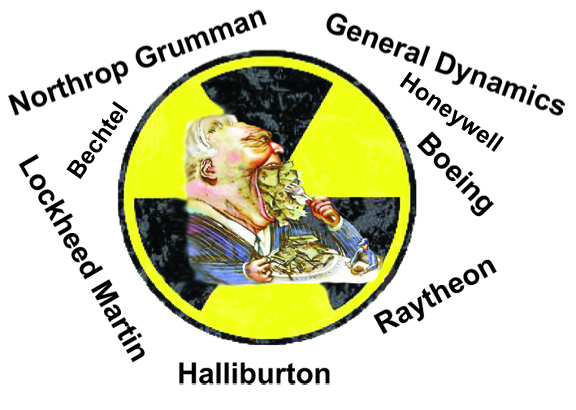
While “a handful of prime contractors” are the initial recipients and main beneficiaries of public money spent on bombers, missiles, and submarines, “the funds trickle down to subcontractors” that often include other prominent companies. The report names firms such as Bechtel, General Dynamics, Honeywell, Lockheed Martin, Northrop Grumman, and Raytheon.
Hartung directs attention to the millions of dollars in political activities by key contractors, writing that “while not all of this spending is devoted to lobbying on nuclear weapons programs, these expenditures are indicative of the political clout they can bring to bear on Congress as needed to sustain and expand the budgets for their nuclear weapons-related programs.”

They also spent $57.9 million on lobbying last year, employing 380 lobbyists, over two-thirds of whom “passed through the ‘revolving door’ from top positions in Congress, the Pentagon, and the Department of Energy to work for nuclear weapons contractors as executives or board members.”
And it should be noted that the revolving door swings both ways,” the report adds, noting that “three of the past five secretaries of defense worked as lobbyists or board members of major nuclear weapons contractors before taking up their positions in the Pentagon: James Mattis (General Dynamics); Mark Esper (Raytheon); and Lloyd Austin (Raytheon).”
‘Profiteers of Armageddon’: Report Reveals Who Benefits From US ‘Nuclear Modernization’ Plan, While taking aim at special interest lobbying and corporate profits that impede “sensible” policy, the author argues the “only way to be truly safe from nuclear weapons is to eliminate them altogether.” https://www.commondreams.org/news/2021/10/12/profiteers-armageddon-report-reveals-who-benefits-us-nuclear-modernization-plan
JESSICA CORBETT A short list of contractors that pour large sums of money into campaign contributions, lobbying, and industry-friendly think tanks benefits from the U.S. government’s ongoing, decadeslong “nuclear modernization” plan worth up to $2 trillion, according to a report out Tuesday.
The issue brief—entitled Profiteers of Armageddon: Producers of the next generation of nuclear weapons—was authored by William Hartung, director of the Arms and Security Program at the Center for International Policy, who also outlined his report in Inkstick.
Hartung details how the U.S. departments of Defense (DOD) and Energy (DOE) are ramping up a plan to build the next generation of nuclear-armed bombers, missiles, and submarines as well as warheads, and the beneficiaries are major contractors along with operators of the National Nuclear Security Administration’s (NNSA) nuclear weapons complex.
The brief notes the U.S. nuclear weapons budget has climbed in recent years to over $43 billion in the Biden administration’s proposed budget for fiscal year 2022, and warns that “this figure will grow dramatically,” pointing to a Congressional Budget Office (CBO) estimate that parts of the Pentagon’s plan “will cost tens of billions each over the next decade, including $145 billion for ballistic missile submarines, $82 billion for the new Intercontinental Ballistic Missile (ICBM), and $53 billion for the new nuclear-armed bomber.”
“And the costs will not end there,” the report continues, noting that “the estimated lifetime cost of building and operating the new ICBM is $264 billion.”
While “a handful of prime contractors” are the initial recipients and main beneficiaries of public money spent on bombers, missiles, and submarines, “the funds trickle down to subcontractors” that often include other prominent companies. The report names firms such as Bechtel, General Dynamics, Honeywell, Lockheed Martin, Northrop Grumman, and Raytheon.
Hartung directs attention to the millions of dollars in political activities by key contractors, writing that “while not all of this spending is devoted to lobbying on nuclear weapons programs, these expenditures are indicative of the political clout they can bring to bear on Congress as needed to sustain and expand the budgets for their nuclear weapons-related programs.”
From 2012 to 2020, campaign contributions from contractors mentioned in the brief topped $119 million, more than a quarter of which was in the 2020 cycle alone. They also spent $57.9 million on lobbying last year, employing 380 lobbyists, over two-thirds of whom “passed through the ‘revolving door’ from top positions in Congress, the Pentagon, and the Department of Energy to work for nuclear weapons contractors as executives or board members.”
And it should be noted that the revolving door swings both ways,” the report adds, noting that “three of the past five secretaries of defense worked as lobbyists or board members of major nuclear weapons contractors before taking up their positions in the Pentagon: James Mattis (General Dynamics); Mark Esper (Raytheon); and Lloyd Austin (Raytheon).”
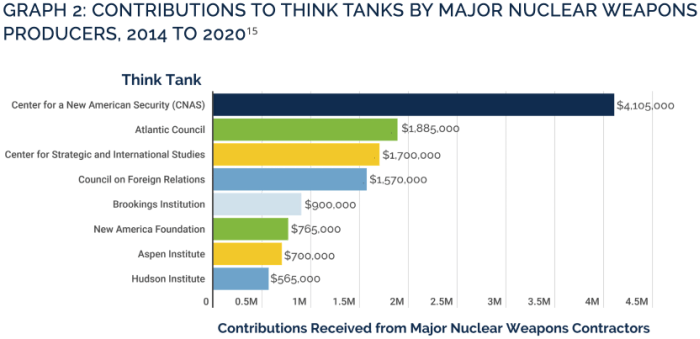
The brief also pushes back against “routinely exaggerated” claims about job creation that both companies and lawmakers use to promote nuclear weapons programs, and points out that contractors pump millions into supporting think tanks that opine on relevant policy.
Continued lobbying for the modernization plan “ignores the fact that building a new generation of nuclear weapons at this time will make the world a more dangerous place and increase the risk of nuclear war while fueling the new arms race,” Hartung argues. “It’s long past time that we stopped allowing special interest lobbying and corporate profits stand in the way of a more sensible nuclear policy.”
While asserting that “the only way to be truly safe from nuclear weapons is to eliminate them altogether,” in line with a global treaty that states with such weapons continue to oppose, Hartung also highlights that “the organization Global Zero has outlined an alternative nuclear posture that would eliminate ICBMs, reduce the numbers of bombers and ballistic missile submarines, and implement a policy of no first use of nuclear weapons as part of a ‘deterrence-only’ strategy that would reduce the danger of a nuclear conflict.”
Global Zero CEO Derek Johnson welcomed Hartung’s brief in a tweet Tuesday.
Earlier this year, Sen. Elizabeth Warren (D-Mass.) and Rep. Adam Smith (D-Calif.) led the reintroduction of legislation (S.1219/H.R. 2603) to establish that “it is the policy of the United States to not use nuclear weapons first,” but the bill has not advanced in Congress, despite pressure from progressive lawmakers and campaigners.
Peace Action of Wisconsin’s Pamela Richard said in August that while activists encourage the passage of Warren and Smith’s bill as well as a related one (S. 1148/H.R. 669) from Sen. Ed Markey (D-Mass.) and Rep. Ted Lieu (D-Calif.), “our long-term goal is total nuclear disarmament.”
“Unstoppable transition:” Australia can hit 91% renewables by 2030 — RenewEconomy

Transgrid study says Australia could – and should – be 100% renewable powered by 2035, with all coal generation phased out by 2032. The post “Unstoppable transition:” Australia can hit 91% renewables by 2030 appeared first on RenewEconomy.
“Unstoppable transition:” Australia can hit 91% renewables by 2030 — RenewEconomy
Diné groups seek justice — Beyond Nuclear International

Navajo have suffered disproportionately from legacy of uranium mining
Diné groups seek justice — Beyond Nuclear International
NSW unveils $80 billion green hydrogen strategy, with incentives to plug into grid — RenewEconomy

NSW unveils a green hydrogen plan, aiming to attract $80 billion of investment and slashing costs of the technology. The post NSW unveils $80 billion green hydrogen strategy, with incentives to plug into grid appeared first on RenewEconomy.
NSW unveils $80 billion green hydrogen strategy, with incentives to plug into grid — RenewEconomy
Australians reject “gas led recovery” as climate concern surges to new highs — RenewEconomy

New survey shows 8 in 10 Australians support the phase-out of coal power, and vast majority say economic recovery should be powered by renewables, not gas. The post Australians reject “gas led recovery” as climate concern surges to new highs appeared first on RenewEconomy.
Australians reject “gas led recovery” as climate concern surges to new highs — RenewEconomy
1 This month.


PETITION – To: Prime Minister Anthony Albanese and the Australian Labor Government
Chernobyl: The Lost Tapes – A good documentary on Chernobyl on SBS available On Demand for the next 3 weeks– https://www.sbs.com.au/ondemand/tv-program/chernobyl-the-lost-tapes/235274195556

19 May – Webinar- Webinar: No Nuclear Weapons in Australia
Start: 2026-05-19 18:00:00 UTC Canberra, Melbourne, Sydney (GMT+10:00)
End: 2026-05-19 19:30:00 UTC Canberra, Melbourne, Sydney (GMT+10:00)
20 May – Webinar – The dangerous world of AUKUS, US, military occupation and suppression of dissent

National Webinar, 20th May, 2026, 6.30pm AEST. Confronting laws restricting/suppressing protest speech and action
Speakers: Former Sen. Rex Patrick, Lawyer Nick Hanna ,Arthur Rorris ,Jorgen Doyle, Sen David Shoebbridge,
Facilitator Kelley Tranter.

of the week – Australians for War Powers Reform (AWPR)
To see nuclear-related stories in greater depth and intensity
 Antinuclear