Taylor and Pitt pour another $250m into CCS projects that not may not be complete until 2031 — RenewEconomy

Taylor and Pitt will spend another $250 million on controversial carbon capture projects – which may not be operational for almost a decade. The post Taylor and Pitt pour another $250m into CCS projects that not may be complete until 2031 appeared first on RenewEconomy.
Taylor and Pitt pour another $250m into CCS projects that not may be complete until 2031 — RenewEconomy
NSW greenlights network link to unlock wind and solar in state’s south-west — RenewEconomy

Stage one of the new Project EnergyConnect transmission link gets NSW planning approval, set to underpin the South-west REZ. The post NSW greenlights network link to unlock wind and solar in state’s south-west appeared first on RenewEconomy.
NSW greenlights network link to unlock wind and solar in state’s south-west — RenewEconomy
Iberdrola boosts renewable capacity with purchase of NSW solar project — RenewEconomy

Iberdrola to begin construction of 190MW solar farm in south-west NSW after sealing purchase from RES Australia. The post Iberdrola boosts renewable capacity with purchase of NSW solar project appeared first on RenewEconomy.
Iberdrola boosts renewable capacity with purchase of NSW solar project — RenewEconomy
NSW unveils plan to transition biggest coal state into renewable energy superpower — RenewEconomy

NSW to slash emissions by 50% by 2030 and become a renewable energy superpower, as state Coalition underlines divide among federal counterparts. The post NSW unveils plan to transition biggest coal state into renewable energy superpower appeared first on RenewEconomy.
NSW unveils plan to transition biggest coal state into renewable energy superpower — RenewEconomy
Turnbull challenges Morrison to go to Glasgow: “History is made by those who turn up” — RenewEconomy

Turnbull says Morrison’s absence from COP26 will send a message about his priorities, slamming the “nonsense of a gas led recovery.” The post Turnbull challenges Morrison to go to Glasgow: “History is made by those who turn up” appeared first on RenewEconomy.
Turnbull challenges Morrison to go to Glasgow: “History is made by those who turn up” — RenewEconomy
September 29 Energy News — geoharvey

World: ¶ “The Energy Crunch Is Roiling Markets” • Global markets are stumbling as energy prices soar. One big problem has been shortages of natural gas, triggered by low stocks and a jump in demand as activity recovers from its Covid-19 lull. In the US, natural gas futures have also jumped, and China is contending […]
September 29 Energy News — geoharvey
Why an Australian nuclear industry would bomb.
Why Nuclear Will Bomb ByThe Echo September 28, 2021 Andrew P. Street Unless you’ve been blissfully slumbering in a very welcome coma, you’d be aware that Scott Morrison abruptly cancelled the terribly important contract we had with France, to build new submarines, in order to get fancy nuclear sink-boats from the US instead (in decades time and at incalculable cost, much like the previous contract)……..
it’s not hard to see the argument that’s already starting in op-eds and Coalition talking points. ‘Well,’ reasonable sounding people with ties to the mining and energy industries will say thoughtfully, while trembling with barely concealed avarice, ‘if we’re looking at a nuclear submarine fleet, then it makes sense for us to have a domestic nuclear industry.’…….
In fact, the one selling point which the US submarine design had over the French one was that the engines never need to be refuelled with more nuke-coal, making them like those children’s toothbrushes where you can’t change the heads or batteries and therefore go straight from our kids’ mouths to proudly clogging up our nation’s landfills.
But Australia should avoid a nuclear industry for a whole lot of reasons, and submarines aren’t remotely the biggest one…….
So what’s the problem with nuclear power? Well, there are two.
One is that reactors are staggeringly expensive to build. Like, jaw-droppingly, eye-wateringly, scrotum-clenchingly expensive.
A new reactor in the US right now would set you back the equivalent of about $31 billion in Australian dollarbucks, and that’s without the added need to build a whole new supply chain and industry knowledge base from scratch.
Why Nuclear Will Bomb https://www.echo.net.au/2021/09/why-nuclear-will-bomb/?fbclid=IwAR34ZiZyZpjldhnGvywzW8FYMgunuIpYZEQqyMGiz3Jg91_V_0dVqifzH_MByThe EchoSeptember 28, 2021 Andrew P. Street
Stop trying to make nuclear happen, Gretchen.
Unless you’ve been blissfully slumbering in a very welcome coma, you’d be aware that Scott Morrison abruptly cancelled the terribly important contract we had with France, to build new submarines, in order to get fancy nuclear sink-boats from the US instead (in decades time and at incalculable cost, much like the previous contract).
And much has been said about the failure in diplomacy this has entailed: how it provokes China, insults the European Union and makes things mighty awkward with staunchly anti-nuclear New Zealand. What a triumph!
Even so, it’s not hard to see the argument that’s already starting in op-eds and Coalition talking points. ‘Well,’ reasonable sounding people with ties to the mining and energy industries will say thoughtfully, while trembling with barely concealed avarice, ‘if we’re looking at a nuclear submarine fleet, then it makes sense for us to have a domestic nuclear industry.’
Short version: we don’t.
In fact, the one selling point which the US submarine design had over the French one was that the engines never need to be refuelled with more nuke-coal, making them like those children’s toothbrushes where you can’t change the heads or batteries and therefore go straight from our kids’ mouths to proudly clogging up our nation’s landfills.
But Australia should avoid a nuclear industry for a whole lot of reasons, and submarines aren’t remotely the biggest one.
Neither is safety, incidentally. Yes, nuclear fission does produce plutonium, the most poisonous substance known to humankind, which we have no good way of storing for the thousands of years it takes to decay into safety. And nuclear accidents are horrendous, but they’re also vanishingly rare – and nuclear is unambiguously a better bet than burning coal or gas in terms of its effect on human health or warming the climate.
So what’s the problem with nuclear power? Well, there are two.
One is that reactors are staggeringly expensive to build. Like, jaw-droppingly, eye-wateringly, scrotum-clenchingly expensive.
A new reactor in the US right now would set you back the equivalent of about $31 billion in Australian dollarbucks, and that’s without the added need to build a whole new supply chain and industry knowledge base from scratch.
Plants typically take about seven to twelve years to build, assuming everything goes reasonably smoothly (which seldom happens). They also need to be built away from where people are living, which means there’s a lot of bonus infrastructure costs. They also use a lot of water – a resource of which Australia has a very finite amount – unlike, say, wind and sunshine which are ample, versatile, and require much, much cheaper tech to harness.
But the bigger problem is the way that nuclear power companies have a rich and storied history of getting the hell out of Dodge the second reactors stop making money, leaving the public to handle the question of what to do with the big useless radioactive power plant sitting poisonously on the edge of town.
The profit curve for a nuclear reactor over time is a lot like a brontosaurus: very long and flat at the start while they’re being built, huge in the middle where they’re reasonably cheap to run, and then long and flat again at the end during the cleanup. And that’s why companies tend to get governments (ie: you) to pay for the building bit, and then profiteer heavily until such point as they move the profits to the parent company and shunt the ageing physical assets off to a shell company to collapse into bankruptcy.
That’s so that when the government says ‘Okay, power company, time to start cleaning up the site like we agreed’, they can look confused at why they’re being expected to deal with a site that doesn’t belong to them. And that’s the point at which the whole de-plantification project gets paid for by the government (ie: you) again.
And cleanups can be tricky, expensive, and far outlast the reactors’ lifespan. …………
don’t believe the greenwashing campaign when it inevitably arrives. A local nuclear industry is not simply unnecessary; it’s yet another opportunity for power companies to hang onto their profitable monopolies and pass a new generation of costs on to you. https://www.echo.net.au/2021/09/why-nuclear-will-bomb/?fbclid=IwAR34ZiZyZpjldhnGvywzW8FYMgunuIpYZEQqyMGiz3Jg91_V_0dVqifzH_M
IAEA concerned that AUKUS coud weaken non-proliferation system
Nuclear inspection under AUKUS deal ‘very tricky’ – IAEA chief, Sky News, Jonathan Talbot, Deputy Editor, 430 Sep 21,
Nuclear inspections of Australia under the AUKUS deal will be “very tricky” and could lead to a weakened non-proliferation system, says the head of the UN International Atomic Energy Agency.
The AUKUS deal which sees Australia acquire nuclear-powered submarine technology will make nuclear inspections “very tricky”, according to the head of the United Nations International Atomic Energy Agency (IAEA).
“It is a technically very tricky question and it will be the first time that a country that does not have nuclear weapons has a nuclear sub,” IAEA Director General Rafael Grossi told BBC’s HARDtalk.
The IAEA keeps track of all nuclear material in countries – like Australia – that have ratified the Non Proliferation Treaty (NPT).
One of its primary tasks is to ensure nuclear materials are not being siphoned off for use in a nuclear bomb.
Mr Grossi confirmed NPT signatories can exclude nuclear material from IAEA inspection while that material is fueling a submarine – a rare exception to the agency’s supervision of nuclear materials.
“A country… is taking highly enriched uranium away from inspection for a period of time, which could result in a weakening of the nuclear non-proliferation regime,” he said.
“What this means is that we, with Australia, with the United States and with the United Kingdom, we have to enter into a very complex, technical negotiation to see to it that as a result of this there is no weakening of the nuclear non-proliferation regime.”
One challenge posed by Australia’s purchase of nuclear-powered submarines concerns the fact these vessels are designed to be undetectable and therefore beyond the reach of IAEA inspectors…
“China has taken note of the statements of Director General Grossi” and is “vigilant about AUKUS and the plan for nuclear submarine cooperation,” spokesperson of the Chinese Foreign Ministry, Hua Chunying, said during the ministry’s daily press conference.
The provision of nuclear materials to a non-nuclear-weapon state will exclude weapons-grade highly-enriched uranium from necessary supervision and pose huge nuclear proliferation risks.”
Ms Hua also said AUKUS displayed a “typical contempt of rules” by the “Anglo-Saxon clique” and will undercut the non-proliferation system and other efforts to create nuclear free zones. “In brief, this is a malicious exploitation of loopholes in international rules for out-and-out proliferation activities.
“Supervisions on the Australian nuclear submarines will set a precedent, concerns the rights and obligations of all IAEA member states, especially signatories to the NPT, and will have far-reaching impact on the international non-proliferation system.”
China is not alone in its concerns about AUKUS.
Indonesia and Malaysia have come out strongly against Australia’s acquisition of nuclear-powered submarines.
Singapore – Australia’s most reliable ally among ASEAN member states – has also expressed worry.
Writing in The Conversation, James Chin, Professor of Asian Studies at the University of Tasmania, said this is because “many of them think there is no such thing as acquiring nuclear-powered submarines without the prospect of acquiring nuclear weapons in the future.”……. https://www.skynews.com.au/australia-news/defence-and-foreign-affairs/nuclear-inspection-under-aukus-deal-very-tricky-iaea-chief/news-story/1e5b391af8622cbc9450f181c1a28047
No solution to submarine nuclear waste. Australia would be crazy to take on this mess.
Donna Gilmore, SanOnofreSafety.org 30 Sep 21,
There is no solution for the submarine nuclear waste. It’s a forever storage cost. I wonder who will pay for that?
In the U.S. the spent fuel is stored in Idaho in spent fuel pools or dry storage in unsafe thin-wall steel canisters with steel lined thick concrete casks. The concrete casks have air vents for convection cooling so the thin-wall canisters are the only real barrier. The thick concrete is need to reduce gamma rays and neutrons since the 316L stainless steel canisters are too thin to stop those.
There is no way to maintain those thin-wall canisters or detect or repair cracks before the canisters crack. No repair or inspection technology exists once loaded with fuel. If you hear otherwise, it’s a lie.
Each canister contains about one ton of spent nuclear fuel.The rest of the contaminated submarine is stored in trenches at Hanford, Washington.
Each transport cask (holding one canister) costs $20 million.
Europe and the rest of the world use maintainable thick-wall metal casks 10″ to over 19″ thick — with no air vents and no cracking problems.
In essence, there is no good short or long term solution to store the nuclear waste since geological repositories are not technically feasible even for the short-term.
The best the world has is maintable thick-wall bolted-lid metal casks stored in hardened buildings. They will last much longer than the thin-wall canisters, but are not considered a permanent solution.
Australia would be crazy to take this mess.
Norway paid to help Russian nuclear submarine waste clean-up – but now – new submarines!
Norway celebrates 25-years paying for nuclear-dump cleanup. Russia showcases new reactor weapons
Rosatom officials and Norwegian project partners are Wednesday marking that it is 25 years since the first money check was sent from Oslo to help improve infrastructure at the ill-fated Andreeva Bay dump site for spent nuclear fuel and radioactive waste accumulated from the operation of Cold War submarines. The Barents Observer ,By Thomas Nilsen September 29, 2021
Hindered from on-site meetings due to the pandemic, today’s 25-years anniversary meeting in Andreeva Bay is long overdue. However, the meeting comes in pole position as the two countries are trying to improve bilateral relations in times of more complex geopolitics and higher tensions between NATO and Russia up north.
……. ensuring nuclear safety is another topic for good bilateral cooperation.
For the Soviet nuclear navy, the Coastal Technical Base in Andreeva Bay became the main storage site for both spent fuel assemblies from submarine reactors, as well as a site to store containers with solid radioactive waste. Focus was not on safety and after years of exposure to Arctic climate, the site became contaminated and the infrastructure started to fall apart. With Russia being broke after the collapse of the Soviet Union, the call for international action was precarious. Norwegian money, and will to solve the problem, was most welcomed……………
Success story
More than 2 billion kroner (nearly €200 million) of Norwegian taxpayers money are spent on helping Russia secure its nuclear legacy since the mid-1990ties. The ground-breaking nuclear safety work initiated on the Kola Peninsula, only some 60 km from the border to Norway, has since been followed by many other countries and international financial grant programs.
For projects in Andreeva Bay, Norway has paid more than €30 million on things like fixing electricity, water pipelines, roads, fences, constructing a new sanitary building and improving the old pier in port with a new lifting crane. About half of the 21,000 spent uranium fuel elements originally stored in three rundown concrete tanks is so far lifted out, repacked and shipped out of Andreeva Bay. First to Atomflot in Murmansk, then by train further to Russia’s reprocessing plant at Mayak in the South Urals. Some 10,000 cubic meters of solid radioactive waste that previously was stored outdoor and exposed to snow and frost is now under roof in a new building erected at the site. Soon, also that will be transported away.
Present at the celebrations in Andreeva Bay is also representatives from the environmental NGO Bellona. It was this organization, with offices both in Murmansk and Oslo, that before the official country-to-country cooperation started, was first to uncover security breaches and the urgency to act before the entire storage site turned out to be a Chernobyl in slow-motion.
“Time has come”
Bellona’s Aleksandr Nikitin says to the Barents Observer that the time has come for Russia to solve its own nuclear challenges, not the international community. “But first we have to complete already started international projects, like the nuclear legacy,” Nikitin says and points to the ongoing work in Andreeva Bay………….
Meanwhile, and unlike the 1990ties, Russia is now investing huge money in building new nuclear-powered submarines and other military nuclear installations. A key question is whether Moscow now is arming the country again into a nuclear age that later could cause similar radiological waste challenges as the legacy from the last Cold War created.
…….. It is a task for Russia and Rosatom. We cannot hire anymore for a rich uncle from the west to come and help again. It was a time when it was necessary, not anymore.”
Meanwhile, Aleksandr Nikitin is glad to see the solution-oriented results of the work in Andreeva Bay.
“Bellona started it, and we have to finish it,” he says………………………………….
A Norwegian intelligence official has previously expressed fears for more accidents with the reactor-powered weapons systems now under testing and development in Norway’s neighboring areas up north.
For Norway, a challenge is to balance the aid-support to nuclear safety with making sure no funding ends up in Russia’s new crazy nuclear weapons programs…………..
The “Serebryanka” dilemma
A review made by the Barents Observer of the publicly available documents on financial aid from Norway and Sweden to equip modern communication and positioning systems on board “Serebryanka” shows that about 9 million kroner (€900,000) were spent on the project in 2013 and 2014. That was shortly before the Burevestnik testing program started.
The Swedish Radiation Safety Authority, in charge of the project, says in its annual overview of Non-Proliferation cooperation for 2013 that the “Serebryanka” was the largest project initiated in the Murmansk region.
Stockholm spent 4,1 million Swedish kroner (SEK) on equipment for “Serebryanka” in 2013 and an additional 217,000 SEK in 2014.
Describing the project, the Radiation Safety Authority writes: “This project is co-financed with Norway and the purpose is to equip the vessel “Serebryanka” with a physical protection system, as well as communications and positioning systems, in order to increase security when transporting nuclear materials and radioactive substances.”
The Norwegian share of the project was 3 million Norwegian kroner, paid as part of the Nuclear Action Plan financed by the Ministry of Foreign Affairs.
Conflict-of-interests
Asked about the potential conflicting interests, State Secretary Audun Halvorsen in Norway’s Foreign Ministry told the Barents Observer upfront of the annual meeting in the Norwegian-Russian Commission on Nuclear Safety this spring that “…. our bilateral cooperation on nuclear safety projects are related to civilian activities only, and questions regarding military activities are therefore considered outside of the scope of the commission by the Russian side.” https://thebarentsobserver.com/en/nuclear-safety/2021/09/while-norway-celebrates-25-years-paying-cleanup-nuclear-dumpsite-russia-gives
Nuclear power’s long decline in shadow of wind and solar

The World Nuclear Industry Status Report 2021 (WNISR) was released overnight. For nearly 30 years, these reports have provided important factual antidotes to industry promotion and obfuscation. This year’s report is the work of 13 interdisciplinary experts from across the world.
Naoto Kan, Japan’s Prime Minister at the time of the Fukushima disaster, writes in the foreword: “As Prime Minister of Japan at the time of the disaster, I now believe that the time has come for Japan and the world to end its reliance on nuclear power.”
In broad terms, nuclear power has been stagnant for 30 years. WNISR notes that the world’s fleet of 415
power reactors is 23 fewer than the 2002 peak of 438, but nuclear capacity and generation have marginally increased due to uprating and larger reactors being built.
There is one big difference with the situation 30 years ago: the reactor fleet was young then, now it is old. The ageing of the reactor fleet is a huge problem for the industry (as is the ageing of the nuclear workforce ‒the silver tsunami). The average age of the world’s reactor fleet continues to rise, and by mid-2021 reached 30.9 years. The mean age of the 23 reactors shut down between 2016 and 2020 was 42.6 years. The International Atomic Energy Agency anticipates the closure of around 10 reactors or 10 gigawatts (GW) per year over the next three decades.
Reactor construction starts need to match closures just for the industry to maintain its 30-year pattern of stagnation. But construction starts have averaged only 4.8 per year over the past five years, and
there’s no indication of looming growth. Nuclear power’s contribution to global electricity supply has fallen from a peak of 17.5 percent in 1996 to 10.1 percent in 2020 (a 4.3 percent share of global commercial primary energy consumption).
Renewables reached an estimated 29 percent share of global electricity generation in 2020, a record share. Non-hydro renewables(10.7 percent in 2020) overtook nuclear in 2019 and the gap grew in 2020.
Criminality
In addition to a vast amount of energy data, WNISR includes detailed analyses of the Fukushima and Chernobyl disasters; the vulnerabilities of nuclear power to the impacts of climate change (e.g. dwindling and warming water resources, storm impacts, sea-level rise, etc.); and a chapter on nuclear decommissioning.
WNISR details the slow and unsteady progress of small modular reactors. The report notes that “so-called advanced reactors of various designs, including so-called Small Modular Reactors (SMRs), make a lot of noise in the media but their promoters have provided little evidence for any implementation scheme before a decade at the very least.”
WNISR notes that previous reports have covered irregularities, fraud, counterfeiting, corruption, and other criminal activities in the nuclear sector. This year’s report dedicates a chapter to nuclear criminality and includes 14 case studies with serious implications (safety, public governance) that came to trial in the period 2010-2020.
The report states:
“A stunning number of revelations in recent years on irregularities, fraud, counterfeiting, bribery, corruption, sabotage, theft, and other criminal activities in the nuclear industry in various countries suggest that there is a systemic issue of “criminal energy” in the sector. …
“Although not comprehensive, this analysis offers several noteworthy insights:
* Criminal activities in the nuclear sector are not new. Some major scandals date back decades or have been ongoing for decades.
* Organized crime organizations have been supplying workers to nuclear sites — e.g. the Yakuza in Japan — for over a decade.
* Serious insider sabotage has hit major nuclear countries in recent years — like a Belgian nuclear power plant — without ever leading to arrests.
There is no systematic, comprehensive, public database on the issue.
* In 2019, the IAEA released a report on cases of counterfeit or fraudulent items in at least seven countries since at least the 1990s.
* In Transparency International’s 2020 Corruption Perceptions Index about half of the 35 countries operating or constructing nuclear power plants on their territory rate under 50 out of 100.
* In the Bribery Payers Index (BPI, last published in 2011), seven out of the ten worst rated
countries operate or are building nuclear power plants on their territory.”
Author: Dr. Jim Green is the national nuclear campaigner with Friends of the Earth Australia
Renew Economy 29th Sept 2021
No, a nuclear-powered superyacht won’t save the world
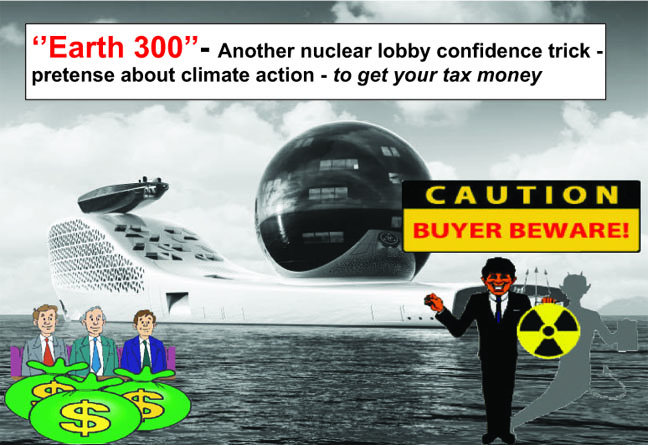
Earth to CNN: No, a nuclear-powered superyacht won’t save the world, https://thebulletin.org/2021/09/earth-to-cnn-no-a-nuclear-powered-superyacht-wont-save-the-world/ By Dawn Stover | September 28, 2021 Who knew that a sexy nuclear superyacht could save us from climate catastrophe? That was the awesome news from CNN’s travel desk yesterday.
CNN wasn’t alone. Forbes, BBC Science Focus Magazine, and a host of other media outlets have previously hailed the world-rescuing potential of what CNN described as “an emissions-free megaship that will pit together climate scientists and the wealthy in a daring quest to save the planet.”
“Pit together” sounds like an apt description of a would-be merger between luxury tourism and climate action. You can put those two things together in a sentence, but in the real world they mix about as easily as oil and water.
And there’s another big problem with the plan for this overhyped 300-meter-long vessel and its global research: Earth 300, as the $700 million superyacht is called, will be powered by a molten salt nuclear reactor that doesn’t exist yet and won’t be certified for at least five years. The company’s website illustrates the reactor with a scale model of an experiment done in the 1960s at Oak Ridge National Laboratory.
The website also says the scientists onboard Earth 300 will have the world’s first ocean-going quantum computer. But that, too, has yet to be built.
Meanwhile, the climate crisis needs immediate attention. “We really are out of time,” UN Secretary-General António Guterres warned this month.
While they wait for a modular nuclear reactor that might never come, the developers of Earth 300 say they will use green synthetic fuels. These are liquid fuels derived from coal or natural gas in a process that captures carbon. However, they are much more expensive than fossil fuels. Aaron Olivera, the entrepreneur behind Earth 300, told CNN he plans to “eventually” retrofit the yacht with a reactor being developed by the UK company Core Power in collaboration with TerraPower, a US nuclear engineering firm chaired by Bill Gates.
Globally, there are at least 171 motorized megayachts that are 75 meters (246 feet) or more in length. Jeff Bezos, the world’s richest man, is rumored to be buying a superyacht so big that it will have a dock for its own “support yacht.” Eclipse, an even bigger superyacht owned by Russian-Israeli billionaire businessman Roman Abramovich, has its own missile defense system. The largest yacht currently operating, Azzam, is 180 meters (590 feet) long and consumes 13 metric tons of fuel per hour at its top speed of 33 knots. That’s about 0.01 miles (or a little over 50 feet) per gallon.
And the customers Olivera would like to attract—the wealthiest people in the world—also tend to have the world’s largest carbon footprints, thanks in no small part to their habit of traveling aboard superyachts and private airplanes. According to calculations by two researchers at Indiana University, a superyacht with a permanent crew and helicopter pad is “by far the worst asset to own from an environmental standpoint.”
Earth 300’s luxury suites will each rent for $300,000 a day, which presumably will cover the personnel and expenses needed to operate the ship and its 22 scientific laboratories. But construction won’t begin until 2025 at the earliest, and any groundbreaking scientific discoveries or billionaire epiphanies that could help stabilize the climate are even further into the future.
Construction is already delayed on another 600-foot-long yacht that will combine climate research with charters for paying customers. Financed by Kjell Inge Røkke, a Norwegian billionaire who made his fortune in fishing and oil drilling, REV Ocean will investigate climate change and ocean acidification, plastic pollution, and overfishing, but the nonprofit project is at least three years behind schedule.
Who will be aboard these superyachts? CNN asked Olivera which famous people he’d like to host on his future ship, and he named Elon Musk, Michelle Obama, Greta Thunberg, Naomi Klein and Yvon Chouinard. Like the superyacht itself, some of those potential guests seem more aspirational than realistic.
Greta Thunberg doesn’t take airplanes or motor yachts. Elon Musk doesn’t take vacations. And Bill Gates may be hurt that he’s not on the A-list.
With breathless enthusiasm, media applauds another nuclear lobby confidence trick – ”Earth 300”.
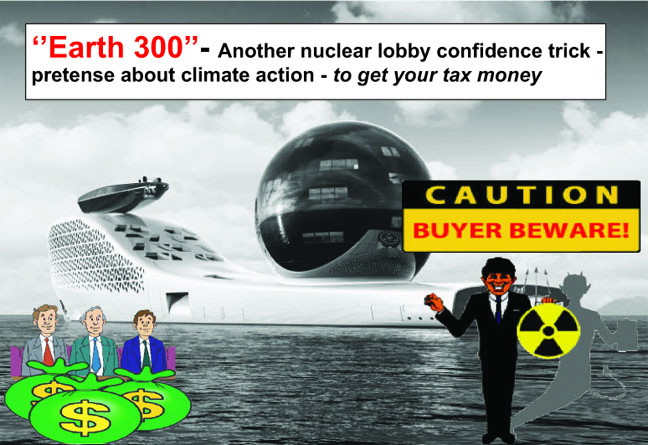
Full of deceptive wors and phrases – “clean” ”emissions-free” ”solutions to climate change” ”safe and sustainable atomic energy from a molten salt reactor” – journalists can hardly contain themselves as they regurgitate the propaganda from the nuclear lobby. Not so long ago, nuclear proponents were climate change deniers. Now they see that getting on the climate change bandwagon is their only chance to get taxpayers’ money, to fund their failing industry.
Tickets for this nuclear-powered superyacht will cost $3 million for VIPs and be free to scientists and students selected to help study climate change., Business Insider, APR 13, 2021,
The striking behemoth has been dubbed Earth 300‚ with a stated mission to carry out research expeditions in order to “confront earth’s greatest challenges,” according to Jefferson. Featuring naval architecture by NED, it spans an insane 984 feet—300 meters, hence the suffix—which makes it even longer than RMS Titanic (883 feet). The majority of that real estate has been dedicated to scientific equipment and tech straight from Silicon Valley.
The vessel will reportedly be powered by nuclear tech known as molten salt reactors (MSRs). ……he project has gained a number of partners, including IBM, RINA, Triton Submarines and EYOS Expeditions. Iddes anticipates Earth 300 will launch in 2025,- Robb Report 14 Apr 21,
Nuclear submarines and more – this week’s news
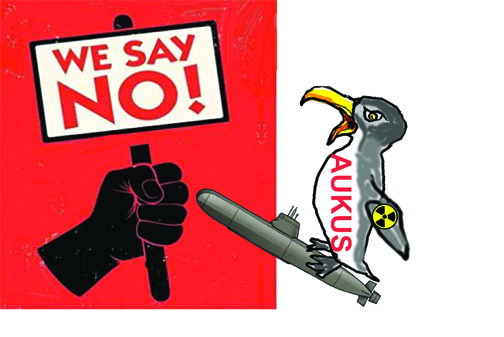
Well, this is something of an overdose on nuclear submarines. Sorry, because, important though they are , especially for Australia, they are not the only issue for this week. It’s getting closer to the COP26 climate summit (31 October – 12 November 2021). Research shows that children will face more climate disasters than their grandparents did. Lord Stern and Mary Robinson are among the key people warning that Cop26 climate talks will not fulfil the aims of the Paris agreement, but they still offer hope. The nuclear issue is a huge threat, but the world is awakening – too late, really, to global heating, and struggling to find ways to address it.. Of course, the pandemic is still there too.
AUSTRALIA.
Nuclear submarines. – what it’s aboutWhy America is ecstatic about Morrison’s AUKUS pact. Much posturing, but little content, on how AUKUS, and the nuclear submarines, will work. An incompetent threesome – Morrison, Biden; Johnson – out of their depth on nuclear submarine decision.
International ramifications. Talk of war with China reveals Australia’s delusions of grandeur. What is the Quad?. AUKUS and talk of conflict with China could torpedo COP26 climate summit. AUKUS and confronting China throws fuel on the fire of Indo-Pacific tensions – an accelerating arms race will follow. France and other NATO members perturbed at the AUKUS agreement. Australia’s Prime Minister Scott Morrison on the defensive as Europe and South-East Asian countries react badly to AUKUS and the nuclear submarines. “Rolling amateur hour”: Kevin Rudd lashes Scott Morrison’s handling of nuclear subs deal.
Deception and politics. Morrison and cronies have really botched this nuclear submarine deal. Deceived’: France says it had assurances from Australia on day subs deal cancelled. The Federal government’s nuclear submarine promotion masks a huge mess of its own making. Former Labor PM Paul Keating castigates Labor for supporting the Liberals’ AUKUS and submarine deal.
Highly Enriched Fuel (HEF) and related problems. AUKUS, nuclear submarines, Highly Enriched Uranium and weapons proliferation. . Nuclear submarines – a step towards full nuclear chain, importing wastes, and joining in USA nuclear brinkmanship. . Nuclear submarines must be ‘subject to rigorous parliamentary review’: Senator Rex Patrick.
Financial aspects. USA has conned Australia into paying for its super-costly nuclear submarine project. The massive subsidy to nuclear submarines must not be used to justify subsidy to nuclear power.
Opposition to programme Former subs boss blasts ‘hocus pocus’ nuclear deal. Maritime and electrical trades unions stand against nuclear submarines. Australia’s Nuclear-Sub Shakeup Hits Shipbuilding Supply Chain. Submarine shift puts thousands of jobs at risk: unions. No nuclear submarines, say protesters.
Maralinga – ushered in Australia’s nuclear age.
Sutherland Shire doesn’t want any more nuclear waste stored at Lucas Heights in their Shire.
CLIMATE. As Frydenberg peddles net-zero, it’s still all about… coal . ‘We’re faffing about here in Australia’: Calls for further climate action ahead of Glasgow conference. Australia will be represented at Glasgow climate conference, it’s just not clear if Scott Morrison will go Scott Morrison is yet to make a decision on whether he will fly to Glasgow later this year to attend major climate change talks.
Good ideas, good work and good luck’: Australian grassroots campaigners on how they got it done
INTERNATIONAL.
Women to bring a wake-up call to a world facing nuclear annihilation. 2030 . Jane Goodall launches effort in support of planting 1 trillion trees by 2030 . Young global climate strikers vow change is coming – from the streets
‘Humanity remains unacceptably close to nuclear annihilation, says UN chief on International Day. Security Council marks 25th anniversary of Test Ban Treaty with call for nuclear weapons-free worldThe Record-Breaking Failures and Costs of Nuclear Power.
Plutonium: How Nuclear Power’s Dream Fuel Became a Nightmare..
Going nuclear: the secret submarine deal to challenge China, PODCAST Vatican concerned over deal for Australian nuclear-powered subs.
Interaction of Nuclear Waste With the Environment More Complicated Than Previously Thought.
Bitcoin miners strike deals with nuclear industry [on the ”clean energy” lie].
Novel chemical entities: Are we sleepwalking through a planetary boundary?
CIA Reportedly Considered Kidnapping, Assassinating Julian Assange,
AUKUS and confronting China throws fuel on the fire of Indo-Pacific tensions. An accelerating arms race will follow.

Australia commits fully to China containment
Canberra is now a fully paid-up member of a China containment front, whether it wants to admit it, or not. In the process, it has yielded sovereignty to the US by committing itself to an interlocking web of military procurement decisions that includes the acquisition of a nuclear-propelled submarine fleet.
New drives to counter China come with a major risk: throwing fuel on the Indo-Pacific arms race SMH, Tony Walker Tony Walker is a Friend of The Conversation.Vice-chancellor’s fellow, La Trobe University September 27, 2021 An accelerating arms race in the Indo-Pacific is all but guaranteed now that China finds itself a target of new security arrangements — AUKUS and the Quad — aimed at containing its power and influence.
This has the makings of a new great game in the region in which rival powers are no longer in the business of pretending things can continue as they are.
The AUKUS agreement, involving Australia, the US and UK to counter China’s rise means a military power balance in the Indo-Pacific will come more sharply into focus.
The region has been re-arming at rates faster than other parts of the world due largely to China’s push to modernise its defence capabilities.
In their latest surveys, the London-based International Institute of Strategic Studies (IISS) and the Stockholm International Peace Research Institute (SIPRI) report no let-up in military spending in the Indo-Pacific. This is despite the pandemic.
SIPRI notes a 47% increase in defence spending in the Indo-Pacific in the past decade, led by China and India.
China can be expected to respond to threats posed by the new security arrangements by further expediting its military program.
It will see the formation of AUKUS as yet another attempt to contain its ambitions — and therefore a challenge to its military capabilities.
The Quad makes clear its ambitions
Unambiguously, AUKUS implies a containment policy.
Likewise, the further elevation of the Quad security grouping into a China containment front will play into an atmosphere of heightened security anxiety in the Indo-Pacific.
The four Quad participants – the US, Japan, India and Australia – have their own reasons and agendas for wanting to push back against China.
After their summit last week in Washington, the Quad leaders used words in their joint statement that might be regarded as unexceptional in isolation.
Together with other developments such as AUKUS, however, the language was pointed, to say the least:
Together, we re-commit to promoting the free, open, rules-based order, rooted in international law and undaunted by coercion, to bolster security in the Indo-Pacific and beyond.
The “beyond” part of the statement was not expanded on, but might be read as a commitment to extend the Quad collaboration globally.
All this has come together at the dawn of a new US administration whose members include several conspicuous China hawks, and at a moment when China has shown itself to be ever-willing to throw its weight around.
Beijing’s crude campaign against Australian exports in an effort to bend Australia’s policy to its will is a prime example. It is doubtful an AUKUS or an invigorated Quad would have emerged without this development.
The Obama administration talked about pivoting to the Asia-Pacific without putting much meat on the bones.
Under President Joe Biden, this shift will be driven by a hardening in American thinking that now recognises time is running out, and may already have expired, in the US ability to constrain China’s rise.
These are profound geopolitical moments whose trajectory is impossible to predict.
Australia commits fully to China containment
Canberra is now a fully paid-up member of a China containment front, whether it wants to admit it, or not. In the process, it has yielded sovereignty to the US by committing itself to an interlocking web of military procurement decisions that includes the acquisition of a nuclear-propelled submarine fleet.
Whether these submarines are supplied by the US or Britain is a bit immaterial since the technology involved originates in America.
The submarines will not be available for the better part of two decades under the most optimistic forecasts. However, in the meantime, Australia could base US or British submarines in its ports or lease American submarines.
Meanwhile, Australia is committing itself to a range of US-supplied hardware aimed at enhancing the inter-operability of its military with the US.
This is the reality of fateful decisions taken by the Morrison government in recent months. Such a commitment involves a certain level of confidence in America remaining a predictable and steadfast superpower, and not one riven by internal disputes.
Australian defence spending likely to rise. What is absolutely certain in all of this is that an Indo-Pacific security environment will now become more, not less, contentious. …………………………………
What other Indo-Pacific nations are doing
Many other Indo-Pacific states can now be expected to review their military acquisition programs with the likelihood of a more combative security environment.
Taiwan, for example, is proposing to spend $US8.69 billion (A$11.9 billion) over the next five years on long-range missiles, and increase its inventory of cruise missiles. It is also adding to its arsenal of heavy artillery.
South Korea is actively adding to its missile capabilities. This includes the testing of a submarine-launched ballistic missile.
Seoul has also hinted it might be considering building its own nuclear-propelled submarines (this was among President Moon Jae-in’s election pledges in 2017). Signs that North Korea may have developed a submarine capable of firing ballistic missiles will be concentrating minds in Seoul.
All this indicates how quickly the strategic environment in the Indo-Pacific is shifting.
Australia — perhaps more so than others — is the prime example of a regional player that has put aside a conventional view of a region in flux. It now sees an environment so threatening that a policy of strategic ambiguity between its custodial partner (the US) and most important trade relationship (China) has been abandoned.
The price tag for this in terms of equipment and likely continuing economic fallout for Australian exporters will not come cheap. https://theconversation.com/new-drives-to-counter-china-come-with-a-major-risk-throwing-fuel-on-the-indo-pacific-arms-race-168734
1 This month.
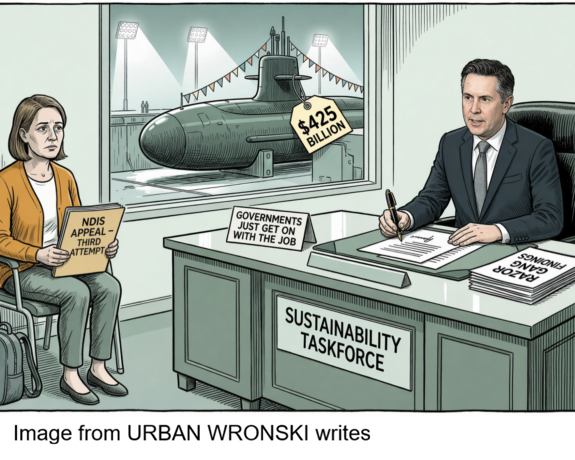

PETITION – To: Prime Minister Anthony Albanese and the Australian Labor Government
Chernobyl: The Lost Tapes – A good documentary on Chernobyl on SBS available On Demand for the next 3 weeks– https://www.sbs.com.au/ondemand/tv-program/chernobyl-the-lost-tapes/235274195556
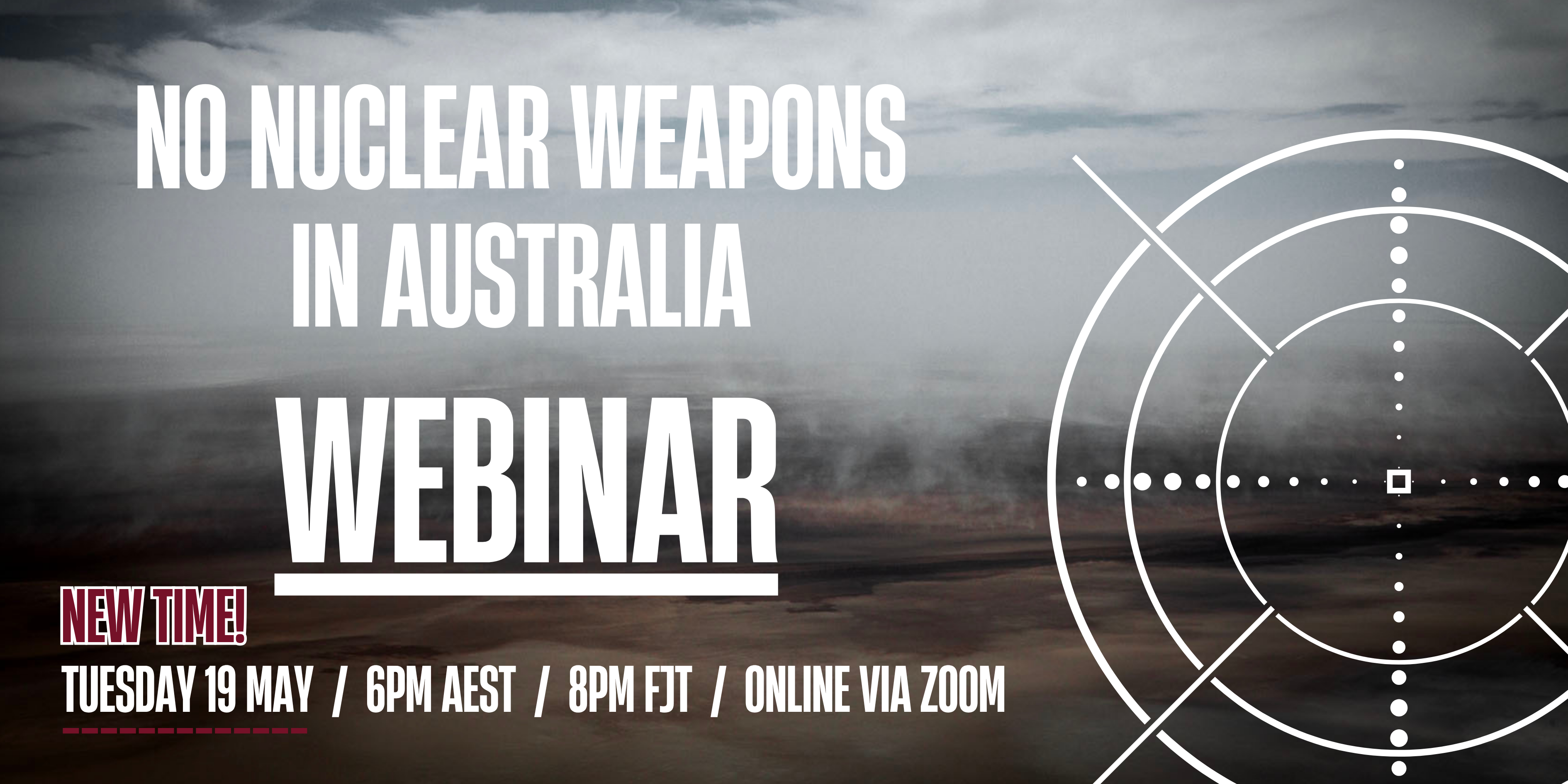
19 May – Webinar- Webinar: No Nuclear Weapons in Australia
Start: 2026-05-19 18:00:00 UTC Canberra, Melbourne, Sydney (GMT+10:00)
End: 2026-05-19 19:30:00 UTC Canberra, Melbourne, Sydney (GMT+10:00)
20 May – Webinar – The dangerous world of AUKUS, US, military occupation and suppression of dissent

National Webinar, 20th May, 2026, 6.30pm AEST. Confronting laws restricting/suppressing protest speech and action
Speakers: Former Sen. Rex Patrick, Lawyer Nick Hanna ,Arthur Rorris ,Jorgen Doyle, Sen David Shoebbridge,
Facilitator Kelley Tranter.

of the week – Australians for War Powers Reform (AWPR)
To see nuclear-related stories in greater depth and intensity
 Antinuclear