Australian Greens blast nuclear submarine deal.
Floating Chernobyls: : Greens blast sub deal https://www.perthnow.com.au/politics/floating-chernobyls-greens-blast-sub-deal-c-3978289, Matt CoughlanAAP, September 16, 2021
The Greens have warned Australia acquiring nuclear-powered submarines will create “floating Chernobyls” in the heart of major cities.
The UK and US will give Australia access to top secret nuclear propulsion technology for a fleet of new submarines to be built in Adelaide through new security pact AUKUS.

Greens leader Adam Bandt believes the move increases the prospect of nuclear war in the region and puts Australia in the firing line.
“It’s a dangerous decision that will make Australia less safe by putting floating Chernobyls in the heart of our major cities,” he told the ABC on Thursday.
It’s a terrible decision. It’s one of the worst security decisions in decades.”
Mr Bandt said the Greens would fight the decision and urged Labor to do the same.
“The prime minister needs to explain what will happen if there’s an accident with a nuclear reactor now in the heart of one of our major cities?” he said.
“How many people in Brisbane, Adelaide or Perth, will die as a result of it? What is going to happen if there is a problem with one of the nuclear reactors?”
It is understood the submarines will not require a civilian nuclear capability but rather will have reactors and fuel which will last the life of the vessel.
Independent senator and former submariner Rex Patrick wants an urgent parliamentary inquiry to report before the next federal election.
Senator Patrick, who has been a vocal critic of the $90 billion French submarine deal that is now over, said scrutiny was crucial.
We have to be careful we don’t move from one massive procurement disaster into something else that hasn’t been thought through properly,” he said.
The government has sunk $2.4 billion on the French program and is negotiating on other compensation, which remains commercial in confidence.
Labor leader Anthony Albanese and three senior frontbenchers received a briefing ahead of the announcement on Thursday morning.
Napandee radioactive waste dump plan – a nuclear waste of money.
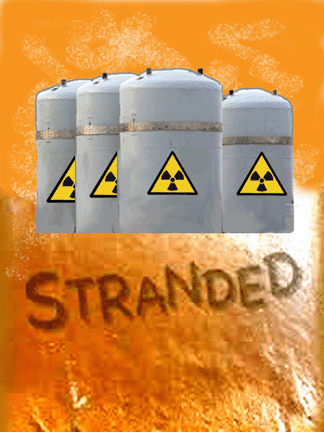
“A Nuclear waste of money – Greenies”The Advertiser 14Sept 2021 p.9 MICHELLE ETHERIDGE
RADIOACTIVE waste should be stored at an expanded nuclear medicine production site in Sydney, rather than shipped to Kimba, opponents of the Eyre Peninsula project say.
The federal government has set aside $59.8m over four years for an expansion of “temporary” nuclear waste storage at Lucas Heights, NSW. During a parliamentary committee hearing on Monday, conservation groups argued the project rendered unnecessary a plan to move intermediate-level waste to a new facility near Kimba, where it is to be stored for several decades.
The federal government says space for some types of nuclear waste at Lucas Heights will be exhausted by 2027 and the expansion will provide at least a further 10 years’ capacity until the new national radioactive waste site planned for Napandee, near Kimba, is operational about or after 2030. Conservation SA chief executive Craig Wilkins, said his organisation supported keeping the waste at Lucas Heights until a longterm deep geological (underground) repository was found.
“I and others are genuinely scratching our heads as to why this waste from ANSTO (Australian Nuclear Science and Technology) is being transferred from one temporary place that’s safe and secure to another place on an interim basis. This is … a phenomenal waste of money,” he said.
The Australian Conservation Foundation’s Dave Sweeney said waste could become stranded at Kimba in the absence of a long-term plan. ANSTO staff said the new Lucas Heights facility would have a life of about 50 years
Too late to pull out of Australia’s botched super-expensive submarines purchase?
‘Lost the plot’: How an obsession with local jobs blew out Australia’s $90 billion submarine program, By Anthony GallowaySEPTEMBER 14, 2021 Nick Minchin isn’t surprised Australia’s future submarines are arriving later than expected and $40 billion more expensive. He has seen it all before……..
I was staggered by that, no wonder we ran into financial difficulties with Defence’s estimates of maintaining and operating these things,” Minchin tells The Sydney Morning Herald and The Age…………
Now, history is repeating itself.
Australia’s 12 new attack-class submarines – Australia’s largest military acquisition in its history – were originally slated to cost between $40 billion and $50 billion. According to the latest projections they will now cost about $90 billion to build and $145 billion to maintain over their life cycle. Despite the fact former prime minister Tony Abbott promised the first of the submarines would be in the water by the mid-2020s, it is now not scheduled to become operational until the mid-2030s.
In the current debate on Australia’s submarine debacle, French-bashing has been all the rage. And with French builder Naval Group’s cost blowouts, schedule slippages and dubious commitments on meeting local content requirements – it’s been an easy sport. But it’s worth asking: would we have arrived at this point regardless of which bidder we chose? After all, Defence’s acquisition debacles are not confined to French-designed submarines…………….
And it’s not just submarines where there are inherent problems………..
………………. the Abbott government opted for a deeply flawed Competitive Evaluation Process which led to the current mess.”.
……….. On April 26, 2016, Turnbull announced France had won the hard-fought global race for the $50 billion contract and all the submarines would be built in Adelaide. According to Turnbull, the recommendation from Defence was “unequivocal” that the French proposal for a conventionally powered version of the latest French nuclear submarine design – the Shortfin Barracuda – was the best of the three options.
Is it too late to pull out?
Once Scott Morrison took over the prime ministership, the project was already going off course. By late 2019, Defence officials conceded that the cost of building and maintaining the submarines would total $225 billion over the life of the program, while concerns were mounting about Naval Group’s schedule slippages and its ability to meet its local content commitments, which were never written into the agreement.
…………. Morrison tasked Vice-Admiral Jonathan Mead and Commodore Tim Brown to look at alternative options for the submarine fleet, including long-range conventionally powered submarines that Swedish company Saab Kockums had offered the Dutch navy. The government also rejected Naval Group’s proposal outlining the next two-year phase of the program, telling the company it needed more information on how its cost and schedule projections would be met.
After taking over the defence portfolio, Peter Dutton told The Sydney Morning Herald and The Age he was having some “frank discussions” with his department. A month later, Dutton revealed he had ordered life-of-type extensions for all six Collins-class submarines, which involves completely rebuilding them so they can continue to operate beyond their planned retirement date of the mid-2020s. Dutton also tasked Defence to embrace more asymmetric warfare capabilities by acquiring long-range missiles and drones, which can be “produced in bulk, more quickly and cheaply, and where their loss would be more tolerable, without significantly impacting our force posture”.
After taking over the defence portfolio, Peter Dutton told The Sydney Morning Herald and The Age he was having some “frank discussions” with his department. A month later, Dutton revealed he had ordered life-of-type extensions for all six Collins-class submarines, which involves completely rebuilding them so they can continue to operate beyond their planned retirement date of the mid-2020s. Dutton also tasked Defence to embrace more asymmetric warfare capabilities by acquiring long-range missiles and drones, which can be “produced in bulk, more quickly and cheaply, and where their loss would be more tolerable, without significantly impacting our force posture”.
Within the next week, the government is expected to announce it has reached a deal with Naval Group on the next two-and-half years of the submarine program.
By then, it almost certainly will be too late to pull out. https://www.theage.com.au/politics/federal/lost-the-plot-how-an-obsession-with-local-jobs-blew-out-australia-s-90-billion-submarine-program-20210913-p58r34.html
27 September Australian premiere of film ”The Atom: A Love Affair”
In November the UN Climate Change Conference takes place in Glasgow and time is running out for our federal government to decide on a new climate plan.
Positive pressure is coming from state governments and the private sector who are moving away from coal and gas and investing in clean energy solutions. People power is blocking public money going to climate pollution. However, I fear that a pivot away from fossil fuels might encourage a handful of politicians and lobbyists to once again take up the toxic torch and spruik nukes in Australia.
Nuclear power is high cost and high risk. It would be a threat to our communities and natural world and, like coal and gas, has no place in our future.
We know this because we have had decades of watching its deadly and avoidable consequences hit all parts of the world. The Atom: A Love Affair documents this story and humanity’s turbulent love-hate relationship with nuclear power from post-war to present day – watch an exclusive Australian-first screening of it.
What: Australian premiere screening of The Atom: A Love Affair and Q&A with Director Vicki Lesley, former Greens nuclear spokesperson and writer Scott Ludlam and former ACF President Professor Ian Lowe AO
When: Monday 27 September 7.30pm AEST (Q&A starts at 9pm AEST)
Where: Online via livestream – buy your tickets now.
Cost: $10
Panellists:
Vicki Lesley has been working in documentaries for over 20 years. She has developed and made top-rated & award-winning TV shows for broadcasters including the BBC, Channel 4, Channel 5, Discovery & National Geographic and directed independent short films which have screened at festivals around the world and online. THE ATOM: A LOVE AFFAIR is her first feature documentary.
Professor Ian Lowe AO is a leading Australian public academic and intellectual with a keen interest and direct experience in the nuclear and climate sectors and discourse. As well as being a physicist, former CEO of the Commission for the Future, President of the Australian Conservation Foundation and a referee with the International Panel on Climate Change his career has included extensive engagement with universities, research councils and advisory groups. Ian is the author of numerous books and articles, including Living in the Hothouse, A Big Fix, A Voice of Reason, Bigger or Better?, The Lucky Country? and the newly published Long Half Life – exploring the nuclear industry in Australia. He is also the author of a 2006 Quarterly Essay on the prospects for nuclear power in Australia, and a ‘flip book’ with Professor Barry Brook, giving the two sides of the nuclear argument.
Scott Ludlam was a Senator from 2008 to 2017 and served as nuclear spokesperson and deputy leader of the Australian Greens. He has also worked as a filmmaker, artist and graphic designer. Full Circle, recently published by Black Inc., is Scott’s first book and reflects a life of activism, study and travel.
Moderator:
Dave Sweeney has been active in mining, resource and nuclear issues for three decades through his work with the media, trade unions and environment groups. He has been active in some of Australia’s major community campaigns including against uranium mining in Kakadu and radioactive waste dumping in the arid zone. Dave is a co-founder of the International Campaign to Abolish Nuclear Weapons which was awarded the Nobel Peace Prize in 2017. Dave leads the Australian Conservation Foundation’s nuclear free campaign and holds a vision of an Australia that is thoughtful about its future and honest about its past.
Baseload coal is rapidly losing value, and poses biggest risk to Australian utilities — RenewEconomy

Coal will struggle to remain economically viable beyond 2030. Companies with a heavy exposure, like AGL, need to act quickly to survive. The post Baseload coal is rapidly losing value, and poses biggest risk to Australian utilities appeared first on RenewEconomy.
Baseload coal is rapidly losing value, and poses biggest risk to Australian utilities — RenewEconomy
Australia’s hidden carbon market: New options allow companies to out-bid government — RenewEconomy

Surging prices in voluntary market means that carbon abatement projects are now likely to be funded by companies rather than the government. The post Australia’s hidden carbon market: New options allow companies to out-bid government appeared first on RenewEconomy.
Australia’s hidden carbon market: New options allow companies to out-bid government — RenewEconomy
September 13 Energy News — geoharvey

Opinion: ¶ “Australia Is Shaping Up To Be The Villain Of COP26 Climate Talks” • If Australia’s allies were worried that the country might cause them problems at upcoming climate talks in Glasgow, the events of the past week should leave little doubt in their minds. Australia made clear that it plans to pursue a […]
September 13 Energy News — geoharvey
“No new coal:” Majority of coal projects abandoned since Paris but China is key — RenewEconomy

World edges closer to point of “no new coal” after widespread collapse of new coal proposals and growth of government commitments to end coal. The post “No new coal:” Majority of coal projects abandoned since Paris but China is key appeared first on RenewEconomy.
“No new coal:” Majority of coal projects abandoned since Paris but China is key — RenewEconomy
UK invites mammoth offshore wind proposals in “biggest ever” renewables auction — RenewEconomy

Conservative UK government releases details of “biggest ever,” all technologies renewable energy support package, including a massive £200m targeting offshore wind. The post UK invites mammoth offshore wind proposals in “biggest ever” renewables auction appeared first on RenewEconomy.
UK invites mammoth offshore wind proposals in “biggest ever” renewables auction — RenewEconomy
Biden’s proposed tenfold increase in solar power would remake US electricity system — RenewEconomy

New US Department of Energy report finds solar power could generate up to 45% of America’s electricity supply by 2050. But what it would take to meet this target? The post Biden’s proposed tenfold increase in solar power would remake US electricity system appeared first on RenewEconomy.
Biden’s proposed tenfold increase in solar power would remake US electricity system — RenewEconomy
This week – nuclear news, Australia and beyond
NUCLEAR. While the pandemic goes on, not much physically is happening. But on the lobbying scene, it’s at fever pitch. The target is the European Commission. The goal is to get the Commission to declare nuclear power as clean, green and sustainable in the European Taxonomy. And then on to inclusion in the COP 26 Climate Summit in November, so that the nuclear industry can get the money that goes with that acceptance. Even more beneficial- by saving this failing industry, they’ll be able to keep old reactors going for longer, thus avoiding the huge costs of demolishing them, and thus kicking that problem down the road, for our grandchildren to solve.Delay in climate change action helps, too, as nuclear power is depicted as ”transitional” from fossil fuels.
Coronavirus: What’s happening in Canada and around the world .
Climate change: Fossil fuels must stay underground, scientists say
A bit of good news – New data shows vaccines are cutting the risk of serious COVID-19.
AUSTRALIA.
- Australia is part of Asia, and is unwise and unsafe in parroting the USA agression about China.
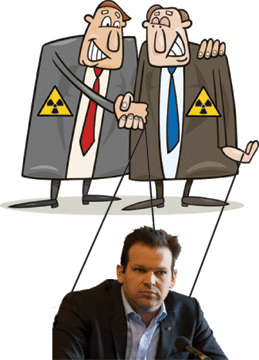
- Senator Matt Canavan – a chameleon of contradictions on coal and nuclear power. Sloppy and unconvincing pro nuclear propaganda from the Australian Nationals and the Murdochracy.
- News Corpse’s climate change shame. News Corpse’s new snide approach on climate change – to help Morrison win next election?
- Planned UK-Australia trade deal – a dangerous precedent for climate change policy.
- Environmentalists want independent review on plans for rocket launch from Eyre Peninsula.
- Small nuclear reactors – thin end of the nuclear wedge for Australia, as Australian Strategic Policy Institute pushes for submarines.
INTERNATIONAL
We need global action on climate, just like global action on pandemic – Jane Goodall. Jane Goodall still has hope for humanity. Here’s why.
Vested interests — controlling the news about nuclear safety.
UN General Assembly President calls for halt to nuclear tests.
BRICS countries (Brazil, Russia, India, China, South Africa) reaffirmed commitment to preventing an arms race in space.
Nuclear ”ethics” – fatally ill man kept alive against his will, in the cause of nuclear research. Irradiated man kept alive .
British Scientist discovers the cause of cancer in the Hiroshima Black Rain survivors -2021.
Thorium nuclear fuel has risks.
‘‘Fossil Free Media’‘ aims to redress the balance of well-funded press that opposes action on climate change.
USA Bill to protect journalists – EXCEPT FOR JULIAN ASSANGE
On the positive side – heading for a better and a nuclear-free, world – theme for September 21
It’s time to recognise the positive developments – towards a clean and more just world. And time to turn away from the corporate spin of the polluters and nuclear lobbyists.

The the world is finally realising the urgency of the existential threat of global heating. Meanwhile the polluting corporative partners, fossil fuel and nuclear industries, now redouble their spin to the public,
And, don’t let’s forget, most of the mainstream media is owned by corporations that also have interests in those polluting industries.
We need to acknowledge the good stuff that’s happening. We also need to turn our attention to those independent voices – the ones who seek out and explain both the facts about the dirty industries, and the positive developments leaving those industries behind.
Great work is being done towards energy conservation, and truly clean energy technologies, and environmental protection. On this page, I’m confining the story to the work of the nuclear-free movement .
Starting out with opposition to nuclear weapons, the movement broadened to opposing the nuclear industry as a whole. Major anti-nuclear groups include Sortir du Nucleaire, Greenpeace International, Campaign for Nuclear Disarmament, Friends of the Earth, Greenpeace, Physicians for the Prevention of Nuclear War, Peace Action and the Nuclear Information and Resource Service. International Campaign to Abolish Nuclear Weapons, Ploughshares Fund
There are many others across the world, including in Russia and China.
You might think that the nuclear-free movement has failed, especially given the proliferation of nuclear weapons. But the organised protests and work of the movement has had, and continues to have, some success. Most countries do not have nuclear power. Several advanced countries remain opposed to nuclear power – Australia, Austria, Denmark, Greece, Malaysia, New Zealand, and Norway . Over the decades, activist movements have led to the stopping of atmospheric nuclear bomb tests, and the prevention of nunerous nuclear power projects.

Importantly, nuclear energy has been excluded from the Green Zone at the COP26 Climate Summit.
Also importantly , the USA Nuclear Regulatory Commision reaffirms the standard that low dose ionising radiation is bad for your health, and rejects the nuclear industry’s petition to weaken that standad.
The work continues, with the most important recent development – the UN Treaty on the prohibition of nuclear weapons . Nuclear weapons and nuclear power are in lockstep – a fact quite openly acknowledged now, even boasted about, by the industry.
The nuclear-free movement works alongside the clean energy movement. On the world stage, the challenge is to keep real climate action in the COP26 climate conference in November, without nuclear. Locally, the clean fight is fought by communities around the world, especially indigenous people, who are always the victims of nuclear bomb tests and waste dumping.
Most mainstream writers, and some academics, are caught up in the pro nuclear spin.
Look for the fine writers who really seek the truth, A few examples – M.V. Ramana, Helen Caldicott, Jim Green, Mary OLson, Gordon Edwards Alice Slater Arnie Gundersen, Libbe Halevy, Diesendorf, Mark , Beatrice Fihn, Lovins, Amory B. Eric_Schlosser and for song – Caitlin Johnstone………
You will note that women are prominent in the truth-seeking writers. They have been dramatically absent from the push for nuclear weapons, (though a few women are now ostentatiously promoted by the desperate nuclear industry)
This little website has a very small readership. But we are still here, and trust our readers to spread the information. And we will keep on promoting the work of the honest seekers after truth, through this site, and via my weekly email newsletter.
Vested interests — controlling the news about nuclear safety

Who controls the truth about a nuclear disaster?
The end of the monopoly of these experts would allow a proper debate on the risks of nuclear energy. At a time when many voices are speaking out in favor of the development of atomic energy as the lesser evil in the face of climate change, such a debate is urgent.
How monolithic institutions decide what is safe for the rest of us, Beyond Nuclear, By Christine Fassert and Tatiana Kasperski, 12 Sept 21,
In December 2020, twenty years after the final closure of the Chernobyl nuclear power plant, the Ministry of Culture of Ukraine announced its intention to prepare an application to include certain objects in the exclusion zone around Chernobyl in the UNESCO World Heritage List….
The Chernobyl site would symbolize the long history of accidents that have marked the atomic age, from Kychtym and Windscale (1957), to Three Mile Island (1979) and Fukushima (2011), whose tenth anniversary we commemorated this year.
Moreover, the Chernobyl accident constitutes a particular moment in this history, namely the beginning of the institutionalization of the international management of the consequences of nuclear accidents, whose impact became fully apparent at the time of the Fukushima accident.
A small group of organizations
If the origins of accidents are most often explained by factors related to the development of the nuclear industry and its regulatory bodies at the national level, the “management” of their consequences gradually extends beyond national borders
In this respect, Chernobyl established the monopolization of the authoritative knowledge of ionizing radiation by a small group of organizations — the International Atomic Energy Agency (IAEA), the International Commission on Radiological Protection (ICRP) and the United Nations Scientific Committee on the Effects of Atomic Radiation (UNSCEAR).
Through a series of alliances and co-options, these organizations formed a monolithic bloc on the issue of radiological risk.
Relegated to a militant marginality
From that moment on, divergent points of view were de-legitimized and relegated to a form of militant marginality. These included the positions of such individuals as “dissident” scientist Keith Baverstock who directed the radiation protection program at the World Health Organization’s Regional Office for Europe, and those of such organizations as the International Association of Physicians for the Prevention of Nuclear War (IPPNW).
This monopoly translates into an internationalization of accident management that relies on a series of tools designed to establish a “normalization” of the post accident situation through the depoliticization of the management of risks related to radioactive fallout. They enshrine the power of experts close to international nuclear organizations to determine what sacrifices in terms of health and the environment are acceptable.
As physicists Bella and Roger Belbéoch point out:
“Far from calling into question the power they have secured for themselves in society, the nuclear disaster allows them to constitute themselves into a unified international body with even greater powers. It is at the moment when the scientific experts can no longer promise anything other than disaster management that their power inevitably takes hold.”
Fukushima
This monopoly over knowledge and management of an accident was very much present in Japan in 2011, when the Japanese authorities put in place measures, which, by largely referring to international standards, warded off objections: the accident was dealt with by the experts.
However, a shift occurred in this monopoly when a UN rapporteur, Anand Grover, severely criticized Tokyo’s management of the disaster.
At the same time, new conceptual tools proposed by the social sciences, such as the “production of ignorance”, offer a framework for analysis that makes it possible to extend the criticisms beyond the domain of a purely expert debate, opening the way to a re-politicization of the accident and its consequences.
Making nuclear accidents manageable
But, first of all, how can you make a nuclear accident manageable when, as was the case at Chernobyl and Fukushima, it causes very large releases of radioactive particles, spreading around the globe and causing long-term contamination of tens of thousands of square kilometers?
Hundreds of thousands of people have been evacuated or relocated from these territories, and hundreds of thousands of others continue to live in an environment affected by radioactivity.
Zoning, that is, the division of these territories into several “zones” according to the density of contamination and the necessary protective measures, was the first instrument that made it possible, in Japan and in the former Soviet Union, to make the accident manageable……
This zoning mechanism set up by the Japanese government is part of a regulatory framework established by the two major international nuclear institutions, the IAEA and the ICRP. The ICRP sets the dose limit for the public at 1 millisievert (mSv)/year. Since 2007, the ICRP has authorized government authorities to raise this threshold (from 1 to 20 mSv/year) in the case of a nuclear accident.
When the Japanese authorities, like the Soviet authorities in 1986, chose to raise the threshold following the accident, they justified it in terms of the virtual absence of any health risks.
The radiological threshold
The mechanism is based in particular on the choice of a radiological threshold from which the population will be evacuated.
In Japan, government officials consider that the risk of developing cancer from exposure to a dose of 100mSv or less is so low according to “the international (scientific) consensus, (that) it is made undetectable by the carcinogenic effects of other factors.”
Limiting evacuations and compensations
The sociologist and historian of science Sezin Topçu shows how this zoning mechanism, which has become an indispensable element of nuclear accident management, is above all a way of limiting evacuation and compensation for damage caused by an accident, since its costs (economic, political or social) would be prohibitive for the nuclear industry and the State.
This optimization approach is also enshrined at the international level in the recommendations issued by the IAEA and the ICRP.
For example, in the case of Japan, the threshold of 20 mSv/year appears to have been chosen in part to avoid evacuating the Naka Dori region and its major cities: the established zone borders made it possible to exclude such cities in the center of the prefecture, including Fukushima, from evacuation orders…………………………..
Mechanisms of ignorance production
More recently, however, various social scientists have proposed an analysis of the promotion of a reassuring stance on these dangers as part of the mechanisms of ignorance production.
The production of ignorance, which can be both involuntary and intentional, was initially studied for a number of risks, such as tobacco.
Approaching radiological risks in terms of the production of ignorance makes it possible to break with the “exceptionalism” with which the nuclear issue has long been associated, and to consider the dangers of ionizing radiation within the broader field of health risks and its banal issues of power.
Minimizing gravity
The internationalized management of nuclear disasters is in fact based on various mechanisms of ignorance production. For instance, the sociologist of science, Olga Kuchinskaya,- describes the “politics of invisibility” that were adopted after the Chernobyl disaster.
She points out that the public visibility of the effects of ionizing radiation depends on the existence of material infrastructures – such as measuring devices, information systems and equipment — but also institutional infrastructures (for example, following a cohort of people in order to make health effects visible depends on this articulation between material and institutional elements).
This infrastructure is very costly and, in the case of Chernobyl, has not been maintained over time. Moreover, the assessment of the effects of radiation was essentially taken care of by international institutions, while local doctors and researchers, for their part, revealed a completely different and much more alarming picture of the health situation.
Kate Brown describes how various international bodies, primarily the IAEA and WHO, worked to redefine the health effects of Chernobyl, to minimize their severity, and thus actively to produce “ignorance” about the impact of the disaster.
This non-knowledge was in fact a crucial instrument that made the disaster “manageable” and allowed, as Adriana Petryna points out, “the deployment of authoritative knowledge, especially when applied to the management of the exposed population”.
The monopoly of international experts, until when?
By addressing the “exceptional” character of nuclear energy and ionizing radiation, these criticisms, whether they are made within UN bodies or by social science researchers, open the way to questioning the monopoly of international nuclear institutions in assessing radiological risk and framing so-called “post-accident” policies.
A re-politicization of the management of accident consequences that brings the “management” of a nuclear accident into the broader framework of human rights therefore becomes possible.
When the next nuclear accident occurs, it is not a given that citizens will accept the “inevitability” of the power of international experts to decide, on their behalf, what constitutes an acceptable risk.
The end of the monopoly of these experts would allow a proper debate on the risks of nuclear energy. At a time when many voices are speaking out in favor of the development of atomic energy as the lesser evil in the face of climate change, such a debate is urgent.
This article was first published in The Conversation in French on April 26, 2021, as well as on Beyond Nuclear International. English translation provided by the authors.
Christine Fassert is a social anthropologist at Université Paris 1 Panthéon-Sorbonne. Tatiana Kasperski is a research associate– Department of Humanities at Universitat Pompeu Fabra https://beyondnuclearinternational.org/2021/09/12/vested-interests/
@ChristinaMac1
Australian and global fossil fuel giants make $1 trillion bet against global climate efforts — RenewEconomy

Australian and global oil and gas companies continue to pour huge amount of investment growing their production, defying global climate targets, new report finds. The post Australian and global fossil fuel giants make $1 trillion bet against global climate efforts appeared first on RenewEconomy.
Australian and global fossil fuel giants make $1 trillion bet against global climate efforts — RenewEconomy
Australian solar innovator backed by Cannon-Brookes claims world efficiency record — RenewEconomy

Australian solar start-up founded in a garage and backed by billionaire investors included Mike Cannon-Brookes, claims new world solar efficiency record. The post Australian solar innovator backed by Cannon-Brookes claims world efficiency record appeared first on RenewEconomy.
Australian solar innovator backed by Cannon-Brookes claims world efficiency record — RenewEconomy
1 This month.
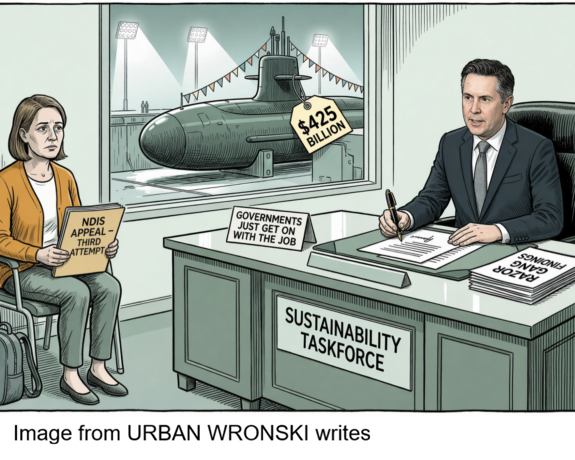

PETITION – To: Prime Minister Anthony Albanese and the Australian Labor Government
Chernobyl: The Lost Tapes – A good documentary on Chernobyl on SBS available On Demand for the next 3 weeks– https://www.sbs.com.au/ondemand/tv-program/chernobyl-the-lost-tapes/235274195556
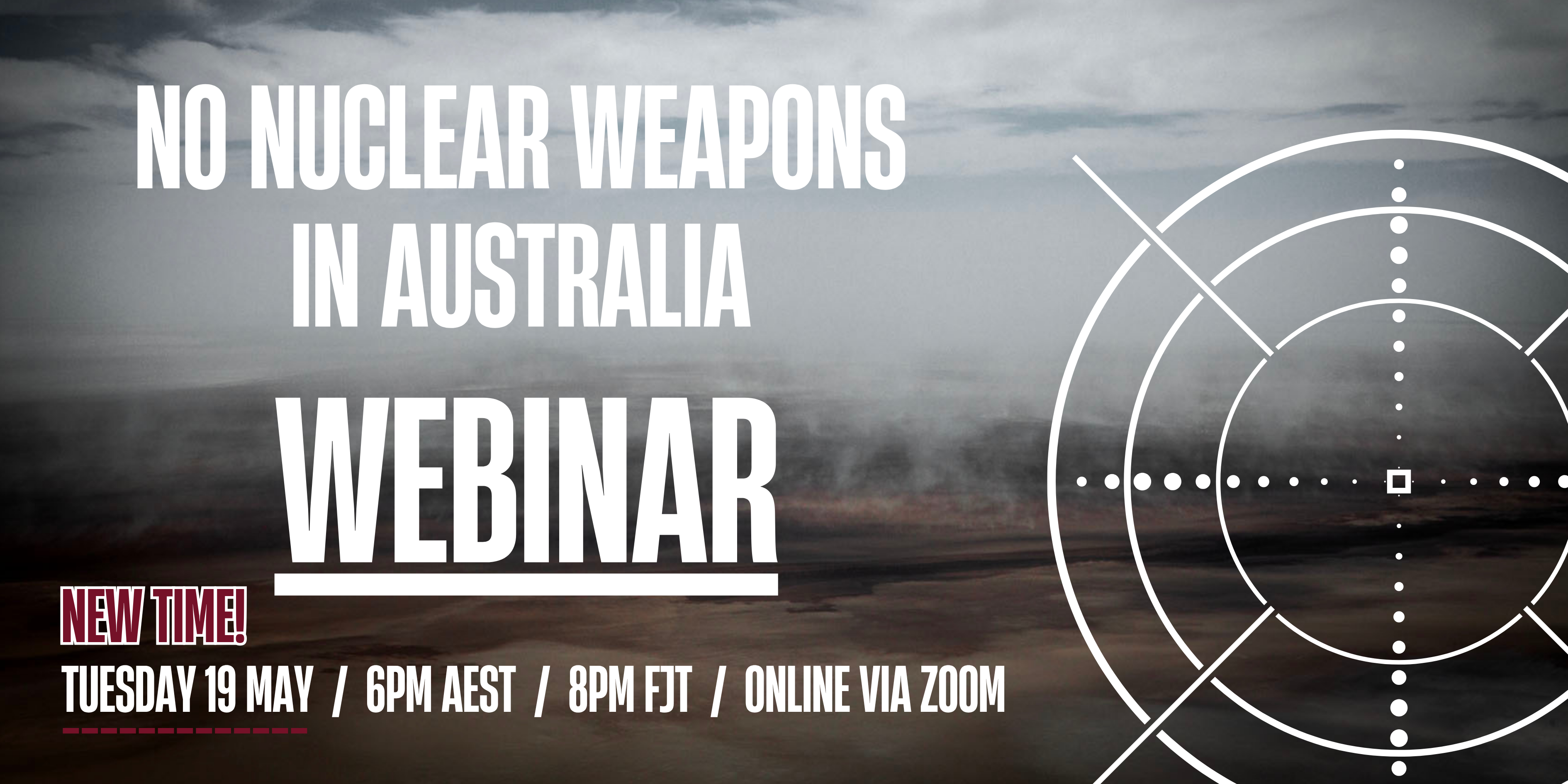
19 May – Webinar- Webinar: No Nuclear Weapons in Australia
Start: 2026-05-19 18:00:00 UTC Canberra, Melbourne, Sydney (GMT+10:00)
End: 2026-05-19 19:30:00 UTC Canberra, Melbourne, Sydney (GMT+10:00)
20 May – Webinar – The dangerous world of AUKUS, US, military occupation and suppression of dissent

National Webinar, 20th May, 2026, 6.30pm AEST. Confronting laws restricting/suppressing protest speech and action
Speakers: Former Sen. Rex Patrick, Lawyer Nick Hanna ,Arthur Rorris ,Jorgen Doyle, Sen David Shoebbridge,
Facilitator Kelley Tranter.

of the week – Australians for War Powers Reform (AWPR)
To see nuclear-related stories in greater depth and intensity
 Antinuclear