Advanced nuclear reactors need the government to create a market – nuclear loves socialism

……….………. Advanced reactors are in a position where they need a HALEU supply for commercialization of their technology to be possible, but there needs to be commercial market with demand for the fuel in place for the HALEU supply to get off the ground, according to nuclear engineer Matthew Corradini, a professor emeritus at the University of Wisconsin. “It’s a chicken and egg situation,” he said
One solution proposed by NEI is for the federal government to create the market ………….
Nuclear reactors of the future have a fuel problem, Utility Dive
Higher levels of uranium enrichment can unlock value from smaller and simpler reactors, but they come with new hurdles that the nuclear industry says only the federal government can address. Aug. 30, 2021 By Matthew Bandyk

President Joe Biden entered office being hailed by nuclear power advocates as perhaps the most pro-nuclear-energy president ever. He followed up his campaign trail discussions of nuclear energy as a necessary source of carbon-free emissions with a budget that proposed a record-setting $1.85 billion for the U.S. Department of Energy’s Office of Nuclear Energy
But many in the nuclear industry are concerned that the budget does not sufficiently address a problem that could prevent nuclear reactors of the future from being able to function. The impasse would stand even if technological advancements to make nuclear energy technology cheaper and easier to operate are realized. Some of the most prominent of these next-generation reactor designs can only run on a fuel for which there is no commercial supply chain currently — and building that supply chain could take years and lots of political will, according to reactor developers and nuclear fuel supply companies alike.
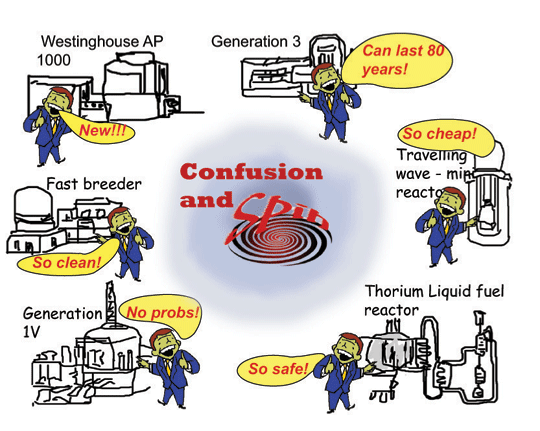
The nuclear industry, beset by massive cost overruns in the construction of current-generation reactors, has placed its hopes for new nuclear capacity in “advanced” or “next-generation” reactor designs, a broad category that includes everything from smaller versions of conventional light-water reactors to designs that eschew water entirely in favor of other cooling substances in the nuclear core like helium or salt. These reactors have the potential to help achieve decarbonization goals [an unlikely claim, and certainly not in time for the urgent climate need] by replacing fossil fuel plants, powering the production of clean hydrogen and firming renewable energy, among other possibilities. Several companies are developing designs and targeting deployment of their first commercial demonstration projects over the next decade.
Both the Biden and Trump administrations have supported research and development efforts toward advanced reactors, and Congress has passed legislation intended to streamline the regulatory path ahead. But the Nuclear Energy Institute (NEI), the primary trade association for the nuclear industry, argues that if advanced reactors are to succeed, the federal government needs to do much more to create a domestic market for this fuel. “The commercialization of many advanced nuclear technologies is in jeopardy,” NEI President and CEO Maria Korsnick said in a 2020 letter to then-U.S. Energy Secretary Dan Brouillette.
The biggest policy change advocated by NEI is for the federal government to sign a contract with a nuclear fuel supplier to essentially create a new market.
Both the Biden and Trump administrations have supported research and development efforts toward advanced reactors, and Congress has passed legislation intended to streamline the regulatory path ahead. But the Nuclear Energy Institute (NEI), the primary trade association for the nuclear industry, argues that if advanced reactors are to succeed, the federal government needs to do much more to create a domestic market for this fuel. “The commercialization of many advanced nuclear technologies is in jeopardy,” NEI President and CEO Maria Korsnick said in a 2020 letter to then-U.S. Energy Secretary Dan Brouillette.
What is HALEU?
What most of the advanced reactor developers seeking Nuclear Regulatory Commission (NRC) approval have in common, however, is that they would not be fueled by the form of uranium used in most nuclear power plants operating around the world today. Rather, they would use a form that is more highly enriched — or, to be more specific, has been made into a more fissionable form by using technology such as centrifuges to alter the balance of protons and neutrons in the uranium……….
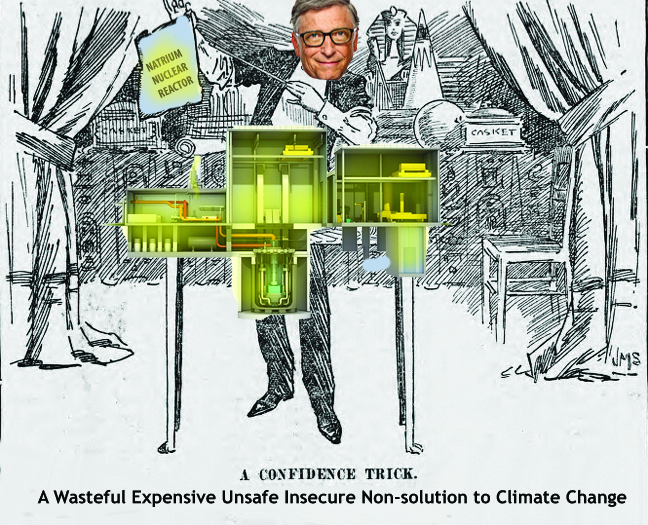
TerraPower, the Bill Gates-funded startup that is developing the Natrium sodium fast reactor with GE Hitachi Nuclear Energy, is also banking on HALEU. While, at 345-MW, the Natrium reactor is much larger than Oklo’s, TerraPower’s design also relies on the high uranium-235 content of HALEU to allow the reactor to run efficiently, particularly when ramping up or down to follow changes in load driven by renewable energy. TerraPower declined to comment for this story. The startup and Centrus have said they plan to work together to expand HALEU production after Centrus’s DOE contract ends in 2022.
……………….. Advanced reactors are in a position where they need a HALEU supply for commercialization of their technology to be possible, but there needs to be commercial market with demand for the fuel in place for the HALEU supply to get off the ground, according to nuclear engineer Matthew Corradini, a professor emeritus at the University of Wisconsin. “It’s a chicken and egg situation,” he said
One solution proposed by NEI is for the federal government to create the market …………. https://www.utilitydive.com/news/nuclear-reactors-of-the-future-have-a-fuel-problem/604707/
Since 9/11, US Has Spent $21 Trillion on Militarism at Home and Abroad

Since 9/11, US Has Spent $21 Trillion on Militarism at Home and Abroad https://www.commondreams.org/news/2021/09/01/911-us-has-spent-21-trillion-militarism-home-and-abroad“Our $21 trillion investment in militarism has cost far more than dollars.” JAKE JOHNSONSeptember 1, 2021
In the 20 years since the September 11 attacks, the United States government has spent more than $21 trillion at home and overseas on militaristic policies that led to the creation of a vast surveillance apparatus, worsened mass incarceration, intensified the war on immigrant communities, and caused incalculable human suffering in Afghanistan, Iraq, Yemen, Libya, Somalia, and elsewhere.
According to State of Insecurity: The Cost of Militarization Since 9/11 (pdf), a report released Wednesday by the National Priorities Project, the U.S. government’s so-called “War on Terror” has “remade the U.S. into a more militarized actor both around the world and at home” by pouring vast resources into the Pentagon, federal law enforcement, and the Department of Homeland Security (DHS), an agency established in response to the September 11 attacks.
Released in the wake of the final withdrawal of U.S. troops from Afghanistan after two decades of devastating war and occupation, the new report argues that the Taliban’s rapid takeover of the country “raises deep questions about our military investments to date.”
“Twenty years ago, we were promised a vision of the War on Terror that did not come to pass: that Afghanistan would not become a quagmire, or that the Iraq War would be over in ‘five weeks or five days or five months’ and cost a mere $60 billion,” the report notes. “As the country went to war and refocused domestic security spending on terrorism, few had any inkling of the far-reaching ramifications for the military, veterans, immigration, or domestic law enforcement.”
The National Priorities Project (NPP), an initiative of the Institute for Policy Studies, estimates that of the $21 trillion the U.S. invested in “foreign and domestic militarization” in the aftermath of September 11, 2001, $16 trillion went to the military, $3 trillion to veterans’ programs, $949 billion to DHS, and $732 billion to federal law enforcement.

In addition to fueling death and destruction overseas, the new report stresses that spending on overseas wars heightened domestic militarization, making police crackdowns on dissent at home even more violent.
There is evidence that the War on Terror drove transfers of military equipment to police, as surges ended and the Pentagon looked to divest from surplus equipment,” the analysis notes. “Transfers in 2010, when the military was still deeply engaged in the War on Terror, totaled $30 million. Over the next few years, the U.S. pulled forces out of Iraq, and military equipment transfers skyrocketed, peaking at $386 million in 2014. Today, transfers are still far higher than they were early in the War on Terror, totaling $152 million in 2020 and $101 million in just the first half of 2021.”
Lindsay Koshgarian, program director of NPP and lead author of the new report, said in a statement Wednesday that “our $21 trillion investment in militarism has cost far more than dollars.”
There is evidence that the War on Terror drove transfers of military equipment to police, as surges ended and the Pentagon looked to divest from surplus equipment,” the analysis notes. “Transfers in 2010, when the military was still deeply engaged in the War on Terror, totaled $30 million. Over the next few years, the U.S. pulled forces out of Iraq, and military equipment transfers skyrocketed, peaking at $386 million in 2014. Today, transfers are still far higher than they were early in the War on Terror, totaling $152 million in 2020 and $101 million in just the first half of 2021.”
Lindsay Koshgarian, program director of NPP and lead author of the new report, said in a statement Wednesday that “our $21 trillion investment in militarism has cost far more than dollars.”
- $4.5 trillion could fully decarbonize the U.S. electric grid;
- $2.3 trillion could create five million $15-per-hour jobs with benefits and cost-of-living adjustments for 10 years;
- $1.7 trillion could erase student debt;
- $449 billion could continue the extended Child Tax Credit for another 10 years;
- $200 billion could guarantee free preschool for every 3-and-4-year old for 10 years, and raise teacher pay; and
- $25 billion could provide Covid vaccines for the population of low-income countries.
- The NPP report was published on same day that Brown University’s Costs of War Project released a new analysis estimating that U.S.-led post-9/11 wars in Iraq, Afghanistan, and elsewhere have killed at least 929,000 people—a figure deemed likely to be a “vast undercount”—and cost more than $8 trillion.”The end of the war in Afghanistan represents a chance to reinvest in our real needs,” Koshgarian said Wednesday. “Twenty years from now, we could live in a world made safer by investments in infrastructure, job creation, support for families, public health, and new energy systems, if we are willing to take a hard look at our priorities.”
Oblivion and 9 Other Best Dystopian Films About Nuclear War
Oblivion & 9 Other Best Dystopian Films About Nuclear War
Whether they show the build-up, detonation, or aftermath of a nuclear war, these movies portray those disasters better than others. Screen Rant BY TRICIA MAWIRE, 1 Sept 21, Nothing is more thrilling and simultaneously terrifying like a film about nuclear war. From the build-up to the detonation and aftermath of the attack, every minute is an emotional experience using fiction to show the grim reality of such a disaster. Although not all these movies show a post-apocalyptic dystopian world, those that do paint quite a picture of what life would be like when disaster strikes.
……On The Beach (1959)……………… . With the central theme being the end of the world, there are no happy endings in this one, even for the romance storyline which has a tragic ending.
Dr. Strangelove (1964)………. As one of Stanley Kubrick’s best productions, the film combines humor and the doom and gloom of nuclear warfare to create a feeling of comic dread throughout its run. ……..
Testament (1983)…………. Testament is an emotionally devastating film with an accurate depiction of the fallout of a nuclear war. The factual accuracy of the impact and effects of such a disaster are haunting, leaving a heartwrenching image in the minds of all who watch the movie.
Special Bulletin (1983)………. a group of terrorists threatens to detonate a homemade nuclear device if the U.S. government doesn’t agree to hand over the triggers for their nuclear weapons.
The Day After (1983)……… depicts ordinary people living their lives, the terrifying build-up to the disaster, and the aftermath of the nuclear attack. This approach shows the audience how easily an ordinary day can turn tragic within seconds.
Threads (1984)……….. struggles to survive the post-apocalyptic world where food has become the only thing of value and the cause of many fights…… Most dystopian movies about nuclear war have a grim tone, but Threads takes it a notch higher. It shows the horrifying reality of a nuclear war, highlighting the message that no one wins when it comes to such a tragedy. From the beginning right until the heartbreaking end, Threads is unrelentingly dreadful.
When The Wind Blows (1986)……..Despite the animated nature of the film, it captures the couple’s emotions throughout the attack in a way that’s touching and relatable……Miracle Mile (1988)………. mainly focuses on the leading moments before the attack, capturing Harry’s panic and the doubts of the unconfirmed attack he keeps warning others about….
The Divide (2011) ………. an interesting take on a post-apocalyptic world that captures the sentiment “survival of the fittest” in a brutal way. It holds the audience’s attention but is one of those creepy movies fans wouldn’t watch twice.
Oblivion (2013)…… The post-apocalyptic action flick paints a gruesome picture of a war-torn planet…. https://screenrant.com/oblivion-best-dystopian-films-about-nuclear-war/
Kean says states may carve own path on energy transition, flags talks with coal owners — RenewEconomy

‘Whether Canberra likes it or not, we’ve got to crack on with it’, Kean signals states could leave Morrison government behind in transition to clean energy. The post Kean says states may carve own path on energy transition, flags talks with coal owners appeared first on RenewEconomy.
Kean says states may carve own path on energy transition, flags talks with coal owners — RenewEconomy
“Missing in action:” Former defence chief says Australia failing on climate change — RenewEconomy

New report says failure of leadership by Australian governments has left country ill-prepared for the security implications of devastating climate impacts. The post “Missing in action:” Former defence chief says Australia failing on climate change appeared first on RenewEconomy.
“Missing in action:” Former defence chief says Australia failing on climate change — RenewEconomy
CopperString gets transmission approval for Townsville to Mt Isa renewables link — RenewEconomy

CopperString reaches key milestone with transmission authority, but still needs approvals and deal with governments and customers. The post CopperString gets transmission approval for Townsville to Mt Isa renewables link appeared first on RenewEconomy.
CopperString gets transmission approval for Townsville to Mt Isa renewables link — RenewEconomy
Offshore wind set for take off in Australia as legislation tabled in parliament — RenewEconomy

Angus Taylor introduces legislation to allow offshore wind projects, a move that is likely to kickstart several multi-gigawatt scale projects. The post Offshore wind set for take off in Australia as legislation tabled in parliament appeared first on RenewEconomy.
Offshore wind set for take off in Australia as legislation tabled in parliament — RenewEconomy
September 1 Energy News — geoharvey

Opinion: ¶ “It’s Time To Pay Serious Attention To The Power Grid” • Millions of Americans have gone without power this year. The examples include California (heat), Texas (cold) and Louisiana (hurricanes). New Orleans is powerless, potentially for weeks, after Hurricane Ida, and dangerously high temperatures setting in. It’s time to think about a resilient […]
September 1 Energy News — geoharvey
Solar Insiders Podcast: Solar is king, but who gets to control it? — RenewEconomy

Why rooftop solar will be dominant feature of grid within 5 years. And we speak to Autonomous Energy over recent buyout. The post Solar Insiders Podcast: Solar is king, but who gets to control it? appeared first on RenewEconomy.
Solar Insiders Podcast: Solar is king, but who gets to control it? — RenewEconomy
Amp Energy secures land for massive solar, battery, green hydrogen play — RenewEconomy

Plans to establish a renewable hydrogen hub in South Australia’s Whyalla region gain ground with a site locked in for the first of three solar and big battery projects. The post Amp Energy secures land for massive solar, battery, green hydrogen play appeared first on RenewEconomy.
Amp Energy secures land for massive solar, battery, green hydrogen play — RenewEconomy
Chloe Munro Scholarship to honour “enormous legacy” of leader in renewables — RenewEconomy

Scholarship to support emerging female leaders in renewables, energy management and carbon abatement established in honour of Chloe Munro. The post Chloe Munro Scholarship to honour “enormous legacy” of leader in renewables appeared first on RenewEconomy.
Chloe Munro Scholarship to honour “enormous legacy” of leader in renewables — RenewEconomy
Biggest wind farm in NSW reaches financial close, to feature Australia’s biggest turbines — RenewEconomy

Biggest wind farm in NSW reaches financial close, to be built in electorate of federal energy minister Angus Taylor. The post Biggest wind farm in NSW reaches financial close, to feature Australia’s biggest turbines appeared first on RenewEconomy.
Biggest wind farm in NSW reaches financial close, to feature Australia’s biggest turbines — RenewEconomy
Morrison will take catastrophic climate policy failure to COP26 — RenewEconomy

The last emissions data before COP26 is out, adding to the long list of failures Morrison will be taking to Glasgow’s climate meeting in November. The post Morrison will take catastrophic climate policy failure to COP26 appeared first on RenewEconomy.
Morrison will take catastrophic climate policy failure to COP26 — RenewEconomy
A positive outlook for Australia’s clean climate, nuclear-free, future- theme for September 21
As we head towards the Climate Summit, COP26 in Glascow, Australia ought to have a pivotal role to play in discussions on climate action. Unfortunately we have a federal government, and mass media, in the thrall of the polluting industries. Australians who care about their children’s future might well be ashamed.
However, there is cause for optimism. The Australian public is aware and wants action on climate change. A national poll, reported on August 30, shows that in every single electorate across the land, voters want more government action on climate change. Whoever is sent by the government to COP26 to muddy the waters on climate action, will not be representing Australians asa whole.
Meanwhile, Australians are taking up clean reneweable energy with enthusiasm. Reports on 31 August show the rapid growth in rooftop solar, ”AEMO forecasts rooftop solar would continue its boom and by 2026 would on its own supply 77 per cent of the demand in the National Electricity Market during the day.” ”Australia’s energy transition really does continue at pace and now our base case forecast by 2025 is the national electricity market can be supplied by 100 per cent renewable energy,”
Australians have a proud history of environmental action. Particularly in relation to nuclear issues. We have, as Professor Ian Lowe puts it ”dodged a bullet” in rejecting nuclear power. Australians have been foremost in the nuclear disarmament movement, more recently in initiating The International Campaign to Abolish Nuclear Weapons (ICAN) , which brought about the UN Treaty on the Prohibition of Nuclear Weapons.
Both in small local groups, and in organisations, (Friends of the Earth, Australian Conservation Foundation, ICAN, Extinction Rebellion, and more) there’s a wellspring of enthusiasm for saving the environment, and bringing about a nuclear-free world.
We now know that ”peaceful” nuclear power is absolutely connected to nuclear weapons (indeed, the nuclear industry now boasts of that). We also know that the nuclear industry is flat out publicising itself as ”clean and green”. A global task is to keep that dirty and dangerous industry out of the climate action policies to be decided on at COP26.
Australians have a role in local action to keep this country clean and nuclear-free, and also in joining with international non-government organisations in the global environmental movement.
20 reasons why the Lucas Heights unviable production of medical isotopes is a sham and a dud.

The claim by Australian Nuclear Science and Technology Organisation (ANSTO) that it requires additional storage
capacity for intermediate level nuclear or radioactive waste at its Lucas Heights operations is completely false and consequently unjustified in all respects.
REASONS
- The present storage capacity at Lucas Heights is more than adequate for many years and even decades – this is the view of the Australian Radiation Protection and Nuclear Safety Agency (ARPANA) as the regulator and licensing authority
- The main undertaking representing 80% of its total operations and activity by ANSTO at Lucas Heights is the
production of nuclear medicineThe main undertaking representing 80% of its total operations and activity by ANSTO at Lucas Heights is theproduction of nuclear medicine - Only some 10% of this production annually is for local use in Australia
- The remainder is sold overseas but it is a very limited market
- The predominant purchasers of this production of nuclear medicine are third world countries
- These countries cannot afford to pay ANSTO for this nuclear medicine and hence it is treated as additional foreign aid by Australia
- The manufacture of nuclear medicine even in fully and proper commercial circumstances is a large loss making proposition
- It is estimated from authoritative overseas research that revenue from isotope production for nuclear medicine would likely offset only approximately 10% to 15% of the costs of the reactor used for the production and this does not include all the other costs associated with the production
9. Added to this ANSTO is regarded by world standards as an extremely high cost manufacturer of nuclear medicine
- ANSTO is fully funded as to its existence and operations by the federal government
11. On top of this ANSTO has proved to be a less than efficient producer of nuclear medicine due to the instances of shutting down of its reactor at Lucas Heights
- When this has occurred ANSTO purchased the nuclear medicine isotopes from overseas which has proved to be more efficient and cheaper than local production
- It was reported that ANSTO received $238 million last year as its annual funding from the federal government
- ANSTO because of this funding has no incentive or need to achieve profitability particularly in its production of nuclear medicine which represents its major undertaking and operational activity
- In any case there is a strong move in medicine throughout the world away from using nuclear medicine in all diagnosis and treatment due to its harmful nature
- Some countries are virtually banning nuclear medicine both in its manufacture and its use locally and for export because of its inherent dangerous nature
- An alternative permanent disposal would be better.
- The indisputable conclusion internationally is that the use of nuclear medicine generated by reactors is rapidly declining to a level where its future production will no longer be viable
- In view of the foregoing there are no justifiable or valid reasons or pretext for :
(a) the continued production by ANSTO of nuclear medicine by using a nuclear reactor for whatever reasons at Lucas Heights or elsewhere in Australia;
(b) the continuing loss making production of nuclear medicine by ANSTO at Lucas Heights for export overseas;
(c) the need to increase the storage capacity at Lucas Heights for intermediate level waste generated by the production of nuclear medicine; and
20 No pretext for the establishment whatsoever of the nuclear waste management facility by the federal government at Napandee
1 This month.

PETITION – To: Prime Minister Anthony Albanese and the Australian Labor Government
Chernobyl: The Lost Tapes – A good documentary on Chernobyl on SBS available On Demand for the next 3 weeks– https://www.sbs.com.au/ondemand/tv-program/chernobyl-the-lost-tapes/235274195556

19 May – Webinar- Webinar: No Nuclear Weapons in Australia
Start: 2026-05-19 18:00:00 UTC Canberra, Melbourne, Sydney (GMT+10:00)
End: 2026-05-19 19:30:00 UTC Canberra, Melbourne, Sydney (GMT+10:00)
20 May – Webinar – The dangerous world of AUKUS, US, military occupation and suppression of dissent

National Webinar, 20th May, 2026, 6.30pm AEST. Confronting laws restricting/suppressing protest speech and action
Speakers: Former Sen. Rex Patrick, Lawyer Nick Hanna ,Arthur Rorris ,Jorgen Doyle, Sen David Shoebbridge,
Facilitator Kelley Tranter.

of the week – Australians for War Powers Reform (AWPR)
To see nuclear-related stories in greater depth and intensity
 Antinuclear