Labor to lose progressive identity with small-target policies — John Quiggin
I’ve written another denunciation of Labor’s capitulation on high-income tax cuts at Independent Australia. Read there, comment here.
Labor to lose progressive identity with small-target policies — John Quiggin
Guess who joined Angus Taylor on Empire-funded fracking gas trip to Beetaloo Basin — RenewEconomy

Gas company Empire Energy funded a trip for Angus Taylor and a range of prominent Liberal party figures and donors to its Beetaloo Basin project. The post Guess who joined Angus Taylor on Empire-funded fracking gas trip to Beetaloo Basin appeared first on RenewEconomy.
Guess who joined Angus Taylor on Empire-funded fracking gas trip to Beetaloo Basin — RenewEconomy
Afghanistan: Who’s to Blame and What Next? panel by Code Pink — Rise Up Times

Includes Biden’s full speech to the U.S. nation and responses of the panelists.
Afghanistan: Who’s to Blame and What Next? panel by Code Pink — Rise Up Times
Action on climate change is stalled by unwise spending on small nuclear reactors

So Who Is Advocating For SMRs & Why?
So why are they doing this?
Because it allows them to defer governmental climate action while giving the appearance of climate action. They can pander to their least intelligent and wise supporters by asserting that renewables aren’t fit for purpose, while also not doing anything about the real problem because SMRs don’t exist in a modern, deployable, operable form yet.
the people asserting that SMRs are the primary or only answer to energy generation either don’t know what they are talking about, are actively dissembling or are intentionally delaying climate action.
Small nuclear reactor advocates refuse to learn the lessons of the past, While history doesn’t repeat, merely rhymes, SMRs are rhyming hard, Medium.com Michael Barnard, 12 Aug 21, Like hydrogen, small modular nuclear reactors have been seeing a resurgence of interest lately. Much of that is driven by governmental policies and investments focusing on the technology. Much of it comes from the nuclear industry. And inevitably, some comes from entrepreneurs attempting to build a technology that they hope will take off in a major way, making them and their investors a lot of money.
Small modular reactors won’t achieve economies of manufacturing scale, won’t be faster to construct, forego efficiency of vertical scaling, won’t be cheaper, aren’t suitable for remote or brownfield coal sites, still face very large security costs, will still be costly and slow to decommission, and still require liability insurance caps. They don’t solve any of the problems that they purport to while intentionally choosing to be less efficient than they could be. They’ve existed since the 1950s and they aren’t any better now than they were then.
Most of the attention and funding is misguided at best, and actively hostile to climate action at worst.
There are a handful of differences between them and traditional nuclear generation reactors. The biggest one is that they are smaller, hence the ‘small’ and ‘medium’ in the names. They range from 0.068 MW to 500 MW in capacity, with the International Atomic Energy Association using small for up to 300 MW and medium for up to 700 MW.
Despite the buzz, this is not new technology. The first nuclear generation plant was a Russian 5 MW device that went live in 1954. Hundreds of small reactors have been built for nuclear powered vessels and as neutron sources. This is well trodden ground. Most of the innovations being touted were considered initially decades ago.
Continue readingSome uncomfortable questions for Sam Chard · General Manager, Australian Radioactive Waste Agency.

Why was Manager Chard nearly two years ago referring to Whyalla as a port for the transport of nuclear material?
Was this to pave the way for using Whyalla for transport of nuclear material for the proposed Kimba facility?
Had the Whyalla municipal administration been approached about the possible use of its port for transport of nuclear material?
Has Chard or someone else from the federal government approached or discussed possible transport arrangements for nuclear material with any transport or logistics contractors or consultants?
If so will Chard publicly and fully disclose the extent and details of the approaches or discussions including identifying the contractors or consultants?
Was the Whyalla municipal administration involved in these approaches and discussions?
Did any of the contractors or consultants point out that the transport proposals by the federal government were in breach of international standards and prescriptions and did not follow the recognised best practices with respect to the transport ingredient of those proposals?
In seeking this information Chard should be warned that parts of it are already known and hence she should be careful about the veracity of her responses and waive any claims of confidentiality
Presumably the parties seeking any form of judicial review would be able to seek this information as a pre-trial disclosure
Woodside-BHP oil and gas merger “disastrous” for climate, and some shareholders — RenewEconomy

BHP and Woodside to merge oil and gas businesses, creating a $41bn giant. It might be good for BHP, but could be a disaster for the climate. The post Woodside-BHP oil and gas merger “disastrous” for climate, and some shareholders appeared first on RenewEconomy.
Woodside-BHP oil and gas merger “disastrous” for climate, and some shareholders — RenewEconomy
Australian “dual turbine” wave power breakthrough promises to double efficiency — RenewEconomy

Australian-led research breakthrough raises fresh hopes that wave power can play a large-scale and commercially viable role in the global shift to renewables. The post Australian “dual turbine” wave power breakthrough promises to double efficiency appeared first on RenewEconomy.
Australian “dual turbine” wave power breakthrough promises to double efficiency — RenewEconomy
Australian researchers set new efficiency record for double-sided solar cells — RenewEconomy

Australian National University researchers set new efficiency record for double-sided solar cells and hope deliver a boost solar farm output. The post Australian researchers set new efficiency record for double-sided solar cells appeared first on RenewEconomy.
Australian researchers set new efficiency record for double-sided solar cells — RenewEconomy
Italian energy giant plans another 1,000MW renewables in Australia, seeks retail licence — RenewEconomy

Europe’s biggest utility plans to add another 1,000MW of renewables capacity in Australia and is seeking a retail licence to focus on industrial customers. The post Italian energy giant plans another 1,000MW renewables in Australia, seeks retail licence appeared first on RenewEconomy.
Italian energy giant plans another 1,000MW renewables in Australia, seeks retail licence — RenewEconomy
Radioactive snakes may monitor Fukushima fallout,
Radioactive snakes may monitor Fukushima fallout, Bulletin of the Atomic Scientists, By Susan D’Agostino | August 17, 2021 When a massive earthquake followed by a tsunami hit Japan a decade ago, the Fukushima Daiichi Nuclear Power Plant experienced a catastrophic meltdown. Humans fled a wide area around the plant that today is known as the Fukushima Exclusion Zone, while animals and plants remained. Now, scientists have enlisted the help of snakes in the zone to make sense of the disaster’s impact on the environment. Their findings, reported in an Ichthyology and Herpetology paper, indicate that Fukushima’s native rat snakes, like canaries in a coal mine, may act as living monitors of radiation levels in the region.
“Because snakes don’t move that much, and they spend their time in one particular local area, the level of radiation and contaminants in the environment is reflected by the level of contaminants in the snake itself,” Hannah Gerke, a lead author on the study, said.
………… The scientists’ findings reinforced their 2020 study that found a high correlation between levels of radiocesium—a radioactive isotope of cesium—in the snakes and levels of radiation in their environment.
………. rat snakes have relatively small home ranges; they travel an average of 65 meters (approximately 213 feet) each day, according to the study. And they are susceptible to accumulating radionuclides—unstable atoms with excess nuclear energy—from disasters such as the one that took place in Fukushima. A rat snake that makes its home in a small but heavily contaminated area will tell a different story than a rat snake lives in a less contaminated locale.
In the decade since the nuclear disaster, most of the contaminants have settled in the soil. This means that animals such as birds that spend much of their time in trees have limited insight to offer about contaminants on the ground. But snakes, whose long bodies slither in and burrow under the soil, can help determine degrees of contamination.
Also, snakes live long, which means that the data they gather provides information about environmental contaminants over time……………..
The scientists identified more than 1,700 locations in the region that the snakes frequented. Rat snakes in Fukushima, it turns out, avoid evergreen broadleaf forests but spend time close to streams, roads, and grassland. They also frequent trees and buildings.
What did the snakes reveal? Some of the snakes’ radiation exposure in the Fukushima Exclusion Zone hails from contaminated prey they eat, but most—80 percent—comes from contact with contaminated soil, trees, and plants.
“Understanding how contaminants move throughout an ecosystem and how they move in different animals throughout the food web gives us a better picture of the impacts [of the nuclear disaster] to the ecosystem,” Gerke said………….. https://thebulletin.org/2021/08/radioactive-snakes-may-monitor-fukushima-fallout/
Big winners from the Afghan war -the weapons-making corporations.

Progressive Critics Say Investors in US Weapon-Makers Only Clear Winners of Afghan War
“The military-industrial complex got exactly what it wanted out of this war.” https://www.commondreams.org/news/2021/08/17/progressive-critics-say-investors-us-weapon-makers-only-clear-winners-afghan-war
As the hawks who have been lying about the U.S. invasion and occupation of Afghanistan for two decades continue to peddle fantasies in the midst of a Taliban takeover and American evacuation of Kabul, progressive critics on Tuesday reminded the world who has benefited from the “endless war.”
“Entrenching U.S. forces in Afghanistan was the military-industrial complex’s business plan for 20+ years,” declared the Washington, D.C.-based advocacy group Public Citizen.
“Hawks and defense contractors co-opted the needs of the Afghan people in order to line their own pockets,” the group added. “Never has it been more important to end war profiteering.”
In a Tuesday morning tweet, Public Citizen highlighted returns on defense stocks over the past 20 years—as calculated in a “jaw-dropping” analysis by The Intercept—and asserted that “the military-industrial complex got exactly what it wanted out of this war.”
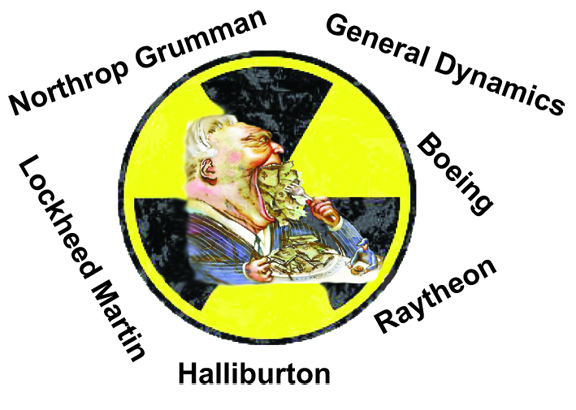
The Intercept‘s Jon Schwarz examined returns on stocks of the five biggest defense contractors: Boeing, Raytheon, Lockheed Martin, Northrop Grumman, and General Dynamics
defense stocks outperformed the stock market overall by 58% during the Afghanistan War.
.
Schwarz found that a $10,000 investment in stock evenly split across those five companies on the day in 2001 that then-President Georg W. Bush signed the authorization preceding the U.S. invasion would be worth $97,295 this week, not adjusted for inflation, taxes, or fees.
According to The Intercept:
This is a far greater return than was available in the overall stock market over the same period. $10,000 invested in an S&P 500 index fund on September 18, 2001, would now be worth $61,613.
That is, defense stocks outperformed the stock market overall by 58% during the Afghanistan War.
“These numbers suggest that it is incorrect to conclude that the Taliban’s immediate takeover of Afghanistan upon the U.S.’s departure means that the Afghanistan War was a failure,” Schwarz added. “On the contrary, from the perspective of some of the most powerful people in the U.S., it may have been an extraordinary success. Notably, the boards of directors of all five defense contractors include retired top-level military officers.”
“War profiteering isn’t new,” journalist Dina Sayedahmed said in response to the reporting, “but seeing the numbers on it is staggering.”
Progressive political commentator and podcast host Krystal Ball used Schwarz’s findings to counter a key argument that’s been widely used to justify nearly 20 years of war.
“This is what it was really all about people,” she tweeted of the defense contractors’ returns. “Anyone who believes we were in Afghanistan to help women and girls is a liar or a fool.”
Jack Mirkinson wrote Monday for Discourse Blog that “it is unquestionably heartbreaking to think about what the Taliban might inflict on women and girls, but let us dispense with this fantasy that the U.S. has been in Afghanistan to support women, or to build democracy, or to strengthen Afghan institutions, or any of the other lines that are deployed whenever someone has the temerity to suggest that endless war and occupation is a harmful thing.”
“We did not go into Afghanistan to support its people, and we did not stay in Afghanistan to support its people,” he added. “It is astonishing, given what we know about the monsters that the U.S. has propped up time and time again around the world, that the myth persists that we do anything out of our love for human rights. We went in and we stayed in for the same reason: the American empire is a force that must remain in perpetual motion.”
As Common Dreams reported Monday, while the Taliban has retaken control, anti-war advocates have argued diplomacy is the only path to long-term peace, with Project South’s Azadeh Shahshahani emphasizing that “the only ones who benefited from the U.S. war on Afghanistan were war-profiteering politicians and corporations while countless lives were destroyed.”
Responding to Shahshahani’s tweet about who has benefited from two decades of bloodshed, Zack Kopplin of the Government Accountability Project wrote, “Adding war-profiteering generals to the mix too.”
Afghanistan: anatomy of a fool’s errand — daryanenergyblog

Originally posted on daryanblog: The algorithm’s running social media seem to be getting darn smart. Because just the other day, 55 days: the fall of Saigon popped into my feed. And to say this is eerily similar to events in Afghanistan is an understatement. You even had incidences of desperate people trying to hang on…
Afghanistan: anatomy of a fool’s errand — daryanenergyblog
August 18 Energy News — geoharvey

Opinion: ¶ “Higher Carbon Prices Driving Greater Interest In Carbon Capture Technology” • Carbon capture is expensive, at about $120 a ton, and it doesn’t work very well. It may be a decade or more before carbon capture is commercially viable. But as countries prices on carbon, it might be possible to make carbon capture […]
August 18 Energy News — geoharvey
Australia’s participation in America’s wars. Was it worth it?
War Powers: immense profits for arms dealers, incalculable losses for Australians,michael West Media,
By Tasha May|August 17, 2021
“Freedom’s always worth it,” said Scott Morrison. “What a waste,” said the father who had lost his son in Afghanistan. Afghanistan, Iraq, Vietnam. Tasha May totes up the immense cost of futile wars and the immense profits.
As Australians watched the Taliban take Afghanistan’s capital Kabul Sunday, many were left wondering why Australia spent two decades there.
If we draw a line back to Australia’s participation in foreign wars since we followed America into Vietnam in 1962, Afghanistan presents yet another conflict with far greater losses than anything gained. It begs the question of why the pattern keeps repeating itself, with yet more soldier and civilian lives lost, billions more dollars spent, without any greater foresight exercised before entering these conflicts?
As Adam Bandt, leader of the Greens has said, “the wars in Vietnam, Afghanistan and Iraq were all wars Australia got involved in with the Prime Minister exercising the powers as though they were a monarch. They didn’t even consult cabinet. All those invasions were disasters”.
These were the words Bandt shared with Parliament as he introduced a bill for war powers reform, requiring parliament’s approval before Australians are sent into armed conflict abroad. Yet it’s a reform that’s been introduced before, first by the Democrats in 1985 and 1988 and 2003, and then by the Greens in 2003 and 2014 and which Coalition and Labor governments have opposed.
While this most serious of decisions has continued to rest with the Prime Minister and his executives, where have their decisions led Australia and what has been achieved?
Michael West Media has summarised below the toll the wars in Vietnam, Iraq and Afghanistan have taken on human lives, both solider and civilian, as well as heavy economic costs. Looking at the balance sheet, it’s clear only the defence contractors like Lockheed Martin, Raytheon, BAE and Northrup Grumman come out as winners.
The Losses
The economic cost to Australia are in the billions of dollars………. [ excellent graph]
But of course that price tag is nothing compared to the millions of lives that have been lost, lives of Australian defence personnel and civilians. [graph]
The number of defence personnel killed does not even include the 500 veteran suicides in Australia since the start of the Afghanistan war.
The Winners
In the last 20 years, arms manufacturer Lockheed Martin’s value on the New York Stock Exchange has risen from $US33 to today over $US360. They have proudly called their technology “Afghanistan’s Eyes in the Sky.”
In the same period arms manufacturer Northrup Grumman have risen from $US40 on the NYSE to today to today over $US365. The company has supported unmanned aircraft systems in Afghanistan. https://www.michaelwest.com.au/war-powers-immense-profits-for-arms-dealers-incalculable-losses-for-australians/—
Australian government moves to limit charities’ ability to campaign during election period.
Charity sector faces new advocacy threat, Sector leaders say the government is trying to make charities less visible during election periods, Pro Bono Australia, Luke Michael | 16 August 2021 Charities are deeply concerned by a new government proposal that would force more community groups to register as political campaigners, amid fears this will restrict charitable advocacy at election times.
The Morrison government has introduced a new bill to lower the expenditure threshold for political campaigners from $500,000 to $100,000 during the financial year, or for any of the three previous years.
This means any organisation spending more than this amount seeking to influence voters in an election will be subject to extra reporting requirements and restrictions.
Assistant Minister for Electoral Matters Ben Morton said this would enhance public confidence in Australia’s political processes by making these groups more transparent, in line with political parties and candidates.
He said these amendments did not “represent a significant change” for organisations that meet the updated thresholds, noting many already need to submit a return to the Australian Electoral Commission as a third party campaigner.
But charity sector leaders argue the new requirements would be onerous and stifle the voices of community groups.
Community Council for Australia CEO David Crosbie told Pro Bono News charities were very different from political parties and should not be treated as such.
He said the threat of being labelled a political campaigner would restrict charitable advocacy at election times.
“Charities advocate on their issues only and do not seek political power,” Crosbie said.
“The level of reporting and transparency required of those who would represent us needs to be a much higher bar than individual charities advocating on their public benefit charitable purpose.
“Even though some political parties may think it is in their political interests if charities are less visible during election periods, the reality is that silencing charitable voices also silences voices from the community, and that is never good for democracy or for Australia………
The Australian Conservation Foundation’s (ACF) democracy campaigner, Jolene Elberth, noted that charities have made it clear during committee reviews that lowering the threshold would hurt the sector.
“The existing ‘political campaigner’ threshold was determined after extensive consultation with civil society only a couple of years ago,” Elberth said.
“The committee that recommended lowering the threshold provided only two paragraphs of reasoning for this proposed change and did not give any evidence or reference submissions it had received.
“This is not evidence-based policy making.”
Elberth said while this change seemed small, it would have the effect of silencing community voices.
She said elections were crucial times for charities to highlight policy reforms in the public interest and elevate important issues.
“The government should encourage many diverse voices during election campaigns, not seek to silence them, as these bills would do,” she said……..
While the ALP’s position on the legislation is currently unclear, the Greens has already voiced its opposition to the changes.
Greens deputy leader Senator Larissa Waters said: “This is another dangerous attack on civil society groups and an attempt to limit their advocacy by adding additional financial and disclosure burdens.”
You can take a look at the bill here. https://probonoaustralia.com.au/news/2021/08/charity-sector-faces-new-advocacy-threat/
1 This month.


PETITION – To: Prime Minister Anthony Albanese and the Australian Labor Government
Chernobyl: The Lost Tapes – A good documentary on Chernobyl on SBS available On Demand for the next 3 weeks– https://www.sbs.com.au/ondemand/tv-program/chernobyl-the-lost-tapes/235274195556

19 May – Webinar- Webinar: No Nuclear Weapons in Australia
Start: 2026-05-19 18:00:00 UTC Canberra, Melbourne, Sydney (GMT+10:00)
End: 2026-05-19 19:30:00 UTC Canberra, Melbourne, Sydney (GMT+10:00)
20 May – Webinar – The dangerous world of AUKUS, US, military occupation and suppression of dissent

National Webinar, 20th May, 2026, 6.30pm AEST. Confronting laws restricting/suppressing protest speech and action
Speakers: Former Sen. Rex Patrick, Lawyer Nick Hanna ,Arthur Rorris ,Jorgen Doyle, Sen David Shoebbridge,
Facilitator Kelley Tranter.

of the week – Australians for War Powers Reform (AWPR)
To see nuclear-related stories in greater depth and intensity
 Antinuclear