Dirty deed: Dutton’s nuclear scheme locks in 20 years of higher climate pollution

February 24, 2025 AIMN Editorial, Climate Council https://theaimn.net/dirty-deed-duttons-nuclear-scheme-locks-in-20-years-of-higher-climate-pollution/
Federal Opposition leader Peter Dutton is keeping Australians in the dark about his risky nuclear scheme. An explosive new report from Australia’s independent Climate Change Authority reveals the Federal Coalition’s nuclear scheme would see climate pollution blow out for more than 20 years, leading to up to 2 billion tonnes of additional climate pollution by 2050.
The Climate Council says Mr Dutton’s nuclear scheme risks locking Australia into worsening climate catastrophes, with no credible plan to cut pollution from coal, oil or gas.
Climate Council CEO Amanda McKenzie said: “Mr Dutton knows most Australians want their government to be making progress on climate action. But modelling from the Climate Change Authority shows his nuclear scheme would massively drive up climate pollution and put Australia in breach of its own national law, and international law. Mr Dutton himself has warned that failing to meet our global climate commitments would hurt our own economy and cost Australians jobs.
“The Coalition is out of step and out of touch with the majority of everyday Australians, who overwhelmingly voted for climate action at the last election and want to ditch climate pollution for clean power.”
Climate Councillor Greg Bourne said: “The Federal Coalition has spent the past three years actively blocking policies that cut climate pollution in our electricity, industrial and transport sectors, and now they’re trying to sell an energy scheme to Aussies that could add more than two billion tonnes of pollution and blow up our targets as a credible climate policy.
“Records show the Federal Coalition voted against capping pollution from big industrial polluters. They opposed cleaner and more efficient vehicles being made available to Australians by voting against the National Vehicle Efficiency Standard. And they opposed key policies for making clean energy more accessible, affordable and reliable like the Capacity Investment Scheme. The Coalition’s policies obstruct climate progress.”
Climate Council CEO Amanda McKenzie said: “Dutton’s risky nuclear scheme would burden our kids with more unnatural disasters, rising pollution and higher power bills. All Australians deserve a bright future. We need proven solutions like renewable power, backed by big batteries, that cut pollution now, not a reckless delay that locks us into climate catastrophe.”
Peter Dutton’s nuclear accounting trick #3: Hide the costs of keeping coal

Tristan Edis, Feb 21, 2025, https://reneweconomy.com.au/peter-duttons-nuclear-accounting-trick-3-hide-the-costs-of-keeping-coal/
This is part 3 of a five part series of articles examining the four accounting tricks that the Liberal-National Party employed in the costing of their energy plan to slow the roll-out of renewables and rely instead on nuclear power. The first article, which provides the overarching context is published here. Part 2 is here. Part 3 is here.
These four accounting tricks act to mislead voters that the Liberal-National Party could lower energy bills through a shift to nuclear when in reality it is likely to increase power bills.
This article focuses on accounting trick three of four: Hide most of the cost of replacing coal with nuclear to outside the time period considered in the costing.
It’s very important to note that the Coalition’s costing of its electricity system cuts out in the year 2051. It only accounts for costs incurred between 2025 to 2051 and anything after that date is ignored.
The LNP’s claim of a 44% saving does not represent the cost of two alternative systems for achieving near zero emissions once they are both completed to see how nuclear might reduce the cost of the system.
Instead, a heavy influence on the cost estimates in the model is the degree to which the scenarios can delay incurring costs in replacing the old, highly polluting and likely to be increasingly unreliable coal power plants.
How is this a problem?
Coal power stations are much like a car – they are exposed to extreme heat, pressure and general mechanical stress that means they wear out and become unreliable as they get old. That’s physics.
Many of us will have experience with an old car that has got to the point where it increasingly encounters mechanical problems and the mechanic is warning us that it really needs some major repairs but these would cost more than the car is worth.
At this point many of us can be tempted to take a gamble by putting off such repairs, and go for temporary, less costly patch-ups and hope the car keeps going. That will be a lot cheaper than buying a new car, at least for as long as we can keep the old car going. But it comes with the risk that it could leave us stranded with a broken-down car at an extremely inconvenient point in time and even pose a danger to our safety and that of others.
The Coalition’s modeled plan chooses to take that gamble with our electricity system. But it doesn’t account for the risks and potentially extreme costs this involves if the gamble goes wrong.
Clare Savage, the head of the Australian Energy Regulator has repeatedly warned that failing to replace aging coal plants risks both power system reliability and also affordability observing, “Coal can’t last until you have nuclear power available.”
The bulk of Australia’s operating coal power stations commenced operation more than 30 years ago. By the 2030’s these power stations, particularly in NSW and Victoria, will be close to, or exceeding, the point when coal power stations are typically retired from service. At this point they are likely to be increasingly unreliable and suffering from mechanical wear and tear that can even lead to dangerous explosions and fires that pose a serious risk to worker safety.
This is not theoretical – several Australian coal power stations have suffered from explosions and fires over the years. It’s also important to note that coal power stations over the next decade will face a level of output ramping to work around rooftop solar that is far more stressful than Australian coal plants have typically faced in the past.
Unless Peter Dutton has a secret plan to prioritise curtailment of rooftop solar in favour of coal generators, this is likely to get worse over time.
Now, the way that the consultant, Frontier, constructed Dutton’s costing is that they space out the cost of constructing new power stations as an annualised payment – a bit like how you’d purchase a new car not by paying for it upfront but rather by taking out a loan and then paying it back incrementally over time.
Except in this case the annualised payment for a new power station is spaced out over several decades and for nuclear it is 50 years. Meanwhile for the existing, very old power plants the original cost of constructing those plants is omitted from the annualised costs.
By pushing out the point at which they replace the old power stations with new ones until the 2040’s, the Coalition gets to hide much of the cost of the nuclear plants until towards the very back end of the projection period. We’ll still have to pay for these nuclear power stations well after 2051, but that’s conveniently left out of the costing period.
Meanwhile, in the scenario said to represent Labor Policy, the coal-fired power stations are replaced quite quickly, so the cost of the new, replacement power stations is taken into account across almost the entire time period considered in the model.
You can get a glimpse of how this works in a chart the modelling consultant provides of the annualised cost, which is provided below [on original] (they’ve refused to provide the actual underlying numbers in the chart).
The red solid line is the scenario the Liberal Party claims represents its policy. What the red line shows is that annualised costs grow only slightly up until 2039 with the one exception of a blip upward in 2036. But after 2039 costs grow very quickly.
This growth in costs – both the blip in 2036 and the rapid growth from 2040 onwards corresponds exactly to the timing of replacement of the old coal power plants with new nuclear power plants.
The nuclear plants aren’t really delivering any meaningful saving in the unit cost of energy relative to relying on renewables and storage. Instead, the savings are coming from the Liberal Party delaying the point at which the coal power plants are replaced.
No matter which party is in government, physics still takes its toll on power stations and very old ones will need to be replaced. This will incur costs no matter which technologies we chose to go with.
If we choose to take a gamble that we can string out the life of the old coal power stations, we might save some money in the short-run, but if it doesn’t work out the costs to electricity bills will be very severe.
While building power stations is costly, not having enough power stations is far more costly. We can see that cost through the fact that when coal power stations break down unexpectedly when supply is short then electricity prices typically spike to many multiples of the price needed to pay for a new power plant. That is tolerable if it happens only occasionally, but if frequent we would be far better off building the new replacement plant.
This becomes a particularly significant risk if we choose to go down the path of nuclear power stations. This is not just because we’ll have to wait longer for them to be built, but also because the nuclear industry has been hopeless at accurately estimating their construction timeframes and they come in such large chunks of capacity.
If a utility-scale battery plant comes in late it is unlikely to exceed a year delay, and they come in blocks of a few hundred megawatts. But nuclear power stations come in units of at least a thousand megawatts and can be more than 10 years late (as France has just experienced with its most recently built reactor).
This could create a no-man’s land where multiple coal units are repeatedly out of service and unable to provide reliable supply, but no one is prepared to step into the breach to invest in technologies that are reasonably quick to build. That’s because once the nuclear plant is eventually completed, financial returns in these fast-build power plants will be undermined.
Tristan Edis is director of analysis and advisory at Green Energy Markets. Green Energy Markets provides analysis and advice to assist clients make better informed investment, trading and policy decisions in energy and carbon abatement markets.
Carbon time bomb: Dutton’s nuclear plan will blow up Paris and emissions targets, CCA says
ReNew Economy Rachel Williamson, Feb 24, 2025
Choosing a nuclear power future over renewables will blow up Australia’s carbon emissions budget and create a carbon time bomb of up to 2 billion tonnes in extra greenhouse gases by 2050, a new analysis from the federal government’s Climate Change Authority says.
The analysis, released on Monday, poses a grim picture of what the nuclear future, as painted by Opposition leader Peter Dutton and analysed in a controversial and contested Frontier Economics’ report in December, would look like from an emissions perspective.
Extra emissions from the electricity sector alone would spike by a cumulative 1 billion tonnes come 2050, and this number would double when adding emissions from a broader economy unable to use zero-carbon electricity.
Australia would miss its 82 per cent emissions-free electricity target by more than a decade, reaching that target by 2042, and those emissions would also be consistent with global warming of 2.6ºC, rather than the 1.8ºC currently forecast for a renewables-led transition.
It will also ruin short term targets, causing Australia to miss its legislated 43% national emissions reduction target for 2030 by more than five percentage points, and still not achieving this level of reduction by 2035.
The Coalition plans to build nuclear plants at seven sites across Australia for an estimated $331 billion over 25 years. The locations are all old or current coal power plant sites of Mount Piper and Liddell in New South Wales, Loy Yang in Victoria, Tarong and Callide in Queensland, Port Augusta in South Australia, and Collie in Western Australia.
Retaining coal fired power stations to hold space for the first nuclear generators, which would come fully online in the late 2040s, means the worst years for emissions will be 2034-2040……………………………
“What comes next is the fork in the road we are in the middle of. The market knows we are on a renewables road, supported by storage and where needed, gas. The Opposition has proposed a nuclear diversion, which provides a dramatic shift in momentum and direction.”
The former NSW Liberal treasurer says the choice as to which road Australia takes – nuclear or renewables – is now “imminent” but the consequences of that choice can be estimated.
“We will find out soon what Australians think of this proposed change in direction for the country’s energy source. The RBA considers the pressures nudging prices up or down and it is the Climate Change Authority’s role to do the same for emissions,” Kean says.
Breaching commitments
The emissions bill from switching to nuclear means Australia will need to re-negotiate national and international commitments, including the legislated national target of reducing emissions by 43 per cent by 2030.
Australia can’t meet this target, due in just five years, if it chooses nuclear as economy-wide emissions would be about 34 million tonnes higher in 2030 than under the current trajectory.
Instead, Australia would hit an emissions reduction below 2005 levels of just 37.1 per cent.
New Paris Agreement targets for 2035 are due this year, although Australia has already formally missed the deadline to issue these and Opposition leader Peter Dutton says while he wants to keep Australia in the global agreement, he won’t participate in the target-led pathway that it mandates. ……………………………………………………………………………………The current renewables-first energy transition has its own challenges and the nuclear debate is a distraction from focusing on ways to deal with these and other energy-related problems, The Australia Institute research director Rod Campbell said in a statement.
……………….“Nuclear is a distraction that avoids scrutiny of Australia’s real climate problems.” https://reneweconomy.com.au/carbon-time-bomb-duttons-nuclear-plan-will-blow-up-paris-and-emissions-targets-cca-says/
New report confirms nuclear fears: Higher bills, higher emissions
Australians for Affordable Energy February 24, 2025, https://theaimn.net/new-report-confirms-nuclear-fears-higher-bills-higher-emissions/
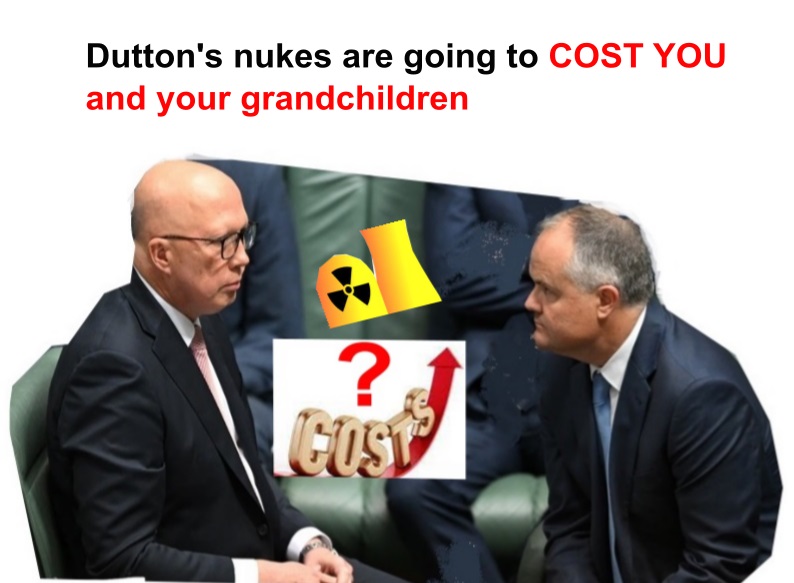
The Climate Change Authority’s latest report confirms the risks of delaying a clean energy future in favour of nuclear power will lead to higher emissions and increased costs for households.
The report warns that the Coalition’s nuclear energy proposal could add a staggering 2 billion tonnes of emissions while increasing costs for households, resulting in Australia missing its 2030 emissions targets and delaying the transition to clean energy until 2042.
“This report confirms our worst fears – betting on nuclear power isn’t just expensive, it’s a lose-lose for Australian families. Every year we waste waiting on nuclear means higher power bills and more emissions,” Jo Dodds, spokesperson for Australians for Affordable Energy, said.
“The Climate Change Authority has done the hard numbers. They’re telling us that going down the nuclear path means we’ll miss our 2030 targets and won’t get clean energy until 2042. That’s an extra 2 billion tonnes of emissions while we sit around waiting for nuclear plants that might never show up.
“Guess who pays for the delay? Everyday Australians – through their power bills and taxes.”
Crucial questions about the impact nuclear power will have on household budgets remain unanswered.
“Australians still need answers to fundamental questions: What is it going to cost? When will it actually deliver? What happens to our bills while we wait? What happens to our emissions?” Ms Dodds said.
“Families are already struggling with the cost of living and they can’t afford to bankroll expensive nuclear experiments that won’t deliver for decades all while their bills continue to rise. Every year we spend chasing nuclear dreams instead of getting on with real solutions is another year of higher costs for Australian households.
“We need to have a serious talk about our energy choices. This report makes it crystal clear – nuclear means paying more to get less and waiting longer to get it.
“Australian families deserve better.”
Australians for Affordable Energy is urging policymakers to focus on practical, cost-effective energy solutions that can deliver cleaner, more affordable power right now – not in decades.
Burying The CIA’s Assange Secrets

The Dissenter, Kevin Gosztola, Feb 19, 2025
The CIA won the dismissal of a lawsuit brought by four Americans who claimed they had their privacy rights violated when they visited Julian Assange in Ecuador’s London embassy.
A United States judge dismissed a lawsuit pursued by four American attorneys and journalists, who alleged that the CIA and former CIA Director Mike Pompeo spied on them while they were visiting WikiLeaks founder Julian Assange in Ecuador’s London embassy.
“The subject matter of this litigation,” Judge John Koeltl determined [PDF], “is subject to the state secrets privilege in its entirety.” Any answer to the allegations against the CIA would “reveal privileged information.”
Few publications followed this case as closely as The Dissenter. It unfolded at the same time that the U.S. government pursued the extradition of Assange, making any outcome potentially significant.
On August 15, 2022, Margaret Ratner Kunstler, a civil rights activist and human rights attorney, and Deborah Hrbek, a media lawyer, filed their complaint. Journalist Charles Glass and former Der Spiegel reporter John Goetz also joined them as plaintiffs.
The lawsuit claimed that the plaintiffs, like all visitors, were required to “surrender” their electronic devices to employees of Undercover Global, a Spanish security company managed by David Morales that was hired by Ecuador to handle embassy security. They were unaware that UC Global had allegedly “copied the information stored on the devices” and shared the information with the CIA.
Pompeo allegedly approved the copying of visitors’ passports, “including pages with stamps and visas.” He ensured that all “computers, laptops, mobile phones, recording devices, and other electronics brought into the embassy,” were “seized, dismantled, imaged, photographed, and digitized.” This included the collection of IMEI and SIM codes from visitors’ phones.
Morales and UC Global were named as defendants in the lawsuit, however, due to the fact that they were not in the U.S., the claims against them were never really litigated.
In December 2023, Koeltl dismissed multiple claims that were filed against the CIA. But remarkably, he found that the four Americans who had visited Assange had grounds to sue the CIA for violating their “reasonable expectation of privacy” under the Fourth Amendment of the U.S. Constitution.
“If the government’s search (of their conversations and electronic devices) and seizure (of the contents of their electronic devices) were unlawful, the plaintiffs have suffered a concrete and particularized injury fairly traceable to the challenged program and redressable by a favorable ruling,” Koeltl declared.
Soon after, the court was notified that the CIA would assert the state secrets privilege to block the lawsuit.
Bill Burns, who was the CIA director, submitted a declaration in April 2024 that asserted “serious” and “exceptionally grave” damage to the “national security” of the U.S. would occur if the case proceeded.
……………………………………………… Burying secrets so deep and for so long that the public does not find them is typically the CIA’s objective when they invoke the state secrets privilege. They have buried a 6,300-page Senate intelligence report on CIA rendition, detention, and torture during the global war on terrorism. They are now burying their Assange secrets.
The decision all but ensures that the CIA will be able to conceal what they allegedly did to Assange, WikiLeaks, and his supporters for several decades. The agency, with support from the U.S. Justice Department, has already frustrated a Spanish court trying to prosecute Morales and other UC Global employees for alleged criminal acts.
It was always unlikely that Assange’s defense would uncover details about the CIA’s alleged actions and share those revelations during an Espionage Act trial. The restrictions the government and courts impose on defendants come with procedures to shield the CIA from scrutiny.
When the prosecution against Assange ended in a plea deal in June 2024, that benefited the CIA even if it was not the outcome that current and former high-ranking officials had desired. The CIA would never have to worry about the agency’s actions being discussed by the press and on social media during a high-profile trial.
Of course, there is also the matter of the CIA allegedly violating the privacy rights of Assange visitors while the U.S government targeted a journalist living under political asylum in a foreign embassy. The U.S. news media never showed much interest in the CIA’s actions, however, let’s not forget there was widespread global opposition to the Assange prosecution that helped end the case. The agency is right to be concerned that if more was known it might erupt into an international scandal. https://thedissenter.org/burying-the-cias-assange-secrets/
Conveniently forgotten and ignored – the 8 years war in Ukraine up to 2022
https://theaimn.net/conveniently-forgotten-and-ignored-the-8-years-war-in-ukraine-up-to-2022/ 22 Feb 25
There’s uproar in the Western media, about Donald Trump wanting to negotiate with Putin, a peace deal in Ukraine. And Trump called Ukraine’s President Zelensky a dictator and blamed him for starting the present war Ukraine.war. And he said that that Zelensky’s approval rating has fallen to 4%. General agreement that Donald Trump was “rewriting history”.
Well, Trump is well known for lying, and it’s just so easy to scrutinise those statements and smugly assert that they are incorrect, and obviously Donald Trump has no idea of what he’s talking about.
And yet, and yet…. all those statements deserve further scrutiny. Because underneath their careless inaccuracy lies the real history of the Ukraine mess.
Historically, Ukraine as a sovereign State goes back only until 1991. In its previous history, it was dominated by a motley succession of European powers, but in the 19th and 20th.Century, by Russia. Cruel exploitation by Stalin’s rule in the 1930’s, was followed in 1941 by a brutal Nazi regime, and after 1944 back under oppressive Soviet control.
It is no surprise that there are long-standing resentments among both Ukrainian dwellers and in the diaspora. There is also a variety of ethnic backgrounds, and a clear difference between the ‘West-leaning” culture of Western Ukraine, and the more pro-Russian culture to the East.

At the end of World War 2, the Allies had the opportunity to include Russia in some co-operative Council of the powers, as was done by the Congress of Vienna in 1815, after the Napoleonic Wars. Instead, the USA, Britain and France chose to set up a co-operative group, North Atlantic Treaty Organisation (NATO), that excluded Russia. American triumphalism gradually encouraged this into a defensive group against Russia, and encouraged former Soviet States to be part of America’s “sphere of influence” and to join NATO.
As Ukraine is the largest Western State on Russia’s border, it is obvious that Russia would not want it to be NATO state, potentially with U.S military bases aimed at Russia

Now, to go to the forgotten 8 years Ukrainian war.
In 2014, an American-sponsored coup overthrew the democratically elected President Viktor Yanukovych. He was subsequently followed by oligarch Petro Poroshenko, who removed Russian as an official language, – causing opposition in the Eastern provinces. The result was fierce repression against the Russian-speaking regions (Odessa, Dnepropetrovsk, Kharkov, Lugansk and Donetsk). The rebels of Donetsk and Lugansk held referendums, seeking not to separate from Ukraine, but to have a status of autonomy, guaranteeing them the use of the Russian language as an official language .
2014-15 Minsk Agreements. Leaders of France, Germany, Russia and Ukraine gathered in Minsk, and supported the agreements between Russia, Ukraine, the Organisation for Security and Cooperation in Europe (OSCE) and the leaders of separatist-held regions Donetsk and Luhansk. This formally gave Donetsk an Luhansk autonomous status within Ukraine.
2015 – 2022 . The agreements were never implemented. The Ukrainian President Petro Poroshenko launched a massive “anti-terrorist operation” against the Donbass, and the fighting continued. This war was not popular, reservists failed to tun up. “. In October/November 2017, 70% of conscripts did not show up for the “Fall 2017” recall campaign. This is not counting suicides and desertions (often over to the autonomists), which reached up to 30 percent of the workforce in the ATO area”. Young Ukrainians refused to go and fight in the Donbass and preferred emigration, which also explains, at least partially, the demographic deficit of the country.”
The Office of the United Nations High Commissioner for Human Rights (OHCHR)OHCHR estimates the total number of war-related casualties in Ukraine from 14 April 2014 to 31 December 2021 to be 51,000–54,000
This entire 8 years of war is rarely mentioned by the Western media. There’s no recognition of the impact of imposing the Ukrainian language on Russian-speakers. No consideration of some loyalties to Russia and her role in WW2. No consideration of the influence of Ukrainian Nazi collaborators, and the role of the minority neo-Nazis. There was one exceptional coverage by The Guardian in 2014 – It’s not Russia that’s pushed Ukraine to the brink of war.
2019. Volodymr Zelensky was elected with a huge majority, on his pledge to uphold the Minsk agreements, and bring peace to Ukraine. But soon after coming to power, Zelensky reneged on that pledge. He later made it clear that he intentionally chose to sabotage Minsk, give his country more time to prepare for war. A large-scale militarisation of Ukraine began. The build-up of the Ukrainian army was accompanied by the development of militias, notoriously the Azov brigade, with links to the Nazi past and the philosophy of past far-right leader Stepan Bandera.
2022. February 24. Russia launched its Special Military Operation into Ukraine, claiming that it was a limited operation, not a war. Russia argued that this was lawful under Article 51 of the UN Charter, that it may use force against Ukraine in order to defend the Donetsk and Luhansk Peoples Peoples Republics. Anyway it soon turned into a full-scale war against Ukraine, which certainly was not legal, and Ukraine got the enthusiastic backing of the USA and NATO, though no foreign troops.
The Political situation in Ukraine. The Zelensky regime has banned opposition parties, cracked down on the use of the Russian language, restricted media and freedoms of expression and peaceful assembly, violating international law. Zelensky signed a law that threatens to effectively shut down the Ukrainian Orthodox Church (UOC) – the largest faith-based organization in the country. He signed a law that restricted import of books from Russia.
So – to go back to Donald Trump’s inaccurate claims and “rewriting history”. How far off the mark was Trump? In fact, Zelensky was elected democratically, but has now turned Ukraine into a dictatorship. Zelensky did not start the war, but he provoked it, by overturning his election policy to implement the Minsk agreements. Zelensky’s approval rating is still above 50%, but has slipped over the past year.
It is Western dogma that you can’t approve of anything that Donald Trump does. So for anyone to even mention the 8 years’ war in Ukraine is to invite being branded as an idiotic puppet of Russian propaganda and disinformation.
The “progressive” West notices with disapproval, that Donald Trump’s aim is to get American business’s control of Ukraine’s mineral resources, in exchange for Russia getting territorial concessions. Well, what else would you expect from Trump – whose whole aim is to get American (and his) control of business, preferably everywhere? It still might be a better deal for Ukrainians than obliteration. Way back, the West, and Zelensky could have honoured the Minsk agreement, and given the Donbass provinces self-government within the state of Ukraine.
Peter Dutton’s nuclear accounting trick #3: Hide the costs of keeping coal
RENEW ECONOMY. Tristan Edis, Feb 21, 2025
This is part 4 of a five part series of articles examining the four accounting tricks that the Liberal-National Party employed in the costing of their energy plan to slow the roll-out of renewables and rely instead on nuclear power. The first article, which provides the overarching context is published here. Part 2 is here. Part 3 is here.
These four accounting tricks act to mislead voters that the Liberal-National Party could lower energy bills through a shift to nuclear when in reality it is likely to increase power bills.
This article focuses on accounting trick three of four: Hide most of the cost of replacing coal with nuclear to outside the time period considered in the costing.
It’s very important to note that the Coalition’s costing of its electricity system cuts out in the year 2051. It only accounts for costs incurred between 2025 to 2051 and anything after that date is ignored.
The LNP’s claim of a 44% saving does not represent the cost of two alternative systems for achieving near zero emissions once they are both completed to see how nuclear might reduce the cost of the system.
Instead, a heavy influence on the cost estimates in the model is the degree to which the scenarios can delay incurring costs in replacing the old, highly polluting and likely to be increasingly unreliable coal power plants.
How is this a problem?
Coal power stations are much like a car – they are exposed to extreme heat, pressure and general mechanical stress that means they wear out and become unreliable as they get old. That’s physics.
Many of us will have experience with an old car that has got to the point where it increasingly encounters mechanical problems and the mechanic is warning us that it really needs some major repairs but these would cost more than the car is worth.
At this point many of us can be tempted to take a gamble by putting off such repairs, and go for temporary, less costly patch-ups and hope the car keeps going. That will be a lot cheaper than buying a new car, at least for as long as we can keep the old car going. But it comes with the risk that it could leave us stranded with a broken-down car at an extremely inconvenient point in time and even pose a danger to our safety and that of others.
The Coalition’s modeled plan chooses to take that gamble with our electricity system. But it doesn’t account for the risks and potentially extreme costs this involves if the gamble goes wrong.
Clare Savage, the head of the Australian Energy Regulator has repeatedly warned that failing to replace aging coal plants risks both power system reliability and also affordability observing, “Coal can’t last until you have nuclear power available.”……………………………………………………………………
Unless Peter Dutton has a secret plan to prioritise curtailment of rooftop solar in favour of coal generators, this is likely to get worse over time.
Now, the way that the consultant, Frontier, constructed Dutton’s costing is that they space out the cost of constructing new power stations as an annualised payment – a bit like how you’d purchase a new car not by paying for it upfront but rather by taking out a loan and then paying it back incrementally over time.
Except in this case the annualised payment for a new power station is spaced out over several decades and for nuclear it is 50 years. Meanwhile for the existing, very old power plants the original cost of constructing those plants is omitted from the annualised costs.
By pushing out the point at which they replace the old power stations with new ones until the 2040’s, the Coalition gets to hide much of the cost of the nuclear plants until towards the very back end of the projection period. We’ll still have to pay for these nuclear power stations well after 2051, but that’s conveniently left out of the costing period.
Meanwhile, in the scenario said to represent Labor Policy, the coal-fired power stations are replaced quite quickly, so the cost of the new, replacement power stations is taken into account across almost the entire time period considered in the model. …………………………
The nuclear plants aren’t really delivering any meaningful saving in the unit cost of energy relative to relying on renewables and storage. Instead, the savings are coming from the Liberal Party delaying the point at which the coal power plants are replaced. ………………………………………. more https://reneweconomy.com.au/peter-duttons-nuclear-accounting-trick-3-hide-the-costs-of-keeping-coal/
Dutton hints at privatising nuclear – one day
Phillip Coorey, 21 Feb 25
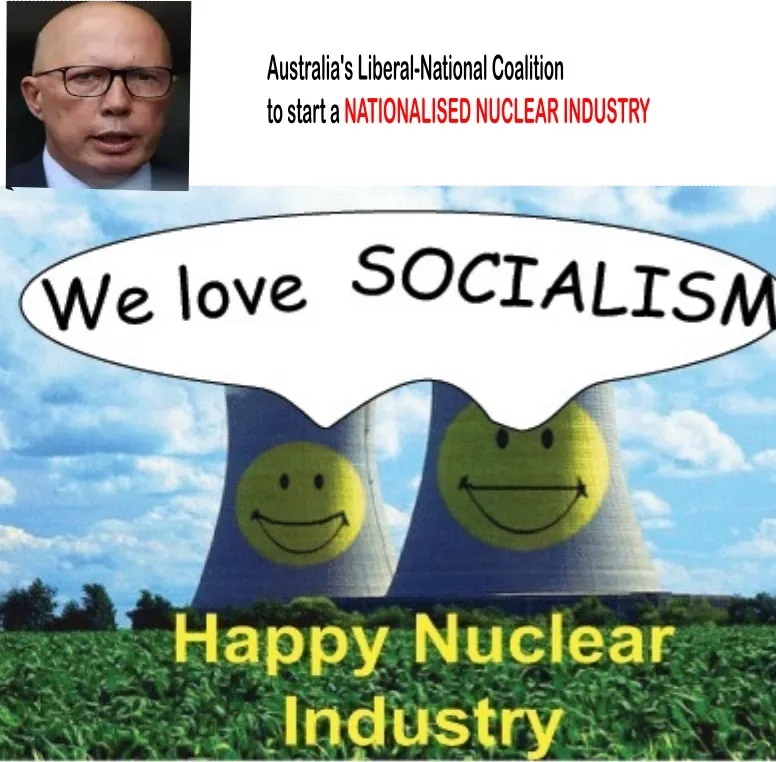
Peter Dutton has suggested his proposed nuclear power plants would one day be privatised, as he rejected the idea of the Albanese government taking an equity stake in the Whyalla steelworks.
With the $2.4 billion rescue plan for the steelworks in mid-north South Australia sparking a broader discussion about the re-nationalisation of business, the opposition leader said while he supported the plan, he derided the prospect of an equity stake in the Whyalla plant as “Whitlamesque”………………………….
Dutton said he was “completely opposed” to an equity stake.
“The prime minister can’t run a government – how can he run a steelworks? He’s now proposing to own an airline. I mean, this is Whitlamesque,” Dutton said.
Asked to explain why he opposed governments buying into troubled businesses but planned to spend $331 billion to build own and operate seven nuclear power plants, Dutton said there was a key difference in the nuclear energy would be a start-up industry.
“Nuclear power carries with it, from our country’s perspective, a zero-based knowledge, or a very low level of understanding, unlike in the United Kingdom or in Canada or in France or other parts of the world, including the United States,” he said.
“It’s obvious to me that there is greater reassurance in the public’s mind about the safety and the safe delivery of nuclear technology if it’s in government ownership.
“Now, it doesn’t need to be in government ownership forever.” https://www.afr.com/politics/federal/dutton-hints-at-privatising-nuclear-one-day-20250221-p5ldzj
Community consultation kicks off for submarine yard, but don’t mention nuclear
“South Australians should understand that AUKUS involves not only plans for the construction and sustainment of nuclear submarines at Osborne, but also for eventual decommissioning, storage and dismantling of those submarines on the banks of the Port Adelaide River, and indefinite storage of high-level nuclear waste, most likely in SA.”
The Australian Submarine Agency (ASA) will today start information sessions for community members about its planned nuclear submarine construction yard project, but any concerns about nuclear issues are out of scope.
The first of four information sessions for community members interested in the Australia Submarine Agency’s (ASA) planned nuclear submarine construction yard at Osborne begin today.
The first – at the State Library on North Terrace – comes during a period of public consultation through which the ASA is receiving feedback from community members on its draft ‘Strategic Impact Assessment Report’ for the yard.
Until 17 March members of the public can submit comments about the 203-page draft, which considers the plan’s potential impact on the environment but notably rules nuclear issues as “outside the scope” of the plan for a shipyard to build nuclear submarines.
It follows an agreement struck in November 2023 between the ASA and the Environment and Water Minister – Tanya Plibersek – which specifically precluded all nuclear issues from the scope of the environmental assessment process.
“The operation, sustainment and decommissioning of the submarines built at the Osborne SCY is considered out of scope of the Strategic Assessment and will be managed via separate environmental assessment processes and approvals as necessary,” the agreement reads.
“The manufacture, delivery and subsequent operation of the reactor power module is considered outside of the scope of the Strategic Assessment, however the assembly into the submarine is included.”
What is included is the processing of steel, outfitting of submarine sections, manufacture of pipe and electrical components, the use of supporting facilities (guard houses, car parks, warehousing, office accommodation, etc.) and more.
The resulting draft environmental impact report, plus 754 pages of appendices, asserts that the impacts of the construction yard are “likely to be acceptable”.
It also confirms on page 156 that “no nuclear actions” are included in the scope of the draft and that “other activities are considered outside the scope of the strategic assessment and will be managed via separate assessment processes and approvals as necessary”.
Former Senator and submariner Rex Patrick – who plans on running for a South Australian seat at the next Federal Election as a member of Jacqui Lambie’s political party – said the consultation process was designed to “minimise public engagement”.
“This is a ‘strategic assessment’ of a nuclear facility in which everything nuclear is excluded. More attention is paid to the environmental impacts of car parks than nuclear reactors,” he told InDaily.
“South Australians should understand that AUKUS involves not only plans for the construction and sustainment of nuclear submarines at Osborne, but also for eventual decommissioning, storage and dismantling of those submarines on the banks of the Port Adelaide River, and indefinite storage of high-level nuclear waste, most likely in SA.”
He added that the fact that Port Adelaide is yet to be visited by a nuclear-powered vessel because it has never been approved as a suitable location for such visits made the situation “an extraordinary state of affairs”.
“Whatever one thinks about AUKUS, it’s clear the environmental assessment has been rigged from the beginning.
“It’s been rigged by ASA with the connivance of Minister Plibersek to produce a predetermined outcome, opening the way for further stages of the project to be ticked off by Defence bureaucrats as they wish.
Those decisions will have consequences for South Australia that will last decades, hundreds and indeed thousands of years.”
Peter Dutton’s nuclear accounting trick #1: Assume you can halve the cost of nuclear power
they claim they will be ordering nuclear plants several years in the future after the nuclear industry has had the chance to improve on what have been some shocking project cost blow outs.
the nuclear industry in the western world has tended to experience escalating, not declining costs over time.
would have to commence the nuclear procurement process immediately.
Tristan Edis, Feb 19, 2025, https://reneweconomy.com.au/peter-duttons-nuclear-accounting-trick-1-assume-you-can-halve-the-cost-of-nuclear-power/
This is part 2 of a five part series of articles examining the four accounting tricks that the Liberal-National Party employed in the costing of its energy plan to slow the roll-out of renewables and rely instead on nuclear power. The first article, which provides the overarching context is published here.
These four accounting tricks act to mislead voters that the Liberal-National Party could lower energy bills through a shift to nuclear when in reality it is likely to increase power bills.
This article focuses on accounting trick one of four: Assume a cost for nuclear reactors which is around half what nuclear reactors have actually cost to build across Europe and North America.
The most important point you need to understand is that the unit cost of energy the Liberal-National Party claims its future nuclear-underpinned power system will deliver – about $80 per megawatt-hour – is unrealistically low.
More realistic cost assumptions for nuclear would inflate the modelled cost of their system per MWh to $141.50 per MWh which is two-thirds higher than what they’ve estimated for the Labor Party scenario.
The Liberal-National Party’s costing has assumed that a nuclear reactor built today in Australia would cost $10,000 per kilowatt of capacity and that cost would decline by 1% per annum. The costing also assumes the first reactors would commence operation in 2036 followed by a rapid scale-up from 2039.
This is far below the real-world construction cost experience of nuclear reactors across Europe and North America in the past 20 years. This experience is detailed in a report I co-authored with energy analyst Johanna Bowyer from the Institute for Energy Economics and Financial Analysis – Nuclear in Australia would increase household power bills.
The table below [on original] lists the costs per kilowatt of plants which have proceeded to construction or managed to get to the point of a contracted price. Importantly you need to consider both the actual price paid to construction contractors (known as the ‘overnight cost’ – the cost if the project could literally be built within a night), but also a range of costs incurred by the owner in building the plant such as financing, known as the ‘all-in costs’.
These owner-incurred costs are very large, mainly because construction takes a long time and leads to significant bank debt interest bill accumulating over this period. The Liberal-National’s costing report does not explain what construction period it assumes for nuclear plants, which is a major black hole in their costing.
For a nuclear reactor with an all in cost of almost $29,000 per kilowatt to recover a commercial financing cost of 6% it would need to capture an electricity price close to $260 per MWh, and that’s if it could operate close to its full capacity without ramping down around solar generation.
If we multiply that out by the amount of electricity nuclear is expected to generate under the Liberal-National Party scenario, that gives us an annualised cost just for the nuclear component of their power system of $27 billion in 2051. We then need to add on top of that the costs to provide the remaining 60% or so of electricity not provided by nuclear.
Unfortunately, the inadequate transparency of the consultant’s report makes it difficult to disentangle these costs. Using the limited data the consultant has provided these non-nuclear costs appear to roughly lie somewhere around $8 to $10 billion.
So, if we use more realistic nuclear costs and then take the mid point for the non-nuclear costs of $9 billion, we end up with a total annualised cost of $36 billion for the complete system in 2051.
This is $7.5 billion higher than what the consultant estimates for the Labor scenario in 2051. It gives us an averaged cost per MWh of around $141.50, which is around two-thirds higher cost per MWh than the Labor scenario.
The Coalition likes to claim that the costs from these real-world nuclear power plant projects are somehow not relevant. This is because they claim they will be ordering nuclear plants several years in the future after the nuclear industry has had the chance to improve on what have been some shocking project cost blow outs.
There are just two fundamental problems with this.
The first is that the nuclear industry in the western world has tended to experience escalating, not declining costs over time. UK’s next planned nuclear project Sizewell C will represent the fifth and sixth European Pressurised Reactor (EPR) design built by French corporate entities.
The latest cost reported by the UK’s Financial Times suggests it will cost around two and half times what the Coalition costing assumes at $24,540 per kW. That’s substantially more expensive than the first EPR they built in Finland – Olkiluoto 3.
The second problem is that for the Coalition to have any chance of meeting its time frame for the roll-out of nuclear it would have to commence the nuclear procurement process immediately. It won’t be able to wait for the nuclear industry to achieve what would amount to some incredible cost breakthroughs.
To explain why it is helpful to look at the Czech Republic experience, where they just very recently completed a nuclear tender process. The tender commenced in 2022 (preparation leading into the tender such as permitting and environmental impact assessments for the reactor site began several years before that but let’s leave that to one side).
Two years later they had selected the winner, being Korean Hydro and Nuclear Power. Yet Korean Hydro and Nuclear Power won’t be able to actually commence the real construction work until 2029. That’s because nuclear power plants are very complex, from both a physical and commercial perspective, and require considerable preparatory work. From there, they don’t expect the nuclear power plant to be fully operational until 2038. Note that this is for a site where preexisting nuclear power plants are already in place with all the associated supporting infrastructure that entails.
So, realistically, if the Coalition wanted to achieve the timelines outlined in its modelling, it really needed to commence the nuclear procurement tender process back several years ago when it was previously in government. It has no time available to wait around for the nuclear industry to come up with the cost breakthroughs its costing relies upon.
Tristan Edis is director of analysis and advisory at Green Energy Markets. Green Energy Markets provides analysis and advice to assist clients make better informed investment, trading and policy decisions in energy and carbon abatement markets.
Peter Dutton sidesteps questions on state-funded nuclear disaster insurance plan
Albanese government also asked if it has considered nuclear insurance pool in context of Aukus nuclear-powered submarines.
Dan Jervis-Bardy Guardian 18 Feb 25
Peter Dutton has sidestepped questions about the potential need for a government-backed insurance pool for nuclear disasters after the industry’s peak body exposed a possible missing piece in his flagship energy plan.
The Insurance Council of Australia on Monday suggested the commonwealth may need to underwrite a scheme to cover communities against nuclear accidents.
“Around the world, nuclear has a special [insurance] cover that is usually done by governments,” the council’s chief executive, Andrew Hall, told ABC RN Breakfast.
“So it’s a conversation: if Australia turns to a net zero nuclear future, then we’re going to need to have a conversation with the government about a pool that would cover communities in the extremely unlikely event something would happen.”
Hall indicated such a scheme would be needed even if the Coalition’s nuclear plans never eventuated, to cover residents living near naval bases for the Aukus nuclear-powered submarines.
Neither the US nor UK has ever experienced a nuclear reactor accident on their submarines.
The insurance question has been largely overlooked in the debate about Dutton’s proposal to build nuclear reactors at seven sites. Attention has focused instead on the cost and timeline for starting an Australian nuclear power industry from scratch.
Countries with established nuclear industries have longstanding insurance schemes to cover personal injury and damage caused by nuclear disaster.
In the US, operators of nuclear power plants pay an annual premium for US$500m (about A$786m) in private insurance for liability coverage for each reactor.
Asked on Monday if the Coalition had modelled the cost of a nuclear insurance scheme, Dutton did not respond to the question, instead reiterating the threat of market intervention if insurers did not lower premiums.
The Nationals leader, David Littleproud, struggled to answer similar questions when pressed repeatedly on ABC radio earlier in the day.
Insurance is not mentioned in either the Coalition’s six-page nuclear blueprint or in the Frontier Economics costings underpinning the proposal.
The Australia Institute thinktank in 2019 described nuclear power as “uninsurable”, warning that if operators were forced to cover the cost of accidents then the reactors would be “completely uncompetitive”.
In a statement to Guardian Australia, an Insurance Council of Australia spokesperson said it was common for insurance policies to exclude loss or damage caused by nuclear power.
“However, insurers in Europe, the US, and other countries where nuclear power generation is common have insurance mechanisms in place to cover liability concerns,” the spokesperson said.
“These include liability insurance pools, international agreements and conventions, and government programs to establish coverage and frameworks for nuclear liability insurance.”
Guardian Australia asked the defence minister, Richard Marles, if the government had considered a nuclear insurance pool in the context of Aukus.
In a statement, an Australian Submarine Agency spokesperson did not comment on the idea of an insurance pool……………………………………………….. more https://www.theguardian.com/australia-news/2025/feb/17/nuclear-disaster-insurance-pool-funding-peter-dutton-questioned-coalition-costing?fbclid=IwY2xjawIh-1VleHRuA2FlbQIxMQABHVTDHY1ZfGqoH8vCwqMsqPd2DFwsmd0_nUu-wn14Gnes6DAWgXMuUXO-ow_aem_JRtSrA2wjsbbfPQiwb-vqg
Where’s the policy?’: Coalition criticised over ‘pipedream’ nuclear plan

Sky News Australia, 19 Feb 25, https://www.msn.com/en-au/news/other/where-s-the-policy-coalition-criticised-over-pipedream-nuclear-plan/ar-AA1zjMZd
Sky News Political Editor Andrew Clennell believes the rate cut by the Reserve Bank “puts the focus” on Opposition Leader Peter Dutton.
The Reserve Bank has cut the official cash rate for the first time in more than four years, lowering it by 25 basis points, from 4.35 per cent to 4.10 per cent.
“I think this very much puts the focus on Peter Dutton now, I have to say,” Mr Clennell said.
“We’re at five minutes to midnight on an election now. Where’s the policy?
“They announced a nuclear policy – seven federal government-owned nuclear power plants, and then they kind of ran away from it.
“They’d have to convince a hostile Senate to end the moratorium.
“That looks like a pipedream.”
Dutton’s HALF-BAKED plans for dealing with global heating and Australia’s energy future.
Dr Tony Webb, 20 February 25
Coalition’s plans for our energy future including Nuclear power plants are based on:
Delivering half the electricity anticipated as needed to power homes and industry
and transition to zero carbon emissions.
Assuming cost of building nukes in Australia which has no experience of doing this
will be about half what the most nuke-favourable evidence world-wide from
countries that do have the experience suggests is needed.
Assuming these can be built in less than half the time evidence suggests they take to
build.
Ignoring the evidence that current official radiation-induced cancer-risk-estimates,
on which standards for worker OH&S are based, are less than half what the evidence
from nuclear power plant workers in Europe and North America suggests is the
inevitable and unavoidable reality. Also, ignoring that the cardio-vascular and heart
disease risk from such exposures is double that expected and the childhood
leukaemia risk in the community near these plants has been similarly under-
estimated.
Not to mention that the coalition’s costings ignore the long-term costs of
decommissioning these plants, the management, and (perhaps . . . . Dutton dream
on!) eventually finding a solution for long-term storage (never ‘disposal’) of the
highly radioactive wastes –
Nor to mention the fact that state and federal legislation currently prohibits such
nuclear power plants and is unlikely to be overturned any time in the near future.
And – despite this overwhelming evidence that the whole silly idea is half-baked – in
fact a smokescreen for continuing climate denial and extending use of polluting and
planet life-threatening fossil fuels, inface of this the Coalition doubles down on it
with backing from sections of the media and the fossil fuel lobby.
And finally, we are so far only half-baked. Global warming is passing the climate
catastrophe 1.5 degree centigrade target and now heading to at least 3 degrees and
possibly more.
Australian nuclear news headlines 17 – 24 February

Headlines as they come in:
- Peter Dutton’s nuclear accounting trick #4: Assume climate change has no cost.
- Peter Dutton’s nuclear accounting trick #3: Hide the costs of keeping coal.
- Carbon time bomb: Dutton’s nuclear plan will blow up Paris and emissions targets, CCA says.
- Dirty deed: Dutton’s nuclear scheme locks in 20 years of higher climate pollution
- New report confirms nuclear fears: Higher bills, higher emissions
- Peter Dutton’s nuclear accounting trick #3: Hide the costs of keeping coal
- Dutton hints at privatising nuclear – one day.
- Where’s the policy?’: Coalition criticised over ‘pipedream’ nuclear plan
- Community consultation kicks off for submarine yard, but don’t mention nuclear.
- Peter Dutton’s nuclear accounting trick #1: Assume you can halve the cost of nuclear power.
- Dutton’s HALF-BAKED plans for dealing with global heating and Australia’s energy future.
- Before we decide where to dump nuclear waste, let’s answer the bigger questions,
- Peter Dutton sidesteps questions on state-funded nuclear disaster insurance plan.
- The election could be called any day – but Peter Dutton still hasn’t explained how his nuclear proposal will work.
- Taxpayers should not foot the bill for nuclear risk.
- Nuclear gamble is an economic wrecking ball.
- The four accounting tricks behind Peter Dutton’s nuclear cost claims.
Before we decide where to dump nuclear waste, let’s answer the bigger questions
February 19, 2025 AIMN Editorial, Australians for Affordable Energy, https://theaimn.net/before-we-decide-where-to-dump-nuclear-waste-lets-answer-the-bigger-questions/
Australians for Affordable Energy is urging caution following calls for South Australia to become a nuclear power hub and waste storage site, warning fundamental questions about nuclear remain unanswered.
Alexander Downer’s comments advocating for nuclear power plants in South Australia and positioning the state as a nuclear waste storage site are deeply concerning given there has been no comprehensive discussion around nuclear power.
The nuclear debate must go beyond location discussion and first address economic and logistic concerns, Australians for Affordable Energy spokesperson Jo Dodds said.
“Before we even talk about where to dump nuclear waste, we need to ask some hard questions. How much will nuclear really cost Australian taxpayers? What will it do to energy prices and the cost of living? How long will it take to build? Who funds insurance?” Ms Dodd said.
“There are global examples of nuclear projects that have blown out in cost and time frames and just fallen over, leaving consumers to foot the bill. Australians deserve transparency on these issues before any commitments are made.”
The practical implications of nuclear power for everyday Australians remain unclear. Australians deserve a full and open discussion of nuclear power’s real impacts rather than ideological endorsements from political figures.
“We know nuclear energy requires massive upfront investment, long construction times, intensive oversight, expensive insurance, and creates long-term waste management challenges. These factors could seriously impact affordability – for the country and individuals who will have to pay the bills since private investment won’t go near nuclear,” Ms Dodds said.
“We need an evidence-based national conversation about our energy future before committing to specific locations for waste storage. We can’t afford to let political enthusiasm override economic and practical considerations.
“If politicians are serious about nuclear, let’s see the full breakdown of costs, risks and alternatives before making any decisions.”
AFAE warns against locking into costly or uncertain energy options and calls for a transparent review of nuclear power in Australia before any site is considered for waste storage.
1 This month

of the week – Australians for War Powers Reform (AWPR)
To see nuclear-related stories in greater depth and intensity
 Antinuclear