David Swanson explodes the myths about why the USA nuclear bombed Hiroshima and Nagasaki

Why do U.S. history teachers in U.S. elementary schools today — in 2021! — tell children that nuclear bombs were dropped on Japan to save lives — or rather “the bomb” (singular) to avoid mentioning Nagasaki? Researchers and professors have pored over the evidence for 75 years. They know that Truman knew that the war was over, that Japan wanted to surrender, that the Soviet Union was about to invade. They’ve documented all the resistance to the bombing within the U.S. military and government and scientific community, as well as the motivation to test bombs that so much work and expense had gone into, as well as the motivation to intimidate the world and in particular the Soviets, as well as the open and shameless placing of zero value on Japanese lives. How were such powerful myths generated that the facts are treated like skunks at a picnic?
Hiroshima Is A Lie Endangerment By David Swanson, World BEYOND War, August 5, 2021
”………………… could an 18-year-old in 2015 be expected to know that most of the victims of WWII were civilians — men and women and children alike? Who would have told her that? Certainly not her text books. Most definitely not the endless saturation of her culture with WWII-themed entertainment. ……… In U.S. culture as well, which heavily influences Italian, a top focus for drama and tragedy and comedy and heroism and historical fiction is WWII.
……… WWII is often called “the good war,” and sometimes this is thought of as principally or originally a contrast between WWII, the good war, and WWI, the bad war. However, it was not popular to call WWII “the good war” during or immediately after it happened, when the comparison with WWI would have been easiest. Various factors may have contributed to the growth in popularity of that phrase over the decades, including increased understanding of the Holocaust (and misunderstanding of the war’s relationship to it),[ii] plus, of course, the fact that the United States, unlike all the other major participants, wasn’t itself bombed or invaded …………
Perhaps the strangest myths, though, are those about nuclear weapons, especially the idea that by murdering huge numbers of people with them a far greater number of lives, or at least the right kind of lives, were spared. The nukes did not save lives. They took lives, possibly 200,000 of them. They were not intended to save lives or to end the war. And they didn’t end the war. The Russian invasion did that. But the war was going to end anyway, without either of those things. The United States Strategic Bombing Survey concluded that, “… certainly prior to 31 December, 1945, and in all probability prior to 1 November, 1945, Japan would have surrendered even if the atomic bombs had not been dropped, even if Russia had not entered the war, and even if no invasion had been planned or contemplated.”[vi]
One dissenter who had expressed this same view to the Secretary of War and, by his own account, to President Truman, prior to the bombings was General Dwight Eisenhower.[vii] Under Secretary of the Navy Ralph Bard, prior to the bombings, urged that Japan be given a warning.[viii] Lewis Strauss, Advisor to the Secretary of the Navy, also prior to the bombings, recommended blowing up a forest rather than a city.[ix] General George Marshall apparently agreed with that idea.[x] Atomic scientist Leo Szilard organized scientists to petition the president against using the bomb.[xi] Atomic scientist James Franck organized scientists who advocated treating atomic weapons as a civilian policy issue, not just a military decision.[xii] Another scientist, Joseph Rotblat, demanded an end to the Manhattan Project, and resigned when it was not ended.[xiii] A poll of the U.S. scientists who had developed the bombs, taken prior to their use, found that 83% wanted a nuclear bomb publicly demonstrated prior to dropping one on Japan. The U.S. military kept that poll secret.[xiv] General Douglas MacArthur held a press conference on August 6, 1945, prior to the bombing of Hiroshima, to announce that Japan was already beaten.[xv]
The Chairman of the Joint Chiefs of Staff Admiral William D. Leahy said angrily in 1949 that Truman had assured him only military targets would be nuked, not civilians. “The use of this barbarous weapon at Hiroshima and Nagasaki was of no material assistance in our war against Japan. The Japanese were already defeated and ready to surrender,” Leahy said.[xvi] Top military officials who said just after the war that the Japanese would have quickly surrendered without the nuclear bombings included General Douglas MacArthur, General Henry “Hap” Arnold, General Curtis LeMay, General Carl “Tooey” Spaatz, Admiral Ernest King, Admiral Chester Nimitz, Admiral William “Bull” Halsey, and Brigadier General Carter Clarke. As Oliver Stone and Peter Kuznick summarize, seven of the United States’ eight five-star officers who received their final star in World War II or just after — Generals MacArthur, Eisenhower, and Arnold, and Admirals Leahy, King, Nimitz, and Halsey — in 1945 rejected the idea that the atomic bombs were needed to end the war. “Sadly, though, there is little evidence that they pressed their case with Truman before the fact.”[xvii]
On August 6, 1945, President Truman lied on the radio that a nuclear bomb had been dropped on an army base, rather than on a city. And he justified it, not as speeding the end of the war, but as revenge against Japanese offenses. “Mr. Truman was jubilant,” wrote Dorothy Day. Weeks before the first bomb was dropped, on July 13, 1945, Japan had sent a telegram to the Soviet Union expressing its desire to surrender and end the war. The United States had broken Japan’s codes and read the telegram. Truman referred in his diary to “the telegram from Jap Emperor asking for peace.” President Truman had been informed through Swiss and Portuguese channels of Japanese peace overtures as early as three months before Hiroshima. Japan objected only to surrendering unconditionally and giving up its emperor, but the United States insisted on those terms until after the bombs fell, at which point it allowed Japan to keep its emperor. So, the desire to drop the bombs may have lengthened the war. The bombs did not shorten the war.[xviii]
Presidential advisor James Byrnes had told Truman that dropping the bombs would allow the United States to “dictate the terms of ending the war.” Secretary of the Navy James Forrestal wrote in his diary that Byrnes was “most anxious to get the Japanese affair over with before the Russians got in.” Truman wrote in his diary that the Soviets were preparing to march against Japan and “Fini Japs when that comes about.” The Soviet invasion was planned prior to the bombs, not decided by them. The United States had no plans to invade for months, and no plans on the scale to risk the numbers of lives that U.S. school teachers will tell you were saved.[xix] The idea that a massive U.S. invasion was imminent and the only alternative to nuking cities, so that nuking cities saved huge numbers of U.S. lives, is a myth. Historians know this, just as they know that George Washington didn’t have wooden teeth or always tell the truth, and Paul Revere didn’t ride alone, and slave-owning Patrick Henry’s speech about liberty was written decades after he died, and Molly Pitcher didn’t exist.[xx] But the myths have their own power. Lives, by the way, are not the unique property of U.S. soldiers. Japanese people also had lives.
Truman ordered the bombs dropped, one on Hiroshima on August 6th and another type of bomb, a plutonium bomb, which the military also wanted to test and demonstrate, on Nagasaki on August 9th. The Nagasaki bombing was moved up from the 11th to the 9th to decrease the likelihood of Japan surrendering first.[xxi] Also on August 9th, the Soviets attacked the Japanese. During the next two weeks, the Soviets killed 84,000 Japanese while losing 12,000 of their own soldiers, and the United States continued bombing Japan with non-nuclear weapons — burning Japanese cities, as it had done to so much of Japan prior to August 6th that, when it came time to pick two cities to nuke, there hadn’t been many left to choose from. Then the Japanese surrendered.
That there was cause to use nuclear weapons is a myth. That there could again be cause to use nuclear weapons is a myth. That we can survive significant further use of nuclear weapons is a myth. That there is cause to produce nuclear weapons even though you’ll never use them is too stupid even to be a myth. And that we can forever survive possessing and proliferating nuclear weapons without someone intentionally or accidentally using them is pure insanity.[xxii]
Why do U.S. history teachers in U.S. elementary schools today — in 2021! — tell children that nuclear bombs were dropped on Japan to save lives — or rather “the bomb” (singular) to avoid mentioning Nagasaki? Researchers and professors have pored over the evidence for 75 years. They know that Truman knew that the war was over, that Japan wanted to surrender, that the Soviet Union was about to invade. They’ve documented all the resistance to the bombing within the U.S. military and government and scientific community, as well as the motivation to test bombs that so much work and expense had gone into, as well as the motivation to intimidate the world and in particular the Soviets, as well as the open and shameless placing of zero value on Japanese lives. How were such powerful myths generated that the facts are treated like skunks at a picnic? ………………………………. https://worldbeyondwar.org/hiroshima-is-a-lie/
Tokyo Olympics were touted as a showcase for Fukushima nuclear recovery. That didn’t work
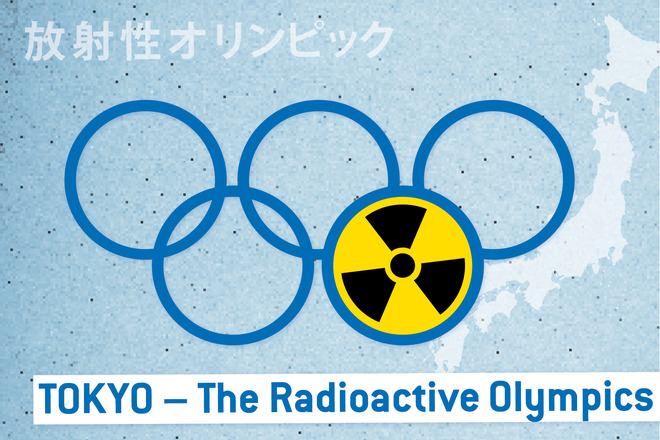
Fukushima struggles on 10 years after devastating earthquake and tsunami, Tokyo Olympics had been touted as a chance to showcase the recovery efforts in the region, Adrienne Arsenault · CBC News Aug 06, 202
The Tokyo Olympics have been without many things — spectators, cheering, singing — and Fukushima may feel the sense of loss more than most.
When Tokyo bid for the Olympics in 2013, the healing of Fukushima and the country’s Tohoku region was part of the pitch.
When the 15-metre tsunami flooded the Fukushima Daiichi Nuclear Power Plant, there were explosions and meltdowns. A contaminated cloud blew north and 150,000 people moved out of the way.
Most haven’t come back.
Japanese Olympic officials had wanted to use the Games to show confidence in the region’s growth. The fresh flowers given to athletes at the medal ceremonies are from three prefectures affected by the disaster. Fukushima grew some of the food served in the athletes’ village. The torch relay began there. The cauldron was lit with clean energy from the region.
It was a neat narrative constructed around a messier reality.
Testing vegetables and soil
Ito, who became an apprentice farmer after his career, started collecting soil samples from throughout the village, and growing potatoes in them — not to eat, but to test. He has been measuring the radioactive properties in the food and soil for nearly a decade, trying to determine what is and isn’t safe to eat, and where it is and isn’t safe to go.
He carries a handheld radiation dosimeter with him, constantly evaluating the atmospheric contamination. And despite the evacuation orders being rescinded in Fukushima, Ito says people — especially children — shouldn’t return to his village.
“It will take 300 years to restore the village to its original state, and it will continue to emit radiation for 300 years,” he said. “The question is, can we bring our children, our newborn children, to such a village?”………
Dealing with the soil has been a priority for the Japanese government. When you drive through the region, you see fields of black bags, emerging like cruel crops on the landscape. They contain the contaminated vegetation and topsoil scraped away from areas near homes, public buildings and schools over the course of years.
There are millions of cubic metres of it. Unnervingly, some appear next to rice paddies. Japan’s government has said that, by 2045, the soil will move to a permanent site outside of Fukushima prefecture. But so far, there’s no word on where the toxic waste will go.
Ito continues to have his doubts about just how much the region has recovered.
“It’s all lies and deceit, isn’t it?” he said.
And if the Olympics were intended to offer the needed boost to reconstruction and confidence for all, it was a chance denied.
The shiny, freshly painted barriers built to guide the throngs of spectators outside the Fukushima Azuma Baseball Stadium never got their Olympic moment. The people never came.
Those barriers were pulled down last week — the experience over, even before the Olympic cauldron goes out. https://www.cbc.ca/news/world/fukushima-recovery-olympics-tokyo-1.6130299
Tokyo Covered Up Arrival of Deadly New COVID Variant Just Before the Olympics SHHHH…
Tokyo Covered Up Arrival of Deadly New COVID Variant Just Before the Olympics SHHHH…
The Daily Beast has discovered that Japan reported a case of the highly infectious Lambda variant in Tokyo three days before the Olympics began. Then it kept it quiet.Jake AdelsteinChihiro KaiUpdated Aug. 06, 2021 ……….. (subscribers only) https://www.thedailybeast.com/tokyo-covered-up-arrival-of-deadly-lamda-covid-variant-just-before-the-olympics
France’s secrecy and censorship on the atomic bomb tests in the Pacific

New study on nuclear testing in French Polynesia reveals France’s ‘censorship and secrecy’ https://www.pri.org/stories/2021-08-06/new-study-nuclear-testing-french-polynesia-reveals-france-s-censorship-and
More than 400 claims have been filed against the French government for nuclear tests on French Polynesia between 1966 and 1996. Scientists say about 110,000 people have been affected by The WorldAugust 06, 2021 · 12:30 PM EDT
By Ashley Westerman It’s been nearly two decades since France stopped testing nuclear weapons in French Polynesia.
But many across French Polynesia’s 118 islands and atolls across the central South Pacific were disappointed last month when President Emmanuel Macron, on his very first trip to the territory France has controlled since 1842, failed to apologize for the nearly 200 nuclear tests conducted between 1966 and 1996.
“Faced with dangerous powers in the concert of nations, I wish to say here that the nation owes a debt to French Polynesia,” Macron said in a July 27 speech. He went on to admit that the tests on the Mururoa and Fangataufa atolls were “not clean in any way” — but stopped short of an official apology.
Guillaume Colombini, who works for Radio Te Reo-o-Tefana, said while they weren’t expecting an apology, it was still devastating not to get one.
“So, when you do something wrong, whatever it is, if you go and see the people you have hurt and you say, ‘Listen, I’m sorry for what I’ve done,’” said Colombini, “it is easier for the community to say, ‘OK, we accept, here’s forgiveness,’ or ‘No, we don’t accept. You have to do something for us.’”
Colombini, 41, grew up in Tahiti during the last decades of the nuclear tests and said he remembers seeing images of blue lagoons turning white after bombs were set off. He can recount the hyper-polarization of the issue and the anti-nuclear demonstrations spurred across the Pacific.
Although testing stopped more than two decades ago, its legacy lives on in French Polynesia’s politics, health, economy and environment, he said.
Underestimated exposure levels
Scientists have long estimated some 110,000 people were affected by the radioactive fallout — many of them French Polynesians who worked at the testing sites. However, a study released earlier this year revealed that France underestimated the level of toxic exposure during the atmospheric tests that took place in the 1960s and ’70s.
The Mururoa Files was based on a two-year investigation of more than 2,000 declassified French state documents as well as various interviews conducted in French Polynesia.
“We found that they underestimated the level of exposure by factors of two to 10, depending on the tests and locations,” said Sebastien Philippe, a researcher and lecturer at the Princeton School of Public and International Affairs with the program on science and global security and co-author of the study.
That’s two to 10 times higher than the estimates given by France’s Atomic Energy Commission in a report produced nearly a decade after testing stopped. The findings compiled by Philippe and his team found, among other things, that one reason the estimates of radiation exposure were so low is that France did not take into account contaminated drinking water.
Ultimately, this systematic underestimation not only made it more difficult to link cases of cancer to the nuclear tests, but it also made it harder for victims to get compensated.
“The compensation process was scientifically broken, and I think the reason for that is the government really realized how much money it was going to cost them, and decided it would be easier to deal with this in court,” Philippe said.
More than 400 claims have been filed against the French government, but only about half have been settled in the last 10 years. Philippe said this was allowed to happen because of the French government’s “censorship and secrecy” surrounding the nuclear testing.
One upside of the release of this study, he said, was the French government’s commitment to open more government archives to the public — a commitment that President Macron made on his recent trip. The French government did not respond to The World’s request for comment about Marcon’s trip.
The underestimation of the radioactive fallout also made it difficult to fully understand the scope of irreversible environmental damage from the nuclear testing.
Keitapu Maamaatuaiahutapu, a physicist and climate scientist at the University of French Polynesia, said the destruction was particularly bad when the testing went underground in the mid-’70s and bombs were set off in boreholes drilled into the atolls.
These bombs had power “100 to 1,000 times more than the bomb dropped on Hiroshima,” he said.
Whole lagoons full of coral were decimated and fish populations were poisoned for years. Now, there’s also a concern that the atolls may break apart — a process being sped up by rising ocean levels due to climate change, he said.
“And the release of the radioactivity from those holes,” Maamaatuaiahutapu said. “Not only would that create [a] tsunami, but it would pollute the ocean.”
France continues to control all of the information about the damage caused by nuclear testing, including heavily guarding the test sites themselves, he said, so there might not be a way to tell when something might happen. Both the Mururoa and Fangataufa atolls are more than 700 miles away from the main island of Tahiti.
Maamaatuaiahutapu also said that he doesn’t believe that French Polynesia will never get an official apology from Paris, and that also creates political problems.
Experts said that French Polynesians who are loyal to France don’t want to criticize Paris, because it supports the territory with some $2 billion a year.
On the other hand, the independent movement, which both Maamaatuaiahutapu and Colombini are part of, supports every effort to hold France accountable, and to spread the word about nuclear tests across the Pacific — a place known mostly for its beauty.
“In every other Pacific Island, you have the same,” said Colombini, who also spent more than a decade working in French Polynesia’s tourism sector. “You have the postcard, but if you look beyond that, there’s something you cannot even imagine.”
More Nuclear Power Isn’t Needed, So Why Do Governments Keep Hyping it?
the claim that the ‘latest nuclear technology will be up and running within the next decade’ is unconvincing.”
That’s a problem, given that Britain needs to reduce its emissions 78% by 2035 to stay on track with the Paris Agreement.
Indeed, according to the independent World Nuclear Industry Status Report, nuclear energy “meets no technical or operational need that low-carbon competitors cannot meet better, cheaper and faster.”
The U.S. and France have openly acknowledged this military rationale for new civil nuclear build,” he told me. “U.K. defense literature is also very clear on the same point.
More Nuclear Power Isn’t Needed. So Why Do Governments Keep Hyping It?, Forbes, David Vetter 6 Aug 21,
.. …….Prime Minister Boris Johnson has consistently backed the development of “small and advanced reactors,” while last week the country’s Minister for Energy, Clean Growth and Climate Change, Anne-Marie Trevelyan, stated: “While renewables like wind and solar will become an integral part of where our electricity will come from by 2050, they will always require a stable low-carbon baseload from nuclear.”
This pronouncement, offered as a statement of fact, left some observers scratching their heads: here was a U.K. government minister claiming renewables would always require nuclear power to function. Was this true? And why do politicians like to use the word “baseload,” anyway?
………. many experts, including Steve Holliday, the former CEO of the U.K. National Grid, say that [the baseload] notion is outdated. In a 2015 interview Holliday trashed the concept of baseload, arguing that in a modern, decentralized electricity system, the usefulness of large power stations had been reduced to coping with peaks in demand.
But even for that purpose, Sarah J. Darby, associate professor of the energy program at the University of Oxford’s Environmental Change Institute, told me, nuclear isn’t of much use. “Nuclear stations are particularly unsuited to meeting peak demand: they are so expensive to build that it makes no sense to use them only for short periods of time,” she explained. “Even if it were easy to adjust their output flexibly—which it isn’t—there doesn’t appear to be any business case for nuclear, whether large, small, ‘advanced’ or otherwise.”
In a white paper published in June, a team of researchers at Imperial College London revealed that the quickest and cheapest way to meet Britain’s energy needs by 2035 would be to drastically ramp up the building of wind farms and energy storage, such as batteries. “If solar and/or nuclear become substantially cheaper then one should build more, but there is no reason to build more nuclear just because it is ‘firm’ or ‘baseload,’” Tim Green, co-director of Imperial’s Energy Future Lab told me. “Storage, demand-side response and international interconnection can all be used to manage the variability of wind.”
Another vital issue concerns time. Owing to the well-documented safety and environmental concerns surrounding ionizing radiation, planning and building even a small nuclear reactor takes many years. In 2007, Britain’s large Hinkley Point C nuclear power station was predicted to be up and running by 2017. “Estimated completion date is now 2026,” Darby noted. “And Hinkley C was using established technology. Given the nuclear industry’s record of time delays and overspends, the claim that the ‘latest nuclear technology will be up and running within the next decade’ is unconvincing.”
That’s a problem, given that Britain needs to reduce its emissions 78% by 2035 to stay on track with the Paris Agreement.
Indeed, according to the independent World Nuclear Industry Status Report, nuclear energy “meets no technical or operational need that low-carbon competitors cannot meet better, cheaper and faster.”
So if there isn’t a need for more nuclear power, and it’s too expensive and slow to do the job its proponents are saying it will do, why is the government so keen to back it?
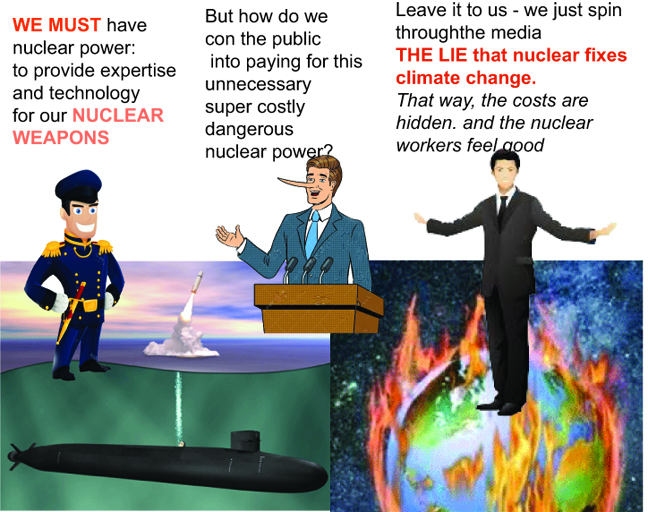
Andy Stirling, professor of science and technology policy at the University of Sussex, is convinced that the pressure to support nuclear power comes from another U.K. commitment: defense. More specifically, the country’s fleet of nuclear submarines.
The U.S. and France have openly acknowledged this military rationale for new civil nuclear build,” he told me. “U.K. defense literature is also very clear on the same point. Sustaining civil nuclear power despite its high costs, helps channel taxpayer and consumer revenues into a shared infrastructure, without which support, military nuclear activities would become prohibitively expensive on their own.”
This is no conspiracy theory. In 2018, Stirling and his colleague Philip Johnstone published the findings of their research into “interdependencies between civil and military nuclear infrastructures” in countries with nuclear capability. In the U.S., a 2017 report from the Energy Futures Initiative, which includes testimony from former U.S. Energy Secretary Ernest Moniz in 2017, states: “a strong domestic supply chain is needed to provide for nuclear Navy requirements. This supply chain has an inherent and very strong overlap with the commercial nuclear energy sector and has a strong presence in states with commercial nuclear power plants”
In the U.K., bodies including the Nuclear Industry Council, a joint forum between the nuclear industry and the government, have explicitly highlighted the overlap between the need for a civil nuclear sector and the country’s submarine programs. And this week, Rolls-Royce, which builds the propulsion systems for the country’s nuclear submarines, announced it had secured some $292 million in funding to develop small modular reactors of the type touted by the Prime Minister.
In Stirling’s view, these relationships help to explain “the otherwise serious conundrum, as to why official support should continue for civil nuclear new build at a time when the energy case has become so transparently weak.”
Stirling and other experts say the energy case for nuclear is weak because there are better, cheaper and quicker alternatives that are readily available.
“When there is too little wind and solar, zero emissions generators which can flexibly and rapidly increase their output are needed,” said Mark Barrett, professor of energy and environmental systems modelling at University College London. “These can be renewables, such as biogas, or generators using fuels made with renewables such as hydrogen. But unlike nuclear, these can be turned off when wind and solar are adequate.”
Indeed, Barrett pointed out, renewables are becoming so cheap that energy surpluses won’t necessarily be that big a deal.
Renewable costs have fallen 60-80% in the last decade with more to come, such that it is lower cost to spill some renewable generation than store it, and predominantly renewable systems are lower cost than nuclear. Renewables can be rapidly built: U.K. wind has increased to 24% of total generation, mostly in just 10 years. And of course renewables do not engender safety and waste problems.”
Sarah Darby agreed, saying “a mix of energy efficiency, storage and more flexible demand shows much more promise for reducing carbon emissions overall and for coping with peaks and troughs in electricity supply.”
“The U.K. market for flexibility services is already delivering effective firm-equivalent capacity on the scale of a large nuclear reactor per year, at costs that are a small fraction of the costs of nuclear power,” Stirling told me. “With costs of flexibility diminishing radically—in batteries, other storage, electric vehicles, responsive demand, hydrogen production—the scope for further future cost savings is massive.”
“There is no foreseeable resource constraint on renewables or smart grids that makes the case for nuclear anywhere near credible,” he added. “That the U.K. Government is finding itself able to sustain such a manifestly flawed case, with so little serious questioning, is a major problem for U.K. democracy.”
In the U.K., both the incumbent Conservative party and the main opposition party, Labour, support the development of new and advanced nuclear power reactors. In an emailed response to questions for the U.K. government’s Department for Business, Energy and Industrial Strategy, a government spokesperson categorically denied any link between the civil nuclear sector and the defense industry……..
I contacted the office of Labour’s shadow secretary of state for business, energy and industrial strategy Edward Miliband for comment, but no response has been forthcoming……..https://www.forbes.com/sites/davidrvetter/2021/08/06/more-nuclear-power-isnt-needed-so-why-do-governments-keep-hyping-it/?sh=285eb017ddda
To fix unequal rooftop solar benefits, there’s a better way than taxes — RenewEconomy

Rather than a solar tax, we should keep growing the solar pie, and improve benefit sharing through technologies like community batteries. The post To fix unequal rooftop solar benefits, there’s a better way than taxes appeared first on RenewEconomy.
To fix unequal rooftop solar benefits, there’s a better way than taxes — RenewEconomy
August 6 Energy News — geoharvey

Opinion: ¶ “What Is The UN Climate Conference In Glasgow And Why Is It So Important?” • COP26 (COP is for Conference of the Parties) is widely seen as crucial if climate change is to be brought under control. In 2015, the countries agreed to try to keep temperature increases “well below” 2°C (3.6°F), but […]
August 6 Energy News — geoharvey
Hiroshima Nagasaki – the story they want us to forget
Bruce Gagnon 6 August 2021, The world’s first nuclear explosion occurred on July 16, 1945, when a plutonium implosion device was tested at a site located 210 miles south of Los Alamos, New Mexico, on the barren plains of the Alamogordo Bombing Range, known as the Jornada del Muerto (day of the dead).
US President Harry Truman ordered the first atomic bomb to be dropped on Hiroshima, Japan on August 6, 1945. Days later (August 9) Washington dropped a second bomb on Nagasaki.
Official figures of those killed by the atomic bombs is well over 150,000 from the two cities. More than 100,000 were injured with most likely dying. Then over the years many thousands have died from the initial radiation poisoning.
Trip to Hiroshima & Nagasaki
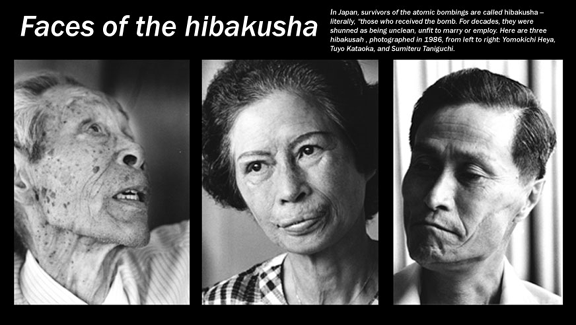
On a trip to Japan for memorial events at Hiroshima and Nagasaki in 1984 I met many Hibakusha (survivors of the US bombing attacks in 1945). One told the story that after the bomb was dropped the US military would not initially allow medical personnel to come tend the injured. Instead US radiological teams came in to study the effects of the bombing on the people. Arms and legs were cut off and taken back to the US. Photos were taken. Skin samples and blood were taken. The Japanese people were lab rats for the Americans to study.
When I returned home to Orlando, Florida where I was working for the Florida Coalition for Peace & Justice I decided that I had to share this story with the larger community. The Orlando Sentinel newspaper had a regular column called ‘My Word’ so I sent in a piece about what the Hibakusha told me. The paper refused to print it saying that I could not prove what I had written.
We’ve been dealing with this same kind of censorship ever since.
A soldier’s story
In 1997, while still working for the Florida Coalition, we were organizing a campaign to stop NASA’s launch of 72 pounds of deadly plutonium-238 to be used for on-board heat and power on a deep state mission called Cassini. Prior to the launch we were holding a rally at Cape Canaveral (now called Cape Canaveral Space Force Station) and before we began an older man walked up to me and asked to speak. I asked him what he wanted to say.
He said that when the first a-bomb was exploded at Alamogordo in 1945 he was just a new recruit in the Army. He was a paratrooper. His unit was put on a transport plane and dropped into the mushroom cloud. The troopers were then medically tested and put on a train for a long trip around the country. While on the train every now and then it would stop and the GI’s would be medically tested again.
He said it wasn’t until years later he learned that located at each stop was a Department of Energy (DoE) nuclear lab that helped work on the bomb program. The GI’s were tested for time, space, longitude, latitude and other key variables. This man told me he was dying of cancer. His daughter had cancer. He was the only member of his unit that chuted into the toxic bomb cloud still alive.
Needless to say I invited him to speak and listened closely as he warned us never to trust NASA safety claims when they launch nuclear devices into space.
This is a history Washington wants us to forget
I recently heard Vladimir Putin say that some number of young people in Japan these days think it was Russia that dropped the atomic bombs on Hiroshima and Nagasaki.
This mis-education is being done to turn the Japanese people into an uncritical US ally as the US-NATO make their aggressive military moves on China and Russia.
We can’t let the world ever forget the true story of August 6 & 9, 1945.
What kind of nation would do these terrible things?
Never forget!
Thousands of litres of sulphuric acid leaks from tanker as it travels through South Australia
| Thousands of litres of sulphuric acid leaks from tanker as it travels through South Australia https://www.abc.net.au/news/2021-08-04/truck-leaks-sulphuric-acid-smelter-uranium-mine-south-australia/100348628 ABC North and West SA / By Declan Gooch South Australia’s Environment Protection Authority (EPA) says a manufacturing fault is likely to blame for the leakage of thousands of litres of sulphuric acid from a tanker truck. Key points:A tanker has leaked 4,500 litres of sulphuric acid across regional South AustraliaIt was on its way from Port Pirie to the outback Beverley uranium mine The EPA says the spill had caused no apparent environmental damage, possibly thanks to rain The truck was loaded with sulphuric acid at the Nyrstar lead smelter in Port Pirie on July 22. According to the EPA’s director of regulation Andrew Pruszinski, two days later, the truck left for the Beverley uranium mine in the state’s north-east, and was about 70 kilometres north of Yunta — or about 270 km from Port Pirie — when the driver was alerted to a problem.”On the way to the mine site … [a] driver, who was in the truck behind the tanker, noticed something wasn’t right with the truck in front,” Mr Pruszinski said. |
Technology won’t be enough to tackle climate emergency, researchers say — RenewEconomy

Researchers say relying on technologies alone will not be enough to avoid a climate emergency, and question the viability indefinite economic growth. The post Technology won’t be enough to tackle climate emergency, researchers say appeared first on RenewEconomy.
Technology won’t be enough to tackle climate emergency, researchers say — RenewEconomy
Taylor’s contentious ARENA regulations survive after tied senate vote — RenewEconomy

Angus Taylor’s second attempt at introducing controversial ARENA regulations narrowly survives an attempt by the Australian Greens to cancel them out. The post Taylor’s contentious ARENA regulations survive after tied senate vote appeared first on RenewEconomy.
Taylor’s contentious ARENA regulations survive after tied senate vote — RenewEconomy
Beyond the Burn: A photographic essay of Australian solar farms — RenewEconomy

Beyond the Burn is a photographic essay to capture the solar farms powering Australia’s clean energy future, and the people behind them. The post Beyond the Burn: A photographic essay of Australian solar farms appeared first on RenewEconomy.
Beyond the Burn: A photographic essay of Australian solar farms — RenewEconomy
Amazon contracted solar farm gets registration from AEMO in western NSW — RenewEconomy

NSW solar farm with large contract with Amazon obtains registration and will be in full operation by the end of the year. The post Amazon contracted solar farm gets registration from AEMO in western NSW appeared first on RenewEconomy.
Amazon contracted solar farm gets registration from AEMO in western NSW — RenewEconomy
Net zero target for 2050 is too slow, and a strategy for climate failure — RenewEconomy

Long-term targets are an excuse for “procrastination”, and even targeting net zero by 2050 will only lock in fossil fuel use, Australian think tank says. The post Net zero target for 2050 is too slow, and a strategy for climate failure appeared first on RenewEconomy.
Net zero target for 2050 is too slow, and a strategy for climate failure — RenewEconomy
Edward Snowden and Julian Assange’s warning about the Security and Surveillance Industrial Complex — Rise Up Times

This video was released today (August 3, 2021) to show that journalists and whistleblowers warned us years ago about the recent revelation of the Pegasus spy software developed by the Israeli cyberweapons company NSO Group, which was found on the phones of journalists around the world, and that this is just the tip of the iceberg.
Edward Snowden and Julian Assange’s warning about the Security and Surveillance Industrial Complex — Rise Up Times
1 This month.


PETITION – To: Prime Minister Anthony Albanese and the Australian Labor Government
Chernobyl: The Lost Tapes – A good documentary on Chernobyl on SBS available On Demand for the next 3 weeks– https://www.sbs.com.au/ondemand/tv-program/chernobyl-the-lost-tapes/235274195556
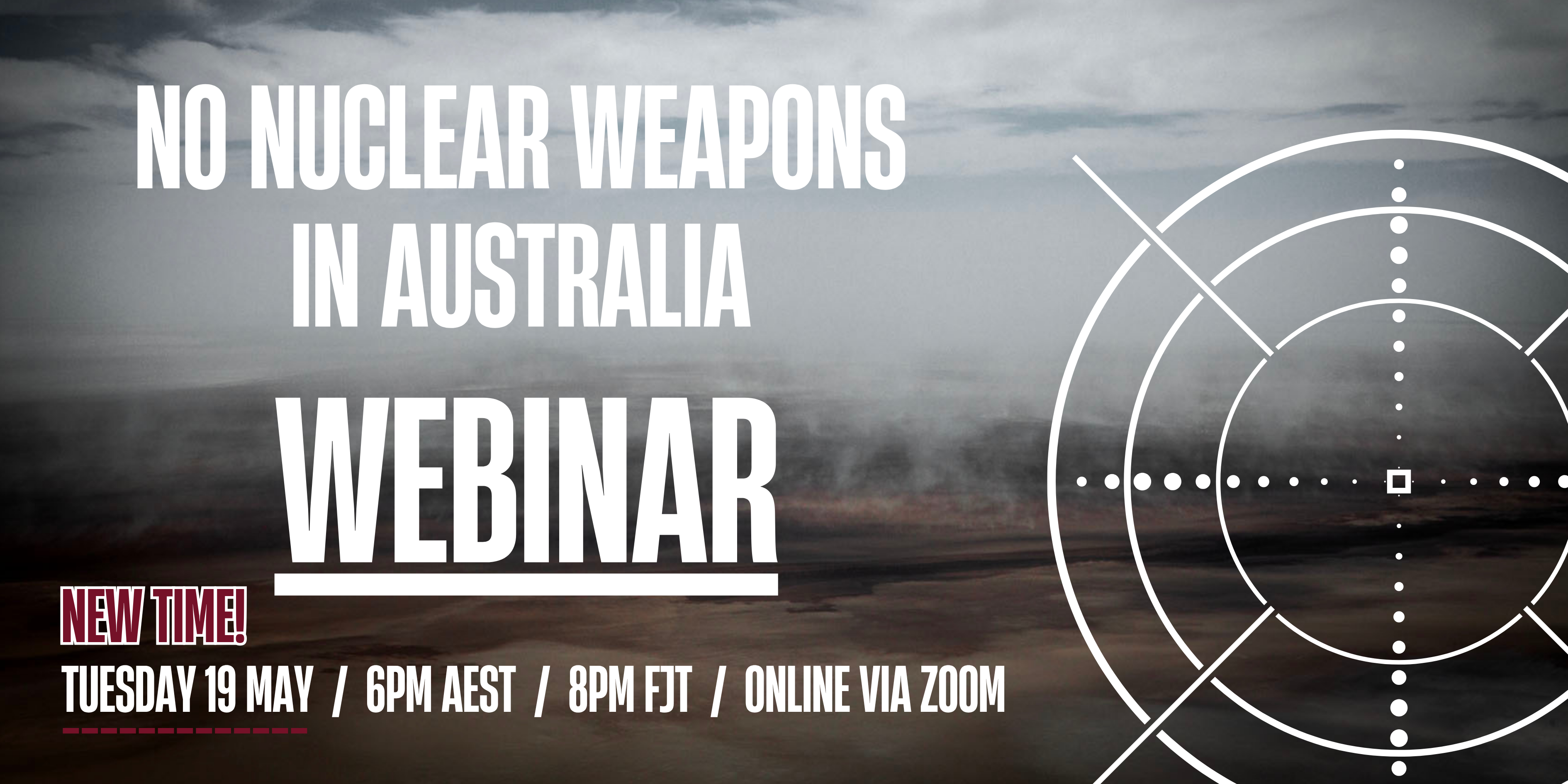
19 May – Webinar- Webinar: No Nuclear Weapons in Australia
Start: 2026-05-19 18:00:00 UTC Canberra, Melbourne, Sydney (GMT+10:00)
End: 2026-05-19 19:30:00 UTC Canberra, Melbourne, Sydney (GMT+10:00)
20 May – Webinar – The dangerous world of AUKUS, US, military occupation and suppression of dissent

National Webinar, 20th May, 2026, 6.30pm AEST. Confronting laws restricting/suppressing protest speech and action
Speakers: Former Sen. Rex Patrick, Lawyer Nick Hanna ,Arthur Rorris ,Jorgen Doyle, Sen David Shoebbridge,
Facilitator Kelley Tranter.

of the week – Australians for War Powers Reform (AWPR)
To see nuclear-related stories in greater depth and intensity
 Antinuclear