August 9 Energy News — geoharvey

Opinion: ¶ “Why China’s Climate Policy Matters To Us All” • China’s carbon emissions are vast and growing, dwarfing those of other countries. Experts agree that without big reductions in China’s emissions, the world cannot win the fight against climate change. China’s President Xi Jinping has said his country will aim for its emissions to […]
August 9 Energy News — geoharvey
Balancing on a Knife’s Edge: Climate Security Implications of the IPCC Findings — The Center for Climate & Security

A wildfire at Florida Panther NWR. Photo by Josh O’Connor – USFWS.By Akash Ramnath and Kate Guy New scientific consensus released today details the potential future course of climate change, with serious repercussions for international security and stability. The Intergovernmental Panel on Climate Change (IPCC) released the first product of its Sixth Assessment Report (AR6),…
Balancing on a Knife’s Edge: Climate Security Implications of the IPCC Findings — The Center for Climate & Security
(Sorry not the Olympics) Nuclear and Climate News
I’m thinking of changing my name to ”Cassandra”.(Greek goddess of gloom and doom) The media in my country, and elsewhere, has been ecstatic about Olympic Games medals. I guess that’s a relief from the virus/vaccine focus. But it seems that nobody knows that this week has been the anniversary of the atomic bombing of Hiroshima and Nagasaki, and that Fukushima ”recovery” has not really happened. That the Japanese government, despite the pandemic, in fact did not have the power to cancel the Games – under the contract, only the IOC can do that. That vast sums were spent, and will leave the Japanese people with vast debt, right when they have a crippling health crisis. . That the extravagant arenas and buildings will become white elephants.That 430 athletes and others in the Olympic Village got Covid-19.
Similarly, in the news we heard some whispers about wildfires around the world, and catastrophic floods, too. You really need alternative media to put all this together. A leader in this is Radio Ecoshock – ”I’ve Seen Fire and I’ve Seen Rain”.
BUT – just as I write this – up comes the UN Climate report 2021 – https://www.youtube.com/watch?v=PDSySmJChXgSurely this will wake up the mainstream media, even in Australia.Coronavirus – there’s still a surge in cases, worldwide, with a clear trend to the pandemic affecting the un-vaccinated.
Some bits of good news. Hard to find – but here’s a place – Empathy in the English Channel and A bird recovery programme, and Africa’s largest forest reserve in recovery.
AUSTRALIA
On the brink of a new nuclear arms race. On Hiroshima Day, the City of Newcastle reaffirms its commitment as a Nuclear Free Zone, supporting United Nations Treaty on the Prohibition of Nuclear Weapons.
People of the Pacific condemn Talisman Sabre Military Exercises.
Conservation Council of South Australia supports ANSTO’s proposal for a new Intermediate Level Solid Waste Storage Facility at Lucas Heights. Thousands of litres of sulphuric acid leaks from tanker as it travels through South Australia froma uranium mine.
INTERNATIONAL.
Global average temperature rise of 1.5c likely to be reached 10 years early. The world is getting “dangerously close” to running out of time to avert catastrophic climate change.
Towards a clean and sustainable energy system: 26 criteria nuclear power does not meet .
Nuclear weapons cannot be used, but their danger persists. Now, in the times of the UN Nuclear Ban Treaty, nuclear deterrence continues, but becomes increasingly discredited. Renounce the use and further development of nuclear weapons. The hard fought campaign continues – to ban nuclear weapons.
The myth that the nuclear destruction of Hiroshima and Nagasaki was justified.
Complicit – The countries, companies and think tanks that support the deadly nuclear arms trade.
JAPAN.Hiroshima City remembers the sudden cruelty of the atomic bombing . https://www.youtube.com/watch?v=TWP3GWFI7nk Tokyo Olympics part of propaganda strategy to downplay Fukushima nuclear disaster, as Olympics have been previously used to downplay Hiroshima bombing. Tokyo Olympics were touted as a showcase for Fukushima nuclear recovery. That didn’t work.
People of the Pacific condemn Talisman Sabre Military Exercises
9 Aug 21, Groups from the Pacific region condemn the recent military exercises in Australia as damaging to the environment, health and peace in the region.
After two weeks of high intensity combined forces training, the U.S. forward-deployed America Expeditionary Strike Group is moving again as Australia’s largest warfighting exercise, joint exercise Talisman Sabre 2021 (TS21), winds down.
On July 24, at the height of Talisman Sabre, representatives from Pacific nations including Australia, New Zealand, Guahan (Guam), Hawaii (USA), Japan, Rep of Korea, West Papua and the Philippines called for an end to Talisman Sabre – and all exercises in the Pacific.
Their statements of concern and commitment to collaboration for peace in the Pacific can be heard here.
TS21 saw 17,000 U.S., Australian and allied troops engaging in combined land, sea and air manoeuvres inland and along the Queensland coast.
This year’s exercise marked many firsts, among them:
● The first year the ADF did not engage in Public Environment Report
● South Korea participating in Talisman Sabre for the first time, sending a destroyer. Japan, U.K., Canada, New Zealand also participated, with France, Germany, India and Indonesia present as observers.
● U.S. forward deployed Expeditionary Strike Group. America, part of the 7th Fleet, joining the exercise.
● The first use of U.S. Patriot missiles in Talisman Sabre – reportedly the first use in the Southern Hemisphere.
● First involvement of U.S.F-35B fighter jets and to integrate non-US aircraft into HIMARS system.
● First to use regional township of Hughenden and to activate RAAF Base RAAF Base Scherger in Queensland’s far north, Cape York near Weipa.
Robin Taubenfeld spokesperson for Friends of the Earth Australia and Pacific Peace Network member group said: “The Pacific Peace Network condemns Talisman Sabre. At this time of global health and climate crisis, there is no justification for ongoing investment in war or increased military activity. We call for the Pacific to be honoured for its name; rather than as a stage for sabre rattling, it should be a region of peace. ”
“2021 was a year for many notable firsts for Talisman Sabre. Though smaller in size, the exercise targeted a greater number of defence and non-defence areas and used more lethal firepower than previous exercises. If this is the down-sized version of Talisman Sabre, we are alarmed at what post-pandemic iterations of the exercise might bring.”
“2021 was the first year the ADF did not engage in the Public Environment Report (PER) process around the exercise, despite its spread into regional locations and numerous non-defence areas.”
The ramping up of firepower, the spreading of activity to Queensland’s northernmost region and the increased number of participating nations sends a clear message of U.S. allied strength to China.”
“With tensions mounting in the South China Sea, allied governments may spruik the benefits of interoperability with the U.S.”
“Many of their constituents and people around the Pacific, however, have grave concerns about the increasing presence of U.S. troops and the social and environmental cost of ongoing militarism in the region and want to see these exercises cancelled.”
For more information or interviews:
Robin Taubenfeld 0411118737 robin.taubenfeld@foe.org.au
Annette Brownlie 0431597256 Ipan.australia@gmail.com
On Hiroshima Day, the City of Newcastle reaffirms its commitment as a Nuclear Free Zone, supporting United Nations Treaty on the Prohibition of Nuclear Weapons
Hiroshima Day flag-raising reaffirms City’s commitment to Nuclear Free Zone, Mirage News, 8 Aug 21, City of Newcastle reaffirmed its long-held commitment to declaring the city a Nuclear Free Zone, raising the Hunter Peace Group and International Campaign to Abolish Nuclear Weapons (ICAN) flags in Civic Park in recognition of Hiroshima Day.
Observed each year on 6 August, 2021 marks the 76th anniversary of the devastating bombing of Hiroshima and Nagasaki by US forces.
In support of ongoing efforts to raise awareness about the campaign toabolish nuclear weapons, the flags were flown alongside the Australian and Aboriginal flags to mark the historic anniversary.
It followed a Lord Mayoral Minute supported by City of Newcastle councillors in June, acknowledging the City’s long-standing history with local, national and international peace movements, dating back to 29 June 1982 when the City first declared Newcastle a Nuclear Free Zone under Lord Mayor Joy Cummings AM, and resolving to establish with Hunter Peace Group a dedicated Newcastle Peace Park at Tighes Hill Reserve, adjacent to Islington Park.
Peace parks exist in many cities across the country, including Adelaide, Hobart and Canberra, and more locally at Cessnock and Tanilba Bay.
Lord Mayor Nuatali Nelmes said the City of Newcastle was proud to support these efforts as a progressive city.
“The City of Newcastle has a long and proud history of activism against nuclear weapons, particularly as a city with a large working port,” Cr Nelmes said.
“Former Newcastle Lord Mayor Joy Cummings was a passionate advocate for the peace movement, inspiring strong community support and joining with Hunter Peace Group, trade unionists and activists to hold demonstrations on the importance of nuclear disarmament and protecting Newcastle as a Nuclear Free City and port.
I am honoured to uphold that mission today on behalf of the City, in which there is no place for nuclear weapons in modern society.”
Hunter Peace Group Secretary Lynda Forbes said the group was pleased to continue this important work with the City of Newcastle.
While ever there is nuclear testing being conducted across the globe, Hunter Peace Group believes it is important to continue to commemorate the anniversaries of the bombing of Hiroshima and Nagasaki, to draw public attention to the threat that nuclear weapons pose to communities throughout the world,” Ms Forbes said.
“Despite City of Newcastle supporting the United Nations’ Treaty on the Prohibition of Nuclear Weapons in 2019, and advocating to the Federal Government in 2020, Australia is yet to sign and ratify the treaty, which came into force in January this year.
………..https://www.miragenews.com/hiroshima-day-flag-raising-reaffirms-citys-609135/
Complicit – The countries, companies and think tanks that support the deadly nuclear arms trade

The world spends $137,000 a minute on nuclear weapons
Complicit — Beyond Nuclear International 8 Aug 21, The countries, companies and think tanks that support the deadly nuclear arms trade
From ICAN
A new report from ICAN — Complicit: 2020 Global Nuclear Weapons spending — names names and produces some horrifying spending numbers, made all the more immoral by the desperate needs around the world due to the COVID-19 pandemic, along with the ever worsening conditions brought on by the climate crisis.
As the report notes, “In 2020, during the worst global pandemic in a century, nine nuclear-armed states spent $72.6 billion on their nuclear weapons, more than $137,000 per minute, an inflation adjusted increase of $1.4 billion from last year.”
It goes on to ask the obvious question: Why? The answer lies in the profits to be made by the world’s nuclear weapons companies, not to mention the funding flowing to a few think tanks, some of which have missions that should make taking this money unacceptable. “Not only does this report reveal the massive spending on nuclear weapons during the worst global pandemic in a century, it also shines a light on the shadowy connection between the private companies building nuclear weapons, lobbyists and think tanks,” wrote ICAN’s Susi Snyder in an email to launch the report.
She also narrates this short video above that explains the findings.
“The exchange of money and influence, from countries to companies to lobbyists and think tanks, sustains and maintains a global arsenal of catastrophically destructive weapons. Each person and organisation in this cycle is complicit in threatening life as we know it and wasting resources desperately needed to address real threats to human health and safety”, says the report’s executive summary. It goes on:
“The $72.6 billion spent on nuclear weapons was split between governmental departments and private companies. Companies in France, the United Kingdom and the United States received $27.7 billion from nuclear-weapon-related contracts in 2020, of which $14.8 billion was new.
“Those companies then funded think tanks that research and write about nuclear weapons policies. At least twelve major think tanks that research and write about nuclear weapons in India, France, the United Kingdom, and the United States received collectively between $5 million and $10 million from companies that produce nuclear weapons.
“The CEOs of companies that produce nuclear weapons sit on their advisory boards and are listed as ‘partners’ on their websites.
“And to make sure the enormous budgets are approved to pay for these contracts, those same companies hire lobbyists. In 2020, nuclear weapons producers spent $117 million in lobbying on defence. For every $1 spent lobbying, an average of $236 in nuclear weapon contract money came back.
“Nuclear-armed states spent an obscene amount of money on illegal weapons of mass destruction in 2020, while the majority of the world’s countries support a global nuclear weapons ban. But the story doesn’t stop there. Companies, lobbyists and think tanks are complicit and deserve to be held accountable for their role in building and shaping a world with more than 13,000 life- ending weapons. We need to call on them to cut it out.”
The executive summary of the report then calls out the names of the countries, companies and think tanks complicit in effectively planning the world’s destruction.
Country Spending On Nuclear Weapons In 2020
The United States: $37.4 billion; $70,881 / minute
China: $10.1 billion; $19,149 / minute
Russia: $8 billion; $15,222 / minute
The United Kingdom: $6.2 billion; $11,769 / minute
France: $5.7 billion; $10,786 / minute
India: $2.48 billion; $4,567 / minute
Israel: $1.1 billion; $2,059 / minute
Pakistan: $1 billion; $1,968 / minute
North Korea: $667 million; $1,265 / minute
2020 Total: $72.6 billion; $137,666 / minute
2019 Total: $71.2 billion* $135,424 / minute
*Adjusted for inflation…………………..
more https://beyondnuclearinternational.org/2021/08/08/complicit/
The myth that the nuclear destruction of Hiroshima and Nagasaki was justified

Over the years, the myth that the “nuking” of two Japanese cities was justified, has lost much of its appeal on both sides of the Pacific
Mythmaking and the Atomic Destruction of Hiroshima and Nagasaki, CounterPunch BY JACQUES R. PAUWELS, 8 Aug 21, Myth: The war in the Far East only ended in the summer of 1945, when the US president and his advisors felt that, to force the fanatical Japanese to surrender unconditionally, they had no other option than to destroy not one but two cities, Hiroshima and Nagasaki, with atom bombs. This decision saved the lives of countless Americans and Japanese who would have perished if the war had continued and required an invasion of Japan.
Reality: Hiroshima and Nagasaki were destroyed to prevent the Soviets from making a contribution to the victory against Japan, which would have forced Washington to allow Moscow to participate in the postwar occupation and reconstruction of the country. It was also the intention to intimidate the Soviet leadership and thus to wrest concessions from it with respect to the postwar arrangements in Germany and Eastern Europe. Finally, it was not the destruction of Hiroshima and Nagasaki, but the Soviet entry into the war against Japan, which caused Tokyo to surrender.
With the German capitulation in early May 1945, the war in Europe was over. The victors, the Big Three,[1] now faced the complex and delicate problem of the postwar reorganization of Europe. The United States had entered the war rather late, namely in December 1941. And the Americans only started to make a major contribution to the victory against Germany with the landings in Normandy in June 1944, that is, less than one year before the end of the hostilities in Europe. When the war against Germany came to an end, however, Uncle Sam occupied a seat at the table of the victors, ready and eager to look after his interests, to achieve what one might call the American war aims. (It is a myth that the presumably deeply isolationist Americans just wanted to withdraw from Europe: the country’s political, military, and economic leaders had urgent reasons for maintaining a presence on the old continent.) The other big victorious powers, Britain and the Soviet Union, also looked to pursue their interests. It was clear that it would be impossible for one of the three to “have it all”, that compromises would have to be reached. From the American point of view, the British expectations did not present much of a problem, but Soviet aspirations were a concern. What, then, were the war aims of the Soviet Union?
As the country that had made the biggest contribution by far to the common victory over Nazi Germany and suffered enormous casualties in the process, the Soviet Union had two major objectives. First, hefty reparation payments from Germany as compensation for the huge destruction wrought by Nazi aggression, a demand similar to the French and Belgian demands for reparations payments from the Reich after World War I. Second, security against potential future threats emanating from Germany………………………….
on April 25, 1945, only days before the German capitulation, the president received electrifying news. He was briefed about the top-secret Manhattan Project, or S-1, the code name for the construction of the atom bomb. That new and powerful weapon, on which the Americans had been working for years, was almost ready and, if tested successfully, would soon be available for use. Truman and his advisors thus fell under the spell of what the renowned American historian William Appleman Williams has called a “vision of omnipotence”. They convinced themselves that the new weapon would enable them to force their will on the Soviet Union. The atomic bomb was “a hammer”, as Truman himself put it, that he would wave over the heads of “those boys in the Kremlin”.[3]
Thanks to the bomb, it would now be possible to force Moscow to withdraw the Red Army from Germany and to deny Stalin a say in its postwar affairs. It now also seemed a feasible proposition to install pro-Western and even anticommunist regimes in Poland and elsewhere in Eastern Europe, and to prevent Stalin from exerting any influence there. It even became thinkable that the Soviet Union itself might be opened up to American investment capital as well as American political and economic influence,………… Indeed, with the nuclear pistol on his hip, the American president did not feel that he had to treat “the boys in the Kremlin”, who did not have such a super-weapon, as his equals……….
Possession of a mighty new weapon also opened up all sorts of possibilities with respect to the ongoing war in the Far East and the postwar arrangements to be made for that part of the world, of great importance to the leaders of the US, as we have seen when dealing with Pearl Harbor. Nevertheless, playing that powerful trump card would only be possible after the bomb had been successfully tested and was available to be used………
Truman concluded that only an actual demonstration of the atomic bomb could persuade the Soviets to give way.
…………………The Americans thus knew only too well that the situation of the Japanese was hopeless. “Fini Japs when that comes about”, Truman wrote in his diary, referring to the expected Soviet intervention in the war in the Far East.[9]
…………….. In order to finish the war against Japan without having to make more sacrifices, Truman thus had a range of attractive options. He could accept the trivial Japanese condition, immunity for their emperor; he could also wait until the Red Army attacked the Japanese in China, thus forcing Tokyo into accepting an unconditional surrender after all; and he could have instituted a naval blockade that would have forced Tokyo to sue for peace sooner or later. But Truman and his advisors chose none of these options. Instead, they decided to knock Japan out with the atomic bomb.
This fateful decision, which was to cost the lives of hundreds of thousands of people, mostly civilians, offered the Americans considerable advantages.
………………… The atom bomb seemed to offer the American leaders an additional important advantage. Truman’s experience in Potsdam had persuaded him that only an actual demonstration of this new weapon would make Stalin pliable. Using the atom bomb to obliterate a Japanese city seemed to be the perfect stratagem to intimidate the Soviets and coerce them to make major concessions with respect to postwar arrangements in Germany, Poland, and elsewhere in Central and Eastern Europe. Truman’s secretary of state, James F. Byrnes, reportedly declared later that the atom bomb had been used because such a demonstration of power was likely to make the Soviets more accommodating in Europe.
To make the desired terrifying impression on the Soviets – and the rest of the world -, the bomb obviously had to be dropped on a big city. It is probably for this reason that Truman turned down a proposal, made by some of the scientists involved in the Manhattan Project, to demonstrate the power of the bomb by dropping it on some uninhabited Pacific island: there would not have been sufficient death and destruction. It would also have been extremely embarrassing if the weapon had failed to work its deadly magic; but if the unannounced atomic bombing of a Japanese city backfired, no one would have known and no one would have been embarrassed. A big Japanese city had to be selected, but the capital, Tokyo, did not qualify, since it was already flattened by previous conventional bombing raids, so that additional damage was unlikely to loom sufficiently impressive. In fact, very few cities qualified as the required “virgin” target. ……….
The atom bomb was ready just in time to be put to use before the USSR had a chance to become involved in the Far East………………
Already on August 10, 1945, just one day after the Soviet Union’s entry into the war in the Far East, a second bomb was dropped, this time on the city of Nagasaki. About this bombardment, in which many Japanese Catholics perished, a former American army chaplain later stated: “That’s one of the reasons I think they dropped the second bomb. To hurry it up. To make them surrender before Russians came”.[11] (The chaplain may or may not have been aware that among the 75,000 human beings who were “instantaneously incinerated, carbonized and evaporated” in Nagasaki were many Japanese Catholics as well an unknown number of inmates of a camp for allied POWs, whose presence had been reported to the air command, to no avail.)[12]
Japan capitulated not because of the atom bombs but because of the Soviet entry into the conflict. ………………………
Truman, however, wanted to use the bomb for a number of reasons, and not just to get the Japanese to surrender. He expected that dropping the atom bomb would keep the Soviets out of the Far East and terrorize that country’s leaders, so that Washington could impose its will on the Kremlin with respect to European affairs. And so, Hiroshima and Nagasaki were pulverized. Many American historians realize this only too well. Sean Dennis Cashman writes:
With the passing of time, many historians have concluded that the bomb was used as much for political reasons . . . Vannevar Bush [the head of the US Office of Scientific Research and Development] stated that the bomb “was also delivered on time, so that there was no necessity for any concessions to Russia at the end of the war”. Secretary of State James F. Byrnes [Truman’s secretary of state] never denied a statement attributed to him that the bomb had been used to demonstrate American power to the Soviet Union in order to make [the Soviets] more manageable in Europe.[16]
Truman himself, however, hypocritically declared at the time that the purpose of the two nuclear bombardments had been “to bring the boys home”, that is, to quickly finish the war without any further major loss of life on the American side. This explanation was uncritically broadcast in the American media and thus was born a myth eagerly propagated by them and by mainstream historians in the US and in the Western World in general, and of course by Hollywood.
The myth that two Japanese cities were nuked to force Tokyo to surrender, thus shortening the war and saving lives, was “made in USA”, but it was to be eagerly espoused in Japan, whose post-war leaders, vassals of the US, found it extremely useful for a number of reasons, as War Wilson has pointed out in his excellent article on the Bomb. First, the emperor and his ministers, who were in many ways responsible for a war that had caused so much misery for the Japanese people, found it extremely convenient to blame their defeat, as Wilson puts it, on “an amazing scientific breakthrough that no one could have predicted”. The blinding light of the atomic blasts made it impossible, so to speak, to see their “mistakes and misjudgments”. The Japanese people had been lied to about how bad the situation really was, and how the misery had dragged on so long just to save the emperor, but the Bomb provided the perfect excuse for having lost the war. No need to apportion blame; no court of enquiry need be held. Japan’s leaders were able to claim they had done their best. So, at the most general level the Bomb served to deflect blame from Japan’s leaders.
Second, the Bomb earned Japan international sympathy. Like Germany, Japan had waged a war of aggression and committed all sorts of war crimes. Both countries looked for ways to improve their image, seeking to exchange the mantle of perpetrator. for that of victim…………
Third, echoing the American notion that the Bomb had ended the war was certain to please Japan’s post-war American overlords. The latter would protect Japan’s upper class against the demands for radical societal change emanating from radical elements, including communists,………………..
Over the years, the myth that the “nuking” of two Japanese cities was justified, has lost much of its appeal on both sides of the Pacific……………
References: multiple sources are quoted . https://www.counterpunch.org/2021/08/06/mythmaking-and-the-atomic-destruction-of-hiroshima-and-nagasaki/
Bribing politicians pays off for weapons companies

The countries, companies and think tanks that support the deadly nuclear arms trade, From ICAN 8 Aug 21,
” ………….Company defence contract awards and defence lobby spending in 2020
Aerojet Rocketdyne: Awarded: $132 million Spent lobbying: $2.3 million
Airbus: Awarded: $170 million Spent lobbying: $6.1 million
BAE Systems: Awarded: $10.8 billion ($72.5 million for nuclear weapons) Spent lobbying: $5.6 million
Bechtel: Awarded: $2.9 billion Spent lobbying: $990,000
Boeing: Awarded: $50 billion ($105 million for nuclear weapons) Spent lobbying: $15.6 million
Constructions Industrielles de la Méditerranée (CNIM): Awarded: $39.1 million Spent lobbying: $17,226
Charles Stark Draper Laboratory: Awarded: $443.5 million ($342.3 million for nuclear weapons) Spent lobbying: $120,000
Fluor: Awarded: $3.9 billion Spent lobbying: $5.1 million
General Dynamics: Awarded: $39.4 billion ($10.8 billion for nuclear weapons) Spent lobbying: $13.9 million
Honeywell International: Awarded: $14 billion ($41.6 million for nuclear weapons) Spent lobbying: $7.4 million
Huntington Ingalls Industries: Awarded: $7.4 billion ($53 million for nuclear weapons); Spent lobbying: $5.2 million
Jacobs Engineering: Awarded: $2.6 billion Spent lobbying: $900,000
L3 Harris Technologies: Awarded: $5.6 billion ($60 million for nuclear weapons) Spent lobbying: $200,000
Leidos: Awarded: $10.8 billion Spent lobbying: $2.4 million
Leonardo: Awarded: $728.8 million Spent lobbying: $86,644
Lockheed Martin: Awarded: $124.5 billion ($2.1 billion for nuclear weapons) Spent lobbying: $15 million
Northrop Grumman: Awarded: 29.1 billion ($13.7 billion for nuclear weapons) Spent lobbying: $13.3 million
Raytheon Technologies Corporation: Awarded: $27.5 billion ($450 million for nuclear weapons) Spent lobbying: $15.2 million
Safran: Awarded: $12.3 million Spent lobbying: $382,211
Serco: Awarded: $896 million Spent lobbying: $420,000
Textron: Awarded: $1.8 billion ($3.2 million for nuclear weapons) Spent lobbying: $5.1 million
Total: Awarded: $332 billion ($27.7 billion for nuclear weapons) Spent lobbying: $117 million………
more https://wordpress.com/read/feeds/72759838/posts/3488978062
Global average temperature rise of 1.5c likely to be reached 10 years early

The planet is odds-on to hit 1.5C of global warming within 20 years, the world’s leading climate scientists will warn in a milestone report tomorrow. The paper, produced by the UN’s Intergovernmental Panel on Climate Change (IPCC), is the starkest warning yet about the speed and scale of warming. Experts said the report would paint a “devastating”
picture.
The document is predicted to trigger a “turning point” in the run-up to the Cop26 climate conference in Glasgow in November. Tomorrow’s report, produced by 200 scientists from 60 countries, is the first comprehensive assessment of the physical science of climate change since 2013. An interim report, published in 2018, said global warming was likely
to reach 1.5C between 2030 and 2052.
According to insiders who have seen the final document, the report brings this window forward by a decade to between 2021 and 2040. The report is expected to detail the risk of “tipping points”, in which climate change becomes hard to reverse. The melting of glaciers and ice sheets, for example, may create “feedback
loops” in which global warming spirals out of control. “That sensitivity means you can be too late,” Rivett-Carnac said.
“A lukewarm agreement [at Glasgow] that kicks the can down the road and solves some problems, has become, in a way, as much something to be avoided as not reaching the outcome you want.”
Times 8th Aug 2021
https://www.thetimes.co.uk/article/rise-of-1-5c-likely-to-be-reached-ten-years-early-l99rx5cmm
Hiroshima Day 2021 on August 6 in Berlin Worldpeacebell – Nukes are now illegal — limitless life

Heinrich Buecker Hiroshima Day 2021 on August 6 in Berlin Worldpeacebell – Nukes are now illegal https://cooptv.wordpress.com/2021/08/07/hiroshima-day-2021-on-august-6-berlin-worldpeacebell-nukes-are-now-illegal/ some videos: Hiroshima Day 2021 on August 6 in Berlin Worldpeacebell – Nukes are now illegal https://youtu.be/kq1z0DpwYy8 Hiroshima / Nagasaki mahnen: Atomwaffen abschaffen Friedensglocke Berlin 6.8. Auftakt https://youtu.be/PLYIA7Yp19M Music – Hiroshima / Nagasaki – Atomwaffen abschaffen – Friedensglockengesellschaft Berlin […]
Hiroshima Day 2021 on August 6 in Berlin Worldpeacebell – Nukes are now illegal — limitless life
August 8 Energy News — geoharvey

Opinion: ¶ “Five Key Things To Watch For In The UN Climate Report” • Filled with detail and tracing multiple future scenarios, the IPCC report is likely to run hundreds or even thousands of pages. New research, computer modeling, and data collection will make this report the most comprehensive yet. Here are five key things […]
August 8 Energy News — geoharvey
On the brink of a new nuclear arms race.

Ed. note. An intelligent article (for THE AUSTRALIAN, that is) with insights into the current nuclear arms race, and into why Australia should not aim to get nuclear weapons.
Still, the rest of the article goes on to praise the American war machine, and to advise Australians to stick with it. That is the sucking up to America thinking that we have come to know and love, from Murdoch’s THE AUSTRALIAN
Worrying signs we’re on the brink of a new nuclear arms race, THE AUSTRALIAN By ALAN DUPONT From Inquire rAugust 7, 2021
There are worrying signs the world is on the brink of a new nuclear arms race. A regional conflict between nuclear-armed states could escalate quickly into a destructive global crisis with catastrophic consequences.
Fear that a conflict between the US and China over Taiwan could go nuclear is shaping the government’s risk assessments, strengthening the case to upgrade our missile defences for critical defence installations and operationally deployed units of the Australian Defence Force………..
Although China’s arsenal is still dwarfed by those of the US and Russia, its nuclear breakout could double the number of its nuclear warheads. The expansion is part of a disturbing global trend that reverses the late Cold War momentum towards nuclear arms reductions. There are continuing tensions over North Korea’s nuclear weapons program. Tehran is inching its way towards becoming the 10th nuclear weapons state despite the Biden administration’s efforts to resurrect a nuclear deal abandoned by Donald Trump. And Russian military planners seem to believe it is possible to win a limited nuclear war in what has been dubbed an “escalate to de-escalate strategy”……….
The Cold War was fought in the shadow of nuclear Armageddon.
The 1962 Cuban missile crisis came perilously close to initiating an existential war that would have devastated the planet and killed more than 100 million Americans and Russians.
These estimates don’t include deaths from the long-term effects of radiation and the nuclear winter that would follow, blanketing the sun and causing massive crop losses and damage to the Earth’s ecosystem. A 1982 study calculated that if Europe, China and Japan were included, there would be 400 million to 500 million fatalities.
After the close call in Cuba, a new doctrine emerged. Mutual assured destruction recognised that since the US and Soviet Union each had a comparable number of warheads neither could win a nuclear war. Any attempt to strike pre-emptively would be tantamount to suicide since the country attacked would have enough missiles left to annihilate the other.
MAD was satirised brilliantly by Stanley Kubrick in the memorable black comedy starring Peter Sellers as the US President’s eccentrically unhinged scientific adviser, Dr Strangelove………
The main concern after the Cold War break-up of the Soviet Union was that “loose nukes” might fall into the hands of terrorists untroubled by moral constraints and undeterred by the superior military power of nation-states. While still a problem, a bigger concern is the emerging second cold war between the US and its authoritarian challengers, Russia and China, which is eroding the trust essential for verifiable arms control agreements.
Most forms of bilateral arms control between the US and Russia have collapsed since the arms control agreements signed by Reagan and Gorbachev in the late 1980s. Beijing has resisted pressure to join new arms control talks, fearful of being locked into the position of a second-rate nuclear power since it has only a fraction of the nuclear weapons possessed by the US and Russia.
Other important drivers of the new nuclear arms race are Beijing’s determination to become a fully fledged nuclear power, Washington’s decision to modernise its nuclear forces and the development of smaller, stealthier and low-yield nuclear weapons.
The outcome of this race is less predictable and even more dangerous than before because there are more players, fewer constraints and greater potential for the proliferation of destabilising nuclear weapons technologies. Today’s nukes can be carried by an expanding list of delivery systems – from suitcases and artillery guns to cruise missiles and super-fast hypersonic missiles…….
Technological advances – notably the miniaturisation of nuclear warheads and advances in guidance systems, sensors and satellites – have increased the speed, accuracy and manoeuvrability of the latest missile classes.
They also have reduced warning times dramatically, encouraging hair-trigger “launch on warning” responses that make nuclear war more probable……………….
Trump ruffled feathers in Beijing and Moscow by proposing to spend $US1 trillion across the next 30 years upgrading all three elements of America’s nuclear triad (land, air and sea). His 2018 Nuclear Force Posture Review declared new warheads were necessary to maintain the viability of the US nuclear deterrent and to provide more flexibility for a range of plausible contingencies. These new warheads – low-yield variants of the missiles on its nuclear submarines and sea-launched cruise missiles – were heavily criticised as destabilising by Moscow and Beijing, as well as non-government organisations advocating for reductions in nuclear arms.
Despite branding Trump’s warhead initiative as a “bad idea” on the campaign trail and assuring NGOs the current arsenal “is sufficient”, Joe Biden has left intact Trump’s key initiatives and asked congress for a similar level of funding. This has drawn the ire of critics including progressives in his own party, who accuse Biden of expanding nearly all Trump’s programs and have vowed to fight his budget request.
Beijing’s historic nuclear shift must be seen against the background of a fragmenting international order. Confronted with the mega-challenges of the mutating Covid-19 pandemic and a warming planet, the last thing the world needs is a new nuclear arms race and a China determined to close a perceived [ perceived? it’s real] nuclear gap with the US. But that’s where we are headed……………
…….under pressure to develop our own nuclear weapons. But going down this path would be folly. Apart from stirring domestic controversy, a decision to develop nuclear weapons would be prohibitively expensive, alarm our neighbours and fly in the face of our commitment to the nuclear non-proliferation treaty. A handful of Australian nukes could never replace the protection afforded by the US nuclear guarantee………… https://www.theaustralian.com.au/inquirer/how-were-relearning-to-worry-about-the-bomb/news-story/422df1145c1965471987fb043bdf7769
Hiroshima City remembers the sudden cruelty of the atomic bombing

— On this day 76 years ago, a single atomic bomb instantly reduced our hometown to a scorched plain. That bombing brought cruel death to countless innocent victims and left those who managed to survive with profound, lifelong physical and emotional injuries due to radiation, fear of aftereffects, and economic hardship.
One survivor who gave birth to a girl soon after the bombing says, “As more horrors of the bomb came to light,
and I became more concerned about their effects, I worried less about myself and more about my child. Imagining the future awaiting my daughter, my suffering grew, night after sleepless night.”
City of Hiroshima 6th Aug 2021
Nuclear weapons cannot be used, but their danger persists
For the first time in our history, a treaty titled “Treaty on the Prohibition of Nuclear Weapons,” passed by the United Nations in 2017, presents the chance to end the nuclear madness. It was entered into force this past January; more nations, including those with nuclear weapons, need to sign on.
Through sheer luck, the planet has not yet been destroyed.
Nuclear weapons, an issue submerged from view https://tucson.com/opinion/local/tucson-opinion-nuclear-weapons-an-issue-submerged-from-view/article_8f18d4de-f61b-11eb-98ad-43c2514cef99.html, By Raymond Graap Arizona Daily Star, 6 Aug 1,
Donald Trump had it right after being told about nuclear weapons: Briefing officer: “You know, we can’t use them.” Trump answered: “Then why do we have them?”
So why can’t we use them? Because a launch would result in a catastrophic counter launch that would destroy both attacking nations.
It is also now known that a “limited” nuclear war between India and Pakistan, besides unbelievable destruction and death of a massive scale, would send 6 metric tons of debris up to 50,000 feet.
That would result in a nuclear winter and could put 2 billion people at risk of famine.
Previous treaties have reduced the number of nuclear warheads so that the U.S. and the Soviet Union have “only” 1,500 each, which is better than the 30,000 years ago. But now other nations feel the need for the nuclear gun. Here are facts to consider:
It would take only a dozen or so warheads to destroy the major cities of any country.
Accidents, even with warheads distributed in place, have happened. Eric Schlosser in his 2013 book “Command and Control” points these out in chilling detail. Cybersecurity threats are on the increase.
On six occasions, a launch due to human and computer failure has come within minutes of happening.
Destroy the planet by mistake? Absolutely possible and more likely now than during the Cold War.
These weapons remain on U.S. Cold War status: hair-trigger alert, sole authority by the president to launch, and first-use authority to launch. Once launched, there is no possibility to recall them.
Proposed plans are to replace the entire triad of delivery vehicles: new bombers, new submarines, and new land-based missiles. Estimated cost: $1 trillion.
New and more lethal and accurate missiles are now being made and designed by engineers here in Tucson.
Once a city is bombed, there is no medical or public health response possible.
What about “deterrence,” the threat of holding nuclear guns to each other’s heads?
To quote Gen. George Butler, Commander of Nuclear Forces in the early 90s: “Over time, as arsenals multiplied on both sides and the rhetoric of mutual annihilation grew more heated, we were forced to think about the unthinkable, justify the unjustifiable, rationalize the irrational. We contrived a new and desperate theology to ease our moral anguish, and we called it deterrence.”
Through sheer luck, the planet has not yet been destroyed.
Mankind has made little progress in finding creative ways to resolve conflicts peacefully. Technology has allowed us to see our small planet from space, but also has created the most sordid weapons conceivable.
Politicians often say, “This is not the right time.” If 76 years after Hiroshima and Nagasaki, then when is “the right time?”
So where does that leave us? We are spending huge amounts of tax dollars and scientific expertise to support an effort on something that cannot be used.
For the first time in our history, a treaty titled “Treaty on the Prohibition of Nuclear Weapons,” passed by the United Nations in 2017, presents the chance to end the nuclear madness. It was entered into force this past January; more nations, including those with nuclear weapons, need to sign on.
In his 2014 book “No Use” by Thomas M. Nichols, he states: “If disaster eventually strikes due to our inaction, we will not have the titanic ideological struggle of the twentieth century to blame.
And so, we must begin to create a more durable nuclear peace by reducing the number of nuclear arms and renouncing them as weapons of war. It is long past time, and we are out of excuses.”
Our current and prospective legislators need to break their silence and take this issue out of the darkness and speak up.
1 This month.


PETITION – To: Prime Minister Anthony Albanese and the Australian Labor Government
Chernobyl: The Lost Tapes – A good documentary on Chernobyl on SBS available On Demand for the next 3 weeks– https://www.sbs.com.au/ondemand/tv-program/chernobyl-the-lost-tapes/235274195556
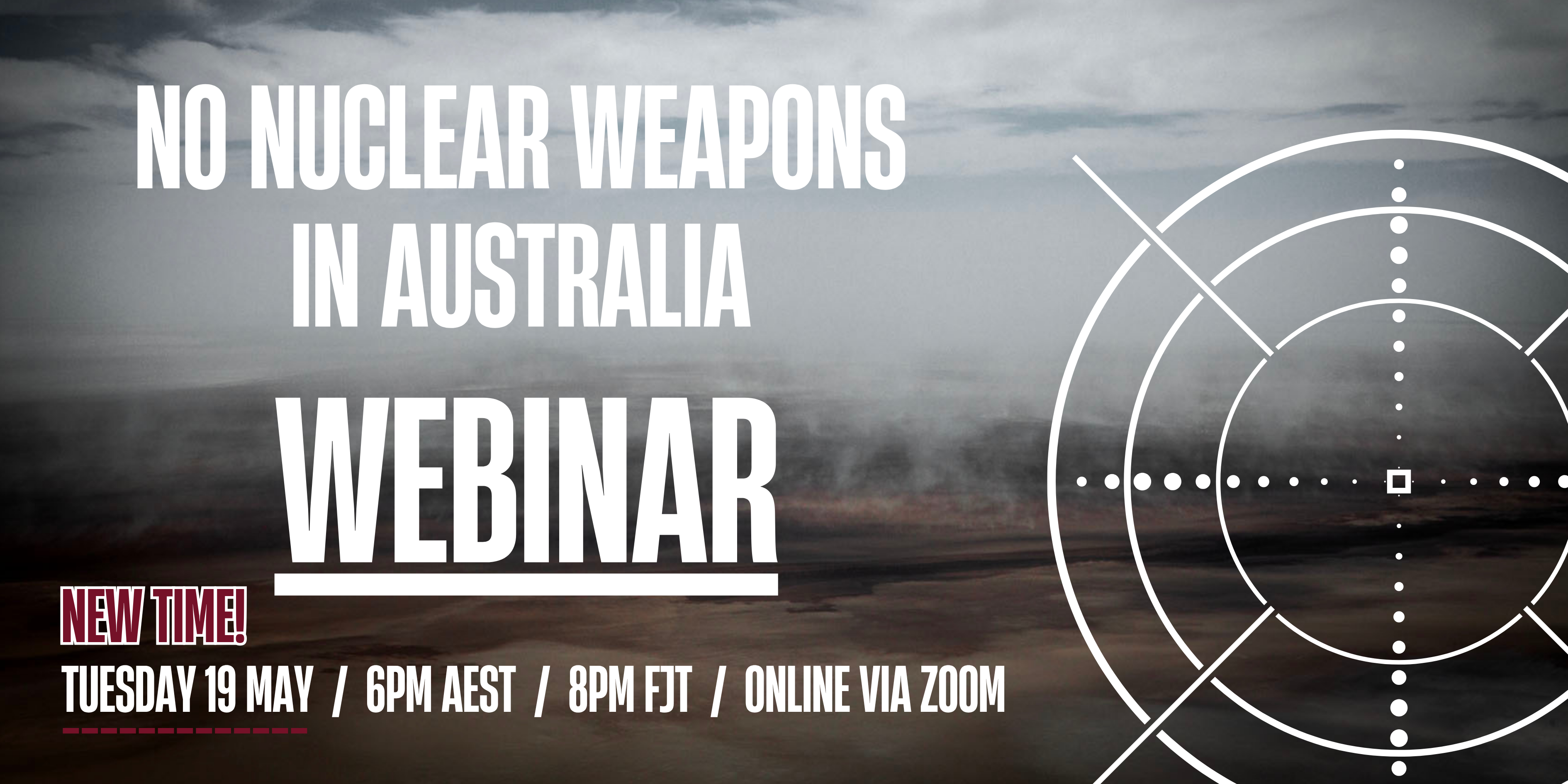
19 May – Webinar- Webinar: No Nuclear Weapons in Australia
Start: 2026-05-19 18:00:00 UTC Canberra, Melbourne, Sydney (GMT+10:00)
End: 2026-05-19 19:30:00 UTC Canberra, Melbourne, Sydney (GMT+10:00)
20 May – Webinar – The dangerous world of AUKUS, US, military occupation and suppression of dissent

National Webinar, 20th May, 2026, 6.30pm AEST. Confronting laws restricting/suppressing protest speech and action
Speakers: Former Sen. Rex Patrick, Lawyer Nick Hanna ,Arthur Rorris ,Jorgen Doyle, Sen David Shoebbridge,
Facilitator Kelley Tranter.

of the week – Australians for War Powers Reform (AWPR)
To see nuclear-related stories in greater depth and intensity
 Antinuclear