Uranium mining and high cancer rates in Aboriginals around Ranger mine
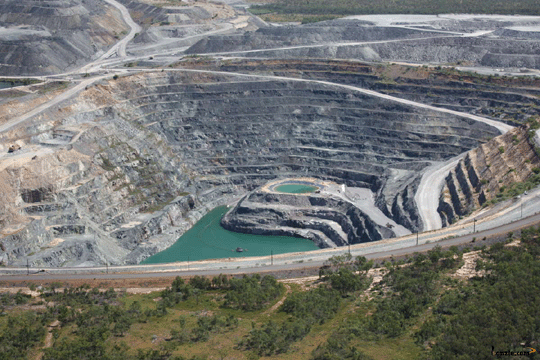
Kakadu mining and radiation, The Saturday Paper 14 Aug 21, Max Opray Carved out of the pristine surroundings of Kakadu National Park in the Northern Territory, the Ranger uranium mine has long been a site of deep controversy.
The mine may have been decommissioned in January, but concerns remain about its legacy, as the Mirarr traditional owners suffer through a mysterious health crisis.
The stillbirth rate among Aboriginal people living near the mine is more than twice as high as among Indigenous Australians elsewhere in the Top End, and rates of cancer are almost 50 per cent higher.
A six-year Northern Territory investigation into the issue failed to identify the cause, noting only that risk factors relating to diet, smoking and alcohol consumption were higher in the local population than in other Aboriginal populations.
The investigation was conducted by staff at the Population and Digital Health Branch of the Northern Territory Department of Health and overseen by an independent reviewer in cancer, epidemiologist professor Bruce Armstrong.
The report, published in November 2020, concluded ionising radiation from uranium mining was unlikely to be linked but did not categorically rule it out.
However, a Flinders University Centre for Remote Health analysis of the government investigation, published in the Medical Journal of Australia this month, found that the parameters of the inquiry were too narrow.
“Cancer is a complex condition,” Dr Rosalie Schultz, author of the analysis, tells The Saturday Paper. “A study like this can’t find a definitive cause.”
The Alice Springs GP was concerned that the main outtake of the report was that Aboriginal people should smoke and drink less.
“Statistically, it didn’t look like smoking and drinking caused the excess cancer rate,” she says. “It’s almost like blaming people rather than looking into the reasons – why is it people are smoking and drinking more in that area in particular, for instance?”
With more than 200 documented leaks, spills and other incidents associated with the mine, Schultz argues the impact of Ranger was multifaceted, including social consequences not considered by the investigation. “Things like destruction of waterbirds and creeks, the worry of that when you get your food and livelihood from the land,” she says.
A senate estimates committee heard in 2009 that 100,000 litres of contaminated water a day was leaking from the mine’s tailings dam into rock fissures beneath Kakadu.
In another breach in 2004, dozens of mine employees were found to have showered in and consumed water containing 400 times the legal limit of uranium.
In response to the release of the Territory government report, Reuben Cooper, chair of the Red Lily Health Board Aboriginal Corporation, welcomed messages “to encourage reduction in smoking and alcohol consumption” but said the findings offered an incomplete picture.
“This investigation does not discuss the reasons for higher rates of smoking and alcohol consumption in the Gunbalanya–Kakadu region,” he said, “which could include factors such as cultural dislocation, stress and royalty payments. Nor does it discuss the potential social impacts that the uranium mining industry has had on the population in the region.”
Schultz’s analysis expands further on these points, noting how unevenly distributed royalty money can increase inequality and the ways in which locals were deprived of a sense of agency and authority.
“The inquiry didn’t look at other knowledge, such as the Dreaming stories about sickness country,” Schultz says.
Centuries before Western science understood the dangers of radioactive substances, Aboriginal people were avoiding the uranium-rich sites near Kakadu, which were considered inappropriate places to camp.
The Dreaming stories of the Jawoyn people warn against disturbing stones or drinking water in what they called “sickness country” south of Ranger, beneath which Bula the creator is said to lie dormant.
In and around the Ranger site itself, the Dreaming stories of the Mirarr warn of sacred sites that are dangerous to disturb……………..
With no data available about individual exposure to ionising radiation, the report authors concluded this was unlikely to have been a contributing factor based on measurement of environmental radiation levels, consumption of bush tucker, and airborne exposure to radon gas.
Justin O’Brien, chief executive of the Gundjeihmi Aboriginal Corporation, which represents the Mirarr people, says the “shocking paucity of data” extends to all aspects of the health and social impacts of the mine. “It’s a very limited data set, so no wonder the findings are inconclusive,” he says………..
With the mine decommissioned in January this year, O’Brien is concerned about whether operators Energy Resources of Australia, a subsidiary of Rio Tinto, will properly rehabilitate the Ranger site, warning that radioactive waste from uranium mining can remain hazardous for tens of thousands of years.
“This is just the first chapter of the legacy of this mine, and the world is watching Rio Tinto,” he says. “The mining company has been given five years to complete all the rehabilitation work – this is patently insufficient.”…………
For Schultz’s part, the monitoring of Ranger failed even in the context of Western science. “They didn’t do what was recommended to consider local perspectives and concerns,” she says. “It was a top-down epidemiological approach, where if you can exclude ionising radiation, the mine is off the hook. It feels like the science is taking a narrower approach now – we used to have researchers embedded in communities. Forty years later … we just look at five data points and that’s it.” https://www.thesaturdaypaper.com.au/life/health/2021/08/14/kakadu-mining-and-radiation/162886320012251#mtr
Conservative British MP opposes ‘nuclear dumping ground’ for town in County Durham
JILL MORTIMER (Conservative MP for Hartlepool): Plan would turn the town into a ‘nuclear dumping ground’. I am sure that a number of you are already aware of a meeting between Sacha Bedding, Chief Executive of the
Wharton Trust charity, and representatives from the Labour group on Hartlepool Borough Council – I want to take this opportunity to make my position on the proposal to introduce a nuclear waste dump to Hartlepool clear – not on my watch!
I was shocked to hear that these discussions have taken place, and I fully support Ben Houchen – Tees Valley Mayor in
his opposition to such a suggestion. This week myself and Ben have submitted a Freedom of Information request to Hartlepool Borough Council, relating to any correspondence between Staff at Radioactive Waste Management, Staff at The Wharton Trust and the Council, including elected councillors. Whoever is encouraging behind the scenes discussions of something that we believe will have such a devastating impact on the town’s prospects – the people of Hartlepool deserve to know.
Hartlepool Mail 12th Aug 2021
Nuclear waste – we don’t want that muck here!
‘We don’t want that muck here’: Residents react to nuclear waste row in
Hartlepool. A row exploded between politicians in Hartlepool over the issue
this week. People in Hartlepool have expressed concern about their town
becoming a nuclear waste “dumping ground”, after a row exploded between
politicians over the issue this week.
The decision by Hartlepool council’s
deputy leader, Conservative Mike Young, to defend facilitating meetings
about the potential for a waste disposal facility in the town, was branded
“hugely disappointing” by Tees Valley Mayor Ben Houchen. Mr Houchen is
“concerned” that the admission was only made after he brought the issue to
the attention of the public, and submitted an FOI to the council demanding
information about who has discussed Hartlepool as a potential location.
Teesside Gazette 13th Aug 2021
https://www.gazettelive.co.uk/news/teesside-news/we-dont-want-muck-here-21294512
Energy Insiders Podcast: Will IPCC overcome Morrison’s prosperity doctrine? — RenewEconomy

IPCC report falls on deaf ears in Canberra, as AGL scrambles to adapt. We talk to IPCC contributor Martina Linnenluecke. The post Energy Insiders Podcast: Will IPCC overcome Morrison’s prosperity doctrine? appeared first on RenewEconomy.
Energy Insiders Podcast: Will IPCC overcome Morrison’s prosperity doctrine? — RenewEconomy
Wind and solar projects take “material hit” from ESB and Morrison — RenewEconomy

New investment in large scale wind and solar projects has come to a virtual halt in Australia, thanks to the ESB and unhelpful interventions from the federal government. The post Wind and solar projects take “material hit” from ESB and Morrison appeared first on RenewEconomy.
Wind and solar projects take “material hit” from ESB and Morrison — RenewEconomy
Solar tax counts cost of panels, but who will pay for Snowy 2.0? — RenewEconomy

Snowy Hydro will impose a massive additional cost on NSW customers, but solar panels on household roofs, which bring prices down for all of us, are the focus of massive reform. The post Solar tax counts cost of panels, but who will pay for Snowy 2.0? appeared first on RenewEconomy.
Solar tax counts cost of panels, but who will pay for Snowy 2.0? — RenewEconomy
Olympic champions in Tokyo, let’s be climate champions in Glasgow — Inside track

This post is by Robbie MacPherson, environment APPG coordinator and political adviser at Green Alliance. This week the Intergovernmental Panel on Climate Change (the IPCC) reconfirmed what we already knew; that climate change is the most serious challenge of our time and that human behaviour has contributed to a warming planet. The IPCC Report was […]
Olympic champions in Tokyo, let’s be climate champions in Glasgow — Inside track
Floods, fires and Angus Taylor: Coal plants don’t have much else going for them — RenewEconomy

The only hope for improved profits for Australian coal generators are a series of catastrophes: Natural ones, mishaps, and Angus Taylor’s policies. The post Floods, fires and Angus Taylor: Coal plants don’t have much else going for them appeared first on RenewEconomy.
Floods, fires and Angus Taylor: Coal plants don’t have much else going for them — RenewEconomy
Fossil fuel misinformation may sideline IPCC’s most important climate reports — RenewEconomy

Climate misinformation campaigns are often backed by corporate interests which stand to lose in a clean energy transition. The post Fossil fuel misinformation may sideline IPCC’s most important climate reports appeared first on RenewEconomy.
Fossil fuel misinformation may sideline IPCC’s most important climate reports — RenewEconomy
August 13 Energy News — geoharvey

Science and Technology: ¶ “Theory Versus Reality: The Dirty Hydrogen Story” • Not all hydrogen is clean. According to a report in the New York Times, a peer-reviewed study by researchers at Cornell and Stanford finds that most hydrogen used today is extracted from natural gas in a process that requires a lot of energy […]
August 13 Energy News — geoharvey
Radioactive Dump ~ call for submissions ~ open until October 22nd 2021
Radioactive Dump ~ call for submissions ~ open until October 22nd 2021
“As part of the process of declaring a site for the National Radioactive Waste Management Facility, our department is collecting comment(s) from nominators of land and persons with a right or interest in the nominated land at Napandee, near Kimba in South Australia, as the preferred site for the proposed
facility.”
https://consult.industry.gov.au/arwa/nrwmf-site-declaration/
ENuFF[SA]
Office Admin
https://www.facebook.com/sanuclearfree/
Labor Party – State and National opinions on the plan for nuclear waste dump at Kimba, South Australia
Labor opinions on the waste dump (state and federal)
The Transcontinental Oct 2019 (Pt Augusta newspaper)
Deputy Opposition leader slams federal government’s nuclear waste site selection process
“We are utterly opposed to the process,” says Deputy Leader of the Opposition Susan Close regarding the current federal approach to a national radioactive waste facility in regional South Australia.
“We understand there is a need to do something with Australia’s domestic waste but they have gone about it so badly that they have put the community off.
“They haven’t done the due consideration that they ought to be doing of what the possibilities physically are.”
At a recent state conference, the South Australian Labor Party adopted a policy contesting the federal government’s site nomination and selection process.
They have called for full transparency, broad public input and best practice technical and consultative standards.
Ms Close condemned the federal government’s current approach to building a potential facility at sites in Kimba and Hawker.
“It is a federal issue but we just have a view about it that they have gone about it in an appalling way,” Ms Close said.
“They get to make the decision, we don’t have have any capacity even if we were in government to do anything, but what they have done is asked landholder if anyone wants to have this and left the Aboriginal community out.
“For some reason, the only three sites they are looking at are in South Australia which is very strange.”
ALP Media Release “Kimba site selection process flawed, waste dump plans must be scrapped. (Kimba is in Eddie Hughes’s electorate). Sept 15, 2020
Quotes attributable to Shadow Minister for Environment Susan Close
“This was a dreadful process from start to finish, resulting in fractures within the local community over the dump.
The SA ALP has committed to traditional owners having a right of veto over any nuclear waste sites, yet the federal government has shown no respect to the local Aboriginal people.”
Quotes attributable to Member for Giles Eddie Hughes
“This report clearly reflects that any mediation undertaken with the Barngarla people did not have any legal or political weight.
This has been a very divisive process from the beginning due to individual land owners nominating the sites.
Instead of rushing this quick fix by dumping in SA, the federal government should do the work on a long-term plan for the management of nuclear waste in Australia.
We clearly have an obligation to manage our domestic nuclear waste in a responsible way for the long term. This proposal falls far short of meeting that obligation.”
ALP Assistant Shadow Minister for the Environment Josh Wilson MP has stated in a speech “Social license missing from Coalition’s nuclear push” to federal Parliament (11 June 2020):
“But where is the evidence that there is any problem with the intermediate-level waste staying where it is, as it should do, until the government of Australia identifies and resources an appropriate permanent disposal site for intermediate-level waste? … But the claims that the government and government members in this place have made that intermediate-level storage needs to go to South Australia because there’s no room for it and that there are health and safety concerns about where it is currently are rubbish. And so it should stay where it is as a spur to the government to get on with the process, which currently hasn’t even started, of finding and resourcing a permanent-level disposal site. That is not occurring. … They need to immediately start and resource the process of a permanent disposal site for intermediate-level waste. They should commit to maintaining that waste where it is currently stored…”
ALP Senator Murray Watt stated in regard to a NRWMF Bill 2020 (Hansard p.20-21, 21 June 2021): “… Labor will act in accordance with scientific evidence and with full transparency, broad public input and best-practice technical and consultative standards, taking into account the views of traditional owners, to progress responsible radioactive waste management. … Labor is concerned that, to date, the government has been unable to provide any assurances on progress towards establishing a permanent facility for intermediate-level waste. We note that the community will expect a clear plan for a permanent facility to safely secure intermediate waste. It is hard to understand why, to date, so few resources have been allocated to the creation of a permanent, intermediate-level waste storage facility. In the absence of such resources or planning, the government should explain why the existing intermediate-level waste should be moved from one temporary storage facility to another. Labor will continue to hold the government to account and press for the department to explain how it plans to establish a permanent underground repository for waste of this nature.”
Labor Premier Mike Rann successfully fought the Howard government over a federal nuclear waste dump and Premier Jay Weatherill committed in 2017-18 to an Indigenous right of veto over any federal nuclear waste dump siting on their lands in SA. All South Australians have a right to a Say.
The SA legislation:
Nuclear Waste Storage Facility (Prohibition) Act 2000
We have SA legislation prohibiting the building of a dump, but according to the constitution, federal legislation overrides state legislation whenever there is a conflict. I’ve asked both Peter Malinauskas and Susan Close if SA Parliament would need to overturn our state prohibition legislation before building a dump, but they don’t know. The legislation requires “A Public inquiry into the environmental and socio-economic impact of nuclear waste storage facility if a licence or authority to construct a facility is granted.” – we need to ask Labor to do all they can to make sure this happens.
UN Declaration on the Rights of Indigenous People re Hazardous Waste disposalThe “United Nations Declaration on the Rights of Indigenous People” (2007) Article 29 calls on States “to ensure that no storage or disposal of hazardous material shall take place in the lands or territories of indigenous peoples without their free prior and informed consent.”
Senator Matt Canavan, and MP Ken O’Dowd ”happy to have a nuclear power station” in their backyard – (Gladstone Queensland).

Nats push to lift nuclear ban, senator happy to see plant in regional Queensland, Mandurah Mail , Jamieson Murphy , 11 Aug 21,
The Nationals will attempt to lift Australia’s ban on nuclear power, with a senior senator stating he’d be happy to see a nuclear power station in regional Queensland.
The Nationals senators will try to remove the prohibition with an amendment to the Environment Protection and Biodiversity Conservation (EPBC) Act, which is due to be debated as the government seeks to overhaul the regulations.
Queensland senator Matt Canavan said despite being a devisive issue, it was time to put the nuclear power option on the table……
“Myself and [Nationals] Member for Flynn, Ken O’Dowd, we’re happy to have one in our backyard.
“Gladstone, I think, would support a nuclear power station with open arms, because they want to keep their manufacturing jobs, their aluminium smelter, their refinery. There’s thousands of jobs there.”…….
Senator Canavan was asked if lifting the prohibition on nuclear power would be an olive branch to get the party to support a 2050 net-zero target.
“I don’t support a net-zero emissions target because it won’t change the environment and it will send thousands of Australian jobs to other countries,” Senator Canavan said.
The proposal appears unlikely to be supported by the Liberal Party.
Senator McMahon indicated the push to lift the ban on nuclear power was the policy of the Nationals senate team, rather than the party’s position.
This story Nats push to lift nuclear ban, senator happy to see plant in the regions first appeared on Farm Online. https://www.mandurahmail.com.au/story/7380478/nats-push-to-lift-nuclear-ban-senator-happy-to-see-plant-in-the-regions/?cs=9397&utm_source=website&utm_medium=index&utm_campaign=sidebar
Resource Minister Pitt’s intention to declare site for the National Radioactive Waste Management Facility
Samantha Chard, General Manager, Australian Radioactive Waste Agency at Department of Industry, Science, Energy and Resource, 12 Aug 21, The Hon Keith Pitt MP, has given notice that he intends to make a declaration under the National Radioactive Waste Management Act 2012 (the Act). This declaration would confirm part of the land at Napandee as the site for the National Radioactive Waste Management Facility (NRWMF).
Under the Act, this consultation is a prescribed process with set timelines.
The intention is announced under section 18 of the Act. Persons with rights or interests are invited to comment on the proposed declaration by Friday 22 October 2021.
Comments can be made online at https://consult.industry.gov.au/arwa/nrwmf-site-declaration, and a comments form will also be available for download from the website. Comments can be posted to the address on the form.
Following the comments period, the Minister will consider any relevant comments in regard to his intended declaration. He may then ‘declare’ Napandee as site for the facility. Acquisition of the site to host the NRWMF by the Australian Government will occur at the time specified in that declaration.
Senator Matt Canavan all for nuclear energy; economists are not so sure

‘‘nuclear power is clearly a workable way of producing clean energy,” Senator Canavan said
Nationals senators call for end to ‘nonsensical’ nuclear power ban, SMH, By Mike Foley August 10, 2021 Nationals senators have called for Australia’s ban on nuclear power to be lifted so the technology can be explored as a clean energy source as the federal government faces increased pressure to set a deadline for net-zero emissions.
A Coalition-dominated parliamentary inquiry last year found the ban should be partially lifted but Energy and Emissions Reduction Minister Angus Taylor said at the time the government had no plans to alter the moratorium, which has been in place since 1998.
Speaking on behalf of the Nationals Senate team on Tuesday, Queensland senator Matt Canavan said Australia’s “nonsensical prohibition” on nuclear power prevented investigation of the technology, which in time could become an economically viable source of emission-free power.
…….nuclear power is clearly a workable way of producing clean energy,” Senator Canavan said.A government source said the Nationals senators had raised the issue in Tuesday’s joint party room meeting but there were no plans for a change of policy at this point………..
Senator Canavan, who has been a vocal supporter of public funding for new coal plants, conceded nuclear power was not currently commercially attractive but said the moratorium should be lifted so the technology could be developed.
……..Tim Buckley, an analyst with the Institute for Energy Economics and Financial Analysis, said there was “no economic logic” to pursuing nuclear power, noting the only viable current technology came from China and Russia.
“The National party are pushing a technology that, if we look at Hinkley Point in the UK, involves a power price that is three to four times the price of renewables in Australia today,” he said. “The average development time of the Finnish, French and British for nuclear power plants is about 20 years.
“Do the Nats understand the only technology comes from China and Russia?”
Environment Minister Sussan Ley was contacted for comment. https://www.smh.com.au/politics/federal/nationals-senators-call-for-end-to-nonsensical-nuclear-power-ban-20210810-p58hix.html
1 This month.

Australians deserve the truth
about
AUKUS – https://aukuspublicinquiry.com/

PETITION – To: Prime Minister Anthony Albanese and the Australian Labor Government

of the week – Australians for War Powers Reform (AWPR)
To see nuclear-related stories in greater depth and intensity
 Antinuclear