Australia’s policy recipe for expensive and unreliable electricity — RenewEconomy

In 2021 we are learning that relying on a few old coal generators, owned by an oligopoly, makes electricity expensive and unreliable – and how AEMO and China aren’t helping. The post Australia’s policy recipe for expensive and unreliable electricity appeared first on RenewEconomy.
Australia’s policy recipe for expensive and unreliable electricity — RenewEconomy
“Clearly unacceptable:” Morrison government blocks massive Pilbara renewable hydrogen hub — RenewEconomy

Plans to build a massive renewable hydrogen hub including up to 26GW of wind and solar in WA Pilbara rejected by federal Morrison government on environmental grounds. The post “Clearly unacceptable:” Morrison government blocks massive Pilbara renewable hydrogen hub appeared first on RenewEconomy.
“Clearly unacceptable:” Morrison government blocks massive Pilbara renewable hydrogen hub — RenewEconomy
Australia will likely adopt a net-zero target by COP26. It will be a bad target — RenewEconomy

It doesn’t matter who’s leader of the Nationals – the Morrison government’s net-zero greenwashing narrative is already written and is very, very easy to predict. The post Australia will likely adopt a net-zero target by COP26. It will be a bad target appeared first on RenewEconomy.
Australia will likely adopt a net-zero target by COP26. It will be a bad target — RenewEconomy
NSW unveils $490 million support package for electric vehicles, waives stamp duty on new sales — RenewEconomy

NSW government aims for 50 per cent EVs for new vehicle sales by 2030 as part of an ambitious $490m incentive package that will abolish stamp duty. The post NSW unveils $490 million support package for electric vehicles, waives stamp duty on new sales appeared first on RenewEconomy.
NSW unveils $490 million support package for electric vehicles, waives stamp duty on new sales — RenewEconomy
June 20 Energy News — geoharvey

Opinion: ¶ “American West is drying out. Things will get ugly” • A depleted Lake Mead illustrates the effects of a drought brought on by climate change. Stories are popping up across the West of possible rationing, coming restrictions and looming standoffs between farmers and the government over the most precious natural resource. [CNN] Drought […]
June 20 Energy News — geoharvey
THIS WEEK’S SPECIAL THEME. Australian government headed to impose a nuclear waste dump on Kimba, South Australia
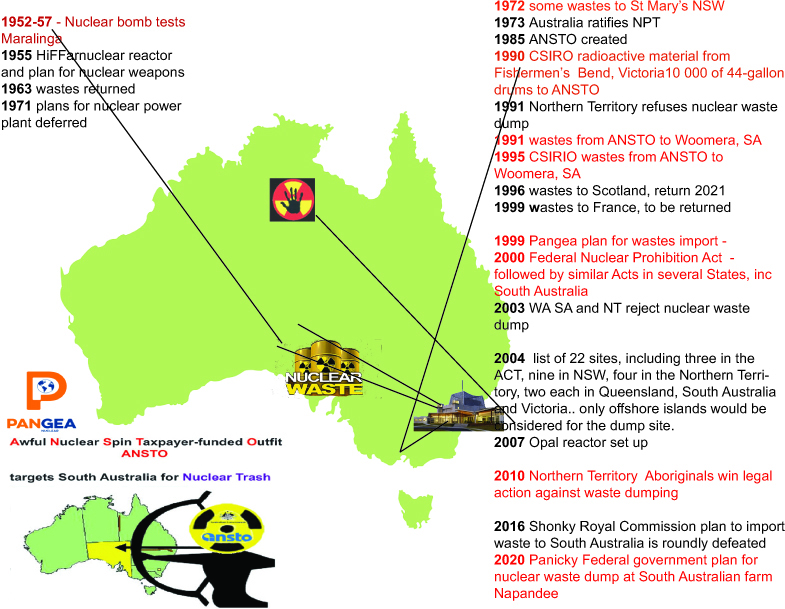
Never mind that South Australia has clear laws prohibiting a nuclear waste dump, the Australian Senate has passed a law enabling the Resources Minister, Keith Pitt, to impose a nuclear waste dump on any site apptroved by the government – but they mean Kimba. Far far away from the source of the nuclear waste (ANSTO’s OPAL nuclear in Sydney) the Napandee farm will be the dump for ANSTO’s toxic wastes. The plan is simply to shove the responsibility for these stranded wastes over to South Australia. The government cons the locals that this will be an economic boon for them
It’s just the latest in the long saga of the nuclear lobby’s attempt to get a nuclear waste dump. It has never been a goal that would make sense – ethically and environmentally . – (an ethical goal would be a complete clean-up drive, permanently getting rid of Australia’s nuclear reactor and its radioactive trash).
But no, this latest push is just part of ANSTO’s grandiose goal of expanding its operations, to produce more toxic trash.
And that may not be all. The Australian saga follows decadesof efforts by the nuclear lobby to make South Australia the nuclear waste dump for the world. That goal, spelt out clearly in 1999 by the company Pangea (now reborn as Arius), was pushed again in the 2016 South Australian Nuclear Fuel Chain Commission
The Napandee dump is1700 km from Lucas Heights. The dump will house the same ”interim” waste conatainers as at ANSTO. They could stay at ANSTO, more safely, for many years. As for a permanent repositary, there are many geolocally more suitable sites much closer to the reactor.
I have no doubt that some who push for the Napandee dump see it as a foot in the door for the old dream of importing the world’s muclear trash.
The Federal government is pulling a nuclear waste confidence trick on South Australia.
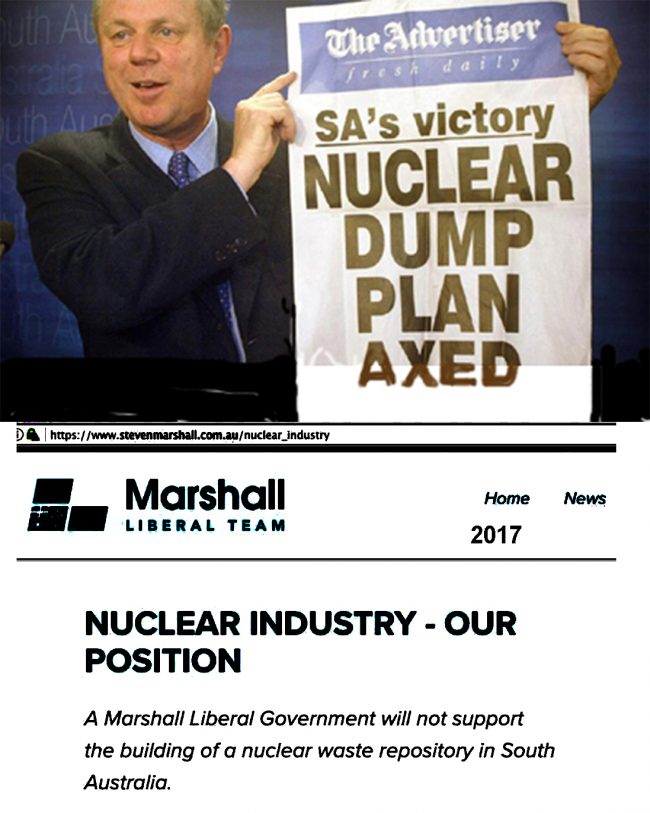
Well, that’s a relief to South Australians.
But aw shucks, that was 2017. Is Premier Marshall now going to do a backflip, and let the Federal government send ANSTO’s radioactive trash to a small rural community in South Australia?
On Monday 21 June at 12.20 pm, the Australian Senate will debate, and may vote on, the revised National Radioactive Waste Management Amendment (Site Specification, Community Fund and Other Measures) Bill 2020 .
South Australia has clear laws prohibiting the establishment of a nuclear waste dump in that State. Nuclear Waste Storage Facility (Prohibition) Act 2000
There is a strange and hypocritical silence from the State’s Liberal leaders, and Labor Opposition. Only the Greens have spoken out against this Federal plan to establish a nuclear waste dump in a rural area.
Why the silence from the rest? It could be because they sort of support the plan, even though it contravenes the State’s law. Or, just as likely, they know that even if this Bill is passed, it’s not really going anywhere, anyway.
The idea of toting ANSTO’s ”intermediate level” nuclear waste from temporary storage at Lucas Heights, to way across the continent to another temporary storage in some little rural agricultural area in South Australia, is fraught with problems, and unanswered questions.
If this Bill becomes law, three previously short-listed locations Lyndhurst in New South Wales, Napandee near Kimba, and Wallerberdina in the Flinders Ranges are nominated as suitable sites, and Minister Keith Pitt will be required to formally declare a site. Correction. I am informed that the New South Wales site is not included, and that Federal Labor have put up an amendment to remove that Wallerberdina site in theFlinders Ranges.
From then on, the rot will really set in, and I don’t like Minister Pitt’s chances of imposing a facility on any of these communities. For a start, the Wallerberdina site has already been rejected. via a community ballot, and that location was scrapped by the previous Minister Matt Canavan.
The obvious target is the Kimba site, where in a fairly restricted vote, a community vote did favour this ”interim” waste dump, accompanied as it was by financial incentives for the town.. But there is strong opposition from the Barngarla people, traditional owners who were excluded from the vote. There are also farmers most unhappy with the choice of this agricultural area: they have formed a group – No Radioactive Waste on Agricultural Land in Kimba or SA.
The newly amended Bill opens the matter up for legal challenge, which is sure to come about. There are serious objections to the plan, not least of which is the problem of transport, involving numerous communities whose residents are likely to object to having radioactive waste transported through their area. There certainly is the question of placing nuclear waste in an agricultural area. Nuclear enthusiasts claim that this is acceptable overseas. They cite France ignoring the protest continuing in the village of Bure where the French government has tried to set up a waste facility.
There are serious doubts on the soundness of the proposal, especially as it relates to the Napandee site . Is it geologically suitable, seismically safe?Meanwhile the interim storage at Lucas Heights has room for years more storage, and has the staff, the security, and the expertise to safely manage the wastes on site.
Above all – the Napandee site has been promoted to the local community, with enthusiastic information from ANSTO and Industry Department experts, and promises of economic benefits. What has not been provided, but in fact, actively discouraged, is the other side of the story. Kimba residents have not had access to the misgivings of other experts about this proposal – economic disadvantages, environmental considerations, water problems, and the long-term probability for the community to be stuck with stranded wastes
A pity that Australia’s that National Medical Cyclotron was snuffed out after only 20 years.
Greg Phillips Nuclear Fuel Cycle Watch, 18 June 21,
Not sure why our National Medical Cyclotron was snuffed out after only 20 years. It was the only cyclotron in Australia that could make Iodine123. But good news, here is another new cyclotron – and it can make Iodine123. Much cleaner than reactors.”…It is more compact and versatile than ever and is capable of working over a large energy span (13 to 30MeV) …”https://www.iba-radiopharmasolutions.com/iba-launches…
Kalbar’s exotic minerals mine a toxic risk to Victoria’s food bowl
Kalbar’s exotic minerals mine a toxic risk to Victoria’s food bowl, Michael West Media by Elizabeth Minter | Jun 18, 2021 | A hearing into the Environment Effects Statement for Kalbar’s mineral sands project on rich Victorian farmland has been told about competition for billions of litres of water, high levels of uranium, untested technologies and a strange backflip by the project’s “independent experts”. Elizabeth Minter investigates.
For exactly 100 years, Kane Busch’s family have farmed the fertile soils of the Lindenow Valley in East Gippsland, Victoria. After leaving Denmark in 1913, Kane’s great-grandfather Eiler Busch settled in the Valley, buying in 1921 the land that is now the home of Busch Organics.
Kane’s grandfather, also called Eiler, was behind the push for more environmentally friendly farming while experiencing the devastating droughts of the 1990s. The farm gained official organic certification in 2000. Grandson Kane is following in those footsteps, and was recently a finalist for a national award for “Young Grower of the Year”.
The Lindenow Valley produces the salad greens and vegetables – broccoli, green beans, cauliflower, celery, beetroot, cabbage and carrots – that help feed the nation. The Valley produces nearly one-third of the state’s vegetables; employs up to 2000 people at peak times; and is worth more than $150 million to the local economy.
The area also has huge environmental significance, with the heritage-listed Mitchell River, the Ramsar-protected Gippsland Lakes wetlands, and the Perry River’s unique Chain of Ponds, which is home to many threatened plant and animal species. Once ubiquitous across south-eastern Australia, “chain of ponds” systems are now rare.
But this is all now in jeopardy thanks to a mineral sands mining proposal from Kalbar Operations Pty Ltd (Kalbar), a company that was established as an investment vehicle and that has never operated a mine. It would be almost comical were it not for the potentially deadly consequences.
There’s monazite, which contains rare earth metals plus radioactive uranium and thorium and is thus potentially dangerous to residents, the waterways and the vegetables growing by the mine’s boundary; the competition for billions of litres of water; and the untried technology being proposed to tackle the mining waste. Nowhere in Australia is a mineral sands mine located so closely to, and upwind of, a major vegetable growing industry.
Kalbar is proposing a 1,675-hectare open-cut mine just 350 metres from the Mitchell River, which flows into the Gippsland Lakes wetlands. The mine will operate 24 hours a day, 365 days a year, for 15 years. A public hearing is under way as part of the inquiry into the Environment Effects Statement (EES). The following information has been revealed during the hearing.
Big miners walk away, lack of water the key risk
The multinational miner Rio Tinto originally owned the mining exploration licences. In 2011 Oresome, a subsidiary of Metallica Minerals, entered into a right to explore and option to purchase agreement with Rio for the licences.
A scoping study it commissioned showed a mine could be viable only if there was a dependable water supply. The risk of not finding a reliable source of up to 6.2 billion litres annually for an acceptable price received a Category F rating, defined as a problem with possibly “no viable solution” and a “fatal flaw”.
Water supplies
Kalbar’s proposed mine will sit on the plateau high above the Mitchell River with the vegetables growing just metresfrom the river.
The mine is 3.5 kilometres from the main source of the region’s drinking water (other than tank water). The mine and the horticultural industry will be in direct competition for water, with both relying on the Mitchell River and the same groundwater………….
Treatment of mine waste
Also controversial is access to how mine waste will be managed. The mine’s original design included a 90-hectare tailings dam.
But when government agencies and others highlighted the extreme danger such a dam posed to the Perry River and the Chain of Ponds, Kalbar changed its proposal.
The mine now plans to use giant centrifuge machines to remove water from the tailings waste, and then reuse that water.
The East Gippsland Shire Council, which unanimously opposes the mine, was not convinced of the viability of centrifuges, which are untested in mineral sands mining. The council commissioned a report from an independent mining industry consultancy, Ausenco.
Ausenco’s report raised concerns and advised that many more centrifuges would be required than Kalbar proposed. Then just weeks later, of its own volition, Ausenco issued a new report …………..
Radioactive dust a hazard
Kalbar plans to mine for and partially refine zircon, titanium-bearing rutile, ilmenite and rare earths minerals.
Airborne dust generated from mineral sands mines not only contains toxic heavy metals and radioactive monazite, thorium and uranium but also respirable crystalline silica, which leads to the deadly lung disease silicosis……………
Reputational damage to growers…… https://www.michaelwest.com.au/kalbars-exotic-minerals-mine-a-toxic-risk-to-victorias-food-bowl/
Australia’s government feels no duty of care towards young people on climate — RenewEconomy

Australia’s environment minister has rejected a court finding that she has a duty of care towards young Australians on climate. It’s unsurprising. The post Australia’s government feels no duty of care towards young people on climate appeared first on RenewEconomy.
Australia’s government feels no duty of care towards young people on climate — RenewEconomy
Nationals say no to net zero in extraordinary assault on climate and renewables — RenewEconomy

The Nationals have said no to net zero targets of any sort in an extraordinary assault on climate action and renewables, and their own electorates. The post Nationals say no to net zero in extraordinary assault on climate and renewables appeared first on RenewEconomy.
Nationals say no to net zero in extraordinary assault on climate and renewables — RenewEconomy
EnergyAustralia has three options to avert Yallourn mine collapse — RenewEconomy

Company hopes to repair cracks in the embankment next to the Yallourn mine by the middle of next week, but didn’t reveal plans for river diversion. The post EnergyAustralia has three options to avert Yallourn mine collapse appeared first on RenewEconomy.
EnergyAustralia has three options to avert Yallourn mine collapse — RenewEconomy
Earth is now trapping an ‘unprecedented’ amount of heat, NASA says — limitless life
Climate and Environment New research shows that the amount of heat the planet traps has roughly doubled since 2005, contributing to more rapidly warming oceans, air and land The International Space Station orbits over the Atlantic Ocean southwest of South Africa. (NASA) By Tik Root June 16, 2021 at 3:00 p.m. CDT 893 The amount […]
Earth is now trapping an ‘unprecedented’ amount of heat, NASA says — limitless life
Julian Assange: Separating Fact from Fiction — Rise Up Times

Join Julian Assange’s father, and brother John and Gabriel Shipton, along with panelists Fidel Narvaez (former Ecuadorian consul at the embassy in London), John Kiriakou (CIA torture whistleblower) and Ray McGovern (former CIA analyst/presidential briefer) as they separate fact from fiction about Julian Assange on Sunday, June 13th. Editor’s Note: John and Gabriel Shipton will […]
Julian Assange: Separating Fact from Fiction — Rise Up Times
The Fukushima nuclear disaster and the Tokyo Olympics
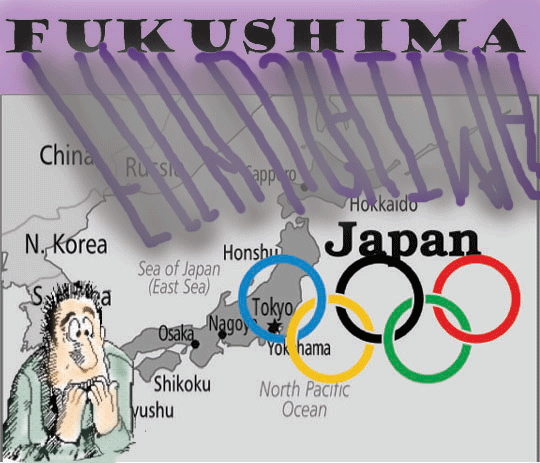
“There was a very clear political agenda by Shinzo Abe, to use the Olympics to rehabilitate the impression of both Fukushima and the nuclear disaster domestically and globally,”
“It’s hard for me to support the idea of using the Olympics to present a narrative of recovery, where so much recovery remains to be done.”
The Fukushima nuclear disaster and the Tokyo Olympics, Engineering and Technology, By Max Bernhard
Wednesday, June 16, 2021 Before Covid-19 forced a delay, Japan’s government saw the ‘Recovery Olympics’ as a way to show the Fukushima nuclear disaster was under control. 10 years on, critics say many issues remain unresolved.
Members of the Japan women’s soccer team began the Olympic torch relay on 25 March this year, kicking off a four-month countdown to the Tokyo Summer Games after a year-long delay due to the Covid-19 pandemic. The brief opening ceremony – closed to the public and attended only by a small number of dignitaries – took place on a football pitch in J-Village. The sports complex lies just 20km south of Japan’s Fukushima Daiichi nuclear power plant, where a devastating earthquake and subsequent tsunami killed more than 18,000 people and triggered a triple nuclear meltdown in 2011. J-Village was used as a base for the thousands of clean-up workers tasked with decommissioning the plant.
Long before the pandemic forced Japan to delay the Games, then-Prime Minister Shinzo Abe pegged the sporting mega-event as a way to show that Japan had overcome the disaster and to promote reconstruction efforts in the region. Ten years on, questions over radiation in the area, its prospects for recovery, and the decommissioning of the reactor, as well as Japan’s overall energy policy, remain.
Abe’s successor Yoshihide Suga has said the Games would also be a sign of overcoming another tragedy. Going ahead with the event would be “proof that humanity has defeated the pandemic”, he said last year. But here, too, not everyone agrees. With less than two months to go until the official start of the Olympics, the Japanese government has recently extended its state of emergency in Tokyo and several other prefectures until at least 20 June. While the number of new Covid-19 infections has been going down and cases remain relatively low in an international comparison, a stretched-out fourth wave has strained the country’s medical sector.
Meanwhile, Japan’s vaccination efforts have been significantly lagging behind other developed nations. Less than 3 per cent of the population have been fully vaccinated as of 27 May 2021 and polls show that most of the public wants the Games cancelled. Despite that, Suga has been iterating his commitment to hold the Olympics in Tokyo this summer.
To assure members of the International Olympic Committee (IOC) that the event in Tokyo would be safe, then-Prime Minister Abe promised in his 2013 pitch to host the 2020 Games that the situation at the destroyed Fukushima nuclear plant was “under control”.
Three years later, Junichiro Koizumi, a former prime minister and fellow member of Abe’s Liberal Democratic Party, called this promise a lie. “I think Abe understands the arguments on both sides of the debate, but he has chosen to believe the pro-nuclear lobby,” Koizumi, who became an outspoken critic of nuclear energy following the catastrophe, said at a press conference in Tokyo in September 2016.
“There was a very clear political agenda by Shinzo Abe, to use the Olympics to rehabilitate the impression of both Fukushima and the nuclear disaster domestically and globally,” says Sean Burnie, a senior nuclear specialist for Greenpeace East Asia, who has surveyed radiation in Fukushima dozens of times since the nuclear meltdowns happened.
Following the disaster, Japan halted all its nuclear reactors. Since then, it has restarted only nine out of a possible 42 across five power plants, while more than 20 are set to be decommissioned. Before the 2011 disaster, Japan generated about a third of its energy from nuclear power, and there were plans to increase that to around 40 per cent. The Japanese government’s current energy policy plans for 30 to 35 reactors operating by 2030, meaning about 20 per cent of the country’s power would come from nuclear energy. That target is also part of the government’s plan to significantly reduce carbon emissions in the country by the end of the next decade. This target requires at least a further 21 reactors to be back online.
One of the major obstacles to those restarts is public opinion, says Burnie. “The perception of Fukushima is that because you have an accident, you can’t rehabilitate, you can’t bring people back to live there, it’s not safe, and the decommissioning of the plant will take many, many decades, or centuries longer,” he adds. “So trying to create a new image, a new perception of Fukushima on the nuclear issue is really important [to the Japanese government].”
Changing public perception played a significant role in the government’s decision to host events in Fukushima and to use the framework of the ‘Recovery Olympics’, Burnie says, adding that the desire of the prefectural government and general society in Fukushima to communicate their region’s recovery was also a factor. “I think it creates a sense of slight schizophrenia because people want to have some good news … the Olympics were seen as perhaps a positive.”
At the same time, there was widespread criticism because the significant investments into the Olympics were seen as taking resources away that could have gone towards the area’s general reconstruction. The entire cost of hosting the 2020 Games is projected to be more than $15bn (£10.6bn), including $2.8bn for the postponement and an estimated $900m for measures to curb the spread of Covid-19. The Tokyo Games are the most expensive to date, according to a 2020 University of Oxford study that looked at Olympic costs since 1960. “There are still tens of thousands of people displaced, people still living in emergency housing. Obviously, the whole radiological situation is still complex and hazardous. There were mixed feelings about it,” Burnie says.
A year ago, when international visitors to the Games were still considered a possibility, some questioned whether it was safe for athletes and spectators to visit sporting venues in Fukushima or even Japan in general. South Korea reportedly considered providing its own food for athletes out of radiation concerns, although the move was seen as political by some.
Levels of radiation in Japan have decreased thanks in part to a massive programme by the government to remove the top layer of soil in affected areas. The contaminated soil is stored in millions of black one-cubic-metre bags that are piled up on temporary open-air areas scattered across the prefecture before being transported to interim storage sites. As of April 2020, about 6.7 million of the black bags were still stored in Fukushima, according to the Ministry of Environment.
While the plant’s operator managed to stabilise the damaged reactors at Fukushima Daiichi, melted nuclear fuel buried deep into the ground below the plant is still to be located and removed – an endeavour that is projected to take at least four more decades. Meanwhile, in April, the government approved plans to gradually release more than one million tonnes of contaminated water into the sea…………………
at the end of 2019 Greenpeace conducted radiation measurements around J-Village, where the Olympic torch relay would later kick off, and found several hotspots.
Continue reading1 This month.


PETITION – To: Prime Minister Anthony Albanese and the Australian Labor Government
Chernobyl: The Lost Tapes – A good documentary on Chernobyl on SBS available On Demand for the next 3 weeks– https://www.sbs.com.au/ondemand/tv-program/chernobyl-the-lost-tapes/235274195556

19 May – Webinar- Webinar: No Nuclear Weapons in Australia
Start: 2026-05-19 18:00:00 UTC Canberra, Melbourne, Sydney (GMT+10:00)
End: 2026-05-19 19:30:00 UTC Canberra, Melbourne, Sydney (GMT+10:00)
20 May – Webinar – The dangerous world of AUKUS, US, military occupation and suppression of dissent

National Webinar, 20th May, 2026, 6.30pm AEST. Confronting laws restricting/suppressing protest speech and action
Speakers: Former Sen. Rex Patrick, Lawyer Nick Hanna ,Arthur Rorris ,Jorgen Doyle, Sen David Shoebbridge,
Facilitator Kelley Tranter.

of the week – Australians for War Powers Reform (AWPR)
To see nuclear-related stories in greater depth and intensity
 Antinuclear