INTERVIEW/ Daniel Ellsberg: Smart statesmen can make bad decisions leading to nuclear war

Asahi Shimbun, , By KOJI SONODA/ Correspondent, June 19, 2021 WASHINGTON—U.S. President Dwight D. Eisenhower seriously considered launching a nuclear attack against China during the Second Taiwan Strait Crisis in 1958, according to a former Department of Defense official.
Daniel Ellsberg, 90, a nuclear policy expert who has disclosed a confidential document about the incident, said Eisenhower was prepared for possible nuclear retaliation from the Soviet Union.
In an interview with The Asahi Shimbun on May 25, Ellsberg also expressed strong concerns about the current tensions between Washington and Beijing over the Taiwan Strait.
“We’re talking now about possibly intervening in the civil war between China and Taiwan with U.S. force,” Ellsberg said. “I felt that this study was particularly relevant now to public debate and consideration.”
Ellsberg is famed for his acquisition and exposure of the classified Pentagon Papers in 1971, which he created with other staff members at the U.S. Department of Defense for the Vietnam War.
At that time, Ellsberg made a copy of another top-secret document written and examined by Morton Halperin, a former deputy assistant secretary of defense, in connection with the Second Taiwan Strait Crisis.
The secret document shows that Eisenhower and high-ranking military officers at a meeting were considering the use of tactical nuclear weaponry for a pre-emptive strike against mainland China.
Ellsberg, who was deeply engaged in compiling the U.S. nuclear war plan, said, “When we look at decision-making that led to catastrophe … there is a very strong tendency for people to think: ‘Well, that was long ago. Those people were dumb.’
“That’s absurd,” he continued. “The statesmen (then) were at least as smart people as the ones right now or in between. They made horribly unwise judgments.”
Ellsberg was quite concerned about the possibility of the current U.S.-China friction leading to an all-out war.
“Both sides would suffer very great costs,” he said. “If they are not stupid and foolish and reckless and crazy, they will not start a war … . But you know, that doesn’t mean it won’t happen.”
Excerpts from the interview follow:……………………………………………………….
The Cuban Missile Crisis, in which I participated as a consultant right below the level of the White House, the executive committee of the National Security Council, I was reporting to them, and studied that for a great deal. I conclude that, contrary to their public statements, neither Kennedy nor Khrushchev had any intention of going to armed conflict. They were, in effect, bluffing.
They were threatening the others and intimidating the others, and were deploying in readiness for nuclear war, but they had no intention actually of carrying out a nuclear war. And nevertheless, as my book “Doomsday Machine” and other places show, they came within a hair’s breadth of an all-out nuclear war because of actions of subordinates who did not realize that their leaders were bluffing, and who were readying for nuclear war in a way that almost exploded into all-out nuclear war……………….
When we look at decision-making that led to catastrophe, like World War I, by almost all parties, or the decision-making in Japan in 1940-41, which looks inconceivably bad when you look at it, or the decision-making in Vietnam, or invasion of Iraq, or in 1958, there is a very strong tendency for people to think: “Well, that was long ago. Those people were dumb. They were naive. They were immature. We’re not like that now. Weren’t they strange and awful?” And so there’s no lesson to be learned for us. That’s absurd.
The statesmen in 1914 were at least as smart people as the ones right now or in between. They made horribly unwise judgments. And that is equally available to our decision-makers right now. http://www.asahi.com/ajw/articles/14373137
Biden and Putin agree: ‘Nuclear war cannot be won and must never be fought’
Biden and Putin agree: ‘Nuclear war cannot be won and must never be fought’ DW, 17 June 21
US President Joe Biden and Russian President Vladimir Putin have concluded a high-stakes summit aimed at cooperation but dominated by deep disagreements.
US President Joe Biden and his Russian counterpart Vladimir Putin have ended their highly anticipated summit in Geneva.
The leaders’ first in-person meeting since Biden became president took place at a lakeside villa amid soaring tensions between their two countries.
As talks ended after less than the five hours either side thought they would need, Biden gave a thumbs up. Members of the US team said the meeting had been “quite successful.”
After the meeting, the two sides released a joint statement on one of the main topics of discussion, nuclear proliferation. The statement read, “Nuclear war cannot be won and must never be fought.”
DW Moscow correspondent Emily Sherwin said, “Biden managed to walk a fine line with Putin,” recognizing Russia’s desire to be seen as a major geopolitical power.
The joint US-Russian statement said progress on shared goals could be achieved, “even in periods of tension,” going on to state, “The United States and Russia will embark together on an integrated bilateral Strategic Stability Dialogue in the near future that will be deliberate and robust.”
The statement added that the countries “seek to lay the groundwork for future arms control and risk reduction measures.” …………………… https://www.dw.com/en/biden-and-putin-agree-nuclear-war-cannot-be-won-and-must-never-be-fought/a-57921072
”Advanced” nuclear reactor designs – the latest version of nuclear wishful thinking
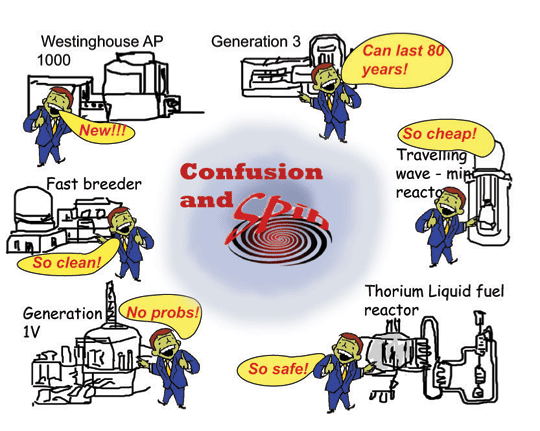
Clean Technica 16th June 2021, Some nuclear energy developers are now promoting what they call “advanced” reactor designs as a solution. Unlike light-water reactors, these non-light-water designs rely on materials other than water for cooling, including liquid sodium, helium and molten salt. Some developerscontend these reactors, which are still in the concept stage, will solve all the problems that plague light-water reactors and be ready for prime time by the end of the decade. The siren song of a cheap, safe and secure nuclear reactor in the offing has attracted the attention of Biden administration officials and some key members of Congress, who are looking for any and all ways to curb carbon emissions. But are so-called advanced reactors merely the latest version of nuclear wishful thinking? A comprehensive Union of Concerned Scientists (UCS) analysis of non-light-water reactor concepts in development suggests they are. Published in mid-March, the 140-page report found that these designs are no better — and in some respects significantly worse — than the light-water reactors in operation today. The report, “Advanced” Isn’t Always Better, assesses the pros and cons of three main types of non-light-water reactors: sodium-cooled fast reactors, high-temperature gas-cooled reactors and molten salt–fueled reactors. It rates each type on three broad criteria: safety; nuclear proliferation and terrorism risks; and sustainability, which refers to how efficiently they use uranium and how much long-lived nuclear waste they generate. https://cleantechnica.com/2021/06/16/when-it-comes-to-nuclear-power-advanced-isnt-always-better/ |
What Has Happened/Is Happening at Taishan, China’s EDF Run Nuclear Plant? — RADIATION FREE LAKELAND
Below is a press release from the Nuclear Free Local Authorities who have asked the UKs Nuclear Regulatory body to investigate …our own experience with the Office for Nuclear Regulation is that they err on the side of the industry – maybe this time they will err on the side of finding out the truth […]
What Has Happened/Is Happening at Taishan, China’s EDF Run Nuclear Plant? — RADIATION FREE LAKELAND
June 18 Energy News — geoharvey

Opinion: ¶ “Can The US Survive California’s Drought?” • The drought facing the Western US is bad. Really bad. It is a national and international crisis. California produces more than a third of the vegetables and two-thirds of the fruits and nuts sold in the US, so the drought is affecting more than California and […]
June 18 Energy News — geoharvey
The Greens will be standing up for a nuclear-free South Australia.

 |
Senator Sarah Hanson-Young The Morrison Government is pushing laws through parliament this week to dump nuclear waste on South Australia, flipping the bird to our great state.South Aussies don’t want it, Traditional Owners don’t want it, the local communities don’t want it. The Greens will be standing up for SA – our state deserve so much better  www.sarahhansonyoung.com/no_dump
The Federal Government has no mandate to situate a radioactive waste management facility in South Australia. The community of Kimba have been significantly impacted by the ongoing mismanagement of the site selection process.
It is imperative that all stakeholders within transport corridors in South Australia, every community impacted by the potential thoroughfare of nuclear waste should be fully informed of the relevant costs and benefits, throughout the transport chain, and offered the opportunity to have their say on the proposal.
The proposed double-handling of intermediate-level radioactive waste is not consistent with international best practice. Alternatives should be canvassed, including the suspension of the site selection process until a permanent disposal site can be identified.
NSW Productivity Commission Has “Lost The Plot” On Nuclear Power,
NSW Productivity Commission Has “Lost The Plot” On Nuclear Power, Solar Quotes, June 3, 2021 by Michael Bloch The Electrical Trades Union has weighed in on the New South Wales Productivity Commission’s recommendation to lift the ban on nuclear electricity generation for small modular reactors.
The recommendation was one of many contained in the Commission’s 371-page “Rebooting the economy” whitepaper released last week.
……….. Small modular reactors operating as terrestrial power stations are vaporware at this point; they do not exist. The Commission notes a U.S. company expects to have its first small modular reactor operating by 2026. “Expecting” gives wiggle room for that to not happen and it’s not unreasonable to assume it won’t given the challenges the SMR technology faces, including the renewables juggernaut.
ETU: Nuclear Power “Not The Answer”
With renewables and storage rapidly evolving and their cost continuing to plummet, it sounds a bit nutty to be even considering SMRs – and the Electrical Trades Union agrees.
“The Productivity Commission has lost the plot if it thinks small modular reactors, a technology that has been ‘just around the corner’ since the 1970’s but still doesn’t exist, is the answer to NSW’s productivity growth,” said ETU National and NSW Secretary, Allen Hicks. “Even if someone finally manages to build one that works, the electricity price forecast for their output is six times more expensive than renewables.”
The Commission notes low-cost renewables pose an additional risk to the economics of large reactors, but doesn’t seem to tweak to the fact they pose the same threat to SMRs…..
Mr. Hicks’ advice:
“Boosting the economy, providing more jobs, and dealing with climate change are big problems, but nuclear power is not the answer.”
But something that wins the trifecta are renewables such as wind and solar power along with supporting technologies.
The 70,000-member strong Electrical Trades Union says it has a long history of opposing uranium mining and the nuclear power industry, and has had a ban on members working in both sectors since 1945. You can learn more about the ETU’s stance on its “No Future For Nuclear” website. Mr. Hicks’ advice:
“Boosting the economy, providing more jobs, and dealing with climate change are big problems, but nuclear power is not the answer.”
But something that wins the trifecta are renewables such as wind and solar power along with supporting technologies. https://www.solarquotes.com.au/blog/productivity-commission-nuclear-mb2021/
Labor consults traditional owners about the Kimba nuclear waste dump Bill, considers supporting the Bill.

Nuclear waste facility in SA may be a step closer, after Labor consults traditional owners
ABC, By political reporter Matthew Doran, 15 June 21, ”………………with the federal opposition preparing to negotiate with the government on legislation that would allow construction to begin.
Key points:
- Labor says the government has agreed to amendments allowing legal challenges against the location
- The federal government has proposed to build the dump at Kimba in South Australia…..
Nuclear waste facility in SA may be a step closer, after Labor consults traditional owners
ABC, By political reporter Matthew Doran, 15 June 21, ”………………with the federal opposition preparing to negotiate with the government on legislation that would allow construction to begin.
Key points:
- Labor says the government has agreed to amendments allowing legal challenges against the location
- The federal government has proposed to build the dump at Kimba in South Australia…..
The federal government has proposed the dump be built near Kimba, on South Australia’s Eyre Peninsula, after a shortlist of locations was whittled down and a community vote was held.
But legislation to give the project the tick of approval stalled in the Senate, with Labor concerned the bill did not allow legal challenges against the choice of location……..
On Tuesday, Labor’s Caucus agreed to let Shadow Resources Minister Madeleine King negotiate on the bill after the Coalition suggested it would present amendments to Parliament allowing for judicial review.
“We said we would not support passage of this legislation unless the traditional owners were comfortable with it,” Ms King said………
Ms King said the opposition would wait to see the details of the amendments before making its final decision.
She was praised by Shadow Indigenous Australians Minister Linda Burney for her consultation with the community.
Representatives of the Barngarla Determination Aboriginal Corporation (BDAC) travelled to Canberra to seek extra assurances from the federal government about the amendments.
“We welcome the engagement Labor to date and the engagement from the crossbench,” a spokesperson said.
We also acknowledge the commitment from Labor to ensure that nothing occurs without our support.
“We are unable to comment further at this stage as we are too busy dealing with this.”……..
The amendments are yet to be introduced to Parliament, and the timeframe for construction is not clear.
Legal challenges have scuttled previous attempts to construct a nuclear waste dump, including at Mukaty Station in the Northern Territory.
Nuclear waste facility in SA may be a step closer, after Labor consults traditional owners
Nuclear waste intended for Kimba, -used to be classified as ”high level” – now called ”intermediate”.
Zac Eagle No nuclear waste dump in South Australia , 16 June 21
teSponst9oreduh · “High Level waste from the existing HIFAR reactor is due to return in 2015 from reprocessing in France”Federal Parliament – 24 January 2005.
This is the stuff they want to dump in SA.When was it reclassified as Intermediate Waste? The link https://www.aph.gov.au/…/BN/2011-2012/RadioActiveWaste
ANSTO’s dodgy classification of nuclear wastes.
When the re-processed material is returned to Australia invariably the processing country refers to that material as high-level waste but ANSTO reclassifies it as intermediate level on the very weak argument of the classifications in Europe being different to Australia…… it seems ludicrous that it should assume its own manner of classification and against the treaty adopted classifications of IAEA and adhered to by other countries.
(b) the intermediate level waste should even when stored on a temporary basis be geologically buried at appropriate depths.
The prescriptive codes of IAEA have been fully adopted by ARPANSA12 as its standards for the classification and treatment and management of nuclear waste in Australia.
It is interesting that a new subsection 3(2) of the Bill gives effect to Australia’s obligations as a party to the Joint Convention for the safe and secure management of what is defined as decontrolled material and in particular Australia’s obligations under Chapters 3 and 4 of the Joint Convention.
The government has always stated that the facility at Kimba would only be used for the permanent disposal of low-level waste and indefinite storage of intermediate level waste with that storage period being up to 100 years.
The government has described the facility at Kimba as being a central one for Australia with the implication that it would dispose of or store as required all the present legend or stockpiled waste in Australia and all waste generated locally in the future.
After accepting Napandee as a nominated site the government engaged AECOM to carry out what is described as a characterisation study of the site at Napandee which concluded with a technical report dated 23 July 2018.
That summary added little to the technical nature of both Kimba sites and dealt principally with community consultations and the results of a recent ballotWhile all three reports were colourful presentations with elaborate artwork and photographs in reality by technical standards they contained little proper information to support and satisfy the selection of Napandee as the site for the waste management facility.
environmental hazards such as seismic and flooding events, can be mitigated via design solutions.
This conclusion again shows that the Napandee selection was both premature as to its choice by the government due to the lack of a full assessment and investigation of the site and completely unsuitable for the facility.
What actually happened at Taishan?
What actually happened at Taishan?https://www.rnanews.eu/what-actually-happened-at-taishan-nfla-call-on-nuclear-regulator-to-carefully-investigate-possible-r-140634.html?fbclid=IwAR2W5hoUwNH-6fgYOgVv6LIbM4wVWPGA1cLA4i8_XAC0PPIpz4odlGmSTcI NFLA call on nuclear regulator to carefully investigate possible radioactive leak and its implications for Hinkley C & Sizewell C | NFLA, 16 June 21,
The UK & Ireland Nuclear Free Local Authorities (NFLA) is concerned to read many contradictory reports over what has been called a ‘radioactive leak’ by some and ‘performance issues’ by others at the Taishan nuclear plant some 100kms from Hong Kong in the Guangdong region of China. NFLA has written to the UK nuclear regulatory, the Office for Nuclear Regulation (ONR), to ask it to investigate this matter with real urgency in terms of the implications for similar reactors being considered for the UK.
The Taishan plants developed in China use the same EPR (European Pressurised Reactors) technology being planned for the Hinkley Point C plant in Somerset and currently being considered in a public inquiry at Sizewell C in Suffolk.
Taishan is a prestige EPR project built after China signed a nuclear electricity generation agreement with ÉDF. Construction started in 2009, and the two units started generating electricity in 2018 and 2019, respectively. It is 70% owned by CGN, and 30% by Framatome, a subsidiary of EDF.
This incident came to light following an investigation by CNN, and it appears to have been going on for some considerable time.
According to the CNN investigation, in late May, one of the EPR reactors started venting radioactive gases – it is not known precisely why or when. The CNN article mentions possible fuel failures, and this is a possibility. It appears the Chinese nuclear regulator and the Chinese Government reacted by proposing to increase the safety limits for residents downwind in order to keep the reactor operating, and they told Framatome of this intention. Framatome objected to such an action and said China should instead shut down the reactor to find out what had gone wrong. The response from Chinese authorities was negative to this suggestion. As a result, Framatome (unusually) submitted an operational safety assistance request to the US Government on June 3rd, formally asking for a ‘legal waiver’ that would allow them to address an urgent nuclear safety matter. This was sent to the US Department of Energy (DOE), warning their officials that the nuclear reactor was leaking fission gas.
On June 8th, EDF asked the US DOE for an expedited review of their request, according to a memo obtained by CNN. “The situation is an imminent radiological threat to the site and to the public and Framatome urgently requests permission to transfer technical data and assistance as may be necessary to return the plant to normal operation” read the memo. Framatome reached out to the US government for assistance, the document indicates, because the Chinese government agency was continuing to increase its limits on the amount of radioactive gas that could safely be released from the facility without shutting it down, according to the documents reviewed by CNN.
Since this report came out, EDF and the Chinese authorities have tried to downplay that any serious incident took place, suggesting these matters were merely “performance issues” within safely levels. It should be noted though that an extraordinary board meeting has been requested by Framatome with its Chinese partners to discuss the matter. (2)
NFLA believe some kind of safety incident could well have taken place at the Taishan reactor, and sincerely hopes that it has not been anything approaching a major nuclear incident. The reaction of the Chinese nuclear regulator is of real concern to us, as is the large level of confusion that has clearly taken place over this incident.
NFLA has written to the UK Chief Nuclear Inspector asking for the Office of Nuclear Regulation to investigate this incident as part of the nuclear regulators’ Multinational Design Evaluation Programme, which includes a working group on the EPR that focuses on reviewing lessons learnt from commissioning, construction and early phase operations. Any concern that comes from this incident needs to be learnt quickly given the development of a similar reactor at Hinkley Point and a proposed reactor at Sizewell. For NFLA, this incident only goes to confirm its concern that the EPR reactor is highly complex and difficult to build, and safety issues could well remain within it.
NFLA Steering Committee Chair Councillor David Blackburn said:
“The murky details of what has actually happened to one of the Taishan Chinese EPR reactors in this incident is indicative of the lack of transparency that remains in the global nuclear industry. It also shows the real communication problems that can occur between in this case the French and Chinese nuclear companies and regulators. I hope this has not been a serious incident, but the detail initially provided to CNN suggests something has gone wrong and needs to be carefully considered in terms of its impact on this new nuclear reactor. It confirms to NFLA that there remain so many inherent issues in new nuclear that it would be far better to pursue instead safer, cheaper, more easily realisable and radioactive waste-free renewable energy alternatives.”
Ends – for more information please contact Sean Morris, NFLA Secretary, on 07771 930196.
Australia’s government feels no duty to care towards young people on climate — RenewEconomy

Australia’s environment minister has rejected a court finding that she has a duty of care towards young Australians on climate. It’s unsurprising. The post Australia’s government feels no duty to care towards young people on climate appeared first on RenewEconomy.
Australia’s government feels no duty to care towards young people on climate — RenewEconomy
Solar driving “paradigm shift” in electricity grid, says new AEMO boss — RenewEconomy

AEMO’s Daniel Westerman says there is a “paradigm shift” in the WA grid thanks to rapid uptake of solar, but battery storage will help manage the change. The post Solar driving “paradigm shift” in electricity grid, says new AEMO boss appeared first on RenewEconomy.
Solar driving “paradigm shift” in electricity grid, says new AEMO boss — RenewEconomy
“This is renewable energy, don’t be afraid:” Chris Bowen taunts Coalition in House of Reps — RenewEconomy

Labor’s Chris Bowen brandishes a solar panel in Parliament, telling the Morrison government not to be afraid of renewable energy. The post “This is renewable energy, don’t be afraid:” Chris Bowen taunts Coalition in House of Reps appeared first on RenewEconomy.
“This is renewable energy, don’t be afraid:” Chris Bowen taunts Coalition in House of Reps — RenewEconomy
ACT says it receives 42 proposals for ground-breaking Canberra Big Battery — RenewEconomy

A plan to build a 250MW Canberra Big Battery attracts strong interest for the biggest aggregation of distributed batteries in the country. The post ACT says it receives 42 proposals for ground-breaking Canberra Big Battery appeared first on RenewEconomy.
ACT says it receives 42 proposals for ground-breaking Canberra Big Battery — RenewEconomy
1 This month.
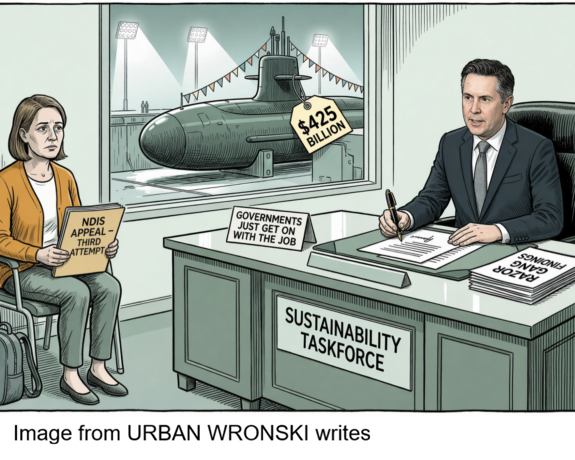

PETITION – To: Prime Minister Anthony Albanese and the Australian Labor Government
Chernobyl: The Lost Tapes – A good documentary on Chernobyl on SBS available On Demand for the next 3 weeks– https://www.sbs.com.au/ondemand/tv-program/chernobyl-the-lost-tapes/235274195556
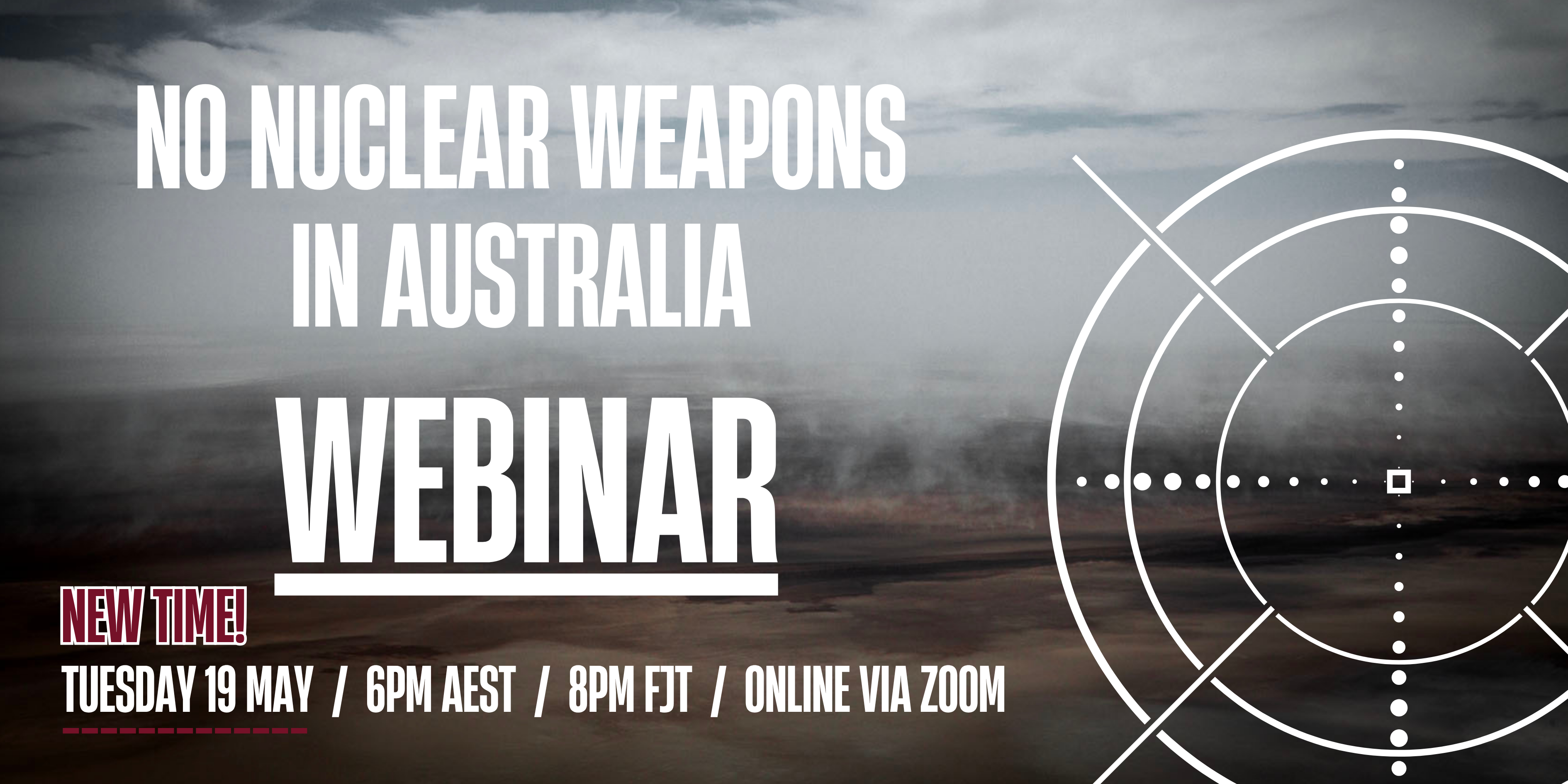
19 May – Webinar- Webinar: No Nuclear Weapons in Australia
Start: 2026-05-19 18:00:00 UTC Canberra, Melbourne, Sydney (GMT+10:00)
End: 2026-05-19 19:30:00 UTC Canberra, Melbourne, Sydney (GMT+10:00)
20 May – Webinar – The dangerous world of AUKUS, US, military occupation and suppression of dissent

National Webinar, 20th May, 2026, 6.30pm AEST. Confronting laws restricting/suppressing protest speech and action
Speakers: Former Sen. Rex Patrick, Lawyer Nick Hanna ,Arthur Rorris ,Jorgen Doyle, Sen David Shoebbridge,
Facilitator Kelley Tranter.

of the week – Australians for War Powers Reform (AWPR)
To see nuclear-related stories in greater depth and intensity
 Antinuclear