Australian company Greenland Minerals fails community test over controversial rare earths and uranium mine plan
Greenland Minerals fails community test over controversial rare earths and uranium mine plan, https://www.acf.org.au/greenland-minerals-fails-community-test 27 May 21, It is a long way from Greenland to Western Australia, but concerns from the Narsaq community in Greenland about a controversial mining project will be raised at today’s annual meeting of Perth-based company Greenland Minerals, listed on the ASX as GGG, which is behind the Kvanefjeld rare earths and uranium mine.
Opposition to the planned mine dominated Greenland’s recent national elections. On 6 April Greenlanders elected the Inuit Ataqatigiit (Community for the People) party, which campaigned on an explicit platform opposing Kvanefjeld.
The new coalition government has committed to stop the mine going ahead.
“When a mine proposal triggers an election and the results show a clear rejection of the project, it is time for the company to accept the community’s will and end its mining plans,” said Mineral Policy Institute board member Dr Lian Sinclair, who will attend the GGG meeting.
Australian groups are calling on GGG to recognise that it has failed to secure social license for the Kvanefjeld project.
“We need a different approach to mining, one based on free, prior and informed consent,” said Australian Conservation Foundation nuclear free campaigner Dave Sweeney.
“Mining materials that are used in renewable energy does necessarily make a company ethical or responsible.
“There are dangerous radioactive elements within these deposits, including uranium, that pose long term environmental and health risks.
“These risks should not be imposed on an unwilling community.
“The Narsaq and wider Greenland community and the new Government have rejected this project. GGG should recognise and respect this clear and democratic decision”.
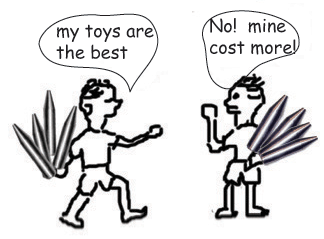
For USA, health care is too costly, while weapons makers wildly profitable -as $634 Billion to go to nuclear arms
The US Will Spend on Nuclear Weapons in the Next Decade, https://jacobinmag.com/2021/05/military-spending-nuclear-weapons-department-of-defense
BY JULIA ROCK, 26 May 21, According to a new Congressional Budget Office report, we’re set to spend well over a half a trillion dollars over the next decade on nuclear weapons. Yet we’re somehow told that Medicare for All is too expensive.
As Capitol Hill lawmakers continue to insist that initiatives like Medicare for All are too expensive, a new congressional report shows that the United States government is on a path to spend more than a half-trillion dollars on nuclear weapons in just the next decade. The report emerges at the same time a separate analysis shows that a handful of top executives at defense contractors are being wildly enriched by a Pentagon spending spree.
The first report from the Congressional Budget Office (CBO) finds that the federal government is on track to spend $634 billion over the next decade to maintain its nuclear forces. Almost two-thirds of those costs are for the Department of Defense, mostly to maintain ballistic missile submarines and intercontinental ballistic missiles. About one-third is for the Department of Energy.
For comparison that is:
- 1.5 times the cost of all of the $1,400 stimulus checks that were sent to people through the American Rescue Plan earlier this year.
- Nearly fourteen times the $47 billion that Congress has spent so far this year helping Americans who are behind on rent.
- Over one-third of the cost of cancelling the $1.7 trillion in student debt held by Americans, most of which is never going to be repaid.
- More than seven times the estimated $81 billion of outstanding medical debt in America, as of 2018.
The new CBO estimate represents a 28 percent increase over the last ten-year estimate that the CBO made on US nuclear forces two years ago.
The figures were released just a few weeks after a new analysis from the Center for International Policy, a foreign policy think tank in Washington, found that “In 2020 alone, the CEOs of the [Pentagon’s] top five contractors received a total of $105.4 million in compensation.”
When accounting for all top corporate officials, these firms paid out more than a quarter billion dollars of total executive compensation in 2020 — and paid out more than $1 billion over the last four years.
About half of the Pentagon’s budget goes directly to corporations such as Lockheed Martin and General Dynamics, according to the report.
So far, the deficit scolds who wanted to narrow eligibility for stimulus checks, student debt cancellation, or rent relief haven’t complained about the spending.
American experts warn Trudeau that small nuclear reactors are likely to prove a nightmare for Canada
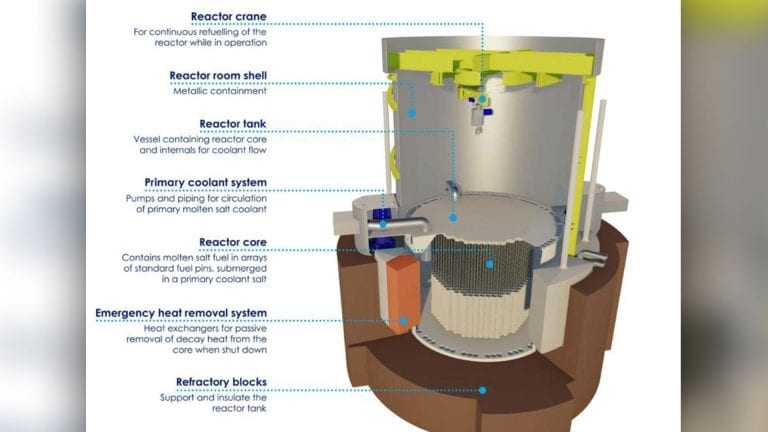
The critics contend that SMRs are costly, unproven and creators of toxic waste of their own. From a practical point of view, it is hard to make the case that SMRs will be crucial in the battle against climate change, since they won’t come off the drawing board for years, if ever. Former Green Party leader Elizabeth May says that opting for experimental SMRs is just another way of delaying real action on global warming.
US Experts to Trudeau: Your Nuclear Dream May Turn Nightmare https://thetyee.ca/Analysis/2021/05/26/US-Experts-Trudeau-Your-Nuclear-Dream-May-Turn-Nightmare/?utm_source=daily&utm_medium=email&utm_campaign=260521
Rethink backing the Moltex reactor, urge nine non-proliferation heavyweights.
Michael Harris TheTyee.ca, 6 May 21, A blue-ribbon group of American nuclear non-proliferation experts warns that Canada’s investment in new nuclear technology could lead to the spread of nuclear weapons and new threats to the environment.
“We write as U.S. non-proliferation experts and former government officials and advisors with related responsibilities to express our concern about your government’s financial support of Moltex — a startup company that proposes to reprocess CANDU spent fuel to recover its contained plutonium for use in molten-salt-cooled reactors.”
The warning came in the form of an open letter to Prime Minister Justin Trudeau that was delivered on Tuesday and signed by the nine experts.
The group is spearheaded by Frank von Hippel, professor and senior research physicist at Princeton University; it includes Matthew Bunn, the Schlesinger professor of the practise of energy, national security, and foreign policy at the Harvard Kennedy School; and Thomas Countryman, former U.S. assistant secretary of state for non-proliferation.
“We understand your government’s motivation to support nuclear power and to reduce fossil fuel use but saving the world from climate disaster need not be in conflict with saving it from nuclear weapons. Also, like other reprocessing efforts, Moltex, even in the R&D stage, would create a costly legacy of contaminated facilities and radioactive waste streams, and require substantial additional government funding for cleanup and stabilization prior to disposal,” they wrote.
Rory O’Sullivan, CEO of Moltex North America painted a very different picture of his company’s experimental technology in an interview with World Nuclear News: “We are working to develop a technology that uses the fuel from the first generation of nuclear power to the next. This reduces the challenges associated with spent nuclear fuel, while expanding nuclear power to help Canada achieve its climate change objectives.”
The Trudeau government has invested $50.5 million in Moltex, and backs the company’s plan to build a 300 MW molten salt reactor in New Brunswick on the Bay of Fundy. Theoretically, it would then reprocess spent fuel from the Point Lepreau nuclear plant, which is set to be decommissioned in 2040.
The Moltex reactor belongs to a class of nuclear power plants termed small modular reactors or SMRs that generate small amounts of electricity in comparison with typical CANDU reactors.
Natural Resources Minister Seamus O’Regan has said that Canada can’t get to net-zero carbon emissions by 2050 without nuclear as part of the equation, along with renewables.
Despite marketing its roll of the dice on Moltex as part of its war on climate change, Ottawa isn’t getting much love from environmentalists, or many other people. Three federal political parties, the NDP, the Bloc and the Greens; the Green Budget Coalition; and the Canadian Environmental Law Association all oppose the federal investment in small modular reactors. University of British Columbia professor of public policy and global affairs M.V. Ramana has levelled criticisms in these pages as well.
The critics contend that SMRs are costly, unproven and creators of toxic waste of their own. From a practical point of view, it is hard to make the case that SMRs will be crucial in the battle against climate change, since they won’t come off the drawing board for years, if ever. Former Green Party leader Elizabeth May says that opting for experimental SMRs is just another way of delaying real action on global warming.
One who has closely followed and opposes the two experimental SMR reactors planned for New Brunswick, the ARC-100 and the Moltex SSR, is Dr. Susan O’Donnell, an adjunct professor of sociology at the University of New Brunswick. O’Donnell is also the primary investigator of Raven, a research team based at the university dedicated to highlighting rural environmental issues in the province.
O’Donnell points out that Moltex has never built a nuclear reactor before. In fact, only two molten salt reactors have ever been built — 50 years ago. Neither of them produced electricity. One of them lasted four years before shutting down, the other, just 100 hours.
On the environmental side, O’Donnell says that SMR pollution or a serious failure could lead to “disasters and no-go zones.”
On the non-proliferation front, she denounces the plan to broadly “export” the Moltex technology, assuming it ever gets up and running.
“What we have learned from Canada’s role in making India a nuclear power is that one of the dangers of the Moltex proposal is its plan to export the technology. We’re exporting bomb-making capacity,” she told The Tyee.
O’Donnell has pushed for public consultations to help develop a national radioactive waste policy. Last Aug. 13, she made an offer to the federal minister of natural resources to have the Raven project organize such a public consultation in New Brunswick. It would be online because of the pandemic, in both official languages, and would include Indigenous nations and rural communities. Minister O’Regan responded two months later, on Oct. 30, turning her down.
“Strangely, he cited the pandemic, even though our offer clearly stated the consultation would be virtual,” the professor said.
O’Donnell’s take on the Moltex project is backed up by Allison Macfarlane, former chair of the U.S. Nuclear Regulatory Commission. The specialist in the storage of nuclear waste told the CBC in January that the molten salt technology is totally unproven with respect to viability, costs and storage risks.
“Nobody knows what the numbers are, and anybody who gives you numbers is selling you a bridge to nowhere…. Nobody’s been able to answer my questions yet on what all those wastes are, and how much of them there are, and how heat-producing they are and what their compositions are,” Macfarlane said. She is now the director of the School of Public Policy and Global Affairs at UBC.
But the Trudeau government does have allies at the provincial level for its nuclear ambitions. The governments of New Brunswick, Ontario, Saskatchewan and Alberta have all signed a memorandum of understanding to develop SMRs, which means promoting them.
They are excited about the promises by Moltex that it will be able to produce clean energy at a low cost by recycling something that everyone wants to get rid of — the three million spent fuel bundles in Canada that the government still doesn’t know how to dispose of safely and permanently.
The U.S. experts made clear to the PM in their letter that they are not convinced by the company’s assertions. They want the Trudeau government to convene a high-level review of both the non-proliferation and environmental implications of Moltex’s reprocessing proposal. Key to that proposal is including “independent international experts,” before Ottawa makes any further investments in support of the Moltex proposal.
The earliest projects to reprocess nuclear waste extracted plutonium to make nuclear weapons. The letter signees worry Canada’s new generation of reactors will afford the same opportunity to anyone who buys them.
“Our main concern is that, by backing spent-fuel reprocessing and plutonium extraction, the government of Canada will undermine the global nuclear weapons non-proliferation regime that Canada has done so much to strengthen. Canada is a founding member of the Nuclear Suppliers Group, which was established in 1974 in response to India’s misuse of a Canada-supplied research reactor and U.S.-supplied reprocessing technology to acquire the plutonium needed for its first nuclear weapons.”
The reprocessing of nuclear waste was “indefinitely deferred” in the United States by president Jimmy Carter in 1977 after India tested its first nuclear weapon. At the time, the Americans discovered that several other countries including Brazil, Pakistan, South Korea and Taiwan were all surreptitiously headed down the same nuclear weapons path that India had taken. Of that group, only Pakistan managed to get the bomb.
The U.S. experts who signed the letter to Trudeau also rejected the claim by Moltex that by using spent fuel from older Canadian CANDU reactors, its reactor would reduce the long-term risk from a deep underground radioactive waste repository.
The Trudeau government promised it would base its major policies on science. It’s time for the public consultation, far from the greasy paws of lobbyists, and with the best minds that can be brought to the table.
This is a letter to take to heart.
Does your energy provider take climate change seriously? A new report reveals the answer — RenewEconomy

No Australian energy company has commitments that are in line with Australia achieving net-zero emissions by 2050. The post Does your energy provider take climate change seriously? A new report reveals the answer appeared first on RenewEconomy.
Does your energy provider take climate change seriously? A new report reveals the answer — RenewEconomy
Australia’s main grid reached new record wind output on Tuesday afternoon — RenewEconomy

As Queensland was battling coal plant explosions and emerging from widespread blackouts, the main grid set a new record wind output. The post Australia’s main grid reached new record wind output on Tuesday afternoon appeared first on RenewEconomy.
Australia’s main grid reached new record wind output on Tuesday afternoon — RenewEconomy
We need grid ready for 100 pct renewables now, not in a few decades: AEMO — RenewEconomy

Australian Energy Market Operator underlines need for rapid upgrade to national grid and market systems, warning Australia is hurtling towards 100% renewables. The post We need grid ready for 100 pct renewables now, not in a few decades: AEMO appeared first on RenewEconomy.
We need grid ready for 100 pct renewables now, not in a few decades: AEMO — RenewEconomy
Will Kimba nuclear waste situation become untenable for Kimba District Council?
It is obvious that the South Australian government will have to publicly disclose all documents and information given or received by it which should presumably include all transactions with the federal government in its various guises.
The disclosures will also include the Kimba District Council which will put its councillors in an invidious position in trying to give the Kimba community impartial and independent advice while at the same time trying to justify its past actions with regard to the federal government’s proposals for the nuclear waste management facility at Kimba.
This untenable situation for the Kimba councillors may require them to stand aside while commissioners or administrators are appointed to run the Council
USA’s $634Billion nuclear weapons budget
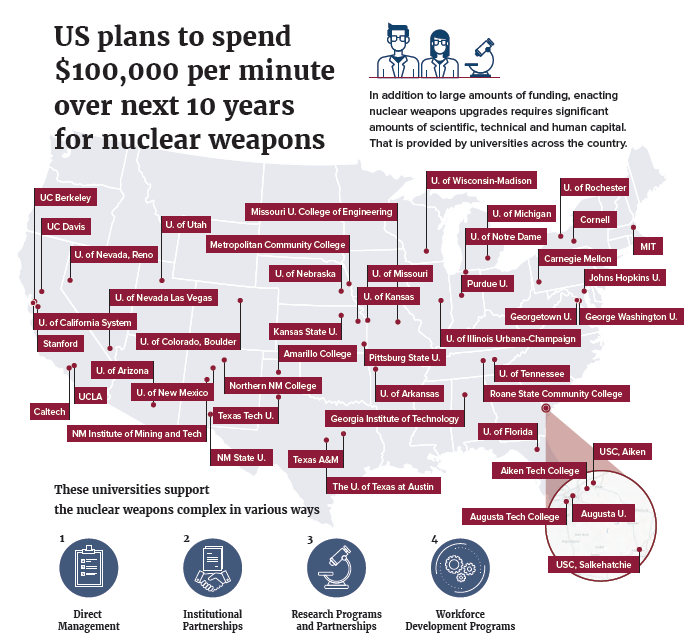
CBO: US nuclear arsenal to cost $634B over 10 years, https://thehill.com/policy/defense/555142-cbo-us-nuclear-arsenal-to-cost-634b-over-10-yearsBY REBECCA KHEEL – 05/24/21 Updating and maintaining the U.S. nuclear arsenal over the next 10 years is projected to cost $634 billion, the Congressional Budget Office (CBO) said in a report published Monday.
The cost estimate for the nuclear forces from 2021-2030 represents a 28 percent increase compared to the last CBO 10-year cost estimate two years ago.
About half of the $140 billion increase comes from the fact that the new estimate now includes 2029 and 2030 when nuclear modernization is expected to be further along and “more expensive,” CBO said.
Of the CBO’s $634 billion estimates, about $551 billion is what would be needed to fulfill the Defense and Energy departments’ current nuclear plans. The remaining $83 billion is what CBO projects could be cost overruns based on how much costs have grown for similar programs in the past, according to the report.
Of the $551 billion, about $188 billion is projected to go toward modernizing nuclear weapons and their delivery systems, the report said.
The United States is in the midst of plans to modernize all three legs of the nuclear triad that the Government Accountability Office has projected could cost $1.7 trillion over 30 years. The triad refers to delivering nuclear weapons by sea, air and land.
“Over the coming years, the Congress will need to make decisions about what nuclear forces the United States should field in the future and thus about the extent to which the nation will continue to modernize its nuclear forces,” the CBO report said.
The report could also inform the Biden administration’s expected review of U.S. nuclear policy and programs, with CBO noting “the Biden Administration is widely expected to undertake a nuclear posture review to determine the nuclear policies and forces it will pursue.”
The new CBO estimate is likely to fuel calls from some Democrats to curb the costly nuclear modernization plans, which were largely started during the Obama administration. In particular, some Democrats have frequently targeted plans to replace aging intercontinental ballistic missiles (ICBM), arguing it would be more cost-efficient to extend the life of the current arsenal.
Earlier Monday, a group of Democrats in the Senate and House, led by Sen Ed Markey (Mass.) and Rep. Earl Blumenauer (Ore.), introduced a bill to cut $73 billion from the nuclear budget.
The bill, dubbed the Smarter Approach to Nuclear Expenditures (SANE) Act, would do that by barring the development of new ICBMs, air-launched cruise missiles and submarine-launched cruise missiles. It would also cap the number of Columbia-class submarines the Pentagon can buy at eight, cut the existing ICBM fleet from more than 400 to 150 and reduce deployed strategic warheads from about 1,500 to 1,000.
Labor tries to block new regulations pushing ARENA into fossil fuels — RenewEconomy

Labor moves to cancel out Taylor’s new ARENA regulations, as department officials confirm they could extend to funding gas projects. The post Labor tries to block new regulations pushing ARENA into fossil fuels appeared first on RenewEconomy.
Labor tries to block new regulations pushing ARENA into fossil fuels — RenewEconomy
“It is crazy:” Greens push new climate laws after Coalition’s fossil fuel subsidy spree — RenewEconomy

Australian Greens propose laws to make fossil fuel companies legally liable for climate change, labelling contradictory Morrison government budget “crazy”. The post “It is crazy:” Greens push new climate laws after Coalition’s fossil fuel subsidy spree appeared first on RenewEconomy.
“It is crazy:” Greens push new climate laws after Coalition’s fossil fuel subsidy spree — RenewEconomy
NSW smart meter program to soak up solar with “everyday batteries” — RenewEconomy

Endeavour Energy gets smart about better managing record numbers of residential rooftop solar systems, with not a solar export charge in sight. The post NSW smart meter program to soak up solar with “everyday batteries” appeared first on RenewEconomy.
NSW smart meter program to soak up solar with “everyday batteries” — RenewEconomy
May 24 Energy News — geoharvey

Opinion: ¶ “Can You Charge An Electric Car With A Regular Outlet? Hell Yes!” • Can you charge an electric car with a regular outlet? This is actually a very common question. Many people even skip past asking this question and assume the answer is “no.” And you don’t even need special hardware to do […]
May 24 Energy News — geoharvey
This week in nuclear news Australia

Coronavirus. I can’t keep up with pandemic news – but it’s not going to go away – for a long time.It’s still looking like vaccination as everyone’s best hope.
Climate. G7 environment ministers have agreed that they will deliver climate targets in line with limiting the rise in global temperatures to 1.5C.
All quiet on nuclear developments this week. One news item from the UK (Hinkley project delays) clearly illustrates that very real, but rarely acknowledged connection between the coronavirus pandemic, and the fizzling out of activity in the ”peaceful” nuclear industry.But nothing stops the weapons makers and the Pentagon from pushing for more $billions for nuclear weapons. No doubt Russia, China then follow suit.
AUSTRALIA
Federal Government’s budget details indicate increased nuclear waste storage at ANSTO, Lucas Heights, rather than a rush for a nuclear waste dump at Kimba South Australia. Time to question the authorities on the nuclear waste dump mess, the incompetence of ANSTO, and the ?inactive role of Kimba nuclear waste staff . South Australian Civil and Administrative Tribunal rules that information on the Kimba nuclear waste dump can be made public
It’s not acceptable to ignore Aboriginal land owners, in order to impose high level nuclear waste on their land. Safety issues in nuclear waste dump proposal. Indigenous rights issues in Kimba nuclear waste dump proposal.
Australia has another go at cleaning up decades old pollution from old uranium mine Rum Jungle. New research on the complexity of particles from plutonium resulting from British atomic bomb tests at Maralinga. Plutonium ”hot particles” are not as stable as we assumed.
Australia has another go at cleaning up decades old pollution from old uranium mine Rum Jungle.
Research on contaminated landscape, plutonium particles, around Maralinga in outback South Australia.
Morrison’s ‘unconstitutional’ crackdown on charities. Senator Rex Patrick challenges Scott Morrison’s special arrangement to protect his government from public scrutiny.
Australia’s mining lobby exaggerates by $45 billion the taxes and royalties they pay.
INTERNATIONAL
The effects of radioactive waste water released into the ocean.
Scaling back missile defense could prevent a nuclear attack .
A world based on 100% renewable energy by 2035 is technically and economically feasible. Both Germany and Britain are decarbonising while nuclear production is greatly reducing. We already have 95% of the technologies and know how to slash emissions, remove air pollution and provide energy security and jobs.
“Advanced” isn’t the answer — New reactors as an answer to climate change are an illusion.
Scientists turn a blind eye to the fraud that is the ITER nuclear fusion project.
Should Bill Gates be viewed as a man of character and a trusted adviser to world leaders?
Tesla’s Bitcoin about-face is a warning for cryptocurrencies that ignore climate change.
Uranium Film Festival – Online for free from May 20 to May 30.
We already have 95% of the technologies and know how to slash emissions, remove air pollution and provide energy security and jobs.
South Australia’s Whyalla Council’s cop-out: just ”don’t want to know nothin” about nuclear waste through their town.

Kazzi Jai No nuclear wastec dump anywhere in South Australia, 24 May 21. Yet AGAIN – sneaky sneaky Feds are hoping for NO RESISTANCE regarding the problems arising from TRANSPORTATION OF NUCLEAR WASTE – NOT YELLOWCAKE, NOT NUCLEAR MEDICINES – ACROSS 1700KMS OF AUSTRALIA….OR IN OUR FRAGILE SEA ECOSYSTEMS!!
Josie Hocking, Whyalla
It seems that our Council don’t consider the transport of intermediate level nuclear waste through our town to be any of their business.
Dear Ms Hocking I write with regard to your question below.This question was submitted to the Ordinary Council Meeting held on Monday 17 May 2021. Below, is Council’s response (as recorded within the Minutes of the Meeting): 10. Public Question Time 10.1 Ms J Hocking – Resident 10.1.1 Transportation of Nuclear Waste.
Question 1. I, and no doubt many others, would like to know if permission is required from the Whyalla Council to allow nuclear waste to be transported through our city or port?
What is the general view of the Mayor and Councillors in this respect? Can the Federal Government override any objections by the Mayor and Councillors?
If the Mayor and Councillors are in favour of allowing this to happen, then I respectfully suggest that the decision should not be theirs alone. A vote should be held among the Whyalla residents to see whether we are willing to take the risks involved in this venture. I have seen nothing about Council’s views on this subject in the Whyalla News or anywhere else.
My personal view is that Council should be taking every opportunity to refuse to allow nuclear waste to be transported though our town, and hopefully other Councils in our neighbourhood might follow your example. Perhaps there could be a meeting between the town Councils to come up with a strategy to protect all of these towns and let them know how populations feel about this dump being imposed on our neighbourhood without proper consultation of everyone involved, and that includes the residents of all towns the nuclear waste is intended to travel through.
Answer1. Council does not have a written public policy which relates to the handling of ‘intermediate level’ nuclear waste, or any matter relating to nuclear energy.
Regarding the road/rail transport of waste through Whyalla and its surrounds, the roads which would be used in the transport of this waste, are managed and controlled by the Department of Infrastructure and Transport, including the Port Augusta Highway which is outside the Whyalla Council boundary. If waste was shipped into, or out of the Whyalla Port, this Port is owned and managed by the GFG Alliance companies, which is also outside of Council’s boundary. On behalf of Council, thank you for taking the time to submit the question under reference.
Regards, Shell Michelle ArmstrongExecutive Co-ordinator – CEO and Mayor https://www.facebook.com/groups/1314655315214929
r
·
Transport issues in Kimba nuclear waste dump plan

Looking back to the 2016 shonky South Australian Nuclear Fuel Cycle Royal Commission, – the same problems apply to the present Federal Government plan . Friends of the Earth Australia examined these- in Arguments against turning SA into the world’s nuclear waste dump.
The Royal Commission’report claimed that ”no accident involving a breach of the package and the release of its contents has occurred. The same record applies to international transport of high and intermediate level waste.”
”That claim is incorrect and is refuted by documented evidence provided to ‒ and ignored by ‒ the Royal Commission. For example a whistleblower sparked a major controversy over frequent excessive radioactive contamination of waste containers, rail cars, and trucks in France and Germany. International transport regulations for spent fuel shipments were constantly over a period of many years and this was done knowingly. Another example concerns the derailment of a train wagon carrying spent fuel in December 2013, 3 km from Paris, with testing by AREVA revealing a hotspot on the rail car.
Numerous other train derailments involving nuclear materials transport have been documented. It is unsettling to consider the multiple derailments on the Ghan train line in Australia in the relatively short period of time it has been in operation.
Transport incidents and accidents are routine in countries with significant nuclear industries. The case of the UK is pertinent. A UK government database contains information on 1018 events from 1958 to 2011 (an average of 19 incidents each year).
There were 187 events during the shipment of irradiated nuclear fuel flasks from 1958−2004 in the UK (an average of four per year):
- 33% involved excess contamination on the surface of the flask;
- 24% involved collisions and low speed derailments of the conveyance;
- 16% involved flask preparation faults, and loading/unloading faults;
- 13% involved excess contamination of conveyance;
- 11% involved faults with the conveyance; and
- the remainder included three cases involving fire on a locomotive with no damage to flasks.
The French nuclear safety agency IRSN produced a report summarising radioactive transport accidents and incidents from 1999−2007. The database lists 901 events from 1999−2007 − on average 100 events annually or about two each week. The IRSN report notes that events where there is contamination of packages and means of transport were still frequent in 2007.
Potential costs of transport accidents: Spent fuel / high level nuclear waste transport accidents have the potential to be extraordinarily expensive. Dr. Marvin Resnikoff and Matt Lamb from Radioactive Waste Management Associates in New York City calculated 355−431 latent cancer fatalities attributable to a “maximum” hypothetical rail cask accident, compared to the US Department of Energy’s estimate of 31 fatalities. Using the Department of Energy’s model, they calculated that a severe truck cask accident could result in US$20 billion to US$36 billion in clean-up costs for an accident in an urban area, and a severe rail accident in an urban area could result in costs from US$145 billion to US$270 billion.
Transport and nuclear security: Nuclear engineer Dr John Large writes: “Movement of nuclear materials is inherently risky both in terms of severe accident and terrorist attack. Not all accident scenarios and accident severities can be foreseen; it is only possible to maintain a limited security cordon around the flask and its consignment; … terrorists are able to seek out and exploit vulnerabilities in the transport arrangements and localities on the route; and emergency planning is difficult to maintain over the entire route.”
A number of nuclear transport security incidents are listed in the body of this submission (section 3.8).
Security and proliferation risks…….”Arguments against turning SA into the world’s nuclear waste dump https://nuclear.foe.org.au/waste-import-arguments/?fbclid=IwAR1yajKABFYLvMp3gFjM_DuYJFFMu4nnuc3LXxLFEBLpI7Da9-OjSv0IHrk#_ftnref4
1 This month.


PETITION – To: Prime Minister Anthony Albanese and the Australian Labor Government
Chernobyl: The Lost Tapes – A good documentary on Chernobyl on SBS available On Demand for the next 3 weeks– https://www.sbs.com.au/ondemand/tv-program/chernobyl-the-lost-tapes/235274195556

19 May – Webinar- Webinar: No Nuclear Weapons in Australia
Start: 2026-05-19 18:00:00 UTC Canberra, Melbourne, Sydney (GMT+10:00)
End: 2026-05-19 19:30:00 UTC Canberra, Melbourne, Sydney (GMT+10:00)
20 May – Webinar – The dangerous world of AUKUS, US, military occupation and suppression of dissent

National Webinar, 20th May, 2026, 6.30pm AEST. Confronting laws restricting/suppressing protest speech and action
Speakers: Former Sen. Rex Patrick, Lawyer Nick Hanna ,Arthur Rorris ,Jorgen Doyle, Sen David Shoebbridge,
Facilitator Kelley Tranter.

of the week – Australians for War Powers Reform (AWPR)
To see nuclear-related stories in greater depth and intensity
 Antinuclear