The budget should have been a road to Australia’s low-emissions future. Instead, it’s a flight of fancy — RenewEconomy

The Morrison government is betting heavily on failed climate alternatives and blatantly ignoring internationally proven technology, like electric vehicles. The post The budget should have been a road to Australia’s low-emissions future. Instead, it’s a flight of fancy appeared first on RenewEconomy.
The budget should have been a road to Australia’s low-emissions future. Instead, it’s a flight of fancy — RenewEconomy
Vestas unveils new technology to recycle wind blades and stop dumping — RenewEconomy

New “game-changing” technology could be the final technological step towards a fully recyclable wind turbine. The post Vestas unveils new technology to recycle wind blades and stop dumping appeared first on RenewEconomy.
Vestas unveils new technology to recycle wind blades and stop dumping — RenewEconomy
Australia’s wind and solar farms seek to dodge negative prices and grid costs — RenewEconomy

The days of a ‘set and forget’ bidding strategy are long gone in Australia in a rapidly changing market with more wind and solar. The post Australia’s wind and solar farms seek to dodge negative prices and grid costs appeared first on RenewEconomy.
Australia’s wind and solar farms seek to dodge negative prices and grid costs — RenewEconomy
Australia’s best performing wind farms in 2020 on spot prices — RenewEconomy

Which wind farms performed the best on spot prices, and revenue per megawatt of capacity in Australia’s main grid. The post Australia’s best performing wind farms in 2020 on spot prices appeared first on RenewEconomy.
Australia’s best performing wind farms in 2020 on spot prices — RenewEconomy
White House environmental justice advisers express opposition to nuclear
White House environmental justice advisers express opposition to nuclear, carbon capture projects, The Hill
BY RACHEL FRAZIN – 05/17/21 The White House Environmental Justice Advisory Council expressed opposition to nuclear and carbon capture projects as well as projects that expand capacity for fossil fuel production in a report issued Friday.
The volunteer advisory council listed such projects as among “examples of the types of projects that will not benefit a community,” in a set of recommendations issued to the White House.
The recommendations issued by the council, which is made up of leaders in the environmental justice movement, are meant to advise the Biden administration, but don’t necessarily reflect administration policy.
In fact, the opposition appears to be somewhat at odds with policies the administration has backed, like President Biden’s promotion of a carbon capture tax credit in his infrastructure plan.
The report did not specify why the advisory panel considers such projects not to be beneficial, but opponents have raised concerns about nuclear waste. …….. https://thehill.com/policy/energy-environment/553927-white-house-environmental-justice-advisors-expresses-opposition-to
Should Bill Gates be viewed as a man of character and a trusted adviser to world leaders?

Gates’ reputation and practices are now open to further questions and scrutiny.
Billionaire Bill Gates’ Alleged Relationships With Women While Married Raise Questions About His Character, Forbes, Jack Kelly, Senior Contributor 17 May 21, Bill Gates, the multibillionaire cofounder of Microsoft, was viewed and mostly respected by the public as a nerdy, brainy and awkward guy. In the tech community, it was different. Gates was feared. Rivals saw him as brutal and ruthless.
The U.S. Justice Department’s antitrust division accused Microsoft of running a monopoly and filed suit—United States v. Microsoft. Competitors were knocked out of business. His childhood best friend and cofounder, Paul Allen, claimed Gates “conspired with Microsoft’s first chief executive, Steve Ballmer, to reduce his co-founder’s stake,” while he was “recovering from treatment for lymphoma.”
Continue readingTesla’s Bitcoin about-face is a warning for cryptocurrencies that ignore climate change

Don’t be lulled into thinking that Elon Musk is some sort of expeert on environmrent. He plans to continue with Bitcoin, as well as with a multitude of rockets and space satellites – all mpowered by – guess what” plutonium and other forms of nuclear energy
Tesla’s Bitcoin about-face is a warning for cryptocurrencies that ignore climate change, The Conversation, John Hawkins, Senior Lecturer, Canberra School of Politics, Economics and Society and NATSEM, University of Canberra 17 May 21
Over the weekend, Tesla chief executive Elon Musk suggested his company could sell off its Bitcoin holdings, sending the cryptocurrency plummeting.
It followed Musk’s announcement earlier this month that his company would no longer accept Bitcoin in payment for its electric cars, due to the fossil fuels needed to create the digital currency.
Bitcoin is created via high-powered computers solving complex mathematical equations. These computers use a lot of electricity, which is often generated by fossil fuels. Tesla’s about-face is a blow to Bitcoin, the value of which jumped when Tesla got on board.
Tesla’s stance is a big winner for both the climate, and the company’s “green” reputation. The development has also shone the spotlight further onto the carbon footprint of cryptocurrency – an issue that will not go away soon.
how, exactly, is Bitcoin – and many other cryptocurrencies – bad for the environment?
It all comes down to the energy used to create it. Before a Bitcoin transaction takes place, the person spending the coin must be verified as the valid owner. And once the transaction is complete it must be digitally recorded in a database known as a “blockchain” ledger.
Unlike a traditional bank where transactions are centrally verified and recorded, Bitcoin’s ledger comprises a distributed database of users. They verify transactions by running complex mathematical problems through high-powered computers. The first user to solve the calculation and add it to the blockchain is rewarded with Bitcoin. The process is termed “mining”.
Over time, the Bitcoin system increases the complexity of the problems as more computing power is applied to them. In the early days mining could be done by geeks in their bedrooms using home computers. Now it mostly done using vast rooms full of very expensive specialised equipment, which only companies can afford.
The process uses a lot of energy. The University of Cambridge recently estimated Bitcoin used more electricity each year than the entire economies of Argentina or Sweden.
Some of this electricity comes from renewables. But analyses suggest most Bitcoin mining occurs in China, and the main power source is coal. A recent study in Nature concluded Bitcoin operations in China are on track to produce 130 million tonnes of greenhouse gas emissions in 2024 – more than the entire economy of the Czech Republic………. https://theconversation.com/teslas-bitcoin-about-face-is-a-warning-for-cryptocurrencies-that-ignore-climate-change-160928
Alabama hospital installs radiation-free spine imaging tool
Alabama hospital installs radiation-free spine imaging tool https://www.beckersspine.com/orthopedic-a-spine-device-a-implant-news/item/51800-alabama-hospital-installs-radiation-free-spine-imaging-tool.htmlAlan Condon – Birmingham, Ala.-based Princeton Baptist Medical Center reportedly is the first hospital in the state to implement the Flash navigation system for spine and cranial procedures, CBS affiliate WIAT reported May 14.
Designed by 7D Surgical, Flash uses visible light to create a 3D image for spine surgical navigation, eliminating patient and staff exposure to intraoperative radiation, according to the company.
The technology was approved for neurologic surgery in 2016 but since has expanded to spine surgery.
The Flash system costs $500,000, compared to other navigation systems on the market that run up to $1.2 million, according to 7D Surgical.
7D Surgical is expected to be acquired by SeaSpine this quarter.
Chernobyl is showing signs of a possible new nuclear accident
Chernobyl is showing signs of a possible new nuclear accident, scientists say. Nuclear reactions are smoldering again https://thehill.com/changing-america/sustainability/energy/553844-chernobyl-is-showing-signs-of-a-possible-new-nuclear .Christian Spencer | May 17, 2021
Radioactive waste is smoldering in a part of Chernobyl that is unreachable.
Two chemical experts heed caution of another explosion.
The fatal 1986 explosion left the place a ghost town.
Scientists are warning that another explosion could occur in Chernobyl due to the spike in neutron numbers in an underground room called 305/2.
The numbers may indicate that new fission reactions are taking place, and there’s a possibility the smoldering nuclear reaction — in a room that’s currently unreachable — could lead to an explosion, Business Insider reported.
“[It is] like the embers in a barbecue pit,” Neil Hyatt, a professor of nuclear materials science and engineering at the University of Sheffield Lecturer, told Science magazine.
Fellow scientist, Maxim Saveliev, a senior researcher with the Institute for Safety Problems of Nuclear Power Plants (ISPNPP) in Kyiv, Ukraine, agrees with Hyatt, saying “there are many uncertainties, but we can’t rule out the possibility of [an] accident.”
The Chernobyl disaster was a nuclear accident near the No. 4 reactor in the Chernobyl Nuclear Power Plant, close to the city of Pripyat in the north of the Ukrainian SSR. The April 26, 1986 disaster is considered the worst nuclear disaster in history for the amount of money it cost and the number of lives lost. The Chernobyl disaster is one of two energy-related accidents that were rated a level 7, the maximum.
About 50 people were killed, and the explosion resulted in thousands of radiation-related deaths.
As of now, the New Safe Confinement (NCS), a $1.8-billion protective confinement shelter, was built in 2019 to stop the contamination of radioactive.
The NSC was also created to lower the neutron counts, with Saveliev saying the issue of a possible explosion might resolve itself.
After 35 years, the evacuated city still resembles a ghost town.
Nuclear emergency guidelines on thyroid radiation exposure under review in Japan
Nuclear emergency guidelines on thyroid radiation exposure under review in Japan, Japan News, The Yomiuri Shimbun, 17 May, 21
The Nuclear Regulation Authority (NRA) plans to establish a system for measuring thyroid gland radiation levels of nearby residents in the immediate aftermath of a nuclear power plant accident, during a review of the government’s nuclear emergency response guidelines being undertaken this fiscal year.
Revisions will likely include a requirement to measure radiation levels of children under the age of 18 and pregnant women, who are most vulnerable to radiation exposure………
Officials are particularly concerned about areas where radiation levels reach 500 microsieverts per hour, which requires immediate evacuation, and those where levels continuously exceed 20 microsieverts per hour, which requires temporary relocation.
The NRA is considering mainly targeting children under the age of 18, pregnant women and nursing mothers in such areas.
Radioactive iodine-131 released in a nuclear accident halves in about eight days, highlighting the importance of taking measurements immediately after an accident to determine radiation exposure levels.
However, the measurement target until now was unclear and the response system and equipment were insufficient………. only about 1,000 of the 370,000 children under the age of 18 in Fukushima Prefecture have had their thyroid gland radiation levels measured. https://the-japan-news.com/news/article/0007405020
US Nuclear is significantly overvalued

US Nuclear Stock Gives Every Indication Of Being Significantly Overvalued, Yahoo Finance GuruFocus.com, Sat, May 15, 2021,
The stock of US Nuclear (OTCPK:UCLE, 30-year Financials) is believed to be significantly overvalued, according to GuruFocus Value calculation. GuruFocus Value is GuruFocus’ estimate of the fair value at which the stock should be traded. It is calculated based on the historical multiples that the stock has traded at, the past business growth and analyst estimates of future business performance. If the price of a stock is significantly above the GF Value Line, it is overvalued and its future return is likely to be poor. On the other hand, if it is significantly below the GF Value Line, its future return will likely be higher. At its current price of $0.57 per share and the market cap of $13.3 million, US Nuclear stock is believed to be significantly overvalued. GF Value for US Nuclear is shown in the chart below. [on original]
Because US Nuclear is significantly overvalued, the long-term return of its stock is likely to be much lower than its future business growth, which averaged 7.8% over the past five years.
Since investing in companies with low financial strength could result in permanent capital loss, investors must carefully review a company’s financial strength before deciding whether to buy shares. Looking at the cash-to-debt ratio and interest coverage can give a good initial perspective on the company’s financial strength. US Nuclear has a cash-to-debt ratio of 0.43, which ranks worse than 79% of the companies in Hardware industry. Based on this, GuruFocus ranks US Nuclear’s financial strength as 3 out of 10, suggesting poor balance sheet. This is the debt and cash of US Nuclear over the past years:
…………In short, The stock of US Nuclear (OTCPK:UCLE, 30-year Financials) gives every indication of being significantly overvalued. The company’s financial condition is poor and its profitability is poor. Its growth ranks worse than 81% of the companies in Hardware industry. https://finance.yahoo.com/news/us-nuclear-stock-gives-every-111207593.html
May 17 Energy News — geoharvey

Opinion: ¶ “The Stakes Couldn’t Be Higher For America’s First Major Offshore Wind Farm” • The stakes couldn’t be higher. America’s power system needs a serious makeover to meet President Biden’s emissions goals. Dirty coal must be replaced by much more solar and wind – including a series of offshore wind farms that begin with […]
May 17 Energy News — geoharvey
This week’s nuclear news

NUCLEAR . Not much happening this week. Intensified push for small nuclear reactors (SMRs) in Canada and UK.
CORONAVIRUS: Coronavirus Disease (COVID-19): Weekly Epidemiological Update. No easy fix for global vaccine shortage.
CLIMATE CHANGE. Third of global food production at risk from climate crisis.
A bit of good news – ‘The Manta’ Sailing Vessel is Designed to Feed on Plastic Waste for Power–While Cleaning Oceans.
Ionising radiation was scientifically proven to be bad for dogs. Does that mean it’s good for humans?
Nuclear industry survives on its false claim that it helps the fight against climate change.
How Bill Gates bankrolls the news agenda. Corruption in the pharmaceutical industry – the Bill Gates connection. Bill Gates with his GAVI (the Global Alliance for Vaccine Initative) has the power of a member State in the WorldHealth Organisation.
Fusion: Ten Times More Expensive Than Nuclear Power.
NO, nuclear lobby, a nuclear reactor is NOT the only, nor the best, way to produce medical Technetium TC99.
Energy effuciency – the most ignored form of climate action – and the most effective.
If Bitcoin is virtual, why are there environmental concerns?
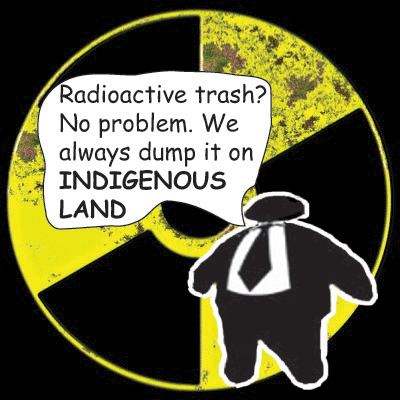
Saugeen First Nation do not want Canada’s nuclear waste. Nuclear Waste Management Organization says the project will not be built without their consent.

Saugeen First Nation debates fate of Canada’s nuclear waste CTV News , Scott Miller CTV News London Videographer @ScottMillerCTV Contact Sunday, May 16, 2021 ”…… Last January, the Saugeen Ojibway Nation voted 85 per cent against plans to bury Ontario’s low and intermediate level nuclear waste along the shores of Lake Huron.
Saugeen members will have a similar decision to make on plans to bury Canada’s high-level nuclear waste under 1,500 acres of farmland, north of Teeswater, because the planned project also falls within their traditional territory.
The Nuclear Waste Management Organization says the project will not be built without SON’s consent.
“Well it’s important now because that’s what was agreed to as part of the treaties. So there’s constitutional rights that are at play,” says NWMO’s Indigenous Knowledge and Reconciliation Section Manager, Jessica Perritt.
SON leadership have said they didn’t ask for nuclear waste to be created and temporarily stored in their territory, but now, they must be part of deciding its fate.
“We’ve got to treat our people, not like the olden days where the Indian Agent didn’t even allow us to think or make decisions. We can make decisions for ourselves,” says Roote………..
Members of the Saugeen Ojibway Nation and residents of South Bruce have until 2023 to decide if they want to permanently house Canada’s first and only underground nuclear waste storage facility. https://london.ctvnews.ca/saugeen-first-nation-debates-fate-of-canada-s-nuclear-waste-1.5430208
Small nuclear reactors – a way to get indigenous people to then accept nuclear waste?
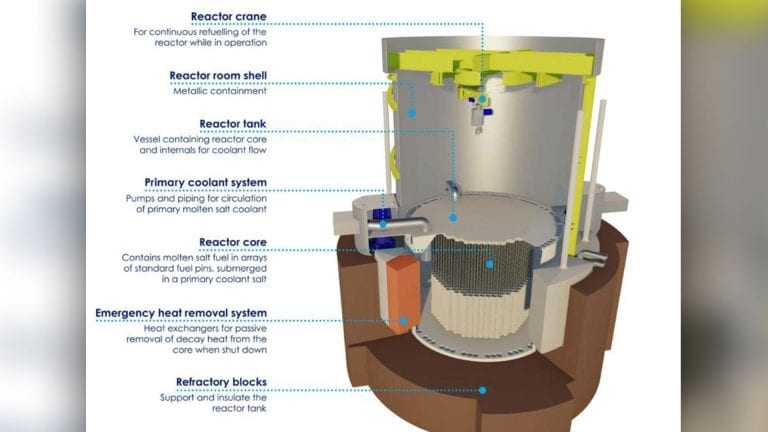
Gordon Edwards is president of the Canadian Coalition for Nuclear Responsibility and notes the Moltex SMR design involves dissolving spent nuclear fuel in molten salt, and there lies an issue, he believes.
“What happens when you dissolve the solid fuel in a liquid, in this molten salt – then all of these radioactive materials are released into the liquid,” says Edwards, “and it becomes more dangerous to contain them because a solid material is much easier to contain than a liquid or gaseous material.”
Peskotomuhkati chief unhappy about nuclear reactor testing on his traditional territory https://www.aptnnews.ca/national-news/peskotomuhkati-nation-nuclear-reactor-testing-new-brunswick-small-modular-reactors/—
Christopher Read cread@aptn.caMay 16, 2021,
Feds say they won’t reach zero emissions by 2050 without small nuclear reactors.
It’s a new kind of nuclear reactor that the federal government is putting up $50.5 million in development money for, but some Indigenous leaders are already speaking out against it
.Moltex Energy Canada is getting the tax-dollar investment to develop what the nuclear industry calls a “small modular reactor” or SMR – which is generally considered to be a reactor with a power output of 300 megawatts or less.The Moltex SMR design is to be developed at New Brunswick Power’s Point LePreau Nuclear Generating Station, which is on the north shore of the Bay of Fundy and in Peskotomuhkati traditional territory.
ARC Clean Energy Canada is another operation also set to develop an SMR at the Point LePreau site. It was announced in February that ARC would get $20 million from the New Brunswick government if the company can raise $30 million of its own cash.
Hugh Akagi is Chief of Peskotomuhkati Nation and has concerns about more nuclear development in the aging facility.
“Well, I don’t feel very good about it, to be honest,” says Akagi. “You paid that money if you pay tax on anything in this country, you’ve just made a donation to Moltex. If you’re not concerned about $50 million being turned over to a corporation for a technology that does not exist – I hope you heard me correctly on that.”
The federal government has taken a shine to the idea of SMRs and Minister of Natural Resources Seamus O’Regan is on the record as saying “We have not seen a model where we can get to net-zero emissions by 2050 without nuclear.”
Under the Small Modular Reactor Action Plan, the federal government is pushing for SMRs to be developed and deployed to power remote industrial operations as well as northern communities.
Three streams of government-supported SMR developments are underway at two sites in Ontario as well as at Point LePreau.
As well, the governments of New Brunswick, Ontario, Saskatchewan and Alberta have all signed a memorandum of understanding pledging their support for SMR development.
Akagi says he hasn’t been formally consulted – but has been to a presentations put on by NB Power about the SMR project.
He says he is unlikely he’ll ever give it his support.
“Until I can have an assurance that the impact on the future is zero,” says Akagi, “I don’t want to 100 years, 200 years is still seven generations. I want zero impact.”
But Moltex Energy Canada CEO Rory O’Sullivan says his company’s technology will ultimately reduce environmental impact, by recycling spent nuclear fuel from full scale reactors.
“Instead of putting it in the ground where it’ll be radioactive for very long periods, we can reuse it as fuel to create more clean energy from what was waste,” says O’Sullivan. “We can’t get rid of the waste altogether. But the aim is to get rid, to get it down to about a thousandth of volume of the original long-lived radioactivity.
O’Sullivan admits to formerly seeing nuclear as too much of a problem to be a viable solution in the climate crisis.
“When I graduated as a mechanical engineer I saw that nuclear is potentially as too expensive, has the waste issue, has a potential safety issue,” says O’Sullivan. “Well, actually, with these innovative new designs, you can potentially have nuclear power that is lower cost, cheaper than fossil fuels – you can get much safer solution using innovation and you can potentially deal with the waste.”
Gordon Edwards, one of Canada’s most prominent nuclear critics, isn’t buying that argument.
Edwards is president of the Canadian Coalition for Nuclear Responsibility and notes the Moltex SMR design involves dissolving spent nuclear fuel in molten salt, and there lies an issue, he believes.
“What happens when you dissolve the solid fuel in a liquid, in this molten salt – then all of these radioactive materials are released into the liquid,” says Edwards, “and it becomes more dangerous to contain them because a solid material is much easier to contain than a liquid or gaseous material.”
Edwards also works on a radioactive task force with the Anishinabek Nation and the Iroquois Caucus.
And as he sees it, small modular reactors could make it harder for Indigenous communities to say no to the deep geological repositories [DGRs] being pitched to Indigenous communities as a supposedly safe way for Canada’s nuclear industry to entomb highly radioactive waste for hundreds of thousands of years.
“We don’t accept the small modular reactors because we know that it’s just a way of implicating us so that we can then have less of an argument against being radioactive waste dumps,” says Edwards. “If we accept small modular reactors into our communities, how can we then turn around and say we don’t want to keep the radioactive waste? It would just put us in an impossible position.”
Edwards and other nuclear critics such as Akagi recently participated in an online webinar focused on concerns around nuclear development at Point LePreau.
And those adding their voices to the critical side of the ledger on nuclear development at Point LePreau include Jenica Atwin – the Green Party’s MP for Fredricton, and Wolastoq Grand Council Chief Ron Tremblay – who issued a Resolution calling for nuclear development to be halted.
Atwin put out a release in April calling Canadian nuclear policies “profoundly misguided.”
“My basic premise is that the government needs to be more responsible in the information that they’re sharing just in general to talk about the risks that exist alongside whatever benefits they’re kind of toting,” says Atwin. “And right now, we’re only hearing that it’s the greatest option. This is how we fight climate change. It is clean, it’s cheap energy. And I have to disagree.”
If all goes to according to the Moltex plan, its SMR could be operable by about 2030.
1 This month.

PETITION – To: Prime Minister Anthony Albanese and the Australian Labor Government
Chernobyl: The Lost Tapes – A good documentary on Chernobyl on SBS available On Demand for the next 3 weeks– https://www.sbs.com.au/ondemand/tv-program/chernobyl-the-lost-tapes/235274195556

19 May – Webinar- Webinar: No Nuclear Weapons in Australia
Start: 2026-05-19 18:00:00 UTC Canberra, Melbourne, Sydney (GMT+10:00)
End: 2026-05-19 19:30:00 UTC Canberra, Melbourne, Sydney (GMT+10:00)
20 May – Webinar – The dangerous world of AUKUS, US, military occupation and suppression of dissent

National Webinar, 20th May, 2026, 6.30pm AEST. Confronting laws restricting/suppressing protest speech and action
Speakers: Former Sen. Rex Patrick, Lawyer Nick Hanna ,Arthur Rorris ,Jorgen Doyle, Sen David Shoebbridge,
Facilitator Kelley Tranter.

of the week – Australians for War Powers Reform (AWPR)
To see nuclear-related stories in greater depth and intensity
 Antinuclear