New research on the complexity of particles from plutonium resulting from British atomic bomb tests at Maralinga

 Pu particles from nuclear testing more complex than previously thought https://www.eurekalert.org/pub_releases/2021-05/mu-ppf051821.php Plutonium particles from British nuclear testing in outback Australia more complex than previously thought, scientists warnMONASH UNIVERSITYResearch News 21 May 21 Pu particles from nuclear testing more complex than previously thought https://www.eurekalert.org/pub_releases/2021-05/mu-ppf051821.php Plutonium particles from British nuclear testing in outback Australia more complex than previously thought, scientists warnMONASH UNIVERSITYResearch News 21 May 21More than 100 kg of highly toxic uranium (U) and plutonium (Pu) was dispersed in the form of tiny ‘hot’ radioactive particles after the British detonated nine atomic bombs in remote areas of South Australia, including Maralinga.Scientists say that these radioactive particles persist in soils to this day, more than 60 years after the detonations. Previously, we had limited understanding of how Pu was released from these “hot” particles into the environment for uptake by wildlife around Maralinga. |
But now, a new study published today in Scientific Reports and led by Monash University researchers warns that the particles are actually more complex and varied than previously thought. This means that the processes which slowly release Pu into the environment are also much more complex and varied.
“The British detonated nine nuclear bombs and conducted hundreds of nuclear tests in outback South Australia between 1953 and 1963,” said lead study author Megan Cook, a PhD student from the Monash University School of Earth, Atmosphere and Environment. “The resulting radioactive contamination and cover-up continues to haunt us.”
“The results of our study profoundly changes our understanding of the nature of hot particles at Maralinga – despite the fact that those were some of the best studied particles anywhere in the world,” said study co-author Associate Professor Vanessa Wong.
The research team used synchrotron radiation at the Diamond Light Source near Oxford, UK to decipher the physical and chemical make-up of the particles.
At Monash University they dissected some of the hot particles using a nano-sized ion beam, and further characterised the complex make-up of these particles down to the nano-size in exquisite details.
The researchers demonstrated that the complexity of the hot particles arose from the cooling of polymetallic melts from thousands of degrees Celsius in the explosion cloud during their formation.
“We found that the particles contained low-valence plutonium-uranium-carbon compounds that are typically highly reactive, yet, had been stabilised in the hot-particle matrix for nearly 60 years,” said corresponding author Dr Barbara Etschmann.
Between 1950 and 1988 alone there were more than 230 recorded nuclear weapon accidents, including at least 10 with documented release of radioactive particles into the environment. The risks of such incidents are only increasing as international treaties such as the Intermediate-Range Nuclear Forces Treaty were cancelled.
“Understanding the fate of hot particles in the unique setting of the Australian outback is critical for securing Australia in case of nuclear incidents in the region, and returning all the native land affected by the British tests to the traditional Anangu owners of the Maralinga Tjarutja lands,” said study co-author Professor Joël Brugger.
May 21 Energy News — geoharvey

Opinion: ¶ “Is The IEA Report A Tipping Point For Oil Investing?” • The demise of oil and thermal coal won’t come from eco-activism or even directly from renewable energy – it will come when big banks decide to stop financing it, rendering it ‘unbankable.’ And big financial companies like Goldman Sachs and BlackRock were […]
May 21 Energy News — geoharvey
On this site, for the first time ever, I am recommending donations to a cause

SUPPORT INDEPENDENT JOURNALISM
I have been, still am, so fed up with Australia’s cringing mainstream media – dominated by the Murdochracy. But they’re not the only ones. Even some of the ”alternative” media swallow the deceptions of our corrupt Federal Government.
Now, – I know that Michael West Media is in no way dedicated to the anti-nuclear cause. Nor even to environmental isses. Their focus is on turning the spotlight on the Morrison government and their crooked and grasping industry backers.
BUT – everything is connected, and in these crisis time of Covid-19 and climate change, Australia must join the progressive people of the world, and the nuclear free cause needs to be a part of this. It’s covered up, or lied about in the media. Yes the ABC tries, but it lives under the shadow of the Liberal Coalition’s goal to destroy it. We desperatelyu need this kind of investigative journalism
Australia has another go at cleaning up decades old pollution from old uranium mine Rum Jungle.

This is why Rum Jungle is so important: it was one of the very few mines once thought to have been rehabilitated successfully.
We got it wrong with Rum Jungle …….. Getting even a small part of modern mine rehabilitation wrong could, at worst, mean billions of tonnes of mine waste polluting for centuries.
Let’s hope we get it right this time.
The story of Rum Jungle: a Cold War-era uranium mine that’s spewed acid into the environment for decades https://theconversation.com/the-story-of-rum-jungle-a-cold-war-era-uranium-mine-thats-spewed-acid-into-the-environment-for-decades-160871, Gavin Mudd Associate Professor of Environmental Engineering, RMIT University, May 18, 2021
Buried in last week’s budget was money for rehabilitating the Rum Jungle uranium mine near Darwin. The exact sum was not disclosed.
Rum Jungle used to be a household name. It was Australia’s first large-scale uranium mine and supplied the US and British nuclear weapons programs during the Cold War.
Today, the mine is better known for extensively polluting the Finniss River after it closed in 1971. Despite a major rehabilitation project by the Commonwealth in the 1980s, the damage to the local environment is ongoing.

first visited Rum Jungle in 2004, and it was a colourful mess, to say the least. Over later years, I saw it worsen. Instead of a river bed, there were salt crusts containing heavy metals and radioactive material. Pools of water were rich reds and aqua greens — hallmarks of water pollution. Healthy aquatic species were nowhere to be found, like an ecological desert.
The government’s second rehabilitation attempt is significant, as it recognises mine rehabilitation isn’t always successful, even if it appears so at first.
Rum Jungle serves as a warning: rehabilitation shouldn’t be an afterthought, but carefully planned, invested in and monitored for many, many years. Otherwise, as we’ve seen, it’ll be left up to future taxpayers to fix.
The quick and dirty history
Rum Jungle produced uranium from 1954 to 1971, roughly one-third of which was exported for nuclear weapons. The rest was stockpiled, and then eventually sold in 1994 to the US.
The mine was owned by the federal government, but was operated under contract by a former subsidiary of Rio Tinto. Back then, there were no meaningful environmental regulations in place for mining, especially for a military project.
The waste rock and tailings (processed ore) at Rum Jungle contains significant amounts of iron sulfide, called “pyrite”. When mining exposes the pyrite to water and oxygen, a chemical reaction occurs generating so-called “acidic mine drainage”. This drainage is rich in acid, salts, heavy metals and radioactive material (radionuclides), such as copper, zinc and uranium.
Acid drainage seeping from waste rock, plus acidic liquid waste from the process plant, caused fish and macroinvertebrates (bugs, worms, crustaceans) to die out, and riverbank vegetation to decline. By the time the mine closed in 1971, the region was a well-known ecological wasteland.
Continue readingU.S. Pentagon hypes up the ”China threat”, in its deceptive propaganda to get more $billions from Congress
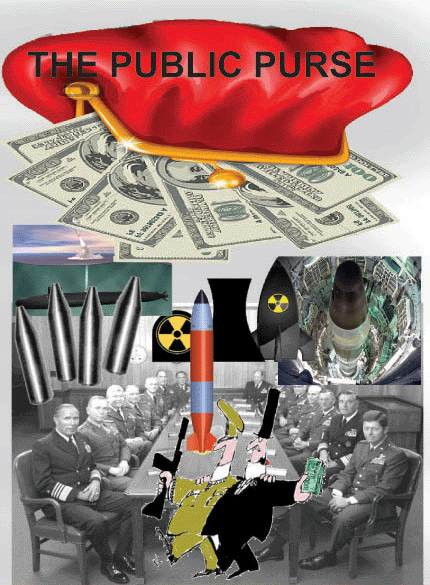
we can expect to be bombarded with Pentagon and industry propaganda on China’s growing air and naval capabilities—requiring, it will be stated, hundreds of billions of dollars in added spending.
Costs for the new intercontinental missile are currently estimated at $100 billion ($10 billion more than a few years ago) and are sure to rise in the years ahead if full-scale production is approved by Congress.
The Pentagon Inflates the Chinese Nuclear Threat in a Push for New Intercontinental Missiles. Every US military service is seeking more money than before, and each one is touting the importance of their weapons in overcoming the Chinese military threat. The Nation, By Michael T. Klare , 19 May 21,
This year, as in every year, the Department of Defense will seek to extract budget increases from Congress by highlighting the severe threats to US security posed by its foreign adversaries. Usually, this entails a litany of such perils, ranging from a host of nation-state adversaries to nonstate actors like ISIS and Al Qaeda. This year, however, the Pentagon is focusing almost entirely on just one threat in its funding appeals: The People’s Republic of China. Sensing that a majority in Congress—Democrats as well as Republicans—are keen to display their determination to blunt China’s rise, senior officials are largely framing the military budget around preparation for a possible conflict with that country. “The Department will prioritize China as our number one pacing challenge and develop the right operational concepts, capabilities, and plans to bolster deterrence and maintain our competitive advantage,” Secretary of Defense Lloyd Austin declared on March 4.
From the Pentagon’s perspective, this means portraying every budgetary item—from Army tanks and Navy ships to Air Force jets and ballistic missiles—in terms of their utility in fighting the Chinese military, the People’s Liberation Army (PLA). Every US military service is seeking more money than before (as they always do), and each one is touting the importance of their weapons in overcoming the Chinese military threat. But this year, after a series of rising budgets during the Trump administration, defense appropriations are expected to remain flat (at a nonetheless colossal $715 billion), meaning that any increase in spending on any given weapons system—be it a major warship, aircraft, or missile—is likely to come at the expense of increases in others. The result, not surprisingly, is a contest among the services to magnify the vital importance of their pet projects in overpowering the PLA.
This means that we can expect to be bombarded with Pentagon and industry propaganda on China’s growing air and naval capabilities—requiring, it will be stated, hundreds of billions of dollars in added spending on new fighter jets, submarines, and surface ships. Although China’s military capabilities still lag far behind those of US forces in terms of their technical proficiency—China’s two aircraft carriers, for example, can launch only a dozen or so combat jets, compared to the 75-plus deployed on America’s 11 carriers—but the PLA has nonetheless acquired many new ships and planes, so promoters of US weaponry have some real data to cite when making their claims of growing Chinese military prowess.
“The PRC maintains the world’s largest naval force, which has tripled in size over the past two decades,” said Adm. Philip S. Richardson on March 21 (while not revealing that most of those ships are coastal frigates with little utility in a conflict with the US Navy). For the advocates of a buildup in US nuclear forces, however, it is hard to justify such claims, and so they have been forced to make wildly exaggerated claims about China’s nuclear capabilities.
This is an especially critical year for America’s nuclear weapons boosters, as plans for modernization of the US strategic “triad”—land-based intercontinental ballistic missiles (ICBMs), sea-launched ballistic missiles (SLBMs) and their submarine platforms, and long-range bombers—are all scheduled to move from the research and development phase to full-scale production. Funds have already been appropriated for a new bomber, the B-21 Raider, and for a new SLBM-carrying submarine, the Columbia class, and now the Pentagon wants to begin work on a new ICBM, which it calls, in its typically obfuscating way, the Ground-Based Strategic Deterrent, or GBSD. Costs for the new intercontinental missile are currently estimated at $100 billion ($10 billion more than a few years ago) and are sure to rise in the years ahead if full-scale production is approved by Congress.
While nuclear modernization enjoys strong support in Congress, questions have been raised about the need for the GBSD, especially given the competition for funds from other favored programs, such as the F-35 fighter and the Los Angeles–class attack submarine, and the fact that an alternative exists in terms of refurbishing the Pentagon’s existing fleet of 400 Minuteman-III ICBMs. Some in Congress have also suggested that land-based missiles would be highly vulnerable in the event of an enemy preemptive strike and that the nation enjoys more-than-adequate deterrence to such attack with its undetectable fleet of missile-carrying submarines. For example, Senator Ed Markey of Massachusetts and Representative Ro Khanna of California have introduced the Investing in Cures Before Missiles (ICBM) Act, which would divert funds from GBSD procurement to development of a universal coronavirus vaccine, while also extending the life of Minuteman missiles. “With all of the global challenges we face,” Khanna declared, “the last thing we should be doing is giving billions to defense contractors to build missiles we don’t need to keep as a strong nuclear deterrence.”
In response to these challenges, the nuclear lobby has gone all-out in touting the threat posed by China’s nuclear capabilities, even though these hardly come close to those possessed by the United States or its principal nuclear adversary, the Russian Federation. According to the latest (and most authoritative) data from the Stockholm International Peace Research Institute, China possesses 320 nuclear warheads in total—none of which is believed to be deployed at present on its ICBMs, SLBMs, or bombers. By comparison, Russia has 6,375 warheads in its stockpile, of which 1,575 are currently deployed on weapons systems, and the United States has 5,800 warheads, with 1,750 deployed. China is said to be increasing the size of its nuclear stockpile, in part because it is replacing some older, single-warhead ICBMs with newer, multiple-warhead versions, but its progress in this direction has been slow and no analyst, inside or outside of government, predicts an increase that will bring the Chinese arsenal anywhere close to those possessed by Russia and the United States………..
Congress members should avoid being swayed by unfounded claims about China’s expanding nuclear arsenal. Of course, any Chinese nuclear weapons—like any nuclear weapons anywhere—pose a threat to US and global security, but we need not embark on a new nuclear arms race simply to overcome an over-hyped increase in Chinese capabilities. https://www.thenation.com/article/politics/pentagon-china-nuclear/
Revealed: Energy lobby group, Rio Tinto to receive ARENA grants — RenewEconomy

Government inadvertently reveals list of grant recipients, including Rio Tinto, the Australian Energy Council and an ambitious concentrating solar project. The post Revealed: Energy lobby group, Rio Tinto to receive ARENA grants appeared first on RenewEconomy.
Revealed: Energy lobby group, Rio Tinto to receive ARENA grants — RenewEconomy
Crony capitalism: Morrison’s gas spending masks a deeper coal addiction — RenewEconomy

The Morrison government is going on a fossil gas spending spree. But a deeper, more urgent coal problem is growing bigger. The post Crony capitalism: Morrison’s gas spending masks a deeper coal addiction appeared first on RenewEconomy.
Crony capitalism: Morrison’s gas spending masks a deeper coal addiction — RenewEconomy
Massive wind farm contract to help power 46 Victorian councils — RenewEconomy

Forty-six Victorian councils sign up to buy 240GWh of renewable electricity from two major wind farms in deal with Snowy Hydro-owned retailer Red Energy. The post Massive wind farm contract to help power 46 Victorian councils appeared first on RenewEconomy.
Massive wind farm contract to help power 46 Victorian councils — RenewEconomy
Taylor’s latest shocker: $600m to Kurri Kurri gas in fossil fuel spending spree — RenewEconomy
Angus Taylor commits $600 million to Kurri Kurri gas plant, extending a remarkable fossil fuel subsidy spending spree, even by this government’s standards. The post Taylor’s latest shocker: $600m to Kurri Kurri gas in fossil fuel spending spree appeared first on RenewEconomy.
Taylor’s latest shocker: $600m to Kurri Kurri gas in fossil fuel spending spree — RenewEconomy
May 19 Energy News — geoharvey

Opinion: ¶ “Is The IEA Still Underestimating The Growth Of Renewable Energy?” • The new report from the International Energy Agency outlined a massive, rapid rise in renewable energy around the world to meet a target of net zero global emissions by 2050. But the EIA still seems to underestimate the potential for growth of […]
May 19 Energy News — geoharvey
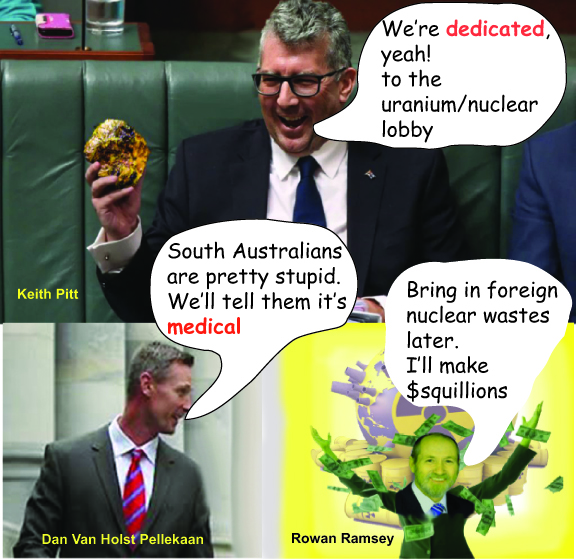
Questions on the ”independence” of Kimba District Council, and on their nuclear waste discussions with Minister Dan van Holst Pellekaan, and the Federal Government.

While I have not seen the details of the Supreme Court decision referred to below it should be a great boost for Kimba and of serious implications for the state and federal governments’
It is obvious that the South Australian government will have to publicly disclose all documents and information given or received by it which should presumably include all transactions with the federal government in its various guises
The disclosures will also include the Kimba District Council which will put its councillors in an invidious position in trying to give the Kimba community impartial and independent advice while at the same time trying to justify its past actions with regard to the federal government’s proposals for the nuclear waste management facility at Kimba
This untenable situation for the Kimba councillors may require them to stand aside while commissioners or administrators are appointed to run the Council
Senator Rex Patrick should be resoundingly thanked and congratulated on his efforts in bringing this action in the face of dire threats by Minister Dan van Holst Pellekaan
South Australian Supreme Court rules that information on the Kimba nuclear waste dump can be made public.
Senator Rex Patrick · SA GOVERNMENT TRANSPARENCY FAILURE, 18 May 21,
Yesterday the South Australian Civil and Administrative Tribunal overturned a decision by SA Energy and Mining Minister Dan van Holst Pellekann to keep information on the National Radioactive Waste Management Facility (NRWMF) from the public. In August last year I made a Freedom of Information request to the Minister asking for access to correspondance between the SA and Federal Government relating to the establishment of a NRWMF facility at Kimba. In November he released four documents to me, with significant redaction on one of them.
When I challenged the redaction the Minister threatened me with legal costs. Yesterday Justice Hughes rejected the Minister’s arguments and found that the document he wished to keep secret was not exempt under FOI.People have a right to know what their Government is saying and doing so that they can properly participate in democracy. This is especially the case when there is a major issue being played out. Minister van Holst Pellekaan needs to rethink who he really owes a duty to. Ministers should serve the people, not their own narrow political interests. https://www.facebook.com/senator.rex.patrick/posts/924739811419769
Federal Government’s budget details indicate increased nuclear waste storage at ANSTO, Lucas Heights, rather than a rush for a nuclear waste dump at Kimba South Australia.

The recent Budget sent mixed messages on this significant issue, both funding the current deeply flawed approach while also holding the possibility of a more considered pathway.
The budget allocations for radwaste were interesting: $100 million to advance Kimba (not good) but also $60 mill for increased interim ILW storage capacity at ANSTO
Like radioactive waste, the Coalition’s waste dump plan will not die https://independentaustralia.net/politics/politics-display/like-radioactive-waste-the-coalitions-waste-dump-plan-will-not-die,15096 By Dave Sweeney | 18 May 2021,
Like the waste itself, a dubious Coalition plan to temporarily dump nuclear waste for a future government to re-locate, 100 years later, at another undecided location is long-lived and toxic, writes Dave Sweeney.
IN THE RECENT Federal Budget, as with much in life, the devil is in the detail.
One public policy area that received a bucket of cash but not a lot of comment is the Government’s approach to Australia’s radioactive waste. Like the waste itself, the political positioning around this issue has been both long-lived and toxic.
Since the mid-1990s, with varying degrees of enthusiasm, successive federal governments have sought to advance one management approach: regional or remote co-location. This involves centralising the bulk of Australia’s radioactive waste in two adjacent facilities at the one location.
One site is for the internment and disposal of low-level waste. This material, which needs to be isolated from people and the wider environment for up to 300 years, would forever remain at the site.
The neighbouring site would hold intermediate-level waste, which needs to be isolated for up to 10,000 years, in extended above ground storage in a purpose-built shed.
The plan is that a future federal government, sometime in the next 100 years, would re-locate this material for deep burial at another currently undecided location via an undisclosed and unfunded process.
Critics of this Federal waste plan see this as a short-term political fix rather than a credible approach to managing inter-generational industrial waste. They are calling for a policy recalibration away from the push to find a compliant or vulnerable postcode and towards a rigorous, transparent, and evidence-based process to identify the least bad management option.
Nothing about the nuclear industry, especially nuclear waste, is clean or uncomplicated.
The recent Budget sent mixed messages on this significant issue, both funding the current deeply flawed approach while also holding the possibility of a more considered pathway.
The Morrison Government remains intent (Budget Papers p138) on advancing a contested plan to locate the twinned national radioactive waste facility near Kimba, a small rural town at the top of South Australia’s Eyre Peninsula.
The issue is deeply divisive with strong local supporters who see the facility as an economic lifeline and fierce critics who see the plan as a threat to the region’s primary economic driver — high-quality cereal cropping.
The local Native Title holders, the Barngarla people, have been actively excluded from participation in Federal mechanisms to measure community sentiment and are also vigorously opposed, as are growing stakeholder voices across the region and the nation.
The Barngarla have previously taken legal action against the Kimba site selection and, in a move to shut the door on any further legal contest, Resources Minister Keith Pitt has been spruiking an amendment to the Federal radioactive waste laws to remove key stakeholders right to judicial review.
Fortunately, this heavy-handed piece of legal corner-cutting remains blocked in the Senate. To their considerable credit, the Greens, Labor and most crossbenchers are not supportive of denying Australians a day in court to challenge a controversial project with inter-generational impacts.
Despite this stalemate, the 2021 Budget saw around $100 million dollars allocated to maintain momentum on a waste plan that lacks support, evidence or meaningful public health or radiological protection rationale.
Interestingly, though, the Budget also contained an allocation that may provide a much-needed circuit breaker.
A separate allocation of $60 million was made ‘to support the interim storage of intermediate level solid radioactive waste’ at the Australian Nuclear Science and Technology Organisation’s nuclear facility at Lucas Heights in southern Sydney.
The majority of Australia’s radioactive waste – and around 95% of the most problematic intermediate-level waste – was both produced and is currently stored at the Australian Nuclear Science and Technology Organisation (ANSTO).
Critics of the Kimba plan maintain that ANSTO is currently the best place to store Australia’s worst waste and that extended interim storage of Australia’s intermediate-level waste at Lucas Heights, coupled with a transparent review of future management options is the most prudent and credible approach.
Not only is the waste already there but ANSTO has certainty of tenure, a secure perimeter, is monitored 24/7 by Australian Federal Police and the waste will be actively managed as ANSTO’s operations are licensed for a further three decades.
Importantly, this approach keeps waste management on the radar of the agency with the highest level of nuclear expertise and radiation monitoring and emergency response capacity in Australia, and helps reduce the negative impacts of a highly politicised decision-making process like we are seeing with Kimba.
After community opposition and Federal Court action ended an earlier proposed waste site at Muckaty Station in the Northern Territory, ANSTO constructed and commissioned a new purpose-built store dedicated to housing reprocessed, spent nuclear fuel waste, which returned from France in late 2015.
This interim waste store has a conservative design life of 40 years, its license is not time-limited and it has (if required) regulatory approval to store these reprocessed wastes until the availability of a final disposal option.
Storage at ANSTO has been previously identified as a credible and feasible option by ANSTO and nuclear industry lobby group, the Australian Nuclear Association.
Most importantly, the CEO of the Federal nuclear regulator, the Australian Radiation and Nuclear Safety Agency (ARPANSA), confirmed to a Senate Inquiry in June 2020 that intermediate-level ‘waste can be safely stored at Lucas Heights for decades to come’.
Builders have a maxim: measure twice, cut once. This sensible approach should also inform Australia’s approach to radioactive waste management, especially in relation to the unnecessary double handling of intermediate-level wastes.
Nothing about the nuclear industry, especially nuclear waste, is clean or uncomplicated.
However, extended interim Federal storage – coupled with a comprehensive public review of the full range of longer-term management options – is the approach that is most likely to advance and realise lasting and responsible radioactive waste management in Australia.
Such an approach would help turn this political football into a worthy goal.
It’s not acceptable to ignore Aboriginal land owners, in order to impose high level nuclear waste on their land.
Kim Mavromatis,No nuclear waste dump anywhere in South Australia, 18 May 21, In 2020 it’s not acceptable to completely ignore the traditional owners of country and not acceptable to deliberately remove Independent Scrutiny or Rights of Appeal from the Legislation process. But these bullies don’t care what South Australia thinks.
The world classifies Spent Nuclear Fuel (10,000 times more radioactive than uranium ore) and Nuclear Waste from reprocessed SNF (still contains 95% of the radioactivity of SNF) as High Level Nuclear Waste but Aust and ANSTO classify it as Intermediate level – and that’s what the Fed Govt want to dump on SA farmland. https://www.facebook.com/groups/1314655315214929
Rolls Royce plans fleets of small nuclear reactors. At approx £2billion per reactor (that’s approx $2.8billion) how much will each fleet cost?

Rolls-Royce expects the first five reactors to cost £2.2bn each, falling to £1.8bn for subsequent units.
SMRs could not achieve economies of scale unless developers secured a large number of orders. “How are you going to get orders for 16 of an unproven reactor type and if you don’t have orders for 16 how are you going to build a factory?”

Rolls-Royce courts investors for mini nuclear plants, Consortium led by engine group seeks £300m in funding as it prepares application for small modular reactors, Nathalie Thomas in Edinburgh and Sylvia Pfeifer in London Ft.com, 17 May 21,
A consortium led by Rolls-Royce that is hoping to build a fleet of mini nuclear power stations across Britain is talking to investors to secure £300m in funding as it prepares to submit its design to regulators later this year. The consortium, which also includes Jacobs and Laing O’Rourke, hopes to be the first “small modular reactor” developer to put its design through the UK’s rigorous nuclear regulatory assessment. The process is expected to take up to four years but would keep the companies on track to complete their first 470MW plant by the early 2030s, which would be capable of generating enough low-carbon electricity for about 1m homes.
UK prime minister Boris Johnson backed SMRs as part of his 10-point plan for a “green industrial revolution” last year. The technology is viewed within the government as a good way to create manufacturing jobs as well as delivering on Johnson’s “levelling up” agenda. Rolls-Royce believes at least 16 SMRs could be installed at existing and former nuclear sites in Britain and more could potentially be built at locations such as former coal mines. It estimates the programme could create as many as 40,000 jobs in the UK regions by 2050.
Environmental groups say the technology is unproved and point out that nuclear energy leaves behind a legacy of waste, the most toxic of which takes at least 100,000 years to decay The prime minister has promised £215m in public funds, which the consortium hopes will help it secure the £300m in private match funding needed for the project to progress.
Rolls-Royce, which has been working on SMRs since 2015, expects the first five reactors to cost £2.2bn each, falling to £1.8bn for subsequent units.
It has argued that its design, which uses pressurised water reactors similar to existing nuclear power stations and boasts an increased generation capacity from 440MW previously, is more commercially viable and lower-risk than rival plans. The company has also claimed it could compete with renewable technologies such as offshore wind. Tom Samson, chief executive of the Rolls-Royce-led consortium, said “the way we manufacture and assemble our power station brings down its cost to be comparable with offshore wind at around £50/MWh”.
But Tom Burke, chair of climate change think-tank E3G, argued that SMRs could not achieve economies of scale unless developers secured a large number of orders. “How are you going to get orders for 16 of an unproven reactor type and if you don’t have orders for 16 how are you going to build a factory?” If sufficient private funding is secured, the consortium intends to set up a special purpose vehicle this summer in which Rolls-Royce is expected to retain a significant interest. The programme could give Rolls-Royce an important new revenue stream as it looks to reduce its exposure to the commercial aerospace sector, which has been severely dented by the coronavirus pandemic.https://www.ft.com/content/11ba5955-2f75-4eb5-b3e9-73f74684eb10
1 This month.

PETITION – To: Prime Minister Anthony Albanese and the Australian Labor Government
Chernobyl: The Lost Tapes – A good documentary on Chernobyl on SBS available On Demand for the next 3 weeks– https://www.sbs.com.au/ondemand/tv-program/chernobyl-the-lost-tapes/235274195556

19 May – Webinar- Webinar: No Nuclear Weapons in Australia
Start: 2026-05-19 18:00:00 UTC Canberra, Melbourne, Sydney (GMT+10:00)
End: 2026-05-19 19:30:00 UTC Canberra, Melbourne, Sydney (GMT+10:00)
20 May – Webinar – The dangerous world of AUKUS, US, military occupation and suppression of dissent

National Webinar, 20th May, 2026, 6.30pm AEST. Confronting laws restricting/suppressing protest speech and action
Speakers: Former Sen. Rex Patrick, Lawyer Nick Hanna ,Arthur Rorris ,Jorgen Doyle, Sen David Shoebbridge,
Facilitator Kelley Tranter.

of the week – Australians for War Powers Reform (AWPR)
To see nuclear-related stories in greater depth and intensity
 Antinuclear