The time to divest from Bitcoin is now

The time to divest from Bitcoin is now, Independent Australia, By John Quiggin | 29 May 2021 The rising price of cryptocurrencies is resulting in higher demands for electricity in order to produce them, writes Professor John Quiggin.
TWO RECENT DEVELOPMENTS in financial markets have big and directly opposed implications for the future of the global climate. On the one hand, financial institutions of all kinds are divesting from carbon-based fuels. On the other hand, they are increasingly embracing one of the most pointless and destructive trends of recent times — cryptocurrencies such as Bitcoin.
Let’s start with the good news. Not so long ago, divestment from coal mines and coal-fired power stations appeared a symbolic moral gesture, undertaken by socially-minded investors who were willing to narrow their investment options rather than profit from environmental destruction. As it turned out, the socially-minded investors did well, while the hardheads who kept coal miners and oil companies in their portfolios lost badly.
Jumping forward to the present, divestment has become the norm, though the process has typically been made in a series of baby steps. At this point, nearly all financial institutions in developed market economies have limited their exposure to coal and indicated a strategy to end any association with thermal coal, used in power generation. (Alternatives to metallurgical coal, used in steelmaking, are in an early stage of development, unlike solar and wind electricity generation)………………….
The progress being made on divestment from coal contrasts sharply with the eager embrace of Bitcoin and other cryptocurrencies. Although they were once supposed to replace existing currencies as a medium of exchange, cryptocurrencies are now used only as a speculative asset and as a way of conducting illegal transactions like ransomware payments.
The “proof of work” process by which Bitcoins and other cryptocurrencies are generated depends on “miners” competing to solve increasingly elaborate, but pointless, mathematical problems using specially designed computers and lots of electricity. The higher the price of Bitcoins, the more electricity it is worth burning to generate them.
Calculations a few years ago suggested that the electricity used in Bitcoin mining was comparable to the total demand of a small country like New Zealand. But as the price has risen, so has the demand on electricity resources, to the point where abandoned coal-fired power stations are being reopened. Even when Bitcoin is mined using renewable electricity, that electricity is diverted from other uses, which must then rely on coal-fired or gas-fired electricity.
As concerns have risen about the environmental damage caused by cryptocurrencies, attempts have been made to find “green” ways of producing them. Past efforts of this kind have failed, but perhaps these will succeed. However, we don’t have time to wait and see. Financial institutions need to divest from cryptocurrencies and financial regulators need to shut them down. When and if an environmentally safe version emerges, we can take another look.
John Quiggin is Professor of Economics at the University of Queensland. His new book, The Economic Consequences of the Pandemic, will be published by Yale University Press in late 2021…………… https://independentaustralia.net/politics/politics-display/the-time-to-divest-from-bitcoin-is-now,15137
A People’s Guide to the War Industry, by Christian Sorensen — Rise Up Times

“The main role of the federal government under capitalism is to maintain the capitalist economic system and set the general conditions by which large corporations and billionaires are able to accrue more and more profit.”
A People’s Guide to the War Industry, by Christian Sorensen — Rise Up Times
How the American war industry infiltrates education

A People’s Guide to the War Industry -2: Profits & Deception Consortium News 26 May 21, ”…………..Academia
Education in the United States exists within narrow confines. The working class educated in elementary and secondary schools are not given the opportunity to learn about capitalism, let alone the horrific nature and devastating effects of the U.S. war industry. They are not taught about how the interests of the ruling class (including the Pentagon’s leadership, industry executives, Wall Street financiers, and Congress) clash head-on with the interests of the working class. An uneducated population will not mobilize effectively against its oppressors. This atmosphere of ignorance greatly benefits the MIC.
The war industry and the Pentagon fund extensive science, technology, engineering, and math (STEM) initiatives across the U.S. and in allied countries. By attracting students into STEM careers, the war industry and the Pentagon prepare and safeguard their future. Industry promotion of STEM lays the groundwork for future design, engineering, and production capacity, while the Pentagon promotes STEM in order to foster a technologically literate workforce and future generations of enlisted troops who are capable enough to operate the war industry’s products. STEM efforts are comprehensive, covering a wide geographical area and all ages, from elementary through university.
Many universities in the United States are part of the U.S. war industry. The role of these academic institutions is threefold: research and develop technology, serve as a holding station (e.g. Harvard’s Belfer Center) for MIC elites before they rotate into government or corporate suites, and accept philanthropy from war profiteers thereby whitewashing capitalist brutality. The main academic participants in the war industry include but are not limited to the Massachusetts Institute of Technology (MIT), Johns Hopkins University, Stanford University, the University of Dayton, and Georgia Tech.
The U.S. government runs many research labs pursuing military and intelligence R&D. The Army Research Lab and the Intelligence Advanced Research Projects Activity are located in Maryland. The Defense Advanced Research Projects Agency (DARPA) and the Office of Naval Research are in Arlington, Virginia. The Air Force Research Lab is run out of Wright-Patterson Air Force Base, northeast of Dayton, Ohio, with branches in New Mexico and upstate New York. The U.S. Army Corps of Engineers’ Engineer Research & Development Center is in Vicksburg, Mississippi. Most work in and for these labs is carried out by corporations and academic institutions, not uniformed military personnel.
A report by the Government Accountability Office (GAO) issued in September 2020 detailed, “DOD does not know how contractors’ independent R&D projects fit into the department’s technology goals.”
“Brain drain” happens when industry herds intelligent people toward purposes of war, like when a graduate of an engineering school goes to work for a war corporation instead of a municipality. Humanity thus loses skilled human beings as a result. Brain drain is a great tragedy, and the war industry’s biggest success. In Boston, the U.S. Air Force alone funds ninety different research projects, according to the Air Force Secretary. And that’s just the publicly declared actions of one branch of the military in one city.
Lockheed Martin alone employs nearly 50,000 scientists and engineers, according to its CEO in her presentation to the Society of Women Engineers. Imagine if these minds were working on problems and projects for the betterment of humanity and the planet, instead of devising more ingenious ways to surveil or murder. Imagine the possibilities.
Effective science is based on free, open discussion. Military funding and stipulations (compartmentation, shoehorned focus, classification, near-term deadlines, stove-piped fields) oppose free, open discussion. Breakthroughs benefitting humanity rarely happen when people are tied to military-industry funding priorities, schedules, and narrow cognitive confines. Military and industry shun and condemn the polymath, the free thinker, and the uninhibited tinkerer. Military and industry embrace and fund the careerist, the complicit academic, the rigid functionary, the greedy corporatist, and the aspiring bureaucrat. Military-industry science may possess strong minds, but it does not often make the scientific breakthroughs society needs…… https://consortiumnews.com/2021/05/26/a-peoples-guide-to-the-war-industry-2-profits-deception/
Opposition grows to small nuclear reactors over alarming risks
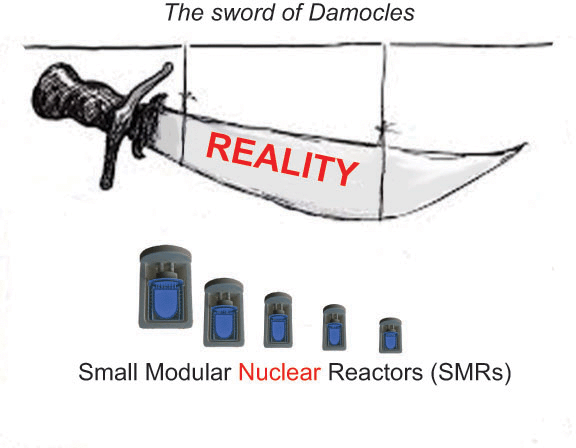
The breadth of opposition is enormous. In a massive display of solidarity in November, some 100 environmental groups signed a letter from the Canadian Environmental Law Association calling SMRs dirty and dangerous.
By Charles Mandel | News | National Observer, May 25th 2021 https://tinyurl.com/3zy8msrp
The federal government and the four provincial governments that back nuclear power as part of the solution to greenhouse gas emissions face widespread opposition to their plans.
Environmental groups, some 120 women in leadership positions and three political parties have raised objections to the continued use of and ongoing development of nuclear power in Canada over the past couple of years. And frustration over the continued push for nuclear has intensified in recent months.
Anger over the intent to position nuclear power as a viable renewable comes at a time when federal Natural Resources Minister Seamus O’Regan (under whose department falls the responsibility for nuclear power) has made bullish speeches endorsing its use.
While the governments tout nuclear as an integral part of any climate crisis solution, alongside solar, wind and other renewables, many environmentalists point out there is one intractable problem no one has been able to solve. Regardless of how small reactors become, they will still produce toxic waste, a deal-killer in many people’s eyes.
Critics also raise red flags over the possibility that the design of some SMRs will enable terrorists to more easily steal nuclear fuel for weapons. And they point out SMR technology is at least five years away and will land too late to address the growing climate crisis.
The breadth of opposition is enormous. In a massive display of solidarity in November, some 100 environmental groups signed a letter from the Canadian Environmental Law Association calling SMRs dirty and dangerous. Susan O’Donnell, an academic at the University of New Brunswick, is one of the more vocal protesters against the use of nuclear. She maintains Canada doesn’t have a solution to the long-term problem of radioactive waste from the CANDU reactors now operating, “and now we’ll be creating new kinds of waste that we won’t know what to do with either.”
“We should not be funding technologies until we figure out how to deal with all those environmental issues that they raise, and we’re so far from doing that.”
Moltex Energy Canada in New Brunswick is developing an SMR that will generate heat when nuclear fission takes place in tubes filled with molten salt fuel. O’Donnell says the process will create new toxic waste streams never dealt with in Canada before.
“We have no experience with it, and if you look at the peer-reviewed literature on this, they actually don’t even know what kinds of materials can contain these liquid waste streams. It’s going to be dirty, it’s going to be messy, and it’s right beside the Bay of Fundy, which is a big red flag for environmentalists.”
She also believes SMRs “are not worth the wait. They’re too slow and costly as a climate crisis solution, and that’s what they’re being touted as…”
SMR technology is still in its infancy; while the Liberal government has given nuclear manufacturers tens of millions of dollars, so far, SMRs remain in research and development with the first reactors expected to be built sometime between 2026 and 2030.
O’Donnell dismisses SMRs as a speculative technology, and contends that it will take at least a decade to get them off the drawing board — and even longer to find out if they actually work. “We don’t have that kind of time for the climate crisis,” she recently told Canada’s National Observer.
When it comes to protesting the ongoing development of the Canadian nuclear industry, O’Donnell is far from a lone voice in the wilderness. Since the Liberal government began seriously pushing nuclear in 2019, a number of disparate groups have pushed back equally hard.
In September, the Green Budget Coalition — made up of groups ranging from the David Suzuki Foundation to the Sierra Club Canada Foundation — stated uncertainties, questionable economics, and a previously unsuccessful track record in developing new nuclear technology should preclude federal support for SMRs.
The coalition points out that between 2002 and 2009, Atomic Energy of Canada Limited received $433.5 million in federal subsidies to develop the Advanced CANDU Reactor 25, but none were ever built. The coalition further cautioned “spending federal resources pursuing such an unproven technology during the climate emergency while the costs of renewables continue to fall and timelines for commercial SMRs continue to be pushed further into the future is imprudent.”
A group of roughly 120 women in leadership roles around Canada took out an open letter to the Treasury Board in the Hill Times in September. In no uncertain terms, they asked the government to stop funding for SMRs and concentrate on other forms of renewable energy.
“We urge you to say ‘no’ to the nuclear industry that is asking for billions of dollars in taxpayer funds to subsidize a dangerous, highly polluting and expensive technology that we don’t need. Instead, put more money into renewables, energy efficiency and energy conservation. This will create many thousands of jobs and quickly reduce greenhouse gas emissions.”
The law association letter noted some proposed reactors would extract plutonium from irradiated fuel, creating concerns over weapons proliferation and new forms of radioactive waste “that are especially dangerous to manage.”
More recently, in March, the Union of Concerned Scientists (UCS) in the U.S. issued a report titled ‘Advanced’ Isn’t Always Better by Edwin Lyman, the director of nuclear power safety in the UCS Climate and Energy Program. Among the concerns its author raised was that molten salt reactors — the same type of SMR that Moltex in New Brunswick is working on — create unique challenges for nuclear security because of difficulties accounting for the nuclear material accurately as the liquid fuel flows through the reactor.
Lyman cautions some designs with on-site, continuously operating fuel-reprocessing plants could “provide additional pathways for diverting or stealing nuclear-weapon-usable materials.”
At various points, the federal NDP, the Green Party and the Bloc Québécois have all also expressed opposition to funding SMRs. Elizabeth May, the former Green Party leader, previously said, “Renewables are far cheaper than nuclear without the toxic waste. Exploring an untried reactor is just another way of delaying climate action.”
In an email to Canada’s National Observer, the Department of National Resources says that it is carrying out a review, expected to be completed by the fall, to develop a new policy for radioactive waste management. The policy will cover both existing waste, and future waste, including that from “emerging new and innovative nuclear technologies, such as SMRs.”
The department also notes Canada remains committed to the Treaty on the Non-Proliferation of Nuclear Weapons, “including the full implementation of safeguards sent by the International Atomic Energy Agency.”
Back in New Brunswick, O’Donnell expresses frustration that the MOU the four provinces signed with the federal government binds the parties to promoting the economic and environmental benefits of nuclear. The MOU also expressly says part of its mandate is to “work co-operatively to positively influence the federal government to provide a clear, unambiguous statement that nuclear energy is a clean technology and is required as part of the climate change solution.”
O’Donnell calls that sales job indefensible given the governments are leaving it up to volunteer advocates to share information about alternatives such as solar and wind. “But instead, we just get silence or this barrage of nuclear sales material, and that’s really the frustrating thing.”
What blackout? Home batteries power through Queensland coal plant calamity — RenewEconomy

While debate builds around whether big batteries could have saved the day in Queensland on Tuesday, the benefits of having a home battery during a coal plant explosion are obvious. The post What blackout? Home batteries power through Queensland coal plant calamity appeared first on RenewEconomy.
What blackout? Home batteries power through Queensland coal plant calamity — RenewEconomy
An Online Course on War and The Environment: Spreading Knowledge Builds Power — limitless life

An Online Course on War and The Environment: Spreading Knowledge Builds Power By David Swanson, World BEYOND War, May 26, 2021 https://worldbeyondwar.org/an-online-course-on-war-and-the-environment-spreading-knowledge-builds-power/ Here’s a video from one of the facilitators lined up for World BEYOND War’s online course on War and the Environment which begins on June 7th, 2021: https://youtu.be/ialEfgofNGQ This course could not be more important. […]
An Online Course on War and The Environment: Spreading Knowledge Builds Power — limitless life
May 28 Energy News — geoharvey

Opinion: ¶ “Electric Vehicle Tax Credit Bill From US Senate Finance Committee Looks Great” • Let’s look at how the bill that has moved through the US Senate Finance Committee. It extends the tax credit until 50% of vehicles are electric. It opens the tax credit up so people who owe little or nothing can […]
May 28 Energy News — geoharvey
New research highlights need for international standards to safeguard against plutonium ”hot” particles.
New study delves into issues relating to soils around Maralinga region, https://www.portlincolntimes.com.au/story/7262167/study-shows-radioactive-particles-from-nuclear-testing-persist-at-maralinga, Luca Cetta,
A new study has highlighted the first international standards needed to safeguard against contamination from nuclear testing, and a Kokatha Elder says the impact of nuclear testing at Maralinga cannot be forgotten.
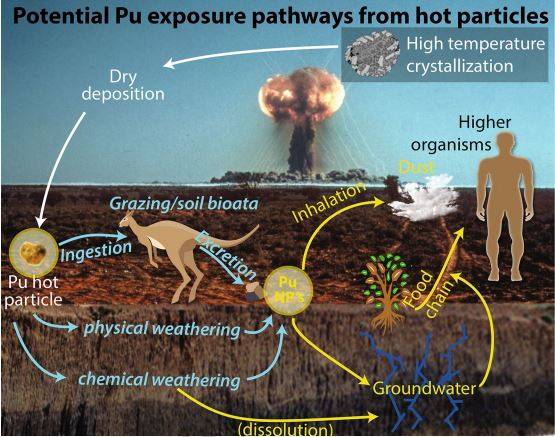
More than 100 kilograms of highly toxic uranium and plutonium was dispersed in the form of tiny ‘hot’ radioactive particles after nuclear tests were conducted by the British in remote areas of South Australia, including Maralinga.
Scientists have new evidence these radioactive particles persist in soils to this day, more than 60 years after the detonations.
The British detonated nine nuclear bombs and conducted nuclear tests in South Australia between 1953 and 1963.
There had previously been limited understanding in how plutonium was released from the particles into the environment for uptake by wildlife around Maralinga.
The new study, published in Nature’s Scientific Reports, led by Monash University researchers, warns the hot particles are more complex and varied than previously thought.
Currently, there are no international best practice standards for the environmental impact or risk assessment of plutonium and uranium-rich hot particles released during nuclear testing.
This study provides the first mechanism for future modelling to predict the environmental life cycle of plutonium from hot particles, including how they are slowly broken down in the environment over a long period, and potentially exposed to animals and humans through inhalation, soil or ground water.
“The resulting radioactive contamination and cover-up continues to haunt us,” lead study author from Monash University’s School of Earth, Atmosphere and Environment Dr Megan Cook said.
“The results of our study profoundly changes our understanding of the nature of hot particles at Maralinga – despite the fact that those were some of the best studied particles anywhere in the world.”
Sue Haseldine, who grew up in the Koonibba district in the 1950s and 1960s, has long campaigned against nuclear testing and weapons.
She has been part of the International Campaign to Abolish Nuclear Weapons (ICAN), an organisation awarded the Nobel Peace Prize in 2017, and has spoken about her experience growing up in the shadow of nuclear testing at Maralinga.
Ms Haseldine said the people in the area had long-suspected there were health issues deriving from those tests.
“Experts would tell you that radiation will not last for 60 years, nor 60,000, but for a long, long time, and it is still causing troubles today,” she said.
“The old ladies told me these cancers and illnesses were not around before the bomb and over the years I have seen the rates go up.
“There are a lot more younger people with heart problems – it is known that radiation problems can cause heart diseases – and it is coming down through the generations.”
Ms Haseldine said the testing and fallout from Maralinga was not spoken about enough and that was why her campaigning with ICAN was so important.
“It is important to let people know what the government’s legacy is to us through their testing and we have to keep the past alive to protect the future, so they don’t do it to future generations,” she said.
“I grew up in the Koonibba district, but the radiation didn’t just stay in the Maralinga area.”
Study co-author professor Joël Brugger said the study invited a revisit of the implications of earlier results for the fate of plutonium at Maralinga.
“Understanding the fate of hot particles in the arid environment setting of the Australian outback is critical for securing Australia in case of nuclear incidents in the region, and returning all the native land affected by the British tests to the traditional Anangu owners of the Maralinga Tjarutja lands.”
The research team used synchrotron radiation at the Diamond Light Source near Oxford in the United Kingdom to decipher the physical and chemical make-up of the particles.
At Monash, they dissected some of the hot particles using a nano-sized ion beam, and further characterised the complex make-up of these particles down to the nano-size.
“It’s a major breakthrough,” study co-author associate professor Vanessa Wong said.
“Our observations of the hot particles from Maralinga provide a clear explanation for the complex and variable behaviour of different hot particles with respect to the chemical and physical weathering that has hindered predictive modelling to this day.
“This study provides a mechanistic foundation for predicting the future evolution of hot particles from high-temperature nuclear events and the likely exposure pathways.”
The researchers demonstrated the complexity of the hot particles arose from the cooling of polymetallic melts from thousands of degrees Celsius in the explosion cloud during their formation.
“We found that the particles contained low-valence plutonium-uranium-carbon compounds that are typically highly reactive – which is unexpected for particles that survived for over 30 years in the environment,” corresponding author Dr Barbara Etschmann said.
U.S. Energy Information reports uranium at lowest price since 2007

Uranium Week: Struggling With Low Prices
FN Arena Weekly Reports By Mark Woodruff May 25 2021, As the uranium spot price rose 2% for the week and 9% for the month, an EIA report revealed the lowest price paid since 2007 by owners and operators of US commercial nuclear plants
The US Energy Information Administration (EIA) released both its 2020 US Uranium Marketing Annual Report and its 2020 Domestic Uranium Production Report last week.
Despite covid roiling energy markets during 2020, the reports pointed to nuclear energy being a fundamental source of base load electricity generation (20%) with capacity factors steady at 94%, explains Canaccord Genuity. The broker believes coverage of future demand will continue to provide an impetus for a more active term market over 2021.
The EIA is responsible for collecting, analysing and disseminating energy information to inform policy making and efficient markets. It also adds to the public understanding of energy and its interaction with the economy and the environment.
The released reports in 2020 quantify developments in the US uranium industry, including decreased inventories, explains industry consultant TradeTech. They also showed an elevated aggregated contractual coverage rate among owners and operators of US civilian nuclear power reactors. Additionally, lower weighted average uranium prices and historically low uranium production were reported.
The Uranium Marketing Annual Report showed owners and operators of US commercial nuclear plants in 2020 purchased nearly 49mlbs uranium from US and foreign suppliers. These were transacted at a weighted-average price of US$33.27/lb, which represents a 1% increase in volume and a -7% decline in price compared to 2019 data. The weighted average price is the lowest price paid by owners and operators of US civilian power reactors since 2007.
Of the US deliveries, 76% were through longer-term contracts, averaging US$34.74/lb. As Canaccord notes, it’s always darkest before the dawn, with pricing failing to represent the marginal cost of production let alone the incentivisation price for restarts or new developments.
During 2020, 11.7mlbs or 24% of sales were on a spot basis, up from 10.5mlbs in 2019 and the highest since 2014. This illustrates that long-term contracts signed post-Fukushima (2011-2015) are starting to expire, explains Canaccord.
The report showed Australian and Canadian-origin uranium combined accounted for 42% of reported volumes by country of origin. Uranium purchased by owners and operators of US civilian power reactors from Russia again was the lowest weighted average price paid at US$25.73/lb, while purchases from Australia occupied the highest cost position at US$39.86/lb.;;;;;;;;;;;;;; https://www.fnarena.com/index.php/2021/05/25/uranium-week-struggling-with-low-prices/
Radioactive particles still endanger wildlife in the landscape around Maralinga.
Daily Mail 25th May 2021, Soil in Australian outback could STILL be leaking plutonium 65 years after
British nuclear tests. Almost 60 years after nuclear tests in the Australian outback, radioactive particles still pose a risk to wildlife and residents, according to new report. In the mid-1950s, Great Britain tested nuclear weapons at Maralinga, a remote area about 500 miles northwest of Adelaide. Radioactive waste dotted the landscape for decades and the
Australian government has spent millions on cleanup.
Australian company Greenland Minerals fails community test over controversial rare earths and uranium mine plan
Greenland Minerals fails community test over controversial rare earths and uranium mine plan, https://www.acf.org.au/greenland-minerals-fails-community-test 27 May 21, It is a long way from Greenland to Western Australia, but concerns from the Narsaq community in Greenland about a controversial mining project will be raised at today’s annual meeting of Perth-based company Greenland Minerals, listed on the ASX as GGG, which is behind the Kvanefjeld rare earths and uranium mine.
Opposition to the planned mine dominated Greenland’s recent national elections. On 6 April Greenlanders elected the Inuit Ataqatigiit (Community for the People) party, which campaigned on an explicit platform opposing Kvanefjeld.
The new coalition government has committed to stop the mine going ahead.
“When a mine proposal triggers an election and the results show a clear rejection of the project, it is time for the company to accept the community’s will and end its mining plans,” said Mineral Policy Institute board member Dr Lian Sinclair, who will attend the GGG meeting.
Australian groups are calling on GGG to recognise that it has failed to secure social license for the Kvanefjeld project.
“We need a different approach to mining, one based on free, prior and informed consent,” said Australian Conservation Foundation nuclear free campaigner Dave Sweeney.
“Mining materials that are used in renewable energy does necessarily make a company ethical or responsible.
“There are dangerous radioactive elements within these deposits, including uranium, that pose long term environmental and health risks.
“These risks should not be imposed on an unwilling community.
“The Narsaq and wider Greenland community and the new Government have rejected this project. GGG should recognise and respect this clear and democratic decision”.
For USA, health care is too costly, while weapons makers wildly profitable -as $634 Billion to go to nuclear arms

The US Will Spend on Nuclear Weapons in the Next Decade, https://jacobinmag.com/2021/05/military-spending-nuclear-weapons-department-of-defense
BY JULIA ROCK, 26 May 21, According to a new Congressional Budget Office report, we’re set to spend well over a half a trillion dollars over the next decade on nuclear weapons. Yet we’re somehow told that Medicare for All is too expensive.
As Capitol Hill lawmakers continue to insist that initiatives like Medicare for All are too expensive, a new congressional report shows that the United States government is on a path to spend more than a half-trillion dollars on nuclear weapons in just the next decade. The report emerges at the same time a separate analysis shows that a handful of top executives at defense contractors are being wildly enriched by a Pentagon spending spree.
The first report from the Congressional Budget Office (CBO) finds that the federal government is on track to spend $634 billion over the next decade to maintain its nuclear forces. Almost two-thirds of those costs are for the Department of Defense, mostly to maintain ballistic missile submarines and intercontinental ballistic missiles. About one-third is for the Department of Energy.
For comparison that is:
- 1.5 times the cost of all of the $1,400 stimulus checks that were sent to people through the American Rescue Plan earlier this year.
- Nearly fourteen times the $47 billion that Congress has spent so far this year helping Americans who are behind on rent.
- Over one-third of the cost of cancelling the $1.7 trillion in student debt held by Americans, most of which is never going to be repaid.
- More than seven times the estimated $81 billion of outstanding medical debt in America, as of 2018.
The new CBO estimate represents a 28 percent increase over the last ten-year estimate that the CBO made on US nuclear forces two years ago.
The figures were released just a few weeks after a new analysis from the Center for International Policy, a foreign policy think tank in Washington, found that “In 2020 alone, the CEOs of the [Pentagon’s] top five contractors received a total of $105.4 million in compensation.”
When accounting for all top corporate officials, these firms paid out more than a quarter billion dollars of total executive compensation in 2020 — and paid out more than $1 billion over the last four years.
About half of the Pentagon’s budget goes directly to corporations such as Lockheed Martin and General Dynamics, according to the report.
So far, the deficit scolds who wanted to narrow eligibility for stimulus checks, student debt cancellation, or rent relief haven’t complained about the spending.
American experts warn Trudeau that small nuclear reactors are likely to prove a nightmare for Canada

The critics contend that SMRs are costly, unproven and creators of toxic waste of their own. From a practical point of view, it is hard to make the case that SMRs will be crucial in the battle against climate change, since they won’t come off the drawing board for years, if ever. Former Green Party leader Elizabeth May says that opting for experimental SMRs is just another way of delaying real action on global warming.
US Experts to Trudeau: Your Nuclear Dream May Turn Nightmare https://thetyee.ca/Analysis/2021/05/26/US-Experts-Trudeau-Your-Nuclear-Dream-May-Turn-Nightmare/?utm_source=daily&utm_medium=email&utm_campaign=260521
Rethink backing the Moltex reactor, urge nine non-proliferation heavyweights.
Michael Harris TheTyee.ca, 6 May 21, A blue-ribbon group of American nuclear non-proliferation experts warns that Canada’s investment in new nuclear technology could lead to the spread of nuclear weapons and new threats to the environment.
“We write as U.S. non-proliferation experts and former government officials and advisors with related responsibilities to express our concern about your government’s financial support of Moltex — a startup company that proposes to reprocess CANDU spent fuel to recover its contained plutonium for use in molten-salt-cooled reactors.”
The warning came in the form of an open letter to Prime Minister Justin Trudeau that was delivered on Tuesday and signed by the nine experts.
The group is spearheaded by Frank von Hippel, professor and senior research physicist at Princeton University; it includes Matthew Bunn, the Schlesinger professor of the practise of energy, national security, and foreign policy at the Harvard Kennedy School; and Thomas Countryman, former U.S. assistant secretary of state for non-proliferation.
“We understand your government’s motivation to support nuclear power and to reduce fossil fuel use but saving the world from climate disaster need not be in conflict with saving it from nuclear weapons. Also, like other reprocessing efforts, Moltex, even in the R&D stage, would create a costly legacy of contaminated facilities and radioactive waste streams, and require substantial additional government funding for cleanup and stabilization prior to disposal,” they wrote.
Rory O’Sullivan, CEO of Moltex North America painted a very different picture of his company’s experimental technology in an interview with World Nuclear News: “We are working to develop a technology that uses the fuel from the first generation of nuclear power to the next. This reduces the challenges associated with spent nuclear fuel, while expanding nuclear power to help Canada achieve its climate change objectives.”
The Trudeau government has invested $50.5 million in Moltex, and backs the company’s plan to build a 300 MW molten salt reactor in New Brunswick on the Bay of Fundy. Theoretically, it would then reprocess spent fuel from the Point Lepreau nuclear plant, which is set to be decommissioned in 2040.
The Moltex reactor belongs to a class of nuclear power plants termed small modular reactors or SMRs that generate small amounts of electricity in comparison with typical CANDU reactors.
Natural Resources Minister Seamus O’Regan has said that Canada can’t get to net-zero carbon emissions by 2050 without nuclear as part of the equation, along with renewables.
Despite marketing its roll of the dice on Moltex as part of its war on climate change, Ottawa isn’t getting much love from environmentalists, or many other people. Three federal political parties, the NDP, the Bloc and the Greens; the Green Budget Coalition; and the Canadian Environmental Law Association all oppose the federal investment in small modular reactors. University of British Columbia professor of public policy and global affairs M.V. Ramana has levelled criticisms in these pages as well.
The critics contend that SMRs are costly, unproven and creators of toxic waste of their own. From a practical point of view, it is hard to make the case that SMRs will be crucial in the battle against climate change, since they won’t come off the drawing board for years, if ever. Former Green Party leader Elizabeth May says that opting for experimental SMRs is just another way of delaying real action on global warming.
One who has closely followed and opposes the two experimental SMR reactors planned for New Brunswick, the ARC-100 and the Moltex SSR, is Dr. Susan O’Donnell, an adjunct professor of sociology at the University of New Brunswick. O’Donnell is also the primary investigator of Raven, a research team based at the university dedicated to highlighting rural environmental issues in the province.
O’Donnell points out that Moltex has never built a nuclear reactor before. In fact, only two molten salt reactors have ever been built — 50 years ago. Neither of them produced electricity. One of them lasted four years before shutting down, the other, just 100 hours.
On the environmental side, O’Donnell says that SMR pollution or a serious failure could lead to “disasters and no-go zones.”
On the non-proliferation front, she denounces the plan to broadly “export” the Moltex technology, assuming it ever gets up and running.
“What we have learned from Canada’s role in making India a nuclear power is that one of the dangers of the Moltex proposal is its plan to export the technology. We’re exporting bomb-making capacity,” she told The Tyee.
O’Donnell has pushed for public consultations to help develop a national radioactive waste policy. Last Aug. 13, she made an offer to the federal minister of natural resources to have the Raven project organize such a public consultation in New Brunswick. It would be online because of the pandemic, in both official languages, and would include Indigenous nations and rural communities. Minister O’Regan responded two months later, on Oct. 30, turning her down.
“Strangely, he cited the pandemic, even though our offer clearly stated the consultation would be virtual,” the professor said.
O’Donnell’s take on the Moltex project is backed up by Allison Macfarlane, former chair of the U.S. Nuclear Regulatory Commission. The specialist in the storage of nuclear waste told the CBC in January that the molten salt technology is totally unproven with respect to viability, costs and storage risks.
“Nobody knows what the numbers are, and anybody who gives you numbers is selling you a bridge to nowhere…. Nobody’s been able to answer my questions yet on what all those wastes are, and how much of them there are, and how heat-producing they are and what their compositions are,” Macfarlane said. She is now the director of the School of Public Policy and Global Affairs at UBC.
But the Trudeau government does have allies at the provincial level for its nuclear ambitions. The governments of New Brunswick, Ontario, Saskatchewan and Alberta have all signed a memorandum of understanding to develop SMRs, which means promoting them.
They are excited about the promises by Moltex that it will be able to produce clean energy at a low cost by recycling something that everyone wants to get rid of — the three million spent fuel bundles in Canada that the government still doesn’t know how to dispose of safely and permanently.
The U.S. experts made clear to the PM in their letter that they are not convinced by the company’s assertions. They want the Trudeau government to convene a high-level review of both the non-proliferation and environmental implications of Moltex’s reprocessing proposal. Key to that proposal is including “independent international experts,” before Ottawa makes any further investments in support of the Moltex proposal.
The earliest projects to reprocess nuclear waste extracted plutonium to make nuclear weapons. The letter signees worry Canada’s new generation of reactors will afford the same opportunity to anyone who buys them.
“Our main concern is that, by backing spent-fuel reprocessing and plutonium extraction, the government of Canada will undermine the global nuclear weapons non-proliferation regime that Canada has done so much to strengthen. Canada is a founding member of the Nuclear Suppliers Group, which was established in 1974 in response to India’s misuse of a Canada-supplied research reactor and U.S.-supplied reprocessing technology to acquire the plutonium needed for its first nuclear weapons.”
The reprocessing of nuclear waste was “indefinitely deferred” in the United States by president Jimmy Carter in 1977 after India tested its first nuclear weapon. At the time, the Americans discovered that several other countries including Brazil, Pakistan, South Korea and Taiwan were all surreptitiously headed down the same nuclear weapons path that India had taken. Of that group, only Pakistan managed to get the bomb.
The U.S. experts who signed the letter to Trudeau also rejected the claim by Moltex that by using spent fuel from older Canadian CANDU reactors, its reactor would reduce the long-term risk from a deep underground radioactive waste repository.
The Trudeau government promised it would base its major policies on science. It’s time for the public consultation, far from the greasy paws of lobbyists, and with the best minds that can be brought to the table.
This is a letter to take to heart.
Does your energy provider take climate change seriously? A new report reveals the answer — RenewEconomy

No Australian energy company has commitments that are in line with Australia achieving net-zero emissions by 2050. The post Does your energy provider take climate change seriously? A new report reveals the answer appeared first on RenewEconomy.
Does your energy provider take climate change seriously? A new report reveals the answer — RenewEconomy
Australia’s main grid reached new record wind output on Tuesday afternoon — RenewEconomy

As Queensland was battling coal plant explosions and emerging from widespread blackouts, the main grid set a new record wind output. The post Australia’s main grid reached new record wind output on Tuesday afternoon appeared first on RenewEconomy.
Australia’s main grid reached new record wind output on Tuesday afternoon — RenewEconomy
1 This month.

Australians deserve the truth
about
AUKUS – https://aukuspublicinquiry.com/



PETITION – To: Prime Minister Anthony Albanese and the Australian Labor Government

of the week – Australians for War Powers Reform (AWPR)
To see nuclear-related stories in greater depth and intensity
 Antinuclear