Nuclear power to be boosted in New South Wales – says News Corpse pulication, Daily Telegraph
Nuclear power to be boosted in NSW Daily Telegraph, 31 May 21,
There are plans to lift a ban on small reactors developing nuclear power in a new proposal being looked at by Treasurer Dominic Perrottet. …. (subscribers only)
As electric vehicles take off, we’ll need to recycle their batteries

As electric vehicles take off, we’ll need to recycle their batteries Electric car batteries contain critical minerals like cobalt and lithium. We’ll need to recycle them unless we want to keep mining the earth for new ones.As electric vehicles take off, we’ll need to recycle their batteries
Electric car batteries contain critical minerals like cobalt and lithium. We’ll need to recycle them unless we want to keep mining the earth for new ones. BY MADELEINE STONE, 29 May 21 , When Ford unveiled the F-150 Lightning last week — an all-electric version of the best- selling vehicle in the United States—it was a big moment in the short history of electric cars. The 530-horsepower, 6,500-pound truck’s sticker price of just under $40,000 ($32,474 with a federal tax credit) drew comparisons to Ford’s Model T, the vehicle credited with making cars accessible to the middle class. In the first 48 hours after the battery-powered behemoth debuted, Ford received close to 45,000 pre-orders for it, equivalent to nearly 20 percent of all EVs registered in the U.S. last year……… (subscribers only)
May 31 Energy News — geoharvey

Opinion: ¶ “Rental Efficiency Standards: A Win For Equity And Climate” • Rental buildings use, on average, 20% more energy per square foot than owner-occupied homes. Landlords have little incentive to improve home efficiency when they do not pay energy bills, and tenants have little incentive to invest in their homes. But the problem can […]
May 31 Energy News — geoharvey
Nuclear trash – a tale of two Sydney suburbs

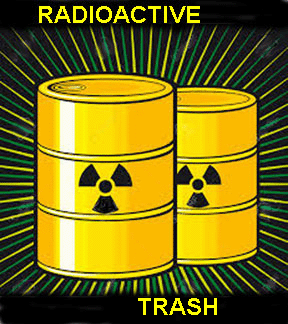
Radioactive trash – a tale of two Sydney suburbs, https://johnmenadue.com/radioactive-trash-a-tale-of-two-sydney-suburbs/ By Noel Wauchope, May 26, 2021
Australia is relatively clear of nuclear reprocessing waste problems. But the Sydney suburbs of Hunters Hill and Barden Ridge have radioactive wastes from uranium processing which have been sitting there for decades. A bill is now before the Senate addressing the issue.
Australia does have radioactive waste problems in the lingering concerns over historic atomic bomb test sites in South Australia., and in both the functioning and the closed uranium mines. But there is only one uranium-processing facility producing radioactive wastes, the Opal nuclear research reactor at Lucas Heights in Sydney.
Now, Federal and State governments are making decisions on the disposal of these wastes. But there is still uncertainty and lack of public information on just how [or whether] these decisions will be carried out. For example, there’s no detail on transport routes, dates etc.
There are significant differences between the situations of the two suburbs. Perhaps the most significant one is that at Barden Ridge, the nearby Opal nuclear research reactor will be continuing to produce nuclear wastes for the foreseeable future, whereas the Hunters Hill wastes are set for final and permanent removal. Hunters Hill residents have been worried about this for over a century. For Barden Ridge, it has been been recognised as a problem for a much shorter time.
2021 looks like being a watershed year for both.
Hunters Hill.
n 1911, radium was a valuable commodity, and was processed was processed at Hunters Hill, Some 2,000 tonnes of uranium ore were transported from Radium Hill in South Australia, to extract the radium. Several tonnes of uranium oxide were left, and also thorium 230, which itself decays to form more radium and is therefore dangerous for thousands of years. The project closed in 1915. From then on, it was a saga of mistakes and failed attempts to clean up this remaining debris. There was a tin smelter there until 1964.
Then the Australian Atomic Energy Commission (AAEC, now ANSTO) decided it was safe for housing. In the following years, residents and others became concerned about the uranium tailings spread over 6 housing blocks, in Nelson’s Parade, with the risk to health. They were met with cover-ups and obfuscation from the government. Health tests were kept secret, radiation hotspots were found, and cancers and deaths were claimed to be linked to this, and legal cases ensued.
Government plans to solve the problem included dumping the wastes at sea. This was resisted by environmentalists. The next plan was to dump it in Western NSW. This was strongly opposed by Aborigines from the area’s Bakandii tribe. When several Nelson Parade residents fell ill in the 1970s, the NSW government purchased several houses and demolished them, but failed to remediate the site.
in 1981 The then NSW Premier, Mr Wran asked South Australia to take 5,000 tonnes of contaminated soil. A NSW Upper House Inquiry in 2008 led to the government attempting to plan for the clean-up of 2,000 tonnes of radioactive waste. The Australian Radiation Protection and Nuclear Safety Agency said radioactive waste from Hunters Hill wasn’t permitted to be stored at ANSTO’s Lucas Heights interim waste storage facility.
In 2012, most of the contaminated earth was reclassified as ”restricted solid waste”. Two Sydney suburbs were mooted as destinations for the wastes – Kemps Creek and Lidcombe. This was resisted by the local residents. Then in 2019, the New South Wales government proposed to store the contaminated soil on site in an ”encapsulated” form. This was vigorously rejected by the Hunters Hill residents.
Now, in 2021, beginning in July, New South Wales Property and Housing Minister Melinda Pavey announced that the radioactive material will beexcavated and and be shipped to Idaho ,USA. The contaminated soil is to be sealed in bags, loaded into shipping containers and taken to a secure facility in the Eastern Sydney suburb of Matraville before shipping them overseas in scheduled consignments. ANSTO would oversee the process with up to 1800 tonnes to be transported to Idaho in an18-month-long mission.
Barden Ridge.
The radioactive waste problem of formerly Lucas Heights has a more recent history, with the original HIFAR nuclear research reactor starting operations in 1958. Lucas Heights was then a remote bushland site well outside the suburban area of Sydney. Nuclear development was meshed in secrecy, and controlled by influential experts Philip Baxter, and Ernest Titterton., without much understanding by the parliament or the public. It was the time of British atomic weapons tests in Australia, and heightened fears about the cold war. Little attention was paid to the subject of radioactive wastes.
In later years, as Sydney grew, Lucas Heights did become more of a suburb. And the Three Mile Island 1979 and Chernobyl 1986 nuclear accidents aroused a general awareness of nuclear risks. Radioactive wastes from Fisherman’s Bend in Victoria was brought to Lucas Heights in 1990. By now, public concern was raised. When Lucas Heights agreed to take the waste from St Mary’s Defence Base NSW (1991) the Sutherland Shire Council won a court case against ANSTO to stop Lucas Heights taking waste from other entities.
In 1992, local residents voted to rename the suburb of Lucas Heights, and in 1996 it officially became Barden Ridge. It is widely accepted that this was done to increase the real estate value of the area, as it would no longer be instantly associated with the HIFAR nuclear reactor.
Barden Ridge has a conservative community, historically voting Liberal, that accepts the reality of ANSTO and the now Opal nuclear reactor, with the jobs that come with it. Still, the presence of nuclear wastes is an issue. The Sutherland Shire Council in 2013 said that they liked having the nuclear reactor, but not the radioactive wastes. Local people and Council were relieved to learn, in 1997, of the federal government’s plan to set up a waste facility in another State. Sutherland Shire Council rejoiced in 2014, when the federal government announced plans for a nuclear waste facility in the Northern Territory.
Which brings us to the Australian Government’s Bill about radioactive waste, now before the Australian Senate, the National Radioactive Waste Management Amendment (Site Specification, Community Fund and Other Measures) Bill 2020. This Bill specifies Napandee, a farm near Kimba, South Australia, as the nation’s nuclear waste dump. Resources Minister Keith Pitt has recently announced more grants to the local community .Yet there is significant local opposition to the plan, from Aborigines and farmers. If this Bill is passed, there can be no judicial review of the decision. So, Barden Ridge residents will get their solution. Or maybe not.
The Hunters Hill solution is an unusual one, and quite a precedent. There could still be some opposition to the planned process. The Barden Ridge one is also fraught with problems, as nuclear waste will continue to be produced by the nearby nuclear reactor. The Senate might not pass this Bill, leaving the Resources Minister with the option of declaring the Napandee site, which would then open the matter up for court action.
It’s again ‘wait and see’ time for two worried communities.
Australian Robert Floyd to head the Comprehensive Nuclear-Test-Ban Treaty Organisation.
‘Never in my wildest dreams’: The Australian set to head UN body policing nuclear weapons has grand plans, SMH, By Anthony Galloway, May 30, 2021 When Australian Robert Floyd began his career as a biological scientist, he had no aspirations of heading a United Nations body charged with policing the world for any signs of nuclear tests. He did not foresee a life of negotiating with the world’s major powers to ban all testing of nuclear weapons.
But that is exactly what is in store for him after last week being elected as the first Australian executive secretary of the Comprehensive Nuclear-Test-Ban Treaty Organisation.
………… He will take up his position in Vienna in August, after 10 years as the Director-General of the Australian Safeguards and Non-Proliferation Office, which implements Australia’s treaty obligations on weapons of mass destruction……..
The CTBTO is the organisation charged with policing the Comprehensive Nuclear-Test-Ban Treaty, which was adopted by the United Nations General Assembly in 1996 and seeks to ban all nuclear tests.
But the treaty is not legally binding because eight countries have held off on ratifying it: the US, China, North Korea, India, Pakistan, Iran, Israel and Egypt.
Floyd concedes it is unlikely that he will convince all eight countries to ratify the treaty, but he is going to try to get some of them across the line before his four-year term is up.
…….. The CTBTO has an arsenal of more than 300 monitoring stations that can pick up seismic vibrations or radioactive particles in the air, ocean or atmosphere. Floyd says this allows it to detect a nuclear explosion “anywhere, anytime”.
“That network produces data that no country can have by themselves. So everyone sees value in the treaty,” he says.
………. Unlike other nuclear treaties, the CTBT is not about nuclear getting states to rid themselves of nuclear weapons; it is focused on convincing them not to test them. ………..https://www.smh.com.au/politics/federal/never-in-my-wildest-dreams-the-australian-set-to-head-un-body-policing-nuclear-weapons-has-grand-plans-20210527-p57vlf.html
Wind and solar help Australia slash emissions, but no credit to Coalition — RenewEconomy

Australia’s emissions fell in 2020, due to the pandemic and the ongoing decline of coal, but signs of a post-Covid bounce back are already starting to show. The post Wind and solar help Australia slash emissions, but no credit to Coalition appeared first on RenewEconomy.
Wind and solar help Australia slash emissions, but no credit to Coalition — RenewEconomy
Despite the Small Nuclear Reactor push from Bill Gates and the rest of the nuclear lobby, we already have the technologies to decarbonise our global economy.
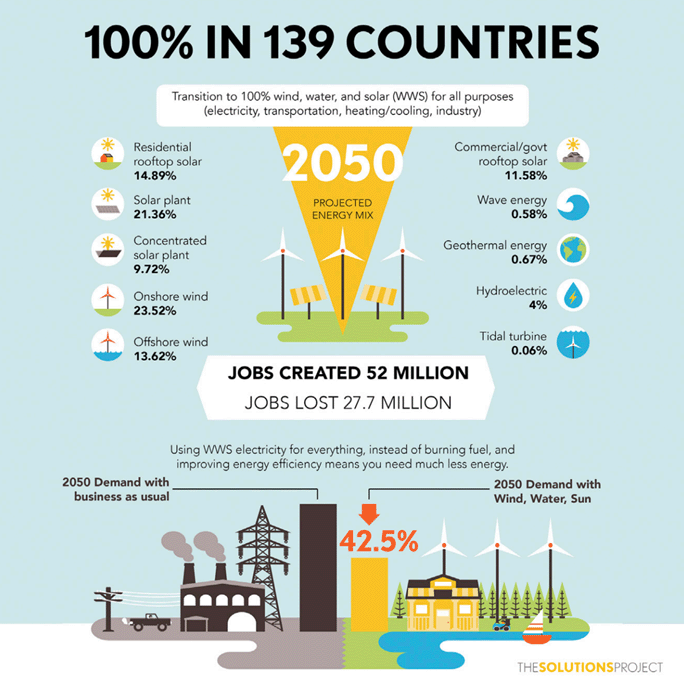
Dave Elliott: The International Energy Institute’s new Global Energy
Roadmap sets a pathway to net zero carbon by 2050, with, by 2040, the
global electricity sector reaching net-zero emissions. It wants no
investment in new fossil fuel supply projects, and no further final
investment decisions for new unabated coal plants. And by 2035, it calls
for no sales of new internal combustion engine passenger cars. Instead it
looks to ‘the immediate and massive deployment of all available clean and
efficient energy technologies, combined with a major global push to
accelerate innovation’.
For its part, on that issue, the IEA report
summary says ‘most of the global reductions in CO2 emissions between now
and 2030 in the net zero pathway come from technologies readily available
today. But in 2050, almost half the reductions come from technologies that
are currently only at the demonstration or prototype phase’. So it says
‘this demands that governments quickly increase and reprioritise their
spending on research and development – as well as on demonstrating and
deploying clean energy technologies – putting them at the core of energy
and climate policy.
. Progress in the areas of advanced batteries,
electrolysers for hydrogen, and direct air capture and storage can be
particularly impactful’. U.S. Climate Envoy John Kerry had already
relayed the suggestion that ‘50 percent of the reductions we have to make
to get to net zero are going to come from technologies that we don’t yet
have.’ And Bill Gates had claimed that that solar, wind and batteries
were not enough, so we need ‘miracle technologies’ to decarbonize our
global economy.
Commenting on this issue, Prof Mark Jacobson from Stanford
University said it all depends on what you mean by ‘new’. Yes, we need
to improve wind, solar, storage and transmission systems, but what was
really being hinted at in these statements was that we need other
completely new technologies- such as Small Modular Reactors, Carbon Capture
systems and such like. He says we don’t need them: ‘we have 95% of the
technologies we need today and the know-how to get the rest’:
Renew Extra 29th May 2021
https://renewextraweekly.blogspot.com/2021/05/the-iea-set-out-way-ahead.html
Not only at the Poles, but also mountain glaciers, are melting faster than ever.

Scotsman 28th May 2021 Richard Dixon: The last few weeks have seen several new studies yielding
new insights into the role and future of ice sheets and glaciers. Last
month, the seasonal sea ice in the Arctic covered almost one million square
kilometres less than the long-term average, making it the sixth-lowest ice
cover ever recorded.
The poles are among the places feeling the heat of
climate change most rapidly. In March, the world was 0.88C above the
long-term average, but parts of the South Pole and all of the North Pole
were between 2 and 4C warmer. Recently, locations in Alaska were officially
reclassified from “sub-Arctic” to “warm summer continental”, based
on the upward trend of yearly average temperatures.
Last week, a studyconcluded that the Greenland ice sheet is already melting sufficiently to
raise global sea levels by one or two metres. If it all went, sea levels
would be seven metres higher.
Another study found that the massive Thwaites
Glacier in Antarctica is melting faster than previously thought. The
picture across the region is confusing because warmer seas mean the ice
sheets are melting, but they also mean there is more new snow falling,
replenishing the ice from the top. So, the ice sheets can be feeding tens
of billions of tonnes of water into the ocean a year, while at the same
time seeming to contain about the same amount of ice.
Despite promises to
keep the global temperature rise well below 2C and even to try for 1.5C,
the world is on track for a potential 3C rise by 2100. A new study suggests
that the tactic some governments are backing – to go over 2C but then
come back down again – would likely create irreversible ice loss in the
Antarctic, even if it worked. But ice is not only found at the poles,
another study finds that mountain glaciers are melting faster even than the
Antarctic ice, adding billions of tonnes of water to the oceans every year.
https://www.scotsman.com/news/environment/dr-richard-dixon-chilling-news-on-polar-ice-trends-3253510
| R |
Good taste and food security: How Sundrop used solar to bring tomatoes to the desert — RenewEconomy

The solar tower that rises at Sundrop Farms shines like a beacon from above the saltbush landscape. The post Good taste and food security: How Sundrop used solar to bring tomatoes to the desert appeared first on RenewEconomy.
Good taste and food security: How Sundrop used solar to bring tomatoes to the desert — RenewEconomy
May 30 Energy News — geoharvey

Opinion: ¶ “Seven Ways Ford Did Everything Right With The F-150 Lightning” • Zach Shahan of CleanTechica summed up the F-150 Lightning: “Thinking on it more after letting the enthusiasm from the opening week settle in, I thought it would be good to point out that I think Ford did basically everything right with the […]
May 30 Energy News — geoharvey
Australia is ready for a change on climate – which party will take the first step? — RenewEconomy

A new poll finds that Australians are ready to take serious climate action – including banning new coal mines across Australia. The post Australia is ready for a change on climate – which party will take the first step? appeared first on RenewEconomy.
Australia is ready for a change on climate – which party will take the first step? — RenewEconomy
Environmentalists and Aboriginal traditional owners object to rocket launching on South Australian protected heritage land, at Whaler’s Way.
Rocket launching proposals worry traditional owners, environmentalists, but company committed to holistic care of the land, ABC Eyre Peninsula / By Evelyn Leckie 28 May 21, Popular South Australian tourist spot Whalers Way could become the site of three test rocket launches later this year, causing concern among some environmentalists and traditional owners.
Key points:
- Traditional owners and conservationists have raised concerns about the proposed site for three rocket launches this year
- Nature Conservation SA holds concerns over two threatened species
- Southern Launch says it’s committed to a holistic approach to care for the area during its testing program.
SA space industry leader Southern Launch is looking to conduct test launches on privately owned land, with a view to making the area a permanent launching site in the future to send satellites into space.
Nature Conservation Society of SA advocate Julia Peacock said the area, on the state’s rugged southern coast, wasn’t the right site to conduct test launches.
“It’s a really special conservation area,” she said.
“It’s actually specifically protected under environment legislation that’s called a heritage agreement, which means a private landholder agreement to protect that area so we would really like to see that agreement honoured.
We’re also really concerned that it is habitat for a number of species of conservation concern.”
Ms Peacock said the society was worried about threatened species in the area such as southern emu wrens and white-fronted whip birds.
“They’re very small and shy birds, so they’re quite hard to see,” she said.
We’re concerned that we’re building an industrial facility that involves explosions that are noisy and causes vibrations — that those species are going to be frightened.
“It’s going to change their behaviour and impact the way they want to move through this area.”
‘Let it be natural’
Nauo elder Jody Miller said there were a lot of cultural issues out at Whalers Way.
“It’s significant culturally, there are stories [out there] and we don’t want to destroy anything,” Mr Miller said.
“If it’s just left alone, let it be natural, people can see this for the next generation — everybody’s children as well as my children.”
Holistic protection
Southern Launch CEO Lloyd Damp said the testing program would provide the chance to specifically measure what the noise effect would have on local species.
“We’re working with one of the best universities in Australia to undertake the measurements and then provide that for the environmental impact statement assessment,” Mr Damp said……….. https://www.abc.net.au/news/2021-05-28/rocket-launching-proposals-worry-environmentalists/100173472
Ionising radiation the big danger to astronauts

NASA says that not only does space radiation potentially put astronauts at greater risk of radiation sickness, but an “increased lifetime risk for cancer, central nervous system effects, and degenerative diseases.”
Astronauts in space are exposed to the radiation equivalent of 150 to 6,000 chest x-rays https://www.revelstokereview.com/news/morning-start-astronauts-in-space-are-exposed-to-the-radiation-equivalent-of-150-to-6000-chest-x-rays/ May 28, 2021
As noted by NASA, radiation is a type of energy that is emitted in the form of rays, electromagnetic waves and/or particles. Radiation can be seen as visible light or felt as infrared radiation. However, some forms of radiation, like x-rays and gamma rays, are not visible.
Space radiation differs from the type of radiation experienced on Earth because intergalactic radiation “is comprised of atoms in which electrons have been stripped away as the atom accelerated in interstellar space to speeds approaching the speed of light – eventually, only the nucleus of the atom remains.”
So how much space radiation are astronauts exposed to? They’re exposed to “ionizing radiation with effective doses in the range from 50 to 2,000 mSv. 1 mSv of ionizing radiation is equivalent to about three chest x-rays. So that’s like if you were to have 150 to 6,000 chest x-rays.”
With that being said, NASA says that not only does space radiation potentially put astronauts at greater risk of radiation sickness, but an “increased lifetime risk for cancer, central nervous system effects, and degenerative diseases.”
New technology comes nowhere close to solving the problem of nuclear waste
New technology comes nowhere close to solving the problem of nuclear waste, Toronto Star, By Thomas Walkom May 27, 2021 What is to be done with nuclear waste? It is a question that dominates the Atomic Age. It is also one that has never been satisfactorily answered…..
nuclear waste is a relentless certainty. A plant that produces nuclear power creates nuclear waste. It is that simple.But what to do with that waste? Up to now, the assumption was that such waste would be buried in deep geological caverns, or repositories. Two potential sites for such repositories have been identified — one in Northwestern Ontario and one near Lake Huron. The usual political battles are being waged over whether either or both sites are safe.
But over the last few years, more attention has been paid to a different solution — using radioactive waste as fuel to create more nuclear power from so-called small modular reactors (SMRs). The governments of Saskatchewan, Ontario and New Brunswick have been particularly interested in developing this new SMR technology.
One New Brunswick start-up, Moltex Energy of Saint John, has received $50.5 million in federal funds.
The new technology has its critics. In the first place, it can create new and even more dangerous radioactive waste. As the Globe and Mail reports, Moltex says it produces an impure form of plutonium as a waste byproduct from its SMRs. Pure plutonium is used in the manufacture of atomic bombs.
Indeed, some nuclear experts, including former senior U.S. officials, were so alarmed that seven of them took the unusual step of penning an open letter this week to Prime Minister Justin Trudeau.
In that letter, they warned that reprocessing waste in a manner that creates plutonium would undermine global efforts to limit nuclear proliferation.
They also noted that the new technology wouldn’t solve the waste problem. Rather, it would just produce different kinds of nuclear waste.
“Moltex, even in the R&D stage, would create a costly legacy of contaminated facilities and radioactive waste streams and require substantial additional government funding for cleanup,” the letter said.
All of this is true. But none of it is enough to derail the new interest in SMR technology. Governments like it because it promises to be cheaper to build than classic Pickering-style nuclear power plants. The nuclear industry sees it as a political lifeline at a time when atomic power is not particularly popular.
So regardless of what its critics say, don’t expect this new technology to fade away. It may not be the silver bullet that its adherents claim it to be. It comes nowhere close to solving the waste problem.
But it is supported by important political constituencies. History has shown how crucial this support has been to the nuclear industry. https://www.thestar.com/opinion/contributors/2021/05/27/new-technology-comes-nowhere-close-to-solving-the-problem-of-nuclear-waste.html
Australia, the USA’s only ”best friend” in the Indo Pacific, to deploy more USA military equipment, heightening the threat against China.

Zhang Junshe, a senior research fellow at the PLA Naval Military Studies Research Institute, told the Global Times on Friday that Australia is likely to allow the US to deploy more military equipment on its soil, making it the only US friend on its Indo-Pacific strategy.
By doing this, Australia will make itself a target for future military conflicts between the US and other countries, Zhang said, adding that a responsible government which really cares about the interests of its people would never allow it.
China urged to increase sea-based nuclear deterrent amid US intensified strategic threat https://www.globaltimes.cn/page/202105/1224773.shtml By Zhang Hui May 28, 2021 Facing a serious strategic threat from the US, China was urged to increase the number of nuclear weapons, especially its sea-based nuclear deterrent of intercontinental submarine-launched ballistic missiles, to deter potential military action by US warmongers, Chinese military experts said on Friday, after reports that the US’ new defense budget will modernize its nuclear arsenal to deter China.
Having a nuclear arsenal appropriate to China’s position will help safeguard national security, sovereignty and development interests and establish a more stable and peaceful world order, which will be beneficial for the world, they said.The US defense budget, set to be sent to Congress on Friday, is expected to include investments in troop readiness, space, and the Pacific Deterrence Initiative aimed at countering China’s military existence in the region, and nuclear weapons technology, Reuters reported on Thursday.
However, Chinese military experts believe that US attempts of increasing military deployment in the Indo-Pacific region will not increase returns for the US as most countries in the region will not allow the flames of war initiated by the US to burn themselves.
The US would buy ships and jets and develop and test hypersonic weapons and other “next-generation” weapons systems to build capabilities to counter Russia and China. The total national security budget will be $753 billion, a 1.7 percent increase over the 2021 figure, Reuters said.
China has kept its defense spending at around 1.3 percent of GDP in recent years, which is far below the average global level of 2.6 percent, data shows. The US, by far the world’s top military spender, has spent about four times that of China in recent years.
Chinese analysts said China has never taken aim at US military spending, nor does China want to engage in any form of arms race with the US.
But the US has applied greater military pressure on China, sending warships and warplanes at an increasing frequency to the South China Sea and Taiwan Straits.
The US is also preparing what US media called its “biggest navy exercise in a generation with 25,000 personnel across 17 time zones,” as it’s preparing for a “possible conflict” with China and Russia.
The US attempted to deepen the militarization of space with its new budget plan, including its investment on future weapons. Considering that the US deems China its top imaginary enemy, China needs to increase the quantity and quality of nuclear weapons, especially submarine-launched ballistic missiles, to effectively safeguard its national security, sovereignty and development interests, Song Zhongping, a Chinese military expert and TV commentator, told the Global Times on Friday.
Some military experts said China should increase the number of its most advanced intercontinental ballistic missiles (ICBM), the DF-41, which has the longest operational range among all Chinese ICBMs.
Facing a serious strategic threat from the US, China was urged to increase the number of nuclear weapons, especially its sea-based nuclear deterrent of intercontinental submarine-launched ballistic missiles, to deter potential military action by US warmongers, Chinese military experts said on Friday, after reports that the US’ new defense budget will modernize its nuclear arsenal to deter China.
Having a nuclear arsenal appropriate to China’s position will help safeguard national security, sovereignty and development interests and establish a more stable and peaceful world order, which will be beneficial for the world, they said.
Song said that strengthening sea-based strategic nuclear deterrence is also an important direction for China’s future development, as these weapons are better at stealth and secondary nuclear strikes.
China could use its most advanced submarine-launched ballistic missile (SLBM) to effectively counter the US threat, Song said.
China just commissioned three PLA Navy warships, namely the Changzheng 18, the Dalian and the Hainan, at a naval port in Sanya, South China’s Hainan Province in April. Observers identified the Changzheng 18 as a likely Type 09IV nuclear-powered strategic ballistic missile submarine.
Burning themselves
The US Pacific Deterrence Initiative, created to counter China, focuses on competition in the Indo-Pacific and aims to boost US preparedness in the region by funding radars, satellites and missile systems, according to Reuters.
Wei Dongxu, a Beijing-based military expert, told the Global Times on Friday that the initiative enables the US to use a variety of spy satellites to conduct reconnaissance and intelligence gathering to provide extensive and accurate intelligence support for US military operations, including joint military operations with its allies, and the US will also use allies, such as US overseas military bases, to deploy more radar systems to guide its weapons.
On the day its budget was sent to Congress, US Secretary of Defense Lloyd Austin was expected to meet with India’s Minister of External Affairs, Subrahmanyam Jaishankar, as part of India’s first cabinet-level visit to Washington, the Pentagon said.
“The secretary’s meeting with the external affairs minister will continue discussions that the two held in New Delhi in March and will continue the robust bilateral defense and security relationship between our two countries,” the Pentagon said.
Chinese military experts said it’s likely that India would buy more American weapons, have more military drills with the US or deepen its cooperation with the US in military intelligence sharing, and the US will use these in exchange for India’s cooperation for its Indo-Pacific strategy.
But India will have second thoughts on US military deployment on its soil, Song said, noting that weapons and radar deployment involves a country’s sovereignty, and India, which has been claiming to pursue an independent foreign policy, will unlikely give the US a satisfactory answer.
Even if India would like to deepen its military cooperation with the US, certain cooperation such as opening military bases to the US is not an option for India, Song said.
India may not be a very ideal partner, and most of US allies in Asia, including Japan and South Korea, also fear that the flames of war would eventually burn themselves.
In South Korea, protests against US military presence have become louder in the past years, and South Korea will not allow the US to turn Northeast Asia into a battlefield and drag itself into war, nor will it sacrifice its relations with China, observers said.
Zhang Junshe, a senior research fellow at the PLA Naval Military Studies Research Institute, told the Global Times on Friday that Australia is likely to allow the US to deploy more military equipment on its soil, making it the only US friend on its Indo-Pacific strategy.
By doing this, Australia will make itself a target for future military conflicts between the US and other countries, Zhang said, adding that a responsible government which really cares about the interests of its people would never allow it.
1 This month.

Australians deserve the truth
about
AUKUS – https://aukuspublicinquiry.com/


PETITION – To: Prime Minister Anthony Albanese and the Australian Labor Government

of the week – Australians for War Powers Reform (AWPR)
To see nuclear-related stories in greater depth and intensity
 Antinuclear