UK in secret talks with Australia and others, about mining rare earths
Telegraph 2nd May 2021, Fears China will “turn off the taps” on Britain’s green revolution
has forced ministers to enter secret talks with seven commonwealth
countries to mine their rare earths. Officials from the Department of
International Trade and the Foreign Office have had meetings with
representatives from Australia, Canada, Malawi and Tanzania in a bid to
persuade them to supply rare earths, as well as critical metals such as
lithium to the UK.
Rare earths are found in abundance across the world, but
are difficult to process and China controls around 90 per cent of the
market. The UK has no known deposits of rare earths, unlike other major
economies such as the US, Canada and Australia, which are also grappling
with the problem. Rare earths are used in a wide variety of technology,
from fighter jets, to MRI machines and loudspeakers, but also in the motors
of electric vehicles and in wind turbines, and the worldwide transition to
green infrastructure is expected to put pressure on global demand.
May 2 Energy News — geoharvey

Opinion: ¶ “Why E-Fuels In Cars Make No Economic Or Environmental Sense” • With the review of the EU CO₂ emissions standards for cars and vans scheduled for June 2021, some are advocating CO₂ credits for advanced biofuels and synthetic fuels. Transport & Environment’s analysis shows why this is neither environmentally nor economically credible. [CleanTechnica] […]
May 2 Energy News — geoharvey
”Low Level” radioactive trash to be removed to USA from posh Sydney suburb, while govt plans to send Higher Level nuclear waste to Kimba, rural South Australia.

This is very interesting. They say it’s ”low leve” – presumably ”safe”. Yet for the residents of a posh Sydney suburb, its worth a century-long fight to get it removed – and sent to America !! Makes you see why the residents of Lucas Heights , – now called Bardon Ridge – might be keen to have their much higher-level radioactive trash foisted on distant rural Kimba, South Australia
Hunters Hill radioactive waste to be removed sent to United States https://www.abc.net.au/news/2021-04-30/hunters-hill-radioactive-waste-to-be-removed-sent-to-us/1001
By Rani Hayman 1 May 21,
Key points:
- The land was the former site of the Radium Hill refinery, which closed in 1915
- The removal will begin in the coming weeks and take 12 months
- Melinda Pavey said the issue had taken a long time to resolve because it was “complicated”
Several properties on Nelson Parade at Hunters Hill were built on land contaminated by a former uranium processing site, which closed in 1915.
The area was also occupied by a carbolic acid plant until the early 1900s and a tin smelter until the 1960s.
Residents have spent decades fighting for the state government to remove the affected soil.
Finally, their calls have been heard, with the waste due to be excavated and sent to the United States.
Philippa Clark from the Nelson Parade Action Group said she was pleased the issued had finally been resolved.
“This is the way you deal with this kind of contamination and the best way possible for us and the environment and future generations,” she said.
The NSW government said the process would begin in the next few weeks and was expected to take 12 months.
The Minister for Water, Property and Housing Melinda Pavey said the health and safety of the community would be the main priority during site remediation works and the transportation of the material.
“The Australian Nuclear Science and Technology Organisation (ANSTO) will supervise the excavation and packing of the contaminated material into sealed bags and containers prior to transport to the USA,” she said.
While there is a sense of relief within the community, the decades-long battle has put strain on the affected residents.
When asked why it has taken so long to find a solution, Ms Pavey said: “Because it was complicated.”
A parliamentary committee in 2008 called for a comprehensive remediation plan for the site and in 2014 the Environmental Protection Agency (EPA) issued a management order to Property NSW to commence the works — although it said the development consent still had not been issued.
A plan to move the contaminated material to Kemps Creek in Sydney’s west was also abandoned in 2014 following community backlash.
The Mayor of Hunters Hill, Ross Williams, said the residents were looking forward to the area being rehabilitated.
“It’s been a health issue and a legacy issue for all that time.
It’s low-level radioactive material and it came from an industry that was essential [really?] back in those days,” he said.
“In modern times the environmental consequences wouldn’t have been tolerated.
“Once it’s totally cleaned up it will be available for any use.”
Ms Clark is pleased with the outcome despite how long it has taken.
“The government has listened to what we all wanted and what the parliamentary inquiry recommendation had been,” she said.
“We overwhelmingly just want to see ordinary houses and [go] back to [living in] an ordinary street, but without the stigma and without the constant anxiety that we’ve had to live with.”
Morrison in mad scramble to boost fossil fuels while the world changes fast — RenewEconomy

A taxpayer funded gas plant and a proposed subsidy for fossils on the grid. As the world shifts away from coal and gas, Australia’s government doubles down. The post Morrison in mad scramble to boost fossil fuels while the world changes fast appeared first on RenewEconomy.
Morrison in mad scramble to boost fossil fuels while the world changes fast — RenewEconomy
Antarctic ‘doomsday glacier’ may be melting faster than was thought
| Christina Macpherson <christinamacpherson@gmail.com> | 11:29 AM (3 hours ago) |  | |
| to me |
Antarctic ‘doomsday glacier’ may be melting faster than was thought

Antarctic ‘doomsday glacier’ may be melting faster than was thought
Study finds more relatively warm water is reaching Thwaites glacier than was previously understood, Guardian, Matthew Taylor Fri 30 Apr 2021, An Antarctic glacier larger than the UK is at risk of breaking up
after scientists discovered more warm water flowing underneath it than previously thought.
The fate of Thwaites – nicknamed the doomsday glacier – and the massive west Antarctic ice sheet it supports are the biggest unknown factors in future global sea level rise.
Over the past few years, teams of scientists have been crisscrossing the remote and inaccessible region on Antarctica’s western edge to try to understand how fast the ice is melting and what the consequences for the rest of the world might be.
“What happens in west Antarctica is of great societal importance,” said Dr Robert Larter, a scientist with the British Antarctic Survey and principal investigator with the International Thwaites Glacier Collaboration, the most ambitious research project ever carried out in Antarctica. “This is the biggest uncertainty in future sea level rise.”……….
Wahlin said the front of the Thwaites glacier was resting on a number of “pinning points” under the sea. But as relatively warm water from the deep ocean increased the melting, she said, these would be lost, breaking up the ice and allowing warm water further under the ice. This would speed up the flow of the glacier into the sea……..
The worst-case scenarios for Thwaites are grim. It is the widest glacier on the planet, more than 1km deep and holds enough ice to raise the sea level by 65cm.
Ice loss has accelerated in the last 30 years and it now contributes about 4% of all global sea level rise. Experts say this could increase dramatically if the ice at the front of Thwaites breaks up, with knock-on effects for other glaciers in the area.
To heighten scientists’ concerns, west Antarctica has been one of the fastest-warming place on Earth in the past 30 years, and since 2000 it has lost more than 1tn tons of ice.
Last year, a team of British scientists discovered cavities half the size of the Grand Canyon under Thwaites that, like decay in a tooth, allow warm ocean water to erode the glacier, internally accelerating melting. And because a lot of the ground on which the glacier sits is below sea level, it is thought to be particularly vulnerable to melting as warmer water encroaches further under the ice inland……
Ella Gilbert, a research scientist at the University of Reading, said what was happening in the polar regions demanded an urgent response from the international community.
“The polar regions are the canary in the coalmine – they are the symbol of climate change,” said Gilbert, who was a joint author of a recent study warning of the catastrophic impact of global heating on Antarctic ice.
“We really do need to minimise our emissions because if we lose the polar regions, not only are we going to amplify climate change … it will contribute to sea level rise which affects everyone around the globe.” https://www.theguardian.com/environment/2021/apr/30/antarctic-doomsday-glacier-may-be-melting-faster-than-was-thought
Extinction Rebellion climate activists block Faslane nuclear base
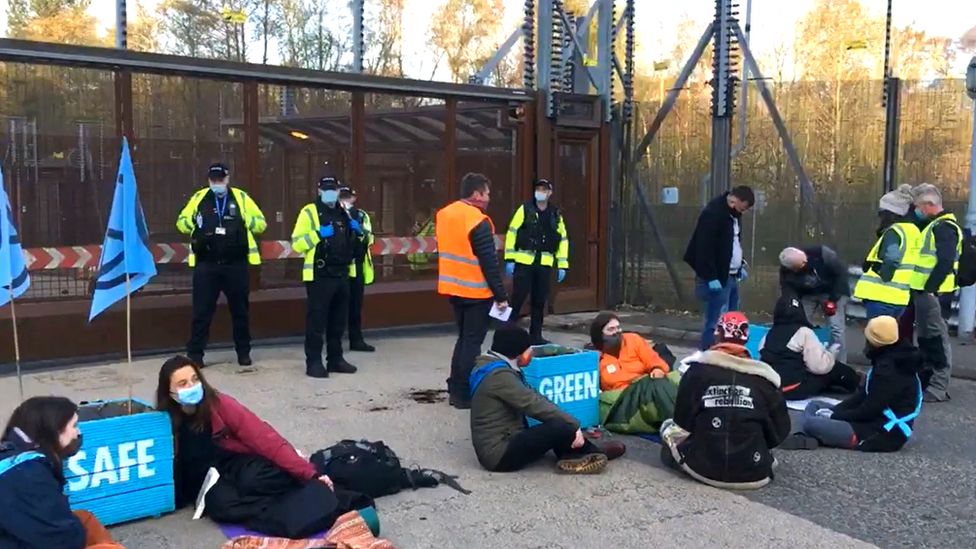
Extinction Rebellion block Faslane nuclear base entrance, Climate activists set up a blockade at the Faslane nuclear base by attaching themselves to plant pots. https://www.bbc.com/news/uk-scotland-glasgow-west-56941041 30 Apr 21,
Members of Extinction Rebellion Scotland staged the protest at the north gate of the base on the Gare Loch in Argyll and Bute.
The all-female group placed three planters painted with the words “Safe”, “Green”, and “Future” on the road.
Police Scotland said they were made aware of the incident at 06:20 and officers were at the scene.
HMNB Clyde – known as Faslane – is the Royal Navy’s main presence in Scotland.
It is home to the core of the submarine service, including the UK’s nuclear weapons, and the new generation of hunter-killer submarines.
The protest group said they were demanding a future “safe from the threat of nuclear weapons and environmental destruction”.
Extinction Rebellion said the action was part of the Peace Lotus campaign, a global day of anti-war resistance celebrating the anniversary of the end of the Vietnam War.
An HMNB spokesman confirmed police were in attendance and assisting Ministry of Defence officers in dealing with the protest. He added: “Well-established, fully co-ordinated procedures are in place to ensure the effective operation of HMNB Clyde is not compromised because of protest action.”
Mobile nuclear reactors? Scathing report slams ‘disturbing’ military program
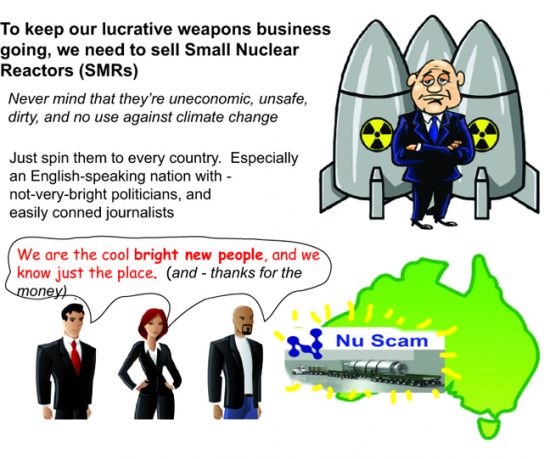
Mobile nuclear reactors? Scathing report slams ‘disturbing’ military program, Times, 1 May 21, Todd South The author of an academic report on Pentagon plans to build mobile nuclear reactors to power future combat bases called the effort “extremely disturbing” and “based on a lie.”
The report released Thursday slams the Pentagon and Army G-4, logistics — specifically the Army office’s 2018 report that lays out the potential uses and needs for such mobile nuclear reactors in future operations.
Alan J. Kuperman wrote the 21-page report titled, “Proposed U.S. Army Mobile Nuclear Reactors: Costs and Risks Outweigh Benefits,” in his role as coordinator of the University of Texas at Austin’s Nuclear Proliferation Prevention Project.
“They don’t reduce casualties, they increase costs and they increase threats to the lives of U.S. service members,” Kuperman said.
The program, known as “Project Pele,” is prototyping the mobile advanced microreactor concept under the Pentagon’s Strategic Capabilities Office……..
The DoD spokesman pointed out that the project is part of a collaboration involving the Department of Energy, Nuclear Regulatory Commission, U.S. Army Corps of Engineers and private industry. Project Pele is not being designed for a specific military service branch but does include experts across defense for a variety of requirements.
Army officials for G-4 deferred comment on the program to DoD……..
Congress approved funding for prototype reactors and the Army awarded $40 million in contracts to three nuclear reactor companies in March 2020 for Project Pele, according to the NPPP report.
Kuperman struck at the Army’s rationale, calling the project unnecessary and dangerous. He counters some of the main justifications that have been provided by DoD and Army reports:
High cost – Kuperman said the Army’s claims that nuclear power can provide cheaper electricity for powering future forward bases is “based on unrealistic assumptions.” Those include that such a reactor would have low construction costs and operate for 18 hours a day over 40 years. The more likely scenario is a mobile reactor would run for half that time over about 10 years, meaning nuclear electricity could cost 16 times more than estimates and still seven times more than diesel-generated power.- Vulnerability to missile attacks – The report points to the 2020 missile attack on forces at al-Asad air base in Iraq. Even with warnings hours ahead of time, more than 100 U.S. personnel suffered traumatic brain injury from the 11 strikes that hit the facility. And the missiles were 10 times more accurate than the Army has predicted in its report on the vulnerability of reactors to precision strikes. The service admits that a direct hit on a reactor would destroy the device. Kuperman notes that even the Army’s plans to protect the reactors, by burying them underground, could inadvertently cause meltdowns by impeding air cooling and causing overheating. A similar strike on an similar such future base with a reactor could cause far more devastating consequences.
Captured reactors – Should a U.S. base housing a mobile reactor be overrun or abandoned, the radioactive waste from the reactor could be used in “dirty bomb” terror attacks.- No mission for reactors – One of the chief purposes of pursing such reactor programs was to reduce casualties from diesel transport to remote bases. But Defense Department data shows a dramatic drop in casualties of five per 1 million gallons of fuel delivered in 2005 to nearly zero by 2013.
- High-energy weapons don’t need reactors – Kuperman states that the justification that future high-energy or laser weapons that the Army hopes to have protecting bases don’t require a reactor to power. “A high energy weapon would have to be fired millions of times to justify a reactor,” Kuperman said. “In reality such a weapon would be fired perhaps hundreds of times in its lifetime.”
- Transport problems – The Army wants to air deliver these reactors to combat posts. Kuperman questions the “regulatory nightmare” that would create. The program calls for initial tests flying the reactors domestically to run then returning them, and their radioactive waste, to another domestic location. Foreign transport would require approval of countries airspace traversed and the approval of a host nation where the reactor would be placed, he said. Other Army recommendations include truck or rail transport domestically and either ship or over-the-ocean flights to friendly ports to then move the reactors again via truck or rail.
Army Times reported on the proposed program in 2019, which had drawn backlash from the Union of Concerned Scientists and its then-director of the Nuclear Safety Project, Edwin Lyman, who called the proposal, “naïve.”The original proposal, approved by the Pentagon’s Strategic Capabilities Office asked for industry solutions in January 2019 on providing a less than 40-ton small, mobile nuclear reactor design that could operate for three years or more and provide 1 to 10 megawatts of power.Planners want the reactor to fit inside a C-17 cargo plane for air transport to theater. More recent moves have reduced the power output to 5 megawatts……..
Lyman notes a major failure with one of the original eight designs in 1961 when a core meltdown and explosion of the ML-1 reactor in Idaho killed three operators.
The three deployed to Antarctica, Greenland and Alaska proved “unreliable and expensive to operate,” Lyman wrote in his response to the Army’s 2018 report on the mobile reactor program.Lyman told Army Times on Thursday that a number of those old reactors required decades of decommissioning and one used at Fort Belvoir, Va., near Washington D.C. is finally scheduled for decommissioning in late 2021……….. https://www.armytimes.com/news/your-army/2021/04/30/mobile-nuclear-reactors-scathing-report-slams-disturbing-military-program/
| Virus-free. www.avast.com |
April 30 Energy News — geoharvey

Opinion: ¶ “Climate Migration” • Climate change is already displacing millions of people. And if countries fail to make sharp cuts to carbon pollution, it will displace hundreds of millions more. By one estimate, climate disasters could uproot upwards of 1 billion people by 2050, raising important questions about how the world will respond. [CleanTechnica] […]
April 30 Energy News — geoharvey
Australia sleepwalks towards nuclear war – enthusiasm for nuclear rockets and submarines.
Small nuclear reactors (SMRs) are being pitched to Australians as ”climate salvation”, ”cheap electricity” etc. Of course this is nonsense. But the toxic macho nuclear zealots are confident that SMRs will have a great future in nuclear wars on land, on sea, in space.

SPACE: Australia’s ”cultural cringe” is so obvious, in the fervour for space research. Breathless enthusiasm in media coverage of rockets, space exploration . Yet the truth is that Australian space research is tied to America’s goal of militarising space. We hold events like The Australian International Aerospace and Defence Exposition – pitched as family entertainment:
”THE AIRSHOW will feature the raw potency and power of modern military aviation. The thrust and grunt of the latest military heavy metal will take centre stage. The stars of the show will be state-of-the-art jet fighters, bombers and giant heavy lift leviathans from home and abroad. See them so close you could almost touch them. Shudder to the roar of their mighty jet turbines as they perform high octane routines and simulated combat manoeuvres. Marvel as swarms of attack helicopters join in the fray.”
Of course, if we can help the American drive for weapons in space, it is all the better to have the tax-payer fund our space research.
SUBMARINES. Australia’s nuclear zealots have long been working away for nuclear submarines…… way before the so-called ”neutral” nuclear military fan Kevin Scarce was made head of the South Australian Nuclear Fuel Chain Royal Commission, in 2016.
A push for nuclear submarines has been part of Australia’s appalling history of submarine deals in recent years. Part of this mess was recently exposed by Michelle Fahy in Murder, corruption, bombings – the company at centre of Australia’s submarine deal. But the whole sorry tale goes further. It probably explains why the Australian government chose the super costly French submarine design – in the hopes that it could easily be transformed from a diesal to a nuclear -powered form.
Impelled by the very right-wing Australian Strategic Policy Institute, the push continues. Academia is co-opted, as The University of New South Wales joins with the Submarine Institute to promote nuclear submarines in a July 15 Canberra seminar. The speakers include well known nuclear propagandists Tom Frame, Kevin Scarce, and Hugh White.
Tom Frame has also recently published a book, rapturously received by the nuclear lobby, enthusing about nuclear submarines, and recommending them as Australia’s way into the full nuclear fuel chain, and into the space race .
With Australia’s Murdoch media monopoly, and the ever-weakening ABC, the public is unaware of these machinations towards Australia’s role in nuclear militarism. The push for small nuclear reactors is the starting point.
Australian government plan for a nuclear waste dump tears apart the small rural community of Kimba
Kimba: A town torn apart by nuclear waste proposal https://independentaustralia.net/environment/environment-display/kimba-a-town-torn-apart-by-nuclear-waste-proposal-,15027 By Noel Wauchope | 28 April 2021
Bogged down in the Australian Senate is a Bill that selects a farming area, Napandee, near Kimba, South Australia, as Australia’s national radioactive waste dump. If that Bill becomes law, that matter will be settled, and there will be no possibility of legal appeal against it.
From a small close-knit community, in a top Australian wheat-growing area, Kimba has become a place of tension. In 2016, a farmer, Jeff Baldock, offered part of his land, Napandee, for the radioactive waste facility, and the offer was accepted by the Federal Government. From then on, the debate has raged in the area, and beyond it. It’s not always a reasonable discussion, and social media has made this worse. Now, years later, there’s no sign of a resolution to this matter. Residents try to get on with their lives, in this uneasy situation. Some people have left town, some are not speaking to former acquaintances. Opinions are black and white, or the subject is avoided completely – there’s no middle ground.
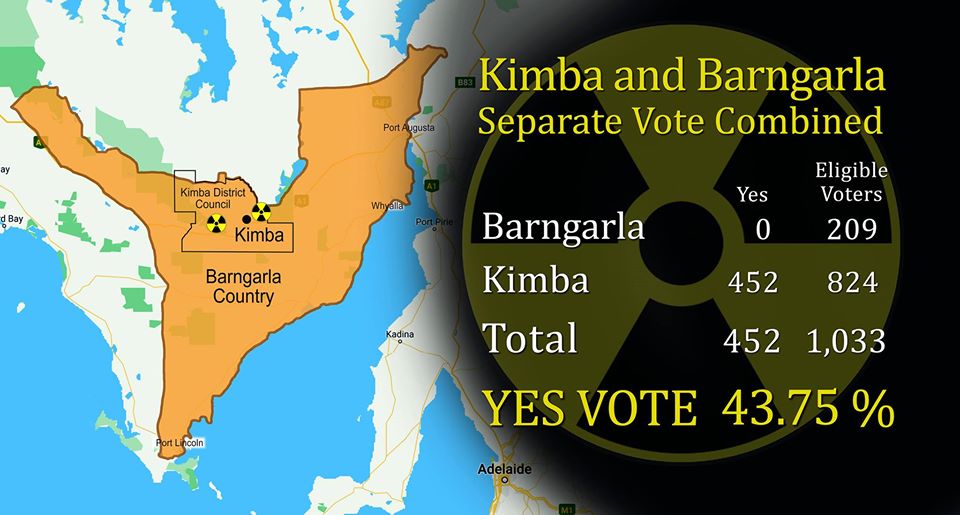
The Federal government’s plan for a nuclear waste facility at Kimba hit the Aboriginal community of the Eyre Peninsula hardest. The Barngarla people, Native Title holders, were excluded from the government’s ”community ballot” held in 2019. Voting was restricted to those living within the Kimba local council area . The Barngarla held their own ballot, resulting in a unanimous ”No” to the dump. Nevertheless, some Aboriginal people supported the plan, and this dispute has divided families.
”As an ally and advocate for Indigenous peoples for more than 30 years, I was appalled at the terrible toll fighting the nuclear waste facility took upon my friends. I watched one of my closest friends visibly age as she surrendered her art practice and her enjoyment of life to dedicate herself to challenging it. ”
– Felicity Wright – Submission to Senate Committee on National Radioactive Waste Management Amendment (Site Specification, Community Fund and Other Measures) Bill 2020 [Provisions] Submission 98
The non indigenous community has been equally affected. There were two community ballots held, 2017 and 2019. While in both cases the result favoured the nuclear waste facility, it was far from overwhelming support. At the final ballot, 824 people were eligible to vote: of 735 votes accepted, 452 said “Yes”.
The plan for the facility was pitched to the community as a medical necessity for Australia. It was an attractive idea. On the one hand Kimba could proudly provide a service to the nation. On the other hand, it was bringing a new industry, and new jobs, to a sometimes drought-stricken agricultural area. More immediate benefits: the farmer who volunteered land would be paid at 4 times the market value. A Community Benefits scheme brings up to $11 million to the town, over the next 4 years, and $20 million when the dump is up and running.
The plan was greeted with enthusiasm from some residents. They relied on the copious information provided by the the Department of Industry Innovation and Science, and by the former Resources Minister, Matt Canavan. When it was pointed out to Mr Canavan that some residents close to the selected site were ineligiblt to vote, he promised that their views would be included. But then he left that Ministry.
The Industry Department has controlled the information reaching the community, and has provided the visiting experts. There has not been any debate provided, with opposing views. Still, there is strong opposition, led by farmers. The group No Radioactive Waste on Agricultural Land in Kimba or SA, is optimistic thar Kimba, despite the prevailing mood of anxiety, can survive and go ahead, without the waste facility.

The group, of 5 years’ standing has researched the issue, and sent submissions to Parliament. Radioactive waste is not recommended for agricultural land. There are concerns about possibile environmental pollution, damage to groundwater. Perception of the area is important, and the presence of a radioactive waste dump could be very damaging to its clean, green image .
Community understanding is at the heart of this problem. The current Resources Minister, Keith Pitt, enthused about the facility, describing it to the Nationals Federal Conference on 27 March 2021 as “a low-level nuclear waste facility to house the by-products from cancer treatment.”
That’s a misleading statement. The waste proposed to be taken to the nuclear dump is waste generated from the industrial production of these isotopes. – not their usage!
There is uncertainty about the toxicity of the nuclear wastes to be placed in “interim storage” at Napandee, with the classification of these wastes as “intermediate level”, but the same wastes classified in Fance as “high level”.
The Kimba community remains troubled, as this nuclear waste problem remains paralysed in the Senate. Freedom of Information documents revealed that the government is well aware of mental health problems likely to be caused by the issue.
Minister Pitt has the option of clearly designating Napandee as the site for the nuclear waste dump. That could solve the problem, and certainly bring clarity to the Kimba community. But, the hitch for the government is that if he does this, it will be possible for opponents of the plan to take legal action against it.
ICAN addresses Mount Isa City Council after nuclear appeal pledge
ICAN addresses Mount Isa City Council after nuclear appeal pledge, Derek Barry,
Mount Isa city councillors got to see the 2017 Nobel Peace prize medal as a deputation thanked council for a recent decision……. (Subscribersonly), https://www.northweststar.com.au/story/7230603/ican-addresses-mount-isa-city-council-after-nuclear-appeal-pledge
France and Russia portray nuclear hydrogen as ”green”- arousing anger of several European nations.
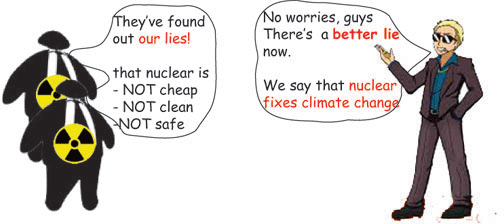
Atomic giants EDF and Rosatom push plan to sell nuclear-powered hydrogen as ‘green’Labelling nuclear hydrogen as green is likely to cause irritation among countries without atomic power or exiting it, 28 April 2021 By Bernd Radowitz , Recharge
French and Russian state-owned nuclear energy giants EDF and Rosatom have teamed up to develop low carbon hydrogen projects in Russia and Europe in order to decarbonise mobility and industrial sectors – but their labelling of H2 produced from nuclear power as ‘green’ is likely to cause irritation elsewhere in Europe.
As part of a strategic cooperation agreement signed last month, the hydrogen is slated to be produced both from nuclear power and from methane conversion linked to carbon capture and storage (CCS) technologies……..
Any massive use of nuclear hydrogen on an EU level is strongly opposed by countries without atomic power, or exiting it, such as Germany and Austria. Andreas Feicht, secretary of state in Germany’s economics and energy ministry, at a late-2020 virtual conference on hydrogen organised by his ministry stressed nuclear is not an option for Germany’s energy system or for the production of hydrogen.
The French government (backed by some Eastern European countries), by contrast, is trying to push nuclear hydrogen and wants it to be entitled for state support, which would be a way to use French or EU funds to help its highly-indebted nuclear utility EDF and give new life to its ageing nuclear fleet.
…… Béatrice Buffon, group executive vice-president in charge of EDF’s International Division.
“The agreement with the Rosatom Group, our historical partner in Russia and one of the country’s key players in the field of decarbonised hydrogen, illustrates EDF’s desire to develop a new energy model with lower CO2 emissions wherever we operate.”
The two nuclear companies didn’t provide more detail on specific projects being studied. https://www.rechargenews.com/energy-transition/atomic-giants-edf-and-rosatom-push-plan-to-sell-nuclear-powered-hydrogen-as-green/2-1-1002350
Ukraine’s nuclear industry in crisis – corrupt, unsafe, with politicised decision-making
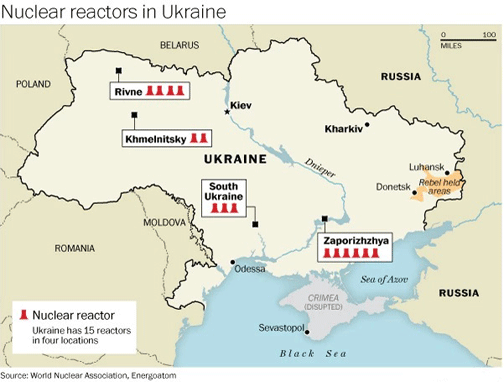
Could Ukraine’s nuclear industry face another Chernobyl?
Thirty-five years after the disaster, the nuclear industry is Ukraine’s most reliable economic lifeline. But critics say it faces a perennial crisis caused by corruption, safety problems and politicised decision-making. Aljazeera, By
Mansur Mirovalev, 26 Apr 2021 ”…………………. The nuclear industry remains Ukraine’s most reliable economic lifeline.
But domestic and international critics claim that the industry faces a perennial crisis caused by corruption; safety problems with ageing, worn reactors; disruption of ties with a Russian nuclear monopoly; and a politicised switch to US-made nuclear fuel.
Industry insiders, environmentalists and politicians claim that the construction of a spent fuel storage facility near the capital, Kyiv, and the proximity of Europe’s largest nuclear station in the southern city of Zaporizhzhia to Europe’s hottest armed conflict add to their concerns about the possibility of a nuclear incident, particularly in a nation that went through two popular uprisings since 2005 and lost a chunk of its territory to Russia.
……….. uranium dioxide sealed in zirconium alloy tubes in the rods emits radiation that has to be contained in hermetically sealed reactors. Ukraine’s Soviet-designed rods are hexagonal, resembling bee cells, while Western-made rods are square.
The switch is far from simple – but necessary, because Rosatom, Russia’s nuclear monopoly that charged Ukraine hundreds of millions of dollars a year, is controlled by the Kremlin. And the Kremlin has a well-known proclivity to use energy supplies as a political cudgel.
The switch to Westinghouse fuel is potentially dangerous,” Oskar Njaa, the Russia and Eastern Europe adviser for Bellona, a Norway-based nuclear industry monitor, told Al Jazeera.
In 2012, Westinghouse fuel rods had to be removed from the South Ukrainian power station after protective envelopes in two reactors were damaged.
Ukraine asked Rosatom for fuel and help – prompting Russian President Vladimir Putin to remark gloatingly that Rosatom experts had “to solve complex technical problems, take [the Westinghouse fuel] out and load the Russian fuel back in”.
Ukraine’s losses amounted to $175 million, Mikhail Gashev, Ukraine’s top nuclear safety inspector at the time, claimed – and banned the use of Westinghouse fuel.
Ukrainian experts doubted his assessment, and his decision was overturned after he was fired among hundreds of pro-Russian officials following Ukraine’s second anti-Russian popular uprising, the 2014 Revolution of Dignity.
Former Prime Minister Nikolay Azarov, another pro-Russian political figure who fled Ukraine after the revolt, said in 2017 that the decision was made “in spite of Ukraine’s security interests”.
Westinghouse modified the rods – and no further incidents were reported.
“That might be a sign of a better culture for safety and security in the industry,” Njaa said adding that his group is, however, “worried that incidents might become more severe and greater in numbers due to the ageing equipment at the plants.”………
Apart from the fuel, observers are also concerned about Ukraine’s ageing, worn reactors, 12 of which began operating in the 1980s and were supposed to be shut down in 2020. But Energoatom extended their lifespan spending hundreds of millions on each, thanks largely to loans from the European Union.
This is a common practice worldwide – the average lifespan of almost 100 nuclear reactors in the US is 40 years, and 88 have been approved for another 20 years. But some experts are worried about the safety measures and upgrades.
“What we witness every time a decision [to extend the lifespan] is made, some of the safety upgrades have either not been made or have not been made in full,” Iryna Holovko, the Ukraine coordinator for Bankwatch, a Prague-based environmentalist group, told Al Jazeera.
Bankwatch has for years been urging Ukraine to stop extending the lifespan of its “zombie reactors” without correcting “safety deviations” and detailed assessments of all the environmental risks for the people living around the stations and in neighbouring nations……….
The fuel switch brought about another problem; unlike Rosatom, Westinghouse does not take the spent fuel back for processing or storage.
Until December, Ukraine had two pretty problematic storage facilities – and an unfinished third one. One at the shut-down Chernobyl station is almost full. At the second one, an open-air yard outside the Zaporizhzhia nuclear plant, thousands of spent fuel rods are stored in ventilated concrete containers. In 2014, the plant was about 200 kilometres (125 miles) southwest of the front line of the separatist conflict.
The sight was horrifying to a visiting expert.
“I suddenly stood in front of the utterly unprotected interim storage,” Patricia Lorenz of Friends of the Earth, an environmentalist group that visited the plant on a fact-finding mission in 2014, told Al Jazeera. “It is basically unprotected against war and terrorism, while the front was close by back then.”
In May 2014, the station’s security and police turned away dozens of armed and masked far-right nationalists who tried to enter the plant to “protect” the station from the separatists.
Since then, the front line has moved eastward, and in December, Energoatom opened a third facility a mere 70 kilometres (43 miles) north of Kyiv, in the Chernobyl exclusion zone that is scheduled to receive the first batch of spent fuel in June.
But plans to transport spent fuel via Kyiv, the city of more than two million, drew sharp criticism.
“This will be happening in a country where everything turns upside-down, collides, explodes, and where lawlessness rules,” Kyiv-based environmentalist Vladimir Boreiko told reporters……………. https://www.aljazeera.com/features/2021/4/26/does-ukraines-nuclear-industry-face-another-chernobyl
Morrison to ignore massive big battery plans and greenlight new gas plant in Hunter — RenewEconomy

The Morrison government is expected to sign off on a new gas fired generator in the Hunter, ignoring critics who argue there’s no clear need for it. The post Morrison to ignore massive big battery plans and greenlight new gas plant in Hunter appeared first on RenewEconomy.
Morrison to ignore massive big battery plans and greenlight new gas plant in Hunter — RenewEconomy
April 28 Energy News — geoharvey

Opinion: ¶ “Climate FUD Campaigns Change Tactics As More Accept Climate Science” • Despite climate denialists, Americans are beginning to accept the connection between human activity and global warming. In his book, The New Climate War: The Fight to Take Back Our Planet, Michael E Mann’s shows fear, uncertainty, and doubt are still being spread. […]
April 28 Energy News — geoharvey
1 This month.

PETITION – To: Prime Minister Anthony Albanese and the Australian Labor Government
Chernobyl: The Lost Tapes – A good documentary on Chernobyl on SBS available On Demand for the next 3 weeks– https://www.sbs.com.au/ondemand/tv-program/chernobyl-the-lost-tapes/235274195556

19 May – Webinar- Webinar: No Nuclear Weapons in Australia
Start: 2026-05-19 18:00:00 UTC Canberra, Melbourne, Sydney (GMT+10:00)
End: 2026-05-19 19:30:00 UTC Canberra, Melbourne, Sydney (GMT+10:00)
20 May – Webinar – The dangerous world of AUKUS, US, military occupation and suppression of dissent

National Webinar, 20th May, 2026, 6.30pm AEST. Confronting laws restricting/suppressing protest speech and action
Speakers: Former Sen. Rex Patrick, Lawyer Nick Hanna ,Arthur Rorris ,Jorgen Doyle, Sen David Shoebbridge,
Facilitator Kelley Tranter.

of the week – Australians for War Powers Reform (AWPR)
To see nuclear-related stories in greater depth and intensity
 Antinuclear