Tokyo Olympic Games torch relay starts, but most Japanese want it cancelled
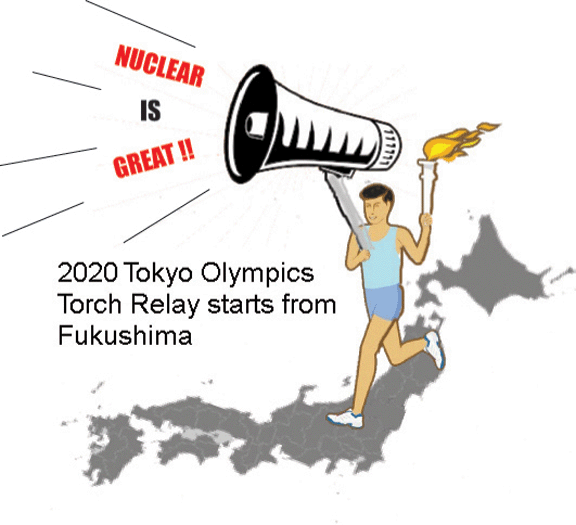
Tokyo Olympic torch relay begins in Fukushima as Japan tries to boost confidence in the delayed event
ABC, By North Asia correspondent Jake Sturmer and Yumi Asada in Fukushima, 26 Mar 21, “………..Japan remains sceptical of the scandal-ridden Games
Organisers hope this relay — and stories like Reina’s — will shift the mood in favour of the Olympics in Japan.
Opinion polls have consistently shown that a majority of Japanese want the Games postponed or cancelled.
Sexism scandals haven’t helped either.
The president of the Organising Committee, Yoshiro Mori, resigned after saying women talked too much in meetings.
Then the creative director of the opening and closing ceremonies Hiroshi Sasaki resigned after suggesting well-known Japanese comedian Naomi Watanabe could play a role in the ceremonies as an ‘Olympig’…………. https://www.abc.net.au/news/2021-03-25/tokyo-olympics-torch-relay-begins-after-pandemic-delay/100025394
The nuclear weapons issue is a women’s issue
During Women’s History Month, thank women for preventing nuclear disaster (Commentary)https://www.syracuse.com/opinion/2021/03/during-womens-history-month-thank-women-for-preventing-nuclear-disaster-commentary.html 26 Mar 21, By Wendy Yost | Syracuse Peace Council Wendy Yost, of Syracuse, writes on behalf of the Nuclear Free World Committee of the Syracuse Peace Council.
Depending on how old you are, you may remember the 1950s and ’60s “duck and cover” drills in elementary school and signs leading to the atomic bomb shelters in public buildings. Or you may remember the Cuban Missile crisis when the world came dangerously close to nuclear war. Then, and now, most of us probably had or have no true idea of the devastation that such a war would bring.
During Women’s History month, we should thank women for bringing some sanity to the insanity of the Cold War. In 1961 Bella Abzug and Dagmar Wilson founded “Women Strike for Peace.” Their goal was to stop nations from nuclear testing. The movement brought 50,000 women in 60 different cities together in protest. Coretta Scott King served as the organization’s delegate to an international disarmament conference in 1962. The public pressure brought by these women and the near-disaster of the Cuban Missile crisis helped bring the Soviet Union, United Kingdom and U.S. together to sign the Limited Nuclear Test Ban Treaty, prohibiting nuclear testing underwater, in outer space and in the atmosphere in 1963. This marked the beginning of a series of hard-won international agreements that have helped prevent nuclear war since the 1960s.
Bella Abzug framed the nuclear issue as a women’s issue in saying “… We are entitled to our shared economic resources of the country. We are entitled to equal pay for comparable work … We are entitled to have some hope for our family with a decent environment. We are permanently entitled to world peace, which is the only way in which we can rebuild and restructure this society to make it for all people.”
These words ring true for our time. In 2021, women are disproportionately impacted by the pandemic in lost wages and increased responsibilities for childcare, education, and emotional support for stressed kids. While our predominantly male Congress has debated the country’s ability to afford childcare subsidies, extended unemployment benefits, child tax credits and support to reopen schools safely, our government spends approximately $67.5 billion per year on nuclear weapons. At the same time, the world has become less safe from nuclear weapons as international agreements have ended and diplomacy has been hollowed out and denigrated by the Trump administration.
There are hopeful signs as the Biden administration has recommitted efforts to end the nuclear threat by already negotiating an extension of the New START Treaty with Russia, reviving efforts to negotiate with Iran over nuclear weapons, and committing to reduced U.S. expenditures on nuclear weapons of annihilation. Notably, Biden has nominated several women to senior positions that involve nuclear non-proliferation including Bonnie Jenkins as Undersecretary of State for Arms Control and Mallory Stewart as Senior Director for Arms Control and National Non-Proliferation for the National Security Council. These appointments are historic in nature for appointing women to top positions who have spent their careers working for peace, security and nuclear non-proliferation.
Let’s have Women’s History Month in 2021 be a time for women (and men) commit to making history by working for a world that is safe from nuclear weapons and a world where resources are committed to life-affirming programs and policies. This means supporting, expecting and demanding that the new administration meet and exceed its commitments to quell the threat of nuclear war. Visit preventnuclearwar.org and or peacecouncil.net/programs/nuclear-free-world-committee to learn more and take action.
Morrison government seeks greater powers to direct taxpayer funds into gas pipelines — RenewEconomy

Forms to the NAIF, designed to give the Morrison government a greater ability to channel its $5 billion funds into gas infrastructure, pass the lower house. The post Morrison government seeks greater powers to direct taxpayer funds into gas pipelines appeared first on RenewEconomy.
Morrison government seeks greater powers to direct taxpayer funds into gas pipelines — RenewEconomy
Why Australia doesn’t need new baseload to replace old coal — RenewEconomy

As federal parliament prepares to undertake yet another review of Australia’s future energy system needs, experts explain why new baseload is not one of them. The post Why Australia doesn’t need new baseload to replace old coal appeared first on RenewEconomy.
Why Australia doesn’t need new baseload to replace old coal — RenewEconomy
Forcing gas generation into NSW is a loser policy — RenewEconomy

The federal government’s attempts to force new gas generation into NSW is sign of just how badly it’s running energy policy. In truth, there is no real policy. The post Forcing gas generation into NSW is a loser policy appeared first on RenewEconomy.
Forcing gas generation into NSW is a loser policy — RenewEconomy
March 26 Energy News — geoharvey

Opinion: ¶ “Assisting Evolution: How Much Should We Help Species Adapt?” • It may no longer be enough to protect species from a changing environment – we may have to assist in their evolution if they are to survive the 21st Century. To protect natural species, it has come to the point that it may […]
March 26 Energy News — geoharvey
Might have to leave WordPress. I find their new system not user-friendly
For 13 years, this has been a great posting system. Now it has been ”upgrsaded” to a system tha is almost unuseable. Ir looks smarter, but has lost important features. For example, the ability to easily retrieve old posts. I have contacted WordPress to try to get back the practical, useable “Classic Posts”. If that cant be done, I’ll be moving from WordPress to a different blog system.
Australian govt quietly dumps French submarine purchase plan
 | |||
Paul Richards Fight to stop a nuclear waste dump in South Australia, 25 Mar 21, .Noted, this week, the French Subs have been dropped, these were diesel.That media story I picked up on military media.Watch and wait, in all probability we will have a nuclear sub announced next. https://www.facebook.com/groups/344452605899556
Australian-French submarine contract on verge of being abandoned
Australian-French submarine contract on verge of being abandoned
Independent Australia
1st March 2021, The submarine deal France proudly called ‘the contract of the Century’ appears to have collapsed, reports Alan Austin.
IF THERE WAS one thing which should unite all media commentators, economic and military analysts, and informed citizens in outrage against the Morrison Government, it is this. The Government has wasted billions of dollars on a deal to buy 12 new submarines which have virtually no chance of fulfilment.
As this is written, the head of the French naval construction company Naval Group, Pierre Eric Pommellet, is in Australia meeting federal ministers in an attempt to rescue the contract. Tragically for Australia – and for Monsieur Pommellet – not one of those ministers has the experience or competence to wrangle a successful result.
Many informed commentators in France, Australia and elsewhere now expect the much-celebrated deal to be abandoned. If that happens, replacing the current ageing submarines would be delayed many years, depending on the timing of the change of government to a capable administration.
Although defence is just one example of Coalition mismanagement, this is where Australia’s losses are arguably most devastating: both in billions of dollars wasted and in the risk to national security.
Like a fish out of water: Australia’s submarine project is a flop
Responsibility for the project
Multiple failures are evident. The most basic is accountability. Since negotiations with France began, Australia has had three prime ministers, three deputy PMs, three failed treasurers, five defence ministers and four ministers for defence industry. Of the 15 individuals to have held these portfolios, seven have left the Parliament. None remaining has the competence to deliver for Australia or the mettle to take responsibility. The current Defence Minister is in hospital on leave.
Political priorities paramount
A major factor in dashing into the connection with France was the set of promises the Coalition hoped to make chasing votes. In the run-up to the 2019 election, then Minister for Defence Industry Christopher Pyne promised hundreds of new jobs, the “majority of which will be based in South Australia”.
Cost and defence considerations were secondary.
Many military observers were dismayed at Australia taking the French Shortfin Barracudas over the lower-cost and more suitable alternatives tendered by Japan and Germany.
Design and cost errors
Several of Australia’s specifications were plain foolish, as Binoy Kampmark summarised for IA. A nuclear submarine with a diesel-electric engine is a fail. An American combat system won’t work in a French vessel because the Americans and the French do not talk. Lead-acid batteries will be obsolete well before the subs are delivered.
France’s original tender documents put the cost of the project at between $20 billion and $25 billion. The cost in the initial agreement signed in late 2016 was $50 billion.
By February 2020, the Parliamentary Library research service reported that the acquisition cost:
Today, estimates range up to double that quantum.
White elephants of the sea: The French-Australian submarine agreement
Missed deadlines
Delays so far have pushed back delivery of the first Barracuda from the mid-2020s to the early 2030s and now to the 2040s. The latest missed date was finalising the critical Strategic Partnering Agreement which governs the entire project. This was due before last Christmas.
Australian content in labour and components
This is the main area of contestation between the French company and the Morrison ministry. The Defence Minister is holding out for 60 per cent local input, down from 90 per cent when the project was first announced. The French now insist it must be much less as Australia cannot deliver. This was not settled before the production agreement was signed in 2018.
How many subs are needed?
Replacing the current six Collins-class vessels is certainly justifiable and possibly increasing that to seven or eight.
Comparisons with other countries suggest 12 is excessive………..
Excessive secrecy, even from the Senate
Compounding all these failures is Morrison’s Cabinet refusing to be answerable to the Parliament. In an ugly confrontation in last month’s Senate Economics References Committee, Defence Department head Greg Moriarty refused point-blank to provide documents which the Committee had the constitutional right to access.
Independent Senator Rex Patrick warned Moriarty:
Moriarty steadfastly refused the Committee’s requests, insisting he would do the bidding of the craven Minister and Cabinet.
The remedy
Thus the solution is for the people of Australia to get rid of this secretive bungling regime at the earliest opportunity: to save hundreds of billions of dollars and to ensure effective military capability. https://www.bignewsnetwork.com/news/267973668/australian-french-submarine-contract-on-verge-of-being-abandoned
Impacts from Fukushima Nuclear Disaster Still Remain Ahead of Tokyo 2020 Olympics
UAlbany Professor: Impacts from Fukushima Nuclear Disaster Still Remain Ahead of Tokyo 2020 Olympics https://www.newswise.com/articles/ualbany-professor-impacts-from-fukushima-nuclear-disaster-still-remain-ahead-of-tokyo-2020-olympics?ta=home
| by University at Albany, State University of New York ALBANY, N.Y. (March 24, 2021) – The postponed torch relay for the Tokyo 2020 Olympics is set to officially kick off tomorrow, traveling across all 47 prefectures in Japan over 121 days and landing at the Olympic Stadium for the Opening Ceremony on July 23. The starting point of the relay is the J-Village soccer training center in Fukushima which, 10 years ago this month, was used as an operational base after a nuclear disaster in the region that was triggered by a massive earthquake and tsunami. While this is meant to be symbolism of Fukushima’s recovery, Thomas Bass, a professor of English and Journalism at the University at Albany, recently published an article in the Bulletin of the Atomic Scientists that argues many long-lasting impacts from the tragedy still remain and are largely ignored.“ The torch for the 2020 Olympics – delayed for a year by the coronavirus pandemic but still called the ‘2020 Olympics’ – is scheduled to be lit on March 25… 12 miles south of Fukushima Daiichi, where this March also marks something else: the 10th anniversary of the meltdown of three of the six nuclear reactors at the generating complex known as Fukushima No. 1, or F1.” “After a lighting ceremony… the Olympic torch will be run for three days through Fukushima’s nuclear exclusion zone. Japan hopes to focus our attention on the refurbished schools and town halls, re-opened train stations, and two new museums that have been built in Fukushima, while trying to keep the TV cameras away from the ruined houses and radioactive cars lying nearby.” Bass argues that there is a public safety risk, not only for the athletes, but also for the residents of the region who continue to be exposed to dangerous levels of radiation.“The generally accepted safety standard for radiation exposure is one milliSievert, or one-thousandth of a Sievert, per year… The Japanese government now allows individuals in Fukushima prefecture to be exposed to 20 milliSieverts per year.” Bass has taught at UAlbany for more than 15 years and is the author of seven books, including “The Eudaemonic Pie” and “The Predictors,” as well as several books on Asia. He has also written numerous articles for Wired, The New York Times, The New Yorker, Smithsonian, Discover, and other magazines. |
Why Small Modular Nuclear Reactors Won’t Help Counter the Climate Crisis
One in a series of articles on “None of the Above”Small modular nuclear reactors, or SMRs, are designed to generate less than 300 megawatts of electricity – several times less than typical reactors, which have a range of 1,000 to 1,600 MW. While the individual standardized modules would be small, plans typically call for several modules to be installed at a single power generation site. The nuclear industry and the U. S. Department of Energy are promoting the development of SMRs, supposedly to head off the most severe impacts of climate change. But are SMRs a practical and realistic technology for this purpose?
Why Small Modular Nuclear Reactors Won’t Help Counter the Climate Crisis https://www.ewg.org/energy/23534/why-small-modular-nuclear-reactors-won-t-help-counter-climate-crisiswhy-small-modular
To answer, two factors are paramount to consider – time and cost. These factors can be used to divide SMRs into two broad categories:Light water reactors based on the same general technical and design principles as present-day power reactors in the U.S., which in theory could be certified and licensed with less complexity and difficulty.Designs that use a range of different fuel designs, such as solid balls moving through the reactor core like sand, or molten materials flowing through the core; moderators such as graphite; and coolants such as helium, liquid sodium or molten salts.On both counts, the prospects for SMRs are poor. Here’s why.
Economics and scale
Nuclear reactors are large because of economies of scale. A reactor that produces three times as much power as an SMR does not need three times as much steel or three times as many workers. This economic penalty for small size was one reason for the early shutdown of many small reactors built in the U.S. in the 1950s and 1960s.Proponents of SMRs claim that modularity and factory manufacture would compensate for the poorer economics of small reactors. Mass production of reactor components and their manufacture in assembly lines would cut costs. Further, a comparable cost per kilowatt, the argument goes, would mean far lower costs for each small reactor, reducing overall capital requirements for the purchaser.The road to such mass manufacturing will be rocky.
Even with optimistic assumptions about how quickly manufacturers could learn to improve production efficiency and lower cost, thousands of SMRs, which would all be higher priced in comparison to large reactors, would have to be manufactured for the price per kilowatt for an SMR to be comparable to that of a large reactor.If history is any guide, the capital cost per kilowatt may not come down at all. At a fleet-wide level, the learning rate in the U.S. and France, the two countries with the highest number of nuclear plants, was negative – newer reactors have been, on the whole, more expensive than earlier ones. And while the cost per SMR will be lower due to much smaller size, several reactors would typically be installed at a single site, raising total project costs for the purchaser again.
Mass manufacturing aspects
If an error in a mass-manufactured reactor were to result in safety problems, the whole lot might have to be recalled, as was the case with the Boeing 737 Max and 787 Dreamliner jetliners. But how does one recall a radioactive reactor? What will happen to an electricity system that relies on factory-made identical reactors that need to be recalled? These questions haven’t been addressed by the nuclear industry or energy policy makers – indeed, they have not even been posed. Yet recalls are a predictable and consistent feature of mass manufacturing, from smartphones to jet aircraft.The problem is not merely theoretical.
One of the big economic problems of pressurized water reactors, the design commonly chosen for light water SMRs, including the NuScale design, which has received conditional certification from the Nuclear Regulatory Commission, was the need to prematurely replace the steam generators – the massive, expensive heat exchangers where the high-pressure hot water from the reactor is converted to the steam that drives the turbine-generators. In the last decade, such problems led to the permanent shutdown of two reactors at San Onofre, in Southern California, and one reactor at Crystal River, in Florida.Several SMR light water designs place steam generators inside the reactor vessel (Figure 1).(on original) Replacement would be exceedingly difficult at best; problems with the steam generator could result in permanent reactor shutdown.
We have already seen problems with modular construction. It was a central aspect of the design of the Westinghouse AP1000 reactor, yet the AP1000 reactors built in the U.S. and China have had significant construction cost overruns and schedule delays. In 2015, a former member of the Georgia Public Service Commission told The Wall Street Journal, “Modular construction has not worked out to be the solution that the utilities promised.”
The need for mass manufacturing also creates a chicken-and-egg economic problem. Without the factories, SMRs can never hope to achieve the theoretical cost reductions that are at the heart of the strategy to compensate for the lack of economies of scale. But without the cost reductions, there will not be the large number of orders to stimulate the investments needed to set up the supply chain in the first place.
The SMR track record so far
The track record so far points to the same kind of dismal economic failure for SMRs as their larger cousins. Figure 2 [on original] shows the capital cost escalation for the proposed NuScale reactor and actual costs of two foreign SMRs. As a result, the total cost of a proposed project in Idaho using the NuScale design has already risen from around $3 billion, in 2015, to $6.1 billion, in 2020, long before any concrete has been poured.
This pattern of escalations can also be anticipated for other SMR concepts, especially those not based on light water reactors. For instance, the proposed Natrium reactor – at 345 MW, slightly bigger than an SMR – is sodium-cooled. Despite about a hundred billion dollars spent worldwide since 1950, sodium cooled reactors have been commercial failures globally.
The process of getting safety approvals for such designs will likely take longer and be more expensive. In many cases, even setting up the certification process will take years, since the safety and accident modes differ with each design type. For instance, one risk with high-temperature gas-graphite reactors is fires, rather than meltdowns. To give a sense of scale of the expense, the NuScale SMR, which is the familiar light water design, is expected to cost roughly $1.5 billion just for development and certification. New non-light water designs will very likely cost more and take longer to develop from the concept stage to licensing review and approval.
For SMRs to consistently achieve the same cost of power production as the present large reactors would be a monumental task – and given the high costs of large reactors, SMRs would still be an economic failure. The costs of wind and solar electricity have been declining consistently and are projected to decline more.
Lazard, a Wall Street financial advisory firm, estimates the cost of utility-scale solar and wind to be about $40 per megawatt-hour. The corresponding figure for nuclear is four times as high, about $160 per MWh – a difference that is more than enough to use complementary technologies, such as demand response and storage, to compensate for the intermittency of solar and wind.
SMR proponents suggest that nuclear power might provide a suitable complement to variable electricity sources, such as wind or photovoltaic power, whose shares in the electricity grid have been increasing. But such deployment would incur a significant cost penalty.
Nuclear reactors, whether small or large, are not very suitable for responding to variability, because they have high fixed costs (capital) and low variable costs (fuel and maintenance). This is why nuclear power plants have been used as a baseload electricity source – they spread out the fixed costs over the largest number of kilowatt-hours, making each one cheaper. Responding to variability will mean operation at partial load for much of the time, raising costs.
Trying to use SMRs for producing other commodities, such as clean water, by desalinating seawater or using hydrogen or high-temperature heat, is also not economical for a variety of reasons, most importantly, the high cost of the energy supply – i.e., nuclear power.
SMRs and the climate crisis
The climate problem is urgent. The IPCC and other international bodies have warned that to stop irreversible damage from climate change, we need to reduce emissions drastically within the next decade. The SMR contribution in the next decade will be essentially zero. The prospects for SMRs beyond that are also bleak, given that entire supply chains would need to be established after the first ones have been built, tested and proven in the field.
Nearly two decades after that rosy notion, the earliest official projected deployment date is only 2029 to 2030 for the leading design, NuScale. Even that date is highly uncertain, because the Nuclear Regulatory Commission’s Advisory Committee on Reactor Safeguards has identified serious safety concerns that will have to be addressed before any utility applies for permission to construct an SMR. Significantly, a central concern involves the steam generator, which, as noted above, is inside the reactor vessel and a potential source of reliability and economic problems.
SMRs also divert valuable public money. For example, the federal government has contributed at least $314 million to the development of the NuScale SMR design and has reportedly agreed to spend up to $350 million in new matching funds. Babcock & Wilcox received over $100 million from the DOE for its mPower design but abandoned the project in 2017 because there were no customers.
SMRs and the climate crisis
The climate problem is urgent. The IPCC and other international bodies have warned that to stop irreversible damage from climate change, we need to reduce emissions drastically within the next decade. The SMR contribution in the next decade will be essentially zero. The prospects for SMRs beyond that are also bleak, given that entire supply chains would need to be established after the first ones have been built, tested and proven in the field.
Nearly two decades after that rosy notion, the earliest official projected deployment date is only 2029 to 2030 for the leading design, NuScale. Even that date is highly uncertain, because the Nuclear Regulatory Commission’s Advisory Committee on Reactor Safeguards has identified serious safety concerns that will have to be addressed before any utility applies for permission to construct an SMR. Significantly, a central concern involves the steam generator, which, as noted above, is inside the reactor vessel and a potential source of reliability and economic problems.
SMRs also divert valuable public money. For example, the federal government has contributed at least $314 million to the development of the NuScale SMR design and has reportedly agreed to spend up to $350 million in new matching funds. Babcock & Wilcox received over $100 million from the DOE for its mPower design but abandoned the project in 2017 because there were no customers.
Conclusion
There is no realistic prospect that SMRs can make a significant dent in the need to transition rapidly to a carbon-free electricity system. The prospects of timely contributions by even the light water designs, with NuScale being the most advanced in schedule, are dismal. The prospects for reactors of other designs, like those with graphite fuels or sodium cooling, are even more so.
It will be a tough road for SMRs to achieve cost parity with large reactors. And that cost will still be far too high. Two things are in critically short supply on the road to a climate-friendly energy system: time and money. An objective evaluation indicates that SMRs are poor on both counts. There is simply no realistic prospect for SMRs to play materially significant role in climate change mitigation.
Arjun Makhijani is an electrical and nuclear engineer who is president of the Institute for Energy and Environmental Research. M.V. Ramana is the Simons Chair in Disarmament, Global and Human Security and Director of the Liu Institute for Global Issues at the School of Public Policy and Global Affairs, University of British Columbia, in Vancouver, Canada.
Resources by authors
Taylor requests yet another review of future grid needs, to deal with “intermittents” — RenewEconomy

The Morrison government instigates yet another inquiry into the energy system, and it has already backed coal and sidelined renewables before it even started. The post Taylor requests yet another review of future grid needs, to deal with “intermittents” appeared first on RenewEconomy.
Taylor requests yet another review of future grid needs, to deal with “intermittents” — RenewEconomy
Australia’s first mass-made electric trucks go into production — RenewEconomy

SEA Electric announces launch of first locally-assembled volume-produced electric trucks, the SEA 300 and SEA 500. The post Australia’s first mass-made electric trucks go into production appeared first on RenewEconomy.
Australia’s first mass-made electric trucks go into production — RenewEconomy
Australia’s big four banks drag heels on fossil fuel finance: new report — RenewEconomy

A new report on the global supply of finance to fossil fuel companies shows Australia’s big four banks are doing terribly. The post Australia’s big four banks drag heels on fossil fuel finance: new report appeared first on RenewEconomy.
Australia’s big four banks drag heels on fossil fuel finance: new report — RenewEconomy
Solar tax: Networks able to charge households to export solar power to grid — RenewEconomy

Households may soon be taxed for solar exports sent back to the grid, but the rule maker promises this will eliminate current constraints on exports and make the system fairer. The post Solar tax: Networks able to charge households to export solar power to grid appeared first on RenewEconomy.
Solar tax: Networks able to charge households to export solar power to grid — RenewEconomy
1 This month.

PETITION – To: Prime Minister Anthony Albanese and the Australian Labor Government
Chernobyl: The Lost Tapes – A good documentary on Chernobyl on SBS available On Demand for the next 3 weeks– https://www.sbs.com.au/ondemand/tv-program/chernobyl-the-lost-tapes/235274195556

19 May – Webinar- Webinar: No Nuclear Weapons in Australia
Start: 2026-05-19 18:00:00 UTC Canberra, Melbourne, Sydney (GMT+10:00)
End: 2026-05-19 19:30:00 UTC Canberra, Melbourne, Sydney (GMT+10:00)
20 May – Webinar – The dangerous world of AUKUS, US, military occupation and suppression of dissent

National Webinar, 20th May, 2026, 6.30pm AEST. Confronting laws restricting/suppressing protest speech and action
Speakers: Former Sen. Rex Patrick, Lawyer Nick Hanna ,Arthur Rorris ,Jorgen Doyle, Sen David Shoebbridge,
Facilitator Kelley Tranter.

of the week – Australians for War Powers Reform (AWPR)
To see nuclear-related stories in greater depth and intensity
 Antinuclear