Stats of Convenience: Morrison selling his climate spin to rest of the world — RenewEconomy

Morrison deploys his usual spin on Australia’s climate efforts in call with US special envoy John Kerry, but will the world fall for it? The post Stats of Convenience: Morrison selling his climate spin to rest of the world appeared first on RenewEconomy.
Stats of Convenience: Morrison selling his climate spin to rest of the world — RenewEconomy
Conclusions of safety assessment of advanced nuclear reactors – non-light-water ones
|
Assessing the Safety, Security, and Environmental Impacts of Non-Light-Water Nuclear Reactors,Union of Concerned Scientists, Edwin Lyman Mar 18, 2021 “Advanced” Isn’t Always Better ” ”……….Conclusions of the AssessmentThe non-light-water nuclear reactor landscape is vast and complex, and it is beyond the scope of this report to survey the entire field in depth. Nevertheless, enough is clear even at this stage to draw some general conclusions regarding the safety and security of NLWRs and their prospects for rapid deployment. Based on the available evidence, the NLWR designs currently under consideration (except possibly once-through, breed-and-burn reactors) do not offer obvious improvements over LWRs significant enough to justify their many risks. Regulators and other policymakers would be wise to look more closely at the nuclear power programs under way to make sure they prioritize safety and security. Future appropriations for NLWR technology research, development, and deployment should be guided by realistic assessments of the likely societal benefits that would result from the investment of billions of taxpayer dollars. Little evidence supports claims that NLWRs will be significantly safer than today’s LWRs. While some NLWR designs offer some safety advantages, all have novel characteristics that could render them less safe. All NLWR designs introduce new safety issues that will require substantial analysis and testing to fully understand and address—and it may not be possible to resolve them fully. To determine whether any NLWR concept will be significantly safer than LWRs, the reactor must achieve an advanced stage of technical maturity, undergo complete comprehensive safety testing and analysis, and acquire significant operating experience under realistic conditions. The claim that any nuclear reactor system can “burn” or “consume” nuclear waste is a misleading oversimplification. Reactors can actually use only a fraction of spent nuclear fuel as new fuel, and separating that fraction increases the risks of nuclear proliferation and terrorism. No nuclear reactor can use spent nuclear fuel directly as fresh fuel. Instead, spent fuel has to be “reprocessed”—chemically treated to extract plutonium and other TRU elements, which must then be refabricated into new fuel. This introduces a grave danger: plutonium and other TRU elements can be used in nuclear weapons. Reprocessing and recycling render these materials vulnerable to diversion or theft and increases the risks of nuclear proliferation and terrorism—risks that are costly to address and that technical and institutional measures cannot fully mitigate. Any fuel cycle that requires reprocessing poses inherently greater proliferation and terrorism risks than the “once-through” cycle with direct disposal of spent fuel in a geologic repository. Some NLWRs have the potential for greater sustainability than LWRs, but the improvements appear to be too small to justify their proliferation and safety risks. Although some NLWR systems could use uranium more efficiently and generate smaller quantities of long-lived TRU isotopes in nuclear waste, for most designs these benefits could be achieved only by repeatedly reprocessing spent fuel to separate out these isotopes and recycle them in new fuel—and that presents unacceptable proliferation and security risks. In addition, reprocessing plants and other associated fuel cycle facilities are costly to build and operate, and they increase the environmental and safety impacts compared with the LWR once-through cycle. Moreover, the sustainability increases in practice would not be significant in a reasonably foreseeable time frame. Once-through, breed-and-burn reactors have the potential to use uranium more efficiently without reprocessing, but many technical challenges remain. One type of NLWR system that could in principle be more sustainable than the LWR without increasing proliferation and terrorism risks is the once-through, breed-and-burn reactor. Concepts such as TerraPower’s traveling-wave reactor could enable the use of depleted uranium waste stockpiles as fuel, which would increase the efficiency of uranium use. Although there is no economic motivation to develop more uranium-efficient reactors at a time when uranium is cheap and abundant, reducing uranium mining may be beneficial for other reasons, and such reactors may be useful for the future. However, many technical challenges would have to be overcome to achieve breed-and-burn operation, including the development of very-high-burnup fuels. The fact that TerraPower suspended its project after more than a decade of development to pursue a more conventional and far less uranium-efficient SFR, the Natrium, suggests that these challenges have proven too great. High-assay low enriched uranium (HALEU) fuel, which is needed for many NLWR designs, poses higher nuclear proliferation and nuclear terrorism risks than the lower-assay LEU used by the operating LWR fleet. Many NLWR designs require uranium enriched to higher levels than the 5 percent U-235 typical of LWR fuel. Although uranium enriched to between 10 and 20 percent U-235 (defined here as HALEU) is considered impractical for direct use in nuclear weapons, it is more attractive for weapons use—and requires more stringent security—than the lower-assay enriched uranium in current LWRs. The significant time and resources needed to safely commercialize any NLWR design should not be underestimated. It will likely take decades and many billions of dollars to develop and commercially deploy any NLWR design, together with its associated fuel cycle facilities and other support activities. Such development programs would come with a significant risk of delay or failure and require long-term stewardship and funding commitments. And even if a commercially workable design were demonstrated, it would take many more years after that to deploy a large number of units and operate them safely and reliably. Vendors that claim their NLWRs could be commercialized much more quickly typically assume that their designs will not require full-scale performance demonstrations and extensive safety testing, which could add well over a decade to the development timeline. However, current designs for sodium-cooled fast reactors and high-temperature gas-cooled reactors differ enough from past reactor demonstrations that they cannot afford to bypass additional full-scale prototype testing before licensing and commercial deployment. Molten salt–fueled reactors have only had small-scale demonstrations and thus are even less mature. NLWRs deployed commercially at premature stages of development run a high risk of poor performance and unexpected safety problems. Recommendations Continue reading |
Nuclear reactors – “Advanced” Isn’t Always Better”
|
Assessing the Safety, Security, and Environmental Impacts of Non-Light-Water Nuclear Reactors,Union of Concerned Scientists, Edwin Lyman Mar 18, 2021 “Advanced” Isn’t Always Better ”……………………….Key Questions for Assessing NLWR Technologies It is critical that policymakers, regulators, and private investors fully vet the claims that the developers of NLWRs are making and accurately assess the prospects for both successful development_ and_ safe, secure, and cost-effective deployment. Given the urgency of the climate crisis, rigorous evaluation of these technologies will help our nation and others avoid wasting time or resources in the pursuit of high-risk concepts that would be only slightly better— or perhaps worse—than LWRs. Key questions to consider are the following:
To help inform policy decisions on these questions, the Union of Concerned Scientists (UCS) has evaluated certain claims about the principal types of NLWRs. In particular, this report compares several classes of NLWRs to LWRs with regard to safety and security, the risks of nuclear proliferation and nuclear terrorism, and “sustainability”—a term that in this context includes the often-claimed ability of some NLWRs to “recycle” nuclear waste and use mined uranium more efficiently. The report also considers the potential for certain NLWRs to operate in a once-through, “breed-and-burn” mode that would, in theory, make them more uranium-efficient without the need to recycle nuclear waste—a dangerous process that has significant nuclear proliferation and terrorism risks. Continue reading
|
March 18 Energy News — geoharvey

Opinion: ¶ “Rooftop Solar In California Is Ready To Take The Next Step” • California leads the nation in fighting climate change because of state policies that have accelerated clean energy investment. As clean energy blooms in California, these policies need to mature and evolve to continue to be effective. That includes the case of […]
March 18 Energy News — geoharvey
New report finds investing in renewable energy is far better bet than fossil fuels — RenewEconomy

Imperial College Business School says renewable power saw significantly higher total returns over the past ten years than fossil fuels. The post New report finds investing in renewable energy is far better bet than fossil fuels appeared first on RenewEconomy.
New report finds investing in renewable energy is far better bet than fossil fuels — RenewEconomy
BHP, Rio Tinto given carte blanche to export uranium to global hotspots
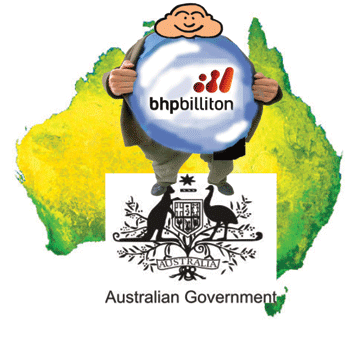 Risky Business: BHP, Rio Tinto given carte blanche to export uranium to global hotspots https://www.michaelwest.com.au/bhp-rio-tinto-given-carte-blanche-to-export-uranium-to-global-hotspots/ Risky Business: BHP, Rio Tinto given carte blanche to export uranium to global hotspots https://www.michaelwest.com.au/bhp-rio-tinto-given-carte-blanche-to-export-uranium-to-global-hotspots/by David Noonan | Mar 17, 2021 It has been 10 years since the Fukushima nuclear disaster that was fuelled by Australian uranium but neither the mining industry nor the nation’s leaders have heeded any of the lessons, instead continuing to export uranium to countries with inadequate regulation and nations beset by corruption. David Noonan and Dr Jim Green report. The Fukushima nuclear disaster, fuelled by Australian uranium mined by multinationals BHP and Rio Tinto, was entirely avoidable, as numerous reports have found. Yet neither company has taken any responsibility for the catastrophic impacts on Japanese society that resulted from the use of their uranium in a poorly regulated industry. With numerous warning signs of impending disaster at Fukushima, the mining giants and our leaders could have played an important role by making uranium exports conditional on improved management of nuclear plants and tighter regulation. Yet the uranium companies get tetchy at any suggestion of culpability, with the Australian Uranium Association describing it as “opportunism in the midst of human tragedy” and “utter nonsense”. Uranium accounts for less than 0.3 per cent of Australia’s export revenue and less than 0.1 per cent of all jobs in Australia. One wonders why an industry that delivers so little is given carte blanche by the government to do as it pleases. Australia ignored scandal after scandalWhile the mining companies won’t acknowledge that Australian uranium was used in the Fukushima reactors, the Australian Safeguards and Non-Proliferation Office confirmed Australian nuclear material was at the Fukushima Daiichi site and in at least five of the six reactors. Moreover, the mining companies can’t claim ignorance. Australia’s uranium industry did nothing as the Japanese nuclear companies lurched from scandal to scandal; accident to accident. The uranium industry did nothing in 2002 when it was revealed that TEPCO had systematically and routinely falsified safety data and breached safety regulations for 25 years or more. The uranium industry did nothing in 2007 when more than 300 incidents of ‘malpractice’ at Japan’s nuclear plants were revealed – 104 of them at nuclear power plants. It did nothing even as the ability of Japan’s nuclear plants to withstand earthquakes and tsunamis came under growing criticism from industry insiders and independent experts. And the uranium industry did nothing about the multiple conflicts of interest plaguing Japanese nuclear regulators. Exporting to countries with inadequate regulationInadequate regulation was a root cause of the Fukushima disaster yet Australia has uranium supply agreements with numerous countries with demonstrably inadequate nuclear regulation, including China, India, Russia, the United States, Japan, South Korea, and Ukraine. Likewise, Australian uranium companies and the government turn a blind eye to nuclear corruption scandals in countries with which it has agreements to supply uranium: South Korea, India, Russia and Ukraine among others. Indeed, Australia has signed up to expand its uranium trade to sell into insecure regions. In 2011 ‒ the same year as the Fukushima disaster ‒ the Australian government agreed to allow uranium exports to India. This despite inadequate nuclear regulation in India, and despite India’s ongoing expansion of its nuclear weaponry and delivery capabilities. A uranium supply agreement with the United Arab Emirates was concluded in 2013 despite the obvious risks of selling uranium into a politically and militarily volatile region where nuclear facilities have repeatedly been targeted by adversaries intent on stopping covert nuclear weapons programs. A uranium supply agreement with Ukraine was concluded in 2016 despite a host of safety and security concerns, and the inability of the International Atomic Energy Agency to carry out safeguards inspections in regions annexed by Russia. However, it is obvious that Australia will take action when it wants to. In 2014, Australia banned uranium sales to Russia, with then prime minister Tony Abbott stating: “Australia has no intention of selling uranium to a country which is so obviously in breach of international law as Russia currently is.” Australia’s uranium supply agreement with China, concluded in 2006, has not been reviewed despite abundant evidence of inadequate nuclear safety standards, inadequate regulation, lack of transparency, repression of whistleblowers, world’s worst insurance and liability arrangements, security risks, and widespread corruption. Civil society and NGO’s are campaigning to wind back Australia’s atomic exposures in the uranium trade with emphasis on uranium sales to China. China’s human rights abuses and a range of strategic insecurity issues warrant a cessation of uranium sales. China’s ongoing human rights abuses in Tibet and mass detention and forced labour against Uyghurs in Xinjiang are severe breaches of international humanitarian law and UN Treaties.` China is obviously in breach of international law on numerous counts. Uranium sales to Russia were suspended because of breaches of international law and the same standard should be applied to China. Scant regard for nuclear risksChina has exported nuclear weapons know-how to Pakistan, targets Australia in cyber-attacks, and is causing regional insecurity on the India border, in Hong Kong and Taiwan, and in the Pacific. BHP’s Olympic Dam is the only company still selling Australian uranium into China. There is a case for the ‘Big Australian’ to forego uranium sales overall and an onus to end sales to China. Australia supplies uranium with scant regard for nuclear safety risks. Likewise, proliferation risks are given short shrift. Australia has uranium export agreements with all of the ‘declared’ nuclear weapons states – the US, UK, China, France, Russia – although not one of them takes seriously its obligation under the Non-Proliferation Treaty to pursue disarmament in good faith. Australia claims to be working to discourage countries from producing fissile (explosive) material for nuclear bombs, but nonetheless exports uranium to countries blocking progress on the proposed Fissile Material Cut-Off Treaty and refusing to sign or ratify the Comprehensive Test Ban Treaty. And Australia gives Japan open-ended permission to separate and stockpile plutonium although that stockpiling fans regional proliferation risks and tensions in North-East Asia. Despite liberal export policies, Australian uranium sales are in long-term decline and now represent only 8.9 per cent of world uranium usage. With the Ranger mine shut down and no longer processing ore for uranium exports, there are only two operating uranium mines in Australia: BHP’s Olympic Dam copper-uranium mine and the smaller General Atomics’ Beverley Four Mile operation ‒ both in South Australia. |
|
Don’t believe hydrogen and nuclear hype – they can’t get us to net zero carbon by 2050
 Don’t believe hydrogen and nuclear hype – they can’t get us to net zero carbon by 2050 https://www.theguardian.com/commentisfree/2021/mar/16/hydrogen-nuclear-net-zero-carbon-renewables Don’t believe hydrogen and nuclear hype – they can’t get us to net zero carbon by 2050 https://www.theguardian.com/commentisfree/2021/mar/16/hydrogen-nuclear-net-zero-carbon-renewables
Jonathon Porritt, 15 Mar,21, Big industry players pushing techno-fixes are ignoring the only realistic solution to the climate crisis: renewables.
ow that the whole world seems to be aligned behind the goal of net zero carbon emissions by 2050, the nuclear industry is straining every sinew to present itself as an invaluable ally in the ambitious aim. Energy experts remain starkly divided on whether or not we can reach this global net zero target without nuclear power, but regardless, it remains a hard sell for pro-nuclear enthusiasts. The problems they face are the same ones that have dogged the industry for decades: ever-higher costs, seemingly inevitable delays, no solutions to the nuclear waste challenge, security and proliferation risks. The drawbacks to nuclear are compounded by the burgeoning success of renewables – both solar and wind are getting cheaper and more efficient, year after year. There is also a growing realisation that a combination of renewables, smart storage, energy efficiency and more flexible grids can now be delivered at scale and at speed – anywhere in the world. While the majority of environmentalists continue to oppose nuclear power, there is now a significant minority, increasingly concerned about accelerating climate change, who just don’t see how we can get to that net zero comfort zone without it. They’re right to be concerned – it is a truly daunting challenge. All emissions of greenhouse gases (across the entire economy, including those from transport, heating, manufacturing and refining, farming and land use, as well as from shipping and aviation) must be brought down to as close to zero as possible, with all residual emissions compensated for by the removal of an equivalent amount of CO2 from the atmosphere. It’s the sheer scale of that challenge that has led a lot of people (including Boris Johnson with the government’s 10-point plan in November) not just to keep a flag flying for the nuclear industry, but to revisit the idea of hydrogen doing some of the heavy lifting. Hydrogen hype has become all the rage over the last 18 months, with some offering up this “clean energy technology”, as government officials insist on describing it, as the answer to all our net zero prayers. For those prayers to be answered, there will need to be a complete revolution in the way in which hydrogen is produced. As it is, 98% of the 115m tonnes used globally is “grey hydrogen”, made from natural gas or coal, that emits around 830m tonnes of CO2 per annum – 2% of total global greenhouse gas emissions. Beyond that, there’s a tiny amount of so-called “blue hydrogen” – essentially grey hydrogen but with its CO2 emissions captured and stored – and an even tinier amount of “green hydrogen” from electrolysing water, both of which are much more expensive than the climate-wrecking grey hydrogen. The gulf between that current reality, one rarely mentioned by hydrogen enthusiasts, and the prospect of readily available and affordable green hydrogen that could help us get to net zero, is absolutely vast. Don’t get me wrong: we will indeed need significant volumes of green hydrogen and it’s good that the government has set an ambitious target for 2030, in the hope that this will significantly reduce the costs of electrolysis to create it. But we need to be clear about what that green hydrogen should be used for: not for electricity; not for heating homes and non-domestic buildings; and not for cars, where electric vehicles will always be better. Instead we will need it for what are called the “hard-to-abate” sectors: for steel – replacing carbon-intensive coking coal – cement and shipping. Much of the hype for hydrogen is coming from the oil and gas sector, in the hope that gullible politicians, seduced by an unattainable vision of limitless green hydrogen, will subsidise the vast investments needed to capture the emissions from gas-powered hydrogen. Their motivation couldn’t be clearer: to postpone the inevitable decline of their industry. The nuclear industry is also desperate to get in on that game. One has to admire its capacity to pivot opportunistically. In February, the Nuclear Industry Council (made up of both industry and government representatives in the UK) published a shiny new Hydrogen Roadmap, exploring how either large-scale nuclear or small modular reactors could generate both the electricity and the heat needed to produce large amounts of green hydrogen. But the entire plan is premised on spectacular and totally speculative reductions in the cost of electrolysis. Rather than being the solution we have been waiting for, this nuclear/hydrogen development would actually be a disastrous techno-fix. Low-carbon nuclear power will always be massively more expensive than renewables and we can never build enough reactors to replace those coming offline over the next decade. We also know that producing hydrogen is always going to be very expensive. The truth is, you need a lot of electricity to produce not a lot of hydrogen. All of which makes pipe-dreams about substituting hydrogen for conventional gas in the UK’s gas grid, or of producing millions of tonnes of blue hydrogen, look almost entirely absurd. This, then, could lead to a double economic whammy of quite monstrous proportions. It would either have to be paid for through general taxation or through higher bills for consumers. That’s particularly problematic from the perspective of the 10% of households in England still living in cruel and degrading fuel poverty. Environmentalists who are tempted by this new nuclear/hydrogen hype should remember that our transition to a net zero world has to be a just transition. Every kilowatt hour of nuclear-generated power will be a much more expensive kilowatt hour than one delivered from renewables plus storage. So let’s just hold back on both the hydrogen hype and the nuclear propaganda, and concentrate instead on ramping up what we already know is cost-effectively deliverable: renewables. We need to do it as fast as we possibly can.
|
|
Nuclear power: at what cost?
Nuclear power: at what cost?
 North East Bylines 15th March 2021, Yet nuclear power with its links to nuclear weapons, its detrimental impacts on health (especially in respect of women and children), the costly disposal of
  highly toxic radioactive waste which will fall to future generations, and the susceptibility of power plants to terrorist attack, should all make us question the wisdom of continuing on this road,
especially as alternative green energy solutions are improving in design, output and cost at a rapid rate.
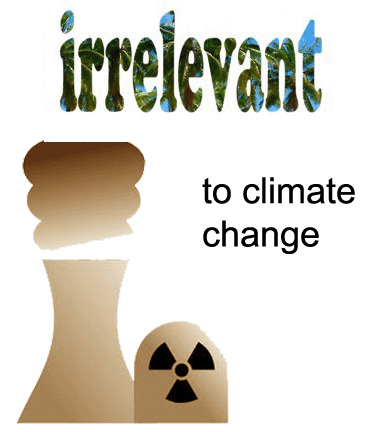
Nuclear power has become irrelevant — like it or not
 https://english.kyodonews.net/news/2021/03/1a9b07886b98-opinion-nuclear-power-has-become-irrelevant—-like-it-or-not.html, By Mycle Schneider, KYODO NEWS , 16 Mar 21,
Ten years went by since the Fukushima Daiichi accident began. What happened in the United States, historically leading the world’s nuclear power programs and still operating the largest reactor fleet in the world? What are global developments in energy policy increasingly dominated by renewable energy?
“The debate is over. Nuclear power has been eclipsed by the sun and the wind,” Dave Freeman wrote in the foreword to the World Nuclear Industry Status Report 2017.
he renowned industry thinker, called an “energy prophet” by The New York Times, passed away last year at age 94. He had seen nuclear power coming and going. President Carter appointed him as chairman of the only fully public electricity utility in the United States, the Tennessee Valley Authority in 1977.
Construction had started on two nuclear reactors in the state in 1972. It took until 1996 to complete the first one and until 2016 for the second one. Those were the last units to start up in the United States.
Construction began on four units in 2013, but in 2017, the bankruptcy of builder Westinghouse led to the abandonment of the $10 billion V.C. Summer two-unit project in South Carolina.
Construction cost estimates for the only other active construction site in the United States, the two-unit Vogtle project in Georgia, have multiplied by a factor nearing five from $6.1 billion in 2009 to $28 billion by 2018. The startup continues to be delayed.
Meanwhile, lacking newbuild, the U.S. nuclear fleet is aging and the 94 still operating reactors now exceed an average age of 40 years. Although the U.S. nuclear industry claims to have achieved decreasing operation and maintenance costs — the only nuclear country to do so — the utilities are still struggling to compete with fierce competitors from the renewable energy sector.
Solar photovoltaic plants saw their electricity-generating costs decrease by 90 percent over the past decade, and wind power is down 70 percent, while nuclear kilowatt-hour costs increased by one third.
The global nuclear industry has lost the newbuild market. Five reactors started up in 2020, while six were closed down. While there was a net nuclear capacity increase of 0.4 gigawatt, renewables added an estimated 248 gigawatt. China, the only country with a significant newbuild program, added 2 gigawatt of nuclear and 150 gigawatt of solar and wind combined.
As Freeman stated, “These renewable, free-fuel sources are no longer a dream or a projection — they are a reality that are replacing nuclear as the preferred choice for new power plants worldwide.”
No wonder despair is reigning in nuclear companies’ headquarters. Ten years after the disaster struck Japan, nuclear power has become irrelevant in the world, an industrial reality that also Japanese policymakers need to face.
(Mycle Schneider is an independent international consultant on energy and nuclear power. He is the coordinator and publisher of the annual World Nuclear Industry Status Report.)
Subsidy or not, Yallourn deal will likely set a precedent for more coal closures — RenewEconomy

Much has been gained with the Yallourn closure deal. It would not be surprising to see other generators approaching the Government along similar lines. The post Subsidy or not, Yallourn deal will likely set a precedent for more coal closures appeared first on RenewEconomy.
Subsidy or not, Yallourn deal will likely set a precedent for more coal closures — RenewEconomy
Cormann’s OECD campaign was a climate fakery trial run for Glasgow COP — RenewEconomy

Australia’s government is about to re-activate its efforts to convince the world that it’s doing enough on climate (it is not). The post Cormann’s OECD campaign was a climate fakery trial run for Glasgow COP appeared first on RenewEconomy.
Cormann’s OECD campaign was a climate fakery trial run for Glasgow COP — RenewEconomy
March 16 Energy News — geoharvey

Opinion: ¶ “Nuclear Power Has Become Irrelevant – Like It Or Not” • Ten years have gone by since the Fukushima Daiichi accident began. What has happened since that time? Dave Freeman, who has been called an “energy prophet” by The New York Times, once wrote, “The debate is over. Nuclear power has been eclipsed […]
March 16 Energy News — geoharvey
Experts urge governments to follow health advice on climate, as they did with Covid — RenewEconomy

Health experts call on governments to recognise climate change as a health emergency that requires urgent action – and claims more lives than Covid. The post Experts urge governments to follow health advice on climate, as they did with Covid appeared first on RenewEconomy.
Experts urge governments to follow health advice on climate, as they did with Covid — RenewEconomy
A breakdown of the misinformation Michael McCormack spread on Insiders — RenewEconomy

Nationals leader Michael McCormack repeated a range of climate myths on ABC’s Insiders, suggesting there’s a long way to go to net zero. The post A breakdown of the misinformation Michael McCormack spread on Insiders appeared first on RenewEconomy.
A breakdown of the misinformation Michael McCormack spread on Insiders — RenewEconomy
Renewables shine over Australian summer, as gas share slumps to new lows — RenewEconomy

Renewables supplied six times more power than gas generators over the most recent Australian summer, the Climate Council reports. The post Renewables shine over Australian summer, as gas share slumps to new lows appeared first on RenewEconomy.
Renewables shine over Australian summer, as gas share slumps to new lows — RenewEconomy
1 This month.


PETITION – To: Prime Minister Anthony Albanese and the Australian Labor Government
Chernobyl: The Lost Tapes – A good documentary on Chernobyl on SBS available On Demand for the next 3 weeks– https://www.sbs.com.au/ondemand/tv-program/chernobyl-the-lost-tapes/235274195556

19 May – Webinar- Webinar: No Nuclear Weapons in Australia
Start: 2026-05-19 18:00:00 UTC Canberra, Melbourne, Sydney (GMT+10:00)
End: 2026-05-19 19:30:00 UTC Canberra, Melbourne, Sydney (GMT+10:00)
20 May – Webinar – The dangerous world of AUKUS, US, military occupation and suppression of dissent

National Webinar, 20th May, 2026, 6.30pm AEST. Confronting laws restricting/suppressing protest speech and action
Speakers: Former Sen. Rex Patrick, Lawyer Nick Hanna ,Arthur Rorris ,Jorgen Doyle, Sen David Shoebbridge,
Facilitator Kelley Tranter.

of the week – Australians for War Powers Reform (AWPR)
To see nuclear-related stories in greater depth and intensity
 Antinuclear