Australia achieves record large solar energy output on Friday — RenewEconomy

Utility scale solar output its hits record level in Australia’s main grid on Friday, although it was still just half that of rooftop solar on households and business. The post Australia achieves record large solar energy output on Friday appeared first on RenewEconomy.
Australia achieves record large solar energy output on Friday — RenewEconomy
Isolated and alone — Beyond Nuclear International
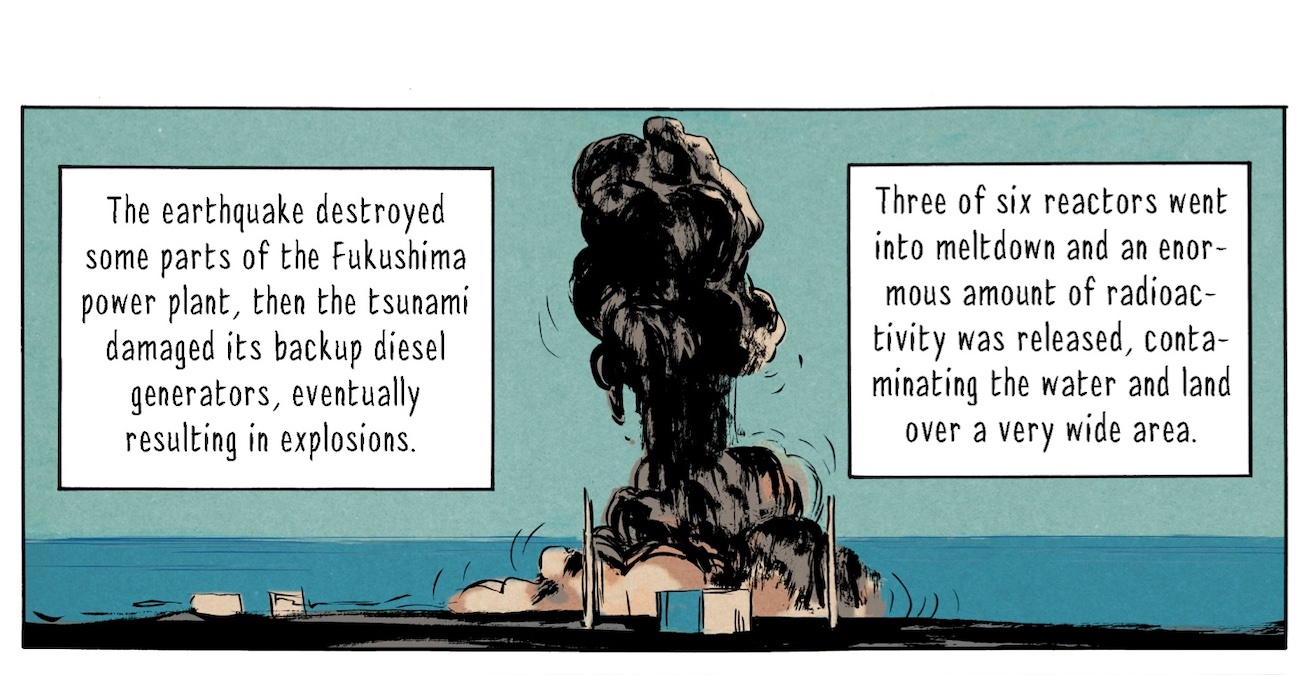
Suguru’s story reveals bullying, ostracization and government whitewash
Isolated and alone — Beyond Nuclear International
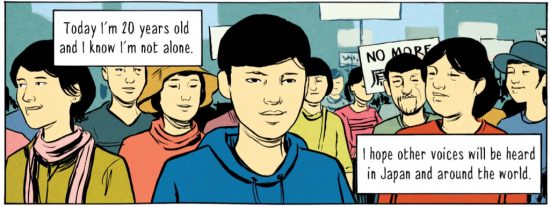
A teenager’s account of the Fukushima ordeal https://wordpress.com/read/feeds/72759838/posts/3219596582By Linda Pentz Gunter
Ten years after the March 2011 Fukushima nuclear disaster, how has the Japanese government responded and what is it like for the people affected, still struggling to return their lives to some semblance of normality? Here is how things look:
- Manuals are being distributed in schools explaining that radioactivity exists in nature and is therefore not something to be afraid of.
- The government is considering getting rid of radiation monitoring posts as these send the wrong message at a time of “reconstruction”.
- The Oversight Committee for Fukushima Prefecture Health Management Survey is discussing the possibility of stopping thyroid inspections at schools because they stress children out and overburden teachers and staff.
Depression and suicide rates among young people from Fukushima are likely to be triggered by being called “germs” and by being seen as “contaminated”.
- Those who speak out about radiation are more stigmatized today than they were 10 years ago.
- Those who “voluntarily” evacuated, recognizing that the so-called protection standards were not adequate for their region, are often ostracized from their new communities. They are seen as selfish for abandoning their homeland, friends and families “just to save themselves” and are bullied as parasites living on compensation funds, even though the “auto-evacuees” as they are known, received none.
- Those forced to evacuate are also bullied if they do not now return, accused of not trusting the government and its assertions that it is safe to do so.
- The taboo against speaking out for proper radiation protection and for compensation has grown worse as the rescheduled Olympics loom for this summer and Japan is determined to prove to the world it has fixed the radiation problem and beaten Covid-19.
- On March 1, 2021, it took three judges all of 30 seconds to dismiss a case brought by 160 parents and children who lived in Fukushima prefecture at the time of the nuclear accident, and known as the Children’s Trial Against Radiation Exposure. The class action suit sought 100,000 yen per person in damages from the government and the prefecture, due to the psychological stress brought on by the lack of measures to avoid radiation exposure after the accident.
These are some of the realities uncovered by France-based Japanese activist, Kurumi Sugita, as she interviewed those affected and began to compile a graphic short story about her findings, entitled Fukushima 3.11 and illustrated by French artist, Damien Vidal. The booklet is produced by the French NGO, Nos Voisins Lontains 3.11 (Our Distant Neighbors 3.11).
Fukushima 3.11, a long-form cartoon strip, is told in the first person by the youngest of Sugita’s interview subjects, Fukushima evacuee, Suguru Yokota, who was 13 at the time of the nuclear disaster.
Suguru was also one of the plaintiffs in the Children’s Trial, and noted after the devastating dismissal, just days before the Fukushima disaster’s 10th anniversary, that “we cannot give up” and that “the court hasn’t issued a legitimate verdict.”
In 2012, Sugita had traveled to Japan with a research project she helped create, financed by the French National Centre for Scientific Research where she worked, to set up an investigation into Japan’s nuclear victims. A list of 70 interview candidates was put together.
“I met Suguru in 2013 in Sapporo where he was living alone after he moved there from Fukushima,” said Sugita. “I also interviewed his mother and they were interviewed once a year over six years.”
A schoolboy at the time of the accident, the book follows Suguru’s account of his experiences. He encounters the refusal by his uncle to believe the dangers in the early days of the accident, “a typical denial case,” says Sugita, and he is ostracized at school where he is the only pupil to wear a mask.
Suguru’s only respite comes when his mother, who is equally alert to the radiation risks, sends him on a “radiation vacation” to Hokkaido, the first time he encounters peers who share his concerns.
Back at school and feeling isolated and alone, Suguru studies at home instead, eventually leaving the region for a different high school and then college.
The book weaves in essential information about radiation risks, and the clampdowns by the Japanese government, which withdrew support for auto-evacuees claiming, as Suguru relates it, that “these families are not victims. They are responsible for their fate.”
The book was first published in the magazine, TOPO, whose audience is predominantly teenagers and which reports on topics of current interest.
“It appealed to us to address an audience interested in world events, but not exclusively the nuclear issue,” said illustrator Vidal. “We thought our comic strip could be read by all those — and not necessarily just teenagers — who want to understand what the consequences of the nuclear accident were, and how it affected the inhabitants of Fukushima Prefecture.”
The book vividly brings home the psychological and emotional pain suffered by those who chose to recognize the true dangers posed by the Fukushima disaster, as well as the financial hardships and fracturing of families. And it exposes the depths of deliberate denial by authorities, more interested in heightened normalization of radiation exposure in the name of commerce and reputation.
Even as early as October 2011, an announcement is made that “rice produced in Fukushima Prefecture will supply school canteens again.” We see Suguru and his mother watching this news on their television, then the name-calling Suguru faces in school for bringing his own lunch. He is shown in the strip being called a “hikokumin”, which, explains Suguru, “is a really insulting word, used during the Second World War. It refers to people who are not worthy of being Japanese citizens.”
But that stigma has only become worse with time, Sugita says.
These days people are name-called “hoshano”. “Hoshano”(放射能) means radioactivity, but with a different Chinese character(放射脳) it means “radioactive brain – or brain contaminated by the fear of radioactivity”, she explains. And that is the slur in common circulation now.
Nevertheless, the book ends on a hopeful note. “Today,” concludes Suguru on the closing page, “I know I’m not alone. I hope other voices will be heard in Japan and around the world.”
It’s easy to say “never again.” But in order to ensure it, we must all continue to raise our voices, joining Suguru’s and others yearning to be heard.Read the English language version of Fukushima 3.11 on line for free. A version is also available in French. Hard copies (in French only), may be ordered from Nos Voisins Lontains 3.11 for 8€ plus shipping costs.
Fukushima Daiichi 2011-2021 — Beyond Nuclear International

Greenpeace report reveals deception and abuse
Fukushima Daiichi 2011-2021 — Beyond Nuclear International
The decontamination myth and a decade of human rights violations
The following is the Executive Summary from the new Greenpeace report. Download the full report.
As a result of a catastrophic triple reactor meltdown at the Fukushima Daiichi nuclear plant on 11 March 2011, several tens of thousands of square kilometres in Fukushima Prefecture and wider Japan were contaminated with significant amounts of radioactive caesium and other radionuclides. The first Greenpeace radiation expert team arrived in Fukushima on 26 March 2011, and Greenpeace experts have since conducted 32 investigations into the radiological consequences of the disaster, the most recent in November 2020.
This report, the latest in a series, chronicles some of our principal findings over recent years, and shows how the government of Japan, largely under prime minister Shinzo Abe, has attempted to deceive the Japanese people by misrepresenting the effectiveness of the decontamination programme as well as the overall radiological risks in Fukushima Prefecture. As the latest Greenpeace surveys demonstrate, the contamination remains and is widespread, and is still a very real threat to long term human health and the environment.
The contaminated areas comprise rice fields and other farmland, as well as a large amount of forest. Many people who lived in these areas were employed as farmers or in forestry. Residents gathered wood, mushrooms, wild fruits and vegetables from the mountain forests, and children were free to play outdoors in the woodlands and streams. Since the disaster, tens of thousands of people have been displaced from their ancestral lands. The harm extends far beyond the immediate threat to health – as well as destroying livelihoods, it has destroyed an entire way of life.
Because of the government’s actions, many thousands of evacuees have been forced to make an impossible choice: to return to their radioactively contaminated homes or to abandon their homes and land and seek to establish a new life elsewhere without adequate compensation. This amounts to economic coercion and may force individuals and families to return against their will due to a lack of financial resources and viable alternatives. Given that these people lost their livelihoods, communities, and property as a result of a nuclear disaster they had no part in creating, this is grossly unjust.
Key findings………..https://wordpress.com/read/feeds/72759838/posts/3219595498
War Mongering for Artificial Intelligence


The testimony is generously spiked with the China threat thesis
the note of warning in not being too morally shackled becomes a screech.
War Mongering for Artificial Intelligence, https://www.counterpunch.org/2021/03/02/war-mongering-for-artificial-intelligence/ BY BINOY KAMPMARK-2 March 21,
The ghost of Edward Teller must have been doing the rounds between members of the National Commission on Artificial Intelligence. The father of the hydrogen bomb was never one too bothered by the ethical niggles that came with inventing murderous technology. It was not, for instance, “the scientist’s job to determine whether a hydrogen bomb should be constructed, whether it should be used, or how it should be used.” Responsibility, however exercised, rested with the American people and their elected officials.
The application of AI in military systems has plagued the ethicist but excited certain leaders and inventors. Russian President Vladimir Putin has grandiloquently asserted that “it would be impossible to secure the future of our civilization” without a mastery of artificial intelligence, genetics, unmanned weapons systems and hypersonic weapons.
Campaigners against the use of autonomous weapons systems in war have been growing in number. The UN Secretary-General António Guterres is one of them. “Autonomous machines with the power and discretion to select targets and take lives without human involvement,” he wrote on Twitter in March 2019, “are politically unacceptable, morally repugnant and should be prohibited by international law.” The International Committee for Robot Arms Control, the Campaign to Stop Killer Robots and Human Rights Watch are also dedicated to banning lethal autonomous weapons systems. Weapons analysts such as Zachary Kallenborn see that absolute position as untenable, preferring a more modest ban on “the highest-risk weapons: drone swarms and autonomous chemical, biological, radiological, and nuclear weapons”.
The critics of such weapons systems were far away in the Commission’s draft report for Congress. The document has more than a touch of the mad scientist in the bloody service of a master. This stood to reason, given its chairman was Eric Schmidt, technical advisor to Alphabet Inc., parent company of Google, which he was formerly CEO of. With Schmidt holding the reins, we would be guaranteed a show shorn of moral restraint. “The AI promise – that a machine can perceive, decide, and act more quickly, in a more complex environment, with more accuracy than a human – represents a competitive advantage in any field. It will be employed for military ends, by governments and non-state groups.”
In his testimony before the Senate Armed Services Committee on February 23, Schmidt was all about “fundamentals” in keeping the US ascendant. Continue reading
Nuclear workers plagued by leukaemia, cancers and other illnesses
Some workers developed cancer, leukemia and other illnesses. The same held true for workers at other nuclear facilities across the nation.
The number of potentially eligible workers across the nation is uncertain. Likewise, the number of employees potentially affected at West Valley could be in the thousands when accounting for temporary workers.
“This was particularly troubling if the same workers were hired repeatedly as temporaries and received high doses each time,”
In addition, the exposure of growing numbers of individuals increased the possibility of genetic consequences for the entire population.”
 Cancer plagues West Valley nuke workers https://www.investigativepost.org/2021/03/01/cancer-plagues-west-valley-nuke-workers/
“What we were doing was insane. We were dealing with so much radiation,” he told Investigative Post from his home in New Hampshire.
“I’ve got absolutely no joints left in my knees — my knees are gone, my ankles are gone and my hips are gone,” he said.
“I wonder if it’s from working in that bathtub full of radiation.”
Pyles was one of about 200 full-time employees who operated the former Nuclear Fuel Services reprocessing facility five decades ago in the hamlet of West Valley, where the company partnered with the federal government to recycle used radioactive fuel. Other workers were hired to contain and dispose of the dangerous waste the operation left behind.
Some workers developed cancer, leukemia and other illnesses. The same held true for workers at other nuclear facilities across the nation. As a result, Congress established the Energy Employees Occupational Illness and Compensation Program in 2000.
An Investigative Post review of the program found the government has paid $20.3 million over the last two decades in cases involving at least 59 people who worked at the West Valley site.
In all, individuals have submitted claims involving 280 employees who worked at the bygone reprocessing facility or during the ongoing $3.1 billion taxpayer-funded cleanup. An undetermined number of claims have been denied; the rest are being adjudicated.
Pyles said he was unaware of the program. He isn’t alone.
The Department of Labor’s Office of the Ombudsman has repeatedly criticized outreach efforts in its annual oversight reports. Most of it has been in the form of events held near former sites. Given the passage of time and people’s movement, reaching more eligible workers is a challenge.
The workforce at West Valley involved more than full-timers. About 1,000 temporary laborers were hired by the company in any given year, according to government and media reports from the time.
The use of temporary workers was a common labor practice at the time, but few operations needed to “raise quite so large an army” as Nuclear Fuel Services, according to a Science Magazine report from the era.
The industry had a nickname for them: “sponges.”
They were hired to “absorb radiation to do simple tasks,” according to Dr. Marvin Resnikoff, a radiological waste consultant who co-authored a study of West Valley.
While working at a site like West Valley does not guarantee later illnesses or genetic complications for offspring, each exposure to radiation increases the likelihood of cancer, Resnikoff said.
“It’s what I guess I would call a meat grinder,” he said.
Exposure to radiation
Decade after Fukushima disaster, decontamination work remains incomplete in 85% of regions — Fukushima 311 Watchdogs

Greenpeace says Japan should suspend returning residents to the afflicted region Mar.5,2021 Decontamination work remains incomplete in 85% of regions where the Japanese government claims to have removed radioactive contaminants from the Fukushima Nuclear Power Plant disaster, an international environment group’s analysis shows. In a report titled “Fukushima Daiichi 2011-2021,” published on Thursday ahead of […]
Decade after Fukushima disaster, decontamination work remains incomplete in 85% of regions — Fukushima 311 Watchdogs
Explainer: What is battery storage? And why is it coming to a grid near you? — RenewEconomy

What is battery storage? What can it do? And where will batteries be used in Australia over the next decade? The post Explainer: What is battery storage? And why is it coming to a grid near you? appeared first on RenewEconomy.
Explainer: What is battery storage? And why is it coming to a grid near you? — RenewEconomy
March 7 Energy News — geoharvey

Opinion: ¶ “Biden Faces Steep Challenges To Reach Renewable Energy Goals” • President Joe Biden wants to change the way the US uses energy by expanding our renewable capacity, but he will need to navigate a host of challenges – including dealing with the Covid-19 pandemic and restoring hundreds of thousands of lost jobs – […]
March 7 Energy News — geoharvey
Kimba nuclear dump project is a futile exercise that will be rejected by the International Atomic Energy Agency
Peter Remta, 4 Mar 21
For the past three years I have had to accept the disingenuous and ignorant comments by the federal government including the responsible ministers which quite frankly are at times personally offensive
I have been particularly disappointed by the comments of the present responsible minister Keith Pitt who from shortly after his appointment publicly stated that the whole Napandee community was highly accepting and in favour of the government’s nuclear waste facility in its locality when Napandee is no more than a farm with a population of the owner and his wife who are selling part of the property to the government for the facility.
In reality Napandee is better referred to as Kimba as the actual generic location
Regrettably from then on Pitt has continued with his ill informed and deceptive comments including his endorsement of the senior government officials who have also provided wrong and misleading information for the community
It is quite clear that the Kimba proposal will not get the necessary legislative approval even though Pitt has put implementing bill on the Senate order of business list on several occasions but never brought it on for a vote knowing full well that it would be defeated to the government’s embarrassment
While there are numerous technical and justifiable objections to the government’s proposals perhaps the most important is that the Kimba facility will not get the necessary licences for its construction and operations
It is considered at an international level that the Australian government and the regulatory entity of ARPANSA have fallen down badly on the licensing and other requirements in that regard and hence the International Atomic Energy Agency will demand a peer review by an external group which will take the whole process out of the government’s hands and lead to a swift rejection of the licence applications
No strong and effective relations and connections with leading experts in the field of nuclear waste are available to the government for its waste disposal plans
What is more the general view internationally is that Australia is lacking in any realistic expertise in nuclear engineering covering the storage and disposal of waste despite being so proficient in the mining of uranium and other radioactive materials
The Kimba proposal is a futile and purely politically driven exercise
Energy Insiders Podcast: Adam Bandt’s climate and energy action plan — RenewEconomy

Greens leader Adam Bandt joins Energy Insiders to discuss his party’s policies, the Coalition’s “deliberate” misinformation program, and the chances of striking a deal with Labor. The post Energy Insiders Podcast: Adam Bandt’s climate and energy action plan appeared first on RenewEconomy.
Energy Insiders Podcast: Adam Bandt’s climate and energy action plan — RenewEconomy
Decade after Fukushima disaster, decontamination work remains incomplete in 85% of regions — Fukushima 311 Watchdogs
Greenpeace says Japan should suspend returning residents to the afflicted region Mar.5,2021 Decontamination work remains incomplete in 85% of regions where the Japanese government claims to have removed radioactive contaminants from the Fukushima Nuclear Power Plant disaster, an international environment group’s analysis shows. In a report titled “Fukushima Daiichi 2011-2021,” published on Thursday ahead of […]
Decade after Fukushima disaster, decontamination work remains incomplete in 85% of regions — Fukushima 311 Watchdogs
Decades-long challenge to scrap Fukushima plant by 2051 in a bind — Fukushima 311 Watchdogs

March 1, 2021 The decades-long challenge to scrap the Fukushima Daiichi nuclear plant, crippled by the massive earthquake and tsunami disaster that struck northeastern Japan in 2011, is becoming more complex as recent remote-controlled probes have highlighted just how damaged the reactors are. Tokyo Electric Power Company Holdings Inc., operator of the six-reactor nuclear complex, […]
Decades-long challenge to scrap Fukushima plant by 2051 in a bind — Fukushima 311 Watchdogs
1. Figures for the 10th anniversary of the Fukushima disaster: Fukushima Daiichi — Fukushima 311 Watchdogs

An article from ACRO translated by Hervé Courtois February 22, 2021 As we approach the tenth anniversary of the nuclear disaster at the Fukushima power plant, here is a numerical assessment based on the media, official sites and the 2,700 articles on this site. Updates will be made regularly. Situation at the Fukushima Daiichi nuclear […]
1. Figures for the 10th anniversary of the Fukushima disaster: Fukushima Daiichi — Fukushima 311 Watchdogs
March 5 Energy News — geoharvey

Science and Technology: ¶ “Humans, Not Nature, Are The Cause Of Changes In Atlantic Hurricane Cycles, New Study Finds” • The idea of the Atlantic Multidecadal Oscillation may have been dealt a deadly blow by Michael Man, who had named it. He concludes the AMO is likely an artifact of climate change in the modern […]
March 5 Energy News — geoharvey
Australia dodged a bullet in not getting nuclear power – Ian Lowe.
 An obvious conclusion flows from the Fox Report’s 1976 comment about a lack of objectivity. We are not objective observers of the world: we all see reality through the lenses of our values and our experience. We all have a tendency to see what we would like to see…….
The probability that any person will be favourably disposed to the idea of nuclear power can be predicted from their values and from their view of the sort of future they would like to see. Fellows of the Academy of Technology and Engineering tend to favour a high-tech future, while conservationists are much more likely to favour small-scale local supply systems.
This is a reminder that the future is not somewhere we are going, but something we are creating. From my perspective, nuclear power now looks like an intractable problem we were just lucky to avoid. Most developed nations have nuclear power stations with mountains of accumulated waste, for which there is no effective permanent solution. The urgent task of moving to clean energy supply, mostly from solar and wind, is made more difficult when resources have been sunk into the nuclear power industry. I believe we dodged a bullet.
Griffith Review,by Ian Lowe, March 21, ON MY DESK there sits a well-thumbed copy of the 1976 Fox Report, the first report of the Ranger Uranium Environmental Inquiry. I grew up in New South Wales, where most electricity came from coal-fired power stations, but miners were often killed or injured and the air pollution from burning coal was obvious. So as a young scientist I was attracted to the idea of replacing our dirty and dangerous coal-fired electricity with nuclear power.
1 This month.

PETITION – To: Prime Minister Anthony Albanese and the Australian Labor Government
Chernobyl: The Lost Tapes – A good documentary on Chernobyl on SBS available On Demand for the next 3 weeks– https://www.sbs.com.au/ondemand/tv-program/chernobyl-the-lost-tapes/235274195556

19 May – Webinar- Webinar: No Nuclear Weapons in Australia
Start: 2026-05-19 18:00:00 UTC Canberra, Melbourne, Sydney (GMT+10:00)
End: 2026-05-19 19:30:00 UTC Canberra, Melbourne, Sydney (GMT+10:00)
20 May – Webinar – The dangerous world of AUKUS, US, military occupation and suppression of dissent

National Webinar, 20th May, 2026, 6.30pm AEST. Confronting laws restricting/suppressing protest speech and action
Speakers: Former Sen. Rex Patrick, Lawyer Nick Hanna ,Arthur Rorris ,Jorgen Doyle, Sen David Shoebbridge,
Facilitator Kelley Tranter.

of the week – Australians for War Powers Reform (AWPR)
To see nuclear-related stories in greater depth and intensity
 Antinuclear