Why Spain plans to ban uranium mining.
Shock waves: what will a Spanish ban mean for uranium mining in Europe?, Mining Technology, Yoana Cholteeva12 January 2021 ” ………. Reasons behind the proposed ban
The proposed ban has been welcomed by environmental groups and local organisations concerned about the potential damage to ecosystems in the country and overall safety, as argued by the Spanish organisation Stop Uranio (Stop Uranium). The group, which was established in 2013, has since then been trying to prevent the approval and construction of Berkley Energy’s uranium mining project in the Campo Charro area of Salamanca.
For the past seven years, Stop Uranium has organised a number of campaigns and protest rallies over the country, with activists from both Spain and Portugal raising concerns over Salamanca’s agriculture lands, pastures, rural tourism, and the population’s health being at stake.
Stop Uranium member and spokesperson Jose Manuel Barrueco has written in The Free – blog of the post capitalist transition, that “the majority of the inhabitants of the area oppose the planned mines due to the negative effects that this activity will entail for the region: explosions with release of radioactive dust into the atmosphere, the continuous transfer of trucks and heavy machinery, loss of forest, diversion of water courses, etc.”.
It terms of scientific evidence to support the some of the claims, according to a 2013 peer reviewed article, ‘Uranium mining and health’, published in the Canadian Family Physician journal, the chemical element has the potential to cause a spectrum of adverse health effects to people, ranging from renal failure and diminished bone growth to DNA damage.
The effects of low-level radioactivity include cancer, shortening of life, and subtle changes in fertility or viability of offspring, as determined from bothanimal studies and data on Hiroshima and Chernobyl survivors.
….. MP Juan Lopez de Uralde has in turn voiced his support of a holistic approach, telling the Spanish online newspaper Publico that banning uranium extraction is directly linked to the energy policies of both Spain and the EU. He continued that “since no uranium mine is active in the Old Continent”, “by committing to the closure of nuclear power stations we should complete the circle entirely by banning uranium mining”………. https://www.mining-technology.com/features/shock-waves-what-will-a-spanish-ban-mean-for-uranium-mining-in-europe/
Unsafe plan for abandoning nuclear reactors onsite, and developing Small Nuclear Reactors
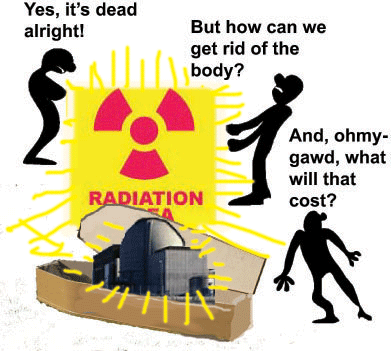 Groups oppose plans to abandon defunct nuclear reactors and radioactive waste, https://rabble.ca/columnists/2021/02/groups-oppose-plans-abandon-defunct-nuclear-reactors-and-radioactive-wasteThe Canadian Nuclear Safety Commission (CNSC) has just given a green light to the preferred industry solution for disposal of nuclear reactors — entomb and abandon them in place, also known as “in-situ decommissioning.” This paves the way for the introduction of a new generation of “small modular” nuclear reactors or SMRs.SMRs bring many challenges, including safety of untested designs, nuclear weapons proliferation risks, high costs, disposal of radioactive waste, and public acceptance. Groups concerned about nuclear safety are objecting to plans in the works to abandon these nuclear reactors and the radioactive waste they produce once they are shut down. Groups oppose plans to abandon defunct nuclear reactors and radioactive waste, https://rabble.ca/columnists/2021/02/groups-oppose-plans-abandon-defunct-nuclear-reactors-and-radioactive-wasteThe Canadian Nuclear Safety Commission (CNSC) has just given a green light to the preferred industry solution for disposal of nuclear reactors — entomb and abandon them in place, also known as “in-situ decommissioning.” This paves the way for the introduction of a new generation of “small modular” nuclear reactors or SMRs.SMRs bring many challenges, including safety of untested designs, nuclear weapons proliferation risks, high costs, disposal of radioactive waste, and public acceptance. Groups concerned about nuclear safety are objecting to plans in the works to abandon these nuclear reactors and the radioactive waste they produce once they are shut down.
Over 100 Indigenous and civil society groups have signed a public statement opposing SMR funding, noting that the federal government currently has no detailed policy or strategy for what to do with radioactive waste. Many of these groups are also participating in a federal radioactive waste policy review launched in November 2020. The Assembly of First Nations passed resolution 62/2018 demanding that the nuclear industry abandon plans for SMRs and that the federal government cease funding them. It calls for free, prior and informed consent “to ensure that no storage or disposal of hazardous materials shall take place in First Nations lands and territories.” SMR waste includes not only reactor fuel but also the reactors themselves. An SMR emits no radiation before start-up (other than from uranium fuel) and could easily be transported at that stage. But during reactor operation, metal and concrete components absorb neutrons from the splitting of uranium atoms — and in the process, transform into radioactive waste. Removing an SMR after shut-down would be difficult and costly, and comes with the need to shield workers and the public from its radioactivity. Abandoning nuclear reactors on site has been in the works for some time. CNSC helped draft a 2014 nuclear industry standard with in-situ decommissioning as an option and then included it in a July 2019 draft regulatory document. However, when the International Atomic Energy Agency (IAEA) released a peer-reviewed report on Canada’s nuclear safety framework last February, it said in-situ decommissioning is “not consistent” with IAEA safety standards. The IAEA suggested that CNSC “consider revising its current and planned requirements in the area of decommissioning to align with the IAEA guidance that entombment is not considered an acceptable strategy for planned decommissioning of existing [nuclear power plants] and future nuclear facilities.” It also noted that CNSC is reviewing license applications for in-situ decommissioning of shut-down federal reactors in Ontario and Manitoba, and encouraged Canada “to request an international peer review of the proposed strategy” for legacy reactors. But CNSC continued to pursue this strategy. Clever language in a June 2020 document appeared to rule out on-site reactor disposal, but left the door open where removal is not “practicable”:
At public meeting last June, CNSC Commissioner Sandor Demeter asked: “why are future facilities in this sentence when in fact we should be designing them so that in-situ decommissioning is not the option?” Former CNSC staff member Karine Glenn replied that “leaving some small parts of a structure behind…especially if you are in a very, very remote area, may be something that could be considered.” Glenn is now with the industry-run Nuclear Waste Management Organization, tasked with leading the development of a radioactive waste management strategy for Canada. Commissioners decided to approve the regulatory document, but with added text to clarify where in-situ decommissioning would be acceptable. They asked for additional text on “legacy sites” and “research reactors,” stating that “[t]he Commission need not see this added text if it aligns with the oral submissions staff made in the public meeting.” But no new clarifying text was added to the final version of the document published on January 29, 2021. It enables abandonment of SMRs — by retaining the reference to future nuclear facilities — and of “research and demonstration facilities, locations or sites dating back to the birth of nuclear technologies in Canada for which decommissioning was not planned as part of the design.” The CNSC seems willing to ignore international safety standards — and a decision of its own commission — to accommodate nuclear industry proponents of SMRs and allow radioactive waste to be abandoned in place. Meanwhile, the federal government has assigned the nuclear industry itself — via the Nuclear Waste Management Organization — the task of developing a radioactive waste strategy for Canada. Barring public outcry, that strategy will be abandonment. Ole Hendrickson is a retired forest ecologist and a founding member of the Ottawa River Institute, a non-profit charitable organization based in the Ottawa Valley. |
|
America’s ”fleet” of dangerously embrittled nuclear reactors
|
Embrittlement in Nuclear Power Plants, https://www.counterpunch.org/2021/02/01/embrittlement-in-nuclear-power-plants/ BY KARL GROSSMAN – HARVEY WASSERMAN
– 1 Feb 2021
Of all the daunting tasks Joe Biden faces, especially vital is the inspection of dangerously embrittled atomic reactors still operating in the United States.
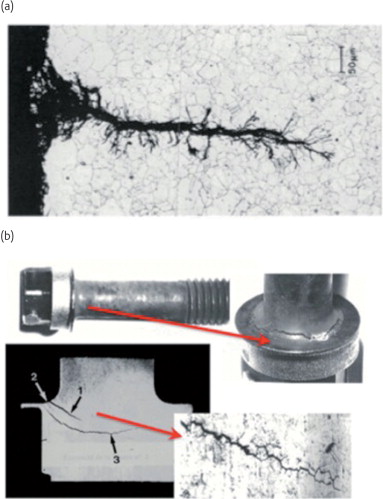
A meltdown at any one of them would threaten the health and safety of millions of people while causing major impact to an already struggling economy. The COVID-19 pandemic would complicate and add to the disaster. A nuclear power plant catastrophe would severely threaten accomplishments Biden is hoping to achieve in his presidency. The problem of embrittlement is on the top of the list of nuclear power concerns. The “average age”—length of operation—of nuclear power plants in the U.S., the federal government’s Energy information Agency, reported in 2019 was 38 years. That’s why the operating licenses originally issued for the plants were limited to 40 years. Here’s how Arnold “Arnie” Gundersen, a nuclear engineer with more than 44 years of experience in the nuclear industry, who became a whistleblower and is now chief engineer at Fairewinds Associates, explains embrittlement: “When exposed to radiation, metal becomes embrittled and eventually can crack like glass. The longer the radiation exposure, the worse the embrittlement becomes.” A nuclear reactor is just like a pressure cooker and is a pot designed to hold the radioactive contents of the atomic chain reaction in the nuclear core,” continues Gundersen, whose experience includes being a licensed Critical Facility Reactor Operator. “And metals in reactors are exposed to radiation every day a plant operates” “If the reactor is embrittled and cracks,” says Gundersen, “it’s ‘game over’ as all the radiation can spew out into the atmosphere. Continue reading |
Radiation illnesses and COVID-19 in the Navajo Nation
 Radiation illnesses and COVID-19 in the Navajo Nation, Bulletin of the Atomic Scientists, By Jayita Sarkar, Caitlin Meyer, February 3, 2021 The COVID-19 pandemic is wiping out Indigenous elders and with them the cultural identity of Indigenous communities in the United States. But on lands that sprawl across a vast area of the American West, the Navajo (or Diné) are dealing not just with the pandemic, but also with another, related public health crisis. The US Centers for Disease Control and Prevention says COVID-19 is killing Native Americans at nearly three times the rate of whites, and on the Navajo Nation itself, about 30,000 people have tested positive for the coronavirus and roughly 1,000 have died. But among the Diné, the coronavirus is also spreading through a population that decades of unsafe uranium mining and contaminated groundwater has left sick and vulnerable. Radiation illnesses and COVID-19 in the Navajo Nation, Bulletin of the Atomic Scientists, By Jayita Sarkar, Caitlin Meyer, February 3, 2021 The COVID-19 pandemic is wiping out Indigenous elders and with them the cultural identity of Indigenous communities in the United States. But on lands that sprawl across a vast area of the American West, the Navajo (or Diné) are dealing not just with the pandemic, but also with another, related public health crisis. The US Centers for Disease Control and Prevention says COVID-19 is killing Native Americans at nearly three times the rate of whites, and on the Navajo Nation itself, about 30,000 people have tested positive for the coronavirus and roughly 1,000 have died. But among the Diné, the coronavirus is also spreading through a population that decades of unsafe uranium mining and contaminated groundwater has left sick and vulnerable.
In Indigenous lands where nuclear weapons testing took place during the Cold War and the legacy of uranium mining persists, Indigenous people are suffering from a double whammy of long-term illnesses from radiation exposure and the COVID-19 pandemic. Yet, we have not witnessed in the mainstream media and policy outlets a frank discussion of how the two public health crises have created an intractable situation for Indigenous communities. The Diné are drinking poisoned water, putting them at risk for more severe coronavirus infections. From 1944 until 1986, 30 million tons of uranium ore was extracted on Navajo lands. At present, there are more than 520 abandoned uranium mines, which for the Diné represents both their nuclear past as well as their radioactive present in the form of elevated levels of radiation in nearby homes and water sources. Due to over four decades of uranium mining that supplied the US government and industry for nuclear weapons and energy, radiation illnesses characterize everyday Diné life. The water crisis Continue reading |
Bees may be more susceptible to ionising radiation than previously estimated

Insects Might Be More Sensitive to Radiation than Thought
A study of bumble bees exposed to levels of radiation equivalent to those existing in Chernobyl hotspots shows that the insects’ reproduction takes a hit. The Scientist, February 2021 Notebook Alejandra Manjarrez, Feb 1, 2021
A few years ago, on one of her first visits to Chernobyl, Katherine Raines went to the Red Forest, a radioactive cemetery of pine trees scorched by the nuclear accident in 1986. She was curious to see if there were bees living in the area. Research on the effect of chronic exposure to ionizing radiation on insects is limited, and some of the findings are controversial, but most experts support the idea that bees and other invertebrates are relatively resilient to radioactive stress.
Raines, a radioecologist at the University of Stirling in Scotland, didn’t spend long in that forest. In one spot there, her personal radiation dosimeter measured an environmental level of ionizing radiation of 200 microsieverts (µSv) per hour; more than a few hours of that exposure could have increased her cancer risk. But even during that brief visit, she did see bees. Whether they were living there or just visiting, Raines says, is hard to tell.
Back in the UK, Raines and colleagues recreated the same levels of radiation in a specialized facility. Boxes each containing a bumble bee colony made up of a queen, workers, and brood were placed at different distances from a radiation source, creating a gradient where bees in each box received a fairly steady dose of between 20 and 3,000 micrograys (µGy) per hour. (The two kinds of units, sieverts and grays, are essentially equivalent measures of the amount of exposure to radiation; sieverts factor in the type of radiation and account for the sensitivity of the exposed tissue. Bees at the site Raines visited in the Red Forest would experience around 200 µGy per hour.) The bees stayed in their artificial homes for four weeks before being moved outdoors into the university gardens for around one month, until the colonies were no longer viable—that is, once the queen had died and only a few workers remained.
The limited lab studies previously carried out by other groups had suggested that bees and other insects should be safe below 400 µGy per hour. So, Raines says, she was shocked when she found that even those colonies exposed to lower rates showed signs of a negative effect of radiation, especially on reproduction. Bumble bee colonies experiencing just 100 µGy per hour, for example, had reduced their production of queens by almost half, dramatically impairing the chances of successfully founding new colonies. According to the study, the overall effect was stronger than the one-fourth reduction observed in colonies exposed to a popular pesticide.
This work “sheds new light on the importance of chronic low-dose radiation exposure in a nonmodel species [with] profound relevance for the natural world,” says Timothy Mousseau, an ecological geneticist at the University of South Carolina who was not involved in this research. But he adds that it is hard to determine how some of these results, based on experimental manipulations in an artificial setting, can translate “to what’s actually going on in Chernobyl” for these important pollinators.
Mousseau and his colleague Anders Pape Møller (now at CNRS in France) have been doing field studies since 2000 to assess the abundance of wildlife populations living in the Chernobyl Exclusion Zone (CEZ), a 2,600 square-kilometer area surrounding the nuclear power plant. Their results have shown a negative correlation between radiation levels—which vary a great deal within the zone—and wildlife abundance. Insects were no exception: the team observed fewer bumble bees in the most contaminated areas, a relationship that held even within a range of extremely low radiation levels (from 0.01 to 1 µGy per hour)
Those studies have been criticized, partly over the accuracy of their estimations of radiation levels. Mousseau and Møller have collaborated with some of their critics to reanalyze some of their data, and maintain that there has been wildlife reduction in the CEZ due to radiation. ………
Researchers who spoke to The Scientist about the study agree that further work is needed to conclusively demonstrate the effects of radiation on bumble bees. ……. Raines is now gathering more data. The next stage of her research, she says, will be to look at the interaction between parasite load, which reduces longevity, and radiation exposure—both in lab-kept bees and in bees she sampled on one of her visits to deserted agricultural land around Chernobyl. “It would be ideal to directly relate lab and field [data].” https://www.the-scientist.com/notebook/insects-might-be-more-sensitive-to-radiation-than-thought-68366
February 3 Energy News — geoharvey

Opinion: ¶ “Mission Possible Partnership: Joining Forces to Decarbonize Heavy Industry” • How should investors with net-zero ambitions evaluate potential investments? What standards can be used to judge decarbonization plans? RMI’s Center for Climate-Aligned Finance was set up to help investors and clients together to solve the decarbonization puzzle. [CleanTechnica] Heavy industry (Ant Rozetsky, Unsplash) […]
February 3 Energy News — geoharvey
Gross domestic product is destroying nature, says landmark UK government report — RenewEconomy

Dasgupta Review up-ends economic assumptions about biodiversity loss, which is increasingly becoming a mainstream financial concern. The post Gross domestic product is destroying nature, says landmark UK government report appeared first on RenewEconomy.
Gross domestic product is destroying nature, says landmark UK government report — RenewEconomy
Australia’s path to zero emissions starts with the power grid — RenewEconomy

It’s going to be a year of net zero talk. 2050 is a long time away, but net zero begins with the grid, and it must happen very soon. The post Australia’s path to zero emissions starts with the power grid appeared first on RenewEconomy.
Australia’s path to zero emissions starts with the power grid — RenewEconomy
“Apprehended bias:” Community group wins High Court appeal against Queensland coal mine — RenewEconomy

High Court supports community group appeal against thermal coal mine expansion, saying previous decisions had been affected by “apprehended bias”, including media coverage. The post “Apprehended bias:” Community group wins High Court appeal against Queensland coal mine appeared first on RenewEconomy.
“Apprehended bias:” Community group wins High Court appeal against Queensland coal mine — RenewEconomy
Australia’s climate policies rated worst of major developed economies — RenewEconomy

Australia gets poor rating on climate policies from BNEF scoreboard, and even worse rating on clean transport. The post Australia’s climate policies rated worst of major developed economies appeared first on RenewEconomy.
Australia’s climate policies rated worst of major developed economies — RenewEconomy
Next three years will be huge for big wind and solar projects in Australia — RenewEconomy

Fully operational wind and solar in Australia’s main grid will almost double from today’s level in three years, adding an average of more than 500MW a month. The post Next three years will be huge for big wind and solar projects in Australia appeared first on RenewEconomy.
Next three years will be huge for big wind and solar projects in Australia — RenewEconomy
Morrison is offering more of the same: indefinite climate delay as time runs out — RenewEconomy

Morrison is gearing up to evolve his climate rhetoric, but leave his policy unchanged. That’s a very big problem. The post Morrison is offering more of the same: indefinite climate delay as time runs out appeared first on RenewEconomy.
Morrison is offering more of the same: indefinite climate delay as time runs out — RenewEconomy
Signs of life at new NSW solar farm, with first generation entering the grid — RenewEconomy

Signs of first generation from Genex’s new solar farm in NSW, as it parts ways with lead contractor for Kidston solar farm in Queensland. The post Signs of life at new NSW solar farm, with first generation entering the grid appeared first on RenewEconomy.
Signs of life at new NSW solar farm, with first generation entering the grid — RenewEconomy
Nuclear news to 1st February Australia
 Crisis within a crisis: Responding to COVID-19 around the world.
Climate crisis: world is at its hottest for at least 12,000 years – study. Scientists say temperatures globally at highest level since start of human civilisation.
Still, the global nuclear lobby keeps up its unrelenting propaganda on nuclear power as the (false) cure for climate change. https://www.youtube.com/watch?v=K0poNgL57kc&feature=emb_title Also distressing is the move for nuclear reactors to be permitted to operat for 100 years, a cunning, but dangerous, way to avoid costs of decommissioning them,
A bit of good news –. Oh dear, I had trouble finding it this week – had to revert to one a few weeks back – What went right this week: hope for stabilising the climate.
AUSTRALIA
Kimba nuclear waste dump issue is in limbo in the Australian Senate. The Australian government’s Radioactive Waste Bill does not meet required IAEA standards. Resource Minister Pitt should withdraw the Bill as the process for a Kimba nuclear waste dump has failed.
Australian Labor Party’s removal of Mark Butler as Shadow Minister for Climate Change & Energy. – an ominous sign for the nuclear-free movement Labor’s climate spokesman, Mark Butler, dumped as Labor’s climate action push collapses at a truly pivotal moment. Joel Fitzgibbon Demands Labor’s Climate Change Policy Be Solely Based On Keeping Him In A Job.
Rupert Murdoch gets a very dodgy ”Australia Day Award’‘, the honour coming from miners and bankers!
INTERNATIONAL
Avoiding a ‘Ghastly Future’: Hard Truths on the State of the Planet.
The most dangerous situation humanity has ever faced – Doomsday Clock stays at 100 seconds to midnight. Who’s next? Experts worry about East Asia and the Middle East getting nuclear weapons. Nuclear weapons proliferation can be contagious.
Nuclear wastes – deliberately left to our grandchildren.
Why nuclear power is a bad way to balance renewable energy .
French parliamentarians nominate Julian Assange for Nobel Peace Prize.
Resource Minister Pitt should withdraw the Bill as the process for a Kimba nuclear waste dump has failed
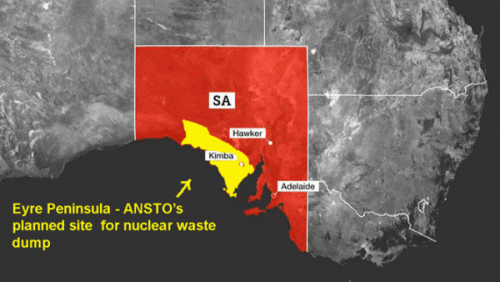
George Gear , 30 Jan 21, Reports have said that there is a possibility of a federal election this year. This means clearing the decks of issues that have the potential to embarrass the government or be a distraction.
One of these is the radioactive waste site at Kimba in SA.
The selection process for the radioactive waste facility project has now been going on for over 4 years.
The government’s bill to site the facility in Kimba will not pass the senate.
The proposed Kimba facility will not get a license to operate a radioactive waste facility as it does not meet
International Atomic Energy Agency standards of burial below ground. Australia is a founding member of the
IAEA. Their standards are our standards.
The minister will not declare Kimba because of the litigation that would follow will add years to the project. The
Barngarla traditional owners have been sidelined from the decision and will litigate. They have the resources to
do it with assets of $300M according to their Adelaide lawyers.
This will still be an issue at the next election unless it is settled. It is a major factor in SA where the government
has marginal seats. Press reports have opposition to the plan in SA at 70%.
Minister Pitt, in February, should announce that he respects the fact that the senate will not pass his bill and he
has decided to withdraw it. The cross bench have actually given the government a “get out of jail free” card. The
senate is now in control of the issue. I say that the government should take back control in the way I have
suggested.
At the same time he announces that negotiations with another nominee in the self selection process has begun.
Leonora did nominate in the process. No names at this point……..
The trouble with the process to date is that it hasn’t followed the science. The PM and Premiers did this with the
Corona Virus. The outcome is positive and they were all rewarded. The waste facility is not being ruled by science
which says that the waste has to be buried underground “at depths of twenty to hundreds of metres.” This
standard has been established by scientists.
The starting point should have been talking to the regulator to confirm the standards need to get a licence to
store the waste. This still hasn’t been done and has been left to the end of the process. Imagine if the bill had
passed the senate and the proposed facility on application to the regulator ARPANSA was refused a license. The
press would have had a field day at the governments expense.
1 This month.


PETITION – To: Prime Minister Anthony Albanese and the Australian Labor Government
Chernobyl: The Lost Tapes – A good documentary on Chernobyl on SBS available On Demand for the next 3 weeks– https://www.sbs.com.au/ondemand/tv-program/chernobyl-the-lost-tapes/235274195556

19 May – Webinar- Webinar: No Nuclear Weapons in Australia
Start: 2026-05-19 18:00:00 UTC Canberra, Melbourne, Sydney (GMT+10:00)
End: 2026-05-19 19:30:00 UTC Canberra, Melbourne, Sydney (GMT+10:00)
20 May – Webinar – The dangerous world of AUKUS, US, military occupation and suppression of dissent

National Webinar, 20th May, 2026, 6.30pm AEST. Confronting laws restricting/suppressing protest speech and action
Speakers: Former Sen. Rex Patrick, Lawyer Nick Hanna ,Arthur Rorris ,Jorgen Doyle, Sen David Shoebbridge,
Facilitator Kelley Tranter.

of the week – Australians for War Powers Reform (AWPR)
To see nuclear-related stories in greater depth and intensity
 Antinuclear