Australia wins at not honouring 1.5C climate commitment. — Climate Action Moreland: people in Brunswick, Coburg, Fawkner and Glenroy wanting action on climate change

Australia wins not honouring the 1.5C commitment Fossil award Australia took out an international award on the eve of the Climate Ambition international conference. But it is not an award to celebrate. Australia was handed the international ‘Fossil Award’ for failing to honour our climate commitments under the Paris Accord. Five years ago Australia signed […]
Australia wins at not honouring 1.5C climate commitment. — Climate Action Moreland: people in Brunswick, Coburg, Fawkner and Glenroy wanting action on climate change
Australian Government Productivity Commission Report fails to realise the complexity of environmental problems in uranium mining
Mia Pepper, Conservation Council of Western Australia, (CCWA) 10 Dec 20, The Productivity Commission Report has been released.
The CCWA had put in a detailed submission on uranium – in response to the Minerals Council of Australia attempts to reduce federal oversight of uranium mine projects. The overall terms for the PC report was to identify best practice regulation – while removing impediments to investment. (emphasis on removing impediments to investment – sigh).The short take home message for us: is that the Productivity Commission (PC) echoes calls, initially made through the EPBC Act Review process, that ARPANSA become the regulator for uranium mines, removing the need for EPBC approvals.This is narrow – it suggests the only problems or issues with uranium mines are related to radiation – the issues are much more complex and need environmental regulators not just radiation expertise.There is pressure from MCA and AMEC to remove the ‘nuclear trigger’ because they say it impacts on Rare Earths and Minerals sands assessments and approvals – this didn’t get much traction by the PC but was a segue to supporting calls that ARPANSA become the federal regulator and remove the need for the Environment Department to asses or approve uranium project.This fits with the larger Federal government agenda to remove federal approval requirements through setting up bilateral agreements with all the states and territories to defer powers to the State governments to both assess and approve projects that trigger federal intervention – like all uranium mines do. This is coming up before the Senate – but a majority of senators are set to block this and are calling for the Federal Government to release the final EPBC review report.The long version with extracts from the PC report: Continue reading
Australia is “rapidly” moving towards a hotter, drier climate

Climate change predictions: Average temps to increase, rainfall to decrease
It seems our already warmer days are only going to get hotter as weather experts paint a grim picture of Australia’s climate in the future. https://www.dailytelegraph.com.au/technology/climate-change-predictions-average-temps-to-increase-rainfall-to-decrease/news-story/c09593fdeb48648c8bfea031bbe7beea
Emily Cosenza, December 9, 2020
NCA NewsWire Australia is “rapidly” moving towards a hotter, drier climate, with average temperatures to continue on an upwards trajectory and rainfall being predicted to gradually decline in parts of the country.Climate change was a major theme in the Bureau of Meteorology’s State of the Climate 2020 biannual report as weather experts demonstrated how the country’s climate had changed since records began in 1910.
CSIRO senior research scientist Dr Michael Grose said weather trends seen in the past were very likely to continue in the future, including warmer temperatures and sea levels rising.
“Heavy rainfall – that‘s the hourly to daily intense downpours – is likely to become more intense through time, partly because that’s just what happens with a warmer atmosphere,” Dr Grose said.
“Unfortunately, that longer fire season with an earlier start and more days of dangerous fire weather is predicted to continue.
We’re heading towards what Australia would have experienced – or the equivalent for Australia – if global warming reached the 1.5 degree and 2 degree global warming level since pre-industrial, (and) we’re heading towards those quite rapidly.” ……..
“What’s really important in the report, and as we’ve seen in past reports, is that we’re experiencing climate change now, and it’s impacting on our community, many industries and other sectors as well,” Dr Bettio said.
She said some temperatures in the warmer months of 1916-89 were seen less than 1.8 per cent of the time but are now presenting more than 12 per cent on the time. “That 1 degree doesn’t sound like a big number, but it’s really impacting on that extreme heat that we experience
Canada to support the nuclear weapons industry with Small Nuclear Reactors (SMRs)
 Canada re-engages in the Nuclear Weapons Business with SMRs, December 3, 2020, WWW.HILLTIMES.COM/2020/12/03/CANADA-RE-ENTERS-NUCLEAR-WEAPONS-BUSINESS-WITH-SMALL-MODULAR-REACTORS/274591
Natural Resources Minister Seamus O’Regan is expected to announce within weeks his government’s action plan for development of “small modular” nuclear reactors (SMRs).
SMR developers already control the federally-subsidized Chalk River Laboratories and other facilities owned by the crown corporation, Atomic Energy of Canada Limited (AECL). Canada is now poised to play a supporting role in the global nuclear weapons business, much as it did during World War II.
Canada was part of the Manhattan project with the U.S. and U.K. to produce atomic bombs. In 1943 the three countries agreed to build a facility in Canada to produce plutonium for nuclear weapons. Researchers who trained at the Chalk River Laboratories went on to launch weapons programs in the U.K. and France. Chalk River provided plutonium for U.S. weapons until the 1960s.
Canada’s Nuclear Schizophrenia describes a long tradition of nuclear cooperation with the United States: “For example, in the early 1950s, the U.S. Navy used Canadian technology to design a small reactor for powering its nuclear submarines.” C.D. Howe, after creating AECL in 1952 to develop nuclear reactors and sell weapons plutonium, remarked that “we in Canada are not engaged in military development, but the work that we are doing at Chalk River is of importance to military developments.”
The uranium used in the 1945 Hiroshima bomb may have been mined and refined in Canada. According to Jim Harding’s book Canada’s Deadly Secret: Saskatchewan Uranium and the Global Nuclear System, from 1953 to 1969, all the uranium mined in Saskatchewan went to make U.S. nuclear weapons. Canada remains the world’s second-largest producer of uranium. North America’s only currently operating uranium processing facility is owned by Cameco in Port Hope, Ontario.
Canada built India’s CIRUS reactor, which started up in 1960 and produced the plutonium for India’s first nuclear explosion in 1974. Canada also built Pakistan’s first nuclear reactor, which started up in 1972. Although this reactor was not used to make weapons plutonium, it helped train the engineers who eventually exploded Pakistan’s first nuclear weapons in 1998.
In 2015 the Harper Government contracted a multi-national consortium called Canadian National Energy Alliance – now comprised of two U.S. companies, Fluor and Jacobs, along with Canada’s SNC-Lavalin – to operate AECL’s nuclear sites, the main one being at Chalk River. Fluor operates the Savannah River Site, a South Carolina nuclear weapons facility, under contract to the U.S. Department of Energy (DOE). Jacobs also has contracts at DOE weapons facilities and is part of a consortium that operates the U.K. Atomic Weapons Establishment.
Joe McBrearty, the president of the consortium’s subsidiary that operates Chalk River and other federal nuclear sites, was a U.S. Navy nuclear submarine commander and then chief operating officer for the DOE’s nuclear laboratories between 2010 and 2019.
All three consortium partners have investments in SMRs and are ramping up research and development at AECL’s Chalk River facility. Some SMR designs would use uranium enriched to levels well beyond those in current reactors; others would use plutonium fuel; others would use fuel dissolved in molten salt. All of these pose new and problematic weapons proliferation risks.
Rolls Royce, an original consortium partner that makes reactors for the U.K.’s nuclear submarines, is lead partner in a U.K. consortium (including SNC-Lavalin) that was recently funded by the U.K. government to advance that country’s SMR program.
A military bromance: SMRs to support and cross-subsidize the UK nuclear weapons program, says “Industry and government in the UK openly promote SMRs on the grounds that an SMR industry would support the nuclear weapons program (in particular the submarine program) by providing a pool of trained nuclear experts, and that in so doing an SMR industry will cross-subsidize the weapons program.”
The article quotes a 2017 Rolls Royce study as follows: “expansion of a nuclear-capable skilled workforce through a civil nuclear UK SMR programme would relieve the Ministry of Defence of the burden of developing and retaining skills and capability.”
The SMR connection to weapons and submarines could hardly be clearer – without SMRs, the U.S. and U.K. will experience a shortage of trained engineers to maintain their nuclear weapons programs.
With the takeover of AECL’s Chalk River Laboratories by SMR developers, and growing federal government support for SMRs, Canada has become part of a global regime linking nuclear power and nuclear weapons.
December 9 Energy News — geoharvey

Opinion: ¶ “Ohi Ruling Could Signal Trouble Ahead For Nuclear Reactor Restart Plans” • The Ohi case is unique because it’s the first time a court has specifically ruled against the central government over the way it operates its screening process for nuclear reactor safety and over the nature of its earthquake safety standards, adapted […]
December 9 Energy News — geoharvey
Angus Taylor hails latest emissions projections, but it’s bad news for wind and solar — RenewEconomy

Taylor says Technology Roadmap will deliver cuts needed to hit 2030 emissions target – but the projections predict doom for large-scale wind and solar investment. The post Angus Taylor hails latest emissions projections, but it’s bad news for wind and solar appeared first on RenewEconomy.
Angus Taylor hails latest emissions projections, but it’s bad news for wind and solar — RenewEconomy
W.A. maps “just transition” for Collie as renewables hasten coal industry decline — RenewEconomy

McGowan government unveils ‘Just Transition’ plan for coal centre of Collie, as next step in 10 to 15-year process to prepare for exit of coal generators. The post W.A. maps “just transition” for Collie as renewables hasten coal industry decline appeared first on RenewEconomy.
W.A. maps “just transition” for Collie as renewables hasten coal industry decline — RenewEconomy
Victoria passes half-way mark on road to 50% renewables by 2030 — RenewEconomy

Victoria says it has officially met its interim renewable energy target of 25 per cent by 2020, as it gears up to double that number over next 10 years. The post Victoria passes half-way mark on road to 50% renewables by 2030 appeared first on RenewEconomy.
Victoria passes half-way mark on road to 50% renewables by 2030 — RenewEconomy
Carbon capture could be six times more costly than wind and storage, analysis shows — RenewEconomy

New analysis suggests that adding CCS to coal and gas generators would be hugely expensive, many times more costly than wind, solar and storage. The post Carbon capture could be six times more costly than wind and storage, analysis shows appeared first on RenewEconomy.
Carbon capture could be six times more costly than wind and storage, analysis shows — RenewEconomy
Michele Madigan sets former Minister Christopher Pyne straight on nuclear waste dump plan
 Funny how after all this time – since 1998 as he acknowledges, former Minister Christopher Pyne (Advertiser 7th December) has not yet caught up with the fact that the federal nuclear waste dump is not just’ a low-level nuclear waste facility.’ Over 90% of the waste measured in radioactivity in fact is intermediate level waste which will remain radioactive for an unimaginable10,000 years. I’d say that will probably be for every generation of South Australians to come.
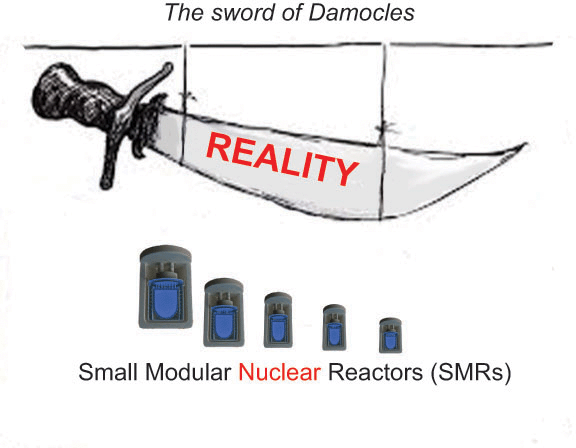
Small Nuclear Reactors (SMRs) if they work, will arrive too late to make a difference to global heating
 Is nuclear power the answer, DECEMBER 8, 2020 JOHN QUIGGIN
The last (I hope) extract from the climate change chapter of Economic Consequences of the Pandemic. I’m in two minds about whether this is really needed. The group of pro-nuclear environmentalists seems to be shrinking towards a hard core who can’t be convinced (and some of them, like Shellenberger turn out to have been concern trolls all along). But every now and then I run across people who seem open-minded enough, but haven’t caught up with the bad news on nuclear.
Debates about decarbonizing electricity generation inevitably raise the issue of nuclear power. Since nuclear power generates no carbon dioxide emissions (except in the construction phase) it is a potential solution to climate change, with a strong body of advocates.
Some of this advocacy may be dismissed as point-scoring. Rightwing pundits who oppose any action on climate change simultaneously promote nuclear power as carbon free, with the aim of embarrassing environmentalist. There is, however, a small but vocal group of nuclear power advocates who are convinced that a massive expansion of nuclear power is the only way to replace coal-fired power………
Today the choice is not between new nuclear and new or existing coal. It is whether to allocate investment to building nuclear plants or to accelerating the shift to solar and wind energy.
The key problem is not safety but economics. New plants are safer and more sophisticated than those that failed in the past, but they are also massively more expensive to build, and quite costly to operate. The capital costs of recent projects in the US, France and Finland (none yet complete) have been around $10/kw, compared to $1/kw or less for solar. And, whereas solar PV is essentially costless to operate, the operating costs of nuclear power plants are around 2c/kwH. Even when solar PV is backed up with battery storage, it is cheaper to build and to operate, than new nuclear.
The facts speak for themselves. Over the last decade, only two or three reactors have commenced construction each year, not even enough to replace plants being retired. This isn’t the result of pressure from environmentalists or alarm about the safety of nuclear plants. The slowdown is evident in countries like China, where public opinion has little influence on policy decisions, and in countries where public opinion is generally favorable to new nuclear power. China failed to reach its 2020 target of 58 GW of installed power, and currently has only about 15 GW of nuclear power under construction. That compares to 55 GW of new solar and wind capacity installed in 2019 alone.
It is clear by now that large-scale nuclear reactors have no future. The last hope for nuclear power rests on Small Modular Reactors. The idea is that, rather than building a single large reactor, typically with a capacity of 1 GW, smaller reactors will be produced in factories, then shipped to the site in the required number. The leading proponent of this idea is Nuscale Power, which currently has a contract with UAMPS to supply a pilot plant with a dozen 60MW modules.
It remains to be seen whether SMR’s will work at all. Even if they do, it is not clear that the reduced costs associated with off-site manufacturing will offset the loss of the scale economies associated with a large boiler, let alone yield power at a cost competitive with that of solar PV.
In any case, the issue is largely irrelevant as far as the climate emergency is concerned. NuScale’s pilot plant, with a total capacity of 720 MW, is currently scheduled to start operation in 2029. Large-scale deployment will take at least a decade more .
If we are to have any chance of stabilising the climate, coal-fired power must be eliminated by 2030, and electricity generation must be decarbonized more or less completely by 2035. SMRs, if they work, will arrive too late to make a difference. ….https://johnquiggin.com/2020/12/08/is-nuclear-power-the-answer/#more-17451
Australia’s Liberal and National Parties got their arithmetic wrong on nuclear waste dump opinion polls
LIBS NATS FAILED MATHS, Kim Mavromatis, 8 Dec 20, Where did these people go to school? – I expect they failed maths because they can’t do % sums.
452 in favour of the dump from 824 eligible Kimba voters = 54.85% of the Kimba community.Not 62%.And Barngarla Native Title Holders, who were deliberately left out of the Kimba ballot,had their own vote : 0 in favour of the dump from 209 eligible voters.Combined Kimba and Barngarla votes = 43.75% in favour of the dump from eligible voters, Does Not equate to Broad Community Support.No mention by Pyne that the Govt want to dump radioactive Spent Nuclear Fuel, and reprocessed SNF on SA farmland that is 10,000 x more radioactive than uranium ore.No mention by Pyne that the Dump legislation removes Judicial Review – no rights of appeal or independent scrutiny.No mention by Pyne that all SA surveys consistently overwhelmingly Do Not support the dump on SA farmland near Kimba.And Christopher, my mum died of an inoperable brain tumour 2 years ago – using nuclear medicine as an excuse to dump radioactive nuclear waste on SA farmland is BS.Why on earth would you knowingly dump radioactive nuclear waste on SA Farmland????
Analysing Christopher Pyne’s article enthusing about proposed Kimba nuclear waste dump
Examining Pyne’s article in The Advertiser – Outdated leftie ideas let nuclear option go to waste. G. Bannon 8 Dec 20
Pyne claimed to be in the thick of things with Nick Minchin in 1998 whenHoward was wanting to get a dump established. There are so many things wrong with his article, – (but if you try to address every single one no one would ever listen to you.
He knows how many jobs they were talking about in his day but says there will be 45 jobs during construction and 25 permanent jobs. When he was involved they were talking about 5 jobs – we’ve all heard that blow out to 15, then 45 and then more than 45. 25 permanent jobs are not part of the current script! Does that 25 including the Agency in Adelaide and does it include the 12/15? security guys as well as the nuclear physicists in white overalls driving all the forklifts?
* He doesn’t mention Intermediate Level Wastes (ILW)
* He wonders where in the world those opposing the dump think
Australia’s waste should go. I haven’t heard one person who opposes the
dump say Australia’s waste should go somewhere else.
* He thinks it’s a “no brainer” that the waste should go in “Outback
South Australia”. Kimba is remote, but it’s cleared, developed, settled and populated – it’s not “Outback”. Woomera might be getting closer to “Outback”. He doesn’t mention that.
* He reckons those opposing the dump have “outdated leftie ideology”
and Penny Wong “should be putting Kimba above kale” (Good, funny old Pyney -It’s such a clever line he says it twice)! I wonder how the kale harvest went at Kimba this year? I assume that big shed by the road, just before you get into Kimba, stores all the bales of kale to feed those leftie,
Greenie, tree-hugging, NIMBY activists!
* He, Pitty, Rowan and all their mates just want to get this done! Its
hung around too long. “It’s time” (sounds like a Labor slogan from the
past, doesn’t it?) to make the hard decisions. I say always be very wary of
people who want to push you into making quick decisions! What’s the saying?
– “Decide in haste, repent at leisure!”
* He says it is a $200 million project and says the community will
benefit by $31 million. We know the breakdown – $20 million for the
Community Benefit Programme, $8 million ($2 million/year for 4 years) to
assist businesses to take part in construction and $3 million for Indigenous training and engagement: 20 + 8 + 3 = $31 million – Who or what gets the remaining $169 million?
* He reckons that a dump in Kimba “would be preferable to the more
than 40 sites in the CBD”, then says that the Bill might be defeated by “not in my backyard NIMBYism”. He lives in Adelaide and wants the stuff to go to Kimba – Not In His Back Yard!

Canada’s Coalition for Responsible Energy Development sceptical about Small Nuclear Reactors
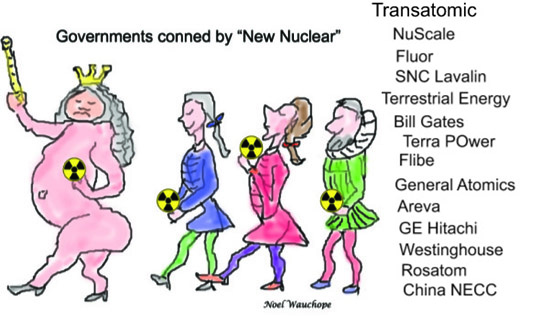
Questions abound about New Brunswick’s embrace of small nuclear reactors
Critics question business case, but CEO says the market is ‘screaming’ for the units, Jacques Poitras · CBC News Dec 07, 2020
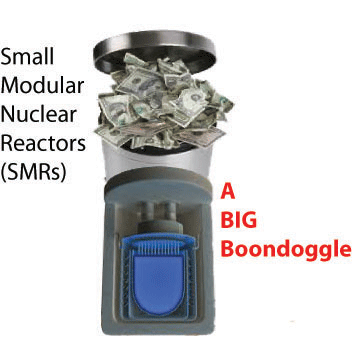 When Mike Holland talks about small modular nuclear reactors, he sees dollar signs.
When the Green Party hears about them, they see danger signs.
The loquacious Progressive Conservative minister of energy development recently quoted NB Power’s eye-popping estimates of the potential economic impact of the reactors: thousands of jobs and a $1 billion boost to the provincial economy.
“New Brunswick is positioned to not only participate in this opportunity, but to be a world leader in the SMR field,” Holland said in the legislature last month.
Green MLAs David Coon and Kevin Arseneau responded cheekily by ticking off the Financial and Consumer Services Commission’s checklist on how to spot a scam.
Is the sales pitch from a credible source? Is the windfall being promised by a reputable institution? Is the risk reasonable?
For small nuclear reactors, they said, the answer to all those questions is no.
“The last thing we need to do is pour more public money down the nuclear-power drain,” Coon said, reminding MLAs of the Point Lepreau refurbishment project that went $1 billion over budget. …….
Premier Blaine Higgs is a fervent supporter, but in the last provincial election the Liberals promised they’d do even more than Higgs to promote them.
Under Brian Gallant, the Liberals handed $10 million to two Saint John companies working on SMRs, ARC Nuclear and Moltex Energy.
Greens point to previous fiascoes
The Greens and other opponents of nuclear power fear SMRS are the latest in a long line of silver-bullet fiascoes, from the $23 million spent on the Bricklin in 1975 to $63.4 million in loans and loan guarantees to the Atcon Group a decade ago.
“It seems that [ARC and Moltex] have been targeting New Brunswick for another big handout … because it’s going to take billions of dollars to build these things, if they ever get off the drawing board,” said Susan O’Donnell, a University of New Brunswick researcher.
O’Donnell, who studies technology adoption in communities, is part of a small new group called the Coalition for Responsible Energy Development formed this year to oppose SMRs.

“What we really need here is a reasonable discussion about the pros and cons of it,” she said……..
What we didn’t see was a market analysis,” O’Donnell said. “How viable is the market? … They’re all based on a hypothetical market that probably doesn’t exist.”
O’Donnell said her group asked for the full report but was told it’s confidential because it contains sensitive commercial information………..
The market is screaming for this product,” Rory O’Sullivan, CEO of Moltex said, adding “all of the utilities” in Canada are interested in Moltex’s reactors ……
ARC’s CEO Norm Sawyer is more specific, guessing 30 per cent of his SMR sales will be in Atlantic Canada, 30 per cent in Ontario and 40 per cent in Alberta and Saskatchewan — all provincial power grids.
O’Donnell said it’s an important question because without a large number of guaranteed sales, the high cost of manufacturing SMRs would make the initiative a money-loser.
The cost of building the world’s only functioning SMR, in Russia, was four times what was expected.
An Australian government agency said initial cost estimates for such major projects “are often initially too low” and can “overrun.”
Up-front costs can be huge
University of British Columbia physicist M.V. Ramana, who has authored studies on the economics of nuclear power, said SMRs face the same financial reality as any large-scale manufacturing.
“You’re going to spend a huge amount of money on the basic fixed costs” at the outset, he said, with costs per unit becoming more viable only after more units are built and sold.
He estimates a company would have to build and sell more than 700 SMRs to break even, and said there are not enough buyers for that to happen. ….
O’Sullivan says: “In fact, just the first one alone looks like it will still be economical,” he said. “In reality, you probably need a few … but you’re talking about one or two, maximum three [to make a profit] because you don’t need these big factories.”
‘Paper designs’ prove nothing, says expert
Ramana doesn’t buy it.
“These are all companies that have been started by somebody who’s been in the nuclear industry for some years, has a bright idea, finds an angel investor who’s given them a few million dollars,” he said.
“They have a paper design, or a Power Point design. They have not built anything. They have not tested anything. To go from that point … to a design that can actually be constructed on the field is an enormous amount of work.
Both CEOs acknowledge the skepticism about SMRs.
“I understand New Brunswick has had its share of good investments and its share of what we consider questionable investments,” said ARC’s CEO Norm Sawyer….
But he said ARC’s SMR is based on a long-proven technology and is far past the on-paper design stage “so you reduce the risk.”
Moltex is now completing the first phase of the Canadian Nuclear Safety Commission’s review of its design, a major hurdle. ARC completed that phase last year.
But, Ramana said there are problems with both designs. Moltex’s molten salt model has had “huge technical challenges” elsewhere while ARC’s sodium-cooled system has encountered “operational difficulties.” …..
federal Natural Resources Minister Seamus O’Regan told CBC earlier this year that he’s “very excited” about SMRs…..
O’Donnell said while nuclear power doesn’t emit greenhouse gases, it’s hardly a clean technology because of the spent nuclear fuel waste.
Government support is key
She also wonders why, if SMRs make so much sense, ARC and Moltex are relying so much on government money rather than private capital.
…….. So far, Ottawa hasn’t put up any funding for ARC or Moltex. During the provincial election campaign, Higgs implied federal money was imminent, but there’s been no announcement in the almost three months since then.
Last month the federal government announced $20 million for Terrestrial Energy, an Ontario company working on SMRs.
…….O’Donnell said her group plans to continue asking questions about SMRs.
“I think what we really need is to have an honest conversation about what these are so that New Brunswickers can have all the facts on the table,” she said. https://www.cbc.ca/news/canada/new-brunswick/questions-small-nuclear-reactors-1.5828784
Nuclear-powered vehicles -not such a great idea.
|
One promising option, according to scientists at Argonne National Laboratory, is small nuclear reactors. Engineer Derek Kultgen is leading efforts at Argonne to develop a microreactor — about the size of two home water heaters — that is specifically designed to charge electric trucks at rest stops across the country lacking EV charging stations………… One promising, carbon-free charging option, according to scientists at Argonne National Laboratory, is small nuclear reactors………. Small nuclear reactors could be ideal for e-truck charging, he said……. In August, the Nuclear Regulatory Commission issued a final safety evaluation report endorsing NuScale Power’s small modular nuclear reactor design (Greenwire, Aug. 31). ……. Critics, however, say there’s insufficient evidence that small reactors are safer than nuclear power plants. It could also take years before they’re ready to be deployed, whereas new solar and wind resources could be built much more quickly. The microreactor being designed at Argonne, for example, is not being planned for construction at this point. NuScale’s design is the first to gain approval by the NRC, and even that project is still more than one year away from coming online, said Edwin Lyman, director of nuclear power safety at the Union of Concerned Scientists. Many proposed microreactor applications — including this one from Argonne — are inappropriate uses of nuclear energy, according to Lyman. “The Department of Energy is desperately trying to think of applications for all sorts of nuclear reactors, no matter how improbable or impractical they are, and I think this is a good example,” he said…….. Cost, security questionsWhile the concept is worth considering as a potential charging tool, some issues would need to be addressed before truck stop microreactors could become a reality, said Rick Mihelic, director of emerging technologies at the North American Council for Freight Efficiency. Opposition to nuclear power could delay the distribution of the microreactors, he said. A network of microreactors would also add to the country’s nuclear waste problem, for which there is no permanent disposal solution. It could be difficult to make the microreactors economical as well. To overcome that barrier, the researchers would need to find a way to mass-produce them, Buongiorno said. “If they are deployed each a little differently, each built at a different location with a different workforce, then achieving good economics may prove hopeless,” he said. Opposition to nuclear power could delay the distribution of the microreactors, he said. A network of microreactors would also add to the country’s nuclear waste problem, for which there is no permanent disposal solution. It could be difficult to make the microreactors economical as well. To overcome that barrier, the researchers would need to find a way to mass-produce them, Buongiorno said. “If they are deployed each a little differently, each built at a different location with a different workforce, then achieving good economics may prove hopeless,” he said……. https://www.eenews.net/stories/1063719531 |
|

1 This month.


PETITION – To: Prime Minister Anthony Albanese and the Australian Labor Government
Chernobyl: The Lost Tapes – A good documentary on Chernobyl on SBS available On Demand for the next 3 weeks– https://www.sbs.com.au/ondemand/tv-program/chernobyl-the-lost-tapes/235274195556

19 May – Webinar- Webinar: No Nuclear Weapons in Australia
Start: 2026-05-19 18:00:00 UTC Canberra, Melbourne, Sydney (GMT+10:00)
End: 2026-05-19 19:30:00 UTC Canberra, Melbourne, Sydney (GMT+10:00)
20 May – Webinar – The dangerous world of AUKUS, US, military occupation and suppression of dissent

National Webinar, 20th May, 2026, 6.30pm AEST. Confronting laws restricting/suppressing protest speech and action
Speakers: Former Sen. Rex Patrick, Lawyer Nick Hanna ,Arthur Rorris ,Jorgen Doyle, Sen David Shoebbridge,
Facilitator Kelley Tranter.

of the week – Australians for War Powers Reform (AWPR)
To see nuclear-related stories in greater depth and intensity
 Antinuclear