Very dubious claims made by proponents of NuScam’s small nuclear reactor plans
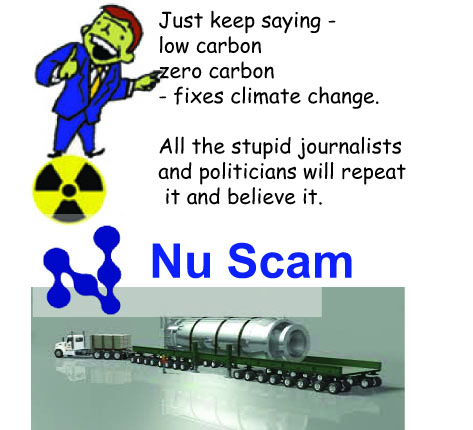 Small Nuclear Reactors Would Provide [a dubious claim] Carbon-Free Energy, but Would They Be Safe? Inside Climate News, Jonathan Moens, -21 Oct 20 Regulators have approved designs for 12 small reactors to be built in Idaho, but opponents say the project is dangerous and too late to fight climate change. “……… Last month, U.S. officials approved NuScale Power’s designs for 12 small nuclear reactors to be built in Boise, Idaho. The reactors could make use of the water, transmission lines and general infrastructure of former coal-powered plants in the West to produce clean energy, said Jose Reyes, co-founder of the company.
NuScale said the energy produced by its reactors would generate enough electricity to power about 50,000 homes across six Western states. The Utah Associated Municipal Power Systems, an energy cooperative, would be the first to build the reactors on a federal site at the Idaho National Laboratory.
The NuScale Power initiative has met with opposition from local environmental groups, who say that nuclear power is a dangerous and unsustainable energy source.
In addition, the highly radioactive waste from nuclear reactors must be securely stored indefinitely to prevent accidents, and contains plutonium and uranium that can be reprocessed into nuclear weapons. “We see this project as a way to create a whole new generation of high level radioactive waste,” said Scott Williams, executive director of Healthy Environment Alliance of Utah, a nuclear watchdog. ……
The designs underwent a public health and safety review by the Nuclear Regulatory Commission. But some scientists think they still aren’t safe enough. In a public statement, Edwin Lyman, director of nuclear power safety with the Union of Concerned Scientists, cited a report by a senior engineer at the Nuclear Regulatory Commission expressing concern that the cooling process might inadvertently cause “catastrophic” core damage to the reactors.
Other scientists worry that NuScale may be getting ahead of itself by not having a planning protocol for a radioactive emergency that affects areas around the site.
“In the event of an accident, the people around there will not have rehearsed how to do an evacuation,” said M.V. Ramana, a professor in the School of Public Policy and Global Affairs at the University of British Columbia. …….
Too Late in a Climate Crisis?
The municipal power systems cooperative still needs to obtain a license to build and begin operating the reactors. To do so, the project will undergo an additional site-specific review to consider the potential ecological, geographic and residential impact the technology may have on the area, said George Griffith, lead technician at the Idaho National Laboratory.
The delay means that while NuScale will be ready to manufacture modular reactors by around 2024, it will take an additional five to six years for them to be operational at the Idaho site, said Reyes.
Some experts, however, question whether 2029 is too late for the technology to be relevant in a time of climate crisis…….
Ramana, of the University of British Columbia, said, “While the overall capital cost [for small modular reactors] might be smaller, they also generate smaller amounts of electricity.” He outlined his concerns in a report released in September urging the Utah energy cooperative to “end their pursuit of small modular reactors.”
Ramana made clear that while devastating incidents associated with nuclear power plants might seem unlikely, we need to remain cautious.
“The lesson we should learn from all the many nuclear and other accidents that have happened with hazardous technologies, is a little bit of humility,” he said. https://insideclimatenews.org/news/20102020/small-nuclear-reactors-carbon-free-energy
Vital need to protect Antarctic seas: groups aim for new protected areas
|
‘No other choice’: Groups push to protect vast swaths of Antarctic seas, Mongabay
BY ELIZABETH CLAIRE ALBERTS ON 19 OCT, 2020
‘……………… While Antarctica’s land mass is currently protected through the Antarctic Treaty (although this expires in 2048), vast swaths of its marine region are open to industrial fishing for species such as Antarctic krill (Euphausia superba) and Patagonian toothfish (Dissostichus eleginoides). Conservationists say these fishing activities are endangering the Southern Ocean’s delicate marine ecosystem that hosts more than 15,000 species, and a region that plays a vital role in regulating the world’s climate.
A coalition of conservation groups, including Pew, ASOC, SeaLegacy, Antarctica2020, Ocean Unite, and Only One, are working together to advocate for the formation of three marine protected areas (MPAs) in East Antarctica, the Antarctic Peninsula, and the Weddell Sea. Together, these areas would protect about 4 million square kilometers (1.5 million square miles), encompassing 1% of the world’s ocean. That’s two and a half times the size of Alaska, and nearly three times the size of Papahānaumokuākea Marine National Monument in Hawaiʻi, which is currently one of the world’s largest marine sanctuaries. “If these three marine protected areas … [are] created at the same time, it would form the largest marine protection in the history of humanity,” Cristina Mittermeier, National Geographic wildlife photographer and co-founder of SeaLegacy, told Mongabay. “[It would be] a piece of good news that the planet needs.” This is a matter of political will’The body responsible for making decisions surrounding Antarctica’s marine region is the Commission for the Conservation of Antarctic Marine Living Resources (CCAMLR), an international commission with 25 member states and the European Union, as well as 10 acceding states. Originally established to manage krill fisheries in the Southern Ocean, the commission meets each year in Hobart, Australia, to negotiate total allowable catches for fisheries, and to discuss other matters related to Antarctica’s marine region, including the designation of MPAs. Any decision requires a consensus among all members, and proposals can take a long time to be approved. For instance, it took more than five years for the commission to approve a proposal to turn a region of the Ross Sea into an MPA, according to Werner. But it finally went ahead in 2016: now 1.55 million km2 (nearly 600,000 mi2)of the Ross Sea is classified as an MPA, with 1.12 million km2 (432,000 mi2) of the region fully protected from commercial fishing. “In CCAMLR, everything is possible,” said Werner, who acts as an official observer and scientific representative at the commission. “You can have a proposal blocked for years like the Ross Sea, and then one day [it happens].”………… The way that Antarctica goes, so does the world’One of the most important species living in the Southern Ocean is krill. These tiny, shrimp-like crustaceans are the foodstuff for many species, such as whales, seals, penguins, squids, fish and seabirds. Without krill, the pelagic food web would entirely collapse. Krill is also heavily harvested for human consumption, mainly for fish meal and omega-3 dietary supplements. The establishment of the three proposed MPAs — which would include no-take zones, but also areas that would allow regulated fishing — would help protect krill populations from overharvesting and enable fishing activities to continue in other areas, Cousteau said. According to one study, MPAs help increase fish mass……… But it’s not just fishing that’s a threat to krill — climate change is wreaking havoc on the species as high temperatures melt the ice it vitally depends upon. …….. https://news.mongabay.com/2020/10/no-other-choice-groups-push-to-protect-vast-swaths-of-antarctic-seas/ |
|
Bees are harmed by quite low levels of ionising radiation
|
Current Chernobyl-level radiation harmful to bees: study https://www.thehindu.com/sci-tech/energy-and-environment/current-chernobyl-level-radiation-harmful-to-bees-study/article32908484.eceAFP
PARIS, FRANCE, OCTOBER 21, 2020 Researchers exposed bee colonies in a laboratory setting to a range of radiation levels found in areas of the exclusion zone around the ruined Chernobyl site Bumblebees exposed to levels of radiation found within the Chernobyl exclusion zone suffered a “significant” drop in reproduction, in new research published Wednesday that scientists say should prompt a rethink of international calculations of nuclear environmental risk. The study, published in the journal Proceedings of the Royal Society B, set out to discover how ionising radiation affects insects, which are often thought to be more resilient than other species. “We found that at radiation levels detectable in Chernobyl, the number of new queen bees produced from the colony was significantly reduced and colony growth was delayed — meaning colonies reached their peak weight at a week later,” said the paper’s lead author Katherine Raines. The lecturer in environmental pollution at the University of Stirling told AFP by email that researchers “anticipate that this may have an effect on pollination/ecosystem services in contaminated areas”. The authors said they chose bumblebees both because of a lack of lab-based research into bees and because of their crucial role in pollination. Ionising radiation can occur either from nuclear sites or medical procedures, although the levels tested were higher than those that would likely be found in the environment from normal releases, Raines said. But she added that the researchers were “very surprised that we could detect effects as low as we did”. “Our research suggests insects living in the most contaminated areas at Chernobyl may suffer adverse effects, with subsequent consequences for ecosystem services such as pollination,” she added. The authors said if their findings could be generalised “they suggest insects suffer significant negative consequences at dose rates previously thought safe” and called revisions to the international framework for radiological protection of the environment. People are not allowed to live near the Chernobyl power station and the abandoned settlements within the exclusion zone are surrounded by forests hosting birds, wolves, elks and lynxes. A giant protective dome was put in place over the destroyed fourth reactor in 2016. |
|
Solar and Covid lead change as grid demand, prices and emissions tumble to record lows — RenewEconomy

Rooftop solar, Covid and more large scale renewables push Australia’s main grid to record low levels of demand and emissions intensity, and the lowest prices in years. The post Solar and Covid lead change as grid demand, prices and emissions tumble to record lows appeared first on RenewEconomy.
Solar and Covid lead change as grid demand, prices and emissions tumble to record lows — RenewEconomy
October 21 Energy News — geoharvey

Opinion: ¶ “The Epitome Of Stupidity: Oil Companies Chill The Ground In Alaska So They Can Keep Drilling” • The Guardian reports that ConocoPhillips and other oil companies operating on the North Slope in Alaska are facing a new challenge. As permafrost melts, their trucks can’t cross the land and rigs can destabilize. They are […]
October 21 Energy News — geoharvey
Australian researchers say “unusual” breakthrough may solve perovskite solar instability — RenewEconomy

An “unusual discovery” by Australian researchers claims to have resolved one of the fundamental challenges slowing the progress of perovskite solar cells. The post Australian researchers say “unusual” breakthrough may solve perovskite solar instability appeared first on RenewEconomy.
Australian researchers say “unusual” breakthrough may solve perovskite solar instability — RenewEconomy
Big Australian super fund makes first foray into Australian wind assets — RenewEconomy

Australian super fund First Sentier makes first purchase in renewables, buying wind portfolio of UK infrastructure group John Laing. The post Big Australian super fund makes first foray into Australian wind assets appeared first on RenewEconomy.
Big Australian super fund makes first foray into Australian wind assets — RenewEconomy
AEMO leads global push for $10 trillion of investment in next 10 years to slash emissions — RenewEconomy

AEMO champions global push to unlock $10 trillion of new investments in renewables and storage to slash emissions by 50 pct in a decade. The post AEMO leads global push for $10 trillion of investment in next 10 years to slash emissions appeared first on RenewEconomy.
AEMO leads global push for $10 trillion of investment in next 10 years to slash emissions — RenewEconomy
ARENA backs program to help manufacturers use more solar, less gas — RenewEconomy

ARENA-backed and ERM Power-led program will help 20 Queensland manufacturers boost industrial energy productivity, cut emissions and reduce costs. The post ARENA backs program to help manufacturers use more solar, less gas appeared first on RenewEconomy.
ARENA backs program to help manufacturers use more solar, less gas — RenewEconomy
Officials contradict Morrison on Liddell shortfall, as government blames the market — RenewEconomy

Department officials concede just 154MW needed to fill gap left by Liddell, as minister blames market for not investing in midst of threats of government intervention. The post Officials contradict Morrison on Liddell shortfall, as government blames the market appeared first on RenewEconomy.
Officials contradict Morrison on Liddell shortfall, as government blames the market — RenewEconomy
Uranium: the mineral that never made sense now doesn’t even make dollars
 Uranium: the mineral that never made sense now doesn’t even make dollars, 20 Oct 20, News that BHP, the world’s biggest mining company, will not continue with the long planned multi-billion dollar expansion of its Olympic Dam uranium and copper project shows the clock is ticking on uranium, the Australian Conservation Foundation said today.
The planned expansion of the mine in northern South Australia enjoyed strong state and federal government support and was on Prime Minister Scott Morrison’s recent list of major projects to be fast-tracked.
“This move is further evidence of the deep market malaise surrounding uranium operations,” said Australian Conservation Foundation campaigner Dave Sweeney.
“Today’s announcement shows that political access, spin and favours cannot change the realities of an ore body or the global commodity market.
“BHP has made a basic, hard-headed business decision not to proceed with this project.
“The global uranium price has been hammered since the Fukushima nuclear disaster and it is unlikely to improve. The sector has scant social license and is increasingly embattled.
“Today’s decision by BHP, coupled with Rio Tinto’s exit from operations at the Ranger mine in Kakadu, shows the clock is ticking on uranium, the asbestos of the 21st Century.
“South Australia’s energy, employment and economic options should not be tied to a continued dependence on high impact, low certainty resource projects.
“South Australia is well placed to lead the nation in renewable energy tools, technology and thinking.
“This decision may be the pivot needed to shift to a secure, sustainable contemporary economy.”
For context or comment contact Dave Sweeney on 0408 317 812
BHP dumps its plan to expand Olympic Dam uranium mine
 BHP shelves $3.7bn expansion plan for Olympic Dam mine in SA for a second time
BHP has shelved a plan to spend $3.7 billion expanding the Olympic Dam copper and uranium mine – just months after the colossal project was put on a Federal Government fast-track. Cameron England, Business Editor, The Advertiser, 19 Oct 20,
BHP’s $3.7 billion expansion plans for the Olympic Dam mine have been abandoned.
The company had been looking at a Brownfields Expansion Project (BFX) which would have increased production from the current capacity of 200,000 tonnes of copper per year to as much as 300,000.
The project was one of a number of big ticket items earmarked for streamlined approval processes by the Federal Government in June in response to the COVID-19 pandemic and has major project status from the State Government……….
It is the second time BHP has scrapped plans for Olympic Dam. In August 2012, the company announced it had shelved its $30 billion expansion and would go back to the drawing board to find a cheaper alternative. Market conditions, subdued commodity prices and higher capital costs led to the decision eight years ago………
in its quarterly review released this morning, BHP said following more than 400km of underground drilling, which improved the knowledge of the ore body, it had decided to focus on incremental improvements, rather than a step change investment at the site.
“Following more than 400 km of underground drilling associated with the Brownfield Expansion (BFX) project studies, we have improved knowledge of the ore body’s variability,’’ the company said.
“This has provided challenges for the economics of the BFX project, and we have decided the optimal way forward for now is through targeted debottlenecking investments, plant upgrades and modernisation of our infrastructure.’………
BHP said Olympic Dam was performing well, and had posted its best quarterly performance in the past five years in the three months to the end of September.
“Over the next two years, our focus will remain on completing our asset integrity program to underpin more stable operations and copper production of more than 200 ktpa. We have a significant investment program in place to achieve that,’’ Mr Basto said.
“We will continue to study longer-term options for growth. Our enhanced understanding of the underground resources in the Southern Mine Area, promising results from Oak Dam and stronger foundations will help us unlock the full potential of Olympic Dam……..
In August, BHP announced Olympic Dam had made a full year loss before interest and tax of $US79 million, on revenues of $US1.463 billion. That was up from a loss the previous financial year of $US58 million on revenues of $1.351 billion.
New government Bill could target journalists, environmental and human rights groups
|
Tue 20 Oct 2020 Journalists and advocacy groups could face compulsory questioning by Asio as part of a proposed expansion of the spy agency’s powers, according to external legal advice prepared by leading barristers.With senior officials of Asio due to give evidence to Senate estimates hearings on Tuesday, the new advice seen by Guardian Australia argues a bill before parliament to extend the reach of questioning powers could have a “chilling effect” on the willingness of people to speak to journalists. It also argues some of the work of civil society organisations – especially those involved in environmental and human rights advocacy – may be caught by the broad definition of “acts of foreign interference” because it includes clandestine acts that “are otherwise detrimental to the interests of Australia”. Members of civil society groups could face potential questioning and the use of tracking devices, according to the advice commissioned by progressive group GetUp and prepared by Sydney-based barrister Dominic Villa SC – an expert in public and administrative law – and fellow barrister Diana Tang, both of New Chambers. The government’s bill – which is currently being scrutinised by parliament’s intelligence committee – would expand the range of matters that are subject to compulsory questioning powers beyond terrorism-related matters. The changes would allow the agency to question adults over espionage and foreign interference, amid warnings from Asio that there are now mores spies and proxies operating in Australia than at the height of the cold war……… “Despite well-recognised professional and ethical obligations of a journalist to maintain anonymity and confidentiality of a source, if so questioned under a warrant, a journalist would be required to disclose the identity of a confidential source.” The advice says there is no exception or exclusion provided for in the bill that would enable a journalist to refuse to answer a question on the basis it would reveal a confidential source. “There may therefore be a chilling effect on the willingness of people to speak to journalists about issues of political significance, including security matters and foreign relations.” Villa and Tang argue the proposed laws may also “undermine the important role played by civil society organisations in holding government to account”, partly because a “foreign power” is defined to include “a foreign political organisation”. The advice argues civil society organisations operating in Australia may “collaborate with or receive support from a foreign political organisation that shares a common interest or objective, in their advocacy campaigns”……… https://www.theguardian.com/media/2020/oct/20/chilling-attack-on-democracy-proposed-asio-powers-could-be-used-against-journalists |
|

Why Nuclear Power Is Unsustainable

https://dragontrailz.tumblr.com/post/632215852166610944/why-nuclear-power-is-unsustainable/amp
Scientific women get together in plan for marine protected area for Antarctica Peninsula
|
All-female scientific coalition calls for marine protected area for Antarctica Peninsula Plus other ways to help penguins, whales, and seabirds, EurekAlert, UNIVERSITY OF SYDNEY, Research News 19 Oct 20, The Western Antarctic Peninsula is one of the fastest warming places on earth. It is also home to threatened humpback and minke whales, chinstrap, Adélie and gentoo penguin colonies, leopard seals, killer whales, seabirds like skuas and giant petrels, and krill – the bedrock of the Antarctic food chain.With sea ice covering ever-smaller areas and melting more rapidly due to climate change, many species’ habitats have decreased. The ecosystem’s delicate balance is consequently tilted, leaving species in danger of extinction.
Cumulative threats from a range of human activities including commercial fishing, research activities and tourism combined with climate change is exacerbating this imbalance, and a tipping point is fast approaching. Dr Carolyn Hogg, from the University of Sydney School of Life and Environmental Sciences, was part of the largest ever all-female expedition to the Antarctic Peninsula, with the women in STEMM initiative, Homeward Bound, in late 2019. There, she witnessed the beauty and fragility of the area, and the negative impacts of climate change and human activity on native species, first-hand. As part of the Homeward Bound program she learnt about the science, conservation and governance of Antarctica. In a new commentary piece published in Nature, Dr Hogg and her colleagues from the expedition outline these threats, and importantly, offer ways to counter them. More than 280 women in STEMM who have participated in the Homeward Bound initiative are co-signatories to the piece. A global initiative, Homeward Bound ‘aims to elevate the voices of women in science, technology, engineering mathematics and medicine in leading for positive outcomes for our planet’. Women are noticeably absent in Antarctica’s human history, which is steeped in tales of male heroism. Female scientists are still a minority in the region’s research stations. “Now, more than ever, a broad range of perspectives is essential in global decision-making, if we are to mitigate the many threats our planet faces,” said Dr Hogg. “Solutions include the ratification of a Marine Protected Area around the Peninsula, set to be discussed on 19 October, at a meeting of a group of governments that collectively manage the Southern Ocean’s resources,” said Dr Hogg. “The region is impacted by a number of threats, each potentially problematic in their own right, but cumulated together they will be catastrophic.” Decreasing krill affects whole ecosystem The Peninsula’s waters are home to 70 percent of Antarctic krill. In addition to climate change, these krill populations are threatened by commercial fishing. Last year marked the third largest krill catch on record. Nearly 400,000 tonnes of this animal were harvested, to be used for omega-3 dietary supplements and fishmeal. “Even relatively small krill catches can be harmful if they occur in a particular region, at a sensitive time for the species that live there,” said Dr Cassandra Brooks, a co-author on the comment from the University of Colorado, Boulder. “For example, fishing when penguins are breeding lowers their food intake, and affects their subsequent breeding success. A Marine Protected Area will conserve and protect this unique ecosystem and its wildlife, and we need to implement it now.” Climate change is fundamentally altering the Western Antarctic Peninsula:…… Three ways to protect the Peninsula 1. A Marine Protected Area (MPA) designation for the waters……… 2. Protect land areas ……… 3. Integrate conservation efforts……. ….https://www.eurekalert.org/pub_releases/2020-10/uos-asc101520.php |
|
1 This month.


PETITION – To: Prime Minister Anthony Albanese and the Australian Labor Government
Chernobyl: The Lost Tapes – A good documentary on Chernobyl on SBS available On Demand for the next 3 weeks– https://www.sbs.com.au/ondemand/tv-program/chernobyl-the-lost-tapes/235274195556
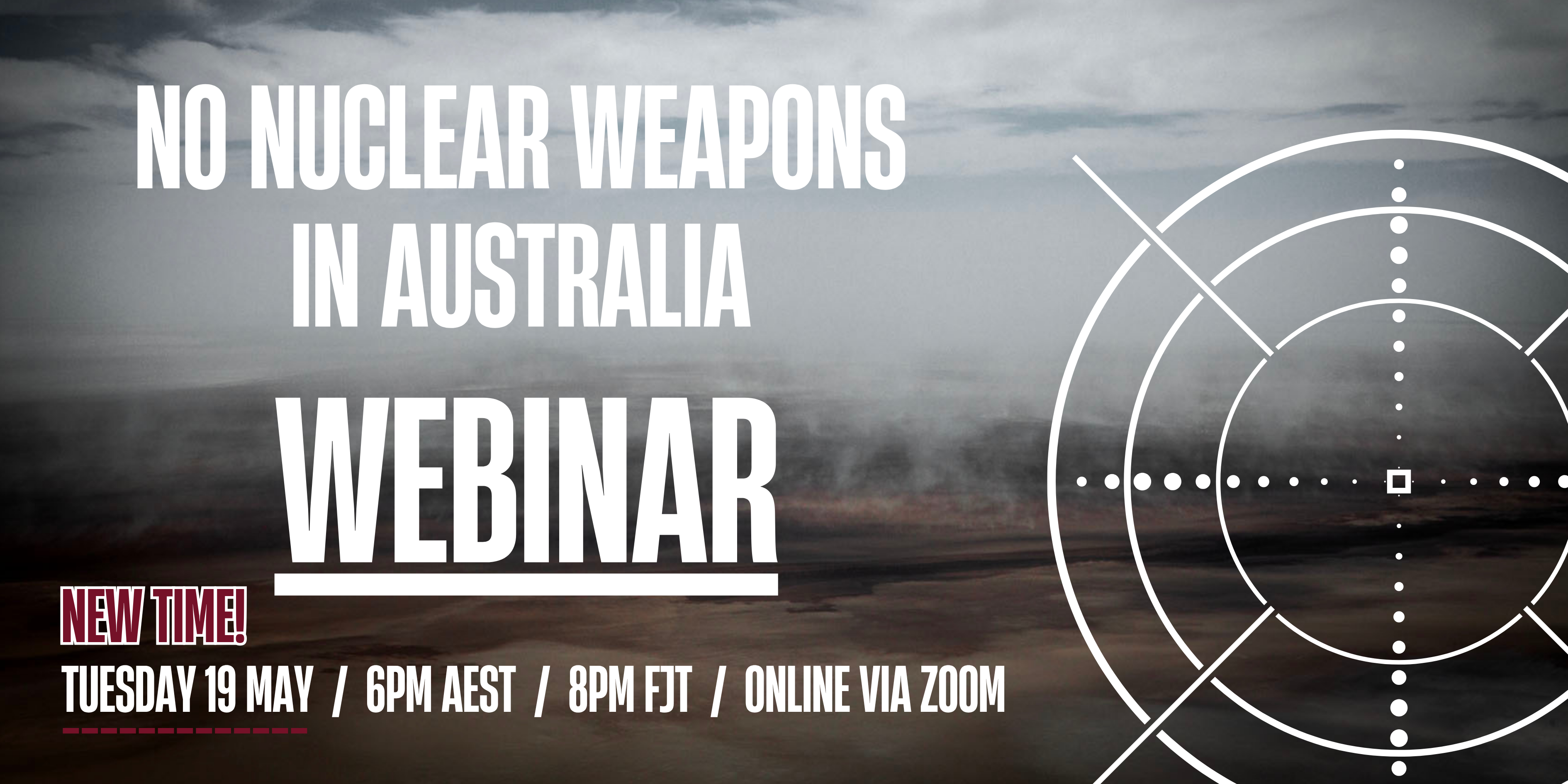
19 May – Webinar- Webinar: No Nuclear Weapons in Australia
Start: 2026-05-19 18:00:00 UTC Canberra, Melbourne, Sydney (GMT+10:00)
End: 2026-05-19 19:30:00 UTC Canberra, Melbourne, Sydney (GMT+10:00)
20 May – Webinar – The dangerous world of AUKUS, US, military occupation and suppression of dissent

National Webinar, 20th May, 2026, 6.30pm AEST. Confronting laws restricting/suppressing protest speech and action
Speakers: Former Sen. Rex Patrick, Lawyer Nick Hanna ,Arthur Rorris ,Jorgen Doyle, Sen David Shoebbridge,
Facilitator Kelley Tranter.

of the week – Australians for War Powers Reform (AWPR)
To see nuclear-related stories in greater depth and intensity
 Antinuclear