Fossil fuels are ”very clean” – in Donald Trump’s world
 Guardian 23rd Oct 2020, In Donald Trump’s world – laid bare during Thursday night’s final
presidential debate with his Democratic rival Joe Biden in Nashville – fossil fuels are “very clean”, the US has the best air and water despite his administration’s extensive regulatory rollbacks, and thecountry can fix climate change by planting trees.
not exist. Humanity has just eight years to figure out how to get climate change under control before the future starts to look drastically worse – multiple-degree temperature increases, global sea-level rise, and increasingly disastrous wildfires, hurricanes, floods and droughts. Doing so will mean that unless there is a technological miracle, humans will at some point have to stop burning oil, gas and coal.
https://www.theguardian.com/us-news/2020/oct/23/joe-biden-transition-from-oil-industry-rowing-back
More on the presidential debate – about climate change
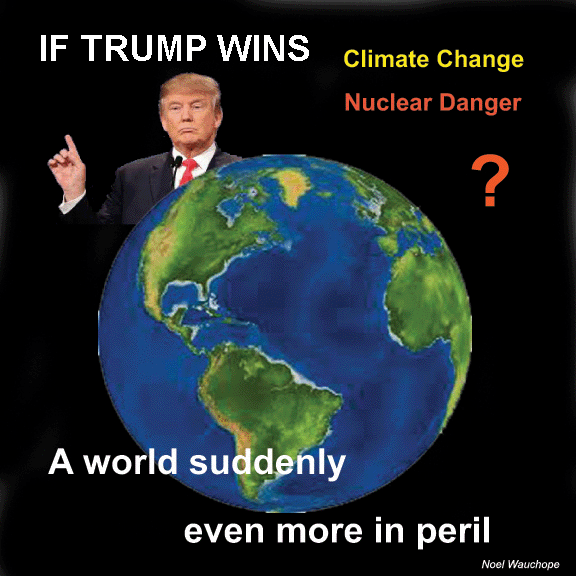 Independent 23rd Oct 2020 It has been around 20 years since a lengthy discussion on climate change featured in a presidential debate during which time a monumental shift has happened in how America views the crisis.
Two-thirds of Americans think that the US government should do more on climate change and moderator Kristen Welker asked both Donald Trump and Joe Biden how they would step up
on the issue during the final presidential debate on Thursday, with millions of Americans already taking to the polls ahead of election day on 3 November.
Calling it an “existential crisis”, Mr Biden sounded the alarm for the world to address global warming, as Mr Trump took credit for pulling the US out of the 2015 Paris Climate Accord, the international agreement aimed at doing precisely that. Mr Trump said his focus was saving
American jobs, while taking credit for some of the “cleanest air and water the nation has seen in generations” — partly down to regulations passed in the Obama era.
Independent 23rd Oct 2020, President Trump, who has repeatedly called climate change a “hoax”, said he planned for a “trillion trees” before touting America’s “clean air”, “clean water” and lower carbon emissions (all of which are, at best, misleading, as The Independent has reported).
The president then pivoted to an attack on clean energy, taking particular issue with windmills. “He thinks wind causes cancer. Windmills,” Mr Biden noted. “I know more about wind than you do,” Mr Trump replied, before going on to say windmills are extremely expensive, “kill all the birds” and “the fumes coming up, if you’re a believer in carbon emission … for these massive windmills is more than anything we’re talking about with natural gas which is very clean”.
BHP’s rejection of uranium is a sign of the future
 Wire 21st Oct 2020, The news this week that mining giant BHP will not continue with its long planned multi-billion dollar expansion of its Olympic Dam uranium and copper project is a sign that the market is turning against the controversial mineral.
It spells good news for the future of renewables but leaves the problem of leftover radioactive waste at Olympic Dam. There is no decision to change tack and mine the many many rare earths which also exist at the site.
http://thewire.org.au/story/bhps-rejection-of-uranium-a-sign-of-the-future/
October 23 Energy News — geoharvey

Science and Technology: ¶ “SAE International Publishes Two New Documents Enabling Commercialization of Wireless Charging for Electric Vehicles” • SAE International announced publication of two documents to enable a safe and efficient method for transferring power from a charging station to an EV. Wireless charging is done through a magnetic field. [CleanTechnica] Charging pad (Courtesy […]
October 23 Energy News — geoharvey
Solar plus storage better than grid connection for remote households — RenewEconomy

Dozens of WA households taken off the grid and given stand alone solar and storage power systems, cutting costs and improving reliability. The post Solar plus storage better than grid connection for remote households appeared first on RenewEconomy.
Solar plus storage better than grid connection for remote households — RenewEconomy
Danish research shows “almost no birds” die in collisions with wind turbines — RenewEconomy

A multi-year scientific study in Denmark has concluded that birds are quite good at avoiding wind turbine blades, and so “almost no birds die in collisions.” The post Danish research shows “almost no birds” die in collisions with wind turbines appeared first on RenewEconomy.
Danish research shows “almost no birds” die in collisions with wind turbines — RenewEconomy
Solar Insiders Podcast: The day South Australia became 100% solar fuelled — RenewEconomy

We look at the day when South Australia reached a world-first peak of 100 per cent solar power, plus the latest rooftop solar PV forecasts, and Victoria opens up for solar business again. The post Solar Insiders Podcast: The day South Australia became 100% solar fuelled appeared first on RenewEconomy.
Solar Insiders Podcast: The day South Australia became 100% solar fuelled — RenewEconomy
South Australian Parliament rejected Kimba nuclear waste dump, but Morrison govt could still impose it

It sounds good that this Motion passed in SA Parliament Legislative Council – credit to Mark Parnell MLC & SA Greens.
Even though Mark Parnell’s motion in the South Australian Parliament was successful last week it may be an illusory outcome as it seems that the Commonwealth government will have the constitutional superiority to override state laws with regard to the nuclear waste facility at Kimba
This is because the Commonwealth will rely on the free trade provision under section 92 of the Constitution as to the transport interstate of the nuclear waste while its storage and disposal falls under the external affairs power of section 51(xxix) as the safe management and disposal of nuclear waste is regulated under international convention and treaty rights
Regrettably the High Court in recent years has based many of its decisions rejecting state legislation on a broad interpretation of the external affairs power which in some circumstances has lead to virtually nonsensical conclusions
For this reason it is still essential to prevent the government’s proposals being carried out by legislative action
The Guardian was grossly unfair to Julian Assange. They could still make up for this.
 The Guardian’s Silence Let UK Trample on Assange’s Rights in Effective Darkness https://consortiumnews.com/2020/10/21/the-guardians-silence-let-uk-trample-on-assanges-rights-in-effective-darkness/?fbclid=IwAR16w5kNgLGJ3jyFI6QvKZmxJ5tn_LjZcD90a7FOG-ZQ8jaGzUYKlhnRT8M
Jonathan-Cook.net WISE Up, a solidarity group for Julian Assange and whistleblower Chelsea Manning, is due to stage a demonstration outside The Guardian offices on Oct. 22 to protest the paper’s failure to support Assange as the U.S. seeks his extradition in an unprecedented assault on press freedom.
The date chosen for the protest marks the 10th anniversary of The Guardian’s publication of the Iraq war logs, leaked by Manning to Assange and which lie at the heart of the U.S. case to reclassify journalism exposing crimes against humanity as “espionage.”
Here is my full statement, part of which is due to be read out, in support of Assange and castigating The Guardian for its craven failure to speak up in solidarity with its former media partner:
Julian Assange has been hounded out of public life and public view by the U.K. and U.S. governments for the best part of a decade.
Now he languishes in a small, airless cell in Belmarsh high-security prison in London — a victim of arbitrary detention, according to a UN working group, and a victim of psychological torture, according to Nils Melzer, the UN’s expert on torture.
If Judge Vanessa Baraitser, presiding in the Central Criminal Court in London, agrees to extradition, as she gives every appearance of preparing to do, Assange will be the first journalist to face a terrifying new ordeal — a form of extraordinary rendition to the United States for “espionage” — for having the courage to publish documents that exposed U.S. war crimes and crimes against humanity.
The Guardian worked with Assange and WikiLeaks on vitally important documents – now at the heart of the U.S. case against Assange – known as the Afghanistan and Iraq war logs. The latter were published exactly a decade ago today. They were a journalistic coup of global significance, and the paper ought to be profoundly proud of its role in bringing them to public attention.
During Assange’s extradition hearing, however, The Guardian treated the logs and its past association with Assange and WikiLeaks more like a dirty secret it hoped to keep out of sight. Those scoops furnished by Assange and whistleblower Chelsea Manning enriched the paper financially, and bolstered its standing internationally. They also helped to pave its path into the lucrative U.S. market.
Unlike Assange and Manning, The Guardian has suffered no consequences for publishing the logs. Unlike Assange and Manning, the paper has faced no retribution. While it profited, Assange continues to be made an example of — to deter other journalists from contemplating following in his footsteps.
The Guardian owes Assange.
- It owes him a huge debt for allowing it to share in the journalistic glory of WikiLeaks’ revelations.
- It owes him a duty of care as its partner in publishing the logs.
- It owes him its voice loudly denouncing the abuse of a fellow journalist for doing the essence of journalism — holding the powerful to account.
- It owes him and its own staff, and the young journalists who will one day take their place, its muscle in vigorously defending the principle of a strong and free press.
- It owes him, and the rest of us, a clear profession of its outrage as the U.S. conducts an unprecedented assault on free speech, the foundation of a democratic society.
And yet The Guardian has barely raised its voice above a whisper as the noose has tightened around Assange’s — and by extension, our — neck. It has barely bothered to cover the dramatic and deeply disturbing developments of last month’s extradition hearing, or the blatant abuses of legal process overseen by Baraitser.
The Guardian has failed to raise its editorial voice in condemnation either of the patently dishonest U.S. case for extradition or of the undisguised mistreatment of Assange by Britain’s legal and judicial authorities.
The paper’s many columnists ignored the proceedings too, except for those who contributed yet more snide and personal attacks of the kind that have typified The Guardian’s coverage of Assange for many years.
It is not too late for the paper to act in defence of Assange and journalism.
Assange’s rights are being trampled under foot close by The Guardian’s offices in London because the British establishment knows that these abuses are taking place effectively in darkness. It has nothing to fear as long as the media abdicates its responsibility to scrutinize what amounts to the biggest attack on journalism in living memory.
Were The Guardian to shine a light on Assange’s case — as it is morally obligated to do — the pressure would build on other media organizations, not least the BBC, to do their job properly too. The British establishment would finally face a countervailing pressure to the one being exerted so forcefully by the U.S.
The Guardian should have stood up for Assange long ago, when the threats he and investigative journalism faced became unmistakable. It missed that opportunity. But the threats to Assange — and the causes of transparency and accountability he champions — have not gone away. They have only intensified. Assange needs the Guardian’s support more urgently, more desperately than ever before.
Jonathan Cook is a former Guardian journalist (1994-2001) and winner of the Martha Gellhorn Special Prize for Journalism. He is a freelance journalist based in Nazareth. If you appreciate his articles, please consider offering your financial support.
This article is from his blog Jonathan Cook.net.
OLympic Dam uranium mine – NOT the great white hope for South Australia
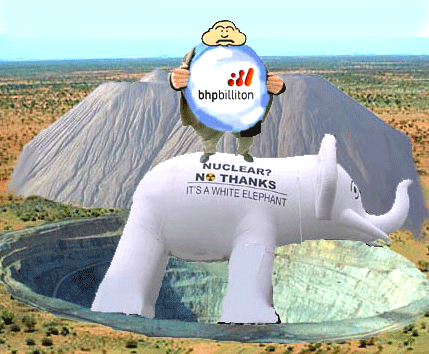 The Olympic Dam silver bullet is forever tarnished
“From the BHP side BFX is dead and buried… I suggest a new name: “OD-PERHAPS” for short.”
It’s time to stop looking to one mine in the state’s Far North for the answer to our economic problems
BHP, and our politicians, should be wary of rolling out the “expansion” tag to a state weary of spin around Olympic Dam, writes Business Editor Cameron England.
Cameron England, Business Editor, The Advertiser, October 20, 2020 ,
South Australians can take today’s announcement from BHP that its expansion plans have been shelved again as a signal that it’s time to step off the Olympic Dam silver bullet train once and for all…………
hanging our hopes on a big bang – or even a small bang – expansion of the project as a pivotal turning point for the state’s economy is a fool’s game.
The initial $30 billion open pit expansion – which was shelved in 2012 – would genuinely have been a game-changer for the state.
It included plans for an open pit bigger than the Adelaide CBD, new ports, and a surge in annual royalties for the State Government. But it was not to be.
The BFX expansion – which was shelved today – was a more modest $3.7 billion proposal, and while the spending would have been a boon to the state, it alone would have not moved the dial in a significant way for the state’s economy.
A broadbased approach, based around SA being a great place to do business – which the government is actually pursuing – stands a better chance of being the tide which lifts all boats.
Unfortunately the idea of an Olympic Dam expansion seems to be enough to make state ministers lose their equilibrium.
Back in 2011, former Infrastructure Minster Pat Conlon, with the caveat that it wasn’t his decision to make, declared the project a “goer” and said “I can tell you, having been regularly updated by my colleague Kevin Foley, Olympic Dam is a goer, it will get a sign-off.
“I’m very, very confident we’ll start up soon.’’
It didn’t of course.
And now current Mining Minister Dan van Holst Pellekaan says, similar to the results from Pantene, it won’t happen overnight, but it will happen…..
From the BHP side BFX is dead and buried, although they are committed to an incremental $500 million smelter maintenance plan and do want to gradually increase production.
But what most people would understand is an “expansion plan” is off the cards for now.
BHP needs to learn to manage expectations around this project, in a state which does have a tendency to hope for silver bullet solutions.
They’re between a rock and a hard place with their obligation to keep investors up to date, and not get people too excited with projects that invariably have billion dollar price tags attached.
I suggest a new name: the Olympic Dam Project Evaluation, Risk, Holistic Analysis and Potential Scheme – or “OD-PERHAPS” for short.
Kimba residents have been sold a lemon – dubious financial gain from nuclear waste dump
 Sandra Kanck Nuclear Fuel Cycle Watch Australia, 22 Oct 20,
How ANSTO’s Synroc nuclear waste solution turned out to be a dud
|
HOW SYNROC’S SCIENCE-PUSH FAILED AS THE PANACEA FOR NUCLEAR WASTE, https://www.aumanufacturing.com.au/how-synroc-s-science-push-failed-as-the-panacea-for-nuclear-waste by Peter Roberts, 21 Oct 20, CSIRO’s Synroc synthetic rock method for safely storing radioactive waste is making headlines again (more on that later), but as someone who has been around for a while it all just demonstrates yet again the topsy turvy way we see innovation in Australia. Synroc was unveiled in 1978 by a team led by Dr Ted Ringwood at the Australian National University, and further developed by CSIRO as the answer to nuclear waste. After a process of hot isostatic pressing, in which cannisters of waste are compressed at high temperature, Synroc ceramic was created and said to be a massive step forward from today’s techniques of storing high level waste in glass. But despite decades of trying to commercialise the technology both CSIRO and the Australian Nuclear Science and Technology Organisation have failed to get it adopted commercially – it is simply not seen by customers as that much better than what they were already doing. The process Synroc went through is typical of the science-push model of innovation in which researchers are seen as being the font of brilliant ideas that only need to be picked up by a grateful private sector. ANSTO’s Michael Deura said in a statement: “I am pretty excited to see the HIP system in action at ANSTO. This type of innovation will change the industry and how it operates in the longer term.” And Synroc technical director Gerry Triani said: “This HIP system is a global first for nuclear waste management.” Not a word in ANSTO’s media release about the three decades plus work and expenditure that has gone into Synroc, and not a word about the meagre uptake of the technology internationally. Really, you would hope we might learn the lessons of the past. |
|
|
Energy giant Engie supercharges green city development with support for EVs, hydrogen transport

Renew Economy 21st Oct 2020, French energy giant Engie backs Greater Springfield development, aiming to be ‘world’s greenest city’, with zero emissions transport plan. The post Energy giant Engie supercharges green city development with support for EVs, hydrogen transport appeared first on RenewEconomy.
A new city being developed in south-east Queensland aiming to become one of
the world’s greenest is set to get a boost, with a new roadmap launched with the backing of one of the world’s largest energy companies.Greater Springfield, which is located around 30km south-west of Brisbane and has
grown to a population of 45,000 has released a new master plan that will see electric vehicle charging infrastructure and a hydrogen fuelled bus network rolled out, in an effort to create the ‘world’s greenest city’ by 2038.The city is one of Australia’s largest privately funded city developments, including a mix of residential and business districts, and has attracted a campus of the University of Southern Queensland.
Energy giant Engie supercharges green city development with support for EVs, hydrogen transport — RenewEconomy
Nations divided over nuclear ban treaty: the ethical case grows stronger
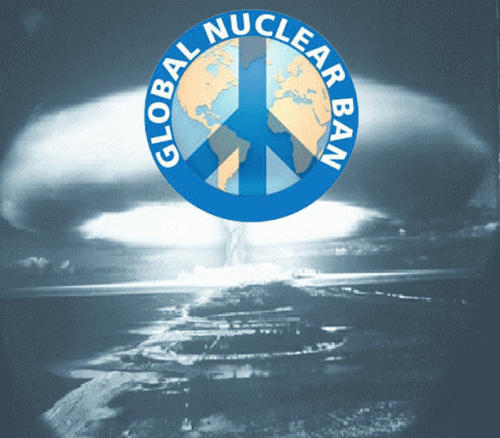 THE NUCLEAR TREATY dividing the World, Byline Times, Stephen Colegrave, 21 October 2020 As the latest United Nations nuclear treaty is on the eve of coming into force, Stephen Colegrave looks at how it might finally end the ethical and moral case for nuclear weapons.
The Treaty on the Prohibition of Nuclear Weapons has been a long time in the making. It is the first legally binding agreement to comprehensively prohibit nuclear weapons and was originally agreed at the United Nations on 7 July 2017.
To enter into force it requires ratification by at least 50 countries. At last, this is in sight. Any day, the fiftieth nation will ratify despite the determined efforts by all NATO countries and others with nuclear weapons.
UK representatives have remained outside of all meetings in Geneva about the treaty, to try to persuade countries not to sign. What are the predominantly Western powers so afraid of? And why is there such a fissure opening up between countries with access to or guaranteed by nuclear weapons and those which want them to be completely banned?
A Different Type Of Treaty
Up until now, most nuclear treaties have either been between nuclear powers or to limit proliferation internationally. This treaty is different.
The Treaty on the Prohibition of Nuclear Weapons seeks to ban all nuclear weapons and wipe out the hegemony of nuclear powers that has lasted since 1945.
It questions the moral basis of the Western powers’ nuclear ‘deterrent’ policy, which claims to have maintained peace, specifically banning the “use of force and the threat of the use of force”. This is why the treaty is vehemently opposed by NATO members and other nations with nuclear weapons. For the first time, the deterrent stance is now being questioned by politicians in nations around the world, not just by activists.
Northern Hemisphere nations such as Austria, Mexico and Ireland have actively campaigned against nuclear weapons and, in the Southern Hemisphere, many nations have already signed treaties and conventions setting up Nuclear Weapon Free Zones. In fact, the six main zones include 60% of the 195 nation states, 59% of the world’s geography and 39% of the world’s population. These nations will not allow the transportation of nuclear weapons, their supply chain in their territories, or even let ships use their harbours. Attitudes in these areas and other non-nuclear states is very different than those found in the UK and America.
Until recently, nations with nuclear weapons have been setting the agenda and the conversation about limiting nuclear proliferation, in countries such as North Korea and Iran, has focused on limiting their ‘special club’.
With this treaty, the countries that have banned nuclear weapons in their own regions have taken global leadership over the issue for the first time. They have been responsible for setting a new legal standard and building the moral case that nuclear weapons must be eliminated. This is because they realise that their Nuclear Weapon Free Zones are worthless if nuclear powers accidently or deliberately set off a nuclear winter.
Kevin Rudd’s vision for a green recovery out of the pandemic
 New jobs, new industries, new wealth’: Kevin Rudd’s vision for a green recovery out of the pandemic
Former PM says Australia risks becoming ‘the complacent country’ and could suffer another recession if it remains tied to fossil fuels, Guardian, Adam Morton Environment editor @adamlmorton, Tue 20 Oct 2020 Kevin Rudd has called for solar panels to be made compulsory on all new buildings and increased incentives to be offered to households that do not yet have them as part of a “genuinely green recovery” from recession.
Speaking at an Australian National University event on Monday, the former prime minister repeated his 2007 declaration that climate change was the “great moral challenge of our time” and accused the Morrison government of putting jobs and long-term living standards at risk by failing to deal with the issue as promised under the Paris agreement.
Rudd said the government could have used the coronavirus pandemic as a spur to accelerate the shift to becoming a zero emissions economy, but had instead used it as an excuse to delay action further. It was evidence Australia had become “the complacent country” on the issue despite the experience of last summer’s catastrophic bushfires, he said.
“Besides the United States under [Donald] Trump and Brazil under [Jair] Bolsonaro, we in Australia are the only major economy that does not take the need for action on climate change seriously. Nor do we recognise the economic opportunities that will come with that action. I would argue this is bad company to keep,” Rudd said as part of his keynote address at the Wilson Dialogue.
“I fear that seeking to untangle our carbon-intensive economy much later than the rest of the world could in fact be what causes the next recession in Australia as the global economy increasingly walks away from fossil fuel dependency.”
Rudd said his vision for a green recovery from the pandemic included large-scale investment in renewable energy to position as a clean energy superpower, saying there was evidence it could create “new jobs, new industries, new wealth” while providing clean energy at home and creating clean energy technology that could be exported……….
In his speech, Rudd urged people to “launch, collectively, a national fusillade against the Murdoch media”, which he said had been the “echo-chamber of climate change denialism for the best part of a decade”. https://www.theguardian.com/australia-news/2020/oct/20/new-jobs-new-industries-new-wealth-kevin-rudds-vision-for-a-green-recovery-out-of-the-pandemic
1 This month.


PETITION – To: Prime Minister Anthony Albanese and the Australian Labor Government
Chernobyl: The Lost Tapes – A good documentary on Chernobyl on SBS available On Demand for the next 3 weeks– https://www.sbs.com.au/ondemand/tv-program/chernobyl-the-lost-tapes/235274195556
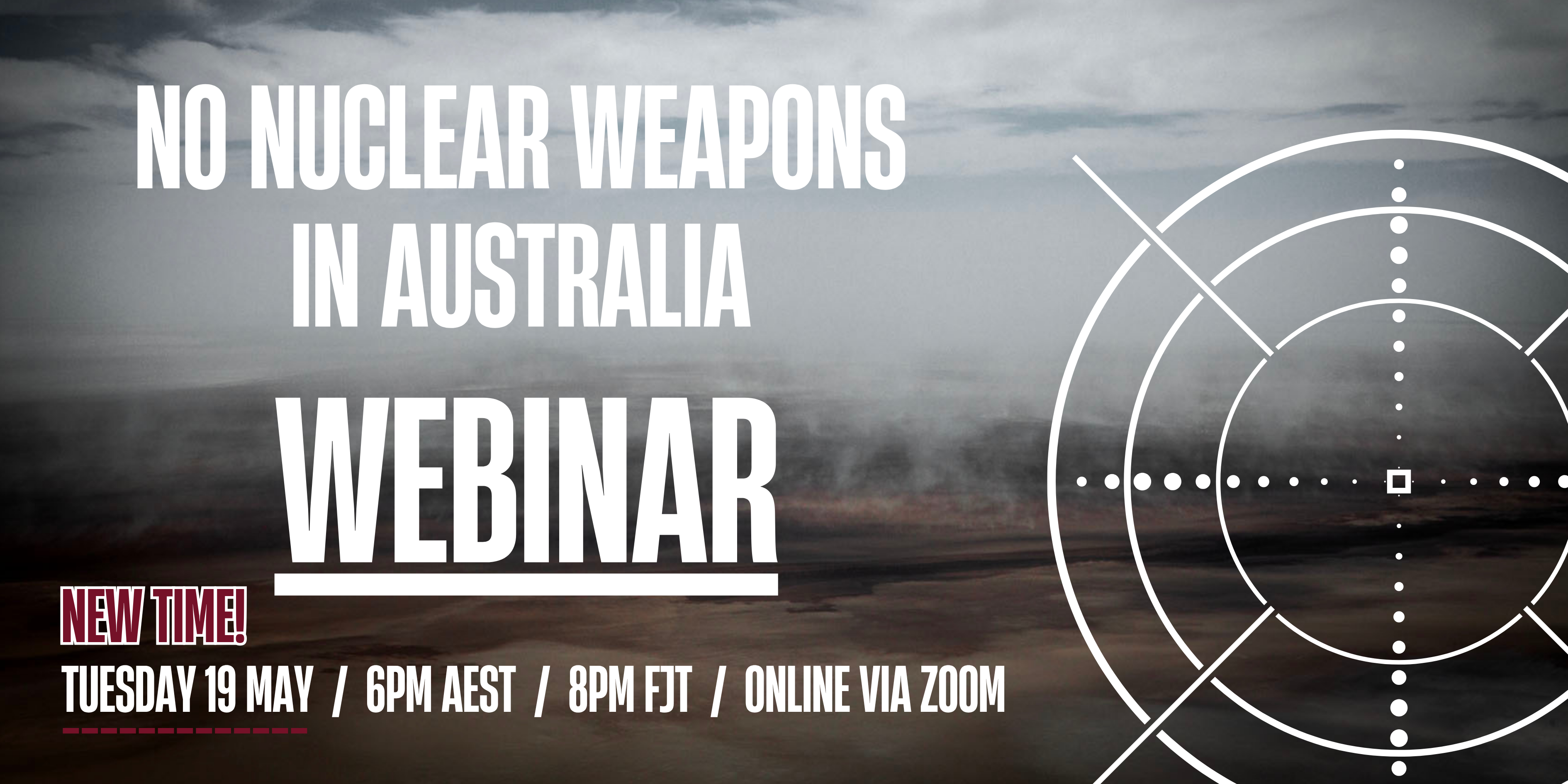
19 May – Webinar- Webinar: No Nuclear Weapons in Australia
Start: 2026-05-19 18:00:00 UTC Canberra, Melbourne, Sydney (GMT+10:00)
End: 2026-05-19 19:30:00 UTC Canberra, Melbourne, Sydney (GMT+10:00)
20 May – Webinar – The dangerous world of AUKUS, US, military occupation and suppression of dissent

National Webinar, 20th May, 2026, 6.30pm AEST. Confronting laws restricting/suppressing protest speech and action
Speakers: Former Sen. Rex Patrick, Lawyer Nick Hanna ,Arthur Rorris ,Jorgen Doyle, Sen David Shoebbridge,
Facilitator Kelley Tranter.

of the week – Australians for War Powers Reform (AWPR)
To see nuclear-related stories in greater depth and intensity
 Antinuclear