Trump’s COVID infection shows why it’s time to retire the nuclear football
Trump’s COVID infection shows why it’s time to retire the nuclear football, Bulletin of the Atomic SCientists By Tom Z. Collina, October 6, 2020 President John Kennedy took powerful pain medications. President Richard Nixon was a heavy drinker. President Ronald Reagan had dementia. And now President Donald Trump has the coronavirus. These conditions can significantly impair one’s ability to think clearly. And yet, as president, each had—or, in Trump’s case, still has–the unilateral authority to launch US nuclear weapons within minutes.
President Trump is followed 24/7 by a military aide that carries the “football,” the briefcase that holds all he would need to order the immediate launch of up to 1,000 nuclear weapons, more than enough megatonnage to blow the world back into the stone age. He does not need the approval of Congress or the secretary of defense. Shockingly, there are no checks and balances on this ultimate executive power.
President Trump took the nuclear football with him to Walter Reed Medical Center, where he received treatment for COVID-19. According to Trump’s doctor, the president’s blood oxygen levels had dipped. And this, according to independent health experts, can impair decision-making ability. He is taking dexamethasone, which can cause mood swings and “frank psychotic manifestations.” Yet as far as we know, at no point did the president transfer his powers to the vice president, as allowed under the 25th Amendment.
To state the obvious, we should not entrust nuclear launch authority to someone who is not fully lucid. (Reagan transferred authority temporarily before planned surgery, as did President George W. Bush before a medical procedure that required his sedation.) A nuclear crisis can happen at any time, including at the worst possible time. If such a crisis takes place when a president’s thinking is compromised for any reason, the results could be catastrophic. ……..
If the president or his advisors have reason to believe that Trump’s thinking may be compromised, nuclear launch authority should be transferred to the vice president, Mike Pence. If Pence also gets COVID, the football could then be passed to House Speaker Nancy Pelosi, President Pro Tempore of the Senate Chuck Grassley, and the secretaries of State, Treasury and Defense, in that order.
But kicking the football down the line does not solve the problem—and in fact shows why the system is broken. Does anyone really believe that the president pro tem of the Senate or the Treasury Secretary has spent much time preparing for nuclear war? And even if they had prepared, the central dilemma remains: All humans are imperfect, and we should not trust the fate of the world to any one person.
The whole concept of giving the president unilateral nuclear authority is built on the false assumption that Russia might launch a surprise first strike. In fact, Russia has never seriously considered a first strike against the United States for a simple reason: It would be national suicide. Both sides have to assume that an attack would provoke an unacceptable nuclear retaliation. Both nations, and much of the rest of the globe, would be obliterated. Starting such a war would be insanity………
It is time to retire the nuclear football. The only thing standing between us and nuclear holocaust is one man with COVID on heavy meds. That is the plan? Ending sole authority is better than entrusting it to any individual. In a vibrant democracy, no one person should have the unchecked power to destroy the world. https://thebulletin.org/2020/10/trumps-covid-infection-shows-why-its-time-to-retire-the-nuclear-football/
Pressure on U.S. Congress to reinstate research on links between nuclear stations and cancer
This is a scientific endeavor which will improve our understanding of cancer, the leading cause of death in California,” the petition states. “It is especially important for women, children, and the human fetus who are much more vulnerable to the biological effects of harmful ionizing radiation.”
More modern studies in Europe have found that children living within 3 miles of nuclear power plants had double the risk of developing acute leukemia as those living farther away, with the peak impact on children ages 2-4.
Activists push Congress to revive probe into links between nuclear plants and cancer
Nuclear Regulatory Commission killed study in 2015 after spending five years and $1.5 million on the effort, Orange County Register, By TERI SFORZA | tsforza@scng.com | October 5, 2020 Scientists and activists were stunned back in 2015 when the Nuclear Regulatory Commission pulled the plug on what was designed to be the best study of cancer near nuclear power plants ever done. Continue reading
Morrison government again fails on climate ation, snubs renewable energy
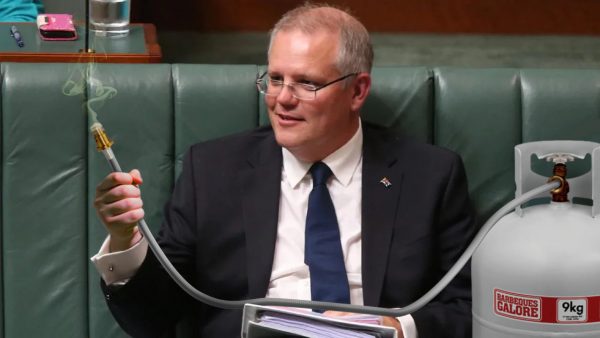
But investment in renewable energy was largely shunned. Notably, the government allocated just A$5 million for electric vehicles. It confirmed funding for the Australian Renewable Energy Agency (ARENA) for another decade, but the money is far less than what’s needed.
The COVID-19 pandemic has seen the Morrison government abandon long-held dogma on debt and deficits. However, the federal budget shows when it comes to climate and energy, the government is singing from the same old songbook.
A techno-fix
The budget doubled down on the Morrison government’s rhetoric of “technology, not taxes”, by choosing preferred technologies for investment.
This “picking winners” approach would have some chance of addressing climate change if it were based on a comprehensive analysis of the best path to zero emissions. But instead, the government has largely made offerings at the altars of technologies worshipped by the conservative side of politics.
The government will spend an as-yet undisclosed sum, possibly A$11 million, to refurbish the Vales Point coal-fired power station. The commitment to this coal infrastructure, co-owned by prominent Liberal party donor Trevor St Baker, is a disgraceful misuse of public money. It will also do little to halt the steady decline of coal-fired power generation.
As previously announced, the government will spend A$52.9 million to support the gas industry, which Frydenberg says will lower prices and support more manufacturing jobs. It includes money for gas infrastructure planning and to open up five gas basins, starting with Beetaloo Basin in the Northern Territory.
The budget confirms A$50 million for carbon capture and storage (CCS) to fund projects to cut emissions from industry. But proving the viability of large-scale CCS projects is extremely difficult, as experience in the United States and Canada has shown. In this context, allocating just A$50 million to get the technology off the ground is simply laughable.
History suggests the spending offers little return on investment. Research by the Australia Institute in 2017 revealed federal governments have spent A$1.3 billion in taxpayers’ money on CCS projects, with very little to show for it.
Renewables snubbed
Meanwhile, last night’s budget largely shunned investment in renewable energy.
The budget confirmed A$1.4 billion in ARENA funding for a further ten years, including a pretty paltry A$223.9 million over the next four years. Separately, the government will also seek to pass legislation to change ARENA’s investment mandate, enabling it to fund gas and carbon capture projects.
The government has allocated a tiny A$5 million towards electric vehicle development, including money towards a manufacturing facility in South Australia. It’s good to see electric vehicles on the government’s radar. But the commitment is dwarfed by investment overseas, including a reported US$300 billion set aside by global car makers over the next decade to bring electric vehicles to mass production.
The measly spending on clean energy technology does not make economic sense. The renewable energy sector is standing by to slash emissions and deliver lower energy prices – if only the right policy environment existed.
The budget was also an opportunity for the government to ditch its irrational opposition to carbon pricing. Recent research has comprehensively shown carbon pricing slows growth in greenhouse gas emissions.
Vehement carbon pricing critics, such as conservatives Tony Abbott, Craig Kelly and Barnaby Joyce, are now either discredited or out of parliament altogether. And scores of countries around the world have implemented some form of price on carbon.
A global outlier
Most obviously, the budget was an opportunity to commit to net-zero emissions by 2050, as many developed countries have done.
The Morrison government has already used dodgy accounting tricks to meet Australia’s Paris Agreement commitment – reducing emissions by 26% on 2005 levels. The absence of a net-zero target suggests the government intends to allow emissions to grow indefinitely after 2030.
This approach is out of step with many of Australia’s international peers. Democratic presidential candidate Joe Biden, now the clear favourite to win the US election in November, is campaigning on what has been described as “the most aggressive climate platform” ever put forward by a presidential nominee.
October 7 Energy News — geoharvey

Opinion: ¶ “Nuclear Energy – The High Cost Of A Dying Industry” • Nuclear energy has had a seriously rough year. In an article by OilPrice.com, the author asked a question: “Why is nuclear energy so expensive?” The nuclear sector, OilPrice says, simply can’t compete with the flood of low cost natural gas and renewables. […]
October 7 Energy News — geoharvey
City of Newcastle has gone wind and solar, now it’s time to look at EVs and charging — RenewEconomy

Having effectively dealt with emissions from electricity sources, transport emissions are the next biggest challenge for the City of Newcastle. The post City of Newcastle has gone wind and solar, now it’s time to look at EVs and charging appeared first on RenewEconomy.
City of Newcastle has gone wind and solar, now it’s time to look at EVs and charging — RenewEconomy
WA’s third-largest wind farm, Warradarge to reach full output by end of October — RenewEconomy

WA’s third largest wind farm, the 180MW Warradarge project, officially opened, using some of the largest turbines deployed in the state. The post WA’s third-largest wind farm, Warradarge to reach full output by end of October appeared first on RenewEconomy.
WA’s third-largest wind farm, Warradarge to reach full output by end of October — RenewEconomy
Europe’s new climate target would mean near total exit from coal by 2030 — RenewEconomy

Proposed new climate target for Europe would result in the near total elimination of coal fired generation by 2030, experts say. The post Europe’s new climate target would mean near total exit from coal by 2030 appeared first on RenewEconomy.
Europe’s new climate target would mean near total exit from coal by 2030 — RenewEconomy
Labor likely to amend the Nuclear Waste Bill, removing certainty about the Napandee dump happening
 Labor’s position on nuclear waste bill means uncertainty remains over South Australian site, Guardian, Paul Karp @Paul_Karp 5 Oct 20, Labor will try to amend a government bill so that the federal resources minister has to nominate the site for a nuclear waste dump, despite concerns within the ALP caucus the change could pave the way for the decision to be challenged in court.On Monday, the Labor caucus agreed it would try to amend the bill by removing a schedule which states the dump should be located at Napandee some 20km north-west of Kimba in South Australia. The caucus resolved to oppose the bill if the change was not supported. Labor’s position on nuclear waste bill means uncertainty remains over South Australian site, Guardian, Paul Karp @Paul_Karp 5 Oct 20, Labor will try to amend a government bill so that the federal resources minister has to nominate the site for a nuclear waste dump, despite concerns within the ALP caucus the change could pave the way for the decision to be challenged in court.On Monday, the Labor caucus agreed it would try to amend the bill by removing a schedule which states the dump should be located at Napandee some 20km north-west of Kimba in South Australia. The caucus resolved to oppose the bill if the change was not supported.
The caucus resolution follows a recommendation by the shadow science minister, Brendan O’Connor, and despite vigorous opposition from senators Alex Gallacher and Kim Carr. They argued that making the minister select the site could leave the decision vulnerable to challenge. The government’s bill, as it stands, nominates Napandee as the location for the dump and provides a compensation package – a formulation that prevents judicial review of the site selection…… https://www.theguardian.com/environment/2020/oct/05/labors-position-on-nuclear-waste-bill-means-uncertainty-remains-over-south-australian-site |
|
Nuclear waste dump – a Federal abuse of a small rural town
 Regina McKenzie Fight To Stop a Nuclear Waste Dump in South Australia, 6 Oct 20
Major study finds that renewables lower emissions substantially, and nuclear power does not
 Two’s a crowd: Nuclear and renewables don’t mix, https://techxplore.com/news/2020-10-crowd-nuclear-renewables-dont.html by University of Sussex OCTOBER 5, 2020
If countries want to lower emissions as substantially, rapidly and cost-effectively as possible, they should prioritize support for renewables, rather than nuclear power, the findings of a major new energy study concludes.
That’s the finding of new analysis of 123 countries over 25 years by the University of Sussex Business School and the ISM International School of Management which reveals that nuclear energy programs around the world tend not to deliver sufficient carbon emission reductions and so should not be considered an effective low carbon energy source.
Researchers found that unlike renewables, countries around the world with larger scale national nuclear attachments do not tend to show significantly lower carbon emissions—and in poorer countries nuclear programs actually tend to associate with relatively higher emissions.
Published today in Nature Energy, the study reveals that nuclear and renewable energy programs do not tend to co-exist well together in national low-carbon energy systems but instead crowd each other out and limit effectiveness.
Benjmin K Sovacool, Professor of Energy Policy in the Science Policy Research Unit (SPRU) at the University of Sussex Business School, said: “The evidence clearly points to nuclear being the least effective of the two broad carbon emissions abatement strategies, and coupled with its tendency not to co-exist well with its renewable alternative, this raises serious doubts about the wisdom of prioritizing investment in nuclear over renewable energy. Countries planning large-scale investments in new nuclear power are risking suppression of greater climate benefits from alternative renewable energy investments.”
The researchers, using World Bank and International Energy Agency data covering 1990-2014, found that nuclear and renewables tend to exhibit lock-ins and path dependencies that crowd each other out, identifying a number of ways in which a combined nuclear and renewable energy mix is incompatible.
These include the configuration of electricity transmission and distribution systems where a grid structure optimized for larger scale centralized power production such as conventional nuclear, will make it more challenging, time-consuming and costly to introduce small-scale distributed renewable power.
Similarly, finance markets, regulatory institutions and employment practices structured around large-scale, base-load, long-lead time construction projects for centralized thermal generating plant are not well designed to also facilitate a multiplicity of much smaller short-term distributed initiatives.
Andy Stirling, Professor of Science and Technology Policy at the University of Sussex Business School, said: “This paper exposes the irrationality of arguing for nuclear investment based on a ‘do everything’ argument. Our findings show not only that nuclear investments around the world tend on balance to be less effective than renewable investments at carbon emissions mitigation, but that tensions between these two strategies can further erode the effectiveness of averting climate disruption.”
The study found that in countries with a high GDP per capita, nuclear electricity production does associate with a small drop in CO2 emissions. But in comparative terms, this drop is smaller than that associated with investments in renewable energy.
And in countries with a low GDP per capita, nuclear electricity production clearly associates with CO2 emissions that tend to be higher.
Patrick Schmid, from the ISM International School of Management München, said: “While it is important to acknowledge the correlative nature of our data analysis, it is astonishing how clear and consistent the results are across different time frames and country sets. In certain large country samples the relationship between renewable electricity and CO2-emissions is up to seven times stronger than the corresponding relationship for nuclear.”
Federal government hiding its toxic nuclear waste Act under the cover of budget fuss
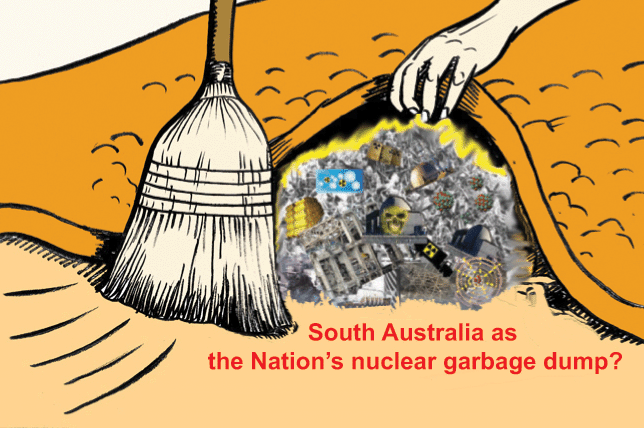 From A letter from Dr Margaret Beavis,
Divisions in Labor, over nuclear waste dump plan
Federal Labor divided over plans to block SA’s nuclear waste dump facility, The Age, By Rob Harris, October 5, 2020 — A 40-year effort to establish a nuclear waste dump in remote South Australia faces a rocky passage through Federal Parliament after Labor signalled it is prepared to block the Morrison government’s attempts to resolve the long-running debate.
The decision, rubber-stamped by the federal caucus in lengthy debate on Monday, has sparked further divisions within the opposition, with veteran senators Alex Gallacher and Kim Carr expressing fierce criticism of their party’s position.
There are also concerns within federal Labor that its stance could unwittingly hand Prime Minister Scott Morrison a double-dissolution trigger should the crossbench sink the laws.
The government intends to introduce legislation to finally establish a low- and medium-level nuclear waste facility at Napandee, a farm on South Australia’s Eyre Peninsula, having spent seven years and more than $60 million finding a suitable home……..
Labor will seek to amend the laws so that the minister responsible, Resources Minister Keith Pitt, can use existing powers to nominate any site under the current legislation. Labor says the changes would still give the local community access to a significant community fund on offer and would ensure the decision be subject to a judicial review.
Seven Labor MPs spoke up in the debate over the legislation, which lasted for more than an hour………
Opposition science spokesman Brendan O’Connor said federal Labor supported the need for a national facility to store radioactive waste.
This government has had existing powers under the current legislation for the past seven years to determine a site, but under the guise of compensation has sought to remove proper scrutiny, through this proposed legislation,” he said.
“This is a contentious issue and should be subject to the highest levels of scrutiny to ensure that the principles of procedural fairness and natural justice have been applied given the national significance of this matter.”……..
A Senate committee last month recommended the legislation be supported but three members – the Greens’ Sarah Hanson-Young, Independent senator Rex Patrick and Labor senator Jenny McAllister – issued dissenting reports.
Senator McAllister said the proposed facility had not received the support of the relevant traditional owners in South Australia. https://www.theage.com.au/politics/federal/federal-labor-divided-over-plans-to-block-sa-s-nuclear-waste-dump-facility-20201005-p5628p.html
14 million tonnes of plastic on ocean floor ! – CSIRO study
Every drink bottle we buy, face scrub we use and chip packet we finish results in tiny plastics entering the ocean.But where are these tiny micro-plastics, exactly?
Are they floating around on the ocean’s surface, waiting to be scooped up by a surfer?
Or are they stuck in the tummies of turtles or seabirds?
A new study by the CSIRO, Australia’s national science agency, has estimated up to 14 million tonnes of micro-plastics have sunk to the bottom of the ocean floor.
The peer-reviewed research, published on Tuesday, is the first global estimate for micro-plastics on the seafloor. Dr Britta Denise Hardesty, team leader with CSIRO’s Oceans and Atmosphere, said 14 million tonnes of micro-plastics was a “huge amount, especially when you think about how tiny all those bits are”.Dr Britta Denise Hardesty, team leader with CSIRO’s Oceans and Atmosphere, said 14 million tonnes of micro-plastics was a “huge amount, especially when you think about how tiny all those bits are”.
But where are these tiny micro-plastics, exactly?
Are they floating around on the ocean’s surface, waiting to be scooped up by a surfer?
Or are they stuck in the tummies of turtles or seabirds?
A new study by the CSIRO, Australia’s national science agency, has estimated up to 14 million tonnes of micro-plastics have sunk to the bottom of the ocean floor.
The peer-reviewed research, published on Tuesday, is the first global estimate for micro-plastics on the seafloor.
Dr Britta Denise Hardesty, team leader with CSIRO’s Oceans and Atmosphere, said 14 million tonnes of micro-plastics was a “huge amount, especially when you think about how tiny all those bits are”.
To put it into perspective: Imagine five carrier bags stuffed with plastic dotted along every single metre of coastline around the world, excluding Antarctica
The piles of bags would sit on every Australian beach, along Italy’s Amalfi Coast, around Vietnam’s Ha Long Bay, and all around Canada’s coastlines and beyond.
Now imagine someone pushing those bags into the ocean, and letting them sink into the darkness.
“It’s a confronting amount, and hopefully it provides a reasonable wake-up call,” Dr Hardesty told The New Daily.
“We’re finding them hundreds of kilometres offshore and thousands of metres deep – more micro-plastics than has been found by lots of other studies.”
“Micro-plastics come from the same place as plastics,” Dr Hardesty said, adding “micro just means they’re smaller than 5mm”.
“It’s really just small plastic from single-use items, consumer goods, industry or fishing-related goods, cosmetics, micro-beads, agriculture, aquaculture, household waste, everything.”Many of these tiny plastics end up in our oceans via stormwater drains, sewage systems, sea-based activities, littering, things falling off the backs of trucks, and improper waste management where people intentionally dump rubbish straight into the sea or rivers.
They often end up in the stomachs of marine animals like dolphins or fish, while bigger pieces of plastic can be just as dangerous.
“Masks that have those little straps can tangle the feet and legs of sea birds and things like that,” Dr Hardesty said.
“Rubber gloves might be more likely to look like a jellyfish that could be mistakenly eaten by turtles if they end up in the ocean.”
The World Economic Forum estimates one garbage truck of plastic alone is dumped into the ocean every minute of every day.
It estimates there could be more plastic in the ocean than fish by 2050.
The missing piece
Although the CSIRO’s findings are troubling, perhaps what’s more concerning is the answer to the following question: Where is the rest of the missing plastic?
Compared to the tonnes of plastic entering the ocean every day, Dr Hardesty said 14 million tonnes on the ocean floor was “just a drop in the ocean”.
“Where is all the missing plastic? Is it in the stomachs of animals? Is it floating on the surface?” she said.
“I’d say most of it is on our coastlines.”
Pretty despicable -tax breaks for company exporting weapons to Saudi Arabia, UAE.
Tax break for weapons exports to Mid-East countries accused of war crimes, Michael West Media, by Michelle Fahy | Oct 6, 2020 Australian weapons manufacturer Electro Optic Systems, with financial support from the federal and ACT governments, is capitalising on the ‘growth market’ of the Middle East, one of the world’s most volatile regions. Michelle Fahy reports.
As has been reported repeatedly, remote weapons systems manufactured by EOS are being exported to the United Arab Emirates and Saudi Arabia despite both countries being accused of war crimes. Numerous UN reports have detailed shocking human rights violations over the six years of the Yemen war.
After a shutdown due to Covid-19, EOS announced last month that it is exporting again.
EOS and the federal government have been asked repeatedly for proof that its weapons are not being used in Yemen. “Trust us,” is the standard response.
Assurances from a company chasing millions in profit and a government intent on catapulting Australia into the global top 10 of weapons exporters seem to be the best the public can expect in terms of accountability.
There is zero transparency when it comes to Australian weapons exports………..
Government support for EOS
EOS has received extensive government support, including an exemption from paying state payroll tax. Under questioning last November by the ACT Greens, Chief Minister Andrew Barr said the ACT Government provided support to EOS (PDF p44), “principally for its space industry related activity”. While EOS separates its space industry work from its weapons side, both companies operate in the same group under the same board……..
EOS has so far supplied the UAE and Saudi with its remote weapons systems. The systems are mounted on armoured vehicles and can incorporate a light cannon, machine gun, grenade launcher or anti-tank missile, which EOS does not manufacture. The system enables the weapon to be operated from inside the vehicle, which makes the soldier safer. It can identify targets and automatically aim the weapon, making the firing of the weapon faster and more accurate. In military parlance, the system enhances lethality. See it in action here.
The claim that it was not a weapons manufacturer may have been technically correct when asserted by EOS and Barr, but that is no longer the case.
Last month EOS announced it had moved into production with a new range of directed energy (laser) weapons. The weapons are being marketed by EOS as ‘drone kill’ technology (counter unmanned aircraft system or CUAS). EOS says “CUAS are entirely defensive systems”. The potential market is large. EOS has named its new range of weapons Mopoke, after the small native Australian owl.
EOS has not disclosed its list of interested customers for Mopoke, but industry insiders – such as AuManufacturing – have noted that its first customers are likely to come from the Middle East, given drone attacks on infrastructure there……….
EOS is now unequivocally a weapons manufacturer, and likely to soon start exporting its weapons to the Middle East.
Supplying weapons to war crimes accused
Melissa Parke, a lawyer, former federal Labor MP, and human rights expert, is one of three UN-appointed Eminent Experts on Yemen. Parke told SBS Dateline last year:
“No country can claim not to be aware of the violations being perpetrated in Yemen. To continue to provide weapons in the knowledge of such violations is both morally and legally hazardous.”
A former secretary of the Defence Department, Paul Barratt, has also stated his position on these weapon sales:
“Regardless of whether Australian-made weapons [are] crossing the border into Yemen, Australia now has a national policy which seeks and facilitates weapons sales with countries that stand accused of gross violations of human rights and likely war crimes. When did this particular trade in arms become official Australian policy? As a country that routinely asks other countries to abide by the rules-based international order, it would seem hypocritical, at best, that Australia is now willing to … make a profit from weapons sales to nations that are openly flouting this international order.”……….
In addition to ministerial lobbying, EOS Defence Systems has received federal financial support, including:
- $3.7 million from Defence between 2013 and 2016
- $41.5 million performance bond from Export Finance Australia (EFIC) (PDF p66)
The company has also gained from influential appointments to its board. Former Chief of Army, Peter Leahy, joined the EOS board in May 2009, just 10 months after retiring as army chief. In April 2016 Leahy was joined by former Chief of Air Force, Geoff Brown, less than 10 months after he had retired from the air force…… https://www.michaelwest.com.au/eos-weapons-export-transparen
SCIENTISTS: NUCLEAR ENERGY IS A WASTE OF TIME
Status Quo
It turns out that nuclear energy, which advocates say is a more feasible means of transitioning away from fossil fuels than solar or wind, might not actually be up to the task.
That’s according to research published Monday in the journal Nature Energy, which shows that countries that adopted nuclear energy didn’t actually reduce their carbon emissions a significant amount — but that countries with renewable energy investments did. It’s a compelling case that clean energy initiatives ought to focus on solar and wind, and perhaps skip nuclear as a stepping stone on the road to decarbonization.
Town Ain’t Big Enough
Looking at global data from the years 1990-2014, the University of Sussex science policy researchers also found that nuclear and renewable energy programs don’t play well together, in part since large, centralized nuclear plants require different infrastructure from more distributed solar fields, for example. Since one had a much bigger impact on emissions than the other, the team recommends being strategic.
“This paper exposes the irrationality of arguing for nuclear investment based on a ‘do everything’ argument,” study coauthor Andy Stirling said in a press release.
Least Resistance
With only so much time and money available, study coauthor Benjamin Sovacool argues that spending money on a new nuclear program might effectively block subsequent renewables programs from working and, as a result, continue to emit too much carbon into the air.
“Countries planning large-scale investments in new nuclear power are risking suppression of greater climate benefits from alternative renewable energy investments,” Sovacool said in the release.
1 This month.
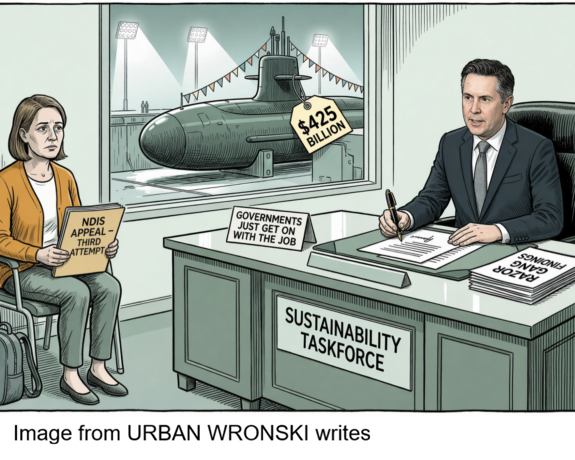

PETITION – To: Prime Minister Anthony Albanese and the Australian Labor Government
Chernobyl: The Lost Tapes – A good documentary on Chernobyl on SBS available On Demand for the next 3 weeks– https://www.sbs.com.au/ondemand/tv-program/chernobyl-the-lost-tapes/235274195556

19 May – Webinar- Webinar: No Nuclear Weapons in Australia
Start: 2026-05-19 18:00:00 UTC Canberra, Melbourne, Sydney (GMT+10:00)
End: 2026-05-19 19:30:00 UTC Canberra, Melbourne, Sydney (GMT+10:00)
20 May – Webinar – The dangerous world of AUKUS, US, military occupation and suppression of dissent

National Webinar, 20th May, 2026, 6.30pm AEST. Confronting laws restricting/suppressing protest speech and action
Speakers: Former Sen. Rex Patrick, Lawyer Nick Hanna ,Arthur Rorris ,Jorgen Doyle, Sen David Shoebbridge,
Facilitator Kelley Tranter.

of the week – Australians for War Powers Reform (AWPR)
To see nuclear-related stories in greater depth and intensity
 Antinuclear