Will we ever be nuclear-free? — Beyond Nuclear International

Six people who think it’s worth fighting for
Will we ever be nuclear-free? — Beyond Nuclear International
Radioactive soil plan casts shadow over Fukushima village — Fukushima 311 Watchdogs

Keiko Shigihara used to make pickles out of flower petals from a cherry tree at her former home in Fukushima Prefecture. Sep 11, 2020 Keiko Shigihara, 58, soaks up the summer sun as she looks over her property in the village of Iitate in Fukushima Prefecture, from where she evacuated after the meltdowns at the […]
Radioactive soil plan casts shadow over Fukushima village — Fukushima 311 Watchdogs
South Australia solar power reaches 94 pct of state demand on Sunday — RenewEconomy

Solar power contributes 94 per cent of South Australia’s state demand at midday on Sunday, as state government looks to use electric vehicles as a “solar sponge”. The post South Australia solar power reaches 94 pct of state demand on Sunday appeared first on RenewEconomy.
South Australia solar power reaches 94 pct of state demand on Sunday — RenewEconomy
September 13 Energy News — geoharvey

Opinion: ¶ “Five Key Reasons To Stop The Mountain Valley Pipeline” • It’s time to stop the Mountain Valley Pipeline and its dangerous attempts to transport dirty fracked gas across Appalachia. This massive dirty energy project would jeopardize sensitive rivers and streams, drinking water sources, the climate, and people in local communities. [CleanTechnica] ¶ “Is […]
September 13 Energy News — geoharvey
Australia betrays Julian Assange, an Australian citizen
 Australia stinks. Apart from a brave effort by Bob Carr, the ABC (Background Briefing) and a few others, the Australian media has ignored Julian Assange. All this while the Australian media recently went on a campaign for “freedom of the press”. ha ha.
As for the Australian government, and most politicians – mealy mouthed spin about “consular support” – is all you get out of them. Exceptions – Andrew Wilkie and a couple of others. I shouldn’t be surprised. We did the same thing decades ago to Wilfred Burchett – who at least was not an Australian citizen. But Julian Assange is. Surely Julian should get the same compassion and help that the Australian government and press give to Australian drug dealers and murderers who are in legal trouble overseas.
Following the UK court hearing on the extradition of Julian Assange
 Your Man in the Public Gallery – Assange Hearing Day 8, Craig Murray September 10, 2020 The great question after yesterday’s hearing was whether prosecution counsel James Lewis QC would continue to charge at defence witnesses like a deranged berserker (spoiler – he would), and more importantly, why?
QC’s representing governments usually seek to radiate calm control, and treat defence arguments as almost beneath their notice, certainly as no conceivable threat to the majestic thinking of the state. Lewis instead resembled a starving terrier kept away from a prime sausage by a steel fence whose manufacture and appearance was far beyond his comprehension.
Perhaps he has toothache.
PROFESSOR PAUL ROGERS
The first defence witness this morning was Professor Paul Rogers, Emeritus Professor of Peace Studies at the University of Bradford. He has written 9 books on the War on Terror, and has been for 15 years responsible for MOD contracts on training of armed forces in law and ethics of conflict. Rogers appeared by videolink from Bradford.
Prof Rogers’ full witness statement is here.
Edward Fitzgerald QC asked Prof Rogers whether Julian Assange’s views are political (this goes to article 4 in the UK/US extradition treaty against political extradition). Prof Rogers replied that “Assange is very clearly a person of strong political opinions.”
Fitzgerald then asked Prof Rogers to expound on the significance of the revelations from Chelsea Manning on Afghanistan. Prof Rogers responded that in 2001 there had been a very strong commitment in the United States to going to war in Afghanistan and Iraq. Easy initial military victories led to a feeling the nation had “got back on track”. George W Bush’s first state of the union address had the atmosphere of a victory rally. But Wikileaks’ revelations in the leaked war logs reinforced the view of some analysts that this was not a true picture, that the war in Afghanistan had gone wrong from the start. It contradicted the government line that Afghanistan was a success. Similarly the Wikileaks evidence published in 2011 had confirmed very strongly that the Iraq War had gone badly wrong, when the US official narrative had been one of success.
Wikileaks had for example proven from the war logs that there were a minimum of 15,000 more civilian deaths than had been reckoned by Iraq Body Count. These Wikileaks exposures of the failures of these wars had contributed in large part to a much greater subsequent reluctance of western powers to go to war at an early stage.
Fitzgerald said that para 8 of Rogers’ report suggests that Assange was motivated by his political views and referenced his speech to the United Nations. Was his intention to influence political actions by the USA?
Rogers replied yes. Assange had stated that he was not against the USA and there were good people in the USA who held differing views. He plainly hoped to influence US policy. Rogers also referenced the statement by Mairead Maguire in nominating Julian for the Nobel Peace Prize:
Julian Assange and his colleagues in Wikileaks have shown on numerous occasions that they are one of the last outlets of true democracy and their work for our freedom and speech. Their work for true peace by making public our governments’ actions at home and abroad has enlightened us to their atrocities carried out in the name of so-called democracy around the world.
Rogers stated that Assange had a clear and coherent political philosophy. He had set it out in particular in the campaign of the Wikileaks Party for a Senate seat in Australia. It was based on human rights and a belief in transparency and accountability of organisations. It was essentially libertarian in nature. It embraced not just government transparency, but also transparency in corporations, trade unions and NGOs. It amounted to a very clear political philosophy. Assange adopted a clear political stance that did not align with conventional party politics but incorporated coherent beliefs that had attracted growing support in recent years.
Fitzgerald asked how this related to the Trump administration. Rogers said that Trump was a threat to Wikileaks because he comes from a position of quite extreme hostility to transparency and accountability in his administration. Fitzgerald suggested the incoming Trump administration had demonstrated this hostility to Assange and desire to prosecute. Rogers replied that yes, the hostility had been evidenced in a series of statements right across the senior members of the Trump administration. It was motivated by Trump’s characterisation of any adverse information as “fake news”.
Fitzgerald asked whether the motivation for the current prosecution was criminal or political? Rogers replied “the latter”. This was a part of the atypical behaviour of the Trump administration; it prosecutes on political motivation. They see openness as a particular threat to this administration. This also related to Trump’s obsessive dislike of his predecessor. His administration would prosecute Assange precisely because Obama did not prosecute Assange. Also the incoming Trump administration had been extremely annoyed by the commutation of Chelsea Manning’s sentence, a decision they had no power to revoke. For that the prosecution of Assange could be vicarious revenge.
Several senior administration members had advocated extremely long jail sentences for Assange and some had even mooted the death penalty, although Rogers realised that was technically impossible through this process.
Fitzgerald asked whether Assange’s political opinions were of a type protected by the Refugee Convention. Rogers replied yes. Persecution for political opinion is a solid reason to ask for refugee status. Assange’s actions are motivated by his political stance. Finally Fitzgerald then asked whether Rogers saw political significance in the fact that Assange was not prosecuted under Obama. Rogers replied yes, he did. This case is plainly affected by fundamental political motivation emanating from Trump himself.
James Lewis QC then rose to cross-examine for the prosecution. His first question was “what is a political opinion?” Rogers replied that a political opinion takes a particular stance on the political process and does so openly. It relates to the governance of communities, from nations down to smaller units………. https://www.craigmurray.org.uk/?fbclid=IwAR1SSVvRVbh8_y-5pargeR-U2E6JHQDcGUq_752VyejbktpjIbMY-g-MdnA
A legal win for Adani, against climate activist Ben Pennings
 Adani granted injunction to stop activist Ben Pennings using ‘confidential material’ABC 11 Sept 20, Mining giant Adani has been granted an injunction ordering an activist to stop using “confidential material” it claims is frustrating the development of its mine and rail network in the Galilee Basin.
Key points:
- The legal action is against Brisbane activist Ben Pennings
- Mr Pennings is accused of demanding contractors to cease working with Adani
- Justice Martin found the “Stop Adani” movement had caused at least three contractors to withdraw
Adani launched legal action in the Supreme Court in Brisbane against activist Ben Pennings, claiming he had continually demanded contractors who had agreements with the mining company to terminate or withdraw from negotiations.
Adani also argued Mr Pennings would encourage others to provide confidential information to an ongoing campaign —The Galilee Blockade — concerning plans and operations at the site.
Today’s order comes after Adani twice failed to secure a search order to seize evidence from Mr Penning’s home.
Activist accused of ‘intimidation and conspiracy’
Outside court, Mr Pennings said he would respect the court’s injunction but was “very concerned” about ongoing civil action in which Adani accused Mr Pennings of a “breach of confidence, inducing breach of contract, intimidation and conspiracy”.
“I have a family at home, kids, a kid with a disability,” Mr Pennings said.
“If Adani is successful with their civil action, I’ll have to sell my house, and that’s really difficult for my family, but Adani seem determined to hurt me.
“I don’t believe I should have to sell my suburban family home in Aspley to make an Indian multi-billionaire even richer.
“The ‘Stop Adani’ movement is massive. I’m just one passionate person. They really can’t sue all of us.”………. https://www.abc.net.au/news/2020-09-11/adani-granted-court-injunction-ben-pennings-galilee-basin/12654486
Global population slowdown – good news for the planet’s ecology

|
The best news of 2020? Humanity may never hit the 10 billion mark
MongaBay by Jeremy Hance on 10 September 2020
While watching 2020 unfold has been like watching someone set themself on fire with a bucket of bacon grease and a firecracker, one morning I stumbled on something that made me smile, and then jump for joy: A new study found that the global human population might peak at just under 10 billion people in the 2060s before tapering off to 8.8 billion by 2100. What miracle could achieve such a slowdown in human reproduction after a century of smack-yourself-in-the-face runaway growth? It’s not war, or nuclear holocaust, or plague (COVID-19, as tragic as its mishandling has been by certain governments, will do little to slow down population growth). It’s two things, both wonderfully non-violent: women’s education, and access to birth control. The new findings, published in the medical journal The Lancet, differ from other population forecasts, most importantly by the United Nations Development Programme (UNPD) and the Wittgenstein Centre, by predicting that the global population will peak sooner than expected and fall quicker than anticipated (though still, by 2100, the Earth would house more humans than the 7.8 billion of us here today). This was good news. No, no, this was freaking great news. Because if this research — which made some clever shifts in how it analyzed the data and predicted the future — could be believed, it could mean that Planet Earth, in all its ecological glory, might just survive our current devastating onslaught and begin to recover in the coming centuries. Assuming we, of course, actually deal with climate change. A big assumption. However, no one else seemed to see it that way. Coverage of the paper’s findings looked more like Munch’s “The Scream.” Perhaps the most ridiculous of these articles came from the BBC, which spent about 1,000 words freaking out over the idea that the human population won’t go on growing forever and societies might have to … adapt. Oh, no! Humans have never had to do that. There is only a single mention of the environment in the BBC article………. Will there be economic challenges? Sure. But I’d hazard the challenges posed by an aging population are going to be far easier to solve than those posed by a total breakdown of Earth’s ecological limits, something we’re already dangerously close to. When it comes to an older population, we already have potential solutions and examples to soften the impact, such as automation, robotics, policy shifts, new ideas like universal basic income, and evolving views around economics. Maybe we don’t have to play the neoliberal capitalism game forever? Maybe we could increase funding for the care of the elderly instead of giving billionaires tax cuts or spending trillions on the military?…… While the research clearly bemoans the challenges of a world where women have fewer children, the alternative is quite simply ludicrous. Is the human population — already tearing the seams of our planetary ecological limits — supposed to just go on growing forever? Perhaps 10 billion humans just isn’t enough and we should aim for 20, 40, why not 100 billion people? How to feed, house and clothe us all? Oh, no worries, by then I’m sure we’ll have terraformed Mars — easily done on a planet we have never set foot on — and invented light-speed travel to bounce around the galaxy. Ha! Let’s get back to reality: if we can’t even take care of the planet that cradles us, what chance do we have of making good on others? The only alternative to endless population growth is population decline. And the only alternative to wrecking our Earth is treating it differently. And this, of course, highlights the problem with our obsession with GDP and never-ending economic growth. As has been pointed out by many conservationists (originally by the economist Kenneth Boulding in the 1960s), “Anyone who believes in indefinite growth…on a physically finite planet, is either mad or an economist.” ……. humans will be fine — if we avoid ecological catastrophe and total climate breakdown. And a slowing population allows us to have a bit of a better chance on both of those. I say “a bit” because human population is just one part of the equation. The other is consumption. We might miss the worst of the predicted population growth, but we still have to rein in our material consumption.
Just don’t tell the economists that. Meanwhile, I’ll celebrate a little. Our incredible, nonviolent revolution of contraceptives, birth control, women’s rights, and education for girls might just prevent our species from destroying the world. Citation: Vollset, S. E., Goren, E., Yuan, C., Cao, J., Smith, A. E., Hsiao, T., … Murray, C. J. (2020). Fertility, mortality, migration, and population scenarios for 195 countries and territories from 2017 to 2100: A forecasting analysis for the Global Burden of Disease study. The Lancet. doi:10.1016/s0140-6736(20)30677-2 https://news.mongabay.com/2020/09/the-best-news-of-2020-humanity-may-never-hit-the-10-billion-mark/
|
|
How Big Oil Misled The Public Into Believing Plastic Would Be Recycled
These commercials carried a distinct message: Plastic is special, and the consumer should recycle it.
It may have sounded like an environmentalist’s message, but the ads were paid for by the plastics industry, made up of companies like Exxon, Chevron, Dow, DuPont and their lobbying and trade organizations in Washington.
The oil industry makes more than $400 billion a year making plastic, and as demand for oil for cars and trucks declines, the industry is telling shareholders that future profits will increasinglycome from plastic.
an industry that didn’t want recycling to work. Because if the job is to sell as much oil as you possibly can, any amount of recycled plastic is competition.
Analysts now expect plastic production to triple by 2050.
 How Big Oil Misled The Public Into Believing Plastic Would Be Recycled, NPR, LAURA SULLIVAN,– 11 Sept 20 Laura Leebrick, a manager at Rogue Disposal & Recycling in southern Oregon, is standing on the end of its landfill watching an avalanche of plastic trash pour out of a semitrailer: containers, bags, packaging, strawberry containers, yogurt cups.
None of this plastic will be turned into new plastic things. All of it is buried.
“To me that felt like it was a betrayal of the public trust,” she said. “I had been lying to people … unwittingly.”
Rogue, like most recycling companies, had been sending plastic trash to China, but when China shut its doors two years ago, Leebrick scoured the U.S. for buyers. She could find only someone who wanted white milk jugs. She sends the soda bottles to the state.
But when Leebrick tried to tell people the truth about burying all the other plastic, she says people didn’t want to hear it.
“I remember the first meeting where I actually told a city council that it was costing more to recycle than it was to dispose of the same material as garbage,” she says, “and it was like heresy had been spoken in the room: You’re lying. This is gold. We take the time to clean it, take the labels off, separate it and put it here. It’s gold. This is valuable.”
But it’s not valuable, and it never has been. And what’s more, the makers of plastic — the nation’s largest oil and gas companies — have known this all along, even as they spent millions of dollars telling the American public the opposite.
“If the public thinks that recycling is working, then they are not going to be as concerned about the environment,” Larry Thomas, former president of the Society of the Plastics Industry, known today as the Plastics Industry Association and one of the industry’s most powerful trade groups in Washington, D.C., told NPR………. Continue reading
September 11 Energy News — geoharvey

Opinion: ¶ “Should People Be Prevented From Living In Fire And Flood Prone Areas?” • A recent survey by Bo MacInnis and Jon Krosnick on behalf of Resources For The Future finds there is broad public support for doing something about natural disasters. According to the New York Times, 57% of those surveyed support making […]
September 11 Energy News — geoharvey
From cottage industry to $7bn powerhouse: How Australian solar grew 100-fold in a decade — RenewEconomy

In just ten years, the Australian solar business went from a fledgling industry, to fundamentally reshaping the way Australia uses energy. The post From cottage industry to $7bn powerhouse: How Australian solar grew 100-fold in a decade appeared first on RenewEconomy.
From cottage industry to $7bn powerhouse: How Australian solar grew 100-fold in a decade — RenewEconomy
Windfall: The dirty politics of Australia’s biggest blackout — RenewEconomy

The story that emerged in wake of South Australia’s system black stuck like dried baby cereal to Australia’s political and media landscape, and it has remained there since. The post Windfall: The dirty politics of Australia’s biggest blackout appeared first on RenewEconomy.
Windfall: The dirty politics of Australia’s biggest blackout — RenewEconomy
South Australia’s biggest solar farm finally moves to full production — RenewEconomy

The Bungala 2 solar farm – long delayed by “technical issues” is now generating at or near full capacity and about to complete its commissioning process. The post South Australia’s biggest solar farm finally moves to full production appeared first on RenewEconomy.
South Australia’s biggest solar farm finally moves to full production — RenewEconomy
Wildlife Decline Continues — GarryRogers Nature Conservation

“The Living Planet Index tracked 20,811 populations of 4,392 vertebrate species and it recorded a 68 percent decline between 1970 and 2016. Over-consumption by humans is primarily to blame, particularly deforestation and agricultural expansion–Niall McCarthy, Data Journalist.
Wildlife Decline Continues — GarryRogers Nature Conservation
Farmers, Traditional Owners fight radioactive waste dump
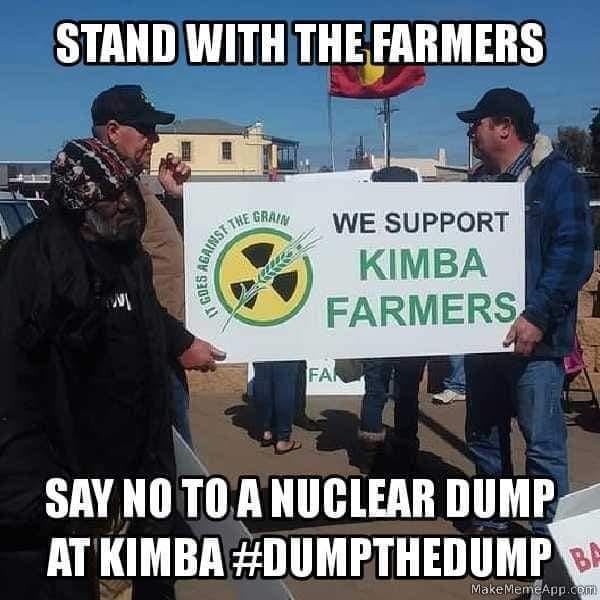
Farmers, Traditional Owners fight radioactive waste dump https://www.greenleft.org.au/content/farmers-traditional-owners-fight-radioactive-waste-dump, Renfrey Clarke, Adelaide, September 8, 2020
A 160-hectare tract of farmland has been purchased near the small town of Kimba and, as inducement to deliver support for the plan, local residents have been promised a $31 million “community development package.” A non-binding ballot conducted last November among residents of the Kimba District Council area recorded 62% in favour of the scheme.
But opponents of the dump remain active and vocal. As well as farmers and townsfolk concerned for their safety and for the “clean and green” reputation of the district’s produce, those against the plan include the Barngarla First Nations people, who hold native title over the area.
Critics argue that last year’s ballot sought the views of only a narrow section of the people affected. In particular, members of the Barngarla people, who do not live locally, are angry at being excluded.
The federal Coalition government, however, has not been deterred. In June, the House of Representatives passed a set of amendments to the legislation governing the scheme. These changes would strip opponents of the dump — including the Barngarla — of the right to mount legal challenges.
The amendments still have to pass through the Senate. But, confident of victory, in July the government set up the Australian Radioactive Waste Agency as part of the Department of Industry, Science, Energy and Resources. With its base in Adelaide, and a satellite office in Kimba, the agency is to “lead the process to deliver” the waste dump.
Low and intermediate-level wastes
In volume terms, the great bulk of the radioactive waste currently produced in Australia results from nuclear medicine, and is considered low-level. These materials do not require shielding in handling or storage, but must be kept secure until the radioactivity has decayed to the point where they can safely go to landfill. At present, these wastes are stored at more than 100 sites around the country, mostly in hospitals or universities.
The amount of low-level waste created here each year is about 40 cubic metres, roughly three truckloads, suggesting that the need to collect these materials into a centralised store is questionable.
More than likely, the risks of shifting these wastes exceed those of keeping them where they are for the decades needed until their radioactivity falls to natural background levels.
There are also intermediate-level wastes. These accumulate at a rate of about five cubic metres a year, and are in a very different category. Highly dangerous, they require shielding, and must be kept secure for as long as 10,000 years. They consist almost entirely of spent nuclear fuel from the research reactor at Lucas Heights, near Sydney, returned after reprocessing in Europe and currently stored on the reactor premises.
The waste dump planned for the farm property Napandee, near Kimba, is meant to provide a permanent home for Australia’s low-level wastes — but not for the intermediate-level materials. The latter are to be held in above-ground canisters at the facility until permanent storage provisions have been made.
Will this “interim” storage turn out to be permanent?
Kimba is remote enough that the temptation will be great for governments to leave these dangerous, long-lasting materials there indefinitely.
Meanwhile, if the Napandee dump is to hold the intermediate-level wastes for only a few decades, where is the need to move these materials there at all? The store at Lucas Heights has room to hold the wastes for many years to come, while permanent disposal methods are being devised and tested. Simply keeping the materials on site would avoid the risks of multiple handling and long-distance transport.
Community rifts
In Kimba, the social rifts from years-long disagreements over the dump remain painful. Many local people look to the facility to sustain a town that is steadily declining as farmers are compelled to “get big or get out”, and as the regional population shrinks.
Farmer Heather Baldock, who supports the dump, lamented to a Senate committee hearing in August: “We lose students, youth, neighbours, friends, sporting club members, emergency service volunteers … We gain more empty houses and property for sale.”
The federal government has suggested that a total of 45 jobs will be created by the facility — a big boost for a town of barely 600 people. Many of these jobs, however, will likely be part–time, or will be performed on a fly-in-fly-out basis.
The $31 million community package will create excellent town amenities, but not a long–term basis for the local economy. It will not solve the worst problem confronting regions like northern Eyre Peninsula: global warming, which raises temperatures, reduces already sparse rainfall and sends farmers into crippling debt.Opponents of the dump, meanwhile, speak bitterly of the deceits by a government determined to impose its scheme regardless of local objections.
Farmer Peter Woolford, who heads the group No Radioactive Waste on Agricultural Land in Kimba or SA, told the Senate hearing: “The path that the federal government has taken … has been a long road of propaganda, manipulation and promises without justification.”
The flow of information to the community, Woolford noted, has been tightly controlled and almost entirely narrated by the department. “No assistance, practical or financial, has been given to provide independent advice. Every speaker who has visited Kimba at the expense of the government has been a supporter of the proposal.”
Ballot manipulation
Opponents of the scheme are especially angry at the way the terms of last year’s ballot were manipulated. Rejecting a call for voting to be open to all residents within a 50-kilometre radius — a far more meaningful measure of the people for whom Kimba is the local hub — the government and the Kimba District Council insisted on the smaller area within the council boundaries. If the 50-kilometre boundary had applied, critics argue, the vote would have failed.
Particularly impressive has been the resolve of the Barngarla people to have their say in deciding the outcome. In 2018, the Barngarla fought and lost a court case against the district council, demanding to be included in the prospective ballot.
Excluded from the official vote, the Barngarla Determination Aboriginal Corporation organised its own independently-run ballot. This recorded a total of 83 members against the dump and zero in favour. A recent letter from the Barngarla to the federal resources minister stated: “The systematic racist behaviour by your government is a stain on the collective consciousness of this country.”
In any case, opponents of the dump ask why “community support” for the dump should be measured only by the views of a few hundred people. Why should the decision not be one for the whole population of South Australia — where indications are that the idea of hosting a radioactive waste dump is highly unpopular?
As Woolford pointed out, of 2789 submissions received in a public consultation 94.5% oppose the facility.
1 This month.


PETITION – To: Prime Minister Anthony Albanese and the Australian Labor Government
Chernobyl: The Lost Tapes – A good documentary on Chernobyl on SBS available On Demand for the next 3 weeks– https://www.sbs.com.au/ondemand/tv-program/chernobyl-the-lost-tapes/235274195556

19 May – Webinar- Webinar: No Nuclear Weapons in Australia
Start: 2026-05-19 18:00:00 UTC Canberra, Melbourne, Sydney (GMT+10:00)
End: 2026-05-19 19:30:00 UTC Canberra, Melbourne, Sydney (GMT+10:00)
20 May – Webinar – The dangerous world of AUKUS, US, military occupation and suppression of dissent

National Webinar, 20th May, 2026, 6.30pm AEST. Confronting laws restricting/suppressing protest speech and action
Speakers: Former Sen. Rex Patrick, Lawyer Nick Hanna ,Arthur Rorris ,Jorgen Doyle, Sen David Shoebbridge,
Facilitator Kelley Tranter.

of the week – Australians for War Powers Reform (AWPR)
To see nuclear-related stories in greater depth and intensity
 Antinuclear