Professor Paul Rogers – a witness explaining how Julian Assange is to be extradited for POLITICAL REASONS
 Julian Assange clearly political, says extradition trial witness, https://www.theaustralian.com.au/world/julian-assange-clearly-political-says-extradition-trial-witness/news-story/735ef7d40551d52f4f7f12d9d6c318d7 JACQUELIN MAGNAY, FOREIGN CORRESPONDENT@jacquelinmagnay, THE TIMES, SEPTEMBER 10, 2020
Julian Assange’s nomination for the Senate during the 2013 federal election campaign and the establishment of the WikiLeaks political party the year before “clearly shows’’ the WikiLeaks founder has a political view and a libertarian standpoint, a witness has told the Old Bailey.
Professor Paul Rogers, the emeritus professor of peace studies at Bradford University, was called as a witness by Assange’s team to persuade the judge that Assange is being targeted for political means, and thus an extradition to the US should not be permitted under the Anglo-US extradition treaty.
In day three of the court hearing where Assange, 49, is objecting to extradition to the US, Professor Rogers said in written testimony that Assange’s expressed views, opinions and activities demonstrate very clearly “political opinions”. He cited how Assange had formed the political party to contest the Australian general election and “central of this is his view to put far greater attention to human rights’’.
He added: “The clash of those opinions with those of successive US administrations, but in particular the present administration which has moved to prosecute him for publications made almost a decade ago, suggest that he is regarded primarily as a political opponent who must experience the full wrath of government, even with suggestions of punishment by death made by senior officials including the current President.’’
But US prosecutor James Lewis QC said: “Assistant US Attorney Gordon D. Kromberg explicitly refutes that this is a political prosecution but rather an evidence-based prosecution.’’
In documents to the court, the prosecution says the investigation into Assange had been ongoing before the Trump administration came into office.
“Assange’s arguments are contradicted by judicial findings, made in the US District Court of the District of Columbia, that the investigation into the unauthorised disclosure of classified information on the WikiLeaks website remained ongoing when the present administration came into office,” the prosecution says.
Mr Lewis added: “If this was a political prosecution, wouldn’t you expect him to be prosecuted for publishing the collateral murder video?’’https://www.theaustralian.com.au/world/julian-assange-clearly-political-says-extradition-trial-witness/news-story/735ef7d40551d52f4f7f12d9d6c318d7
He said Assange was being extradited to face charges relating to complicity in illegal acts to obtain or receive voluminous databases of classified information, his agreement and attempt to obtain classified information through computer hacking; and publishing certain classified documents that contained the unredacted names of innocent people who risked their safety and freedom to provide information to the United States and its allies, including local Afghans and Iraqis, journalists, religious leaders, human rights advocates, and political dissidents from repressive regimes.
Professor Rogers told the court the motivation of Assange and WikiLeaks was to achieve greater transparency and was political. The trial continues.
Julian Assange’s extradition hearing in London. What can we expect?
 What’s at stake at Julian Assange’s long-awaited extradition hearing?, ABC 8 Sept 20, Julian Assange is fighting an attempt by the United States to extradite him to face charges on what it says was “one of the largest compromises of classified information in the history of the United States”.
It marks the culmination of a nearly decade-long pursuit by US authorities of the Australian-born WikiLeaks founder over the publication of secret documents and files in 2010 and 2011.
Assange’s extradition hearing had initially begun in February but was delayed for several months, and the coronavirus pandemic added additional delays, meaning Assange has been kept on remand in Belmarsh prison in south-east London since last September.
As reported by Background Briefing, Assange’s defence team will attempt to persuade the court he is unfit to travel to the US to face trial, and that the attempt to send him there is essentially an abuse of process.
How did he get to this point?
WikiLeaks made international headlines in April 2010 when it published a classified US military video showing an Apache attack helicopter gunning down 11 civilians, including two Reuters journalists, on a street in Baghdad in 2007.
Later that year, WikiLeaks released hundreds of thousands of US military messages and cables, a leak that saw former US Army intelligence analyst Chelsea Manning jailed……..
Assange, 49, has always denied the allegations, saying they were part of a US plot to discredit him and eventually extradite him to the US, and the investigation was eventually dropped in 2017.
He remained holed up in the embassy for seven years until April 2019, when the Ecuadorian government withdrew his asylum and Metropolitan Police officers arrested him for failing to surrender to the court over an arrest warrant issued in 2012……..
In May 2019, Assange was sentenced to 50 weeks in jail for breaching bail conditions, and during that time the US Justice Department brought 18 charges against him.
What is Assange accused of?
Assange is facing 17 charges relating to obtaining and disclosing classified information, and one charge concerning an alleged conspiracy to crack passwords on government servers.
The US alleges he conspired with Chelsea Manning to hack into US military computers to acquire the classified information published by WikiLeaks.
…… Assange maintains the information exposed abuses by the US military and that he was acting as a journalist and is therefore entitled to protection by the US’s First Amendment.
What can we expect from this hearing?
The court must examine a series of factors before any extradition can be granted, such as if the alleged crimes have equivalent offences in the UK and could lead to trial.
“It’s what’s called double criminality, in other words, whether the offences for which Assange is being sought in under US law are broadly being recognised under UK law,” Professor Don Rothwell, from the Australian National University, told Background Briefing.
Prosecutors have argued there is no doubt his actions would amount to offences under the UK’s Official Secrets Act.
If the court agrees, it must then consider how extradition would affect Assange’s health.
Previous court appearances this year have been delayed due to health issues, and his lawyers say his efforts to protect himself from US extradition and being stuck inside the Ecuadorian embassy for seven years had taken its toll.
If the court accepted it would be detrimental to his health, it could open up the possibility of protecting Assange in the UK under European human rights law.
The magistrate may also take issue with how the prosecutors are seeking to impose American law on what Mr Assange is alleged to have done outside of US territory.
“In this matter, US law is seeking to extend all the way, not only from the United States, but into the United Kingdom and into parts of Europe and basically impact upon the activities that Assange has undertaken associated with WikiLeaks over 10 years ago,” Professor Rothwell said…….
Assange’s legal team contends the US is seeking to prosecute Assange for political offences and that he is thereby exempt from extradition under the terms of the UK-US extradition treaty…….
What happens next?
The hearing is expected to last between three and four weeks, with any decision made likely to be appealed and go to a higher court, meaning the legal battle would likely drag into next year and possibly beyond that.
If Assange is eventually extradited to the United States and found guilty, he faces a maximum 175 years imprisonment for the 18 offences listed in the indictment. https://www.abc.net.au/news/2020-09-09/julian-assange-what-does-extradition-hearing-mean/12642972
The nuclear stigma – some Kimba residents selling their assets before the nuclear dump sets sail?
Paul Waldon Fight to Stop A Nuclear Waste Dump in South Australia , 8 Sept 20
Painful to see when you don’t know if it’s Kimba’s pro or an anti nuclear dump dichotomy selling up their assets before the ship sinks. The town of Kimba poisoned by the kafkaesque promotion of a radioactive dump looks to be losing Eatts Hardware with Elders conducting an auction sale on the 18th of October.
The Nuclear Stigma not only eroding personal assets but also that of businesses belonging to both the people that have decried a radioactive dump for their town, plus those who care to embrace it but want to move on.
Oh yeah we have even seen a farmer come nuclear profiteer list a sizable parcel of land, which some people may say “he’s blazing a trail for a quick escape.” https://www.facebook.com/groups/344452605899556
Australia’s nearly 2 $trillion costs by 2050 – if we continue climate change inaction
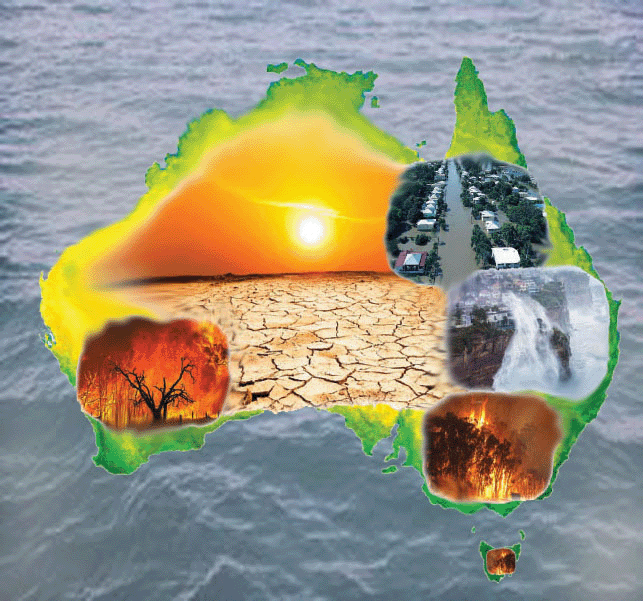 Trillions up in smoke: The staggering economic cost of climate change inaction, New Daily, Ben Silvester, 8 Sept 20, Over the next 30 years, increasing economic damages from climate change will cost the Australian economy at least $1.89 trillion – or roughly 4 per cent of projected GDP each year – if current emissions policies are maintained.New research from the University of Melbourne reveals annual economic damages by 2038 will be comparable to the current estimated annual cost of COVID-19 in Australia. Trillions up in smoke: The staggering economic cost of climate change inaction, New Daily, Ben Silvester, 8 Sept 20, Over the next 30 years, increasing economic damages from climate change will cost the Australian economy at least $1.89 trillion – or roughly 4 per cent of projected GDP each year – if current emissions policies are maintained.New research from the University of Melbourne reveals annual economic damages by 2038 will be comparable to the current estimated annual cost of COVID-19 in Australia.
There have been many attempts at estimating the economic cost of climate change, but the researchers said this is the most detailed and globally comprehensive to date. The modelling covers 139 countries in four potential warming scenarios from now to 2100. The projections draw on a modelling framework in the journal Earth’s Future in 2018 and have been continually updated through adding data points for bushfires and other ecological events. “There is no model in the world that is nearly this computationally large,” said lead researcher Professor Tom Kompas of the university’s school of biosciences. “It’s as much as 10 times larger than standard basic models.” The detail built into the projections allowed researchers to drill down and discover how each country will be affected by rising temperatures at particular points in the coming century. Previous models could only provide average damages across large regions or the world as a whole…………. If this trajectory is maintained, the research found that the economic cost of climate change for Australia alone will total at least $1.89 trillion by 2050 and exceed $100 billion in annual damages by 2038. Professor Kompas described the impact of the coronavirus pandemic as “devastating”, but he said it also puts the huge economic threat of climate change into context. “By 2038, on average projections, climate change may well be dealing a COVID-sized blow to the Australian economy every year … [it] will imply more job losses, unemployment and deeper cuts in GDP. And those damages will continue to increase disproportionately year after year,” Professor Kompas said. Much of the economic damage will be from rising sea levels wreaking havoc on property, infrastructure and agriculture along the coast. It is calculated that damages of more than $992 billion over the next three decades, or more than $30 billion a year, on average, from sea level rise and storm surge alone. The modelling also predicts productivity losses of $261 billion as rising temperatures make it harder for certain crops to grow and for outdoor labourers to work, while losses in biodiversity total $277 billion with thousands of species at risk of extinction. “Many of these damages ramp up over time,” Professor Kompas said. But he said Australia is already getting a taste of what’s around the corner, the past “Black Summer” bushfires being an example. The researchers tallied up the damage to property, infrastructure and agriculture caused by the recent bushfires, assessing the cost at $48 billion. And with research suggesting Australia will have two more “megafires” before the end of the decade, Professor Kompas calculates that by 2050 bushfires will have cost the economy about $360 billion. The $1.89 trillion cost to the economy in the next 30 years is almost certainly an underestimate, he said. His research does not yet account for damage to Australia’s major environmental assets, pollution from burning fossil fuels, tourism losses and natural disasters other than bushfires……. https://thenewdaily.com.au/news/national/2020/09/10/economic-cost-climate-change/ |
|
Labor leader Anthony Albanese says: Australia can be a ‘renewable energy superpower’
Australia can be a ‘renewable energy superpower’, Anthony Albanese declares
Labor leader sidesteps tension in his party around resources to call for embrace of clean energy, Guardian, Katharine Murphy, political editor, 8 Sep 20, The federal Labor leader, Anthony Albanese, says the resources sector has been the backbone of the Australian economy for decades, but the nation’s “long-term future lies in renewable energy sources”.Stepping around tensions within his own ranks, Albanese will use a speech on Wednesday about regional development to note that resources exports will “continue to meet the demands of the rapidly growing nations of our region” even as the world transitions to a lower-carbon future.But the opposition leader says in the speech the task of the coming decades is to “position our nation to be a major player in the clean energy industries that continue to grow in importance over time”.
Labor leader sidesteps tension in his party around resources to call for embrace of clean energy, Guardian, Katharine Murphy, political editor, 8 Sep 20, The federal Labor leader, Anthony Albanese, says the resources sector has been the backbone of the Australian economy for decades, but the nation’s “long-term future lies in renewable energy sources”.Stepping around tensions within his own ranks, Albanese will use a speech on Wednesday about regional development to note that resources exports will “continue to meet the demands of the rapidly growing nations of our region” even as the world transitions to a lower-carbon future.But the opposition leader says in the speech the task of the coming decades is to “position our nation to be a major player in the clean energy industries that continue to grow in importance over time”.
The Labor leader says if the policy settings are right “we can transform our nation into a renewable energy superpower”.
He says resources of lithium and other rare earths offer huge potential in a world that will become increasingly focused on the need for batteries to store energy. Albanese also identifies opportunities for regional development in bio-energy, including bio-mass generation and waste-to-energy.
n a speech to be delivered in the New South Wales coastal town of Coffs Harbour, Albanese will cite a report this week from the state’s chief scientist and engineer that envisages 17,000 jobs and $26bn would be added to annual growth from a domestic hydrogen industry.
The Labor leader will note that report was endorsed by the state’s environment minister, Matt Kean, but “the Morrison government appears to be blind to such opportunities”……..
Albanese’s speech on Wednesday lays out his thoughts on development opportunities for regional Australia. He insists the transition to renewable energy will create jobs in the regions.
He will argue the National party’s resistance to the energy transition is leaving them out of step with the communities they represent.
“The Nationals, who say they represent farmers, are now at odds with the National Farmers’ Federation, which recently embraced the target of net zero carbon emissions by 2050,” the Labor leader says.
He says regional Australia and the investment sector are “moving beyond this do-nothing government”.
Albanese says only Labor can tackle energy policy “in a way that recognises the value of the current resources market while seeking out the massive opportunities in renewables”.
“The right plans will create hundreds of thousands of jobs in new industries, including in regional Australia whilst also reducing power prices”. https://www.theguardian.com/australia-news/2020/sep/09/australia-can-be-a-renewable-energy-superpower-anthony-albanese-declares
Lithium for renewable energy technologies – a Covid recovery way for Australia
How Australia’s ‘white gold’ could power the global electric vehicle revolution
Miners and environmentalists have reached an uneasy truce over lithium – both agree Australia should be mining more of this key ingredient in renewable energy batteries, by Max Opray
”……….On the one side, environmentalists are engaging with a resources sector they distrust to nudge it towards lithium, an element which is used in batteries for electric vehicles and renewable energy storage systems due to its remarkably high energy density.
On the other, miners like Brown are suppressing scepticism of green causes to carve out a future in a world aiming to divest itself of fossil fuels.
Brown joined Altura Mining in 2009, and set about helping the small coal miner diversify into other resources as a way of hedging against headwinds facing the fossil fuel.
Lithium, hyped as the “white gold” of the 21st century, seemed a promising investment. But securing investors for Altura’s exploration tenements in the remote ochre deserts of the Pilbara proved challenging……..
Despite the urgency of the climate crisis, the attachment to coal runs deep for Australians like Brown, and leaving it behind wasn’t easy. ……..
The ‘white gold’ rush
Australia leads the world in lithium production and possesses an estimated 6.3m tons of lithium reserves.
The metal is fast becoming a geopolitical bargaining chip, as China, the US and other major powers jostle to secure access to an element expected to surge in demand as the global economy rapidly ramps up production of electric vehicles and renewable energy storage systems, not to mention lithium-ion mobile phone batteries.
The most common form of extraction in Australia is by crushing a hard rock called spodumene, and from that extracting lithium concentrate using a separation method that Brown says is similar to some coal processing systems.
Harry Fisher, senior consultant at business intelligence company CRU Group, believes the economic recovery from Covid-19 will be the moment the long-promised lithium rush finally gets underway.
“Governments continue to promote the merits of a ‘green recovery’, with EV subsidies being increased in Germany, France, UK and many others,” he says. “Policy is likely to continue to support demand.”
Australia has no formal green recovery plan, but Fisher suggests that might not matter if the rest of the world does.
Fisher forecasts that demand will grow to 830 kilotonnes by 2025, up from around 330 kilotonnes this year. In particular demand, Fisher says, is the spodumene that Australia specialises in…….
Altura will be a key supplier to Shanshan’s new lithium chemical plant in China, which plans to produce 25,000 tonnes per annum.
The deal came, says Brown, thanks to China’s two-year extension of state subsidies and tax breaks for electric vehicles until the end of 2022.
The subsidies were also cited by Pilbara Minerals, the operator of a neighbouring Pilgangoora lithium mine, as a reason for optimism.
Australia’s major competition in the global market is the “lithium triangle” of Bolivia, Chile and Argentina, which extracts the metal out of the region’s salt lakes……..
Elsa Dominish, research principal at the Institute for Sustainable Futures, said the environmental impact of lithium mining is similar to other forms of hard rock mining.
She says Australia has an opportunity to establish the world’s best practice for lithium mining by monitoring water and energy use, management of waste, and impact on sacred cultural sites.
Dominish emphasises that lithium’s footprint pales in comparison to the impact of coal. “In addition to emissions … coal mining is one of the most damaging forms of mining considering health and environmental impacts, particularly respiratory impacts from exposure to coal dust,” she says…….
When Adam Bandt assumed the Greens leadership in February, he immediately went to work spruiking a Green New Deal.
Bandt had even planned to visit the Greenbushes Lithium Mine in south-west WA, the largest hard rock lithium operation in the world, to sell the message of transitioning coal miners into jobs in new energy metals. The trip was called off due to the Covid-19 crisis.
Miners have long moved to where the resources are, and Queensland and New South Wales coal workers might need to relocate to the Pilbara for new lithium mining gigs. In the case of Greenbushes however, there is a coal mining community right on its doorstep.
Unions and the Western Australian government are pushing for a planned Greenbushes expansion to employ coal workers from the nearby Collie mine and power plant, in a bid to secure a future for them as the local coal industry withers away.
Industry analysts, lithium miners, and green groups also agree on something else: simply digging the lithium out of the ground and exporting it with minimal processing is a wasted opportunity.
According to the Million Jobs Plan report, produced by climate thinktank Beyond Zero Emissions, Australia earns only 0.5% of the value of its exported lithium ore, with the remainder going to overseas companies that further refine it and manufacture lithium-ion batteries.
South Australia, home to Tesla’s Big Battery, is developing battery manufacturing capacity, and BZE argues Western Australia could invest in lithium refinement, battery component manufacture, and recycling, to contribute towards 100,000 new jobs nationally by 2025. The state is already host to several processing facility projects.
Heidi Lee, project lead for the Million Jobs Plan, says the Covid-19 shutdown is a generational opportunity for the Australian government to set signals to unlock investment, such as a new renewable energy target………..
The coronavirus pandemic has devastated the economy but also presented a unique opportunity: to invest in climate action that creates jobs and stimulates investment, before it’s too late. The Green Recovery features talk to people on the frontline of Australia’s potential green recovery. https://www.theguardian.com/australia-news/2020/sep/10/how-australias-white-gold-could-power-the-global-electric-vehicle-revolution
Australia’s environmental scientists are being gagged
|
Research reveals shocking detail on how Australia’s environmental scientists are being silenced The Conversation Don Driscoll -Professor in Terrestrial Ecology, Deakin University, Bob Pressey, Professor and Program Leader, Conservation Planning, ARC Centre of Excellence for Coral Reef Studies, James Cook University, Euan Ritchie, Associate Professor in Wildlife Ecology and Conservation, Centre for Integrative Ecology, School of Life & Environmental Sciences, Deakin University, Noel D Preece, Adjunct Asssociate Professor, James Cook University, September 9, 2020 Ecologists and conservation experts in government, industry and universities are routinely constrained in communicating scientific evidence on threatened species, mining, logging and other threats to the environment, our new research has found.
Our study, just published, shows how important scientific information about environmental threats often does not reach the public or decision-makers, including government ministers. In some cases, scientists self-censor information for fear of damaging their careers, losing funding or being misrepresented in the media. In others, senior managers or ministers’ officers prevented researchers from speaking truthfully on scientific matters. This information blackout, termed “science suppression”, can hide environmentally damaging practices and policies from public scrutiny. The practice is detrimental to both nature and democracy.
Code of silenceOur online survey ran from October 25, 2018, to February 11, 2019. Through advertising and other means, we targeted Australian ecologists, conservation scientists, conservation policy makers and environmental consultants. This included academics, government employees and scientists working for industry such as consultants and non-government organisations. Some 220 people responded to the survey, comprising:
In a series of multiple-choice and open-ended questions, we asked respondents about the prevalence and consequences of suppressing science communication.
About half (52%) of government respondents, 38% from industry and 9% from universities had been prohibited from communicating scientific information. Communications via traditional (40%) and social (25%) media were most commonly prohibited across all workplaces. There were also instances of internal communications (15%), conference presentations (11%) and journal papers (5%) being prohibited.
Ministers are not receiving full information’Some 75% of respondents reported having refrained from making a contribution to public discussion when given the opportunity – most commonly in traditional media or social media. A small number of respondents self-censored conference presentations (9%) and peer-reviewed papers (7%). Factors constraining commentary from government respondents included senior management (82%), workplace policy (72%), a minister’s office (63%) and middle management (62%). Fear of barriers to advancement (49%) and concern about media misrepresentation (49%) also discouraged public communication by government respondents. Almost 60% of government respondents and 36% of industry respondents reported unduly modified internal communications.
One government respondent said:
University respondents, more than other workplaces, avoided public commentary out of fear of how they would be represented by the media (76%), fear of being drawn beyond their expertise (73%), stress (55%), fear that funding might be affected (53%) and uncertainty about their area of expertise (52%). One university respondent said: I proposed an article in The Conversation about the impacts of mining […] The uni I worked at didn’t like the idea as they received funding from (the mining company)……….
The system is brokenOf those respondents who had communicated information publicly, 42% had been harassed or criticised for doing so. Of those, 83% believed the harassers were motivated by political or economic interests………… https://theconversation.com/research-reveals-shocking-detail-on-how-australias-environmental-scientists-are-being-silenced-140026 |
–
|
Moorabool wind farm community fund distributes $125,000 to the local community — RenewEconomy

Goldwind Australia today announced the inaugural Moorabool North Community Fund grant distribution of $125,000 to 11 local community groups. The post Moorabool wind farm community fund distributes $125,000 to the local community appeared first on RenewEconomy.
Moorabool wind farm community fund distributes $125,000 to the local community — RenewEconomy
Queensland seeks wind, solar and storage proposals to fill renewable energy zones — RenewEconomy

Queensland calls for registrations of interest in new renewable generation and storage projects in first formal step towards unlocking new renewable energy zones. The post Queensland seeks wind, solar and storage proposals to fill renewable energy zones appeared first on RenewEconomy.
Queensland seeks wind, solar and storage proposals to fill renewable energy zones — RenewEconomy
September 9 Energy News — geoharvey

Science and Technology: ¶ “Trickle Of Green Hydrogen Turns Into Flood Of Good News For Renewables” • Wind and solar developers are eyeballing green hydrogen as a pathway for future growth, and it looks like they won’t have to depend on the transportation sector for sole support. Hydrogen has many other uses, aside from being […]
September 9 Energy News — geoharvey
Victoria’s biggest solar farm starts sending power to grid after long delays — RenewEconomy

The 256MW Kiamal solar farm – the biggest solar project in Victoria, and one of the most heavily delayed in the country – finally sending power to the grid. The post Victoria’s biggest solar farm starts sending power to grid after long delays appeared first on RenewEconomy.
Victoria’s biggest solar farm starts sending power to grid after long delays — RenewEconomy
Latrobe Valley solar and battery project approved by Victoria planning minister — RenewEconomy

A 75MW solar farm and big battery planned for near Toongabbie in Victoria will go ahead after being waved through the approvals process by the state government. The post Latrobe Valley solar and battery project approved by Victoria planning minister appeared first on RenewEconomy.
Latrobe Valley solar and battery project approved by Victoria planning minister — RenewEconomy
Australia’s gas plans could consume one quarter of world’s shrinking carbon budget — RenewEconomy

New report suggests developing Australia’s gas reserves could produce three times the annual carbon emissions of the entire world. The post Australia’s gas plans could consume one quarter of world’s shrinking carbon budget appeared first on RenewEconomy.
Australia’s gas plans could consume one quarter of world’s shrinking carbon budget — RenewEconomy
Australian government helps two journalists escape Chinese oppression, but no help for Julian Assange to escape American oppression

DOUBLE STANDARDS! What a glaring example of kowtowing to USA!
Julian Assange is not getting fair treatment at the Old Bailey (London) hearing about whether or not he should be extradited to the USA, to face 175 years of gaol, on “espionage” charges. Independent journalists, people from Amnesty, or anyone else likely to give Assange’s side of the story, in reporting this bizarre hearing, is excluded from the courtroom. That’s despite the OLd Bailey’s tradition of an open courtroom.
As far as I can ascertain, they’re now charging Julian with publicising the names of USA agents. But in fact, Assange gave the documents to newspapers, I think it was the Guardian and the New York Times, with an express request to NOT publish those names. And the papers went ahead and published them. Julian didn’t. I also understand that, even then no harm came to any of those agents.
It’s all a trumped up thing. Assange revealed evidence of USA military atrocities. So, like Wilfred Burchett, decades ago, he must be punished by almighty America, and Australia must dutifully follow suit.
NSW push for uranium driven by ideologues happy with fossil fuels
NSW push for uranium driven by ideologues happy with fossil fuels, https://www.greenleft.org.au/content/nsw-push-uranium-driven-ideologues-happy-fossil-fuels Paul Gregoire, September 8, 2020,
When New South Wales MLC Mark Latham tabled a bill in mid-2019 that sought to lift the state’s ban on uranium mining and nuclear facilities, no-one paid too much attention. After all, the One Nation MP makes a habit of trying to grab attention and this throwback to the 1980s seemed more of the same.
The bill was sent to a parliamentary review, chaired by Liberal nuclear zealot Taylor Martin. When its March report recommended backing Latham, NSW deputy premier John Barilaro quickly announced the Nationals would support the proposal.
As debate over the bill looked set to take place late last month, it seemed the Coalition would vote with One Nation. However, on August 24, cabinet announced it would consider its own legislation, rather than throw its weight behind Pauline Hanson’s One Nation Party.
While this chain of events seems to be rather happenstance, something more coordinated is at play.
As anti-nuclear activists told Green Left, the move towards mining uranium is part of a push by the Minerals Council of Australia, which reaches all the way to the PM’s office. It is no accident that nuclear energy has resurfaced in the public debate as a more widespread public understanding about the necessary transition to renewables takes place.
 No economic benefits
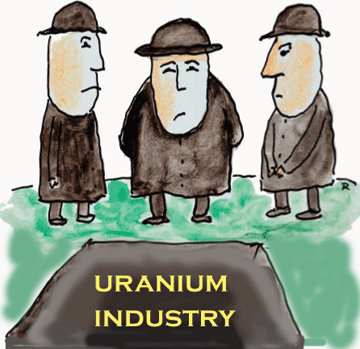
Uranium Free NSW spokesperson Natalie Wasley said the ban on uranium mining has been in place since the late 1980s and that lifting it would not bring in much profit or jobs.
“The price of uranium has been depressed since the Fukushima disaster [in Japan], and it’s not likely to recover any time soon,” Wasley said. “We’ve seen the CEO of Cameco — the largest uranium mining company in the world — say that it doesn’t make sense to invest in primary supply.”
Last November, Cameco chief executive Tim Gitzel said that “even the lowest-cost producers are deciding to preserve long-term value by leaving uranium in the ground”. The Canadian company owns uranium deposits in Western Australia, which are much more significant than those in NSW.
“There are no known economic deposits of uranium in NSW,” Friends of the Earth national nuclear campaigner Dr Jim Green said. “The nuclear push in NSW is driven by far-right wing-nuts who don’t believe in climate change and are quite happy with coal.”
Green was at pains to point out that uranium as an energy source is suffering a global downturn that could mark its end. He said that the trade in uranium in South Australia, the Northern Territory and Western Australia is negligible.
Prior to the NSW Coalition cabinet’s meeting in late August, NSW energy minister Matt Kean had indicated that mining uranium is economically unviable. However, since then he’s since gone silent on the matter and not responded to Green Left’s request for comment.
Desecrating First Nations
“The people who will be first impacted by uranium extraction in NSW — as has happened across the world — will be First Nations people,” NSW Greens MLC David Shoebridge made clear. “Their land will be poisoned. It will be their water that gets poisoned by the radioactive waste.”
Wasley pointed out that areas around Dubbo, the New England region and Broken Hill were raised as potential areas for uranium mining in 2012. At that time, Aboriginal communities voiced strong opposition.
NSW Aboriginal Land Council member Rod Towney told the ABC last month that opening up western NSW for uranium extraction would be a disaster. The Wiradjuri elder said: “We don’t like uranium and what it does”. He added that current mining projects for other resources were also not of benefit to his people.
There is also the significant issue of how to safely dispose of nuclear waste. Wasley said that all nuclear facilities around the world have led to some contamination. She pointed to Jabiru Ranger mine’s ongoing pollution problem in the middle of Kakadu National Park.
“We’ve seen massive contamination spikes in creeks downstream,” Wasley said. “This is in the middle of a World Heritage area, where there are many more layers of scrutiny built into that mining operation than there would be in a remote NSW location.”
Broader agenda
According to Australian Conservation Foundation’s nuclear free campaigner Dave Sweeney, the lack of any economic sense behind investing in either uranium mining or nuclear energy points to this push being an ideological move by conservative MPs on behalf of a larger player.
“There is a very clear campaign from the Minerals Council of Australia (MCA) to remove any current political policy ban, legislative restrictions or prohibitions on uranium and nuclear,” Sweeney said.
The seasoned anti-nuclear activist outlined that the MCA is behind an ongoing Victorian parliamentary inquiry into lifting similar moratoriums on uranium and nuclear energy there. He asserts that the industry body is behind the NSW inquiry into Latham’s bill. “They did the same thing at the federal level, with a push by Minister Keith Pitt.”
The federal government established a parliamentary inquiry last year that ultimately recommended the development of, and investment in, nuclear energy.
Pitt was subsequently appointed federal resources minister in February and, while the nation was still reeling from the catastrophic Black Summer bushfires, the new minister suggested the country needed more investment in coal, gas and uranium to “lift” standards of living.
Knocking out renewables
Renowned United States commentator Professor Noam Chomsky has warned that humanity is facing two great existential threats: uranium-fuelled nuclear war and fossil fuel-driven climate change.
Shoebridge, who is the energy spokesperson for the NSW Greens, pointed out that even if NSW uranium is exported under the proviso that it cannot be used in weaponry, it nevertheless frees up others to provide the metal to build toxic arms.
Sweeney maintains that the ultimate purpose of the conservatives’ push for the economically unviable outdated energy source is ideological: it aims to shift the debate away from the urgent need for a just transition to renewables to an argument over fossil fuels versus uranium.
“It’s a way to further increase and facilitate uncertainty, confusion and delay in developing a genuine and credible energy policy at state and national levels to do what we need to do,” the seasoned nuclear-free campaigner said.
Sweeney said that for those who have an interest in maintaining coal or advancing gas, the “nuclear argument is handy”, as it shifts the debate from the increasingly obvious option of renewables, which are “cheaper, more plentiful, more popular and quicker to deploy”.
“This whole nuclear debate is a dangerous distraction from where we need to be which is ending our reliance on fossil fuels and embracing and supercharging renewables,” Sweeney concluded.
1 This month.
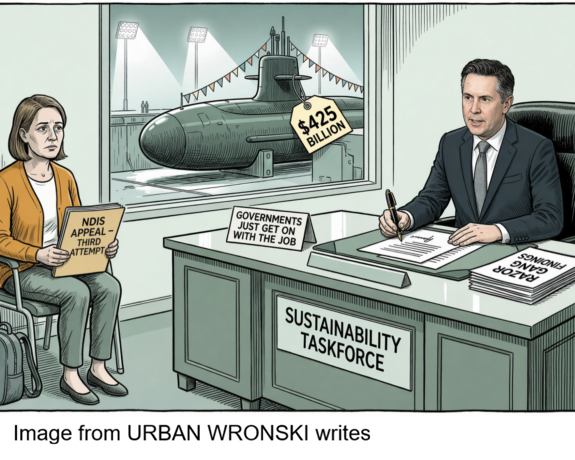

PETITION – To: Prime Minister Anthony Albanese and the Australian Labor Government
Chernobyl: The Lost Tapes – A good documentary on Chernobyl on SBS available On Demand for the next 3 weeks– https://www.sbs.com.au/ondemand/tv-program/chernobyl-the-lost-tapes/235274195556
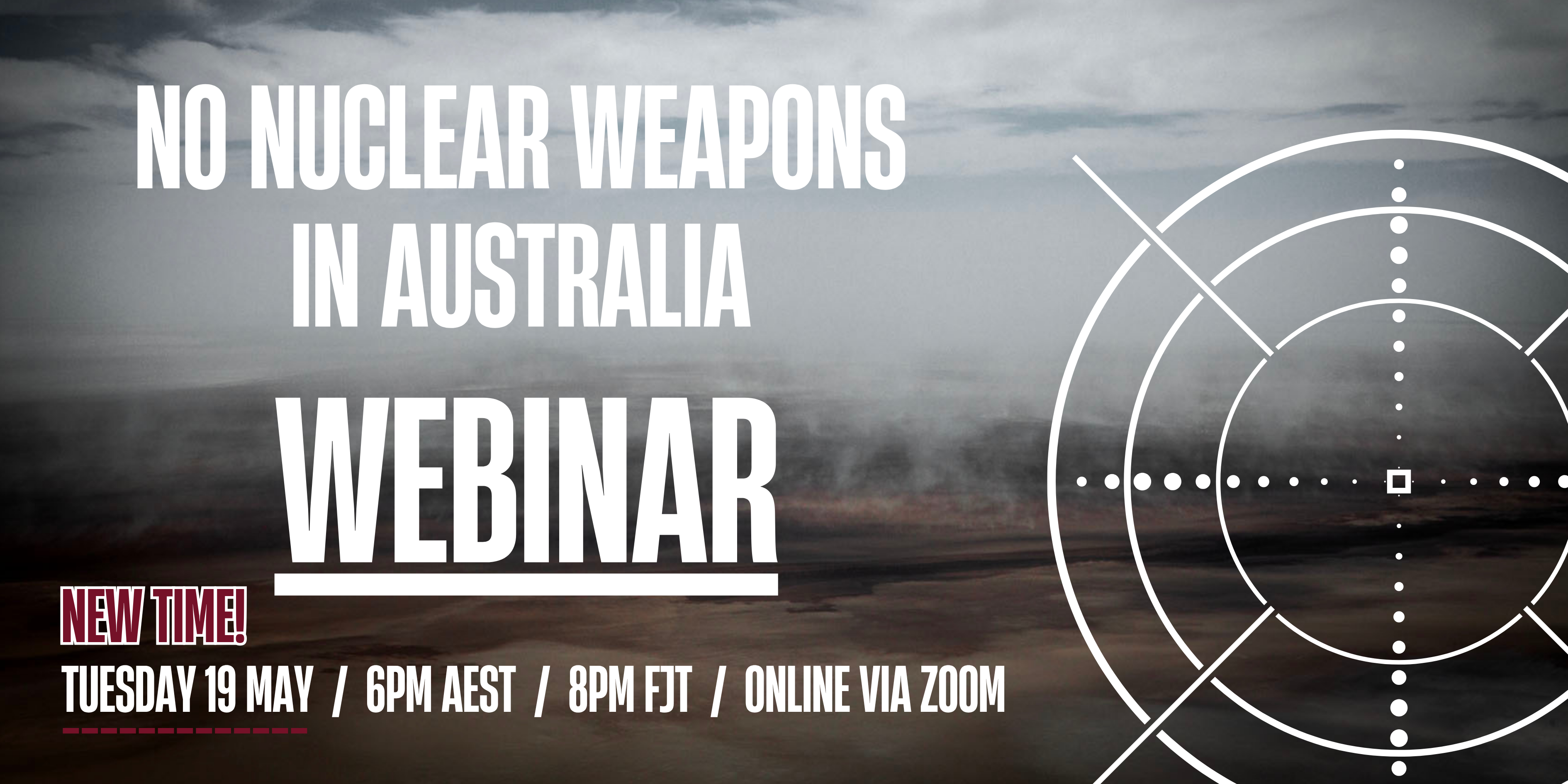
19 May – Webinar- Webinar: No Nuclear Weapons in Australia
Start: 2026-05-19 18:00:00 UTC Canberra, Melbourne, Sydney (GMT+10:00)
End: 2026-05-19 19:30:00 UTC Canberra, Melbourne, Sydney (GMT+10:00)
20 May – Webinar – The dangerous world of AUKUS, US, military occupation and suppression of dissent

National Webinar, 20th May, 2026, 6.30pm AEST. Confronting laws restricting/suppressing protest speech and action
Speakers: Former Sen. Rex Patrick, Lawyer Nick Hanna ,Arthur Rorris ,Jorgen Doyle, Sen David Shoebbridge,
Facilitator Kelley Tranter.

of the week – Australians for War Powers Reform (AWPR)
To see nuclear-related stories in greater depth and intensity
 Antinuclear