Ivan Quail says -No logic in double handling of nuclear waste, and makes 14 strong recommendations

There is no logic behind the proposal to move intermediate-level waste from interim above-ground storage at Lucas Heights to interim above-ground storage at the Kimba site. The proposed double-handling is illogical, it exposes communities to unnecessary risk, and ARPANSA’s Nuclear Safety Committee says it
breaches international best practice
It should further be borne in mind that we in Australia currently enjoy an international
reputation for clean green agricultural products and food. Are we prepared to put that at risk?
Ivan Quail to Senate Committee on National Radioactive Waste Management Amendment (Site Specification, Community Fund and Other Measures) Bill 2020 [Provisions] Submission 12
Intermediate level radioactive waste should not be stored above ground. Low- and intermediate-level radioactive wastes are buried in geological repositories. These repositories must isolate the nuclear waste from the biosphere for as long as 100,000 years. Only solid wastes are stored; liquid wastes are solidified by cementation or bitumen. The strategy adopted by many countries for the disposal of low and intermediate level radioactive wastes requires an engineered repository placed at considerable depth underground.
https://www.sciencedirect.com/topics/chemistry/intermediate-level-radioactive-waste
Long-lived intermediate-level (category S) wastes will be stored above ground in an engineered facility designed to hold them secure for an extended period and to shield their radiation until a geological repository is eventually justified and established, or alternative arrangements made.
Don’t send uranium to India- Dr Vaishali Patil speaks to Australia
 Dr Patil spoke on the first of the Yellowcake Country webinars on 10th June. She spoke of the beautiful country of the Konkon area, formerly a place of thriving agriculture, fruit growing and fishing. It is now known for having the largest nuclear power plant in the world. Despite the opposition of farmers and fishermen, this gigantic and enormously expensive nuclear project has gone ahead.
The local people have continued their protest for 15 years. The government has the right to commandeer land for nuclear activities, giving very little compensation. Many protestors have been gaoled. Livelihoods are threatened, not only by the loss of land, but also, the remaining agricultural and fishing industries lose their markets, due to both the real contamination of the environment, and the perceived contamination, as the area becomes known as a nuclear hub.
Environmental damage has affected the lives of the community, as well as their livelihoods. Radiation has resulted in a rise in cancer incidence. Men who never took part in the past, in protest movements are now joiningthe anti-nucler movement. But women have always been prominent in opposition to nuclear power, in the Jaitapur Anti-Nuclear Movement. It’s a peaceful protest, following Ghandian philosophy. But activists face gaol, and condemnation – are depicted as being against development, against the national interest.
Nuclear power contributes very little to India’s energy, less than 2% of energy supply. However the government invests hugely in it. Despite the devastation from the recent cyclone, despite the onslaught of the coronavirus, the government pours huge amounts of money into nuclear industry, nuclear weapons. This investment continues, while the cyclone destruction has ravaged the Konkon area, with 7000 school buildings collapsed, 500,000 trees uprooted, and thousands of migrant workers still walking through.
The National Alliance of Anti Nuclear Movement of India (NAAM) continues its work and calls for Australia’s anti-nuclear movement to join forces with it, and work to prevent the export of uranium to India.
Senator Rex Patrick – nuclear waste dump should not go on agricultural land

Australia’s very bad record on environment: it’s no time to weaken our laws
 Now is not the time to weaken our environmental protections, Canberra Times, Katherine Barraclough, Fiona Armstrong , 10 June 20 Now is not the time to weaken our environmental protections, Canberra Times, Katherine Barraclough, Fiona Armstrong , 10 June 20
As Australia’s primary environmental legislation undergoes a once-in-a-decade review, businesses and the government have spoken of the need to cut environmental bureaucracy (so-called “green tape”) and speed up approvals. However, health experts insist that environmental protections must be strengthened. Why? Because the stark reality is that our health is fundamentally dependent on the health of the natural world – for clean air, water and soils, food security, protection against infectious diseases and a stable climate. Nature is also the source of over half of all medicines we rely on. Last month, more than 180 health professionals and 19 health groups published an open letter to federal Environment Minister Sussan Ley, warning a failure to significantly reform Australia’s environmental law, the Environmental Protection and Biodiversity Conservation Act (EPBC Act), will risk fuelling further public health crises. Signatories included Nobel laureate Professor Peter Doherty, former Australian of the Year Professor Fiona Stanley and nutritionist and dietician Dr Rosemary Stanton. Despite being a wealthy, developed nation, Australia’s environmental track record is among the worst of all countries. We lead the world in mammal extinctions, have the highest rate of biodiversity loss bar Indonesia, and have been recognised as a land-clearing and deforestation “hotspot”. It is estimated that in Queensland and NSW alone, land clearing kills some 50 million mammals, birds and reptiles annually. Our scarce water resources are in decline, and some of our most precious marine environments, including the Great Barrier Reef, face collapse. Climate change constitutes one of the most serious threats to our natural environment and our nation’s public health, and yet Australia is one of the highest per-capita emitters of greenhouse gases. This degradation of our natural environment is, in essence, a dismantling of our life support systems. That it has occurred despite the existence of the EPBC Act is a clear indication that major environmental law reform is required. Unfortunately, examples of failed environmental protections in Australia are plentiful…….. https://www.canberratimes.com.au/story/6777567/now-is-not-the-time-to-weaken-our-environmental-protections/?cs=14230#gsc.tab=0 |
|
Our existential threat – our extinction
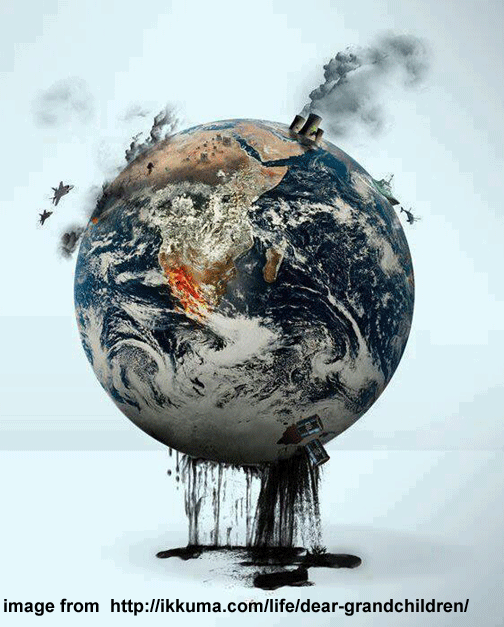 Externalities Are Our Existential Threat, Medium, 10 June 20, It’s the “ex’s” we need to worry about the most. Externalities that create an existential threat. The ultimate threat: Our extinction.
An externality is defined by the Oxford English Dictionary as “a side effect or consequence of an industrial or commercial activity that affects other parties without this being reflected in the cost of the goods or services involved”. Externalities in a global context are the consequence that everyone bears for everyone else’s actions. Externalities result in us all bearing the consequences of living out of synchronization with Nature, but unfortunately in most cases the poor and the vulnerable pay a higher price, disproportionate to their contribution to the cause.
The negative externality consequences of most human economic activity are unaccounted; seemingly off loaded free of charge to the ecosphere. But Nature has a balance sheet — these unaccounted, costs of doing business, that are charged to Nature, are turned into debts. These debts will be settled at a later date and not in a manner of our choosing. The challenge for us is that in many cases the debts are slow to become obvious to everyone, remaining invisible or disguised for a prolonged period. Linking cause and effect is very complex and spans long periods of time, often not directly attributable. It is like a very slow moving train crash — you barely notice it happening but you’ll know when it hits, and then it’s too late. We are all aboard that slow train right now.
In developed countries, we are fortunate to not have to face the poverty, war, famine, diseases that affected humans in the pre-industrial and early industrial times. Capitalism has been an amazing wealth creating and poverty reducing system. Most of us cannot even comprehend how fortunate we are. However, there is a downside to the considerable progress we have made since the industrial revolution; the unintended consequences. Never before were humans able to have an impact on future generations aside from culture or knowledge that was passed on. Today that is different — our actions are determining the fate of billions of people, those currently alive and those not yet born. Unfortunately, we have been brewing trouble……
capitalism can only operate in the best interests of society if it is governed well. It is the good governance part that we have been lacking — unfortunately we have a corrupted, crony capitalism that stems from problems with our democratic system. Quite simply, we seem to be unable to elect leaders who actually care about the long term interests of the people. Our entire political system is deeply corrupted by money — elected officials represent those who contribute to their campaigns, not their constituents, and that’s dominated by the very wealthy, corporations and special interest organizations, not the typical citizen. This is something that needs mainstream understanding as it is the root of all society’s problems and why they are never sensibly addressed.
The common theme is that we have proved ourselves to be incapable of acting in our collective best interests. Together we are all on that metaphorical slow train, steaming towards a cliff edge with no one in the driver’s seat attempting to steer us away from inevitable catastrophe…… Continue reading
Reviews of two TV shows on Australia’s nuclear history at Maralinga
|
Two TV programs revisit Australia’s nuclear history at Maralinga, In Daily, 9 June 20, Two new ABC television programs – both about the mid-century British nuclear testing at Maralinga in South Australia – approach tricky territory in very different ways, writes Mick Broderick.Over successive Sunday nights, the ABC has premiered two important television programs recounting the history of nuclear testing in Australia – the documentary Maralinga Tjuratja and a six-drama series Operation Buffalo. Both explore the ramifications of the Anglo-Australian nuclear venture conducted at Maralinga during the cold war – but in very different ways. Interest in exploring Australia’s atomic history has lingered long after the 1980s Royal Commission into the British nuclear tests in regional South Australia between 1953 and 1963. The new programs seek to add to our understanding of the traumatic and bizarre nature of this time. Familiar groundRecent books by Frank Walker, Elizabeth Tynan and Christobel Mattingley reappraise the official record or draw further from eyewitness accounts. The Nuclear Futures community arts project facilitated a number of Australian and international collaborative art undertakings during 2014-16. A major travelling exhibition, Black Mist Burnt Country (2016-19), toured galleries and museums across Australia showcasing Indigenous and non-Indigenous artworks featuring our nuclear history. There is an important back catalogue of documentary making on the subject, including Backs to the Blast (1981), The Secret Country (1985), Fortress Australia (2001), Silent Storm (2003) and Australian Atomic Confessions (2005). By contrast, Australian film and television drama has made rare ventures into the domain, most notably with Michael Pattinson’s Ground Zero (1987). Clearly, there is still more to say about the events at Maralinga and the other test sites. Maralinga Tjarutja: listening to Indigenous voicesI’ve met with displaced indigenous populations, military veterans and downwind communities affected by cold war nuclear testing and heard their testimony over the years. It was refreshing to encounter a local documentary on the subject produced and narrated by Indigenous Australians. Written and directed by Larissa Behrendt, Maralinga Tjarutja stresses that the Indigenous people of this area should not be solely defined by their displacement and exposure to the nuclear tests, but by millennia of being in-country, where culture, knowledge and country are indivisible. The Indigenous elders interviewed for the documentary reveal a perspective of deep time and an understanding of place that generates respect for the sacredness of both. Importantly, the documentary foregrounds a genuine hunger for knowledge and “truth” alongside the desire to reconcile two at times conflicting narratives, black and white. It reveals the uncertainty that some Maralinga lands remain problematic for habitation, especially for traditional cooking. Elders, children and grandchildren describe the sadness and loss still affecting them, tinged with a hope for the future through the regeneration of the bush overseen by local Oak Valley rangers. The profound and often tragic legacy of British nuclear testing in Australia will continue to have a long cultural and environmental half-life impacting flora, fauna and families for many generations to come. With people gagged by the UK Official Secrets Act and missing, inconclusive or disputed findings about the impacts from exposure to radiation, intergenerational trauma will linger due to uncertainty and anxiety. Operation Buffalo: new fiction, bad historyThe introductory credits for the new six-part ABC series Operation Buffalo declares it “a work of historical fiction”, a point immediately qualified with the proviso “but a lot of the really bad history actually happened”. Viewers expecting a serious docu-drama forensically recounting the major controversies surrounding the British atomic tests in Australia will be disappointed…….. The narrative economy dictated by a historical drama format often results in the conflation of characters and events, as evident in the 2019 HBO series Chernobyl. So, what obligation if any do the series creators have to accurately present these events? In the weeks to come, Operation Buffalo will likely touch on matters still raw in the national psyche. They include Britain’s unilateral abandonment of major military and scientific joint-ventures in Australia, secret human radiation experiments, the mistreatment of Indigenous populations and service personnel, and the compounded denials and deceit over the contamination of the Maralinga lands. The scattergun approach may yet find its target. Operation Buffalo is screening over six weeks on ABC and is available to stream on iView. Maralinga Tjarutja can still be watched via iView. https://indaily.com.au/arts-and-culture/2020/06/09/two-tv-programs-revisit-australias-nuclear-history-at-maralinga/ |
|
Legal fight continues against nuclear waste dump in U.S. District of Columbia
|
Beyond Nuclear filed its appeal on June 4 in the U.S. Court of Appeal for the District of Columbia, questioning the federal Nuclear Regulatory Commission’s April 23 decision to reject challenges to Holtec International’s application for a license to build and operate a consolidated interim storage facility (CISF) that would hold nuclear waste at the surface until a permanent, deep geological repository was available to hold the waste permanently. The facility would store up to 173,000 metric tons of the waste. Such a permanent repository does not exist, and Beyond Nuclear — a non-profit organization that addresses nuclear issues nationwide — worried one wouldn’t be available until 2048. The group also pointed to another NRC order in October 2018 where the NRC deemed contentions inadmissible but argued against both decisions that it said upheld a regulatory process that violated federal law. The licensing process itself was illegal, read NRC’s court filing, because it considered the possibility that the U.S. Department of Energy would take ownership of the waste — a move illegal under federal law unless a permanent repository is available to hold the waste. “This NRC decision flagrantly violates the federal Administrative Procedure Act (APA), which prohibits an agency from acting contrary to the law as issued by Congress and signed by the President,” said Mindy Goldstein, an attorney for Beyond Nuclear. “The Commission lacks a legal or logical basis for its rationale that it may issue a license with an illegal provision, in the hopes that Holtec or the Department of Energy won’t complete the illegal activity it authorized. The buck must stop with the NRC.”…….. https://www.currentargus.com/story/news/local/2020/06/10/federal-appeal-filed-against-nuclear-waste-site-proposed-near-carlsbad/5317995002/ |
|
|

Why W.A. is emerging as the new hot spot for wind energy in Australia — RenewEconomy
W.A. wind farms dominate list of best performing wind projects in Australia in 2019, but it is the improvements in co-located wind projects that point to technology lift. The post Why W.A. is emerging as the new hot spot for wind energy in Australia appeared first on RenewEconomy.
via Why W.A. is emerging as the new hot spot for wind energy in Australia — RenewEconomy
June 10 Energy News — geoharvey

World: ¶ “Peugeot’s New 330-Kilometer e-Traveler Electric Van” • The electric van space has been dominated by a few models. In the past few years, we’ve seen some new entrants try to break in, but one particular announcement looks especially promising. It is that Peugeot is now offering the Peugeot e-Traveler, with a range of […]
Contracts awarded for Brisbane’s $1b all-electric Metro bus project — RenewEconomy
Arup and Acciona lead winning tender for $1 billion all-electric Brisbane Metro bus fleet. The post Contracts awarded for Brisbane’s $1b all-electric Metro bus project appeared first on RenewEconomy.
via Contracts awarded for Brisbane’s $1b all-electric Metro bus project — RenewEconomy
Researchers unveil solar windows that self-adjust to allow right amount of sunlight — RenewEconomy
Researchers develop self-adjusting solar window, that can automatically balance energy output with need for natural light into buildings. The post Researchers unveil solar windows that self-adjust to allow right amount of sunlight appeared first on RenewEconomy.
via Researchers unveil solar windows that self-adjust to allow right amount of sunlight — RenewEconomy
Australia’s best performing wind and solar farms in May — RenewEconomy
The performance rankings for Australia’s wind and solar farms in the the month of May threw up a few surprises, as Broken Hill finally threw off its constraints. The post Australia’s best performing wind and solar farms in May appeared first on RenewEconomy.
via Australia’s best performing wind and solar farms in May — RenewEconomy
Morrison’s $25,000 renovation grant could deliver full energy retrofit for social housing — RenewEconomy

Morrison’s ‘renovation rescue’ stimulus ignores the opportunity to vastly improve living conditions for some of Australia’s most vulnerable communities. The post Morrison’s $25,000 renovation grant could deliver full energy retrofit for social housing appeared first on RenewEconomy.
Azark says: nuclear waste site process unfair and Napandee unsuitable

Azark Project Pty Ltd to Senate Inquiry: National Radioactive Waste Management Amendment (Site Specification, Community Fund and Other Measures ) Bill 2020. Submission No1
Excerpts
This submission is made by Azark Project Pty Ltd who, in conjunction with the Shire of Leonora did apply to be the site to house the storage facility. We were not chosen.
Our submission will deal with, what we believe, was an unfair inquiry by the Department of Industry Innovation and Science who ran the inquiry having already decided that the facility would be above ground. They said as much when they stipulated when calling for applications that “they required no less than 100 hectares of land for the facility”………
The National Radioactive Waste Management Facility project has a Facebook page. Posted on the Facebook site on the 5 March at 16.01 was this statement: “Intermediate level waste will be stored at the NRWMF until a permanent disposal solution is developed. (Attachment 2).
Intermediate level waste disposal will require a different solution- likely a deep geological repository that will take several decades to site and build.” Attachment 3……….
Our submission would like to concentrate on the most important factors in recommending to the senate that this bill not be passed.
There is no greater responsibility that the government has to its people than to keep them safe. The current Corona Virus is a good example. The proposed site at Kimba fails miserably on this score. ILW is deadly to humans if they are exposed to it.
The Kimba proposal by the government admits that it can only be a temporary site for ILW and that it will have to be shifted before that time. This double handling presents yet another danger…………
The second factor the committee should consider is the cost to the taxpayer.Press reports, which have not been denied, put the construction cost of the Kimba facility at $325M. Because this will be borrowed money there is an
additional interest bill of $6.5M per year. That is $65M for ten years and they have a time frame of 30 years……..
There is also the cost of finding a new “deep geological repository” and constructing it within 30 years. It is safe to assume that this will run in to hundreds of millions of dollars given the cost of the current proposal.
At Attachments 4 and 5 are letter from two prominent SA geologists, with over 90 combined years of studying the Kimba region, who both state that the site at Kimba is not suitable and both of them saying what we are saying and that is
Don’t choose Kimba as the site to store ILW. Bury it underground Kimba is in an active earthquake zone
Another major consideration is the stability of the land on which the storage facility is sited……… What is important is that the real responsibility for the safe storage is regulated by ARPANSA and it is that body that will enforce the public safety standards
James Shepherdson – no true community support for Napandee nuclear waste dump, and alternative site ignored
 James Shepherdson to Senate Committee on National Radioactive Waste Management Amendment (Site Specification, Community Fund and Other Measures) Bill 2020 [Provisions] Submission 8 In regards to the federal government process of site selection for a radioactive waste repository, please let it be known to this inquiry that I being a local Kimba resident for thirty two years have observed in the past five years of the events that have taken place a number of obvious examples of what I can only describe as being a very premeditated, deceptive, unbalanced process of manipulation with an agenda to reach an outcome of support for such a facility regardless of the obvious division it has created in my community.
The following points I make are to me evidence of a completely flawed process.
1. Community was given no consultation therefore no right to make a decision prior to a land owner nominating their land.
2. The process continued regardless of the fact Minister Frydenberg conceded there was not broad community support for the initial land nominations.
3. The main criteria for the proposal to move forward was that of broad community support ,however there has never been a clear definition of what constitutes broad community support.
4. The criteria for what described a direct neighbour in the first land nominations was when two properties could share a road between them but in the second round of nominations this was changed to then to deem them to not be direct neighbours therefore the minister being able to declare that all direct neighbours were in support of the
facility when in fact they were not.
5. The traditional owners denied the right to vote.
6. Community supporting members of the Kimba district denied the right to vote just because they happened to be outside the Kimba district council boundary.
7. Given the fact that the traditional owners and residents outside of the Kimba boundary were not given the right to vote the minister always reiterated that all submissions would be taken into account when making his decision ,however by his own admission declared that only submissions from inside the Kimba boundary were taken into
consideration.This deemed 2789 submissions from concerned residents of the Eyre Peninsula and the wider community to be completely irrelevant in his view .
8. A nomination of a much more favorable site in Western Australia in 2017 was completely overlooked .This particular site had already been declared by experts to be suitable for not only the disposal of low level radioactive waste but also the deep geological burial of the intermediate level radioactive waste.
1 This month.
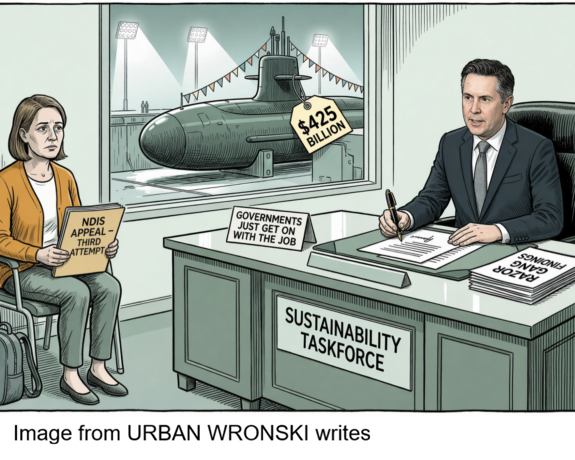

PETITION – To: Prime Minister Anthony Albanese and the Australian Labor Government
Chernobyl: The Lost Tapes – A good documentary on Chernobyl on SBS available On Demand for the next 3 weeks– https://www.sbs.com.au/ondemand/tv-program/chernobyl-the-lost-tapes/235274195556

19 May – Webinar- Webinar: No Nuclear Weapons in Australia
Start: 2026-05-19 18:00:00 UTC Canberra, Melbourne, Sydney (GMT+10:00)
End: 2026-05-19 19:30:00 UTC Canberra, Melbourne, Sydney (GMT+10:00)
20 May – Webinar – The dangerous world of AUKUS, US, military occupation and suppression of dissent

National Webinar, 20th May, 2026, 6.30pm AEST. Confronting laws restricting/suppressing protest speech and action
Speakers: Former Sen. Rex Patrick, Lawyer Nick Hanna ,Arthur Rorris ,Jorgen Doyle, Sen David Shoebbridge,
Facilitator Kelley Tranter.

of the week – Australians for War Powers Reform (AWPR)
To see nuclear-related stories in greater depth and intensity
 Antinuclear