Australia won’t budge on 2030 climate targets, keeps mum on longer term intentions — RenewEconomy
Morrison government won’t be revisiting its 2030 emissions reduction target and we’re unlikely to see any commitments to future targets any time soon. The post Australia won’t budge on 2030 climate targets, keeps mum on longer term intentions appeared first on RenewEconomy.
via Australia won’t budge on 2030 climate targets, keeps mum on longer term intentions — RenewEconomy
May 25 Energy News — geoharvey
Opinion: ¶ “Why Are We Subsidizing Fossil Fuels? Seriously” • Supporting renewables can cut emissions and boost the economy, all while providing cost-competitive energy. The Trump Administration, however, continues propping up the fossil fuel industry, despite the sector’s real financial problems, which began long before the COVID-19 pandemic. [CleanTechnica] ¶ “Experts Warn Climate Change Is […]
“Once in a lifetime opportunity:” NSW farmer on why he wants to host a wind farm — RenewEconomy

Hanging Rock local Jim Robinson explains why he wants the 400MW Hills of Gold wind farm on his land and in his community. The post “Once in a lifetime opportunity:” NSW farmer on why he wants to host a wind farm appeared first on RenewEconomy.
via “Once in a lifetime opportunity:” NSW farmer on why he wants to host a wind farm — RenewEconomy
NSW calls for wind, solar, storage ideas for first renewable zone in central west — RenewEconomy
NSW government wants to hear from wind, solar and storage projects interested in joining the state’s first Renewable Energy Zone. The post NSW calls for wind, solar, storage ideas for first renewable zone in central west appeared first on RenewEconomy.
via NSW calls for wind, solar, storage ideas for first renewable zone in central west — RenewEconomy
To 26 May, nuclear and climate news.

Can’t keep up with the pandemic news – I hope you can.
One thing, though. Beyond Nuclear has pointed out the significance of the floods in Midland, Michigan, where they do have one nuclear research reactor, but fortunately no commercial ones. They warn on ” the almost impossible challenge of evacuating people to safety during simultaneous catastrophic events.” The floods bring together the climate, pandemic, and nuclear dangers all in one area.
Public attention is not on this one. BUT, the 2020 Review Conference of a landmark international treaty on the Non-Proliferation of Nuclear Weapons (NPT), is due soon, though postponed due to the COVID-19 pandemic. The Comprehensive Nuclear Test Ban Treaty is also at risk. It’s under the radar, while everyone worries about COVID-19 and climate, – but the danger of nuclear weapons use is escalating, as Donald Trump unravels the treaty system that is aimed at preventing nuclear war. He also wants USA to hugely increase its nuclear weaponry.
Some bits of good news – Maasai Nature Conservancy Asks For Help To Fight Pandemic—And 100,000 People Answer. World’s Most Endangered Primate Population Triples After 17 Years of Careful Conservation
AUSTRALIA
NUCLEAR
National Radioactive Waste Dump PLan. Peter Remta: Misleading and inaccurate information provided by authorities on National Radioactive Waste Management. The false economics promised by the government’s National Radioactive Waste Management plan. Napandee is geologically and geophysically unsuitable for Australia’s nuclear waste dump. Australian Law on radioactive waste to be changed in order to prevent any judicial review!.
National Radioactive Waste Management Facility (NRWMF) under scrutiny – fact checking.
Some more submissions to the Senate on National Radioactive Waste Bill:
- Felicity Wright: appalled at effect on Aboriginal communities of decision on National Radioactive Waste Dump Site.
- Rose Costelloe – Kimba traditional Aboriginal area not suitable for nuclear waste dump.
- Dianne Ashton on Government untrustworthiness – the rushed, unethical decision on nuclear waste site.
- Felicity Wright: appalled at effect on Aboriginal communities of decision on National Radioactive Waste Dump Site.
- Nick Pastalatzis questions the government’s boast about jobs at the planned nuclear waste dump.
- Terry Schmucker- unfairness of community funding for nuclear dump has split the local community.
- Sue Woolford recommends the Canadian model for selecting a Nuclear Waste Facility Site.
Small Modular Nuclear Reactors included in Morrison govt’s energy plan?.
Australian govt and ERA squabble over monitoring of Ranger uranium clean-up.
CLIMATE Australia, and other countries – deaths from global hatinge are being underestimated . Australian government’s climate and post-Covid policy is a sop to the fossil fuel industries. National Coordination COVID-19 Commission – a fossil fuel mates’ rort of staggering proportions.
Morrison’s lack of transparency is undermining green recovery, Coalition’s Technology Investment Roadmap: Poor policy in practice. Leaked plan for huge gas subsidies– Coalition’s ‘grey’ baseline and credit scheme could pay companies to increase emissions. The Morrison government manipulates, to paint the coal industry as “clean” and “renewable”
MPs sayLeading doctors in Australia (over 180 of them) want Australia’s Australia’s Environmental Protection and Biodiversity Conservation Act 1999 (EPBC Act) made stronger, not weaker. Minerals Council of Australia keen to keep Australia’s environmental law the same, (or make it even worse)
RENEWABLE ENERGY. Greens pitch Green New Deal, 100% renewables target for post-Covid recovery. Huge 2GW of wind, solar and storage to deliver green future for Queensland industrial hub.
INTERNATIONAL
A moment of reckoning – when coronavirus meets climate change. Coronavirus: How to prevent a new nuclear arms race – and future pandemics.
The danger to children of low level nuclear radiation has been underestimated.
The international nuclear weapons race. Comprehensive Nuclear Test Ban Treaty at risk, due to Donald Trump’s accusations ?
Antarctic krill threatened by warming waters – climate change’s danger to the marine ecosystem.
The false economics promised by the government’s National Radioactive Waste Management plan
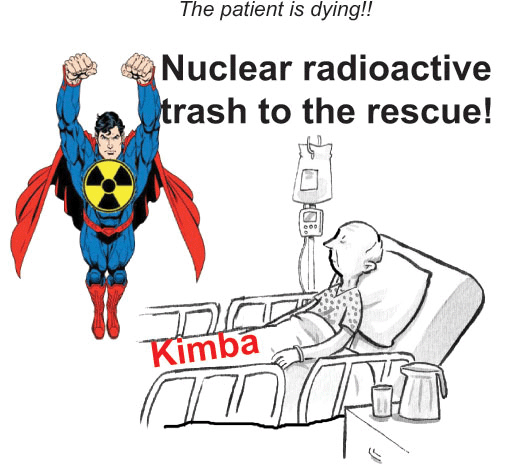
on all proper assessments and studies it is quite clear that the suggested benefits will not become a reality and in fact may lead to a deterioration in the value of the farming lands and residential properties at Kimba due the presence of the nuclear waste facility.
the government is doing no more than attempting to create a false economy which regrettably is being seized on by some members of the Kimba community as the misconceived salvation of its present depressed rural conditions which are actually common to the rest of Australia.
This is an extract from Peter Remta – submission to Senate Committee on National Radioactive Waste Management Amendment (Site Specification, Community Fund and Other Measures) Bill 2020 [Provisions] Submission 65
“………FINANCIAL GRANTS
The government has made significant financial grants to Kimba and also previously Hawker to gain community approval for its proposals. While it is a little difficult to ascertain the exact amounts of the grants the list of
recipients indicates that many of them were for rather nebulous and unnecessary purposes with little support or justification. In December 2018 the government first mentioned a so called community purposes
grant of $31million but failed to provide full details of the grant and its application.
Eventually it was explained that this grant would be a community development package to build economic capacity skills and resilience within those communities and to help realise the economic benefits of hosting the facility.
The three components of the package were:
(a) $8 million for community skills and development
(b) $3 million from the government’s Indigenous Advancement Strategy to support economic opportunities for the local Aboriginal community
(c) $20 million as a community fund to contribute towards a range of community focused projects including sustainable health services agricultural research and development and enhancements to local infrastructure such as roads and telecommunications
Even if component (a) were excluded the remaining applications of money should be part of the normal expenditure by the federal and state governments and be completely unrelated to and independent of the community’s acceptance of the facility.
In fact the local Aboriginal community considers that the moneys from the Advancement Strategy would be available to it in any event under previous arrangements.
Yet at the Senate estimates hearing on 21 February 2019 Manager Chard of the so called national radioactive waste management taskforce stated on behalf of the Department that the community development package of $31 million (she referred to it as $30 million) was being “enshrined” in legislation because this was requested by the community.
She also said that fund – being presumably the component of $20 million of the total package – was “not dependent on the legislation change” since it was envisaged that a fund would be established to support the community when the existing legislation was “conceived” in 2012 even though there had never been any public release or mention of the package and its value until December 2018.
ECONOMIC BENEFITS
The government has constantly promoted the notion and claimed that the establishment of the facility will lead to significant economic benefits for the Kimba region and its community.
The argument espoused and promoted by the government is that Kimba is a dying agricultural area with no future prospects of revival and consequently the establishment of the facility will provide significant increased employment and other infrastructure benefits ensuring its future for an even quoted figure of 300 years. The economic prospects for Kimba would also be augmented and improved by the intended grants from the government already described as the community development package.
However on all proper assessments and studies it is quite clear that the suggested benefits will not become a reality and in fact may lead to a deterioration in the value of the farming lands and residential properties at Kimba due the presence of the nuclear waste facility.
Based on proper and considered financial advice it seems that the government is doing no more than attempting to create a false economy which regrettably is being seized on by some members of the Kimba community as the misconceived salvation of its present depressed rural conditions which are actually common to the rest of Australia.
This is a completely wishful but unrealistic perception since it has already been shown by other examples that the facility would in a normal commercial sense need less than 10 workers unlike the government’s constantly quoted figure of 45 workers. Moreover the construction of the facility at Kimba will probably be carried out by already qualified and well experienced contractors from outside of Kimba and their presence during the building stage will add little to the local community……….”
New study – health effects of low level nuclear radiation on children has been underestimated
 How dangerous is low-level radiation to children? https://climatenewsnetwork.net/how-dangerous-is-low-level-radiation-to-children/#.Xsn914VYtCg.twitter May 22nd, 2020, by Paul Brown How dangerous is low-level radiation to children? https://climatenewsnetwork.net/how-dangerous-is-low-level-radiation-to-children/#.Xsn914VYtCg.twitter May 22nd, 2020, by Paul Brown A rethink on the risks of low-level radiation would imperil the nuclear industry’s future − perhaps why there’s never been one.
The threat that low-level radiation poses to human life, particularly to unborn children, and its link with childhood leukaemia, demands an urgent scientific reassessment. This is the conclusion of a carefully-detailed report produced for the charity Children With Cancer UK by the Low-Level Radiation Campaign. It is compiled from evidence contained in dozens of scientific reports from numerous countries over many decades, which show that tiny doses of radiation, some of it inhaled, can have devastating effects on the human body, particularly by causing cancer and birth defects. The original reports were completed for a range of academic institutions, governments and medical organisations, and their results were compared by the newest report’s authors, Richard Bramhall and Pete Wilkinson. They believe they have provided overwhelming evidence for a basic rethink on so-called “safe” radiation doses. They write: “The fundamental conclusion of this report is that when the evidence is rationally assessed it appears that the health impacts, especially in the more radio-sensitive young, have been consistently and routinely underestimated.” Ceaseless controversy The pair concede this is not the first time such a call has been made, but it has never been acted upon. Now they say it must be. What constitutes safety for nuclear workers and for civilians living near nuclear power stations, or affected by fall-out from accidents like the ones at Sellafield in Cumbria in north-west England in 1957, Chernobyl in 1986 and Fukushima in 2011, has always been highly controversial. Bramhall and Wilkinson detail how the debate began in earnest in the 1980s, when a cluster of childhood leukaemia cases, ten times higher than would be expected, was identified around Sellafield. Government inquiries followed but reached no settled conclusion, and low-level radiation safety has been a scientific battleground ever since. The official agencies appointed by governments are still using dose estimates based on calculations made in 1943, when Western governments were trying to develop an atomic bomb.
The new report highlights that this was when very little was known about how tiny doses of ingested radiation could affect the body − and when DNA was yet to be discovered. Despite the fact that international standards are based on these scientifically ancient, out-of-date assumptions, they have not been revised. If they were, the results could be catastrophic for the nuclear industry and for the manufacturers of nuclear weapons. The report makes clear that if the worst estimates of the damage that low-level radiation causes to children proved anywhere close to correct, then no-one would want to live anywhere near a nuclear power station. Most would be appalled if they knew even small numbers of children living within 50 kilometres of a station would contract leukaemia from being so close. It acknowledges that the stakes are high. If the authors’ findings are accepted, then it will be the end of public tolerance of nuclear power. Revolution needed Despite this long-lived institutional pushback from governments and the industry, the report says what is needed is a scientific revolution in the way that low-level radiation is considered. It compares the situation with the treatment of asbestos. It was in the 1890s that the first evidence of disease related to asbestos exposure was laid before the UK Parliament. But it was not until 1972, when the causal link between the always fatal lung cancer, mesothelioma, and human fatality rates was established beyond reasonable doubt, that the use of asbestos was banned. This delay is why on average 2,700 people still die annually in the UK: they were at some point exposed to and inhalers of asbestos. Another example, which the report does not quote but is perhaps as relevant today, is air pollution. It has taken decades for the scientific community to realise that in many cities it is the tiniest particles of air pollution, invisible to the naked eye, that are taken deepest into the lungs and that cause the most damage, killing thousands of people a year. So far governments across the world have not yet outlawed the vehicles and industrial processes that are wiping out their own citizens in vast numbers. Anxiety not irrational The report cites many studies, with perhaps the most telling those that compare the actual numbers of cancers and malformations in babies which occurred in the aftermath of the Chernobyl accident with the numbers to have been expected if the currently accepted and out-of-date risk calculations had been used. Despite the difficulties of getting information from reluctant governments close to Chernobyl, the report says: “The discrepancy between the number of congenital malformations in babies expected after Chernobyl and the number actually observed was between 15,000 and 50,000.” The authors say their object “is to dispel the repeated assertion that public anxiety about the health impact of radioactivity in the environment is irrational.” Both Wilkinson and Bramhall have considerable experience of dealing with governments, both inside official bodies as members, and as external lobbyists. They detail how they believe the concerns of both ordinary people and scientists have been swept aside in order to preserve the status quo. Clearly, in sponsoring the report, Children with Cancer UK agrees. − Climate News Network |
|
Australia, and other countries – deaths from global heating are being underestimated

|
Experts Warn Climate Change Is Already Killing Way More People Than We Record, Science Alert ,CARLY CASSELLA, 25 MAY 2020
People around the world are already dying from the climate crisis,and yet all too often, official death records do not reflect the impact of these large-scale environmental catastrophes. According to a team of Australian health experts, heat is the most dominant risk posed by climate change in the country. If the world’s emissions remain the same, by 2080 Australian cities could see at least four times the number of deaths from increasing temperatures alone. “Climate change is a killer, but we don’t acknowledge it on death certificates,” says physician Arnagretta Hunter from the Australian National University. That’s a potentially serious oversight. In a newly-published correspondence, Hunter and four other public health experts estimate Australia’s mortality records have substantially underreported heat-related deaths – at least 50-fold. While death certificates in Australia do actually have a section for pre-existing conditions and other factors, external climate conditions are rarely taken into account. Between 2006 and 2017, the analysis found less than 0.1 percent of 1.7 million deaths were attributed directly or indirectly to excessive natural heat. But this new analysis suggests the nation’s heat-related mortality is around 2 percent. “We know the summer bushfires were a consequence of extraordinary heat and drought and people who died during the bushfires were not just those fighting fires – many Australians had early deaths due to smoke exposure,” says Hunter……. “Death certification needs to be modernised, indirect causes should be reported, with all death certification prompting for external factors contributing to death, and these death data must be coupled with large-scale environmental datasets so that impact assessments can be done.” …… Such action, they say, is imperative. Not only for Australia but many other countries in the world. The United Kingdom has documented some problems with accurately filling out death certificates, and cities in several parts of the world are on track for similar heat-related mortality rates as Australia. But there are some places that will need to do more than just update their current system. In the tropics, there’s little valid mortality data on the more than 2 billion people who live in this heat-vulnerable region. And that makes predicting what will happen to these communities in the future much trickier. “Climate change is the single greatest health threat that we face globally even after we recover from coronavirus,” says Hunter. “We are successfully tracking deaths from coronavirus, but we also need healthcare workers and systems to acknowledge the relationship between our health and our environment.” In an unpredictable world, if we want to know where we’re going, we have to know where we’ve been. Figuring out how many of us have already died from climate change will be key to that process. We can’t ignore it any longer. The correspondence was published in The Lancet Planetary Health. https://www.sciencealert.com/official-death-records-are-terrible-at-showing-how-many-people-are-dying-from-the-climate-crisis |
|
|
Australian government’s climate and post-Covid policy is a sop to the fossil fuel industries
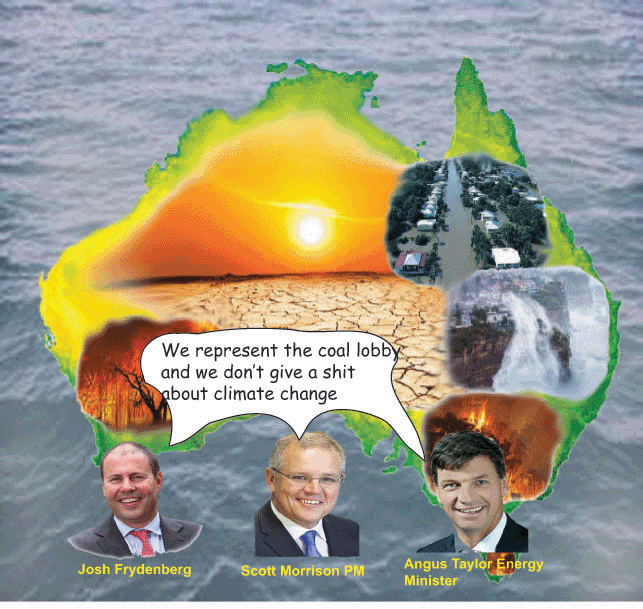
Angus Taylor suggesting it is not government policy to achieve net zero emissions by 2050, and the government giving in-principle support to recommendations made by a panel headed by a former CEO of Origin Energy, Grant King, to allow the Australian Renewable Energy Agency and the Clean Energy Finance Corporation fund projects involving carbon capture and storage.
pushes for the same energy mixes that were being advocated a decade ago – more gas, the discredited carbon capture, as well as nuclear power.
The climate crisis looms as the Coalition fiddles with fossil fuels https://www.theguardian.com/commentisfree/2020/may/24/the-climate-crisis-looms-as-the-coalition-fiddles-with-fossil-fuelsGreg Jericho The government is like a smoker switching to low-tar cigarettes. Its energy policy is just a sop
We may be dealing with a health crisis, but the climate change crisis has not gone away, nor become any less urgent. In fact, the opposite.
A few conservative commentators have suggested Covid-19 shows what a real crisis looks like compared with, in their opinion, the hyperventilating over climate change.
What bollocks.
Nasa estimates that last month was the hottest April on record and the first four months of this year are the second hottest start to a year.
The past seven months have all been 1C or higher than the 1951-1980 average (roughly around 1.3C above the pre-industrial average) – tied with the longest streak set from October 2015 to April 2016. But unlike in 2015 and 2016 the Bureau of Meteorology records we are currently not in El Niño.
That very much suggests the pace of warming is speeding up.
The linear trend of temperatures over the past 60 years suggests we will hit 2C above pre-industrial levels in 50 years; the trend of the past 20 years has it happening in around 30 years, but the trend of the past decade would see us hit that level in 2038 –just 18 years’ time.
And no, the virus has not bought us more time.
A study published this week in Nature Climate Change estimates the annual global drop in emissions due to virus shutdowns will be “comparable to the rates of decrease needed year-on-year over the next decades to limit climate change to a 1.5°C warming”.
That it took forcing people to stop their lives to achieve such cuts highlights just how big the job ahead of us is and how it cannot be done through individual action alone.
Cutting emissions without crippling the economy requires not everyone self-isolating, but changing industries and the very foundations of our economy.
We need to move away from oil, coal and gas to renewable energy.
And so it should be of great concern that the government is using the coronavirus as cover to push fossil fuels.
This week Adam Morton revealed that a manufacturing taskforce, headed by Dow Chemical executive and Saudi Aramco board member Andrew Liveris, is recommending to the National Covid-19 Coordination Commission (itself headed by the current deputy chairman of Strike Energy, Neville Power) that “the Morrison government make sweeping changes to ‘create the market’ for gas and build fossil fuel infrastructure that would operate for decades”.
It comes off the back of Angus Taylor suggesting it is not government policy to achieve net zero emissions by 2050, and the government giving in-principle support to recommendations made by a panel headed by a former CEO of Origin Energy, Grant King, to allow the Australian Renewable Energy Agency and the Clean Energy Finance Corporation fund projects involving carbon capture and storage.
Taylor also this week released a discussion paper for a “framework to accelerate low emissions technologies”. While suggesting renewables are vital, it essentially pushes for the same energy mixes that were being advocated a decade ago – more gas, the discredited carbon capture, as well as nuclear power.
It’s the wrong policy at precisely the wrong time.
As Morton has reported, organisations and governments around the world are advocating using economic stimulus measures to push towards a greener economy.
A report released this week by the Australian Conservation Foundation echoed the Grattan Institute’s recent “Start with steel: A practical plan to support carbon workers and cut emissions” report, arguing that we should see the virus as an opportunity to transform our economy and invest in renewable energy.
But no. It is clear the government remains wedded to a fossil-fuel based economy in which its climate change policy is merely a sop rather being designed to deal with a major crisis that is only becoming more urgent.
Leading doctors in Australia (over 180 of them) want Australia’s Australia’s Environmental Protection and Biodiversity Conservation Act 1999 (EPBC Act) made stronger, not weaker
 More than 180 doctors sign open letter calling for overhaul of ‘failing’ environmental laws, https://www.sbs.com.au/news/more-than-180-doctors-sign-open-letter-calling-for-overhaul-of-failing-environmental-laws 25 May 20, More than 180 health professionals have signed a letter warning the Commonwealth must strengthen Australia’s environmental laws to protect people’s health.
Doctors for the Environment Australia and the Climate and Health Alliance have sent an open letter to federal Environment Minister Sussan Ley as she undertakes a once-in-a-decade review of environmental protection laws.
Australia’s Environmental Protection and Biodiversity Conservation Act 1999 (EPBC Act) was established more than 20 years ago at a time when the doctors say the effects of climate change and its links to human health were not widely considered to be related.
The review comes amid the COVID-19 pandemic and follows Australia’s catastrophic summer bushfires with the health professionals warning that failing to conserve the environment will expose Australians to further devastation and health risks.
“We must protect the natural environment in order to prevent further and potentially even more deadly pandemics,” the letter says.
“The degradation of Australia’s natural environment and loss of our unique biodiversity is in effect a dismantling of our life support systems.”
The doctors argue the laws have failed as Australia has the second-highest rate of biodiversity in the world and is recognised as a land clearing and deforestation hotspot.
“The EPBC Act has failed to achieve its objectives of protecting Australia’s environment and promoting ecologically sustainable development and biodiversity conservation,” the letter says.
The letter, also signed by former Australian of the Year Professor Fiona Stanley, calls for an “entirely new generation” of environmental laws that focus on the impacts on human health and which have greater protections in place for biodiversity.
Associate Professor Katherine Barraclough from Doctors for the Environment Australia argues clearing forests and wildlife habitat increases the risk of infectious diseases being transferred from wildlife to people.
“The COVID-19 pandemic and the summer’s fires serve as a wake-up call. We must recognise the interconnections between humans, animals and natural places,” she said in a statement.
Climate and Health Alliance founder Fiona Armstrong said the government listened to the science in its response to COVID-19 and should do the same in regards to the environment and climate change.
An interim report into the Environment Protection and Biodiversity Conservation Act review is expected mid-year with the final report expected in October.
National Coordination COVID-19 Commission – a fossil fuel mates’ rort of staggering proportions.
 Coalition’s COVID-19 Commission: Another reason for a Federal ICAC Now! Independent Australia By Ross Jones | 25 May 2020 Just how much slush do you reckon is going to wash around the Coalition’s so-called National Coordination COVID-19 Commission? Coalition’s COVID-19 Commission: Another reason for a Federal ICAC Now! Independent Australia By Ross Jones | 25 May 2020 Just how much slush do you reckon is going to wash around the Coalition’s so-called National Coordination COVID-19 Commission?
It is brutally evident that, much like birds in a Hitchcock movie, masses of spivs are preening their flight feathers, readying themselves for a terrifying assault on Australia’s fragile environment to line their own – and others’ – already luxurious nests. This is going to be a mates’ rort of staggering proportions. There are a lot of approaches Australia could take to emerge from the COVID-19 problem a better place. Certainly, Australia is awash with economic problems — high unemployment, battered production capabilities, smashed asset values and a looming surplus of exports are just the start. As you would expect, the Morrison Government eschewed any sensible approaches to these problems, like rebooting manufacturing to set the country up for efficient, long-term solutions, which would enable us to contribute to global attempts to slow climate change while boosting levels of meaningful employment. Instead, the Coalition wants to unleash the dogs of destruction, just to make sure no other generation of Australians has anywhere near the opportunity this lot of privileged elitists has enjoyed. Once fracked and drilled, that land – our children’s land – will be rendered useless. Destroyed. Why are they doing this? Money. Lots of it. Greed, bribes, backhanders and sly winks will ensure the brown paper bags – or Cayman Island cupboards – are nice and plump for all the abusers of our long-term well-being to jam their porky little mitts into. This is exactly why we need an empowered Federal ICAC and that is exactly the reason IA is proposing the formation of a new Australian political party to be named — Federal ICAC Now (FIN). A Federal ICAC won’t stop all the malfeasance but it could put a fair-sized dent in it. Also, it would be great to have a few senators in the House whose focus is on corruption detection and prevention. The next half-senate election, when the term of those elected in 2016 expires, can be held as early as 7 August 2021 but must be held by 30 June 2022. Before the election, and especially in the last months leading up to the big event a registered FIN party would have a presence alerting voters to the issues. At the election, the above-the-line party might just have a chance. A previous IA article floated the idea of FIN and asked readers if they would be willing to join such a party………. https://independentaustralia.net/politics/politics-display/coalitions-covid-19-commission-another-reason-for-a-federal-icac-now,13928 |
|
May 24 Energy News — geoharvey

Opinion: ¶ “With The Navajo Generating Station Gone, We Need Help Luring Renewable Energy Investment To Our Land” • Navajo Generating Station closed last December, over twenty years early, because it was no longer economically viable for its corporate owners. Navajo Power can provide renewable energy and jobs, but it needs funding. [AZCentral.com] Science and […]
Napandee is geologically and geophysically unsuitable for Australia’s nuclear waste dump

This is an extract from Peter Remta – submission to Senate Committee on National Radioactive Waste Management Amendment (Site Specification, Community Fund and Other Measures) Bill 2020 [Provisions] Submission 65
“……….NAPANDEE
Napandee near Kimba in South Australia is the site chosen by the government for its national radioactive waste management facility which would be given legislative effect by the enactment of the Bill.
Unlike what was stated by the responsible minister Napandee is not a locality or community but simply the name of the farm part of which will be acquired by the government by purchase to host the facility. Again contrary to what the minister has said there is no community at Napandee supporting the government’s proposals other than the resident owners of the farm whose opinion must be discounted because of their financial interest.
SUITABILITY
The Napandee site is both geologically and geophysically unsuitable for hosting the facility.
This is confirmed by many experts locally and overseas who are surprised at thechoice of Napandee since it is a most inappropriate ground and soil mineral structure for the construction and the operations of the waste facility.
Because of the soil and ground conditions it would be extremely difficult to properly clean up the area in the event of any escape of waste and would probably leave the ground contaminated for many decades.
The main reasons for its unsuitability are that the Napandee site is on sands of unconsolidated sediments to a depth of some 30 metres in an area of known seismic volatility with several significant earthquakes having been recorded in the past fifty years.
LOCATION
Kimba (and this includes the Napandee farm which is located some 25 kms by road west of the Kimba township) is a prime agricultural area renowned for its cereal crop growing and livestock pastures and is a totally inappropriate and unsuitable location for the facility.
Again based on well regarded and authoritative expert opinion the establishment of the facility at Kimba will be greatly detrimental to its agricultural and farming industry from which the region may never recover.
The financial and economic loss within the agricultural industry for the Kimba region will be incapable of being replaced by any economic benefits claimed by the government to be gained from the waste facility.
The government has attempted to show that agriculture and nuclear waste management can coexist in a satisfactory manner as is the case with the Champagne district of France.
However that situation together with many others throughout Europe has completely changed with significant opposition – and even violent demonstrations – against the storage of nuclear material in their regional localities.
NATURE OF FACILITY
The facility to be constructed at Napandee is based on the model of the El Cabril waste repository in the Córdoba province of Spain.
However the first major difference between the two is that Napandee is in prime agricultural land with many neighbouring and well established farms while El Cabril is in relatively isolated foothills country and until some years ago was a uranium mine which immediately provided a remote and generally uninhabited environment and barrier for that waste facility.
The second is that El Cabril is a very large and highly technical installation with its attendant complexities and costs and consequently is not really an ideal reference example for a very scaled down version for Napandee.
In any case El Cabril despite being regarded as one of the best above ground repositories in the world has recently experienced some water problems which has led the Australian government to look for other possible models for the Napandee facility but no details of this have been publicly released.
In reality El Cabril was probably a bad model to choose for the government’s facility in the first place………..”
Peter Remta: Misleading and inaccurate information provided by authorities on National Radioactive Waste Management
 Peter Remta – submission to Senate Committee on National Radioactive Waste Management Amendment (Site Specification, Community Fund and Other Measures) Bill 2020 [Provisions] Submission 65
“………. EXPLANATORY MEMORANDUM The explanatory memorandum accompanying the Bill simply repeats many of the
inaccurate and misleading comments and information provided by the Department of Industry Innovation and Science and ANSTO to the communities of the initially accepted sites in South Australia since the beginning of the nomination process under the existing legislation.
………I must stress that the serious and unacceptable manner in which quite inaccurate information has been disseminated on behalf of the government on such an important issue both now and during the nomination and selection process has only caused more concern and community dissension and I suggest will lead to a greater general apprehension of starting a nuclear industry in Australia
Explanatory memorandum assertions :
1. While the concept of a single and purpose-built nuclear waste facility is a desired objective as outlined at the start of the explanatory memorandum it will be difficult to achieve as is now proposed.
To begin with it is wrong to say that this facility will support nuclear science and technology since it fails to meet the safety prescriptions for a facility of that nature.
It is also wrong to link the provision of nuclear medicine to the proposed storage and disposal of waste at the facility as the various entities generating waste from medical and research activities will continue relying on their own disposal methods and will not necessarily use a government run business for that purpose.
2. Most importantly it is a totally false and misleading proposition to suggest that the failure to establish the facility as proposed by the government will somehow lead to a reduction in nuclear medical services and treatment and the government should quickly correct that serious misconception since this has been a rather distressing concern for the community at Kimba and generally. It is therefore disingenuous to give that impression that this will be a central
facility for all nuclear waste in Australia.
3. While existing waste is held in numerous locations around the country there is no legal or other requirement that this waste would be disposed of at the facility and it is therefore disingenuous to give the impression that this will
be a central facility for all waste in Australia.
4. The reference to meeting with the international obligations under the Joint Convention4 ignores the safety code requirements promulgated some 12 years later under which it would be very difficult to establish the proposed
facility.
5. The suggestion of acquiring additional land for such things as all weather road access is only another example of the intrinsically unsuitable nature of the chosen site and the lack of planning and the necessary technical knowledge for construction of the facility.
6. The process of identifying a suitable location being a 40 year effort again shows the inability of the government or simply ignores that the current process in a proper manner only began after 2012 under the existing legislation.
7. To suggest proper and successful consultations with community members is a test of normal intelligence having regard to the strong and spirited opposition to the facility from the outset by the community generally and the fact that a concerned Aboriginal group has litigated its opposition to an appeal to the Federal Court5 and may now resort to a referral to the United Nations Human Rights Council.
8. The financial aspects of the government’s proposals lack frankness and justification when it has been claimed variously that the amount so far spent in selecting the site is $55 million or $85 million over the past five years but with a constant refusal to provide any details as to how that money has been spent or applied.
Surely there should be proper public disclosure of this quantum of expenditure when compared to the usual outcry where there is only a fraction of that amount involved if there is no reasonable explanation given. Moreover this should be gauged against the persistent refusal of the government to pay for an independent assessment and scrutiny of its
proposals by the members of the Kimba community who oppose the facility.
9. The statement as to compatibility with human rights is again with respect rather nonsensical when the government was incapable of holding a proper and valid ballot (albeit through the District Council of Kimba) which totally ignored the inclusion of an opposing argument contrary to the recognised and applicable principles of human rights. That ballot and the previous one as well as some claimed community surveys failed to meet the principles of informed consent which places a high standard of compliance on both the government and the District Council.
This becomes even worse by excluding the Aboriginal peoples from the ballotIf the government were genuine then it should hold another ballot with a more appropriate and wider base for voting and with the prior provision of all pertinent
information including the arguments or case against the facility. This goes back to providing a proper assessment and scrutiny of the government’s proposals by the opposing members of the Kimba community which has never been
the case.
Regrettably the compatibility statement is more prescriptive in its content instead of actually dealing with the facts of the situation and circumstances that occurred and which have been presented in the statement in a most favourable light for the government. when under the most basic of constitutional and democratic rights they
should have been included in that process…………
Sections on NAPANDEE FINANCIAL ASPECTS INFORMATION, BALLOTS, and INFORMED CONSENT LEGAL ACTIONS MANAGEMENT of FACILITY INTERNATIONAL OBLIGATIONS TECHNICAL ASSESSMENT [these will be published here separately, later]
…. CONCLUDING COMMENTS aand RECOMMENDATIONS Continue reading
Dianne Ashton on Government untrustworthiness – the rushed, unethical decision on nuclear waste site
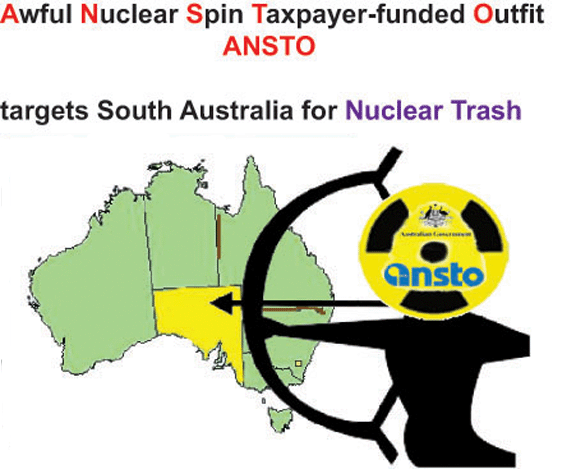
Dianne Ashton to Senate Committee on INQUIRY INTO NATIONAL RADIOACTIVE WASTE MANAGEMENT
FACILITY Submission No 63
Herewith is my submission and reasons for opposing the establishment of a National Radioactive
Waste Management Facility in South Australia.
Having been a part of the Barndioota Consultative Committee for the four years it was operational,
prior to a decision being made by the Government as to the proposed site of a Facility, I questioned
the trustworthiness of the Federal Department (DIIS at the time), the lack of ethics when it came to
Consultation and the reason why South Australia was chosen for a proposed NRWF when, clearly
South Australians are patently against having nuclear waste stored in the state.
South Australians voted against a High Level Nuclear Waste Facility being built in South Australia.
Unfortunately had DIIS been patient until that decision was made, they would have realised that
their hope of the long term Intermediate Level Nuclear Waste (ILW) in a High Level Facility in South
Australia was nothing more than a pipe dream. Unfortunately this decision by South Australians, left
DIIS in the unenviable position of looking for a temporary place to store this highly dangerous waste.
To store ILW temporarily above ground for up to 100 years or more, is not a good decision, which is
now what is intended at the proposed NRWMF.
ll that withstanding, the whole process which was undertaken by DIIS to find the proposed site for
a NRWMF in Australia was flawed in so many ways. If DIIS had actually undertaken the process with
World’s best practice in mind, the outcome may have been very different.
A NRWMF would have been chosen, but only after deep consultation with the neighbours, standing
council and community members of the area. The consultative process would have been a two way
process, information being given from all sides of the situation and then discussed. If there were
divisive issues the aim would have been to build greater connections and understand between
community members, because the notion of “divide and conquer” does not belong in community
engagement. This is not what happened, trust was not built, divide and conquer abounded and
information was the only means forward according to DIIS. Also continuity of engagement would
have been important instead of around 25 staff members leaving the team during the process.
Surveys would be been well thought out and extensively conducted instead of hurried and rushed
with flawed results. DIIS did not do enough to fully engage the community and work with them in an
ethical manner to bring the process to an amenable conclusion. This created mistrust of DIIS and
their process.
If the proposed site at Kimba goes ahead without full scrutiny of the process which put it there, it
will be a sad day for any future proposed facilities, as a wonderful opportunity to all work
collaboratively will have gone missing and will continue to be absent, until there is a new approach
to the process.
Covid 19 is paving the way for change in Australia for the better. The government is called to be
acting on behalf of the people (taxpayers) not on behalf of itself. Let’s hope we can all wake up
before it is too late.
1 This month.
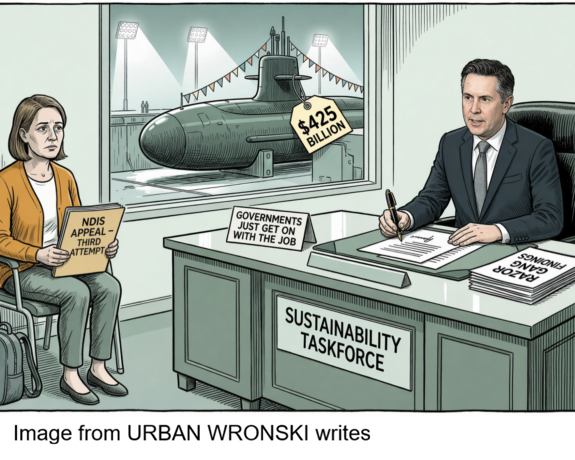

PETITION – To: Prime Minister Anthony Albanese and the Australian Labor Government
Chernobyl: The Lost Tapes – A good documentary on Chernobyl on SBS available On Demand for the next 3 weeks– https://www.sbs.com.au/ondemand/tv-program/chernobyl-the-lost-tapes/235274195556
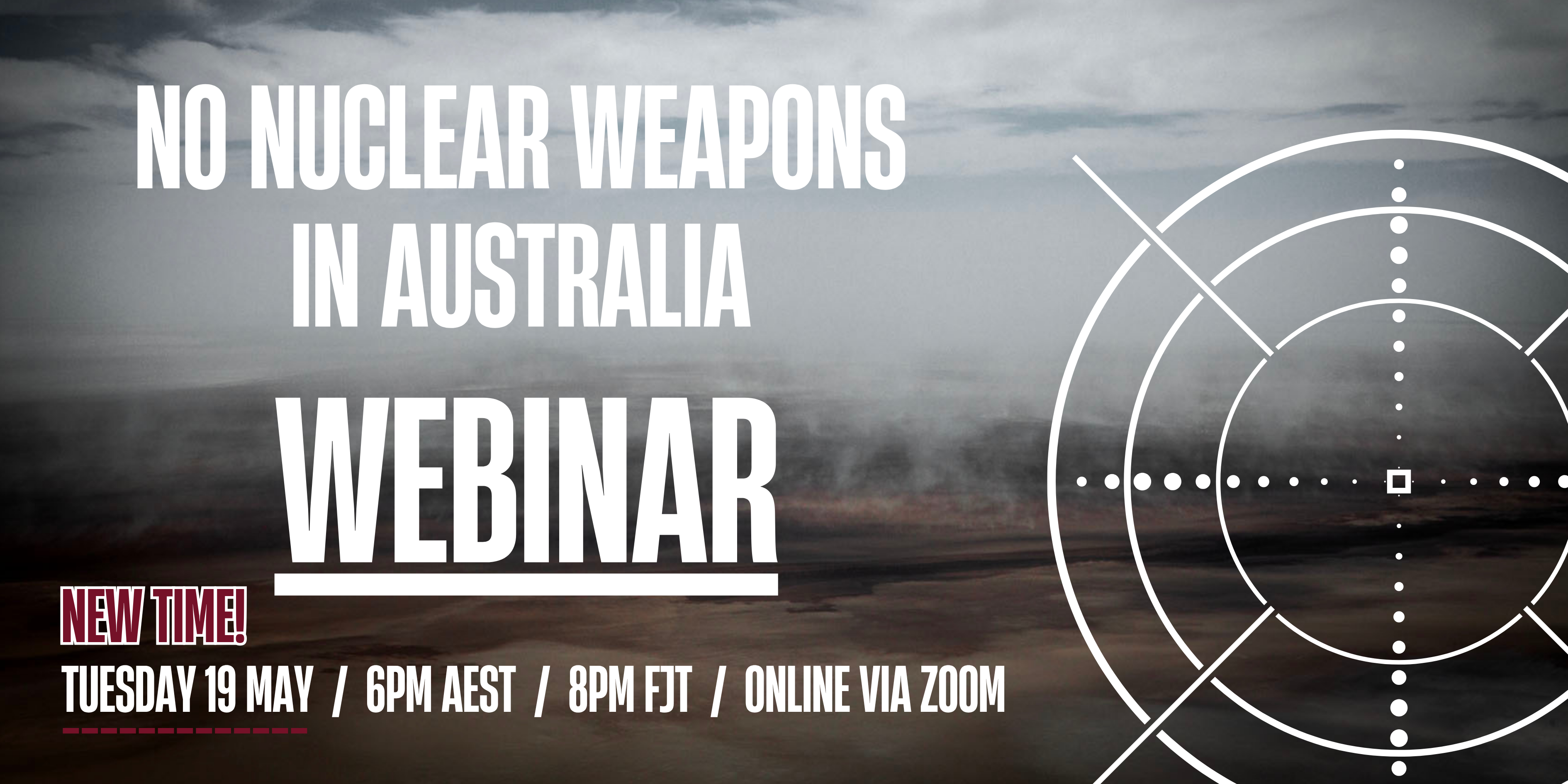
19 May – Webinar- Webinar: No Nuclear Weapons in Australia
Start: 2026-05-19 18:00:00 UTC Canberra, Melbourne, Sydney (GMT+10:00)
End: 2026-05-19 19:30:00 UTC Canberra, Melbourne, Sydney (GMT+10:00)
20 May – Webinar – The dangerous world of AUKUS, US, military occupation and suppression of dissent

National Webinar, 20th May, 2026, 6.30pm AEST. Confronting laws restricting/suppressing protest speech and action
Speakers: Former Sen. Rex Patrick, Lawyer Nick Hanna ,Arthur Rorris ,Jorgen Doyle, Sen David Shoebbridge,
Facilitator Kelley Tranter.

of the week – Australians for War Powers Reform (AWPR)
To see nuclear-related stories in greater depth and intensity
 Antinuclear