Leaked plan for huge gas subsidies
Over 100 public interest organisations call on Canadian govt to halt decision on nuclear waste disposal
 Groups ask Ottawa to press ‘pause’ on nuclear waste
  disposal https://www.tbnewswatch.com/local-news/groups-ask-ottawa-to-press-pause-on-nuclear-waste-disposal-2361184 ‘There’s no rules’ for evaluating an underground storage site, spokesperson says. By: Gary Rinne OTTAWA — More than 100 public interest organizations, environmental groups and others are calling on the federal government to suspend all decision-making regarding radioactive nuclear waste disposal.
In a letter to Natural Resources Minister Seamus O’Regan, they describe Canada’s current nuclear waste policy as “deficient,” saying it must be improved in consultation with the public and Indigenous peoples.
Among the signatories are numerous groups in northern Ontario, including Thunder Bay-based Environment North and Keep Nuclear Waste Out of Northwestern Ontario.
The letter follows a February report from the International Atomic Energy Agency which recommended that the government “enhance” its existing radioactive waste management policy.
The IAEA said the policy framework “does not encompass all the needed policy elements nor a detailed strategy” required for long-term nuclear waste management.
The signatories say their request is urgent because the regulator, the Canadian Nuclear Safety Commission, is pressing ahead with licensing decisions on a number of radioactive waste projects.
“Fearing Canada’s deficient radioactive waste framework will imprint itself on decisions affecting the health and safety of future generations and the environment, signees urged Canada to provide leadership, and establish sufficient guidance and federal policy,” they said in a statement Tuesday.
The groups also want Ottawa to establish objectives and principles to underly a nuclear waste policy, and that the government identify “the problems and issues exposed by existing and accumulating radioactive waste.”
The Nuclear Waste Management Organization is currently studying potential future underground nuclear waste storage sites in the Ignace area and South Bruce in southern Ontario.
Brennan Lloyd of North Bay-based Northwatch said NWMO’s search for a future repository is “part and parcel” of concerns about Canada’s overall approach to managing radioactive waste issues.
Nuclear waste disposal isn’t the only pressing matter, Lloyd said, but “we have lots of concerns about the Nuclear Waste Management Organization, their operation…going back to 2002 when the Nuclear Waste Fuels Act allowed the industry to create the NWMO.”
She added that “the lack of a solid set of rules around radioactive waste, we believe, does affect how the NWMO has conducted itself, but even more importantly it may affect the review process if the NWMO ever actually arrives at a site that they can in some way present as having the support of a host community.”
According to Lloyd, there are no rules as to how such a proposal would be evaluated.
She said that in 1996, the federal government presented a Radioactive Waste Policy Framework that’s less than a page long, and it’s problematic that “almost 25 years later, that’s still all we have in the way of real policy, strategy, rules around radioactive waste at the national level.”
Canadian Nuclear Safety Commission staff have recently proposed regulatory documents, Lloyd said, “which are really very general descriptions of how they might go about issuing a licence for various activities. And they really lack rigour.”
She said two of the five regulatory documents the CNSC plans to bring forward next month deal directly with nuclear waste burial.
“One is around how you would assess the long-term performance of a deep geological repository, and one is about how you would characterize a site that was being considered. And both of them are just incredibly weak documents,” Lloyd maintained.
“The dividing line is between ‘shall’ and ‘should.’ The CNSC documents are all ‘should’ or ‘may.’ Which means there’s no rules.”
Lloyd and the other signatories to the letter ask Minister O’Regan to instruct the CNSC to stop developing radioactive waste management and nuclear decommissioning documents until new, overarching policies and strategies are in place.
Australia’s transcontinental gas pipe dream: It simply doesn’t add up — RenewEconomy
Gas industry people have been saying gas is the transition fuel for at least 30 years. It’s never been true in all that time, and it’s not true now. The post Australia’s transcontinental gas pipe dream: It simply doesn’t add up appeared first on RenewEconomy.
via Australia’s transcontinental gas pipe dream: It simply doesn’t add up — RenewEconomy
May 20 Energy News — geoharvey
Opinion: ¶ “Ohio’s Governor Listened To The Science On Coronavirus. Why Not Climate Change?” • Ohio’s Republican Governor, Mike DeWine, listened to science on the coronavirus. His response is supported by 84% of his Republican constituents and 90% of Democrats. His performance on the environment and climate change, however, has been less consistent. [Grist] ¶ […]
Germany leads globally in energy security levels, thanks to renewables – study — RenewEconomy
Germany boasts the highest energy security level in the world, due in large part to the wide spread use of renewable energy sources in the country. The post Germany leads globally in energy security levels, thanks to renewables – study appeared first on RenewEconomy.
via Germany leads globally in energy security levels, thanks to renewables – study — RenewEconomy
Wind and solar hit record grid levels in Europe as pandemic curbs energy demand — RenewEconomy
Significant falls in electricity demand during Covid-19 lockdowns has led to record shares of variable renewable energy – wind and solar – in some European countries. The post Wind and solar hit record grid levels in Europe as pandemic curbs energy demand appeared first on RenewEconomy.
via Wind and solar hit record grid levels in Europe as pandemic curbs energy demand — RenewEconomy
Coalition’s ‘grey’ baseline and credit scheme could pay companies to increase emissions — RenewEconomy
The proposed mechanism could result in the perverse outcome of paying high emitting businesses to invest in projects which increase absolute emissions. The post Coalition’s ‘grey’ baseline and credit scheme could pay companies to increase emissions appeared first on RenewEconomy.
Michael Moore’s electric vehicle myths only benefit the fossil fuel industry — RenewEconomy
Michael Moore’s ‘Planet of the Humans’ isn’t just wrong. It’s actively denying a range of quality-of-life improvements. The post Michael Moore’s electric vehicle myths only benefit the fossil fuel industry appeared first on RenewEconomy.
via Michael Moore’s electric vehicle myths only benefit the fossil fuel industry — RenewEconomy
Taylor’s response to King review reeks of political and fossil fuel cronyism — RenewEconomy
Angus Taylor seems intent on bastardising the renewable energy mandates of CEFC and ARENA in name of “technology neutral” approach to support failed technologies. The post Taylor’s response to King review reeks of political and fossil fuel cronyism appeared first on RenewEconomy.
via Taylor’s response to King review reeks of political and fossil fuel cronyism — RenewEconomy
Coalition’s reward to Australia’s big polluters: Just don’t call it an ETS — RenewEconomy
Morrison government to establish a new mechanism to reward big emitters. It looks and smells like an emissions trading scheme, even if they won’t say it. The post Coalition’s reward to Australia’s big polluters: Just don’t call it an ETS appeared first on RenewEconomy.
via Coalition’s reward to Australia’s big polluters: Just don’t call it an ETS — RenewEconomy
Felicity Wright: appalled at effect on Aboriginal communities of decision on National Radioactive Waste Dump Site

Felicity Wright – Submision to Senate Committee on National Radioactive Waste Management Amendment (Site Specification, Community Fund and Other Measures) Bill 2020 [Provisions] Submission 98
I am a resident of the Eyre Peninsula. Whilst the bulk of this email has been taken from the ACF template I
confirm that I endorse the contents fully. As an ally and advocate for Indigenous peoples for more than 30 years
I was appalled at the terrible toll fighting the nuclear waste facility in the Flinders Ranges took upon my friends.
I watched one of my closest friends visibly age as she surrendered her art practice and her enjoyment of life to
dedicate herself to challenging it.
It does not escape my attention that the Eyre Peninsula is a significant distance from the east coast and few
politicians would be familiar with the area. Neither would their electorates, therefore it looks like a convenient
location to store something highly problematic.
I have deep concerns about the federal governments proposed changes to the National Radioactive Waste
Management Act. The government has not made a clear case about the need for the planned national facility at Kimba and the process has been restricted and inadequate.
In particular, I am concerned that the planned changes:
• restrict or remove options for judicial review of the government’s site selection under current laws
• unreasonably reduce the rights and options of the Barngarla Traditional Owners and other directly
impacted parties and have not been made with proper consultation
• exempt key environmental and cultural heritage protection laws from being used.
• fail to make any clear or compelling radiological or public health case for doubling handling the long-lived
intermediate level waste (ILW) at significant public expense
• do not provide any certainty about the long-term management of Australia’s radioactive waste
• are not consistent with international best practice in relation to siting, community consultation or
procedural fairness around radioactive waste
• do not recognise or respect long standing South Australian legislation prohibiting any federal radioactive
waste facility
Against the current context of uncertainty and disruption due to the impact of Covid 19 the further uncertainty
and contest generated by the federal government’s approach to radioactive waste is not helpful or justified.
I urge the Committee not to support the proposed changes to the current legislation and instead call for a
dedicated comprehensive review of management options in order to best realise responsible radioactive waste
management in Australia.
Terry Schmucker- unfairness of community funding for nuclear dump has split the local community

It is on advice from the Kimba consultative committee that the existing funding boundary has been set. The promise of many millions of dollars isolated to one particular local government area has changed our community and the way it works. This has also extended to communication and consultation……
I ask also that funding amounts allocated to different council areas be set in law to protect vulnerable neighbourhoodslike ours from bullying and manipulation.
Terry Schmucker. SUBMISSION TO: SENATE ECONOMICS LEGISLATION COMMITTEE
Inquiry into the National Radioactive Waste Management Amendment (Site Specification,
Community Fund and Other Measures) Bill 2020 [Provisions] Submission 92
I would like to put forward my views on some of the impacts this has had on my
neighbourhood and the flaws in the process that have not been addressed. This Bill should not
be accepted as there remain many unanswered questions about naming Napandee as the site.
Firstly, to limit community funding to one particular local government area will harm the
community and put the Radioactive Waste Management Facility at odds with local residents.
I live in a neighbourhood that has our land areas also known as hundreds split in half by two
local government jurisdictions; Kimba and Wudinna District Councils.
The hundreds of Cootra and Koongawa have a long and proud history of working together
and the majority of people here have descended from the original pioneers with a strong
sense of community that came from the history of schooling, socialising, and sporting clubs
covering different local government areas. Continuation of this community spirit is still most
evident in the current Koongawa sports club and the Cootra volunteer CFS brigade. Members
come from both council districts; however the majority of support comes from outside the
Kimba district. For example our CFS brigade responds to incidents in the area around or near
the proposed waste facility and it will again in the future. The majority of brigade members
will not receive any or little support from the community funding if it is limited to just the
Kimba council area.
Our neighbourhood borders the waste site at Napandee and some of my neighbours who live
in the Wudinna district are physically closer to the waste site than the Kimba township. I
have personally brought this to the attention of Minister Canavan, the Department and the
Kimba council, but with no results. I believe vested interests have excluded us from this
process. If our neighbourhood had been given an equal status in the vote we would likely
have a different result. This was the case at Hawker where the vote extended to a 50 km
radius around the waste site as well as the council area. The selected site at Napandee site is
not at Kimba and is offset within the council area.
Before the consultative committee member application process closed, my questioning
prompted the Department to announce that applicants from outside of the council area would
also be accepted. This created a fair bit of confusion and the nominations closed three days
later as scheduled. No extension was given and all the members appointed to the consultative
committee are only from within the Kimba district council area except for the independent
chairman who is not a local. This was the beginning of a bias towards our neighbourhood that
didn’t exist before.
Sue Woolford recommends the Canadian model for selecting a Nuclear Waste Facility Site

I would like to draw the committee’s attention to the Canadian leading example which has
empowered communities to self-nominate for assessment in a long-term process called
“Adaptive Phase Management”2 ensuring trust is being gained in communities prior to any
final site selection for radioactive waste disposal in a deep geological repository over a long
established timeline.
I could not support the proposal as it stands.
The Kimba District Council has not done its due diligence to request an an independent risk analysis for the people it
represents
Sue Woolford SUBMISSION TO SENATE ECONOMICS LEGISLATION COMMITTEE
RE: Inquiry into the National Radioactive Waste Management Amendment (Site
Specification, Community Fund and Other Measures) Bill 2020 [Provisions] Submission No 91
I would like to put forward my personal views on how acceptance of this Bill would be doing
an injustice to the responsible management of radioactive waste in Australia.
I am critical of this current process but not the value of nuclear medicine and the need to
find the right long term solution to benefit all Australians. I have advocated for a fair and
transparent process that instils trust in the public domain and believe that the National
Radioactive Waste Management Act 2012 and this Bill need to have proper assessment to
deliver to all Australians a morally and legally acceptable Act with lessons learnt.
The government department responsible have initiated a consultation and site selection
process under the current Act but have not truly engaged meaningfully with all
stakeholders. Standards have not conformed alongside the principles of the International
Association for Public Participation1 (IAP2) and the spectrum of public participation which is
used internationally.
I believe if more of these principles were applied to provide objective information and listen
to feedback then the key challenges to site the nations radioactive waste into a central
location with community confidence would be taken to a new level of credibility and
assurances. My submission deals with finding the right solution instead of a second rate
option in my hometown.
Currently, I don’t believe the National Radioactive Waste Management Act 2012 has
allowed for the best and safest sites to be voluntarily put forward. The extinguishment of
Native Title holder’s rights and the Commonwealth having the authority to override states
and territories has only confirmed that the Australian example is inconsistent with world’s
best practice and is an abominable act that takes away rights of review to ensure a fair and
transparent process. Continue reading
Australian govt and ERA squabble over monitoring of Ranger uranium clean-up
|
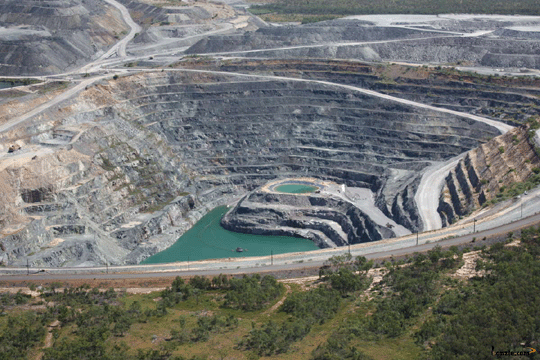
Ranger Mine locked in stoush over funding for Kakadu uranium rehabilitation monitoring https://www.abc.net.au/news/2020-05-19/nt-kakadu-uranium-stoush-ranger-mine-rehabilitation/12260130 By Jane Bardon,
The Federal Government is locked in a stoush with the company mining uranium on the edge of the Northern Territory’s Kakadu National Park over whether it will continue to fund monitoring of the site’s rehabilitation. Energy Resources of Australia (ERA) has flagged it wants to pull out of paying $2.5 million a year for the Supervising Scientist Branch independent monitoring agency, which it funds with the Commonwealth, at the end of June.
Community members of ERA’s independent technical consultation committee, including Dr Gavin Mudd, an Associate Professor of Environmental Engineering at RMIT University, have been told by the Supervising Scientist Branch its future research is in doubt because of the funding uncertainty. “That funding is no longer guaranteed for next year is a major concern,” Dr Mudd said. “This work is needed to give us confidence that what is done at Ranger actually works, including the restoration of ecosystems, how stable the landform is, the radioactivity and the surface and groundwater water quality issues.” Dr Mudd said failures in the rehabilitation of other Northern Territory uranium mines, including Rum Jungle near Bachelor, have demonstrated that there will need to be monitoring for decades after Ranger’s closure. ERA, which is owned by Rio Tinto, has been forced to close the mine by 2021 after a series of uranium leaks and spills into the Alligator Rivers system during its 35 years of operations. The company has promised the mine site will be returned to a pristine state, suitable for inclusion in the Kakadu World Heritage park by 2026, and that monitoring by the Supervising Scientist will prove that. The Federal Government provides three-quarters of the Supervising Scientist’s $8 million annual operating budget. ERA told the ABC it hasn’t made a final decision on the funding. “There has been no decision that ERA’s contribution would cease. But a spokesman for the Federal Environment Minister told the ABC the Government felt it was “unfortunate that ERA is choosing to dispute its ongoing contribution under the Deed”. “The role of the Supervising Scientist ensures the unique environment of Kakadu National Park, its Indigenous culture and its stunning wildlife are protected from the effects of uranium mining within that rehabilitation process and into the future,” he said. “The Commonwealth view is that ERA needs to continue to make an appropriate contribution to support ongoing research during the rehabilitation phase of the mine to ensure there are no shortfalls.” The spokesman added that the Minister Sussan Ley has asked the Environment Department to mediate with ERA to try to resolve the dispute. |
|
The Morrison government manipulates, to paint the coal industry as “clean” and “renewable”

The Clean Energy Finance Corporation has this awkward word “Clean”
The Australian Renewable Energy Agency has this awkward word “Renewable”
How can the those agencies put coal into those categories? With some difficulty.
My heart goes out to them, -like those poor gardeners in “Alice in Wonderland” – forced to paint red all the white roses , lest the Queen should cut off their heads.
Government looks to carbon capture for climate action, The Age By Mike Foley, May 19, 2020 The Morrison government is considering legislative changes to allow its clean energy agencies to fund carbon capture and storage from fossil fuel projects in a bid to unlock $2 billion of private investment to reduce greenhouse gases.
Energy and Emissions Reduction Minister Angus Taylor has accepted 21 of the 26 recommendations from an independent panel reviewing the $2 billion Emissions Reduction Fund, including all those relating to carbon capture and storage.
The panel, chaired by former Business Council of Australia president Grant King, said the government would attract more private investment in the Emissions Reduction Fund if legislation were amended to “enable a method to be developed for carbon capture and storage”.
The King report also recommended an “expanded, technology-neutral remit” for the Clean Energy Finance Corp (CEFC) and the Australian Renewable Energy Agency so they too could attract more private investment in a wider range of technologies outside renewables, such as coal or gas-fired power incorporating carbon capture and storage. This would be a significant change to the remit of the agencies, which were set up to promote the development of renewable wind and solar supplied to the electricity grid.
Carbon capture and storage, which has not yet been successfully implemented on a commercial basis, involves capturing carbon dioxide from industrial processes and transporting it to a suitable storage site for safe, long-term storage deep underground.
Mr Taylor said emissions reduction policy driven by “technology not taxes” would attract significant private investment.
“The government will target dollar-for-dollar co-investment from the private sector and other levels of government to drive at least $4 billion of investment that will reduce emissions across Australia,” he said in a statement accompanying the report’s release.
The Climate Solutions Fund was set up in 2015 with $2.5 billion funding under the Abbott government as an alternative to a carbon tax. It pays polluters to employ cleaner technologies and funds carbon capture through tree planting, soil carbon sequestration on farms and energy efficient systems in commercial properties, as well as methane capture from landfill and waste management.
Last year, the Morrison government topped up the fund with another $2 billion and rebadged it the Climate Solutions Fund. To date, it has issued 450 contracts to abate a cumulative 190 million tonnes of carbon at a total cost of $2.3 billion, or an average of $12 a tonne of carbon…….
Current legislation prohibits CEFC from investing in carbon capture and storage. But changing the legislation would enable the $1 billion Grid Reliability Fund to invest in new gas, hydrogen and coal projects relying on carbon capture.
….
1 This month.

PETITION – To: Prime Minister Anthony Albanese and the Australian Labor Government
Chernobyl: The Lost Tapes – A good documentary on Chernobyl on SBS available On Demand for the next 3 weeks– https://www.sbs.com.au/ondemand/tv-program/chernobyl-the-lost-tapes/235274195556

19 May – Webinar- Webinar: No Nuclear Weapons in Australia
Start: 2026-05-19 18:00:00 UTC Canberra, Melbourne, Sydney (GMT+10:00)
End: 2026-05-19 19:30:00 UTC Canberra, Melbourne, Sydney (GMT+10:00)
20 May – Webinar – The dangerous world of AUKUS, US, military occupation and suppression of dissent

National Webinar, 20th May, 2026, 6.30pm AEST. Confronting laws restricting/suppressing protest speech and action
Speakers: Former Sen. Rex Patrick, Lawyer Nick Hanna ,Arthur Rorris ,Jorgen Doyle, Sen David Shoebbridge,
Facilitator Kelley Tranter.

of the week – Australians for War Powers Reform (AWPR)
To see nuclear-related stories in greater depth and intensity
 Antinuclear