The marine food web threatened, as climate change damages Antarctic krill
Climate change threatens Antarctic krill and the sea life that depends on it The Conversation, Devi Veytia, PhD student , University of Tasmania, Stuart Corney, Senior lecturer, University of Tasmania, 19 May 20,
The Southern Ocean circling Antarctica is one of Earth’s richest marine ecosystems. Its food webs support an abundance of life, from tiny micro-organisms to seals, penguins and several species of whales. But climate change is set to disrupt this delicate balance.
What we found
Antarctic krill are one of the most abundant animal species in the world. About 500 million tonnes of Antarctic krill are estimated to exist in the Southern Ocean.
Antarctic krill play a critical role in the ocean’s food webs. But their survival depends on a delicate balance of food and temperature. Scientists are concerned at how climate change may affect their population and the broader marine ecosystem.
Krill growth depends largely on ocean temperature and the abundance of its main food source, phytoplankton (microscopic single-celled plants)………
Krill growth habitat shifted south as suitable ocean temperatures contracted towards the poles. Combined with changes in phytoplankton distribution, growth habitat improved in spring but deteriorated in summer and autumn.
This early end to the growth season could have profound consequences for krill populations. The krill life cycle is synchronised with the Southern Ocean’s dramatic seasonal cycles. Typically this allows krill to both maximise growth and reproduction and store reserves to survive the winter.
A shift in habitat timing could create a mismatch between these two cycles.
For example, female krill need access to plentiful food during the summer in order to spawn. Since larger females produce exponentially more eggs, a decline in summer growth habitat could result in smaller females and far less spawning success.
Why this matters
Krill’s significant role in the food chain means the impacts of these changes may play out through the entire ecosystem.
If krill shift south to follow their retreating habitat, less food would be available for predators on sub-Antarctic islands such as Antarctic fur seals, penguins and albatrosses for whom krill forms a significant portion of the diet.
In the past, years of low krill densities has coincided with declines in reproductive success for these species…….. https://theconversation.com/climate-change-threatens-antarctic-krill-and-the-sea-life-that-depends-on-it-138436
Japan needs to abandon its troubled nuclear fuel cycle
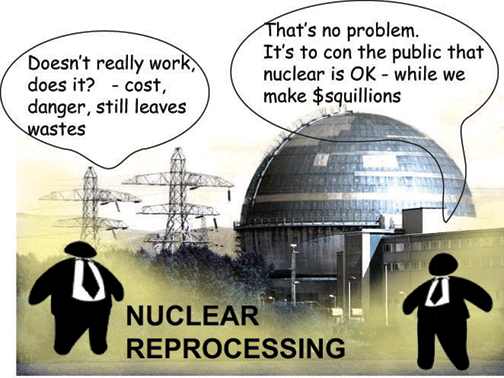
As the situation stands, plutonium will start to pile up with no prospects of it being consumed. Reducing the amount produced is also an issue that needs to be addressed.
The United States and Britain have already pulled out of a nuclear fuel cycle.
|
Editorial: Time to set a course away from Japan’s troubled nuclear fuel cycle https://mainichi.jp/english/articles/20200518/p2a/00m/0na/029000c, May 18, 2020 (Mainichi Japan) The Rokkasho Nuclear Fuel Reprocessing Facility being constructed in the northern Japan prefecture of Aomori has cleared a safety inspection by the Nuclear Regulation Authority (NRA).
Spent fuel from Japan’s nuclear power plants will be reprocessed at this facility, which will play a key role in Japan’s “nuclear fuel cycle” policy. Under the policy, uranium and plutonium extracted from such fuel is to be processed for further use. Japan Nuclear Fuel Ltd., the operator of the reprocessing facility, aims to complete construction by autumn next year, but there are no immediate prospects of the facility going into operation. On top of this, due to changes in the circumstances surrounding nuclear power, the meaning of the facility’s existence is no longer clear. The first issue to consider is declining demand for the use of fuel to be reprocessed at the facility. Such fuel was originally destined to go mainly to the Monju fast-breeder reactor in the western Japan prefecture of Fukui, but a spate of problems with the sodium-cooled reactor led to a decision in 2016 to decommission it. There are no plans to construct a replacement facility. There were also plans to use reprocessed fuel at nuclear power stations to generate electricity, but there are only four reactors that can handle it, far fewer than the 16 to 18 originally planned. As the situation stands, plutonium will start to pile up with no prospects of it being consumed. Reducing the amount produced is also an issue that needs to be addressed. Japan already possesses more than 45 metric tons of surplus plutonium, and there are fears in international society that it could be converted for use in nuclear weapons. In 2018, the government pledged to reduce the amount. A realistic approach is not to reprocess the fuel in the first place. Forming the backdrop to Japan’s persistence with fuel reprocessing is the problem of how to handle the large amount of spent nuclear fuel being stored on the grounds of the reprocessing facility. If Japan gives up on its nuclear fuel cycle policy, then the spent fuel will be sent back to nuclear power plants across the country. But those facilities are already pressed for storage space, making it difficult for them to accept the spent fuel. The total cost of the reprocessing facility, including construction and maintenance costs, stands at 14 trillion yen. Some of the cost will be tacked onto electricity bills. There is a need to rethink the question of whether the public is receiving benefits commensurate with the huge investment into the facility. NRA Chairman Toyoshi Fuketa said he would check with the minister of economy, trade and industry whether operation of the reprocessing plant was in line with the nation’s energy policy. In the wake of the 2011 Great East Japan Earthquake and tsunami and the ensuing nuclear disaster, many countries across the world turned in the direction of abandoning nuclear power. There are sufficient uranium resources in the world, and the justification for reprocessing as “effective utilization of limited resources” has faded. The United States and Britain have already pulled out of a nuclear fuel cycle. Japan must avoid a situation in which it wastes time by sticking to a national policy and becomes laden with risks. The country should squarely face up to the fact that it is in a no-win situation, and search for an alternative to the nuclear fuel cycle policy. |
|
Comparing USA and Russia’s massive nuclear weapons spending with the rest of the world

https://www.rferl.org/a/russia-pakistan-among-biggest-spenders-on-nuclear-weapons/30618712.html
Trump Says U.S. Nuclear Arsenal Must Be ‘Greatly’ Expanded
 Trump Says U.S. Nuclear Arsenal Must Be ‘Greatly’ Expanded, Bloomberg, By Alex Wayne, December 23, 2016
- Russian president said his arsenal also should be strengthened
- Obama has sought to both modernize and reduce U.S. weapons
President-elect Donald Trump said Thursday the U.S. should increase its nuclear arsenal, an apparent reversal of a decades-long reduction of the nation’s atomic weaponry that came hours after Russian President Vladimir Putin reiterated calls for his country’s arsenal to be reinforced.
“The United States must greatly strengthen and expand its nuclear capability until such time as the world comes to its senses regarding nukes,” Trump said in a Twitter post…….(subscribers only)
Morrison govt plans to direct climate action measures to promote coal industry
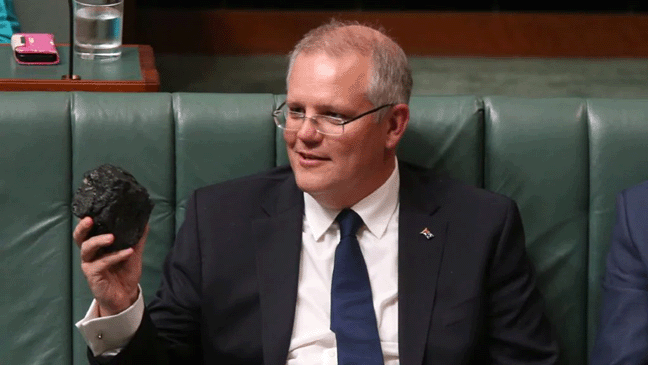 Coalition reveals new emissions reduction measures, including paying polluters to stay under cap
Morrison government also plans to allow businesses to bid for carbon capture projects via the $2.55bn emissions reduction fund Guardian Adam Morton Environment editor @adamlmorton 19 May 2020
Big polluters will be able to earn revenue by emitting less than their allocated limit under new emissionsThe Morrison government has promised new measures to reduce greenhouse gas emissions, including introducing an incentive scheme to allow big industrial polluters to earn revenue by emitting less than an agreed limit.
It also plans to allow businesses to bid for funding from its main climate policy, the $2.55bn emissions reduction fund, for projects that capture emissions and either use them or store them underground.
Angus Taylor, the energy and emissions reduction minister, said the government had agreed to 21 of 26 recommendations in a review headed by former Business Council of Australia president Grant King, who was charged with coming up with new ways to cheaply cut emissions.
The appointment in October of the panel of business leaders and policy experts was not publicly announced, and was seen by observers as an effective concession the emissions reduction fund, now rebadged as a climate solutions fund, was failing to cut national pollution………
Recommendations agreed by the government included allowing carbon capture and storage projects to qualify under the fund, a step the government said it had began consulting with industry on last month.
In a shift likely to be criticised by clean energy advocates, the government gave in-principle support for two agencies, the Australian Renewable Energy Agency (Arena) and the Clean Energy Finance Corporation (CEFC), to be given a “technology neutral remit” to support “the widest possible range of technologies that reduce emissions”. The Greens previously accused the government of planning changes to the CEFC to allow it to fund more fossil fuel projects……
Recommendations agreed by the government included allowing carbon capture and storage projects to qualify under the fund, a step the government said it had began consulting with industry on last month.
In a shift likely to be criticised by clean energy advocates, the government gave in-principle support for two agencies, the Australian Renewable Energy Agency (Arena) and the Clean Energy Finance Corporation (CEFC), to be given a “technology neutral remit” to support “the widest possible range of technologies that reduce emissions”. The Greens previously accused the government of planning changes to the CEFC to allow it to fund more fossil fuel projects…….https://www.theguardian.com/environment/2020/may/19/coalition-reveals-new-emissions-reduction-measures-including-paying-polluters-to-stay-under-cap
Morrison to redirect climate funds to carbon capture and big emitters as ‘King Review’ released — RenewEconomy

Secretive “King Review” into emissions policies released, with the Morrison government to funnel climate funds into carbon capture and big emitters. The post Morrison to redirect climate funds to carbon capture and big emitters as ‘King Review’ released appeared first on RenewEconomy.
May 18 Energy News — geoharvey
Opinion: ¶ “After The Covid-19 Crisis, Will We Get A Greener World?” • The current Covid-19 crisis has revealed a sobering truth: the global economic shutdown has barely dented our carbon emissions. They may be down by 6% to 8%. They have to fall by 7.6% of what they now are every year to 2050 […]
Greens pitch Green New Deal, 100% renewables target for post-Covid recovery — RenewEconomy

The Australian Greens pitch vision for a green Covid-19 economic response, including 100 per cent renewables and a revived, green, manufacturing sector. The post Greens pitch Green New Deal, 100% renewables target for post-Covid recovery appeared first on RenewEconomy.
via Greens pitch Green New Deal, 100% renewables target for post-Covid recovery — RenewEconomy
Huge 2GW of wind, solar and storage to deliver green future for Queensland industrial hub — RenewEconomy

Energy Estate and RES join forces to propose 2GW of wind, solar and storage to deliver low emissions and long term future Queensland industrial hub of Gladstone. The post Huge 2GW of wind, solar and storage to deliver green future for Queensland industrial hub appeared first on RenewEconomy.
The future of solar power: From unbelievably cheap to insanely cheap — RenewEconomy
Solar power has fallen to prices that are, by any stretch of the measure, insanely, world-changingly cheap. And they are going to fall further. The post The future of solar power: From unbelievably cheap to insanely cheap appeared first on RenewEconomy.
via The future of solar power: From unbelievably cheap to insanely cheap — RenewEconomy
Solar-wind-battery microgrid completed and powering remote W.A. gold mine — RenewEconomy

Ground-breaking 56MW hybrid renewable microgrid completed in remote Western Australia – the first in Australia to use wind to power a mine. The post Solar-wind-battery microgrid completed and powering remote W.A. gold mine appeared first on RenewEconomy.
via Solar-wind-battery microgrid completed and powering remote W.A. gold mine — RenewEconomy
Nuclear,Climate, and of course, Coronavirus News -Australia
There’s no avoiding coronavirus news, and it changes all the time. The focus has shifted to”post – virus”, though it is not clear that it is “post” now, or even within 2020. At present, New Zealand and Vietnam are looking like shining success stories. The secret of their success? – strategic testing, aggressive contact tracing and effective public communications campaigns. That last point -all important -that everyone, down to small kids, understands the basic story, the national plan and what they need to do. Planning needs to be national, and then, international.
Who knows whether the post-Covid-19 period will move towards a cleaner and more humane world, or back to “business as usual” or worse? Meanwhile the non-stop news cycle takes its toll, and of course, being news, it’s all bad. It’s probably good to (a) take lots of breaks from the news, and (b) follow good news. Some examples:
- The IEA says greenhouse gas emissions will fall by more than 8% this year, the largest annual decrease ever recorded. NPR
- A decade ago over 40% of the UK’s electricity came from coal. This week, it clocked up its first full coal free month since the advent of the power grid in 1882. Gizmodo
- Sweden has closed its last coal-fired power station two years ahead of schedule, becoming the third European country to exit coal. Independent .
- Freshwater insect species have risen by 11%, possibly due to efforts to clean up rivers and lakes. Science
You can find good news at FUTURE CRUNCH, and at GOOD NEWS NETWORK.
AUSTRALIA
The torture that awaits Julian Assange in the US.
Environment Minister Sussan Ley will not support protection of Murray-Darling river systems
NUCLEAR. The push to weaken Australia’s law regulating the uranium industry, in the review of Environmental Protection and Biodiversity Conservation (EPBC) Act. New South Wales Deputy Premier John Barilaro got it so wrong about Britain and small nuclear reactors.
Kimba Nuclear Waste Dump Plan: Catholic Religious Australia (CRA) question government’s plan for nuclear waste dump near Kimba, South Australia. 13 top Australian non government organisations say that the Kimba nuclear waste dump plan is illogical. Cameron and Toni Scott: brief but compelling critique of National Radioactive Waste Management. Marty and Rachel Yates: the wrong nuclear dump process- individuals nominate their own land for their own personal gain.
CLIMATE. New climate models suggest that Australia could reach 7C temperature rise by 2100. A Covid-19 Green Recovery for Australia. Australia listened to the science on coronavirus. Imagine if we did the same for coal mining. How the Murdoch press defended fossil fuel industry while Australia burned. Experts warn of growing fossil fuel influence in Prime Minister Morrison’s Covid-19 response . Cheap electricity is back, and the next casualty will be a coal fired generator.
RENEWABLE ENERGY. Australian investors play key role in huge 690MW solar and battery project – America’s largest. UNSW solar researcher wins global award, as funding remains in doubt. Tesla big battery recoups cost of construction in little over two years. Balancing act: Tesla battery system earns university nearly $74,000 in 3 months.
Australia’s reputation as solar leader under threat if ARENA funding not extended. Tasmania unveils action plan to reach 200 per cent renewables. Queensland urged to unlock $36bn renewable investment boom in lead-up to election. Australia is uniquely placed to be able to reinvigorate manufacturing through renewable energy.
INTERNATIONAL
Latest climate models suggest global heating could be worse than we thought. Killer heat and humidity already with us. Covid-19 highlights risks of doing nothing on global heating. Water loss in northern peatlands threatens to intensify fires, global warming.
How much radioactive waste is stored on our planet?
The race to nuclear suicide continues despite Covid-19 crisis. $73 billion world spent in 2019 on nuclear weapons, half of it by USA. The Nuclear Non-Proliferation Treaty– its promise and its failure.
THE ATOM: A LOVE AFFAIR – nuclear dream to global nightmare.
John Barilaro got it so wrong about Britain and small nuclear reactors
|
Electrical Review 4th May 2020
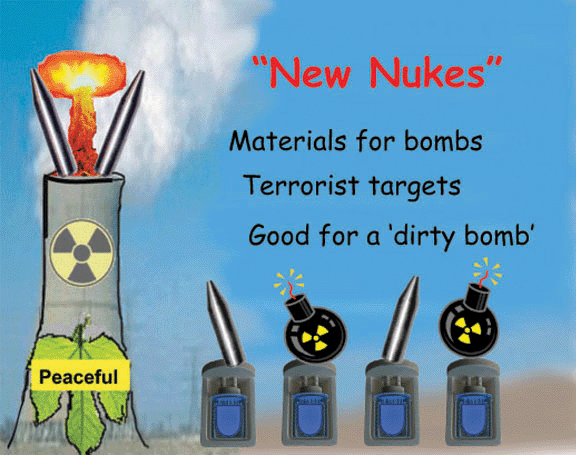 I have to conclude that the Deputy Premier of New South Wales, John Barilaro, is a remarkable clairvoyant. He has announced unequivocally on Australian media that Rolls Royce is set to build up to 15 new small-size nuclear reactors in Britain over the next nine years. I have to conclude that the Deputy Premier of New South Wales, John Barilaro, is a remarkable clairvoyant. He has announced unequivocally on Australian media that Rolls Royce is set to build up to 15 new small-size nuclear reactors in Britain over the next nine years.Strange this. Just 18 months ago, according to the Financial Times, Rolls-Royce was preparing to shut down altogether its R&D project to develop small modular nuclear reactors, unless the British government agreed to an outrageous set of demands and subsidies. Granted the Johnson government has bunged them a few million to keep the R&D going.
But there is as yet no sign of anything being oven-ready to come to the marketplace, let alone 15 up and running. But there remain some rather disturbing connections between small reactor projects and nuclear weapons proliferation. And Rolls-Royce does offer up one of the most glaring examples. Part of the company’s current sales pitch to the British government includes the argument that a civil small-reactor industry in the UK “would relieve the Ministry of Defence of the burden of developing and retaining skills and capability” for its weapons programme. It may be true. But it is not really Atoms for Peace, , is it? https://electricalreview.co.uk/features-mm/13082-mystic-meg-from-down-under |
|
New hold-up to NuScam’s “small nuclear reactors” (yes, they’re the ones touted for Australia)
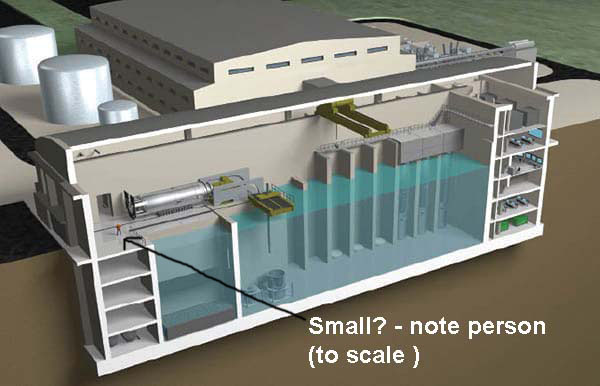 Nuclear Intelligence Weekly 15th May 2020, The US Nuclear Regulatory Commission (NRC) said that NuScale has not “sufficiently validated” the design and performance of the steam generator in its 50 megawatt small modular reactor (SMR) currently under design certification review. The NRC is nevertheless still expected to certify the SMR design but without granting “finality” to the steam generator, toutedmby the Fluor subsidiary as one of the key innovations to its smaller”cost-competitive” design.
core cooling system that NuScale plans to submit to the NRC on May 20. Instead of resolving the steam generator design issue ahead of design certification, the NRC is deferring to the plant operator Energy Northwest
to resolve the issue during the licensing process, after construction. http://www.energyintel.com/pages/eig_article.aspx?DocId=1072564
Fraud in a nuclear research reactor may cause safety problems in other reactors worldwide
 Faked-data scandal might jeopardize safety at unknown number of nuclear power
  plants An investigation at Norway’s now-closed Halden research reactor reveals that results from a number of nuclear fuel experiments were tampered with in an effort that was “planned and well hidden,” according to the facility’s operator — a discovery that could have consequences for numerous nuclear power utilities around the world. Bellona, May 15, 2020 by Charles Digges
An investigation at Norway’s now-closed Halden research reactor reveals that results from a number of nuclear fuel experiments were tampered with in an effort that was “planned and well hidden,” according to the facility’s operator — a discovery that could have consequences for numerous nuclear power utilities around the world.
Many of Halden’s former customers are foreign governments and nuclear utilities that relied on Halden’s data to make decisions about how to fuel their own nuclear reactors. The purpose of research facilities like Halden is to simulate how various nuclear fuels behave under different circumstances, thus allowing nuclear power companies a greater margin of safety in their operations.
While officials have not revealed which nuclear operators might have been impacted by the falsifications, the say the report casts doubt on seven fuel experiments that took place between 1990 and 2005.
“What scares us is that companies around the world operating nuclear reactors may have relied on data from the Halden reactor,” says Frederic Hauge, Bellona’s president. “If data has been manipulated, security can be jeopardized, because the research is used to make decisions about how the reactors are operated.”
The Halden reactor, which is one of four research reactors run in Norway, began operations in 1955 and was shuttered in 2018 after a long period of financial difficulties and technical problems. Kvamme Associates, an Oslo-based anti-corruption research group, led the investigation into the suspect data. The group provided its results to the Institute of Energy Technology, or IFE, Halden’s operator, earlier this week.
According to investigators, the IFE’s suspicions about data manipulation arose last summer. The ensuing inquiry revealed fraud so serious that the IFE reported it to Norway’s economic crimes unit.
The investigation report, which IFE released to Bellona this week, shows that a number of fuel tests were fabricated either because researchers failed to meet test requirements, or because they ran up against deadlines they were unable to meet.
“We have found that data was changed,” IFE director Nils Morten Huseby, told Norway’s national broadcaster, NRK. “What was reported to customers is not what the tests actually showed. It can potentially be serious, but we need to know more about how the customers used the data.”…….
Three other projects carried out at Halden are also under suspicion and are currently under review, NRK said.
Bellona’s Hauge questioned the IFE’s oversight of the experiments in question, and called for a broader investigation into the institute’s management practices………
According to NRK, the Kvamme Associates report states that four international projects conducted at the Halden reactor were found to contain fabricated data. Independent experts found that two of the cases involved no security or safety risks, the broadcaster reported, while two other cases have not been fully evaluated.
Three other projects carried out at Halden are also under suspicion and are currently under review, NRK said.
……The revelations come as a blow to the IFE, which until Halden’s closure had struggled with criticism that the reactor was too costly to the Norwegian public and had battled allegations that it was unsafe following a 2016 iodine leak.
“The fact that IFE’s reputation as a research institution is at stake here is one thing,” said Hauge. “But that it may have affected the safety of an unknown number of nuclear power plants in an unknown number of countries – that’s very, very serious.”…..
Bellona’s Hauge questioned the IFE’s oversight of the experiments in question, and called for a broader investigation into the institute’s management practices. https://bellona.org/news/nuclear-issues/2020-05-faked-data-scandal-might-jeopardize-safety-at-unknown-number-of-nuclear-power-plants
1 This month.


PETITION – To: Prime Minister Anthony Albanese and the Australian Labor Government
Chernobyl: The Lost Tapes – A good documentary on Chernobyl on SBS available On Demand for the next 3 weeks– https://www.sbs.com.au/ondemand/tv-program/chernobyl-the-lost-tapes/235274195556

19 May – Webinar- Webinar: No Nuclear Weapons in Australia
Start: 2026-05-19 18:00:00 UTC Canberra, Melbourne, Sydney (GMT+10:00)
End: 2026-05-19 19:30:00 UTC Canberra, Melbourne, Sydney (GMT+10:00)
20 May – Webinar – The dangerous world of AUKUS, US, military occupation and suppression of dissent

National Webinar, 20th May, 2026, 6.30pm AEST. Confronting laws restricting/suppressing protest speech and action
Speakers: Former Sen. Rex Patrick, Lawyer Nick Hanna ,Arthur Rorris ,Jorgen Doyle, Sen David Shoebbridge,
Facilitator Kelley Tranter.

of the week – Australians for War Powers Reform (AWPR)
To see nuclear-related stories in greater depth and intensity
 Antinuclear